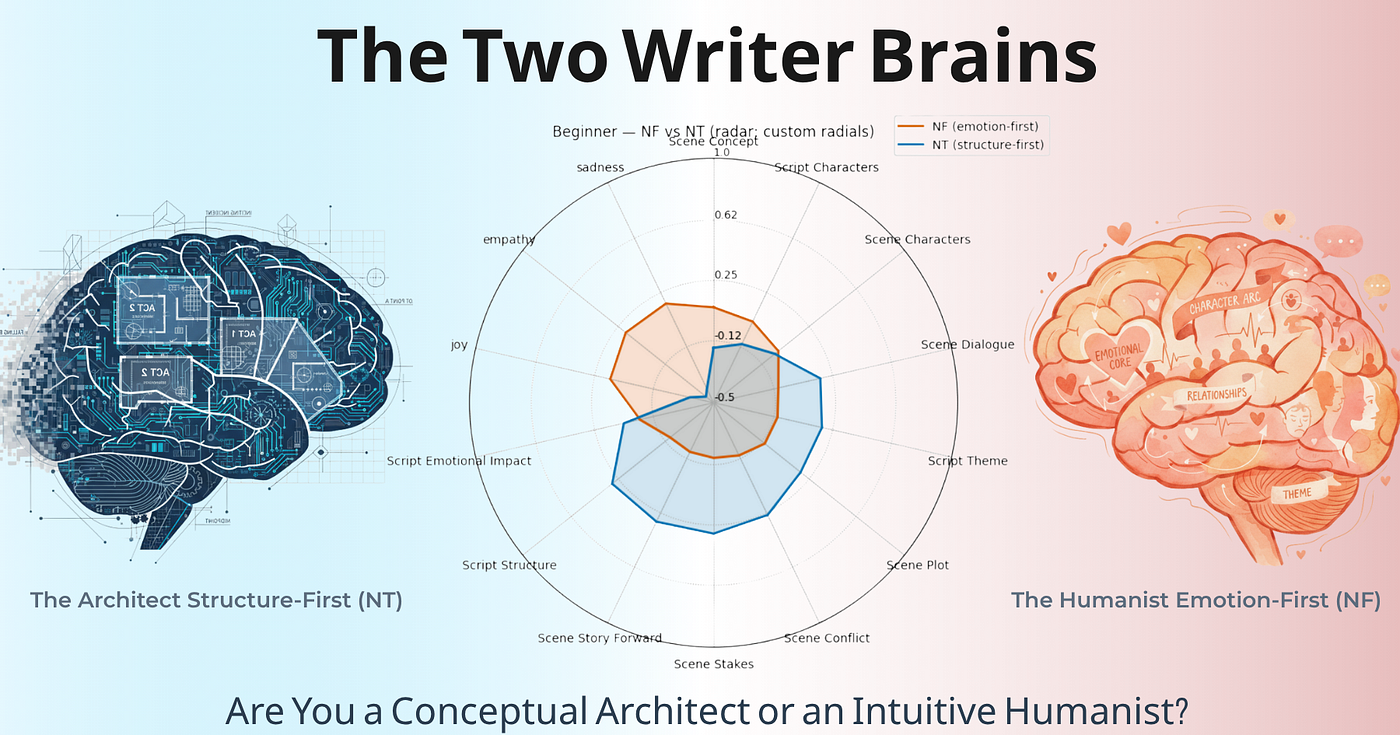
The Two Writer Brains
Structure vs. Feeling — and why knowing your creative bias is the most powerful tool in your writing toolkit.
The Core Idea
What if your biggest writing struggles aren't random? Based on an analysis of 250 screenwriters who submitted scripts along with their Myers-Briggs personality profiles, two repeatable patterns emerged: one that leads with structure, and one that leads with emotion.
When self-reported personality types are overlaid, these clusters align with NT ("Thinking") and NF ("Feeling") preferences — giving us two distinct creative fingerprints that predict a writer's natural strengths and blind spots.
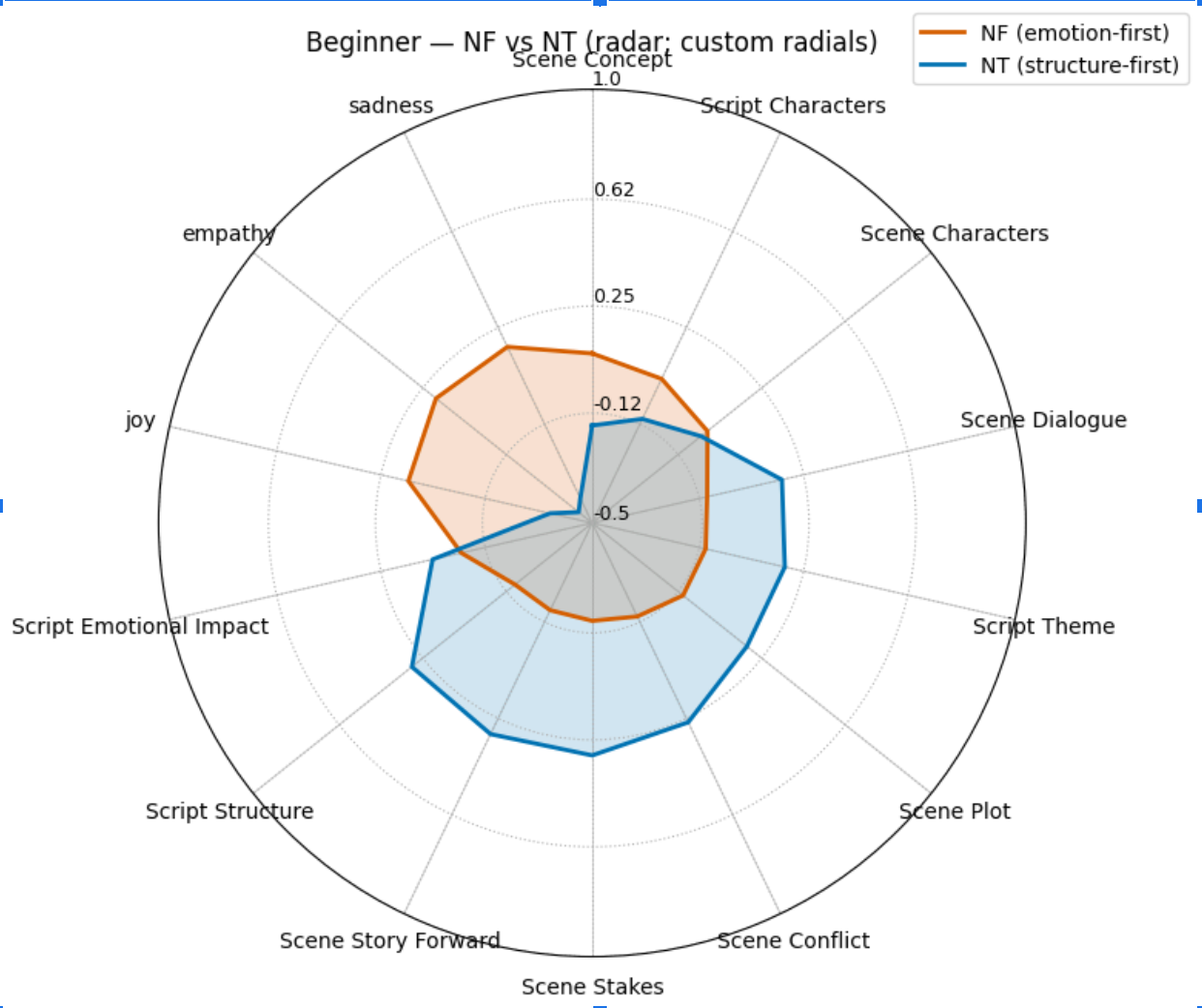
Beginner NF vs. NT screenwriters across 14 craft metrics — based on 250 script submissions.
Two Profiles
The Conceptual Architect (NT)
Leads with plot, logic, and intricate story worlds. Their scripts are structurally precise — setups, payoffs, and reversals all perfectly placed. But early in their journey, the characters can feel like pawns. The Architect's growth path: learning to breathe life into their perfect machine.
The Intuitive Humanist (NF)
Leads with character, theme, and emotional truth. Their scripts are filled with beautifully observed characters and heartfelt dialogue, but scenes can lack purpose and urgency. The Humanist's growth path: channeling their emotional superpower through the engine of structure.
The Universal Pattern
This split isn't just a screenwriting phenomenon. Alan Watts called it "prickles and goo." Nietzsche called it Apollonian vs. Dionysian. Jung called it Thinking vs. Feeling. In screenwriting, it shows up as structure vs. character, plot vs. emotion, the "what happens" vs. the "why it matters."
The path to mastery is always the same: integrate your opposite. The goal isn't to erase your creative fingerprint — it's to build a strong enough hand to leave that print effectively. Your natural voice is your superpower; mastering your weaker side is what builds the professional craft to support it.
What You'll Find in the Full Article
- A diagnostic quiz to identify your own creative bias
- Data-backed deep dives into the specific strengths, blind spots, and growth curves for both profiles
- Practical exercises to strengthen your weaker side (including how SceneProv fits in)
- A Jungian perspective on why this creative integration mirrors personal growth
- Examples from master screenwriters like Charlie Kaufman and Christopher Nolan
Published on Medium / Illumination