Character-driven psychological horror
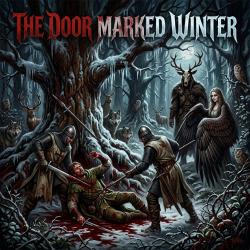
Two immortal adversaries—one who believes humanity is worth saving, one who feeds on its despair—clash across battlefields and centuries, their endless feud hinging on whether a wandering soul can remember the flower-faced woman he loved before he is reborn again.
UNIQUE SELLING POINT
Victorian gothic imagery and Welsh myth collide with abrupt historical ruptures, letting recurring symbols and half-recalled lives carry the mystery rather than fully explaining its cosmic rules.
STANDOUT FEATURES
UNIQUE SELLING POINT
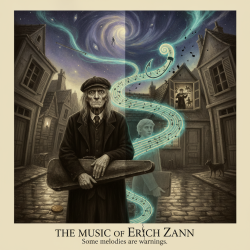
Rather than treating the music as a simple curse, the story folds the violinist’s guilt and doomed connection to a young student into a fractured, dreamlike passage toward annihilation.
STANDOUT FEATURES
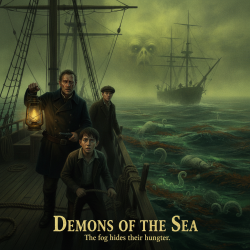
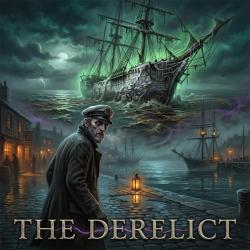
When a becalmed 1891 merchant ship is pursued by a long-vanished barque carrying seal-octopus demons, a young sailor and the second mate must rally the crew before the creatures overrun their vessel.
UNIQUE SELLING POINT
The threat arrives through a feverish chain of maritime omens—boiling water, wet whistles, disembodied voices, and a spectral ship—before erupting into a visceral creature-feature assault. Its ornate, body-horror imagery and unresolved escape keep the sea itself feeling hostile.
STANDOUT FEATURES
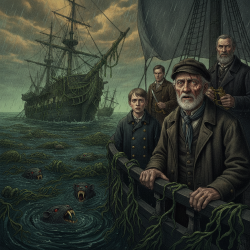
When a passing barque collides with an ancient derelict in the Atlantic, a young sailor joins an armed boarding party to discover what happened—and escape the ravenous horde overrunning the wreck before a storm cuts them off.
UNIQUE SELLING POINT
The creature attack is framed by a scarred old sailor’s partial, folkloric recollection, set against tactile period seafaring detail and an ocean that feels actively hostile.
STANDOUT FEATURES
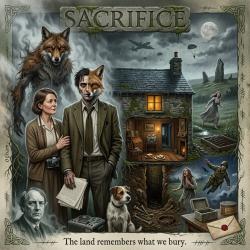
In 1963, a celebrated horror novelist retreats with his wife to a Forest of Dean cottage to finish his final book, but an unearthed relic and a prophetic letter draw him into a possession that threatens to make them permanent inhabitants of the haunted land.
UNIQUE SELLING POINT
Welsh literary occultism and Celtic relics collide with a veteran's memories inside an ordinary marriage. Tea, sandwiches, a pet dog and a writing bureau become anchors for a horror in which the land retains voices, bodies and identities across generations.
STANDOUT FEATURES
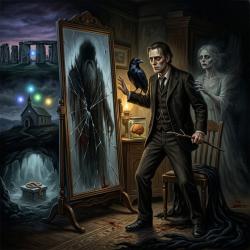
A guilt-ravaged Oxford professor, Thomas Routledge, who condemned Martha, his lover, to the asylum after she contracted syphilis from him, buries himself in folklore, only to have the ancient wizard Myrddin absorb his mind with the buried past as he, Myrddin, invades his dreams, looking-glass mirror, and flesh to claim Routledge's soul.
UNIQUE SELLING POINT
Folkloric and Arthurian history becomes intimate bodily horror: the spirit’s mythic cycle converges with the professor’s culpability toward Martha, making metaphysical dread feel personal rather than merely cosmic.
STANDOUT FEATURES
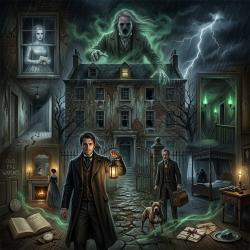
A Victorian researcher, Phillip Lowry, travels, with his manservant, Frank, to a notorious manor to scientifically prove that human consciousness survives death, only to discover the dwelling acts as a psychic battery that strengthen past traumas and systematically strips away the very free will he sought to validate.
UNIQUE SELLING POINT
Instead of treating the ghosts as isolated scares, the story lets sensory fragments of grief and violence emerge through the house itself, tying gothic hauntings to questions of memory and free will.
STANDOUT FEATURES
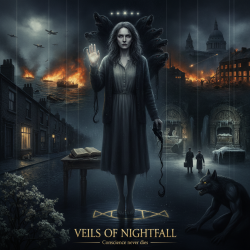
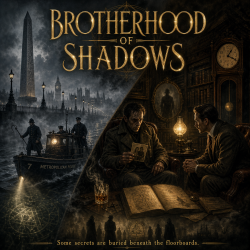
Evelyn Nash lies dead in a decaying Bermondsey house; she reaches across death to stop Nazi occultists and ancient, fish-born horrors from tearing open a passage into wartime Britain.
UNIQUE SELLING POINT
The supernatural conflict unfolds as a solemn Gothic vision of wartime ruin, polluted waters, Christian iconography, and a heroine whose victory is inseparable from bodily sacrifice and erasure.
STANDOUT FEATURES
After a hurricane, a clipper captain leads a boarding party onto a derelict barque that has no right to be afloat, only to discover its rotting hull is a pulsing, breathing organism whose mould devours flesh and grows with every victim—and the survivors must escape before the ship's living body swallows them too.
UNIQUE SELLING POINT
The visceral shipboard horror is framed as a sailor’s haunted confession, tying an inexplicable encounter to the lasting guilt of abandoning its maimed survivor.
STANDOUT FEATURES
When a ghostly girl leaves a doomed 19th-century sea captain a tiny coffin carved with his own sleeping face, he has one day to unravel the childhood sin that summoned her before the schooner's rigging comes alive with tentacled hunger and claims him for the coffin.
UNIQUE SELLING POINT
The script braids rural folklore with maritime ghost-story imagery, making the haunting feel like a symbolic reckoning with personal guilt rather than a mystery to be solved.
STANDOUT FEATURES
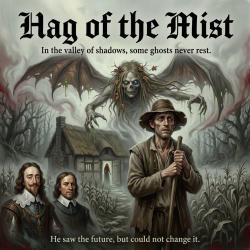
A maimed Puritan soldier, returned home from the English Civil War only to be called back to battle, must lead his men at St. Fagans against the Royalists while visions of the King's execution, a coming plague, and a spectral hag erode his grip on what is real.
UNIQUE SELLING POINT
The haunting folds political and religious conviction into private grief for a dead brother and lost children, making the horror feel like life inside a wounded, fatalistic consciousness rather than a monster hunt.
STANDOUT FEATURES
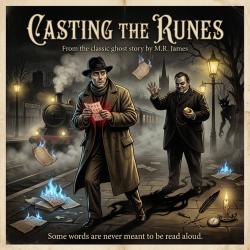
When a skeptical academic’s harsh review provokes a vengeful occultist, he becomes the target of a lethal rune curse that guarantees his death in three months, forcing him to secretly slip the marked paper back to its creator before an unseen supernatural force claims him.
UNIQUE SELLING POINT
The curse unfolds through literary occultism and tactile historical detail—manuscripts, railway compartments, decaying food, gaslight, and empty corridors—so ordinary rational life is gradually contaminated by an unseen folkloric menace before the spell turns back on its caster.
STANDOUT FEATURES
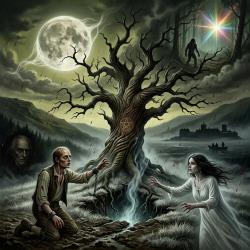
When a burial chamber releases Satanail, an ancient being who claims time and belief are his creations, a dying Welsh laborer must make sense of his apocalyptic visions from a locked island cell before the dead moon returns.
UNIQUE SELLING POINT
The cosmic horror is filtered through Welsh folklore, Christian belief, and a collapsing sense of memory and time, with recurring images—the oak, the moon, the buried body—blurring visions and lived events.
STANDOUT FEATURES
To stop a future genocide, a battle-worn soldier murders Hitler—only to discover the act damns him, leaves Hitler alive, and causes the sole witness to forget everything he sacrificed himself to prevent.
UNIQUE SELLING POINT
Rather than turning the premise into an alternate-history action thriller, the script confines its dread largely to a doomed, intimate conversation between old comrades, haunted by grief, prophetic knowledge, and a failing grasp on reality.
STANDOUT FEATURES
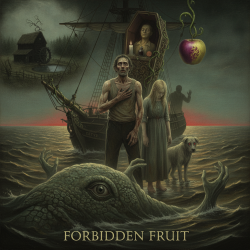
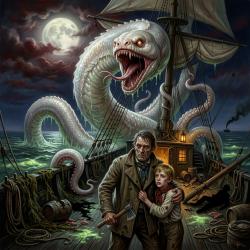
On a becalmed 1895 barque adrift in the Indian Ocean, a young third mate must keep himself and a sickly 14-year-old apprentice alive when a gargantuan sea serpent attacks—trapping the pair in a bolted deck house as the creature methodically tears the ship apart around them.
UNIQUE SELLING POINT
The creature siege is filtered through eerie, tactile maritime detail, while the horror’s emotional center is a working sailor’s protective bond with his young apprentice—and the devastating cost of that bond.
STANDOUT FEATURES
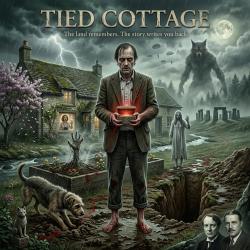
When a war-scarred novelist retreats with his wife to a remote Forest of Dean cottage to write his final book, an unopened wartime letter and a buried Celtic relic draw him into a possession that blurs dreams with waking life.
UNIQUE SELLING POINT
The supernatural erosion of identity is braided with the author’s wartime past and childhood losses, making the cottage feel like a place where personal memory and folkloric violence share the same ground.
STANDOUT FEATURES
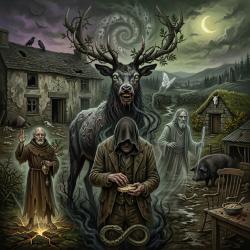
Scene Map The Sin Eater A hunchbacked Victorian sin-eater who has just absorbed a dead man's sins is haunted by an ancient voice that drags him through his past incarnations, so he swallows deadly nightshade to end the torment—only to be shown the monstrous rebirth waiting for him.
UNIQUE SELLING POINT
The dead-cake folk ritual becomes a passage through accumulated guilt and forgotten lives, joining Welsh otherworld beliefs and Christian history to Lovecraftian cosmic horror. Its final turn makes reincarnation feel less like renewal than the next link in a chain of suffering.
STANDOUT FEATURES
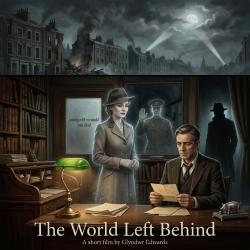
After years trapped in a sadistic marriage, a woman in Blitz-era London pays one last visit to her dead brother's old friend, a solicitor, to ask for the help she never found in life—but as he urges her toward divorce, the solicitor realizes the woman before him is already beyond this world.
UNIQUE SELLING POINT
The supernatural emerges through intimate conversation, poetry, wartime guilt, and the language of domestic abuse rather than conventional horror mechanics. The final disappearance transforms a restrained reunion into an elegy for the dead and the lives violence leaves behind.
STANDOUT FEATURES
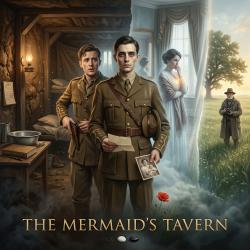
In a Somme dugout, two British officers pass the final hours before the attack debating an ancient pagan afterlife and a poem about dead poets drinking in an Elysian tavern—then one dies and appears to his wife as a ghost at the moment of his death.
UNIQUE SELLING POINT
The battlefield elegy is filtered through literary friendship, ancient metaphysics, and a restrained crisis apparition, making the officer’s death feel like both a generation’s extinction and a private metaphysical passage.
STANDOUT FEATURES
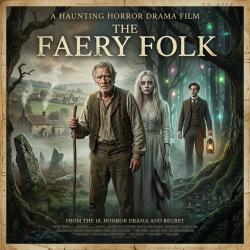
In 1890s Hampshire, a folklorist documenting vanishing country superstitions persuades an elderly farmer to reveal how faery folk mutilated his sister, then ignores the old man's warnings and walks to the stone circle on Walpurgis Night—where the valley's oldest legend claims him.
UNIQUE SELLING POINT
The supernatural emerges through dialect, testimony, agricultural ritual, and the physical memory of the landscape rather than through a literal creature reveal. Historical folklore gradually becomes a living, contaminating reality, leaving the audience unsure whether it has witnessed myth, mutation, or a threshold beyond human perception.
STANDOUT FEATURES
A Victorian angler desperate to prove he isn't losing his mind offers his sceptical companion a dead recluse's diary as evidence, only to discover that the diary is not a record of madness but a precise blueprint for the cosmic assault already taking hold of him.
UNIQUE SELLING POINT
Literary Gothic horror expands from an intimate pastoral haunting into visions of deep time, planetary extinction, and spiritual contamination, linking one recluse's guilt to another man's psychic awakening across generations.
STANDOUT FEATURES
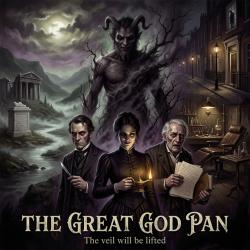
Twenty-one years after witnessing a forbidden experiment expose a young woman to the god Pan, a guilt-haunted Victorian antiquarian joins a victim’s friend to trace a series of ruined men back to her unnatural daughter and confront her before she destroys more lives—and their sanity.
UNIQUE SELLING POINT
An Arthur Machen-inspired Gothic investigation builds cosmic dread through testimony, occult scholarship, corrupted sexuality, and fragmentary glimpses before culminating in a grotesque dissolution of sex, identity, and human anatomy into primordial matter.
STANDOUT FEATURES
To: