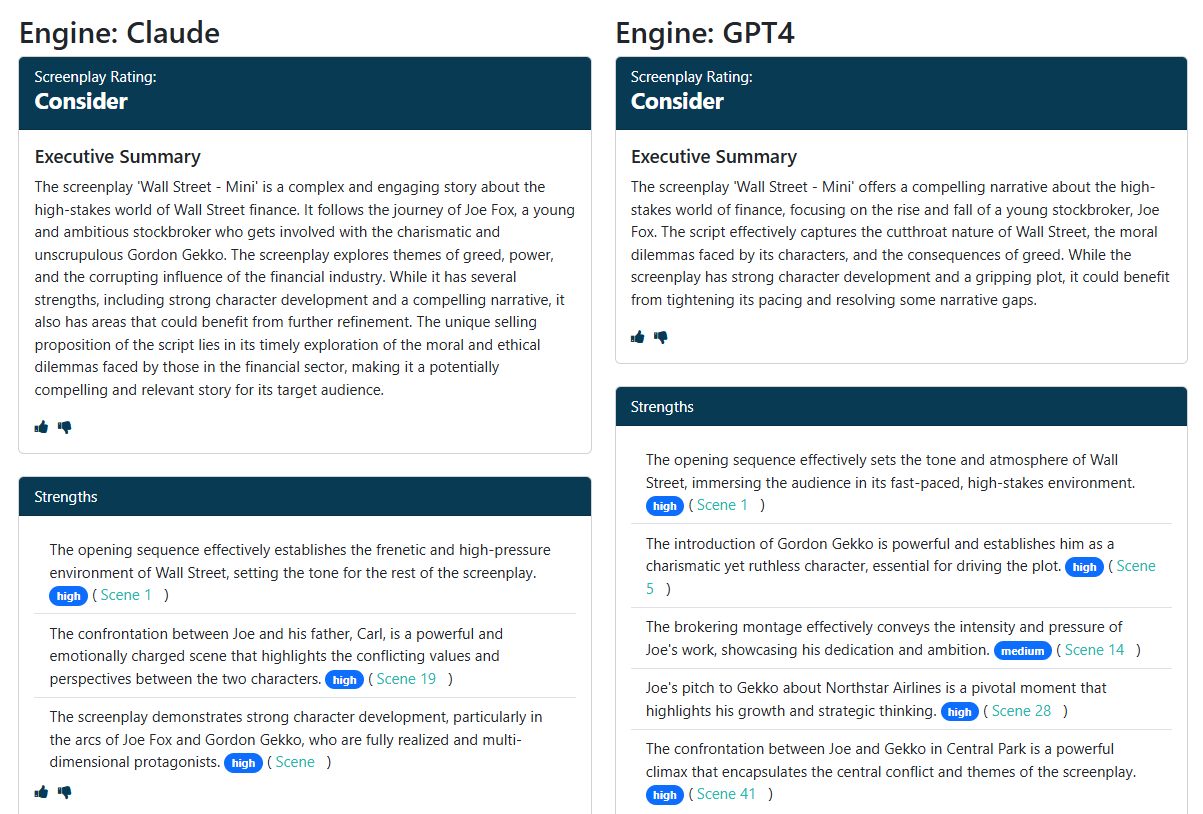
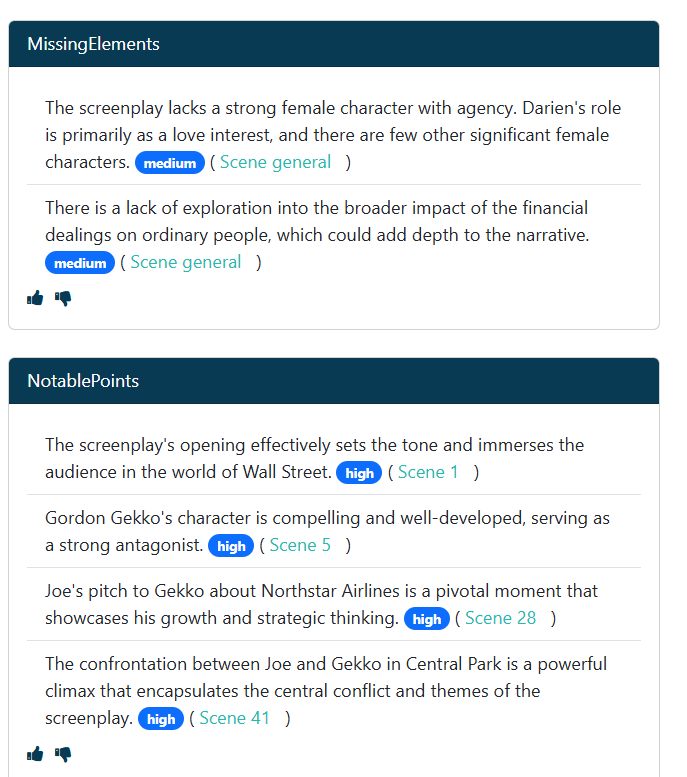
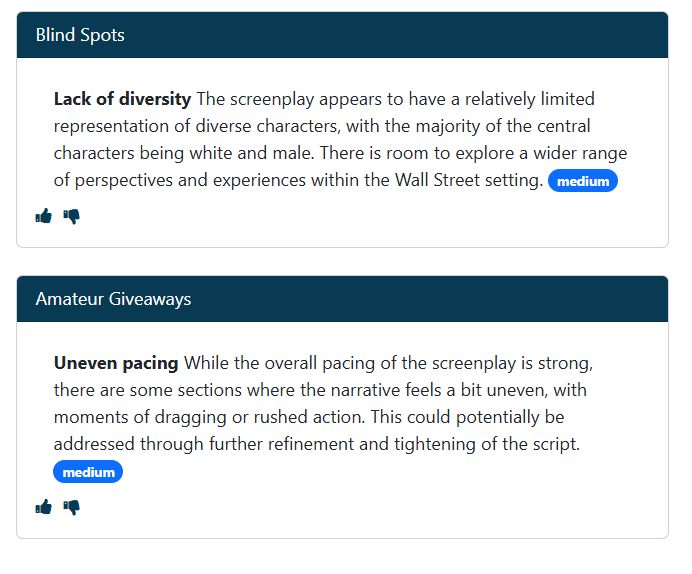
1 I/E. CAR ON COUNTRY ROAD - NIGHT 1
A car on an almost deserted road overlooking the city
whose lights can be seen in the distance.
At the wheel, a MAN, in the passenger seat, his pregnant
WIFE, and in the back, their daughter NILOUFAR. A lively
song by Sadegh Boughi plays on the car radio and Niloufar
sings along at the top of her voice.
A car appears in the distance and the man turns the music
down.
NILOUFAR
No, Dad, please… don’t turn it down!
MAN
Come on, daughter, it’s too loud… it will
bother people!
NILOUFAR
What people? There’s no one here. Mom,
tell him to turn it up!
WOMAN
Turn it up… for once!
Despite his misgivings, the man turns the music up.
NILOUFAR
Dance with me. Believe me, it’s great…
Sing with me! Here we go… Now!
Her mother, happy, and her father, reluctant, sing the
chorus with Nilouf ar.
NILOUFAR
Your hands… Like this… Eo… Eo… Eo… Eo.
Niloufar dances, making hand movements. Her parents do
likewise.
The music becomes more intense. Each time a car passes,
the man watches it attentively, afraid that someone might
catch them like this.
Niloufar seems very happy to see her parents join in. She
is over the moon, shouting for joy, laughing.
All of a sudden, at the height of this little sh ow, the
car hits something. The man brakes sharply. Niloufar and
her mother have trouble keeping their balance. The car
stops. The music continues to play, contrasting with the
ambient silence. The man turns the music off.
WOMAN
What was that?
MAN
I don’t know…
The man gets out of the car. He walks with a limp. The
distinctive sound of his artificial leg is clearly
audible in the silent night.
He reaches the back of the car and looks down. He
immediately glances away, as if he couldn’t bear the
sight of what he sees. We briefly make out the whimpering
of an animal.
The man reluctantly bends down to the animal and pushes
its body to the side of the road.
In the distance, thunder rumbles. Rain begins to fall.
The man straightens up and steps around the car, but he
freezes just before opening the door.
He leans against the car, takes a deep breath, and
finally gets in.
After a few fruitless attempts, the car starts up again
and drives off. The man doesn’t say a word. Heavy silence
settles in the car. No one speaks for a long moment.
The wom an looks at her husband, then at Niloufar. The
latter is frozen in shock. She holds her soft toy tightly
to her chest and huddles up. The woman tries to break the
silence.
WOMAN
Thank God nothing happened to us… Are you
alright, Niloufar, sweetie? Niloufar…
Without saying a word, Niloufar stares at her soft toy
and pushes her mother’s hand away when she tries to reach
out to her. The woman looks at t he man. He is in the same
state as his daughter. The woman turns the music back on.
NILOUFAR
Turn it off…
The woman turns the music off. A moment’s silence.
NILOUFAR
You killed it!
The man and the woman look at each other. She signals to
him to respond.
MAN
It ran out in front of the car! I didn’t
even see it…
WOMAN
It wasn’t his fault… It was an accident!
What is destined to happen happens! If
God placed i t on our path, there has to
be a reason.
NILOUFAR
He killed an animal! What’s that got to
do with God?
WOMAN
It wasn’t deliberate. But if he’d done it
on purpose, you’d be right to ask that.
Outside, the rain grows heavier.
The car starts to make a strange noise. The man, worried,
checks the dashboard controls but doesn’t notice anything
unusual. The car suddenly stops and the man cannot start
it again.
WOMAN
Another problem now!
(turning to the man)
Have you run out of fuel?
MAN
The tank is half-full! I think the spark
plugs must be damp…
The man pulls the lever to open the hood. The woman hands
him a plastic bag.
WOMAN
Here, cover your head with this…
The man puts the plastic bag on his head and gets out of
the car. He examines the engine but cannot see anything
wrong.
MAN
Try to start it up…
The woman turns the key in the ignition several times ,
but the car won’t start. The man looks around. Lights in
buildings on the other side of the road flicker through
the rain. The man comes over to his wife.
MAN
I’ll go get help. Lock the doors…
The woman locks the doors as the man crosses the road. He
goes over to a shed, knocks on the door and waits. After
a while, a voice rings out inside.
OMID (O.C.)
Who’s there?
MAN
Open the door, please. Just for a minute…
The door opens. A young man aged 22, Omid, wearing
overalls, stands in the doorway.
MAN
Hello… Sorry to bother you… My car has
broken down. It won’t start. Do you know
of a mechanic anywhere near here?
OMID
Yes, there’s one not far away. At the
crossroads, turn left. And after a mile
or so, you’ll find a garage that’s open
24 hours.
MAN
The car won’t go that far… If it could,
I’d have gone home… I have my family with
me… Do you have the garage’s number so I
can ask them to come?
OMID
No… I don’t have it.
MAN
Alright… Thank you.
The man turns to go, but Omid, thinking of the family in
the car, stops him.
OMID
Wait a minute, I’ll get some tools, maybe
I’ll be able to help.
The man smiles and shelters beneath an awning as he waits
for him. Omid goes back inside. The room is cramped, with
a mezzanine floor at the far end - the workshop office
accessed via some metal stairs. Omid climbs the stairs
and enters the office.
We discover Vahid, a man in his forties, also in
overalls, caught up in a phone conversation. He seems a
little agitated.
Omid searches in a cupboard and gathers spanners and
screwdrivers. Vahid watches him out of the corner of his
eye.
VAHID
(into the phone)
Listen, I told you to come bac k! It’s not
worth our time!… No, no, it’ll be fine!…
I need the van… My sister’s waiting, I
have to fetch the baby’s things… Rahim,
can’t you understand? Come back…
(to Omid)
Who is it?
OMID
A guy whose car broke down… with his
family in it… I think he lives nearby, at
the edge of the desert. I’ll see if I can
fix it so he can get home.
Omid leaves the office with the tools. As he continues
his phone conversation, Vahid goes over to the window.
VAHID
(still into the phone)
No, Rahim… I’m the one responsible! I
report to the boss… Who is it you
actually work for?… So why are you
wasti ng time? Get back here, I’m waiting…
I’m in a hurry, I’ll see you shortly…
Hurry up!
Vahid hangs up. As he continues to look outside, he calls
someone else on his phone.
We hear his voice as he watches Omid and the man walk
over to the car. The man sits behind the wheel and tries
to start the car while Omid gets to work. The woman and
the girl get out of the car and ask Omid something. He
gestures t o the workshop. They hurry over to use the
bathroom.
Vahid, phone in hand, notices the woman is pregnant and
watches her as she goes over to the bathroom.
VAHID
Hello, Mom?… Please, I said I’d be there
soon… What can I do, the job took longer
than planned… Yes, I know… Have you
eaten? Why not?… I already told you not
to wait for me!… Alright, eat now and
I’ll come to get the baby’s things after
I pic k up the van!… Please, you know it’s
the only vehicle we have and it belongs
to the workshop!… What?… Ah, yes, yes… I
bought it… I’ll bring it… It’s the same
brand, imported!… Okay… See you later…
Bye.
Vahid hangs up and lights a cigarette.
In the meantime, the woman comes out of the bathroom.
Vahid looks at her through the gap in the door. The woman
sits down, apparently overcome by stomach pains. Niloufar
helps her.
We hear the workshop door open. Vahid goes to the far end
of the room but the sound of the man’s artificial leg on
the concrete floor makes him freeze, as if this unusual
noise seemed familiar. He pricks up his ears. Vahid tries
to spot the man, but he can’t. He discreetly steps over
to the door again.
He sees the man come into the workshop, then go over to
his wife and daughter. Vahid looks devastated. He quickly
steps back and presses against the cupboard so as not to
be seen. He takes a deep breath and tries to pull himself
together. All of a sudden, the man calls out to him.
MAN
Vahid… Vahid…
Vahid doesn’t reply.
MAN
Mister Vahid…
Vahid is cornered. He coughs and then answers, but
without showing himself. He alters his voice to reply.
VAHID
Yes?!
MAN
Mister Omid needs the old toolbox.
Vahid heaves a sigh of relief.
VAHID
It’s next to the big machine!
Vahid doesn’t move. He pricks up his ears again. We hear
the man’s steps. Vahid peers at him through a crack in
the door. The man goes over to the machine and takes the
toolbox. He leaves the workshop.
Vahid thinks for a second. He peers out of the win dow.
The man gives the toolbox to Omid who takes a tool from
it and goes back to work.
The man finally manages to start the car. He shakes
Omid’s hand and tries to give him a little money, but
Omid refuses. Omid comes back over to the workshop to
tell the woman and girl that they can go back to the car.
They leave the workshop.
In the meantime, Vahid quickly changes. He removes his
overalls and put s on everyday clothes. Before Omid can
close the workshop door, Vahid hurries down the stairs.
VAHID
Everything okay?
OMID
I did what I could… I think he’ll be able
to get home… But he’ll need it repaired!
VAHID
Give me the motorbike key…
OMID
Mister Vahid, weren’t we supposed to take
the van to fetch the baby things for your
sister?
VAHID
I know, but we’ll see about that later… I
don’t feel up to it this evening… Call me
when Rahim gets back, I’ll tell him where
to take the van.
OMID
Alright…
VAHID
And turn off the outside lights too so
people won’t think we’re open.
Omid hands the motorbike key to Vahid who quickly leaves
the workshop.
2 EX T. ROAD - NIGHT 2
Vahid, on his motorbike, follows the man’s Peugeot. He
keeps a certain distance so as not to be spotted. The
falling rain strikes his face and makes driving
difficult. After passing along several streets and
alleys, the car finally arrives at an isolated house.
Vahid parks the motorbike and hides in a spot where no
one will see him. He takes out his phone and makes a
call.
3 EXT. OUT SIDE THE HOUSE - DAY 3
Still in front of the house, but now at the wheel of a
van, Vahid has fallen asleep. He is woken by the ringing
of his phone. On waking, he feels a pain in his side. A
look of panic comes into his eyes.
He looks at the man’s house. He takes out his phone,
turns on the speaker and puts the phone on the passenger
seat. In the meantime, he looks for his pills in the
glove compart ment.
Scene Objective: To depict a seemingly joyful family moment that quickly turns tragic, setting the stage for the film's exploration of guilt and consequence.
Setting: Country road at night.
POV: The family's perspective, particularly through the eyes of Niloufar.
Emotional Arc: − joy → + guilt
Score Overview
Group
Category
Score
Overall
Overall Score
8.3
Core Elements
Purpose
8
Goal vs Obstacle
7
Stakes
8
Progression
9
Turn Potency
9
Supporting
Exposition
7
Subtext
8
Setups & Payoffs
6
Beat Clarity
8
Quality
Scene Necessity
9
Thematic Resonance
9
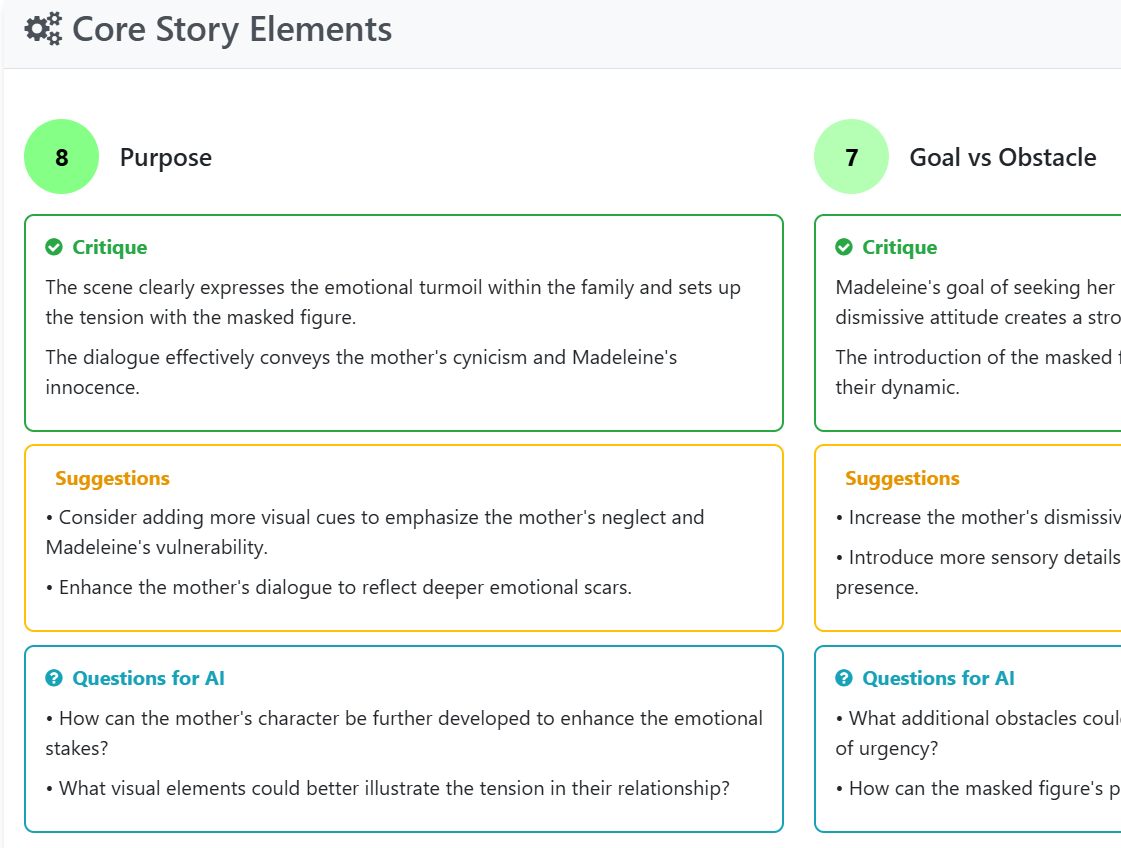
Core Story Elements
8
Purpose
Critique
The scene's purpose is clear in showcasing the family's initial happiness contrasted with the sudden tragedy, effectively setting up the emotional stakes.
Suggestions
• Enhance the contrast between the joyful singing and the somber aftermath to deepen the emotional impact.
Questions for AI
• How can the scene further emphasize the family's emotional state before and after the accident?
• What additional sensory details could heighten the contrast between joy and tragedy?
7
Goal vs Obstacle
Critique
The family's goal of enjoying a carefree moment is abruptly obstructed by the accident, creating a strong conflict.
Suggestions
• Introduce subtle foreshadowing of the accident earlier in the scene to build tension.
Questions for AI
• What elements could be added to hint at the impending accident without being overt?
• How can the family's initial joy be portrayed as more fragile?
8
Stakes
Critique
The stakes are high as the family's safety and emotional well-being are jeopardized by the accident.
Suggestions
• Make the emotional stakes more personal by exploring the characters' backstories briefly.
Questions for AI
• What specific fears or concerns could be highlighted to raise the stakes for the family?
• How can the aftermath of the accident be portrayed to emphasize its significance?
9
Progression
Critique
The scene shows a clear progression from joy to shock and guilt, effectively illustrating the emotional shift.
Suggestions
• Consider adding a moment of reflection for the characters after the accident to deepen the emotional transition.
Questions for AI
• How can the transition from joy to guilt be made more impactful?
• What additional moments could illustrate the family's emotional state post-accident?
9
Turn Potency
Critique
The pivotal moment of the accident is well-timed and shocking, creating a strong emotional turn.
Suggestions
• Explore the characters' immediate reactions to the accident to enhance the turn's emotional weight.
Questions for AI
• What alternative reactions could the characters have to heighten the impact of the turn?
• How can the aftermath of the accident be portrayed to maintain tension?
Supporting Elements
7
Exposition
Critique
The scene provides necessary background about the family dynamics through dialogue and actions.
Suggestions
• Integrate more visual cues about the family's relationships to enhance exposition.
Questions for AI
• What visual elements could better convey the family's dynamics without explicit dialogue?
• How can the exposition be streamlined to maintain pacing?
8
Subtext
Critique
The subtext of guilt and the randomness of fate is present, adding depth to the scene.
Suggestions
• Introduce more symbolic elements that reflect the themes of guilt and consequence.
Questions for AI
• What symbols could be introduced to enhance the subtext of the scene?
• How can the dialogue hint at deeper themes without being overt?
6
Setups & Payoffs
Critique
The setup of the family's joy pays off with the accident, but further foreshadowing could strengthen the impact.
Suggestions
• Add subtle hints earlier in the scene that suggest the potential for disaster.
Questions for AI
• What earlier moments could serve as foreshadowing for the accident?
• How can the payoff of the family's joy be made more poignant?
8
Beat Clarity
Critique
The beats are clear and escalate effectively, leading to a strong emotional climax.
Suggestions
• Consider varying the pacing of the beats to build tension more gradually.
Questions for AI
• How can the rhythm of the beats be adjusted to enhance emotional impact?
• What moments could be expanded or condensed for better flow?
Scene Transitions
Next Scene
9
Hook Out: The scene ends with the family in shock, leading into the next scene's exploration of consequences.
Energy UP
The scene effectively sets up the next sequence, maintaining momentum and emotional tension.
Suggestions
• Consider a more dramatic exit line to heighten the transition into the next scene.
Questions for AI
• What can be done to enhance the emotional impact of the scene's exit?
• How can the transition to the next scene be made more seamless?
Scene Necessity
9
MUST HAVE
This scene is crucial for establishing the emotional stakes and themes of the film.
Suggestions
Ensure that the emotional weight of the scene is fully realized to maintain its necessity.
Questions for AI
• What elements could be added to reinforce the scene's necessity in the overall narrative?
• How can the emotional stakes be heightened to ensure this scene is indispensable?
Enhancement Tags
#family#guilt#accident
Character Delta: The man transitions from a carefree father to a guilt-ridden individual.
Improvement Recommendations
Add foreshadowing elements to build tension before the accident.
Enhance character backstories to deepen emotional stakes.
Incorporate symbolic imagery to reflect themes of guilt and consequence.
The #1 Rule of Screenwriting: Make your reader or audience compelled to keep reading.
“Grab ‘em by the throat and never let ‘em go.”
The scene level score is the impact on the reader or audience to continue reading.
The Script score is how compelled they are to keep reading based on the rest of the script so far.
Compelled to keep Reading Score: 8/10
This scene effectively sets up a compelling mystery and introduces key elements that demand further investigation. The jarring accident, the revelation of the man's artificial leg, and the immediate suspicious behavior of Vahid create a strong sense of unease and curiosity. The abrupt car breakdown and the man's search for help at the workshop further propel the narrative, leading to a tense encounter with Vahid. The scene ends with Vahid covertly following the family, leaving the audience with a clear cliffhanger and the question of Vahid's intentions.
Script Continuation Score: 9/10
The script immediately hooks the reader with a sudden, shocking accident and a subtle but significant detail – the sound of the artificial leg. This is followed by the introduction of a mysterious character, Vahid, whose actions are overtly suspicious. The unresolved tension of Vahid's pursuit and the underlying intrigue of the artificial leg sound as a potential recognition marker promise further developments. The abrupt transition to Vahid's surveillance the next day solidifies the setup for a suspenseful unfolding of events, making the reader eager to uncover the connections and conflicts.
4 EXT. TEHRAN - STREETS - DAY 4
At the wheel of the van, Vahid follows the taxi that
stops on a narrow street. The man gets out. He walks
along the deserted, one-way street. Vahid follows.
The man advances a few steps and is about to cross the
street when Vahid accelerates all of a sudden and hits
the man who falls to the ground. Vahid quickly gets out
of the van and opens the back door.
5 EXT. DESERT OUTSIDE THE CITY - DAY 5
Vahid digs a hole with a shovel.
To one side, a dried-up tree; on the other, the van
parked a few yards from the hole. All around, as far as
the eye can see, arid land.
Vahid goes over to the van, pulls the man out and throws
him to the ground. He drags him over to the hole. The
man, who is conscious now, tries to speak. We can see
that he is in pain. All he can do is make unintelligible
noises. Vahid pushes the man into the hole and starts to
cover him with soil. The man thrashes about, but Vahid
pays no attention. After taking a long breath, he steps
down into the hole and removes the tape from the man’s
mouth. The man twists in pain. Vahid then removes the
sock from his mouth. The man makes the most of this to
breathe and speak.
MAN
Sir, what are you doing? Please, wait a
minute… I’m dying… What did I do?… I have
a wife and children… My wife is pregnant…
Vahid ignores the man’s words and continues to throw soil
in his face.
MAN
No, stop, stop… Is it be cause of that dog
yesterday evening? I swear I felt bad
about it all night… We didn’t sleep… I
made a mistake… I’m sorry… But you don’t
kill someone for running over a dog!
Believe me, it’s not my fault… The dog
ran out in front of the car all of a
sudden. I couldn’t see clearly enough…
Okay?… I admit it… But I didn’t kill
anyone! I beg you, let me go… I’m sick… I
have a child waiting for me at ho me!
Vahid looks calmly at the man. Then he takes the ID card
out of his pocket and reads it.
VAHID
Rashid Shahsavari… So that’s your real
name?
MAN
Yes… My bank card is in the wallet too!
There’s money on the account… The PIN is
1392. Withdraw whatever you want… For the
dog!
VAHID
Eghbal is a better name… It’s shorter and
snappier.
The man freezes all of a sudden. He recognizes this name.
There’s a moment’s silence. Eghbal quickly collects his
wits.
EGHBAL
Who’s Eghbal?
VAHID
Shut up, you son of a bitch… You used to
call me that. You’d say, “If y our mother
hadn’t been a whore, she’d never have
given birth to a shit like you.” And now,
you pathetic jerk, you say you don’t know
who Eghbal is…
EGHBAL
You’re wrong… I swear I’ve never heard
that name before…
VAHID
Don’t play the innocent… Do you think
we’re stupid? You thought blindfolding us
was enough to make you invisible? You
didn’t think we’d recognize you from the
sound your leg makes? Our e yes were
closed, but we haven’t forgotten. We knew
that one day, thanks to that sound, we’d
find you. The sound that haunted my
nights and my days for five years…
EGHBAL
Five years? What do you mean, five years?
I had this accident barely a year ago,
while I was driving… I have all the
medical records. I can show them to you…
I swear, I don’t know who this Eghbal is…
It’s a misunderstanding!
VAHID
You lie so well… You’re all bastards! You
make up these lies to save your skin. But
this is the end, Mister Eghbal!
Vahid picks up the shovel and keeps filling the hole.
Eghbal starts to struggle again.
EGHBAL
You don’t believe me? Look for yourself…
Look at the wound… Is it a wound from
five years ago? I have an appointment to
get the dressing changed later today…
Vahid pauses. Eghbal’s final words seem to have marked
him. Vahid paces up and down, stops and looks at Eghbal
again. He starts pacing again, agitated, then suddenly
hops down into the hole and tries to pull off the
artificial leg. Eghbal screams.
EGHBAL
It’s an artificial limb! Pull my pant leg
up and look…
Vahid tries to pull up his pant leg. He cannot manage it.
In frustration, he takes out a box cutter and tears
Eghbal’s pants. The artificial limb comes loose and a
little blood trickles from the wound.
EGHBAL
Sir, I don’t know what happened to y ou…
An unpaid debt? Honor? But, please, don’t
sacrifice me! I don’t know anything about
it! You have the wrong man…
Vahid looks at him for a moment, then climbs out of the
hole. He goes over to the van and leans against it. He
thinks for a second, takes out a cigarette, lights it and
drags on it. He looks at the hole. He takes another drag
on the cigarette, as if he had just thought of something.
H e stands, opens the van door, takes his phone from the
dash and makes a call.
Genres:
Thriller, Drama Tone:
Intense, Suspenseful, Emotional
Ratings
Scene Objective: To reveal Vahid's internal struggle as he confronts the man he believes is responsible for his past trauma.
Setting: Desert outside the city, during the day.
POV: Vahid's perspective, highlighting his emotional turmoil and motivations.
Emotional Arc: - hope → + despair
Score Overview
Group
Category
Score
Overall
Overall Score
8.5
Core Elements
Purpose
9
Goal vs Obstacle
8
Stakes
9
Progression
8
Turn Potency
9
Supporting
Exposition
7
Subtext
8
Setups & Payoffs
8
Beat Clarity
8
Quality
Scene Necessity
9
Thematic Resonance
9
Core Story Elements
9
Purpose
Critique
The scene's purpose is clearly expressed through Vahid's confrontation with Eghbal, illustrating the theme of revenge and its moral implications.
Suggestions
• Enhance Vahid's emotional turmoil by incorporating flashbacks or inner monologues that reflect on his past experiences.
Questions for AI
• How can Vahid's internal conflict be more vividly portrayed during the confrontation?
• What additional elements could deepen the emotional stakes for Vahid in this scene?
8
Goal vs Obstacle
Critique
Vahid's goal of exacting revenge is clear, but Eghbal's desperate pleas introduce a compelling obstacle that complicates Vahid's resolve.
Suggestions
• Introduce more physical tension in the struggle between Vahid and Eghbal to heighten the stakes.
Questions for AI
• What specific actions can Vahid take that would further illustrate his internal conflict?
• How can Eghbal's responses be crafted to evoke more sympathy or tension?
9
Stakes
Critique
The stakes are high, as Vahid's actions could lead to irreversible consequences for both himself and Eghbal, making the scene feel urgent and impactful.
Suggestions
• Add a ticking clock element, such as the approach of a passerby or the risk of being discovered, to increase urgency.
Questions for AI
• What additional stakes could be introduced to make Vahid's decision even more critical?
• How can the emotional stakes for Eghbal be amplified to create a more intense conflict?
8
Progression
Critique
The scene shows a clear progression from Vahid's initial aggression to a moment of doubt, effectively illustrating his internal conflict.
Suggestions
• Make the transition from aggression to doubt more pronounced by incorporating a moment of hesitation or reflection.
Questions for AI
• How can the pacing of Vahid's emotional shift be adjusted for greater impact?
• What visual or auditory cues could enhance the sense of progression in this scene?
9
Turn Potency
Critique
The pivotal moment when Vahid discovers Eghbal's artificial leg is powerful, as it forces him to confront the possibility of mistaken identity.
Suggestions
• Consider adding a moment of silence or a visual cue that emphasizes the weight of this revelation.
Questions for AI
• What alternative reactions could Vahid have that would still lead to a significant turning point?
• How can the tension be heightened immediately before this pivotal moment?
Supporting Elements
7
Exposition
Critique
The necessary background information about Vahid's past is woven into the dialogue, but could be more seamlessly integrated.
Suggestions
• Use visual flashbacks or subtle hints in Vahid's expressions to convey his history without overt exposition.
Questions for AI
• What are the most effective ways to convey Vahid's backstory without disrupting the scene's flow?
• How can Eghbal's character be introduced more organically within the context of this scene?
8
Subtext
Critique
The subtext of revenge versus justice is present, but could be deepened through more nuanced dialogue and character reactions.
Suggestions
• Incorporate more layered dialogue that hints at the broader implications of their confrontation.
Questions for AI
• What additional layers of meaning could be added to Vahid's dialogue to enhance the subtext?
• How can Eghbal's responses reflect deeper themes of guilt and redemption?
8
Setups & Payoffs
Critique
The setup of Vahid's quest for revenge pays off in this scene, but could benefit from clearer foreshadowing earlier in the script.
Suggestions
• Introduce earlier hints about Vahid's motivations that will resonate during this confrontation.
Questions for AI
• What earlier scenes could be adjusted to better foreshadow the events of this confrontation?
• How can the payoff of Vahid's emotional journey be made more impactful in this scene?
8
Beat Clarity
Critique
The beats within the scene are generally clear, but some moments could benefit from tighter pacing to maintain tension.
Suggestions
• Refine the dialogue to ensure each line contributes to the escalating tension.
Questions for AI
• What specific beats could be restructured for better clarity and impact?
• How can the rhythm of the scene be adjusted to enhance emotional engagement?
Scene Transitions
Previous Scene
8
Hook In: Vahid's surveillance of the family sets the stage for his confrontation with Eghbal.
Energy FLAT
The transition from the previous scene is smooth, but could benefit from a stronger emotional link.
Suggestions
• Incorporate a visual or auditory cue that connects Vahid's surveillance to his actions in this scene.
Questions for AI
• How can the emotional tone from the previous scene be carried into this one more effectively?
• What specific elements can create a stronger bridge between Vahid's surveillance and his confrontation?
Next Scene
9
Hook Out: Vahid's decision to leave Eghbal unresolved creates a compelling cliffhanger.
Energy UP
The scene effectively hands off momentum to the next, leaving the audience eager to see the consequences of Vahid's actions.
Suggestions
• Consider adding a visual cue that emphasizes the weight of Vahid's decision as he leaves.
Questions for AI
• What elements can enhance the emotional impact of this scene's exit?
• How can the tension be maintained as we transition to the next scene?
Scene Necessity
9
MUST HAVE
This scene is crucial for establishing Vahid's motivations and the moral complexities of his quest for revenge.
Suggestions
Ensure that the emotional stakes are consistently high to reinforce the scene's necessity.
Questions for AI
• What elements could be added to further emphasize the necessity of this scene in the overall narrative?
• How can the emotional weight of this scene be made more integral to Vahid's character arc?
Enhancement Tags
#revenge#identity#moralambiguity
Character Delta: Vahid grapples with his desire for revenge and the possibility of mistaken identity.
Improvement Recommendations
Incorporate flashbacks to Vahid's past to deepen emotional resonance.
Add a ticking clock element to heighten urgency during the confrontation.
Enhance the dialogue to reflect deeper themes of guilt and redemption.
The #1 Rule of Screenwriting: Make your reader or audience compelled to keep reading.
“Grab ‘em by the throat and never let ‘em go.”
The scene level score is the impact on the reader or audience to continue reading.
The Script score is how compelled they are to keep reading based on the rest of the script so far.
Compelled to keep Reading Score: 9/10
This scene is incredibly compelling due to its immediate escalation of violence and the unveiling of a deep, personal vendetta. The shocking act of nearly burying a man alive immediately grabs the reader's attention and raises the stakes significantly. The dialogue between Vahid and Eghbal is intensely personal and reveals a history of trauma and revenge, creating a powerful emotional hook. The scene ends on a cliffhanger as Vahid pauses, seemingly affected by Eghbal's claims about his leg, and then makes a crucial phone call, leaving the reader desperate to know who he's calling and what will happen next.
Script Continuation Score: 9/10
The script has successfully established a complex and dangerous narrative. The introduction of Vahid's pursuit and subsequent violent confrontation with Eghbal, driven by a past injustice, has amplified the tension established in the first scene. The mystery of Eghbal's identity and the depth of his past transgressions against Vahid are compelling questions that drive the narrative forward. Furthermore, Vahid's increasingly desperate and violent actions suggest a man consumed by his past, which promises further dramatic developments. The presence of the artificial leg as a recognition factor is a unique and effective plot device that ties back to the initial scene, reinforcing the interconnectedness of the story.
6 EXT. CITY OUTSKIRTS - DAY 6
A long road across the desert. The van arrives in the
city.
7 EXT. TEHRAN - STREETS - DAY 7
Vahid looks for a parking space on a busy street. He
parks, quickly gets out of the van, turns the alarm on
and goes over to a bookstore on the other side of the
street.
8 INT. BOOKSTORE - DAY 8
Vahid comes into the bookstore, looks around and ends up
spotting SALAR who sits with his back to him. He goes
over to him.
VAHID
Hello, Salar!
Salar turns and, on seeing Vahid, beams in delight. He
stands to embrace him.
SALAR
Ah, Vahid! What a joy to see you. Are you
keeping well? You’re back here…
VAHID
Thank you… I’m very busy… I’m digging a
hole in the desert with a shovel…
Vah id sits down at his friend’s invitation.
VAHID
Salar, you no longer answer a poor man’s
calls… I know you’re here on Tuesdays, so
I decided to come to see you in person.
SALAR
I was busy… I forgot to call you back.
VAHID
It’s an urgent matter.
SALAR
Forget work. Did you go to see a doctor?
How many appointments have I made for
you… Go to see a doctor… Before, Jughead
was just a nickname, but now, with you
holding your back all the time, you
really do look like a jug.
Vahid shows Eghbal’s identity card to Salar.
SALAR
Who is this?
VAHID
It’s him!
Salar freezes all of a sudden. He pauses, then asks in a
low voice.
SALAR
What have you done?
VAHID
I’ve caught him at last… I hit him with
the van… And now he’s tied up in the
back.
SALAR
Is he still alive?
Vahid nods.
VAHID
I just need you to take a look and
confirm it’s him or not…
Salar stares at him in disbelief, then looks around.
SALAR
Come on.
Vahid follows Salar. They go down the stairs to the
storeroom.
SALAR
What have you done?! Have you thought
about the consequences?
VAHID
I recognized him, I couldn’t let him go
again. All these years, that bastard has
haunted every second of my life. I still
can’t sleep because of him. He took my
life, my youth, my woman… I’m only human,
how much longer could I have held back? I
took him into the desert… I even dug his
grave… But he struggled and told me he
wasn’t Eghbal… That’s why I need you to
come and check, to tell me if it’s him or
not… Then I’ll know what to do if it is
him.
SALAR
I’d never have imagined you falling into
a trap like this… Listen, my friend,
we’re not killers and we won’t inflict on
him what they did to us… We don’t need to
dig his grave… He’ll dig it himself… But
for now he’s the one who has dug your
grave… because he has destroyed the
humanity within you and left only the
urge to destroy and kill!
VAHID
Salar, I don’t really have time to listen
to all that… It’s too late now… I’m not
asking you to do anything… Just come and
see… Tell me if it’s him or not.
SALAR
Even if it is him… It’s best to let him
go. Otherwise, there’ll be no end to it.
Vahid looks at Salar for a moment. He seems to have
understood that his efforts will get him nowhere. He
takes Salar’s hand and hugs him tightly.
VAHID
You h elped me during the worst times,
I’ll never forget that. If you don’t help
me now, I won’t hold it against you. But
I’ve started this now… and I’ll finish it
myself!
Vahid kisses Salar on the shoulder and leaves. As he goes
out, he hears Salar’s voice and, without turning, he
gives a brief wave.
SALAR (O.S.)
Think of yourself! Have you seen the
state you’re in?
9 EXT. OUTSIDE THE BOOKSTORE - DAY 9
Vahid comes out of the bookstore, crosses the street and
walks over to the van. Salar catches up with him before
he opens the van door. He has a piece of paper in his
hand. He gives it to Vahid.
SALAR
Take this… contact this person and go to
see her… Listen to what she tells you.
Salar walks off without saying goodbye. Vahid looks at
the piece of paper. A phone number and the name of a
woman, Shiva, are wr itten on it. Vahid quickly takes out
his phone and calls the number, but there’s no answer.
Thinking he has made a mistake, he punches out the number
again. Still no answer.
Genres:
Thriller, Drama Tone:
Tense, Emotional, Suspenseful
Ratings
Scene Objective: To reveal Vahid's determination to confront his past while showcasing the moral dilemmas surrounding revenge.
Setting: INT. BOOKSTORE - DAY
POV: Vahid's perspective, reflecting his internal struggle and urgency.
Emotional Arc: − guilt → + resolve
Score Overview
Group
Category
Score
Overall
Overall Score
7.5
Core Elements
Purpose
8
Goal vs Obstacle
7
Stakes
6
Progression
8
Turn Potency
7
Supporting
Exposition
7
Subtext
8
Setups & Payoffs
6
Beat Clarity
7
Quality
Scene Necessity
8
Thematic Resonance
8
Core Story Elements
8
Purpose
Critique
The scene clearly expresses Vahid's purpose of seeking confirmation about Eghbal's identity, driven by his emotional turmoil.
Salar's reaction adds depth to Vahid's motivations, emphasizing the moral implications of his actions.
Suggestions
• Enhance Vahid's internal conflict by adding more visual cues or dialogue that reflect his emotional state.
• Consider incorporating a moment where Vahid hesitates, showcasing the weight of his decision.
Questions for AI
• How can Vahid's emotional turmoil be visually represented in this scene?
• What additional dialogue could deepen the moral conflict between Vahid and Salar?
7
Goal vs Obstacle
Critique
Vahid's goal of confirming Eghbal's identity is clear, but the obstacles presented by Salar's moral objections create a compelling tension.
The scene could benefit from more explicit stakes regarding what happens if Vahid's goal is not achieved.
Suggestions
• Introduce a time constraint that raises the stakes for Vahid's decision.
• Clarify Salar's motivations further to enhance the conflict between them.
Questions for AI
• What specific consequences could Vahid face if he fails to confirm Eghbal's identity?
• How can Salar's objections be made more impactful in the context of Vahid's goals?
6
Stakes
Critique
The stakes are present but could be heightened; the emotional stakes for Vahid are clear, yet the physical stakes for Eghbal remain vague.
The urgency of the situation could be emphasized more.
Suggestions
• Add a moment where Vahid reflects on the potential consequences for Eghbal if he is indeed the right man.
• Incorporate a ticking clock element to increase urgency.
Questions for AI
• What specific risks does Vahid face if he acts on his revenge?
• How can the emotional stakes for Eghbal be made more tangible in this scene?
8
Progression
Critique
The scene shows a clear progression from Vahid's initial determination to a moment of doubt introduced by Salar's warnings.
The emotional shift is well-executed, leading to a more complex understanding of Vahid's motivations.
Suggestions
• Highlight the moment of doubt more dramatically to enhance the emotional impact.
• Consider a visual metaphor that represents Vahid's internal conflict.
Questions for AI
• How can the emotional shift in Vahid be made more pronounced?
• What visual elements could symbolize Vahid's internal struggle?
7
Turn Potency
Critique
The pivotal moment occurs when Salar confronts Vahid about the consequences of his actions, effectively challenging Vahid's resolve.
However, the impact could be sharpened with a more dramatic delivery.
Suggestions
• Enhance the dialogue during this pivotal moment to make it more confrontational.
• Consider adding a physical action that symbolizes Vahid's internal conflict.
Questions for AI
• What alternative dialogue could heighten the tension during the confrontation?
• How can physical actions be used to emphasize the emotional stakes in this scene?
Supporting Elements
7
Exposition
Critique
The necessary background information about Eghbal is conveyed through Vahid's dialogue, but it could be more seamlessly integrated.
Salar's knowledge of Vahid's past adds depth but could be expanded.
Suggestions
• Weave in more subtle hints about Vahid's past throughout the dialogue.
• Consider using visual cues to reinforce the exposition.
Questions for AI
• How can Vahid's past be hinted at more effectively in this scene?
• What visual elements could support the exposition without being overt?
8
Subtext
Critique
The subtext of revenge versus morality is present, particularly in the dialogue between Vahid and Salar.
The tension between personal vendetta and moral integrity adds depth to the scene.
Suggestions
• Explore more nuanced subtext through body language and unspoken reactions.
• Consider adding layers to Salar's character that reflect his own struggles with morality.
Questions for AI
• What additional layers of subtext could be introduced in the dialogue?
• How can body language enhance the unspoken tension between Vahid and Salar?
6
Setups & Payoffs
Critique
The setup of Vahid's quest for revenge is clear, but the payoff regarding Eghbal's identity feels unresolved.
The scene could benefit from stronger foreshadowing of future consequences.
Suggestions
• Introduce a hint of Eghbal's true nature earlier in the scene.
• Create a more definitive moment that sets up future conflicts.
Questions for AI
• What earlier hints could foreshadow Eghbal's identity more effectively?
• How can the scene create a stronger setup for future conflicts?
7
Beat Clarity
Critique
The beats within the scene are generally clear, but some moments could be tightened for better flow.
The rhythm of dialogue could be adjusted to heighten tension.
Suggestions
• Streamline dialogue exchanges to maintain momentum.
• Add pauses or reactions to enhance emotional beats.
Questions for AI
• What specific beats could be tightened for better clarity?
• How can the rhythm of dialogue be adjusted to enhance tension?
Scene Transitions
Previous Scene
8
Hook In: Vahid's unresolved confrontation with Eghbal sets the stage for his urgent quest for confirmation.
Energy FLAT
The transition maintains a consistent tone, but could benefit from a stronger emotional link to Vahid's past. The flow from the previous scene is smooth, but the emotional weight could be amplified.
Suggestions
• Add a moment of reflection for Vahid as he leaves the desert, connecting his past to the present.
• Consider a visual cue that links the two scenes more effectively.
Questions for AI
• How can the emotional connection between Vahid's past and present be strengthened?
• What visual elements could enhance the transition between these scenes?
Next Scene
8
Hook Out: Vahid's determination to confront Eghbal leads to a sense of urgency as he leaves the bookstore.
Energy UP
The scene effectively builds momentum for Vahid's next actions, creating anticipation for the unfolding conflict. The emotional stakes are clear, setting up the next scene well.
Suggestions
• Consider a more dramatic exit for Vahid to heighten the sense of urgency.
• Add a visual cue that symbolizes Vahid's resolve as he leaves.
Questions for AI
• What dramatic elements could enhance Vahid's exit from the bookstore?
• How can visual symbolism be used to reinforce the urgency of his next steps?
Scene Necessity
8
MUST HAVE
This scene is crucial for establishing Vahid's motivations and the moral complexities of his actions, making it essential for the narrative.
Suggestions
Ensure that the emotional stakes are clear to reinforce the scene's necessity.
Questions for AI
• What elements could be added to further emphasize the necessity of this scene?
• How can the emotional stakes be made more apparent to the audience?
Enhancement Tags
#revenge#moral_conflict#identity
Character Delta: Vahid becomes more resolute in his quest for revenge, despite the moral implications.
Improvement Recommendations
Add a moment of hesitation for Vahid to emphasize his internal conflict.
Incorporate visual cues that symbolize Vahid's emotional state.
Enhance the dialogue to create a more confrontational atmosphere between Vahid and Salar.
The #1 Rule of Screenwriting: Make your reader or audience compelled to keep reading.
“Grab ‘em by the throat and never let ‘em go.”
The scene level score is the impact on the reader or audience to continue reading.
The Script score is how compelled they are to keep reading based on the rest of the script so far.
Compelled to keep Reading Score: 8/10
This scene effectively builds upon the escalating tension from the previous one. Vahid's desperate search for answers and his confrontation with Salar about Eghbal create immediate narrative propulsion. The revelation of Vahid's deep-seated trauma and his resolute determination to see his revenge through, despite Salar's moral appeals, leave the reader invested in his next move. The scene concludes with Vahid receiving a new lead in the form of Shiva's contact information, directly pointing towards the next step in his quest, which strongly compels the reader to discover what happens next.
Script Continuation Score: 9/10
The script as a whole maintains a high level of engagement. The mystery surrounding Vahid's past trauma and his relentless pursuit of Eghbal are compelling hooks. The introduction of Salar and the subsequent referral to Shiva indicate a widening network of characters and potential plotlines. The ethical dilemma presented by Vahid's actions, contrasted with Salar's more humane perspective, adds depth to the narrative. The unresolved nature of Eghbal's true identity and Vahid's internal turmoil, coupled with the new contact, ensure the reader's sustained interest.
10 EXT. TEHRAN - STREETS - DAY 10
Vahid drives the van through the city, clearly
frustrated. Each time he calls the number, there’s no
answer.
He throws his phone onto the passenger seat in annoyance.
He drives for a moment, lost in his thoughts. That’s when
his phone rings. He brakes sharply and we hear the other
cars screech to a halt behind him. Vahid frantically
looks for his phone, manages to find it and answers as he
gets out of the van.
11 EXT. TEHRAN - STREETS - RESIDENTIAL DISTRICT - DAY 11
Shiva photographs the bride and groom. They s trike a pose
in a flowery setting for the occasion. Her phone starts
ringing.
SHIVA
Excuse me, just a moment.
GOLROKH
Beware of my train.
SHIVA
I have to answer.
GOLROKH
No problem.
SHIVA
Hello? Hello Maryam? How are you? Yes,
the whole series is ready. I’ll send it
to you tonight.
Shiva walks away from the couple and heads towards a
garden in the villa. Vahid is there and wants to talk to
her.
SHIVA
I’m sorry… I told you on the phone that I
was busy today, but since Salar sent you…
What’s the problem?
VAHID
Are you the Mrs Biglari who was arrested?
SHIVA
Yes, but what’s the problem?
VAHID
Come outside for a minute and I’ll
explain.
SHIVA
Why can’t you tell me here?
VAHID
Well, it’s a little complicated.
SHIVA
You can see I’m busy today. Alright, wait
for me and I’ll come to see you when I
take a break.
Shiva goes back over to the bride and groom.
VAHID
I’ve found Eghbal.
Shiva freezes, then turns to Vahid.
SHIVA
Who are you?
VAHID
Two or three weeks after your arrest… I
too was arrested, on the same charges as
everyone else: collusion, conspiracy and
propaganda against the regime. I read
your reports and those by Golrokh just
before I was arrested… Just come and take
a look at him and I’ll leave you alone!
SHIVA
He’s here?
Vahid nods. Shiva is rooted to the spot with a look of
fear on her face.
VAHID
Don’t worry, he can’t see or move.
SHIVA
Have you killed him?
VAHID
The bastard is still alive. I’ve put him
in a chest.
Shiva wants to go, but Vahid stops her.
VAHID
Listen, I’m not asking you to do
anything… When I came here, I didn’t know
who you were… But as soon as I saw you, I
recognized you…
SHIVA
If you know what he did to us, why are
you still here? Go away…
VAHID
Alright, I’m going… My friends call me
Jughead. Because of all the kicks I
received, I’m always holding my sides
now. I’m not asking you to do anything…
Salar told me that you alone could help
me… All you need to do is see him once
and tell me if it’s him or not.
SHIVA
Listen… I respect Salar, but he made a
mistake giving you my number… It’s none
of my business if you’re a jug now or I
don’t kn ow what… I don’t want to see you
or that bastard… I don’t want to hear
another word… Go on, go now…
Shiva is resolute. She waits for Vahid to leave. Shiva
starts to get angry and steps toward Vahid, speaking to
him in a louder voice.
SHIVA
I told you to leave, you bastard… and
take him with you! Go! I was just
beginning to rid myself of those
memories… Go!
Without waiting for Vahid to react, Shiva goe s back over
to the bride and groom. Vahid calls after her a couple of
times, but Shiva ignores him. He follows her. Shiva
reaches the swimming pool, gets ready and begins to take
photos. Her movements are rapid and edgy. Her behavior
intrigues the others, but no one says anything. She takes
a couple of photos, pauses, then looks at Vahid. She
tries to ignore him, takes another photo, then looks at
him again. She pulls out her phone and makes a call. As
the camera holds on Vahid, we do not hear her voice and
we do not know to whom she is speaking. During her phone
conversation, she walks over to Vahid. We hear the last
few words.
SHIVA
Alright, Salar… I understand… Goodbye.
Shiva hangs up and puts her phone in her pocket.
SHIVA
You’re dumping me in the shit… My hands
are shaking… God damn you, l et’s go see
him.
She joins Vahid and they leave the garden.
Scene Objective: To compel Shiva to confront her past and consider identifying Eghbal.
Setting: Tehran, during the day.
POV: Vahid's perspective, as he seeks validation for his actions.
Emotional Arc: - frustration → + urgency
Score Overview
Group
Category
Score
Overall
Overall Score
8.1
Core Elements
Purpose
8
Goal vs Obstacle
7
Stakes
8
Progression
7
Turn Potency
8
Supporting
Exposition
7
Subtext
8
Setups & Payoffs
7
Beat Clarity
8
Quality
Scene Necessity
9
Thematic Resonance
9
Core Story Elements
8
Purpose
Critique
The scene clearly expresses Vahid's desperation to have Shiva identify Eghbal, showcasing his emotional turmoil and the weight of their shared history.
Suggestions
• Enhance Vahid's emotional stakes by including more of his internal conflict about confronting Shiva.
Questions for AI
• How can Vahid's desperation be portrayed more vividly in his dialogue?
• What additional backstory could deepen the emotional impact of this confrontation?
7
Goal vs Obstacle
Critique
Vahid's goal to get Shiva to identify Eghbal is clear, but Shiva's resistance adds complexity, making the conflict engaging.
Suggestions
• Introduce more tension in Shiva's body language to reflect her internal struggle.
Questions for AI
• What specific actions can Shiva take to show her reluctance more vividly?
• How can Vahid's approach to convincing Shiva be more dynamic?
8
Stakes
Critique
The stakes are high as Vahid's quest for revenge hinges on Shiva's identification of Eghbal, making the outcome critical.
Suggestions
• Clarify the potential consequences of Shiva's decision on both her and Vahid.
Questions for AI
• What are the immediate repercussions if Shiva refuses to help?
• How can the stakes be made more personal for Shiva?
7
Progression
Critique
The scene shows a clear progression from Vahid's initial request to Shiva's eventual agreement, marking a significant shift.
Suggestions
• Highlight the emotional transition in Shiva from anger to reluctant acceptance more distinctly.
Questions for AI
• What moments can be added to emphasize the emotional shift in Shiva?
• How can the pacing of the dialogue enhance the progression of their relationship?
8
Turn Potency
Critique
The pivotal moment occurs when Shiva decides to help Vahid, creating a strong emotional impact and a sense of urgency.
Suggestions
• Make the moment of Shiva's decision more dramatic by incorporating a visual cue or a powerful line.
Questions for AI
• What could be a more surprising way for Shiva to agree to help Vahid?
• How can the tension be heightened just before her decision?
Supporting Elements
7
Exposition
Critique
The scene provides necessary background about Vahid and Shiva's past without feeling forced.
Suggestions
• Integrate subtle hints about their shared history earlier in the dialogue.
Questions for AI
• What additional context can be woven into the dialogue to enrich the backstory?
• How can Vahid's references to their past be made more impactful?
8
Subtext
Critique
The unspoken tension between Vahid and Shiva reveals deeper themes of trauma and revenge, enhancing the scene's emotional weight.
Suggestions
• Use visual cues or body language to further emphasize the subtext of their shared trauma.
Questions for AI
• What non-verbal actions can enhance the subtext of their conversation?
• How can the setting reflect the emotional undercurrents of their dialogue?
7
Setups & Payoffs
Critique
The scene sets up the confrontation effectively, with Vahid's desperation leading to Shiva's eventual agreement.
Suggestions
• Foreshadow Shiva's eventual decision with earlier hints of her internal conflict.
Questions for AI
• What earlier scenes can be referenced to strengthen the setup for this moment?
• How can the payoff of Shiva's decision be made more impactful?
8
Beat Clarity
Critique
The beats are clear and escalate well, maintaining a strong rhythm throughout the scene.
Suggestions
• Consider varying the pacing of dialogue to enhance emotional impact.
Questions for AI
• How can the rhythm of the dialogue be adjusted for greater emotional resonance?
• What beats could be expanded to deepen the conflict?
Scene Transitions
Previous Scene
8
Hook In: Vahid's frustration with not reaching Shiva sets the stage for their confrontation.
Energy FLAT
The transition maintains a consistent tone, but could benefit from a stronger emotional lead-in.
Suggestions
• Add a moment of reflection for Vahid before he approaches Shiva to enhance emotional continuity.
Questions for AI
• How can the emotional tone from the previous scene be better integrated into this one?
• What visual or auditory cues could enhance the transition?
Next Scene
9
Hook Out: Shiva's reluctant agreement to help Vahid propels the narrative forward.
Energy UP
The scene effectively hands off momentum, creating anticipation for the next developments.
Suggestions
• Consider ending with a more dramatic visual or line to heighten anticipation.
Questions for AI
• What could be a more impactful closing line to leave the audience eager for the next scene?
• How can the visual framing of the exit enhance the emotional weight?
Scene Necessity
9
MUST HAVE
This scene is crucial for advancing the plot and deepening character relationships, making it essential for the narrative.
Suggestions
Ensure that the emotional stakes are as high as possible to reinforce the scene's necessity.
Questions for AI
• What elements could be added to make this scene feel even more indispensable?
• How can the emotional stakes be heightened to emphasize the scene's importance?
Enhancement Tags
#revenge#trauma#moralambiguity
Character Delta: Vahid becomes more desperate and emotionally vulnerable as he confronts his past.
Improvement Recommendations
Deepen Vahid's internal conflict through more introspective dialogue.
Enhance Shiva's emotional journey with more visual cues.
Introduce foreshadowing elements that hint at the consequences of their actions.
The #1 Rule of Screenwriting: Make your reader or audience compelled to keep reading.
“Grab ‘em by the throat and never let ‘em go.”
The scene level score is the impact on the reader or audience to continue reading.
The Script score is how compelled they are to keep reading based on the rest of the script so far.
Compelled to keep Reading Score: 8/10
This scene masterfully escalates the tension and introduces a compelling new dynamic. Vahid's growing frustration and the near-accident he causes immediately grab the reader's attention, setting a frantic tone. The introduction of Shiva and her initial resistance, coupled with Vahid revealing he's found Eghbal and has him captive, creates a powerful hook. Shiva's eventual agreement to see Eghbal, prompted by a call from Salar, leaves the reader eager to witness their confrontation and the next stage of Vahid's mission.
Script Continuation Score: 9/10
The overall script continues to build significant momentum. The introduction of Vahid and his vendetta against Eghbal, established in prior scenes, is now directly intersecting with Shiva, a character previously hinted at and now brought into the central conflict. The complexity of their shared past trauma (arrests, the regime) and Vahid's reliance on Shiva for confirmation of Eghbal's identity suggests a deeper layer to the narrative. The urgency of Vahid's situation and Shiva's eventual involvement promise significant plot developments.
12 EXT. TEHRAN - STREETS - RESIDENTIAL DISTRICT - DAY 12
They reach the van. Vahid grabs Shiva’s hand, she turns
to him.
VAHID
Don’t say anything inside… Wait until
we’re back out…
SHIVA
Why?
VAHID
It’s wiser! He mustn’t hear your voice.
Vahid calmly opens the van door and climbs in. Shiva
follows him. He opens the chest and lifts the blanket.
Shiva, her eyes staring, watches Vahid.
Eghbal is lying under the b lanket. He has a rag stuffed
in his mouth and a blindfold covering his eyes. Shiva is
petrified. Eghbal squirms and tries to cry out, but all
we hear is a muffled sound.
Shiva observes his desperate movements. Vahid shows
Eghbal’s plastic leg to Shiva. She looks at Eghbal, then
at Vahid before quickly climbing back out of the van.
Vahid puts the blanket back over Eghbal, closes the chest
and climb s out of the van in turn.
SHIVA
Are you sure it’s him?
VAHID
No, I’m not! That’s why I came… So you
could tell me.
SHIVA
Then what?
VAHID
What do you mean?
SHIVA
If it is him… What are you going to do?
VAHID
Let me handle that. I don’t want to cause
you any trouble… I started this and I’m
going to finish it, one way or another…
SHIVA
You dragged me into this craziness and
now you say you don’t want to cause me
any trouble?
VAHID
Forget that… Is it really him?
SHIVA
I can’t say for certain… I never saw the
bastard, I was blindfolded the whole
time…
The bride and groom come out of the garden and walk over
to Shiva. On spotting them, she becomes edgy.
GOLROKH
Shiva dear… Who is this man?… He isn’t
here for…
Shiva goes over to Golrokh and the groom who are at the
garden gate. Golrokh tries to find out who this stranger
is. She thinks that Vahid is a government agent who is
there to threaten them. Shiva wants to take the couple
back into the garden, but Golrokh resists. The groom,
perplexed, steps away from the two women and comes over
to Vahid. He greets him and shakes his hand.
GROOM
Brother, we’re getting married… We came
to my fiancée’s house to do a few photos…
It’s our wedding tomorrow evening… You
understand what I mean… Everything is
booked…
The groom searches in his pockets for some money, but
Shiva calls him back over.
Shiva starts to speak. The camera holds on Vahid and the
others’ voices are incomprehensible. Shiva gestures
frequently toward Vahid and it is clear that she is
explaining everything to the couple. Golrokh slumps to
the ground. The groom takes her in his arms, asking for
water. A few seconds later, a young man brings a glass of
water. The groom tells Golrokh to drink. He splashes her
face too. Shiva tells the young man to go back into the
garden. Golrokh, who seems to have recovered a little,
then rushes over to the van. Vahid is a little confused.
Without paying any attention to him, Golrokh tries to
open the door. Vahid stops her. Shiva and the groom come
over to them. Before they climb into the van, Shiva makes
a gesture to tell them to keep quiet. The two women and
the groom get into the van and close the door. The camera
holds on Vahid, outside. Worried, he glances around and
lights a cigarette.
After a few seconds, Golrokh, Shiva and the groom get
back out. Golrokh seems exhausted. Vahid quickly closes
the door of the van.
GOLROKH
(to Vahid)
Where did you find him?
Vahid looks at Shiva and doesn’t reply. All of a sudden,
the groom grabs Vahid by his collar.
GROOM
Listen, I don’t know who you are or what
your game is. I just know this is too
much for Golrokh… If anything happens to
her, you’ll have to deal with me.
Shiva parts the two men.
SHIVA
Ali, go back inside. I’ll sort this out.
Ali stares furiously at Vahid.
Shiva rais es her voice.
SHIVA
I told you to go…
The groom, seeing that Shiva is serious, takes Golrokh by
the arm and starts to walk away. But Golrokh refuses to
go back to the garden.
SHIVA
(to Vahid)
Sir. Go now… We can’t help you… Do what
you want, but leave us alone.
GOLROKH
That bastard ruined my life, I’m not just
going to let him leave…
She throws her tiny bouquet to the ground.
GOLROKH
Until I know if it’s him or not… I’m not
going to give up.
Golrokh’s gestures and words plunge everyone into
complete silence. They look at each other. Shiva steps
over to Vahid.
SHIVA
I told you to leave and you didn’t… Now
look at the mess you’ve gotten us into!…
It should never have come to this… Right,
let me see him one more time!
Vahid opens the door of the van and Shiva climbs in with
him. Vahid opens the chest again. Eghbal starts to thrash
about. His left leg (the artificial one) is visible
because of his torn pants. Shiva bends down to lift the
other pant leg in order to see something. But she cannot
manage it. She is nervous and her hands shake. Vahid,
seeing how edgy she is, takes a box cutter out of his
pocket and q uickly cuts open the right pant leg. Eghbal’s
other leg is now exposed, revealing a long scar on it. It
seems to be quite old as the flesh has puckered along the
scar. On seeing this wound, Shiva is petrified. She
quickly climbs out of the van. Vahid closes the chest and
gets out in turn. Golrokh and Ali come over to them.
SHIVA
If it’s up to me, I say it’s him alright…
Hamid told me his right leg w as covered
with scars… But…
GOLROKH
But what?
SHIVA
Only Hamid will be able to say for sure
if it’s him or not.
ALI
Shiva, what are you going to do? I’ve
never met Hamid, but I’ve heard bad
things about him… You want to bring him
here?
SHIVA
No, I’m not bringing that madman here…
We’ll go find him!
Ali leads Shiva off to one side.
ALI
Listen, Shiva, you know how it is…
Golrokh has only just recovered… If
any thing happens, we won’t be able to do
a thing for her.
SHIVA
Something has already happened… There’s
nothing we can do about it… If only you’d
stayed in the garden… I know Golrokh
won’t drop it now… We’d better find Hamid
as soon as possible…
VAHID
Who’s Hamid?
Shiva says nothing for a second or two.
SHIVA
He had the most contact with him. He was
under his guard for eleven months! He’s
the only one who’ll be able to recognize
him.
GOLROKH
So what are we waiting for? Let’s go.
Golrokh, determined, wants to get into the van. Ali,
annoyed, steps over to her.
ALI
Golrokh, wait a minute! We’re expected
back at the house.
Golrokh takes out her phone and makes a call.
G OLROKH
Hi, Mom… How’s it going? Mom, Ali and I
are going with Shiva to take a few
photos… Yes… For the wedding… I wanted to
let you know… We’ll be back late… Love
you…
Golrokh hangs up and looks at Ali.
GOLROKH
There, feel better now? Let’s go…
Before they get into the van, Vahid addresses them all.
VAHID
Please turn off your phones and give them
to me.
The other three look at each other, then take out th eir
phones, turn them off and give them to Vahid. He opens
the door and gets into the van. The others climb in after
him. He puts the phones on the dashboard and takes the
wheel. The van drives off.
Genres:
Thriller, Drama Tone:
Tense, Suspenseful, Emotional
Ratings
Scene Objective: To confirm Eghbal's identity and explore the moral implications of revenge.
Setting: Tehran, during the day.
POV: Vahid's perspective, with moments of Shiva's emotional response.
Emotional Arc: - uncertainty → + urgency
Score Overview
Group
Category
Score
Overall
Overall Score
8.1
Core Elements
Purpose
8
Goal vs Obstacle
7
Stakes
9
Progression
8
Turn Potency
7
Supporting
Exposition
6
Subtext
8
Setups & Payoffs
7
Beat Clarity
8
Quality
Scene Necessity
9
Thematic Resonance
9
Core Story Elements
8
Purpose
Critique
The scene clearly expresses the purpose of identifying Eghbal while raising moral questions about revenge.
The emotional weight of the characters' past traumas is effectively conveyed.
Suggestions
• Enhance the tension by adding more internal conflict for Vahid as he grapples with his desire for revenge.
• Include more visual cues that reflect Shiva's emotional turmoil.
Questions for AI
• How can Vahid's internal conflict be more vividly portrayed during the identification process?
• What additional elements could heighten the emotional stakes for Shiva in this moment?
7
Goal vs Obstacle
Critique
Vahid's goal to confirm Eghbal's identity is clear, but the obstacles presented by Shiva's reluctance and the groom's interference add complexity.
The tension between personal motives and moral dilemmas is well established.
Suggestions
• Clarify the stakes for Shiva to make her reluctance more impactful.
• Introduce more immediate consequences for Vahid's actions to heighten the tension.
Questions for AI
• What specific fears does Shiva have about confirming Eghbal's identity?
• How can the groom's presence be used to further complicate Vahid's goal?
9
Stakes
Critique
The stakes are high, as the characters' past traumas and the potential for violence create a palpable tension.
The urgency of confirming Eghbal's identity is underscored by Golrokh's emotional state.
Suggestions
• Make the consequences of misidentification more explicit to raise the stakes further.
• Explore the emotional stakes for each character involved in the identification process.
Questions for AI
• What would happen if Eghbal is misidentified, and how would that affect the group?
• How can the emotional stakes for Golrokh be amplified in this scene?
8
Progression
Critique
The scene shows a clear progression from uncertainty to a tentative identification of Eghbal.
The emotional tension escalates effectively as characters confront their past.
Suggestions
• Add a moment of hesitation or doubt before the identification to enhance the emotional impact.
• Consider a more dramatic reveal of Eghbal's identity to heighten the scene's climax.
Questions for AI
• How can the moment of identification be made more dramatic or surprising?
• What internal shifts occur for Vahid and Shiva as they confront Eghbal?
7
Turn Potency
Critique
The pivotal moment of revealing Eghbal's scar is impactful, but could be more emotionally charged.
The turn from uncertainty to a potential confirmation of identity is well-timed.
Suggestions
• Increase the emotional weight of the reveal by incorporating more visceral reactions from Shiva.
• Consider a moment of silence or reflection after the identification to emphasize its significance.
Questions for AI
• What could be added to make the reveal of Eghbal's identity more shocking?
• How can the characters' reactions to the identification be deepened?
Supporting Elements
6
Exposition
Critique
The necessary background information is provided, but some details could be woven in more naturally.
Shiva's explanation of Hamid's role feels slightly forced.
Suggestions
• Integrate exposition through dialogue that feels more organic to the characters' interactions.
• Use visual storytelling to hint at past traumas without overtly stating them.
Questions for AI
• How can exposition about Hamid's past be delivered more subtly?
• What visual elements could convey the characters' histories without dialogue?
8
Subtext
Critique
The scene is rich with subtext regarding revenge, trauma, and moral ambiguity.
Characters' unspoken fears and desires add depth to their interactions.
Suggestions
• Enhance the subtext by incorporating more non-verbal cues that reflect the characters' inner turmoil.
• Consider adding moments of silence that allow the audience to feel the weight of the situation.
Questions for AI
• What non-verbal cues could deepen the subtext of revenge in this scene?
• How can silence be used effectively to convey the characters' emotional states?
7
Setups & Payoffs
Critique
The setup of Eghbal's identity is clear, but the payoff could be more impactful.
The emotional stakes established earlier are referenced but not fully realized.
Suggestions
• Strengthen the setup by foreshadowing the emotional impact of the identification.
• Ensure that the payoff resonates with the characters' past experiences.
Questions for AI
• What earlier moments could be referenced to enhance the payoff of Eghbal's identification?
• How can the emotional fallout from this scene be set up for future scenes?
8
Beat Clarity
Critique
The beats are clear and escalate effectively, maintaining tension throughout the scene.
The rhythm of dialogue and action flows well, though some moments could be tightened.
Suggestions
• Streamline dialogue to enhance pacing and clarity.
• Ensure that each beat builds on the previous one to maintain momentum.
Questions for AI
• What beats could be tightened to improve the scene's pacing?
• How can the rhythm of dialogue be adjusted for maximum impact?
Scene Transitions
Previous Scene
8
Hook In: Shiva's reluctant agreement to help Vahid sets the stage for the confrontation with Eghbal.
Energy FLAT
The transition maintains a consistent tone, but could benefit from a stronger emotional lead-in. The flow from the previous scene is smooth, but the stakes could be more pronounced.
Suggestions
• Add a moment of reflection for Vahid before entering the van to heighten anticipation.
• Consider a visual cue that emphasizes the emotional weight of the upcoming confrontation.
Questions for AI
• How can the emotional stakes from the previous scene be more effectively carried into this one?
• What visual elements could enhance the transition between scenes?
Next Scene
9
Hook Out: The urgency of finding Hamid after the identification creates a strong lead-in to the next scene.
Energy UP
The scene effectively hands off momentum, leaving the audience eager to see the next steps. The emotional intensity builds towards a clear objective for the characters.
Suggestions
• Consider a cliffhanger moment that leaves the audience questioning the outcome of the next encounter.
• Enhance the urgency of the transition by emphasizing the characters' emotional states.
Questions for AI
• What can be added to create a stronger cliffhanger at the end of this scene?
• How can the urgency of the characters' next steps be emphasized?
Scene Necessity
9
MUST HAVE
This scene is crucial for advancing the plot and deepening character motivations, particularly regarding revenge and trauma.
Suggestions
Ensure that the emotional stakes are clear to reinforce the scene's necessity.
Questions for AI
• What elements make this scene essential to the overall narrative?
• How can the emotional stakes be heightened to emphasize the scene's importance?
Enhancement Tags
#revenge#trauma#identity
Character Delta: Vahid becomes more resolute in his quest for revenge, while Shiva grapples with her complicity.
Improvement Recommendations
Deepen Vahid's internal conflict during the identification process.
Enhance the emotional stakes for Shiva and Golrokh.
Introduce more visual storytelling elements to convey past traumas.
The #1 Rule of Screenwriting: Make your reader or audience compelled to keep reading.
“Grab ‘em by the throat and never let ‘em go.”
The scene level score is the impact on the reader or audience to continue reading.
The Script score is how compelled they are to keep reading based on the rest of the script so far.
Compelled to keep Reading Score: 9/10
This scene masterfully escalates the tension by bringing the fragmented plot threads together. The introduction of Golrokh and Ali, a wedding couple caught in the crossfire, adds a layer of immediate human stakes and potential complications. Shiva's petrified reaction upon seeing Eghbal's prosthetic leg and the scar on his other leg, coupled with her confession that she cannot be 100% certain without Hamid, creates a significant hook. The decision to find Hamid, a potentially dangerous individual, to confirm the identity is a powerful cliffhanger, leaving the reader desperate to know who Hamid is and what he will do.
Script Continuation Score: 9/10
The script has built considerable momentum, moving from Vahid's initial solitary quest for revenge to a complex web of characters and unresolved mysteries. The introduction of Eghbal, the target of Vahid's obsession, and the potential for him to be a truly dangerous individual, has raised the stakes considerably. The introduction of Shiva, Golrokh, and Ali adds new dimensions and complications, particularly Golrokh's personal connection to the narrative (implied by her past trauma and determination) and Ali's protective nature. The growing distrust within the group, evidenced by Hamid's refusal to join and Vahid's solitary actions, hints at future conflicts. The introduction of Hamid as the ultimate arbiter of Eghbal's identity creates a strong immediate goal for the reader.
13 EXT. TEHRAN - STREETS DAY 13
Golrokh and Ali are sitting in the back of the van.
ALI
What a photo shoot.
GOLROKH
Come on, we've made a lot.
ALI
What a mess.
GOLROKH
You're always complaining. Enough is
enough.
Ali approaches Shiva and Vahid, who are sitting at the
front of the van. He starts talking to them, but Shiva
reminds him that he mustn't be heard.Shiva and Vahid got
out of the van silently and headed towards the pharmacy.
Genres:
Thriller, Drama Tone:
Tense, Emotional, Suspenseful
Ratings
Scene Objective: To illustrate the growing tension and conflict among the group as they navigate their moral dilemmas and the consequences of their actions.
Setting: Tehran - Streets, Day
POV: The audience sees the events through the perspectives of Vahid and Shiva, with a focus on their emotional states and interactions.
Emotional Arc: - frustration → + urgency
Score Overview
Group
Category
Score
Overall
Overall Score
7
Core Elements
Purpose
8
Goal vs Obstacle
7
Stakes
6
Progression
7
Turn Potency
5
Supporting
Exposition
7
Subtext
6
Setups & Payoffs
5
Beat Clarity
7
Quality
Scene Necessity
8
Thematic Resonance
7
Core Story Elements
8
Purpose
Critique
The scene clearly establishes the characters' frustrations and the need for discretion, effectively setting the stage for the subsequent pharmacy interaction.
Suggestions
• Enhance the dialogue to further emphasize the stakes and urgency of their mission.
Questions for AI
• How can the dialogue be adjusted to heighten the sense of urgency in this scene?
• What additional actions could the characters take to illustrate their frustration more vividly?
7
Goal vs Obstacle
Critique
The characters' goals are clear, but the obstacles they face could be more pronounced to heighten tension.
Suggestions
• Introduce a moment of external conflict, such as a passerby noticing their suspicious behavior.
Questions for AI
• What external factors could complicate the characters' goals in this scene?
• How can the internal conflicts among the characters be made more evident?
6
Stakes
Critique
The stakes are implied but could be made more tangible to enhance the audience's emotional investment.
Suggestions
• Include a moment where the characters reflect on the potential consequences of their actions.
Questions for AI
• What specific consequences could be introduced to raise the stakes in this scene?
• How can the characters' emotional stakes be made clearer to the audience?
7
Progression
Critique
The scene shows a clear progression from frustration to urgency, but the transition could be more dynamic.
Suggestions
• Incorporate a moment of realization that propels the characters into action.
Questions for AI
• What pivotal moment could serve as a catalyst for the characters' actions in this scene?
• How can the emotional arc of the scene be made more pronounced?
5
Turn Potency
Critique
The scene lacks a strong turning point that shifts the characters' dynamics or motivations.
Suggestions
• Introduce a surprising element that forces the characters to confront their situation more directly.
Questions for AI
• What unexpected event could serve as a turning point in this scene?
• How can the characters' reactions to a turning point be made more impactful?
Supporting Elements
7
Exposition
Critique
Exposition is woven into the dialogue, but some information feels forced.
Suggestions
• Use subtext to convey necessary background information more naturally.
Questions for AI
• What background details can be revealed through character interactions rather than direct exposition?
• How can the characters' pasts be hinted at without overtly stating them?
6
Subtext
Critique
The subtext is present but could be deepened to enhance thematic resonance.
Suggestions
• Incorporate more nuanced dialogue that reflects the characters' internal struggles.
Questions for AI
• What underlying themes can be subtly referenced in the characters' conversations?
• How can the characters' motivations be hinted at through their actions?
5
Setups & Payoffs
Critique
Setups are present but lack clear payoffs, leaving some threads unresolved.
Suggestions
• Ensure that setups in this scene lead to immediate consequences or revelations.
Questions for AI
• What setups can be introduced that will have a payoff in the next scene?
• How can the characters' actions in this scene foreshadow future events?
7
Beat Clarity
Critique
The beats are generally clear, but some transitions feel abrupt.
Suggestions
• Smooth out transitions between beats to maintain flow.
Questions for AI
• How can the rhythm of the dialogue be adjusted for better clarity?
• What beats could be expanded to enhance emotional impact?
Scene Transitions
Previous Scene
8
Hook In: The group has just turned off their phones, indicating a need for secrecy.
Energy FLAT
The transition maintains the tone but could benefit from a stronger emotional hook.
Suggestions
• Add a moment of reflection on the risks they face to deepen the emotional connection.
Questions for AI
• How can the emotional stakes from the previous scene be carried into this one?
• What imagery can be used to enhance the transition between scenes?
Next Scene
7
Hook Out: The scene ends with the group heading towards the pharmacy, suggesting urgency.
Energy UP
The scene hands off momentum well, but the urgency could be amplified.
Suggestions
• End with a moment that highlights the stakes of their mission.
Questions for AI
• What final line could heighten the urgency as they move to the next scene?
• How can the exit from this scene create anticipation for the next?
Scene Necessity
8
MUST HAVE
This scene is crucial for establishing the group's dynamics and the urgency of their situation.
Suggestions
Emphasize the stakes to ensure the scene feels indispensable.
Questions for AI
• What elements can be added to make this scene feel even more essential to the narrative?
• How can the urgency of the situation be heightened to reinforce its necessity?
Enhancement Tags
#tension#urgency#moral_conflict
Character Delta: Vahid becomes more resolute in his mission, while Shiva grapples with her reluctance.
Improvement Recommendations
Enhance dialogue to reflect urgency and stakes more clearly.
Introduce external conflict to heighten tension.
Add moments of reflection to deepen character motivations.
The #1 Rule of Screenwriting: Make your reader or audience compelled to keep reading.
“Grab ‘em by the throat and never let ‘em go.”
The scene level score is the impact on the reader or audience to continue reading.
The Script score is how compelled they are to keep reading based on the rest of the script so far.
Compelled to keep Reading Score: 4/10
This scene is a definite pause in the action, focusing on character dynamics rather than propelling the plot forward. The conversation between Golrokh and Ali, while adding a touch of realism to their situation, feels like filler and doesn't introduce any new stakes or questions. The brief interaction between Ali and Shiva/Vahid where Shiva reminds Ali to be quiet further emphasizes the lack of forward momentum. The scene concludes with Shiva and Vahid exiting the van to go to a pharmacy, which is a move towards action, but the scene itself doesn't end with a compelling hook. It feels like a necessary but slow beat.
Script Continuation Score: 7/10
While this particular scene takes a breather, the overall narrative momentum is still strong. The mystery surrounding Eghbal's identity and purpose, Vahid's desperate quest, and the formation of this uneasy alliance all continue to provide significant intrigue. The previous scene's cliffhanger of Vahid demanding phones and driving off was a strong hook, and the setup for Shiva and Vahid going to a pharmacy suggests they are actively pursuing solutions or information. The underlying tension of the unknown – who Eghbal truly is, what Vahid's ultimate goal is, and how Shiva got involved – still holds the reader's attention.
14 INT. PHARMACY - DAY 14
Shiva is talking to the doctor behind the counter. The y
seem to be good friends and the doctor looks happy to see
her. Vahid sits on a bench next to some customers,
waiting. Shiva occasionally gestures toward Vahid and
speaks to him, but we do not hear what they say.
Shiva has convinced the doctor who goes into the small
room behind the counter. Shiva smiles at Vahid. The
doctor comes back after a few seconds with a box. He
explains to Shiva what he i s giving to her, but we still
cannot hear anything.
15 EXT. STREET OUTSIDE PHARMACY - DAY 15
Shiva and Vahid come out of the pharmacy. Shiva carries a
bag. She gives what she has bought to Vahid.
SHIVA
Take these and put them in his ears…
Earplugs… When Hamid is here, we won’t be
able to stop him talking… He’ll mess
things up.
(handing the box of
medication to Vahid)
And we have to put him to sleep too.
VAH ID
Are you sure?
SHIVA
I learned certain things with Hamid… And
the doctor showed me what to do too.
VAHID
Isn’t this likely to kill him right away?
Shiva stops in the middle of the street and looks
insistently at Vahid. He looks away and then notices that
a small crowd has gathered around the van. He runs over.
Cars screech to a halt. He reaches the van and sees that
a street musician and a few other people are singing a
festive song just in front of the van. He opens the door
and finds Ali searching in the glove compartment. Ali
notices Vahi d.
ALI
Hey, don’t you have any cash in here to
give them so they’ll leave us in peace?
We’re really getting ourselves noticed
here…
Vahid searches his pockets and finds a bill that he gives
to him. Ali hands it to the musician. Shiva and Vahid get
into the van and they set off again.
Genres:
Thriller, Drama Tone:
Tense, Suspenseful, Emotional
Ratings
Scene Objective: To acquire necessary supplies for managing Eghbal and to heighten the tension surrounding their covert operation.
Setting: Pharmacy during the day
POV: Vahid's perspective, as he navigates the complexities of his mission and the dynamics with Shiva.
Emotional Arc: - tension → + urgency
Score Overview
Group
Category
Score
Overall
Overall Score
7.2
Core Elements
Purpose
8
Goal vs Obstacle
7
Stakes
8
Progression
7
Turn Potency
6
Supporting
Exposition
7
Subtext
6
Setups & Payoffs
5
Beat Clarity
7
Quality
Scene Necessity
8
Thematic Resonance
7
Core Story Elements
8
Purpose
Critique
The scene's purpose is clear as it focuses on acquiring supplies while maintaining the tension of their situation.
The dialogue between Shiva and Vahid effectively conveys the urgency of their task.
Suggestions
• Incorporate more visual cues to emphasize the urgency, such as a ticking clock or anxious body language.
• Add a moment of hesitation or doubt from Vahid to deepen the emotional stakes.
Questions for AI
• How can the dialogue between Shiva and Vahid be made more urgent?
• What visual elements could enhance the sense of urgency in this scene?
7
Goal vs Obstacle
Critique
Vahid's goal to secure supplies is clear, but the obstacle of the crowd adds complexity.
The tension of being noticed creates a dynamic conflict that is engaging.
Suggestions
• Heighten the sense of danger by introducing a potential threat from the crowd.
• Clarify the stakes of being discovered to enhance the urgency.
Questions for AI
• What specific threats could emerge from the crowd that would complicate Vahid's goal?
• How can the tension of being discovered be amplified in this scene?
8
Stakes
Critique
The stakes are tangible, as the supplies are crucial for managing Eghbal and avoiding detection.
The urgency of the situation is well conveyed through the characters' actions.
Suggestions
• Introduce a time constraint to raise the stakes further.
• Show more of the crowd's reactions to emphasize the risk of exposure.
Questions for AI
• What additional elements could raise the stakes for Vahid and Shiva in this scene?
• How can the urgency of the situation be made more palpable?
7
Progression
Critique
The scene shows a clear progression from the pharmacy to the street, but the transition could be smoother.
The shift from acquiring supplies to dealing with the crowd is effective but could be more pronounced.
Suggestions
• Add a moment of reflection for Vahid after leaving the pharmacy to emphasize the shift.
• Use a visual or auditory cue to mark the transition from the pharmacy to the street.
Questions for AI
• How can the transition between the pharmacy and the street be made more impactful?
• What moments of reflection could enhance the progression of this scene?
6
Turn Potency
Critique
The pivotal moment occurs when the crowd gathers, but its impact could be heightened.
The turn from a simple supply run to a tense situation is clear but could be more dramatic.
Suggestions
• Introduce a sudden noise or event that draws attention to the van, increasing the tension.
• Create a moment where Vahid must make a quick decision to heighten the stakes.
Questions for AI
• What unexpected event could heighten the tension during the crowd scene?
• How can Vahid's decision-making process be made more dramatic in this moment?
Supporting Elements
7
Exposition
Critique
The scene provides necessary context about the supplies needed without excessive exposition.
Shiva's dialogue conveys her expertise and past experiences effectively.
Suggestions
• Integrate more subtle hints about the urgency of their mission through visual storytelling.
• Reduce any redundant dialogue that reiterates what is already clear.
Questions for AI
• How can exposition be woven more seamlessly into the dialogue?
• What visual elements could convey the urgency without needing verbal explanation?
6
Subtext
Critique
There are hints of deeper themes regarding trust and the moral implications of their actions.
The tension between Vahid and Shiva suggests underlying conflicts that could be explored further.
Suggestions
• Add more non-verbal cues to express the tension between Vahid and Shiva.
• Explore the implications of their actions through their dialogue more deeply.
Questions for AI
• What deeper themes could be subtly referenced in this scene?
• How can the tension between Vahid and Shiva be visually represented?
5
Setups & Payoffs
Critique
The scene sets up the need for supplies but lacks a clear payoff that resonates later.
The crowd's presence could foreshadow future complications but isn't fully realized.
Suggestions
• Introduce a specific item that becomes crucial later to create a stronger payoff.
• Foreshadow the crowd's role in future scenes more explicitly.
Questions for AI
• What specific items could be introduced that would have significance later?
• How can the crowd's presence be tied to future events in a meaningful way?
7
Beat Clarity
Critique
The beats are clear, but the transitions between them could be smoother.
The rhythm of the scene maintains tension but could benefit from more varied pacing.
Suggestions
• Vary the pacing of dialogue and action to create more dynamic beats.
• Add pauses or moments of silence to heighten tension between beats.
Questions for AI
• How can the rhythm of the scene be adjusted for better flow?
• What specific beats could be expanded or condensed for clarity?
Scene Transitions
Previous Scene
7
Hook In: Shiva and Vahid exit the van quietly and head towards a nearby pharmacy.
Energy FLAT
The transition maintains the tone but could benefit from a stronger emotional connection. The urgency from the previous scene is somewhat diluted in the pharmacy setting.
Suggestions
• Create a more immediate sense of urgency as they enter the pharmacy.
• Use visual cues to maintain tension from the previous scene.
Questions for AI
• How can the emotional stakes from the previous scene be carried into this one?
• What visual elements could enhance the transition between scenes?
Next Scene
8
Hook Out: Vahid runs over to the van, finding a crowd gathered around it.
Energy UP
The scene hands off momentum effectively, escalating the tension as they face a new challenge. The urgency of the situation is clear as they must navigate the crowd.
Suggestions
• Add a moment of hesitation before Vahid approaches the van to heighten the tension.
• Use sound design to amplify the chaos of the crowd as they leave.
Questions for AI
• What elements could enhance the urgency as they transition from the pharmacy to the van?
• How can the crowd's presence be foreshadowed earlier in the narrative?
Scene Necessity
8
MUST HAVE
This scene is crucial for establishing the stakes and urgency of Vahid and Shiva's mission.
Suggestions
Emphasize the consequences of failure to make the scene feel even more essential.
Questions for AI
• What elements could make this scene feel even more indispensable to the narrative?
• How can the urgency of the situation be heightened to reinforce its necessity?
Enhancement Tags
#urgency#tension#trust
Character Delta: Vahid becomes more aware of the risks involved in their mission.
Improvement Recommendations
Introduce a time constraint to raise the stakes.
Add visual cues to emphasize urgency.
Explore the moral implications of their actions through dialogue.
The #1 Rule of Screenwriting: Make your reader or audience compelled to keep reading.
“Grab ‘em by the throat and never let ‘em go.”
The scene level score is the impact on the reader or audience to continue reading.
The Script score is how compelled they are to keep reading based on the rest of the script so far.
Compelled to keep Reading Score: 7/10
This scene injects immediate practical stakes into the narrative. The acquired medication and earplugs directly serve the plot's current objective: controlling Hamid. The ensuing interruption at the van with Ali and the street musician adds a layer of relatable chaos and urgency, forcing the characters to adapt and improvise. The resolution of this minor conflict propels the group back onto their path, maintaining forward momentum. However, the dialogue about the medication's lethality and Vahid's concern about the doctor's advice could be amplified to create a more potent sense of dread and anticipation for what's to come.
Script Continuation Score: 8/10
The script continues to build tension effectively by introducing new complications and revealing more about the characters' motivations and relationships. The acquisition of sedatives and earplugs from the pharmacy, coupled with Shiva's implied expertise and Vahid's apprehension, raises the stakes regarding Hamid's potential threat. The disruption with Ali and the street musician, while a minor obstacle, highlights the group's increasingly precarious situation and their need for discretion. These elements, combined with the lingering questions about Eghbal's fate and the overarching mission, keep the reader invested in the unfolding events and the characters' next moves.
Expert Critiques
Expert Suggestions
View Analysis
View Script
8 -
Confrontation on the Streets of Tehran - Overall Grade:
8.5
16 EXT. TEHRAN - STREETS - DAY 16
The city is full of life. As they drive, Shiva tells
Vahid which streets to take.
SHIVA
Take that street…
Vahid stops the van. Shiva points to Hamid who is talking
to a group of people on the other side of the street.
Shiva gets out of the van and walks towards the man on
the other side of the road.From inside the van, all three
watch the scene unfold. Shiva makes her way through the
traffic. She speaks to the man before he loses his temper
with her. They argue, but we cannot hear what the y are
saying. He pushes her and she falls to the ground. She
quickly gets up and forces him to follow her, grabbing
his hand to cross the road again, towards the van.
HAMID
Okay, I’m sitting down! What is it?
GOLROKH
Let’s go somewhere quiet to talk…
HAMID
What for? I’m already here… Tell me what
you want…
ALI
Hamid, this is serious!
HAMID
Don’t you give me that!
SHIVA
Hamid, stop being do childish… Shut up
for a minute and tell us where we can
find a quiet spot!
In the face of Shiva’s commanding tone, Hamid falls
silent. He takes a deep breath and turns to Vahid.
HAMID
Go to the corner of the street and turn
right…
Vahid starts the van up.
Genres:
Thriller, Drama Tone:
Tense, Emotional, Commanding
Ratings
Scene Objective: To establish the urgency of finding a quiet place to discuss their next steps regarding Eghbal.
Setting: Tehran - Day
POV: The scene is primarily viewed through Shiva's perspective as she navigates the confrontation with Hamid.
Emotional Arc: - tension → + urgency
Score Overview
Group
Category
Score
Overall
Overall Score
7.1
Core Elements
Purpose
8
Goal vs Obstacle
7
Stakes
6
Progression
7
Turn Potency
6
Supporting
Exposition
5
Subtext
7
Setups & Payoffs
6
Beat Clarity
7
Quality
Scene Necessity
8
Thematic Resonance
8
Core Story Elements
8
Purpose
Critique
The scene clearly expresses the need for a private discussion, driven by the escalating tensions among the group.
Suggestions
• Enhance the urgency by incorporating more immediate threats or distractions that force the characters to act quickly.
Questions for AI
• How can the dialogue between Shiva and Hamid be sharpened to convey more urgency?
• What external factors could heighten the tension in this scene?
7
Goal vs Obstacle
Critique
Shiva's goal to find a quiet spot is clear, but Hamid's resistance adds complexity, creating a dynamic conflict.
Suggestions
• Introduce a time constraint or an external threat that complicates their search for a quiet place.
Questions for AI
• What specific motivations could Hamid have that would make him more resistant to finding a quiet spot?
• How can the group dynamics be further complicated in this scene?
6
Stakes
Critique
The stakes feel somewhat abstract; while the need for privacy is urgent, the immediate consequences of failure are not fully articulated.
Suggestions
• Clarify the potential repercussions of being overheard or interrupted during their discussion.
Questions for AI
• What are the potential consequences if they fail to find a quiet place?
• How can the stakes be made more personal for each character involved?
7
Progression
Critique
The scene shows a clear progression from tension to a moment of resolution as they decide on a direction.
Suggestions
• Make the transition from tension to resolution more pronounced by emphasizing the characters' emotional states.
Questions for AI
• How can the emotional journey of the characters be made more visible in this scene?
• What specific actions can signify the shift from tension to resolution?
6
Turn Potency
Critique
The pivotal moment occurs when Shiva asserts her authority, but it could be more impactful with a stronger emotional or physical reaction from Hamid.
Suggestions
• Consider adding a moment of hesitation or doubt from Hamid that heightens the tension before he complies.
Questions for AI
• What alternative reactions could Hamid have that would make the turn more surprising?
• How can Shiva's command be made more compelling?
Supporting Elements
5
Exposition
Critique
The scene lacks clear exposition about the stakes of their mission, which could help ground the audience.
Suggestions
• Integrate brief dialogue that hints at the consequences of their actions or the importance of their mission.
Questions for AI
• What background information can be woven into the dialogue to enhance understanding of the stakes?
• How can the characters' past experiences inform their current situation?
7
Subtext
Critique
There is a layer of tension regarding trust and authority, particularly between Shiva and Hamid, which adds depth to their interaction.
Suggestions
• Explore more unspoken dynamics between the characters that reflect their past interactions.
Questions for AI
• What deeper motivations might be influencing Hamid's behavior in this scene?
• How can the subtext of trust and authority be further developed?
6
Setups & Payoffs
Critique
The scene sets up the need for a quiet place but does not pay off with a clear resolution or consequence.
Suggestions
• Ensure that the decision to find a quiet spot leads to a significant moment in the next scene.
Questions for AI
• What specific setups in this scene can lead to impactful payoffs in subsequent scenes?
• How can the urgency established here resonate in later developments?
7
Beat Clarity
Critique
The beats are generally clear, but the escalation could be more pronounced to maintain tension.
Suggestions
• Add more physicality or urgency to the dialogue to enhance the rhythm of the scene.
Questions for AI
• What specific actions can be added to clarify the beats and enhance the scene's flow?
• How can the pacing be adjusted to maintain tension throughout?
Scene Transitions
Previous Scene
7
Hook In: Vahid notices a small crowd gathering around the van, leading to a sense of urgency.
Energy FLAT
The transition maintains the tension from the previous scene but could benefit from a stronger emotional connection.
Suggestions
• Create a more direct link between the urgency of the crowd and the need for a quiet discussion.
Questions for AI
• How can the emotional stakes from the previous scene be carried into this one?
• What elements can enhance the urgency established in the previous scene?
Next Scene
8
Hook Out: Vahid starts the van, indicating a shift towards action and resolution.
Energy UP
The scene effectively hands off momentum to the next, setting up the urgency of their mission.
Suggestions
• Consider adding a cliffhanger or a moment of doubt that leaves the audience wanting more.
Questions for AI
• What can be added to enhance the transition to the next scene and maintain momentum?
• How can the urgency of the next scene be foreshadowed more effectively?
Scene Necessity
8
MUST HAVE
This scene is crucial for establishing the group's dynamics and the urgency of their mission.
Suggestions
Emphasize the stakes and consequences to make the scene feel even more essential.
Questions for AI
• What elements can be added to ensure this scene feels indispensable to the overall narrative?
• How can the urgency of the situation be heightened to reinforce its necessity?
Enhancement Tags
#tension#urgency#authority
Character Delta: Shiva asserts her authority, gaining a momentary control over the situation.
Improvement Recommendations
Add a time constraint to heighten urgency.
Incorporate more physicality in the confrontation to enhance tension.
Clarify the stakes of their mission through dialogue.
The #1 Rule of Screenwriting: Make your reader or audience compelled to keep reading.
“Grab ‘em by the throat and never let ‘em go.”
The scene level score is the impact on the reader or audience to continue reading.
The Script score is how compelled they are to keep reading based on the rest of the script so far.
Compelled to keep Reading Score: 8/10
This scene is a significant turning point, escalating the tension with a physical confrontation and argument. The dialogue reveals key character dynamics: Hamid's initial defiance, Golrokh's attempt to de-escalate, Ali's insistence on seriousness, and Shiva's authoritative command. The fact that Hamid finally succumbs to Shiva's command and provides directions to a quiet spot creates immediate forward momentum. The scene ends on a cliffhanger with the van driving off to an unknown location, leaving the reader eager to know what will happen next and what Hamid's directions will lead to.
Script Continuation Score: 9/10
The script has built considerable momentum through a series of escalating conflicts and character revelations. The introduction of Eghbal, the complex motivations of Vahid, Shiva's reluctant involvement due to past trauma, and the growing distrust within the group (especially between Hamid and Vahid) have created a compelling narrative. This scene further intensifies the stakes by showing the direct consequences of their actions (the confrontation with Hamid) and leading to an immediate, uncertain next step. The unresolved questions about Eghbal's ultimate fate and the group's ability to work together are powerful hooks.
17 EXT. CARPARK - DAY 17
The van enters a multi-story carpark and stops on the
quiet top level. Ali and Shiva are keeping a close eye on
Hamid who seems ready to run. Vahid opens the chest.
Eghbal is unconscious.
Hamid looks attentively at Eghbal. Everyone awaits his
reaction. He first examines Eghbal’s left leg and
artificial limb, then he closes his eyes and touches his
right leg. Hamid opens his eyes, then moves his hand up
the torn pant leg to look at the older scars on the right
leg. The oth ers hold their breath. Hamid freezes, then
suddenly removes the blindfold from Eghbal’s eyes and,
cursing, attacks the unconscious man. The others try to
hold him back, but Hamid strikes Eghbal several times.
Vahid quickly closes the chest. The other three try to
control Hamid who goes wild. Ali finally manages to
neutralize him at the back of the van. Hamid is breathing
heavily. He seems to have reached a decision.
HAMID
I’m gonna chop him to bits… Let go of me,
you scumbag… Let go of me! I’m not gonna
leave that bastard alive… Let go of my
hand… I’m gonna kill him… Let go of me…
SHIVA
(shouting)
Hamid! Stop! I swear, if you don’t calm
down, I’ll throw you out!
HAMID
Shiva, he’s a total asshole… He always
told me he took it out on guys like us
because he lost his leg in Syria… It’s
him, the fucking bastard… I’ve been
running my hand over that leg of his in
my nightmares for years. It’s him, the
filthy bastard! Let go of me!
SHIVA
Sit down! First, we have to be sure,
then…
HAMID
Sure of what?… I’m telling you it’s him…
Have you spoken to him?
VAHID
I spoke to hi m. Before we put him out.
HAMID
You’re an idiot. What were you expecting?
A confession? If we give him the chance,
he’ll send us all to the gallows! I know
bastards like him. They just have to open
their mouths and, using no end of tricks,
they dump us in the shit…
GOLROKH
He has to talk. Until he talks, I won’t
let anyone touch him.
HAMID
I know how to make him talk.
Hamid moves toward Eghbal, but Vahid grabs his arm.
VAHID
Stay back… Until he confesses, no one has
the right to touch him!
HAMID
Ah… What an idiot… How many people have
one artificial leg and the other covered
with scars like that?
SHIVA
Don’t talk to him like that! He’s a
friend of Salar’s… Salar Sarang!
HAMID
Why’s he hesitating then? His friends are
like him! They hesitated…
Hamid pounces on the chest and, before the others can
stop him, he starts yelling. The others look around,
concerned by the racket that Hamid is making. They grab
hold of him and push him out of the van. Hamid tries to
get closer to the chest by every means possible, but Ali,
Vahid and Shiva push him out of the van again. Ali and
Vahid get out too. Hamid struggles with them. Shiva and
Golrokh stay in the van and lock the door. Vahid and Ali
grab Hamid and drag him into a corner of the carpark.
They squat down between the cars. All of a sudden, TWO
CARPARK SECURITY GUARDS, middle-aged men with walkie-
talkies in hand, come over and look at them, both
surprised and calm. Silence falls. Vahid and Ali let go
of Hamid and stand. Hamid, panting, stares at the
security guards. The silence lingers for a few more
seconds.
SECURITY GUARD #1
Were you searching him?
Vahid is the first to collect his wits. He brushes the
dust from his clothes.
VAHID
No, we’re just joking around!
ALI
Do we look like we were searching him?
Ali holds his hand out to Hamid.
ALI
Get up…
Hamid reluctantly takes Ali’s hand and stands, brushing
down his clothes. Shiva gets out of the van with her
camera, accompanied by Golrokh, an d comes over to them.
SHIVA
Hello… What’s going on? Is there a
problem?
SECURITY GUARD #1
(pointing to Golrokh’s
wedding dress)
Is this another joke?
SHIVA
What joke? We’re working!
SECURITY GUARD #2
So that’s your job, searching people?
SHIVA
No, sir… I’m a photographer. I do wedding
photos. We brought this couple up here to
take photos. For the view…
SECURITY GUARD #1
What view?
SHIVA
Come and see… You have the whole city at
your feet up here! It’s as if you could
take in the whole of Teheran in one look!
Shiva leads the two security guards over to the edge of
the roof and shows them the city below.
SHIVA
Beautiful, isn’t it?
They don’t seem to find the view particularly beautiful.
SECURITY GUARD #2
You can’t see the city… All you can see
is dust!
SHIVA
Yes, but I can put whatever I want in the
background with the computer…
SECURITY GUARD #1
Such as?
SHIVA
Such as Tehran without dust… or the
mountains… plains… forests… Anything the
happy couple wants!
SECURITY GUARD #1
So you lie to people?
SHIVA
The bride and groom are real… But the
backgro unds are often fake!
Shiva steps over to Golrokh and Ali.
SHIVA
Come on! Let’s get started!
Shiva gets Golrokh and Ali to pose as she takes photos.
Vahid and Hamid look on. The security guards also look at
Golrokh with undisguised pleasure. Golrokh feels uneasy
beneath their gaze.
SHIVA
There… That’s it… We can go…
Golrokh, Ali, Shiva, Vahid and Hamid get into the van in
silence. The security guards continue to look at them
calmly. One of them steps over to Shiva, sitting in the
front passenger seat, and signals to her to lower her
window.
SECURITY GUARD #1
Before, newlyweds were more respectful!
SHIVA
Meaning?
SECURITY GUARD #2
(to his colleague)
For my wedding, I gave away enough money
to buy a house, I swear.
Hamid leans toward the window from the back seat. He
hasn’t heard the conversation.
HAMID
Gentlemen, what’s the problem? What is it
you want?
SECURITY GUARD #1
Your friend seems very edgy! That’s not
good on a wedding day!
SHIVA
He’s a bit sick. He doesn’t feel well…
(turning to the others)
Guys, do you have any cash on you?
VAHID
I gave all mine to that musician.
Hamid and Ali don’t have any cash either.
SHIVA
I’m sorry, I’ll pay you for your trouble
next time…
SECURITY GUARD #1
Do you have a bank card?
SHIVA
Yes…
The security guard suddenly takes an EPT out of his
pocket.
SECURITY GUARD #1
If I may…
He enters a sum and holds the terminal out to Shiva.
SECURITY GUARD #1
There you go…
Shiva looks at the terminal’s display.
SHIVA
Don’t you think that’s too much?
SECURITY GUARD #1
Your joke was too much as well… It really
looked like you were searching him.
SECURITY GUARD #2
It’s the same every time… When it’s for
us, it’s always too much!
SHIVA
Alright then, fine…
Shiva enters her PIN.
SHIVA
(to Vahid)
Let’s go, it’s getting late!
Genres:
Thriller, Drama Tone:
Tense, Emotional, Suspenseful
Ratings
Scene Objective: To reveal Hamid's deep-seated rage towards Eghbal and the group's struggle to maintain control amidst rising tensions.
Setting: Multi-story carpark during the day
POV: The scene is primarily viewed through the perspectives of Vahid and Hamid, highlighting their conflicting emotions.
Emotional Arc: - tension → + urgency
Score Overview
Group
Category
Score
Overall
Overall Score
8.1
Core Elements
Purpose
8
Goal vs Obstacle
9
Stakes
8
Progression
7
Turn Potency
8
Supporting
Exposition
7
Subtext
8
Setups & Payoffs
6
Beat Clarity
7
Quality
Scene Necessity
9
Thematic Resonance
8
Core Story Elements
8
Purpose
Critique
The scene clearly expresses the purpose of showcasing Hamid's emotional breakdown and the group's attempt to manage the situation.
The stakes are heightened through the introduction of security guards, adding urgency to the conflict.
Suggestions
• Consider adding more internal dialogue from Hamid to deepen the audience's understanding of his motivations.
• Enhance the physical struggle to emphasize the chaos of the moment.
Questions for AI
• How can Hamid's backstory be woven into his dialogue to enhance emotional impact?
• What additional physical actions could heighten the tension during the struggle?
9
Goal vs Obstacle
Critique
Hamid's goal to confront Eghbal is clear, and the group's attempts to restrain him create a dynamic conflict.
The presence of security guards adds an external obstacle that complicates their situation.
Suggestions
• Introduce more dialogue that reflects the group's differing opinions on how to handle Eghbal.
• Create a moment where the guards' presence directly impacts Hamid's actions.
Questions for AI
• What are the underlying motivations for each character's stance on Eghbal?
• How can the tension between personal revenge and group safety be further emphasized?
8
Stakes
Critique
The stakes feel urgent as Hamid's emotional state threatens to escalate into violence, risking their safety.
The potential for exposure to the security guards adds a layer of immediacy.
Suggestions
• Highlight the consequences of Hamid's actions more explicitly to raise the stakes.
• Consider adding a moment where the group reflects on the potential fallout of their choices.
Questions for AI
• What specific consequences could arise if Hamid acts on his impulses?
• How can the emotional stakes for each character be made more palpable in this scene?
7
Progression
Critique
The scene shows a clear progression from tension to chaos, culminating in the confrontation with the guards.
However, the transition from Hamid's rage to the guards' arrival could be smoother.
Suggestions
• Add a moment of reflection or dialogue that bridges Hamid's emotional outburst and the guards' intervention.
• Consider pacing the scene to allow for a more gradual build-up to the climax.
Questions for AI
• How can the pacing be adjusted to enhance the emotional build-up?
• What moments of silence or reflection could amplify the tension before the guards arrive?
8
Turn Potency
Critique
The pivotal moment occurs when Hamid attacks Eghbal, which is impactful and well-timed.
The subsequent intervention by the guards adds a layer of unpredictability.
Suggestions
• Make Hamid's emotional turn more visceral through physicality or dialogue.
• Consider a more dramatic reveal of the guards to heighten the surprise.
Questions for AI
• What alternative actions could Hamid take that would still lead to a similar confrontation?
• How can the guards' arrival be foreshadowed to enhance the turn's impact?
Supporting Elements
7
Exposition
Critique
The scene provides necessary context about Hamid's past with Eghbal, but could benefit from more explicit exposition.
The audience understands the stakes, but some background could be clearer.
Suggestions
• Integrate brief flashbacks or dialogue that alludes to Hamid's history with Eghbal.
• Use visual cues to reinforce the emotional weight of the confrontation.
Questions for AI
• What specific details about Hamid's past could be woven into the dialogue?
• How can visual storytelling enhance the exposition without being overt?
8
Subtext
Critique
The subtext of revenge and moral conflict is present, particularly in Hamid's struggle.
The tension between personal vendetta and group dynamics adds depth.
Suggestions
• Explore more nuanced interactions between characters that hint at their internal conflicts.
• Consider using symbolism or motifs to reinforce the theme of revenge.
Questions for AI
• What symbols could represent the cycle of violence in this scene?
• How can the characters' body language convey their internal struggles?
6
Setups & Payoffs
Critique
The scene sets up the confrontation well, but the payoff could be more impactful.
The tension builds, but the resolution feels somewhat rushed.
Suggestions
• Create a more gradual build-up to the climax to enhance the payoff.
• Ensure that the consequences of the confrontation are felt in subsequent scenes.
Questions for AI
• What earlier scenes could be referenced to enhance the setup for this confrontation?
• How can the aftermath of this scene be foreshadowed more effectively?
7
Beat Clarity
Critique
The beats are generally clear, but some moments feel rushed, particularly during the struggle.
The rhythm could be improved to enhance tension.
Suggestions
• Slow down key moments to allow for emotional resonance.
• Ensure each beat transitions smoothly to maintain tension.
Questions for AI
• What beats could be expanded to deepen emotional impact?
• How can the rhythm of the scene be adjusted for better flow?
Scene Transitions
Previous Scene
8
Hook In: Hamid's emotional state is already heightened from the previous scene, setting the stage for conflict.
Energy FLAT
The transition from the previous scene is smooth, maintaining the tension. However, a stronger emotional hook could enhance the connection.
Suggestions
• Reinforce the emotional stakes from the previous scene to create a more impactful transition.
Questions for AI
• How can the emotional tone from the previous scene be better integrated into this one?
• What specific moments could serve as a stronger bridge between the two scenes?
Next Scene
9
Hook Out: The scene ends with the group facing the security guards, creating a cliffhanger.
Energy UP
The scene effectively hands off momentum to the next, leaving the audience eager to see the outcome. The urgency of the situation is palpable, enhancing the transition.
Suggestions
• Consider adding a final line or action that heightens the cliffhanger effect.
Questions for AI
• What final moment could amplify the urgency as the scene transitions?
• How can the stakes be raised even further to ensure a gripping exit?
Scene Necessity
9
MUST HAVE
This scene is crucial for developing the central conflict and character motivations, particularly Hamid's.
Suggestions
Ensure that the emotional stakes are clear to reinforce the scene's necessity.
Questions for AI
• What elements could be added to emphasize the scene's importance in the overall narrative?
• How can the emotional stakes be heightened to ensure this scene feels indispensable?
Enhancement Tags
#revenge#moral_conflict#tension
Character Delta: Hamid's internal struggle intensifies, revealing his deep-seated rage and desire for revenge.
Improvement Recommendations
Deepen Hamid's emotional backstory through dialogue or flashbacks.
Enhance the physical struggle to reflect the chaos of the moment.
Introduce more dialogue that reflects the group's differing opinions on handling Eghbal.
The #1 Rule of Screenwriting: Make your reader or audience compelled to keep reading.
“Grab ‘em by the throat and never let ‘em go.”
The scene level score is the impact on the reader or audience to continue reading.
The Script score is how compelled they are to keep reading based on the rest of the script so far.
Compelled to keep Reading Score: 9/10
This scene masterfully escalates the tension and introduces a significant moral dilemma. Hamid's violent reaction to Eghbal, fueled by his past trauma, immediately creates a strong desire to see how this internal conflict will resolve. The arrival of the security guards adds a layer of external pressure and immediate stakes, forcing the characters to improvise and revealing their resourcefulness (or lack thereof). The scene ends with a clever but tense improvisation, leaving the reader eager to know if their cover will hold and what will happen to Eghbal.
Script Continuation Score: 9/10
The script has been building significant momentum with the capture of Eghbal and the increasing emotional stakes for the characters. Scene 9 adds a crucial layer of moral complexity and immediate danger through Hamid's raw trauma and the security guard encounter. This scene not only deepens the conflict around Eghbal's identity and fate but also tests the group's cohesion and their ability to operate under pressure. The introduction of the bribe and the potential exposure raises the stakes considerably for the overall narrative, making the reader invested in how these characters navigate such dangerous situations.
Expert Critiques
Expert Suggestions
View Analysis
View Script
10 -
Tensions on the Tehran Street - Overall Grade:
8.5
18 EXT. TEHRAN - BUSY STREET - DAY 18
They park. Vahid quickly gets out and opens the van’s
door.
VAHID
Everyone get out now, come on, please…
They all look at each other in surprise.
HAMID
Huh?
VAHID
I’m sorry to have taken up your time… But
I don’t need you anymore. Please… I’ll
take care of the rest… I don’t want to
bother you with my problem anymore.
HAMID
So i t’s your problem now?
VAHID
Let me finish this… I’m not moving from
here until you go… It’s up to you.
HAMID
I won’t give up until I see his corpse!
And, if you want, you can bring beds and
sleep here, be my guests!
Ali stands and gets out.
GOLROKH
Where are you going?
ALI
He’s right! We have other things to do.
GOLROKH
Ali, do you realize what you’re saying?
ALI
He’s right…
(pointing to Vahid)
He found him, he captured him… He has the
right to decide his fate…
GOLROKH
You really want to go?… Fine, go then!
ALI
I’m not going without you. Are you
feeling okay, Goli?
GOLROKH
Of course I’m not feeling okay!
ALI
Imagine it is him! What do you plan to do
with him?
Golrokh looks away without answering.
ALI
It’s a trap, Golrokh! Let it go… The
further you take this, the deeper into it
you’ll get. In the end, you’ll all drown!
Please, Golrokh … Come on, let’s leave.
Let’s pretend that everything today never
happened!
Ali holds his hand out to Golrokh.
GOLROKH
It all happened years ago. It has to end
one day! And it was written that day is
today! This is very important for me,
it’s personal… If you want to go, just
go.
ALI
We’re getting married. We mustn’t have
personal problems anymore.
GOLROKH
So it’s nothing more than a personal
problem now?… Let me tell you this… If
this scumbag doesn’t talk, you’ll see my
corpse at my wedding tomorrow.
Golrokh si ts down on the chest where Eghbal is hidden.
Silence falls. Everyone waits for Vahid’s reaction. Ali
sits down next to Golrokh and takes her in his arms.
Vahid, who is still outside the van, lights a cigarette
and leans against the door. He thinks, as if he were at a
dead end. Shiva gets out of the van and comes over to
Vahid.
SHIVA
Can you spare a cigarette?
Vahid holds his pack out to her. Shiva ta kes one, slips
it between her lips and Vahid lights it for her. Shiva
pats Vahid’s hand gently to thank him and signals to him
to close the door. Vahid understands and closes it. After
a couple of drags on the cigarette, Shiva looks at him
again.
SHIVA
So, what do you plan to do now?
VAHID
Quite frankly, I’m not sure.
SHIVA
Do you always do this? Act before you
think?
VAHID
What do you mean?
SHIVA
Nothing, it’s just that you get carried
away… you make hasty decisions… But the
good thing is you then calm down and turn
logical… You know, Vahid, I didn’t intend
to come with you.
Scene Objective: To highlight the internal and external conflicts surrounding Vahid's decision to take control of Eghbal's fate and the group's divided loyalties.
Setting: Tehran - busy street - day
POV: Vahid's perspective, reflecting his turmoil and the weight of his choices.
Emotional Arc: - uncertainty → + resolve
Score Overview
Group
Category
Score
Overall
Overall Score
8.1
Core Elements
Purpose
8
Goal vs Obstacle
9
Stakes
8
Progression
7
Turn Potency
8
Supporting
Exposition
7
Subtext
8
Setups & Payoffs
6
Beat Clarity
7
Quality
Scene Necessity
9
Thematic Resonance
8
Core Story Elements
8
Purpose
Critique
The scene's purpose is clear in showcasing the conflict between Vahid's desire for autonomy and the group's differing opinions on justice.
The emotional stakes are well-established through the characters' dialogues and reactions.
Suggestions
• Enhance Vahid's internal struggle by adding a moment of hesitation before he insists on handling Eghbal alone.
• Include more visceral reactions from the group to heighten the emotional stakes.
Questions for AI
• How can Vahid's internal conflict be more vividly expressed in his dialogue?
• What additional actions could the characters take to illustrate their emotional stakes?
9
Goal vs Obstacle
Critique
The goals of each character are clearly defined, with Vahid wanting to take control and Hamid demanding to see Eghbal's corpse.
The obstacles are effectively portrayed through the group's divided loyalties and Golrokh's personal stakes.
Suggestions
• Introduce a physical barrier or time constraint to heighten the urgency of their decisions.
• Clarify Hamid's motivations further to deepen the conflict.
Questions for AI
• What specific actions could Hamid take to escalate the conflict with Vahid?
• How can Golrokh's motivations be made more explicit in her dialogue?
8
Stakes
Critique
The stakes are tangible, with Golrokh's emotional turmoil and Hamid's insistence on violence creating a palpable tension.
However, the urgency could be heightened by emphasizing the consequences of inaction.
Suggestions
• Add a moment where the group discusses the potential fallout of their actions to raise the stakes.
• Incorporate a ticking clock element to emphasize the urgency of their situation.
Questions for AI
• What are the potential consequences if Vahid fails to resolve the situation?
• How can the emotional stakes for Golrokh be made more immediate?
7
Progression
Critique
The scene shows a clear progression from Vahid's initial insistence to the group's growing dissent.
However, the transition from conflict to resolution could be more pronounced.
Suggestions
• Create a more dramatic shift in tone as the group reacts to Vahid's decision.
• Include a moment of clarity for Vahid that signifies a turning point in his resolve.
Questions for AI
• How can the emotional arc of the scene be made more pronounced?
• What specific moment could serve as a turning point for Vahid?
8
Turn Potency
Critique
The pivotal moment occurs when Vahid asserts his control, which feels earned given the buildup of tension.
However, the impact could be sharpened with a more dramatic reaction from the group.
Suggestions
• Enhance the group's reactions to Vahid's decision to amplify the emotional weight of the turn.
• Consider adding a moment of silence or shock following Vahid's declaration.
Questions for AI
• What alternative reactions could the group have to Vahid's decision to increase tension?
• How can the moment of Vahid's assertion be made more impactful?
Supporting Elements
7
Exposition
Critique
The necessary background information is conveyed through dialogue, but some details feel rushed.
The context of Eghbal's capture could be more seamlessly integrated.
Suggestions
• Weave in brief flashbacks or references to past events to enrich the exposition.
• Clarify the stakes surrounding Eghbal's identity earlier in the scene.
Questions for AI
• What additional context could be provided to clarify the group's history with Eghbal?
• How can exposition be delivered more naturally through character interactions?
8
Subtext
Critique
The subtext of revenge and moral ambiguity is present, particularly in Golrokh's dialogue.
However, more layers could be added to the characters' motivations.
Suggestions
• Introduce more internal conflict in Vahid's thoughts to deepen the subtext.
• Explore the implications of revenge versus justice through character interactions.
Questions for AI
• What deeper motivations could be revealed through Vahid's internal monologue?
• How can the theme of revenge be further explored in this scene?
6
Setups & Payoffs
Critique
Some setups are present, but the payoffs feel somewhat disconnected.
The emotional stakes established earlier could be better tied to the current conflict.
Suggestions
• Reinforce earlier setups by referencing past events or decisions that led to this moment.
• Ensure that character motivations align with the established stakes.
Questions for AI
• What earlier scenes could be referenced to enhance the payoff in this moment?
• How can character motivations be aligned with the stakes established earlier?
7
Beat Clarity
Critique
The beats are generally clear, but some transitions feel abrupt.
The rhythm could be improved by smoothing out character exchanges.
Suggestions
• Add transitional phrases to enhance the flow between character dialogues.
• Consider pacing adjustments to allow for more emotional weight in key moments.
Questions for AI
• What specific beats could be expanded to enhance emotional clarity?
• How can the rhythm of dialogue be adjusted for better flow?
Scene Transitions
Previous Scene
8
Hook In: Shiva's comment about the time creates a sense of urgency as they transition to the next scene.
Energy FLAT
The transition is smooth, but could benefit from a stronger emotional hook.
Suggestions
• Add a moment of reflection before the scene shifts to enhance emotional continuity.
Questions for AI
• How can the emotional tone from the previous scene be better integrated into this one?
• What specific moments could serve as a stronger bridge between the two scenes?
Next Scene
9
Hook Out: Vahid's decision to take control sets the stage for the next scene's developments.
Energy UP
The scene effectively hands off momentum, leaving the audience eager to see the consequences of Vahid's choice.
Suggestions
• Consider adding a cliffhanger moment to further heighten anticipation for the next scene.
Questions for AI
• What elements could be introduced to create a stronger cliffhanger at the end of this scene?
• How can the emotional stakes be amplified to enhance the transition to the next scene?
Scene Necessity
9
MUST HAVE
This scene is crucial for establishing the moral dilemmas and character dynamics that drive the narrative forward.
Suggestions
Ensure that the emotional stakes are consistently high to maintain the scene's necessity.
Questions for AI
• What elements could be added to reinforce the scene's necessity in the overall narrative?
• How can the emotional stakes be heightened to emphasize the scene's importance?
Enhancement Tags
#revenge#moralambiguity#conflict
Character Delta: Vahid grapples with his desire for control while facing the consequences of his actions.
Improvement Recommendations
Add more internal conflict for Vahid to enhance emotional depth.
Introduce a physical barrier to heighten the urgency of the situation.
Clarify character motivations to deepen the conflict.
The #1 Rule of Screenwriting: Make your reader or audience compelled to keep reading.
“Grab ‘em by the throat and never let ‘em go.”
The scene level score is the impact on the reader or audience to continue reading.
The Script score is how compelled they are to keep reading based on the rest of the script so far.
Compelled to keep Reading Score: 9/10
This scene masterfully ramps up the tension by forcing a confrontation between Vahid's singular desire for vengeance and the group's evolving moral compass and practical concerns. The argument between Ali and Golrokh, highlighting their impending marriage versus Golrokh's deep-seated trauma, introduces a potent personal stake. Golrokh's desperate ultimatum – her corpse at the wedding if Eghbal doesn't confess – is a shocking cliffhanger that immediately compels the reader to know Vahid's decision and Golrokh's fate. Shiva's quiet observation and conversation with Vahid outside the van provide a crucial character beat, revealing Vahid's uncertainty and Shiva's own conflicted involvement, setting up a complex dynamic for what comes next.
Script Continuation Score: 8/10
The script maintains a strong pull due to the escalating moral complexities and personal stakes introduced. Vahid's initial mission to capture Eghbal has fractured the group, creating internal conflict between vengeance, justice, and self-preservation. Golrokh's personal vendetta, directly tied to her past trauma and now her future marriage, has become a central driving force, raising the emotional stakes considerably. The unresolved tension between Vahid and Shiva, and the growing distrust among the group members (particularly with Hamid's departure), promises further dramatic confrontations. The introduction of Eghbal's impending confession, forced by Golrokh's extreme promise, ensures that the core mystery of Eghbal's past and its connection to these characters will soon be revealed.
19 EXT. TEHRAN - STREETS - DAY 19
The van heads along the streets. Golrokh and Ali are
still sitting on the chest, Shiva in the front passenger
seat. Vahid drives. Hamid is huddled up in the back of
the van. He moves toward Shiva and stands between the
driver and passenger seats. He talks to Shiva, this time
without shouting.
HAMID
I thought you’d quit smoking… But, with
all this, I guess you can’t resis t a
cigarette…
Shiva and Vahid exchange a meaningful look. Shiva makes a
move to stand and change seats, but Hamid stops her.
HAMID
Stay there, I have something to say to
you… Listen, Shiva. Is it a problem for
you he hasn’t confessed? Let’s find
somewhere out of the way and I’ll get you
a confession in next to no time, it’ll
put all your minds at rest.
SHIVA
Using your usual method for obtaining a
con fession, I presume?
HAMID
If you want, I can even buy him a meal!
And offer him a warm shower so he feels
better!… I mean, come on!… They hanged me
by my feet! I didn’t see the sun for
three months… I could no longer tell day
from night… And now you feel sorry for
them?
SHIVA
So there’s no difference between you and
them? He tortured you, so you have to
torture him too, is that it? It’s one
hellish, u nstoppable chain of events?
HAMID
Why are you pretending not to understand?
You kidnapped someone… you tied him up…
you knocked him out!
VAHID
I should never have gotten you involved…
but I had no other option… I didn’t know
what else to do.
HAMID
Now, you have to act! If this guy walks
away from this, we’re all concerned!
SHIVA
He didn’t see us! He was blindfolded all
the time.
VAHID
I think he saw me. He knows where I work
too.
Silence falls and lingers for a moment.
SHIVA
Thanks a lot! When you took our phones… I
thought you knew what you were doing.
VAHID
I couldn’t know things would go this far!
All of a sudden, the van stops. Vahid tries t o start it
again several times, in vain. They all look at each
other.
HAMID
Your van seems to be in a bad way too.
20 EXT. TEHRAN - STREETS - DAY 20
Vahid, Hamid, Golrokh and Ali push the van along the
streets, beneath the mocking gaze of passersby.
Genres:
Thriller, Drama Tone:
Tense, Emotional, Confrontational
Ratings
Scene Objective: To highlight the moral conflict and urgency surrounding the group's decision-making regarding Eghbal's fate.
Setting: Tehran streets during the day
POV: The audience sees the events through the perspectives of Vahid and Shiva, with a focus on their internal struggles.
Emotional Arc: - urgency → + tension
Score Overview
Group
Category
Score
Overall
Overall Score
7.7
Core Elements
Purpose
8
Goal vs Obstacle
7
Stakes
8
Progression
7
Turn Potency
6
Supporting
Exposition
7
Subtext
8
Setups & Payoffs
6
Beat Clarity
7
Quality
Scene Necessity
9
Thematic Resonance
8
Core Story Elements
8
Purpose
Critique
The scene clearly expresses the purpose of showcasing the group's moral conflict and the urgency of their situation.
The dialogue effectively conveys the stakes involved in their decision-making.
Suggestions
• Consider adding a moment of reflection for Vahid to deepen the emotional impact of the conflict.
• Incorporate more physical reactions from the characters to emphasize their emotional states.
Questions for AI
• How can the dialogue be adjusted to heighten the emotional stakes for each character?
• What additional actions could illustrate the tension in the van more vividly?
7
Goal vs Obstacle
Critique
The characters' goals are clear, but the obstacles they face could be more dynamically presented.
Hamid's aggressive stance contrasts with Shiva's moral objections, creating a compelling conflict.
Suggestions
• Introduce a physical barrier or external threat to heighten the sense of urgency.
• Clarify Hamid's motivations further to enhance the conflict.
Questions for AI
• What specific actions could Hamid take to escalate the conflict with Shiva?
• How can Vahid's internal conflict be more visibly tied to the group's dynamics?
8
Stakes
Critique
The stakes feel urgent as the group grapples with the potential consequences of their actions.
The tension surrounding Eghbal's fate adds a layer of immediacy to the scene.
Suggestions
• Highlight the personal stakes for each character to deepen the emotional resonance.
• Introduce a ticking clock element to amplify the urgency.
Questions for AI
• What personal stakes can be introduced for Vahid to make his conflict more relatable?
• How can the stakes be visually represented in the scene?
7
Progression
Critique
The scene shows a clear progression from tension to a moment of crisis with the van's breakdown.
However, the transition could be more impactful.
Suggestions
• Create a more dramatic moment leading up to the van's failure to enhance the sense of inevitability.
• Use sound design to build tension before the breakdown.
Questions for AI
• How can the pacing be adjusted to create a more dramatic buildup to the van's breakdown?
• What visual cues can indicate the rising tension before the van stops?
6
Turn Potency
Critique
The moment of the van breaking down serves as a pivotal turn, but its impact could be sharpened.
The characters' reactions to the breakdown could be more pronounced.
Suggestions
• Add a moment of realization for the characters that emphasizes the gravity of their situation.
• Consider a more dramatic visual or auditory cue to mark the turn.
Questions for AI
• What alternative ways could the van's breakdown be portrayed to enhance its significance?
• How can the characters' emotional responses be amplified at this turning point?
Supporting Elements
7
Exposition
Critique
The necessary background information is woven into the dialogue, but some details could be clearer.
The characters' past experiences are referenced, adding depth to their motivations.
Suggestions
• Clarify any ambiguous references to past events to ensure the audience understands the stakes.
• Use visual flashbacks or brief dialogue snippets to reinforce key backstory elements.
Questions for AI
• What specific backstory elements could be highlighted to enhance character motivations?
• How can exposition be delivered more organically within the dialogue?
8
Subtext
Critique
The subtext of revenge and moral ambiguity is effectively conveyed through the characters' interactions.
The dialogue hints at deeper philosophical questions about justice and humanity.
Suggestions
• Incorporate more non-verbal cues to enhance the subtextual layers.
• Consider adding moments of silence or hesitation to emphasize unspoken tensions.
Questions for AI
• What additional layers of subtext could be introduced to deepen the philosophical conflict?
• How can the characters' body language reflect their internal struggles more clearly?
6
Setups & Payoffs
Critique
Some setups are present, but the payoffs could be more pronounced.
The tension built around Eghbal's fate needs clearer resolution or escalation.
Suggestions
• Ensure that setups in dialogue lead to immediate payoffs in action or character decisions.
• Create a more explicit connection between earlier scenes and the current conflict.
Questions for AI
• What specific setups can be reinforced to ensure they pay off later in the scene?
• How can the dialogue foreshadow future conflicts or resolutions more effectively?
7
Beat Clarity
Critique
The beats within the scene are generally clear, but some transitions could be smoother.
The rhythm of dialogue shifts effectively between tension and reflection.
Suggestions
• Refine the transitions between beats to enhance the flow of conversation.
• Consider varying the pacing of dialogue to create more dramatic pauses.
Questions for AI
• What specific beats could be restructured for better clarity and impact?
• How can the rhythm of dialogue be adjusted to heighten tension?
Scene Transitions
Previous Scene
8
Hook In: Vahid expresses uncertainty about his next steps, setting the stage for the conflict.
Energy FLAT
The transition from the previous scene is smooth, but could benefit from a stronger emotional hook.
Suggestions
• Add a moment of tension or urgency to bridge the two scenes more effectively.
Questions for AI
• How can the emotional tone from the previous scene be carried into this one more seamlessly?
• What specific elements can be introduced to enhance the connection between scenes?
Next Scene
9
Hook Out: The van's breakdown serves as a clear pivot point, launching the next scene's action.
Energy UP
The scene hands off momentum effectively, creating anticipation for the next developments.
Suggestions
• Consider adding a cliffhanger moment just before the scene ends to heighten suspense.
Questions for AI
• What additional elements could enhance the transition to the next scene?
• How can the exit moment be made more impactful to ensure audience engagement?
Scene Necessity
9
MUST HAVE
This scene is crucial for advancing the plot and deepening character motivations, particularly regarding the moral dilemmas they face.
Suggestions
Emphasize the emotional stakes further to ensure the scene feels indispensable.
Questions for AI
• What elements could be added to make this scene feel even more essential to the narrative?
• How can the emotional weight of this scene be amplified to ensure it cannot be skipped?
Enhancement Tags
#moral_conflict#revenge#tension
Character Delta: Vahid grapples with his impulsive nature and the consequences of his actions.
Improvement Recommendations
Add a moment of reflection for Vahid to deepen the emotional impact of the conflict.
Introduce a physical barrier or external threat to heighten the sense of urgency.
Highlight the personal stakes for each character to deepen the emotional resonance.
The #1 Rule of Screenwriting: Make your reader or audience compelled to keep reading.
“Grab ‘em by the throat and never let ‘em go.”
The scene level score is the impact on the reader or audience to continue reading.
The Script score is how compelled they are to keep reading based on the rest of the script so far.
Compelled to keep Reading Score: 8/10
This scene masterfully escalates the internal conflict within the group, primarily through Hamid's intense backstory and his confrontation with Shiva's moral compass. The revelation of his past trauma and the cyclical nature of violence he fears is deeply compelling. The scene ends on a significant cliffhanger with the van breaking down, immediately creating a sense of urgency and forcing the characters into a vulnerable, public situation.
The breakdown of the van is a brilliant device to propel the narrative forward, as it removes their mobility and directly impacts their ability to control the situation. The mocking gaze of passersby adds external pressure, making their predicament even more precarious and raising questions about their next move.
Script Continuation Score: 8/10
The overarching narrative is gaining significant momentum. The breakdown of the van in Scene 11, following the previous tense discussions and the unresolved conflict with Eghbal, creates an immediate and tangible obstacle. This scene effectively weaves together multiple threads: the moral debate about torture, Vahid's personal responsibility and fear of exposure, Hamid's vengeful past, and the practical crisis of their disabled vehicle.
The introduction of the van breaking down is a critical plot development that immediately raises the stakes. It forces the characters to confront their situation in a public and exposed manner, amplifying the tension. The previous scene's focus on Vahid's personal anxieties and his desire to protect himself, contrasted with the group's moral quandaries, is now amplified by this external crisis. The narrative is no longer just about internal conflict; it's about survival and navigating immediate danger.
Expert Critiques
Expert Suggestions
View Analysis
View Script
12 -
Wedding Confusion at the Gas Station - Overall Grade:
8.5
21 EXT. GAS STATION - DAY 21
The van is on the gas station forecourt and Vahid is
filling the tank. A PUMP ATTENDANT takes the nozzle from
him.
PUMP ATTENDANT
Are you the groom? You can’t do this on
your wedding day… Give me that.
VAHID
No, I’m not the groom.
PUMP ATTENDANT
Never mind! You’re all guests!
Congratulations…
All of a sudden, the door of the van opens and Golrokh
leans out to throw up. Vahid rushes to her.
VAHID
Are you okay?
GOLROKH
It’s nothing…
Vahid peers into the van. The others are all holding
their noses as yellow liquid trickles over the floor of
the van from the chest where Eghbal is hidden. Vahid
turns to the pump attendant who has finished.
PUMP ATTENDANT
Don’t forget the tip… I hope the two of
them will be very happy. Is it your
sister’s wedding?
VAHID
No!
PUMP ATTENDANT
Ah, you’re the groom’s bro ther then!
Vahid hesitates for a second and then, to bring the
discussion to an end…
VAHID
Yes.
PUMP ATTENDANT
It’ll cost a little more then!
VAHID
I don’t have any cash on me.
PUMP ATTENDANT
If I may…
The pump attendant holds an EPT out to him as Vahid turns
to the others who are still holding their noses and
making the best of a bad situation.
Scene Objective: To illustrate the chaotic and desperate circumstances surrounding Vahid and his companions as they navigate the consequences of their actions.
Setting: Gas station during the day
POV: Vahid's perspective, reflecting his internal struggle and the absurdity of their situation.
Emotional Arc: - tension → + absurdity
Score Overview
Group
Category
Score
Overall
Overall Score
7.2
Core Elements
Purpose
8
Goal vs Obstacle
7
Stakes
6
Progression
7
Turn Potency
8
Supporting
Exposition
7
Subtext
6
Setups & Payoffs
5
Beat Clarity
7
Quality
Scene Necessity
8
Thematic Resonance
7
Core Story Elements
8
Purpose
Critique
The scene's purpose is clear in showcasing the absurdity of Vahid's situation while also highlighting the group's deteriorating mental state.
The humor from the pump attendant contrasts sharply with the gravity of their actions, enhancing the scene's impact.
Suggestions
• Consider adding more dialogue that emphasizes the absurdity of their situation to deepen the humor.
• Include a moment of reflection from Vahid that contrasts the humor with his internal turmoil.
Questions for AI
• How can the humor in this scene be amplified without undermining the seriousness of the situation?
• What additional elements could enhance the contrast between the absurdity and the gravity of their actions?
7
Goal vs Obstacle
Critique
The characters' goals are clear, but the obstacles they face are somewhat overshadowed by the humor of the scene.
Vahid's goal to maintain control is challenged by the absurdity of their circumstances.
Suggestions
• Clarify the stakes of their situation to heighten the tension amidst the humor.
• Introduce a moment where Vahid's control slips, emphasizing the obstacles they face.
Questions for AI
• What specific obstacles could be introduced to heighten the tension in this scene?
• How can Vahid's internal conflict be more explicitly tied to the external chaos?
6
Stakes
Critique
The stakes are present but not fully realized; the humor detracts from the urgency of their situation.
The potential consequences of being discovered are hinted at but could be more pronounced.
Suggestions
• Introduce a moment of danger that reminds the characters (and audience) of the stakes involved.
• Highlight the emotional stakes for Vahid and the others to deepen the audience's investment.
Questions for AI
• What specific dangers could be introduced to raise the stakes in this scene?
• How can the emotional stakes for Vahid be made more tangible in this moment?
7
Progression
Critique
The scene shows a clear progression from tension to absurdity, but the emotional arc could be more pronounced.
The transition from the previous scene to this one is effective, but the emotional shift could be clearer.
Suggestions
• Add a moment of reflection for Vahid that highlights his emotional state before the humor takes over.
• Consider a more dramatic shift in tone to emphasize the progression from tension to absurdity.
Questions for AI
• How can the emotional progression be made more visible in this scene?
• What moments could serve as turning points to enhance the shift in tone?
8
Turn Potency
Critique
The pivotal moment of Golrokh throwing up is impactful and serves as a strong turning point.
The humor that follows creates a surprising contrast, enhancing the scene's effectiveness.
Suggestions
• Consider building up to this moment with more tension to make the turn even more impactful.
• Explore ways to deepen the emotional resonance of this turning point.
Questions for AI
• What additional elements could heighten the impact of Golrokh's turning point?
• How can the emotional stakes be tied to this pivotal moment for greater effect?
Supporting Elements
7
Exposition
Critique
Exposition is woven into the scene through dialogue and actions, but could be more seamless.
The context of their situation is clear, but some details feel forced.
Suggestions
• Integrate exposition more naturally through character interactions.
• Consider using visual cues to convey information without relying solely on dialogue.
Questions for AI
• How can exposition be delivered more organically in this scene?
• What visual elements could enhance the audience's understanding of the situation?
6
Subtext
Critique
The subtext of absurdity amidst chaos is present but could be more pronounced.
The humor masks deeper themes that could be explored.
Suggestions
• Introduce moments of reflection that hint at the underlying themes of trauma and revenge.
• Use dialogue to subtly reveal the characters' internal struggles.
Questions for AI
• What deeper themes could be explored through subtext in this scene?
• How can the humor be balanced with more serious undertones?
5
Setups & Payoffs
Critique
Setups are present but not fully realized; the humor detracts from potential payoffs.
The connection between setups and payoffs could be clearer.
Suggestions
• Strengthen setups to ensure they lead to meaningful payoffs later in the story.
• Consider how humor can serve as a setup for deeper emotional moments.
Questions for AI
• What setups could be introduced to enhance future payoffs?
• How can humor be used as a setup for more serious moments later?
7
Beat Clarity
Critique
Beats are clear, but the rhythm could be improved to enhance tension.
The flow of dialogue and action is generally good, but some moments feel disjointed.
Suggestions
• Refine the pacing of dialogue to maintain tension throughout the scene.
• Consider the order of beats to create a more cohesive flow.
Questions for AI
• How can the rhythm of beats be improved for better clarity?
• What specific changes could enhance the flow of dialogue and action?
Scene Transitions
Previous Scene
7
Hook In: The tension from the previous scene carries over as the group faces the absurdity of their situation.
Energy FLAT
The transition is smooth, but the tonal shift could be more pronounced. The humor contrasts with the previous scene's tension, creating an interesting dynamic.
Suggestions
• Consider a more dramatic shift in tone to emphasize the transition.
• Use visual cues to enhance the connection between the two scenes.
Questions for AI
• How can the tonal shift be made more impactful between these two scenes?
• What visual elements could strengthen the connection between the scenes?
Next Scene
8
Hook Out: The scene ends with Vahid's hesitation, leading into the next scene's chaos.
Energy UP
The scene hands off momentum effectively, setting the stage for the next chaotic moment. The humor provides a surprising contrast that enhances the transition.
Suggestions
• Consider adding a cliffhanger moment to heighten anticipation for the next scene.
• Explore ways to deepen the emotional resonance of the exit.
Questions for AI
• What elements could strengthen the cliffhanger or transition to the next scene?
• How can the emotional stakes be tied to the exit moment for greater impact?
Scene Necessity
8
MUST HAVE
This scene is essential for illustrating the absurdity of Vahid's situation and the group's deteriorating mental state.
Suggestions
Enhance the humor to balance the gravity of their circumstances, making the scene more impactful.
Questions for AI
• What elements could make this scene feel even more essential to the overall narrative?
• How can the humor be sharpened to enhance the scene's necessity?
Enhancement Tags
#absurdity#tension#humor
Character Delta: Vahid's internal struggle deepens as he grapples with the absurdity of their situation.
Improvement Recommendations
Enhance the humor to balance the gravity of the situation.
Introduce a moment of danger to heighten the stakes.
Add character reflections to deepen the emotional impact.
The #1 Rule of Screenwriting: Make your reader or audience compelled to keep reading.
“Grab ‘em by the throat and never let ‘em go.”
The scene level score is the impact on the reader or audience to continue reading.
The Script score is how compelled they are to keep reading based on the rest of the script so far.
Compelled to keep Reading Score: 7/10
This scene immediately throws the audience back into the precarious and increasingly chaotic situation the group finds themselves in. The humor of the pump attendant's mistaken assumptions provides a brief, albeit dark, respite from the tension. However, the visceral reaction of Golrokh vomiting and the reappearance of the foul odor from Eghbal's hiding place, coupled with the attendant's persistent probing about the 'wedding,' creates a strong sense of unease and immediate problems the group must navigate. The scene ends with Vahid needing to pay for the gas, leaving the audience wondering how he will handle the situation and what fresh complications will arise from this seemingly mundane interaction.
Script Continuation Score: 8/10
The script continues to build on its themes of deception, moral compromise, and the increasingly desperate measures the characters are taking. The breakdown of the van in the previous scene led directly to this awkward encounter, highlighting the snowball effect of their bad decisions. The characters' individual reactions—Vahid's attempts to placate, Golrokh's physical distress, and the others' discomfort—showcase their strained relationships and the mounting pressure. The presence of Eghbal, now a significant problem due to his condition, and the group's reliance on elaborate lies (like the wedding excuse) keep the reader invested in how they will escape their current predicaments and what the ultimate consequences will be.
Expert Critiques
Expert Suggestions
View Analysis
View Script
13 -
Tensions Under the Bridge - Overall Grade:
8.7
22 EXT. QUIET SPOT UNDER A BRIDGE - DAY 22
The van has stopped on a waste lot. The chest is empty.
Ali is cleaning the inside of the van while Hamid, Shiva
and Golrokh wait a short distance away. Hamid drags on
his cigarette and steps over to Shiva.
HAMID
(gesturing to Vahid a short
distance away)
How long have you known him?
SHIVA
I met him today!
HAMID
Tell me the truth! Who is this guy?
SHIVA
…
HAMID
Why did you all trust him so easily?
GOLROKH
He said he was a friend of Salar’s!
SHIVA
Salar gave him my number!
HAMID
So as soon as someone turns up saying
he’s a friend of Salar’s, you believe
every word he says?
SHIVA
We haven’t all done a course in paranoia
like you!
HAMID
No need for a course! He’s clearly one of
them!
GOLROKH
Oh, co me on…
HAMID
Why is he so quiet? Look at the way he
acts! He knows a lot about us now and
he’ll bring us down!
SHIVA
What do you mean?
HAMID
He’s worming information out of us!
GOLROKH
So where does Eghbal fit in?
HAMID
He’s part of the whole scheme!
Shiva and Golrokh look at Hamid as if they were having
doubts. Ali finishes cleaning the van.
Vahid comes back, carrying the unconscious Eghbal on his
back and carefully lays him in the chest. He takes the
dirty rags, steps out of the van and walks off to throw
them away. All of a sudden, Vahid falls to the ground.
The other four rush over to him. Vahid presses his hand
to the small of his back, he is in pain.
ALI
What’s wrong?
VAHID
My kidneys… Give me some water.
Hamid stands and runs back to the van. The others help
Vahid to his feet. Ali and Shiva take Vahid’s arms and
support him. All of a sudden, we hear the van start up.
Everyone turns. Ali and Shiva run toward the van that
begins to pull away, and Ali manages to jump in at the
last second. Shiva remains standing there, watching the
van that circles the dusty plot of waste land while Ali
fights with Hamid behind the wheel. In the end, the van
collides with a mound of earth and stops.
Vahid falls to the ground, twisting in pain.
Genres:
Thriller, Drama Tone:
Tense, Suspenseful, Confrontational, Dramatic
Ratings
Scene Objective: To establish doubt and conflict among the group regarding Vahid's intentions and to showcase Vahid's deteriorating physical condition.
Setting: Quiet spot under a bridge during the day
POV: The audience sees the events through the perspectives of Shiva and Hamid, reflecting their growing mistrust of Vahid.
Emotional Arc: - trust → + suspicion
Score Overview
Group
Category
Score
Overall
Overall Score
7.4
Core Elements
Purpose
8
Goal vs Obstacle
7
Stakes
6
Progression
7
Turn Potency
8
Supporting
Exposition
7
Subtext
8
Setups & Payoffs
6
Beat Clarity
7
Quality
Scene Necessity
8
Thematic Resonance
8
Core Story Elements
8
Purpose
Critique
The scene clearly expresses the purpose of creating tension and mistrust among the characters, particularly towards Vahid.
The dialogue effectively conveys the characters' concerns and suspicions.
Suggestions
• Add more internal thoughts or reactions from Shiva and Golrokh to deepen the sense of doubt.
• Include a moment where Vahid overhears their conversation to heighten the tension.
Questions for AI
• How can I further illustrate the growing mistrust among the characters?
• What additional dialogue could enhance the sense of suspicion towards Vahid?
7
Goal vs Obstacle
Critique
The characters' goals of understanding Vahid's true nature are clear, but the obstacles they face are primarily internal doubts rather than external conflicts.
Hamid's aggressive questioning serves as a strong obstacle to group cohesion.
Suggestions
• Introduce an external threat or complication that forces the group to rely on Vahid, thereby complicating their mistrust.
• Create a moment where Vahid's actions inadvertently reinforce their doubts.
Questions for AI
• What external factors could complicate the characters' mistrust of Vahid?
• How can I make the internal conflict more dynamic in this scene?
6
Stakes
Critique
The stakes feel somewhat abstract, focusing on trust rather than immediate physical danger.
While the emotional stakes are present, they could be made more tangible.
Suggestions
• Introduce a time constraint that forces the group to make a decision about Vahid.
• Highlight the consequences of mistrust more explicitly, such as potential betrayal.
Questions for AI
• How can I raise the stakes for the characters in this scene?
• What immediate consequences could arise from their mistrust of Vahid?
7
Progression
Critique
The scene shows a clear progression from initial trust to growing suspicion, but the shift could be more pronounced.
Vahid's physical pain adds to the tension but could be tied more closely to the group's dynamics.
Suggestions
• Include a pivotal moment where Vahid's actions directly contradict the group's trust.
• Make Vahid's physical condition a more central element in the group's decision-making.
Questions for AI
• What specific actions can Vahid take that would shift the group's perception of him?
• How can I better connect Vahid's physical pain to the emotional tension in the scene?
8
Turn Potency
Critique
The moment when Vahid collapses is impactful and serves as a strong turning point, highlighting his vulnerability.
The group's reaction to his collapse effectively raises the tension.
Suggestions
• Enhance the moment of Vahid's collapse with more sensory details to heighten its impact.
• Consider adding a moment of hesitation from the group before they rush to help Vahid.
Questions for AI
• How can I amplify the emotional weight of Vahid's collapse?
• What additional reactions from the group could enhance the scene's tension?
Supporting Elements
7
Exposition
Critique
The scene provides necessary context about Vahid's condition and the group's suspicions, but it could be more seamlessly integrated.
Some exposition feels a bit forced through dialogue.
Suggestions
• Weave in exposition through character actions rather than dialogue to make it feel more organic.
• Use visual cues to hint at Vahid's past and the group's history.
Questions for AI
• What visual elements can I use to convey backstory without relying on dialogue?
• How can I make the exposition feel more natural in this scene?
8
Subtext
Critique
The subtext of mistrust and the burden of past traumas is present and adds depth to the dialogue.
Characters' fears and insecurities are subtly conveyed through their interactions.
Suggestions
• Explore deeper layers of subtext by hinting at each character's past experiences with betrayal.
• Use body language and non-verbal cues to enhance the subtext.
Questions for AI
• What deeper fears or insecurities can I reveal through the characters' interactions?
• How can I use non-verbal communication to enhance the scene's subtext?
6
Setups & Payoffs
Critique
The scene sets up the group's mistrust but lacks clear payoffs that resonate later in the narrative.
Some setups feel underdeveloped and could benefit from stronger connections to future events.
Suggestions
• Foreshadow future conflicts that arise from this mistrust to create a stronger payoff.
• Develop character arcs that reflect the consequences of their decisions in this scene.
Questions for AI
• What future events can I connect to the setups established in this scene?
• How can I create stronger payoffs for the characters' mistrust?
7
Beat Clarity
Critique
The beats are generally clear, but some transitions between character dialogues could be smoother.
The rhythm of the scene could be tightened to maintain tension.
Suggestions
• Refine the dialogue transitions to enhance the flow between beats.
• Consider adding pauses or reactions to heighten emotional impact.
Questions for AI
• How can I improve the transitions between character dialogues for better clarity?
• What specific beats could be tightened to enhance the scene's rhythm?
Scene Transitions
Previous Scene
7
Hook In: Vahid's physical pain and the group's growing tension set the stage for conflict.
Energy FLAT
The transition from the previous scene is smooth, but the energy could be heightened to reflect the urgency of the situation. The tone aligns well, but a stronger emotional hook could enhance engagement.
Suggestions
• Add a moment of reflection or urgency to bridge the scenes more dynamically.
• Consider a visual cue that emphasizes the shift in emotional stakes.
Questions for AI
• What can I do to create a stronger emotional hook between the previous scene and this one?
• How can I enhance the urgency of the transition to better reflect the stakes?
Next Scene
8
Hook Out: Vahid's collapse serves as a strong exit point, leading into the next scene's focus on the group's dynamics.
Energy UP
The scene effectively hands off momentum to the next, with Vahid's collapse creating a sense of urgency. The emotional stakes are heightened, making the transition impactful.
Suggestions
• Consider adding a moment of hesitation from the group before they react to Vahid's collapse to heighten tension.
• Use visual cues to emphasize the urgency of the situation as they move into the next scene.
Questions for AI
• How can I make the transition from this scene to the next even more impactful?
• What additional elements can I introduce to enhance the urgency of the exit?
Scene Necessity
8
MUST HAVE
This scene is crucial for establishing character dynamics and the theme of mistrust, making it essential for the narrative.
Suggestions
Emphasize the consequences of mistrust to reinforce the scene's necessity.
Questions for AI
• What elements can I add to ensure this scene feels indispensable to the overall narrative?
• How can I deepen the emotional impact of this scene to enhance its necessity?
Enhancement Tags
#mistrust#betrayal#pain
Character Delta: Vahid's physical pain reflects his internal struggle and vulnerability.
Improvement Recommendations
Enhance the dialogue to reflect deeper emotional stakes and character histories.
Introduce a physical threat that forces the group to reconsider their trust in Vahid.
Use visual storytelling to convey the emotional weight of the characters' decisions.
The #1 Rule of Screenwriting: Make your reader or audience compelled to keep reading.
“Grab ‘em by the throat and never let ‘em go.”
The scene level score is the impact on the reader or audience to continue reading.
The Script score is how compelled they are to keep reading based on the rest of the script so far.
Compelled to keep Reading Score: 9/10
This scene ends with an explosive cliffhanger. Vahid collapses in pain, Hamid steals the van with Ali inside fighting him, and the van crashes. The immediate aftermath of this chaos – Vahid's condition, Ali's fate, Hamid's intentions, and Eghbal's safety – are all highly compelling questions that demand immediate answers. The abruptness of the climax and the sheer number of unresolved plot points make it impossible not to want to know what happens next.
Script Continuation Score: 9/10
The script has maintained a high level of engagement throughout, with escalating stakes and deepening mysteries. The introduction of Vahid's trauma in Scene 2, his complex motivations, and the introduction of Salar and Shiva in subsequent scenes have layered the narrative effectively. The current predicament – Vahid's physical collapse, the theft of the van, and the ongoing mystery of Eghbal and Eghbal's past – are direct consequences of these established plot threads. The sheer number of unresolved conflicts (Vahid's health, Ali's situation, Hamid's actions, Eghbal's fate, and the overarching purpose of their actions) ensures a powerful drive to continue reading.
Expert Critiques
Expert Suggestions
View Analysis
View Script
14 -
Desert Dusk: A Choice of Action - Overall Grade:
9.2
23 EXT. DESERT - DUSK 23
We are in the same desert as in scene 6.
Everyone is sitting some distance away from the hole.
Vahid is on the van’s step smoking a cigarette. Hamid
stands and steps over to the grave, looking into the
empty hole.
HAMID
Maybe the dose was too strong and it
killed him.
SHIVA
No, I check ed… we just have to wait.
HAMID
How much longer?
SHIVA
Until he comes round.
HAMID
What difference does it make?
ALI
He has the right to know why we captured
him!
HAMID
Ah, Mister Silent Majority speaks at
last… You didn’t say anything until
seeing which way the wind was blowing so
you could go along with it, of course…
People like you think they’re the Gandhis
and Mandelas, and they see us as the
Hitlers and Mussolinis… You don’t get it…
if this guy survives, he won’t spare us…
Don’t you realize that?!
He turns to Vahid and addresses him directly.
HAMID
You id iot, this guy heard your voice…
He’ll find you in a split second,
whatever hole you hide in, and he’ll tear
you apart…
He looks at Shiva as he gestures to Vahid.
HAMID
You think this guy will never give in…
that he’ll never give your names… but
he’ll betray you all the first chance he
gets!
He turns to Ali again.
HAMID
You think you’re right…
GOLROKH
(interrupting him)
Why do you say none of us understands ?
Everyone has the right to their opinion!
HAMID
Ah, here we go, you always have to be
right… Mrs Golrokh, its high time you
realized… You think I don’t know
anything… But I found out all there is to
know about your dear father-in-law… Do
you know how your rich boy husband’s
father climbed so high overnight?
GOLROKH
How long are you going to keep thinking
like a child?… Why do you continually
find way s to sully people? Aren’t you
ever going to grow up?
SHIVA
Golrokh… calm down! Don’t let him get to
you.
GOLROKH
I don’t see why I should calm down…
remain calm, to be depressed day and
night and zombify myself with meds… no,
enough… Mister Vahid, I don’t know who
you are or who you aren’t… what I do know
is that you want to know why I’m here…
I’m here because, after prison… this
bastard spread the rumor that I had
collaborated with them… When Shiva to ld
me that Eghbal was in the car, I decided
to come along to make him confess that I
never betrayed anyone, that I never caved
in… I decided to come so that before
saying “I do”, Ali would hear everything
I went through. Ali, in jail, I was
blindfolded when they took me out of the
cell. They took me to the gallows… I
heard a woman ask, “Do I let her fall?”
Then I heard a broken voice answer her,
“ Yes, let her fall. But she’s young, make
sure her neck breaks right away so she
doesn’t suffer too much…” I waited for
hours for them to lower the lever and put
me out of my misery… until I heard that
voice again, “Take her down, she needs to
be married first before we cast her into
hell”… They thought an executed virgin
would go straight to heaven, and they
didn’t want to do me that honor… After I
got out, they kept harassing me with
phone calls and threats… I was waiting
for the right moment to tell you all
that, Ali, so that if ever anyone
threatens you in any way whatsoever… or
calls you, you’ll know the truth… you’ll
be aware of everything… Hamid, do you
really want to hang me here, now, when
they didn’t even do it?
HAMID
Such fine compliments from a bride… you
turn me into a supporter of the regime
now.
GOLROKH
No, I know you’ll never collaborate with
them… but you’ll gain nothing if you
carry on like this.
HAMID
I’ll manage to prove who’s behind all
this…
Ali cries out all of a sudden.
ALI
Stop, Hamid! That’s enough…
HAMID
Shut up, you! You’ve never been locked up
in a room, blindfolded, with that
bastard!
ALI
Listen… I’ve respected you all this time…
but I have to react to that.
HAMID
I got my answer long ago. When they were
dragging me from one cell to another,
your daddy was receiving foreign currency
and selling it on the black market to
secure a prosperous future for his little
boy! But you’ll see, one day all those
people will have to explain themselves!
SHIVA
You can pray for that day to come!… But,
believe me, your justice isn’t the right
one either.
HAMID
Don’t talk to me about justice, you’ll
make me puke! You dumped me when I had
nothing left. What became of all your
fine promises… “Together fo rever…”
SHIVA
I didn’t leave you because you had no
money left. You never had money anyway. I
left you because you couldn’t rid
yourself of your rancor and hate… I left
you because you could no longer tell the
difference between friends and enemies,
and you still can’t…
HAMID
Stop. You want me to tell you all what
your problem is? You’re scared… scared of
consequences, scared they’ll come back to
haun t you! So let me deal with it… it’ll
be for the best, even for you… you’ll get
your revenge!
( ORE)
(MORE)
H MID (CONT’D)
HAMID CONT’D)
(speaking to them all)
And you’ll avoid any violence.
SHIVA
It’s not violence I have a problem with,
but crime.
HAMID
How come you still don’t understand?… I’m
telling you, this is war, it’s kill or be
killed…
(turning to Ali)
Ali, Mister Silent Majority, try to
understand… Come on, let’s throw him in
his grave!
ALI
Look, you’ve said what you had to say.
Out of respect for Golrokh, I haven’t
said anything. But this silent majority
you talk about… it remembers history
well… The religious leaders arrived
brandishing the slogan of paradise, now
they start their morning prayer with
executions… And you tell us we have to
kill and bury him?
HAMID
Listen to me, I’m not promoting violence
here… I’m preventing barbarity… The only
language they understand is that of the
strongest… But you’re acting as if you
s till hoped you could change them…
SHIVA
Who said they were going to change? If
they could, they would have already… I’m
saying there has to be a fair trial,
that’s all.
HAMID
What fair trial?!… Where?… When?… Now
that the courts are in their hands… They
pass death sentences in the courtrooms
every minute… Do you think they’ll ever
judge their own one day? You must be
dreaming!… A fair trial, that will come
once we’re victorious, not for now…
SHIVA
If you carry on acting like this, you’ll
only make things worse.
Silence falls.
Ali gently takes Golrokh by the arm and leads her off to
one side. We do not hear their conversation, but it looks
as if Ali is trying to comfort her.
Shiva walks over to the dried-up tree, sits and leans
against it.
Hamid goes over to the van and looks at Vahid who has
remained silent all this time, sitting on the step,
smoking a cigarette and observing the scene. Vahid’s
serious expr ession discourages Hamid from coming any
closer. He gazes at him for a second, looks away and
stares at Shiva. He walks over to her and lights a
cigarette.
HAMID
(to Shiva)
Looking at you there, in that position,
against this tree, it reminds me of that
play Waiting for Godot that you took me
to see. Why won’t you listen to me?
You’ve never listened to a word I say…
but listen to me now at least… I’m
telling you again, this is a trap! That
guy is with state security!
SHIVA
It doesn’t matter now, the damage has
been done.
HAMID
Why is he refusing to let me check if
Eghbal is alive or dead?
SHIVA
That’s obvious… No one here trusts you!
HAMID
Thanks a lot!
SHIVA
You really want to kill him? You’re
obsessed by revenge, that’s the problem…
Eghbal “killed” you so you then try to
kill him!
HAMID
Yes, he “killed ” me… He and people like
him killed off the five best years of my
life… And those of hundreds of others
too. How many years in all? In fact,
killing this man just once is too little…
the others like him should be punished
too and, if there are any left
afterwards, they’ll know what’s what.
SHIVA
I have no problem with punishment… but at
the right time… Hamid, killing won’t
solve anything! The problem isn’t these
people themselves, the problem is the
system that gives them unlimited power…
In a system like that, if you kill him,
don’t you think they’ll simply put
another man in his place?… No, Hamid,
even if they put an angel of justice in
his place… it would still be the same
problem !
HAMID
The same old speeches all over again…
What system are you talking about? They
created that system, you know.
SHIVA
Those people would behave differently in
another system. The problem isn’t people…
it’s the system… You confuse the system
with a few submissive people…
HAMID
Submissive?… Remember, this guy wanted to
marry Golrokh off before hanging her. Why
turn a blind eye to that? The guy
believ ed body and soul in the hell where
he wanted to send Golrokh…
All of a sudden, Hamid stands and raises his voice to
speak to everyone.
HAMID
All you do is talk, nothing but talk…
It’s been going on for almost half a
century… Aren’t you fed up of talking?
It’s easy for you to label me. You find
excuses for yourselves. But you never do
anything because you’re scared of the
consequences. Why can’t you u nderstand
that this guy is a filthy, worthless rag…
however often you wash him, he’ll never
be clean.
Shiva stands and walks over to Hamid with fire in her
eyes.
SHIVA
You really want to kill him? That’s
exactly what he wants, someone to put an
end to his cursed life… so that the next
regime will be based on murder… the same
endless cycle… Is that really what you
want for the future of your country and
your people?!… Come on then, let’s go
kill him together… Come on!
Shiva grabs Hamid’s hand and leads him over to the van.
Vahid stands. He stares at Shiva. Go lrokh and Ali come
over too. They stay at the door and watch what happens
inside the van.
Shiva is still holding Hamid’s hand. She climbs into the
van, goes to the back of it, searches for a few seconds
and finds a crowbar. She uses it to break open the chest.
Eghbal lies inside, still unconscious. Shiva hands the
crowbar to Hamid.
SHIVA
Come on… You can kill him with this.
Hamid, hesitant, takes the c rowbar and stares at Shiva.
SHIVA
If you really think that killing guys
like him is the answer… If you don’t do
it, I will.
She lays her hand on the crowbar. They are both touching
it now. Total silence reigns. The other three look at
Hamid and Shiva in disbelief. The atmosphere is heavy
with astonishment and wariness. All of a sudden, a phone
rings. The ringing sounds even louder in this silence.
Va hid is the first to react. He goes to the front of the
van and opens the glove compartment, but the ringing
doesn’t seem to be coming from one of the phone stored
there.
ALI
It’s coming from the chest…
Vahid goes to the chest. He searches Eghbal’s pockets.
But he doesn’t find anything. The phone keeps ringing. He
finally finds it under a blanket. It’s an old Nokia.
Vahid stares incredulously at the p hone.
VAHID
I didn’t know he had this one too… His
other phone is in the glove compartment.
Vahid looks at the others and is about to answer the
phone.
SHIVA
Don’t answer it!
They wait and, after a few seconds, the ringing ends. But
then the phone starts ringing again.
VAHID
Forget it, it’s best to answer…
Vahid alters his voice as he answers the phone.
VAHID
Yes… Hello…
Vahid listens. We make out the confused voice of a little
girl who seems to be crying and pleading. Vahid listens
for a moment, then hangs up.
SHIVA
Who was it?
VAHID
His daughter! His wife is pregnant… She
said her water broke… and that she
fainted in the kitchen!
HAMID
I said it before and I’ll say it again…
It’s a trap!
ALI
What?!
HAMID
They know their colleague has been
kidnapped and they’re setting a trap for
us!
VAHID
I don’t think it’s a trap… A child
couldn’t lie that well! I’m going. You
can all do what you want.
Vahid gets in behind the wheel. The others look at him.
SHIVA
(to the oth ers)
What about you?
GOLROKH
I think he’s telling the truth… I’m going
with him…
Scene Objective: To deepen the conflict among the characters regarding their approach to Eghbal and the moral dilemmas surrounding revenge.
Setting: Desert at dusk
POV: The audience sees the scene through the perspectives of Vahid, Shiva, and Hamid, highlighting their conflicting ideologies.
Emotional Arc: − tension → + urgency
Score Overview
Group
Category
Score
Overall
Overall Score
8.3
Core Elements
Purpose
8
Goal vs Obstacle
7
Stakes
9
Progression
8
Turn Potency
8
Supporting
Exposition
7
Subtext
9
Setups & Payoffs
8
Beat Clarity
8
Quality
Scene Necessity
9
Thematic Resonance
9
Core Story Elements
8
Purpose
Critique
The scene clearly expresses the purpose of exploring the characters' conflicting views on justice and revenge, particularly through Hamid's aggressive stance and Shiva's moral objections.
Suggestions
• Enhance the emotional stakes by incorporating more visceral reactions from the characters as they confront their past traumas.
Questions for AI
• How can the dialogue be sharpened to more clearly reflect the characters' internal conflicts?
• What additional actions could heighten the emotional stakes in this confrontation?
7
Goal vs Obstacle
Critique
The goals of each character are clear, but the obstacles they face could be more dynamically illustrated through their interactions.
Suggestions
• Introduce physical actions that reflect their emotional states, such as Hamid's aggression manifesting in body language.
Questions for AI
• What specific actions could Hamid take to more vividly express his desire for revenge?
• How can Shiva's resistance be portrayed more forcefully in her body language?
9
Stakes
Critique
The stakes are high, as the characters' moral choices could lead to irreversible consequences, particularly regarding Eghbal's fate.
Suggestions
• Incorporate a ticking clock element to emphasize the urgency of their decisions.
Questions for AI
• What additional elements could be introduced to raise the stakes for the characters in this scene?
• How can the emotional stakes be made more personal for each character?
8
Progression
Critique
The scene shows a clear progression from heated debate to a moment of potential violence, effectively escalating tension.
Suggestions
• Make the transition to the climax of the scene more abrupt to enhance the shock value.
Questions for AI
• How can the pacing be adjusted to create a more dramatic build-up to the climax?
• What moments can be added to heighten the emotional intensity before the climax?
8
Turn Potency
Critique
The pivotal moment when Shiva confronts Hamid about his desire for revenge is impactful, but could be sharpened for greater effect.
Suggestions
• Add a moment of silence before the confrontation to heighten the tension.
Questions for AI
• What alternative approaches could Shiva take to confront Hamid that would increase the scene's impact?
• How can the dialogue be adjusted to make the turn feel more inevitable?
Supporting Elements
7
Exposition
Critique
Exposition is woven into the dialogue, but some backstory could be more seamlessly integrated.
Suggestions
• Use visual cues or flashbacks to provide context without relying solely on dialogue.
Questions for AI
• What visual elements could be introduced to provide context for the characters' motivations?
• How can the dialogue be streamlined to convey necessary backstory more efficiently?
9
Subtext
Critique
The subtext of revenge versus justice is rich and layered, adding depth to the characters' interactions.
Suggestions
• Explore more nuanced subtext through non-verbal cues and reactions.
Questions for AI
• What additional layers of subtext could be introduced to deepen the characters' motivations?
• How can the characters' body language reflect their internal conflicts more clearly?
8
Setups & Payoffs
Critique
The scene effectively sets up the moral dilemmas that will pay off later in the narrative.
Suggestions
• Reinforce earlier setups by referencing past events that led to this confrontation.
Questions for AI
• What earlier scenes could be referenced to enhance the payoff of this confrontation?
• How can foreshadowing be used to make the stakes feel more inevitable?
8
Beat Clarity
Critique
The beats are clear and escalate well, but some transitions could be smoother.
Suggestions
• Add transitional phrases to enhance the flow between beats.
Questions for AI
• What specific beats could be restructured for better clarity?
• How can the rhythm of dialogue be adjusted to improve flow?
Scene Transitions
Previous Scene
8
Hook In: Vahid's physical pain and the chaos of the previous scene set a tense atmosphere.
Energy FLAT
The transition maintains tension but could benefit from a more dynamic shift in energy.
Suggestions
• Introduce a visual or auditory cue that heightens the sense of urgency.
Questions for AI
• How can the transition be made more dynamic to reflect the escalating tension?
• What specific elements from the previous scene can be echoed here for continuity?
Next Scene
9
Hook Out: The ringing phone serves as a dramatic pivot point, launching the next scene.
Energy UP
The scene effectively hands off momentum, creating anticipation for the next developments.
Suggestions
• Consider adding a cliffhanger moment to further enhance the transition.
Questions for AI
• What additional elements could heighten the suspense as we transition to the next scene?
• How can the urgency of the phone call be amplified to create a stronger hook?
Scene Necessity
9
MUST HAVE
This scene is crucial for establishing the moral complexities of revenge and the characters' motivations.
Suggestions
Emphasize the emotional stakes to ensure the scene feels indispensable.
Questions for AI
• What elements could be added to make this scene feel even more essential to the narrative?
• How can the emotional weight of this scene be amplified?
Enhancement Tags
#revenge#moral_conflict#trauma
Character Delta: Vahid becomes more introspective, questioning the morality of his actions.
Improvement Recommendations
Introduce a physical confrontation to heighten the stakes.
Add a moment of silence before the climax to build tension.
Incorporate flashbacks to deepen character motivations.
The #1 Rule of Screenwriting: Make your reader or audience compelled to keep reading.
“Grab ‘em by the throat and never let ‘em go.”
The scene level score is the impact on the reader or audience to continue reading.
The Script score is how compelled they are to keep reading based on the rest of the script so far.
Compelled to keep Reading Score: 9/10
This scene is incredibly compelling because it throws the audience directly into the ideological battleground of the group. The escalating arguments between Hamid, Shiva, and Ali reveal deep-seated traumas and conflicting worldviews, making the reader desperate to see how these tensions resolve. Golrokh's powerful, personal account of her suffering in prison is a gut-wrenching moment that adds immense emotional weight and raises the stakes significantly. The scene culminates in a dramatic confrontation where Shiva challenges Hamid to kill Eghbal, followed by the ringing of Eghbal's phone, introducing a new, urgent dilemma that demands immediate attention. This series of events creates a powerful pull to discover what happens next.
Script Continuation Score: 9/10
The script continues to build immense momentum. The introduction of Eghbal's past abuses and the group's fractured response to dealing with him (kill vs. confess vs. understand) creates a complex moral and ethical landscape. Golrokh's revelation about her past trauma adds a crucial layer to her character and the overall stakes. The ongoing distrust between characters, particularly Hamid's suspicion of Vahid, and the introduction of Eghbal's daughter's phone call, which immediately shifts the focus from revenge to potential rescue, all contribute to a gripping narrative. The ensemble cast is now fully engaged in a high-stakes moral quandary, making the reader eager to see how these conflicts and newly introduced plot points will unfold.
24 EXT. OUTSIDE EGHBAL’S HOUSE - NIGHT 24
The van arrives at Eghbal’s house. Everyone looks
attentively at the place and its surroundings, but they
don’t spot anything suspicious. They drive slowly past
the house. The van turns onto a street a little further
along and stops.
Total silence reigns.
ALI
If it were a trap, they’d already have
stopped us.
The phone rings again.
SHIVA
Put it on speaker…
Vahid answe rs the phone and turns the speaker on. The
little girl’s voice, crying and pleading, echoes around
the van.
NILOUFAR (O.S.)
Daddy, were are you? Mommy won’t wake up…
Please, hurry… Mommy’s dying… Daddy,
hurry… Daddy… Daddy, why aren’t you
saying anything? Mommy’s dying… Daddy…
Please, say something…
Vahid can’t stand the sound of this voice any longer and
hangs up. He does a U-turn in the van and dri ves up to
the house. He parks in the same spot as at the start of
the film and hurriedly gets out.
SHIVA
Hold on… I’m coming with you…
Vahid turns to the others.
VAHID
If we take too long or if you see
anything suspicious, leave right away…
Don’t wait for us.
Vahid and Shiva hurry over to the house. They reach the
door. After hesitating for a second, they ring the bell.
Shortly after, Niloufar’s tearful and choked voice is
heard over the intercom.
NILOUFAR (O.S.)
Yes?
VAHID
Hello, sweetie… I’m a friend of your
daddy’s. I’ve come to help… He told me
that your Mommy wasn’t well… Can you let
me in?
NILOUFAR (O.S.)
But where’s my daddy?
VAHID
He had to work… He couldn’t come. That’s
why he sent me… It’s late… Open the door,
sweetie.
Scene Objective: To depict Vahid's emotional turmoil and the urgency of rescuing Eghbal's family while highlighting the moral dilemmas faced by the characters.
Setting: Outside Eghbal's house at night.
POV: Vahid's perspective, intertwined with Shiva's observations.
Emotional Arc: - tension → + urgency
Score Overview
Group
Category
Score
Overall
Overall Score
8.2
Core Elements
Purpose
8
Goal vs Obstacle
7
Stakes
9
Progression
8
Turn Potency
8
Supporting
Exposition
7
Subtext
8
Setups & Payoffs
7
Beat Clarity
8
Quality
Scene Necessity
9
Thematic Resonance
9
Core Story Elements
8
Purpose
Critique
The scene's purpose is clear as it establishes the emotional stakes for Vahid and the urgency of the situation.
The ringing phone serves as a catalyst for action, effectively driving the narrative forward.
Suggestions
• Consider adding more internal conflict for Vahid as he grapples with the implications of his actions.
• Enhance the emotional weight of Niloufar's plea to further engage the audience.
Questions for AI
• How can Vahid's internal struggle be more vividly portrayed in this moment?
• What additional details could amplify the emotional impact of Niloufar's voice?
7
Goal vs Obstacle
Critique
Vahid's goal to help Eghbal's family is clear, but the obstacles are primarily emotional rather than physical, which could be more explicitly defined.
The tension between urgency and moral hesitation is present but could be heightened.
Suggestions
• Introduce a moment of hesitation or doubt from Vahid that complicates his decision to act.
• Clarify the potential consequences of their actions to heighten the stakes.
Questions for AI
• What specific fears or doubts might Vahid have about confronting Eghbal's family?
• How can the urgency of the situation be contrasted with the moral implications of their actions?
9
Stakes
Critique
The stakes are high, as Vahid's actions could directly impact the lives of Eghbal's family, creating a palpable sense of urgency.
Niloufar's emotional plea adds a personal dimension to the stakes.
Suggestions
• Explore the potential fallout of their actions more explicitly to deepen the stakes.
• Consider adding a time constraint to increase urgency.
Questions for AI
• What are the potential consequences if Vahid fails to act quickly?
• How can the emotional stakes be further personalized for the audience?
8
Progression
Critique
The scene shows a clear progression from tension to action as Vahid decides to confront Eghbal's family.
The emotional shift is well-executed, leading to a decisive moment.
Suggestions
• Make the transition from hesitation to action more dramatic to enhance the emotional impact.
• Consider adding a moment of reflection for Vahid before he acts.
Questions for AI
• How can the emotional transition from fear to action be made more impactful?
• What specific moment could serve as a turning point for Vahid's decision?
8
Turn Potency
Critique
The pivotal moment occurs when Vahid hears Niloufar's voice, prompting his decision to act.
This moment is well-timed and resonates with the audience's emotions.
Suggestions
• Enhance the buildup to this moment to increase its emotional weight.
• Consider adding a visual cue that reflects Vahid's internal conflict.
Questions for AI
• What visual or auditory elements could amplify the impact of Niloufar's plea?
• How can the moment of decision be made more dramatic?
Supporting Elements
7
Exposition
Critique
The necessary background information is conveyed through dialogue and context, but could be more seamlessly integrated.
Niloufar's voice provides exposition but could be more impactful.
Suggestions
• Weave in more context about Eghbal's situation through Vahid's internal thoughts.
• Consider using visual cues to reinforce the urgency of the situation.
Questions for AI
• How can the exposition be delivered more organically within the scene?
• What additional context might enhance the audience's understanding of the stakes?
8
Subtext
Critique
The subtext of familial bonds and the moral complexities of revenge is present, adding depth to the scene.
Vahid's internal conflict reflects broader themes of justice and morality.
Suggestions
• Explore the subtext further through Vahid's reflections on his past actions.
• Consider adding visual metaphors that reinforce the themes of family and revenge.
Questions for AI
• What deeper themes could be explored through Vahid's internal dialogue?
• How can visual elements enhance the subtext of familial bonds?
7
Setups & Payoffs
Critique
The setup of Vahid's emotional turmoil pays off in this scene, but could be more tightly woven throughout the narrative.
Niloufar's earlier introduction serves as a strong setup for this moment.
Suggestions
• Reinforce earlier setups to create a more cohesive narrative thread.
• Consider foreshadowing Vahid's decision through subtle hints in previous scenes.
Questions for AI
• What earlier moments could be emphasized to strengthen the payoff in this scene?
• How can foreshadowing be used to enhance the narrative continuity?
8
Beat Clarity
Critique
The beats within the scene are clear and escalate effectively, leading to a decisive moment.
The emotional rhythm is well-maintained throughout.
Suggestions
• Consider tightening the pacing in moments of hesitation to maintain tension.
• Add more dynamic shifts in tone to enhance the emotional flow.
Questions for AI
• How can the pacing of beats be adjusted for maximum impact?
• What specific moments could benefit from heightened emotional clarity?
Scene Transitions
Previous Scene
8
Hook In: Vahid's decision to act after hearing Niloufar's plea.
Energy UP
The transition from the previous scene is effective, maintaining tension and urgency. The emotional buildup is well-executed, leading to a natural escalation.
Suggestions
• Consider adding a moment of reflection for Vahid before he acts to enhance the transition.
• Tighten the pacing to maintain momentum.
Questions for AI
• How can the transition be made more seamless?
• What additional elements could enhance the emotional buildup?
Next Scene
9
Hook Out: Vahid's urgent decision to confront Eghbal's family.
Energy UP
The scene hands off momentum effectively, propelling the narrative forward with urgency. The emotional stakes are heightened, creating anticipation for the next scene.
Suggestions
• Consider adding a cliffhanger element to further enhance the transition.
• Ensure that the emotional intensity carries through to the next scene.
Questions for AI
• What elements could strengthen the cliffhanger aspect of this scene?
• How can the emotional intensity be maintained in the following scene?
Scene Necessity
9
MUST HAVE
This scene is crucial for advancing the plot and deepening the emotional stakes, making it essential to the narrative.
Suggestions
Ensure that the emotional weight of this scene is fully realized to maintain its necessity.
Questions for AI
• What elements could be added to further emphasize the scene's necessity?
• How can the emotional stakes be heightened to reinforce the scene's importance?
Enhancement Tags
#urgency#family#moral_conflict
Character Delta: Vahid becomes more resolute in his mission to help Eghbal's family.
Improvement Recommendations
Add more internal conflict for Vahid to deepen emotional stakes.
Enhance Niloufar's plea to amplify urgency.
Introduce a moment of hesitation to complicate Vahid's decision.
The #1 Rule of Screenwriting: Make your reader or audience compelled to keep reading.
“Grab ‘em by the throat and never let ‘em go.”
The scene level score is the impact on the reader or audience to continue reading.
The Script score is how compelled they are to keep reading based on the rest of the script so far.
Compelled to keep Reading Score: 9/10
This scene masterfully ratchets up the tension by introducing a dire emergency that directly impacts the protagonist, Vahid, and the core mystery of the story. The urgent plea from Niloufar over the phone, coupled with the immediate visual of Vahid and Shiva rushing to her aid, creates a powerful emotional hook. The uncertainty of whether this is a trap or a genuine crisis leaves the reader desperate to know if they will be able to help Eghbal's wife and child, and if Eghbal himself will be compromised or find redemption. The scene ends on a cliffhanger as Vahid and Shiva are about to enter the house, leaving the reader in suspense about what they will find inside and what the immediate consequences will be.
Script Continuation Score: 9/10
The script has been building a complex web of paranoia, trauma, and moral ambiguity, and this scene injects a critical emotional turning point. The potential danger to Eghbal's family, combined with Vahid's personal connection to the situation (however tenuous, as he's acting on Eghbal's behalf), raises the stakes significantly. The previous scene's focus on internal group conflict and distrust is momentarily sidelined by this external, immediate crisis, re-focusing the narrative drive. The lingering questions about Eghbal's true nature, Hamid's vendetta, and the overall conspiracy are now intertwined with the immediate need to ascertain the safety of Niloufar and her mother, creating a powerful impetus to continue reading to see how these threads resolve.
25 EXT. TEHRAN - STREETS - NIGHT 25
The woman is lying in the van on the chest where Eghbal
is hidden. Hamid, Ali and Golrokh, worried, stare at her.
Vahid drives. Shiva is in the passenger seat. She turns
and looks at the back of the van. Golrokh has Niloufar in
her arms and comforts her. Shiva looks at Vahid and
speaks to him in a whisper.
SHIVA
We need to think about what we do when we
reach the hospital.
VAHID
No need to go in! We drop her at the ER
and leave.
SHIVA
Are you making fun of me or do you really
take everything so lightly?… Someo ne has
to go with her… Hospitals will never
accept her without someone to accompany
her…
VAHID
Accompanying her isn’t the problem… I can
accompany her… The problem is, there are
loads of cameras there… We have to be
sure that no one but me will be seen. And
you have to talk to Niloufar… We don’t
have all the information we need to fill
out the forms…
Shiva gets out of the passenger seat and goes to sit next
to Niloufar. Vahid watches them in the rearview mirror.
Just then, the van runs over a pot-hole.
NILOUFAR
Sir, please, slow down…
Vahid looks away from the rearview mirror to focus on the
road.
The street is calm in the Tehran night.
Genres:
Thriller, Drama Tone:
Tense, Serious, Urgent
Ratings
Scene Objective: Establish the urgency of getting Azam to the hospital while revealing the characters' conflicting motivations.
Setting: Tehran, night
POV: Vahid's perspective, with glimpses of Shiva's concerns.
Emotional Arc: - urgency → + responsibility
Score Overview
Group
Category
Score
Overall
Overall Score
7.7
Core Elements
Purpose
8
Goal vs Obstacle
7
Stakes
8
Progression
7
Turn Potency
6
Supporting
Exposition
7
Subtext
8
Setups & Payoffs
6
Beat Clarity
7
Quality
Scene Necessity
9
Thematic Resonance
8
Core Story Elements
8
Purpose
Critique
The scene's purpose is clear as it sets up the immediate need for action regarding Azam's health.
However, the tension could be heightened by emphasizing the stakes of being discovered.
Suggestions
• Incorporate more dialogue that reflects the urgency and fear of being caught.
• Show Vahid's internal conflict more vividly as he weighs the risks.
Questions for AI
• How can Vahid's internal struggle be made more apparent in this scene?
• What additional dialogue could enhance the sense of urgency?
7
Goal vs Obstacle
Critique
Vahid's goal to get Azam to the hospital is clear, but the obstacles are somewhat implicit.
The tension between Vahid and Shiva regarding the hospital's requirements adds complexity.
Suggestions
• Clarify the potential consequences of their actions if they are caught at the hospital.
• Introduce a more immediate external threat to raise the stakes.
Questions for AI
• What specific external threats could complicate their hospital visit?
• How can Shiva's concerns be portrayed as a more significant obstacle?
8
Stakes
Critique
The stakes are high due to Azam's critical condition, but the emotional weight could be deepened.
Niloufar's presence adds a personal stake for Vahid.
Suggestions
• Highlight Niloufar's emotional state to amplify the stakes.
• Include a moment where Vahid reflects on the consequences of failure.
Questions for AI
• How can Niloufar's feelings be used to heighten the emotional stakes?
• What moments could illustrate the potential fallout of their actions?
7
Progression
Critique
The scene shows a clear progression towards the hospital, but the emotional journey could be more pronounced.
Vahid's focus on the road contrasts with the emotional turmoil in the back.
Suggestions
• Add more internal dialogue from Vahid to show his emotional state as they drive.
• Create a moment of reflection that contrasts their current situation with past experiences.
Questions for AI
• What internal thoughts could Vahid have that reflect his emotional state?
• How can the contrast between the calm outside and chaos inside be emphasized?
6
Turn Potency
Critique
The pivotal moment of realizing the need for someone to accompany Azam is effective but could be sharper.
The tension could be heightened with a more dramatic realization.
Suggestions
• Introduce a moment where Vahid's plan is challenged unexpectedly.
• Create a sense of urgency that forces a quick decision.
Questions for AI
• What unexpected event could force Vahid to reconsider his plan?
• How can the moment of realization be made more dramatic?
Supporting Elements
7
Exposition
Critique
Exposition is woven in through dialogue, but some details feel rushed.
The urgency of the situation could overshadow necessary background information.
Suggestions
• Integrate exposition more naturally through character interactions.
• Use visual cues to convey urgency without excessive dialogue.
Questions for AI
• How can exposition be delivered more organically in this scene?
• What visual elements could convey urgency without dialogue?
8
Subtext
Critique
The subtext of moral responsibility versus self-preservation is present but could be more pronounced.
Shiva's concerns hint at deeper issues regarding their actions.
Suggestions
• Enhance the dialogue to reflect the moral dilemmas they face.
• Include moments of silence that allow the weight of their decisions to sink in.
Questions for AI
• What lines could be added to deepen the moral conflict?
• How can silence be used effectively to convey tension?
6
Setups & Payoffs
Critique
Setups for future conflicts are present but not fully realized.
The urgency of the hospital visit could foreshadow future complications.
Suggestions
• Introduce hints of potential consequences for their actions at the hospital.
• Create a setup that leads to a payoff in the next scene.
Questions for AI
• What foreshadowing could be added to hint at future complications?
• How can setups be made more explicit in this scene?
7
Beat Clarity
Critique
Beats are generally clear, but some transitions feel abrupt.
The rhythm could be improved with smoother transitions between moments.
Suggestions
• Add transitional dialogue or actions to create smoother beat shifts.
• Ensure each beat builds on the previous one for better flow.
Questions for AI
• What transitional elements could improve the flow between beats?
• How can the rhythm of the scene be enhanced for clarity?
Scene Transitions
Previous Scene
8
Hook In: Vahid's urgency to help Azam and Niloufar sets the tone for the scene.
Energy FLAT
The transition maintains the urgency from the previous scene but could benefit from a stronger emotional hook. The flow is generally smooth, but a more dramatic entry could enhance engagement.
Suggestions
• Add a moment of reflection for Vahid before entering the scene to deepen emotional engagement.
• Create a more dramatic visual or auditory cue to signal the transition.
Questions for AI
• What emotional beats could enhance the transition from the previous scene?
• How can the visual elements of the transition be made more impactful?
Next Scene
9
Hook Out: The urgency of getting Azam admitted to the hospital leads directly into the next scene.
Energy UP
The scene effectively builds momentum towards the hospital, creating a clear handoff. The urgency is palpable, setting up the next scene well.
Suggestions
• Ensure that the emotional stakes carry over into the next scene for continuity.
• Consider a cliffhanger moment that leaves the audience eager for the next development.
Questions for AI
• What elements could enhance the urgency as we transition to the next scene?
• How can the emotional stakes be maintained in the next scene?
Scene Necessity
9
MUST HAVE
This scene is crucial for advancing the plot and deepening character motivations.
Suggestions
Ensure that the emotional stakes are as high as the plot stakes to reinforce necessity.
Questions for AI
• What elements could make this scene feel even more essential to the overall narrative?
• How can the emotional stakes be heightened to reinforce the scene's necessity?
Enhancement Tags
#urgency#moral_conflict#family
Character Delta: Vahid becomes more aware of the moral implications of his actions.
Improvement Recommendations
Add more internal dialogue for Vahid to express his emotional turmoil.
Introduce a moment of reflection that contrasts their current situation with past experiences.
Enhance the urgency of the hospital visit with more dramatic stakes.
The #1 Rule of Screenwriting: Make your reader or audience compelled to keep reading.
“Grab ‘em by the throat and never let ‘em go.”
The scene level score is the impact on the reader or audience to continue reading.
The Script score is how compelled they are to keep reading based on the rest of the script so far.
Compelled to keep Reading Score: 7/10
This scene effectively ratchets up the tension and introduces new stakes. The immediate problem of the injured woman and the need to get her to a hospital is coupled with the group's paranoia about being seen and leaving evidence. The dialogue between Vahid and Shiva about how to handle the hospital admission highlights their conflicting priorities and the precariousness of their situation, raising questions about who will be seen, how much information they can reveal, and the potential for them to be identified. Niloufar's plea to slow down after hitting a pothole is a subtle but effective moment that emphasizes her vulnerability and the group's current predicament.
Script Continuation Score: 8/10
The script continues to build momentum by introducing a critical humanitarian crisis that forces the group's hand and potentially exposes them. The presence of Eghbal hidden in the van, the growing concern for the injured woman, and the underlying tension from previous scenes (like Hamid's mistrust and Vahid's past) all contribute to a compelling narrative. The focus on hospital procedures and the need for information adds a layer of bureaucratic obstacle that Vahid and Shiva must navigate, further increasing the stakes. This scene introduces the possibility of a new plot thread involving Eghbal's family and the consequences of their actions, keeping the reader invested in how these disparate elements will resolve.
26 INT. HOSPITAL - NIGHT 26
Niloufar and Vahid are at the hospital reception desk,
with the little girl’s pregnant mother on a stretcher
next to them. A HOSPITAL RECEPTIONIST fills out a file on
the other side of the counter.
HOSPITAL RECEPTIONIST
What’s the patient’s name?
NILOUFAR
Azam… Azam Pourniyaz!
HO SPITAL RECEPTIONIST
And her platelet count was 39?
NILOUFAR
Yes…
HOSPITAL RECEPTIONIST
Your father doesn’t say much.
NILOUFAR
He’s not my father, he’s my uncle.
HOSPITAL RECEPTIONIST
So where’s your father?
NILOUFAR
He’s at work… He couldn’t come. He sent
my uncle.
HOSPITAL RECEPTIONIST
That’s not right, sweetie. Your father
has to sign the consent form.
NILOUFAR
Well, I can sign it.
HOSPITAL RECEPTIONIST
You have a signature?
NILOUFAR
No… Can my uncle sign?
HOSPITAL RECEPTIONIST
No, sweetie… Call your father and tell
him to come here.
NILOUFAR
He can’t!
HOSPITAL RECEPTIONIST
Sweetie, there’s nothing more urgent than
this. He has to come and sign it.
NILOUFAR
Give me the form then, I’ll sign it.
HOSPITAL RECEPTIONIST
You don’t have a signature…
NILOUFAR
Then my uncle can sign, can’t he?
HOSPITAL RECEPTIONIST
No, sweetie… Call your father and tell
him to come.
The woman on the stretcher seems to be suffering. Vahid
keeps an eye on her.
VAHID
M adam, excuse me… This woman is dying…
Are you waiting for her husband to come
here to collect her corpse?
HOSPITAL RECEPTIONIST
Sir, it’s the law! If anything goes wrong
during the operation, who will take
responsibility?
VAHID
I will! Just let me sign…
HOSPITAL RECEPTIONIST
You don’t even have any ID with you!
VAHID
What if I’d found this woman on the
street and brought her here… Would you
have waited fo r her to die before
admitting her?
As Vahid begins to raise his voice, a DOCTOR, a file in
his hand, comes over to him.
DOCTOR
What’s going on here, sir?
HOSPITAL RECEPTIONIST
The patient’s accompanying adult doesn’t
have any ID papers! I can’t admit them!
VAHID
She’s in a critical condition… Look at
her! I didn’t have time to fetch any
papers.
DOCTOR
What’s your relationship to the patient?
VAHID
I…
NILOUFAR
He’s my uncle!
The doctor rapidly examines the pregnant woman and then
turns to the receptionist.
DOCTOR
Mrs. Soltani, admit her right now… They
can bring us the ID papers later.
(to his staff)
Get this patient to the surgical unit
immediately. It’s urgent !
VAHID
Thank you.
DOCTOR
You’re welcome. Is it her second child?
NILOUFAR
Yes…
DOCTOR
What a bright little girl…
(to Vahid)
How old is she?
NILOUFAR
My mommy is forty!
DOCTOR
Not the ideal age to give birth.
HOSPITAL RECEPTIONIST
Young lady… Tell me your father’s full
name…
NILOUFAR
Rashid Shahsavari…
HOSPITAL RECEPTIONIST
And how old is your father?
NILOUFAR
Fifty. He’s ten years older than Mommy!
HOSPITAL RECEPTIONIST
Such precision! Sir, please sign here…
Hey, angry uncle… I’m talking to you…
Sign here… And pay this bill too… As soon
as that’s done, we’ll take her to the
delivery room…
Vahid is still in shock. He signs the document. He takes
the bill. Vahid tells Niloufar to stay there and walks
over to the cashier’s counter in the hallway. He stands
there. He looks at the bill, then takes out his bank
card. He hesitates for a second.
Genres:
Drama, Medical Tone:
Tense, Emotional, Urgent
Ratings
Scene Objective: To secure medical assistance for Azam while navigating hospital bureaucracy.
Setting: Hospital reception, night.
POV: Vahid's perspective, focusing on his desperation to help Azam and protect Niloufar.
Emotional Arc: - urgency → + hope
Score Overview
Group
Category
Score
Overall
Overall Score
8.1
Core Elements
Purpose
8
Goal vs Obstacle
9
Stakes
8
Progression
7
Turn Potency
8
Supporting
Exposition
7
Subtext
6
Setups & Payoffs
7
Beat Clarity
8
Quality
Scene Necessity
9
Thematic Resonance
8
Core Story Elements
8
Purpose
Critique
The scene's purpose is clear: to illustrate the struggle for medical aid in a critical situation.
The emotional stakes are high, as Vahid's desperation contrasts with the receptionist's rigid adherence to protocol.
Suggestions
• Enhance Vahid's emotional turmoil to deepen the audience's connection to his plight.
• Include more dialogue from Niloufar to showcase her innocence and fear.
Questions for AI
• How can Vahid's internal conflict be more vividly expressed during the interaction?
• What additional details could heighten the emotional stakes for Niloufar?
9
Goal vs Obstacle
Critique
Vahid's goal to admit Azam is clearly opposed by the receptionist's bureaucratic barriers.
The tension between urgency and protocol is palpable, driving the scene forward.
Suggestions
• Introduce a time constraint to amplify the urgency of the situation.
• Consider adding a moment where Vahid's frustration leads to a more drastic action.
Questions for AI
• What could be a more dramatic obstacle that Vahid faces in this scene?
• How can the receptionist's character be developed to create more conflict?
8
Stakes
Critique
The stakes are high, as Azam's life hangs in the balance, making the urgency feel real.
However, the emotional stakes for Vahid and Niloufar could be more pronounced.
Suggestions
• Show more of Azam's condition to heighten the urgency.
• Include a moment where Niloufar expresses her fear or concern for her mother.
Questions for AI
• How can the stakes be made more personal for Vahid in this scene?
• What elements could be added to emphasize the life-or-death nature of the situation?
7
Progression
Critique
The scene progresses from a bureaucratic standoff to a resolution with the doctor’s intervention.
However, the transition could be more dynamic to reflect the urgency.
Suggestions
• Add a moment of crisis where it seems like they might fail to get help.
• Make the doctor's arrival feel more like a turning point rather than a simple resolution.
Questions for AI
• What could be a more dramatic turning point in this scene?
• How can the pacing be adjusted to reflect the urgency of the situation?
8
Turn Potency
Critique
The doctor's intervention serves as a pivotal moment, shifting the scene from despair to hope.
The timing of this turn is effective, but could be enhanced with more tension leading up to it.
Suggestions
• Build more tension before the doctor arrives to make the turn feel more earned.
• Consider having the doctor initially side with the receptionist before changing course.
Questions for AI
• How can the doctor's arrival be made more impactful?
• What could delay the doctor's intervention to increase tension?
Supporting Elements
7
Exposition
Critique
Exposition is delivered through dialogue, but could be more seamlessly integrated.
Niloufar's explanation of her relationship to Vahid is clear but could be more natural.
Suggestions
• Weave in exposition through action rather than dialogue where possible.
• Show Vahid's concern for Azam through his actions rather than just his words.
Questions for AI
• What are more organic ways to convey the urgency of Azam's condition?
• How can Niloufar's background be revealed without feeling forced?
6
Subtext
Critique
The subtext of familial bonds and the struggle against bureaucracy is present but could be deeper.
Vahid's frustration hints at larger themes of systemic failure.
Suggestions
• Add layers to Vahid's dialogue that reflect his past experiences with authority.
• Include more non-verbal cues from Niloufar that express her fear and reliance on Vahid.
Questions for AI
• What deeper themes can be explored through Vahid's interactions with the receptionist?
• How can Niloufar's character reflect the emotional weight of the situation?
7
Setups & Payoffs
Critique
The setup of the bureaucratic process pays off with the doctor's intervention.
However, the emotional setup for Vahid's character could be stronger.
Suggestions
• Foreshadow Vahid's desperation earlier in the scene to enhance the payoff.
• Create a more significant emotional moment before the doctor arrives.
Questions for AI
• What earlier moments could foreshadow the urgency of this scene?
• How can the emotional stakes be set up more effectively?
8
Beat Clarity
Critique
The beats are clear, with a strong escalation of tension as Vahid argues with the receptionist.
However, the rhythm could be tightened to maintain urgency.
Suggestions
• Shorten dialogue exchanges to quicken the pace.
• Add more physicality to Vahid's frustration to enhance the emotional beats.
Questions for AI
• How can the pacing of dialogue be adjusted to increase tension?
• What physical actions can Vahid take to express his urgency more clearly?
Scene Transitions
Previous Scene
8
Hook In: Vahid's determination to help Azam leads directly into the hospital's bureaucratic challenges.
Energy FLAT
The transition maintains the urgency but could benefit from a more dramatic shift in tone.
Suggestions
• Add a moment of reflection for Vahid before entering the hospital to deepen the emotional connection.
Questions for AI
• How can the emotional tone from the previous scene be better integrated into this one?
• What moments could enhance the urgency as Vahid enters the hospital?
Next Scene
9
Hook Out: Vahid's signing of the document leads to a moment of hope as Azam is admitted.
Energy UP
The scene ends on a hopeful note, effectively transitioning to the next scene's focus on waiting.
Suggestions
• Consider a brief moment of reflection for Vahid after Azam is admitted to deepen the emotional impact.
Questions for AI
• What can be added to enhance the emotional weight of the transition to the next scene?
• How can Vahid's feelings be expressed as they move into the waiting room?
Scene Necessity
9
MUST HAVE
This scene is crucial for establishing the stakes of Azam's health and Vahid's commitment to family.
Suggestions
Ensure that the emotional weight of this scene is felt throughout the narrative.
Questions for AI
• What elements make this scene indispensable to the overall narrative?
• How can the emotional stakes be heightened to ensure this scene's necessity?
Enhancement Tags
#family#bureaucracy#urgency
Character Delta: Vahid becomes more determined to protect Niloufar and Azam.
Improvement Recommendations
Add more emotional depth to Vahid's character through internal monologue.
Include more dialogue from Niloufar to showcase her innocence and fear.
Create a more dramatic moment of crisis before the doctor intervenes.
The #1 Rule of Screenwriting: Make your reader or audience compelled to keep reading.
“Grab ‘em by the throat and never let ‘em go.”
The scene level score is the impact on the reader or audience to continue reading.
The Script score is how compelled they are to keep reading based on the rest of the script so far.
Compelled to keep Reading Score: 8/10
This scene effectively ramps up the tension by presenting a bureaucratic obstacle that directly threatens the life of a pregnant woman. The conflict between Vahid's urgency and the hospital receptionist's rigid adherence to protocol creates immediate stakes and compels the reader to see how this life-or-death situation will be resolved. Niloufar's quick thinking and Vahid's escalating frustration contribute to a compelling push to find out if the doctor will intervene successfully and what the implications of the required signatures and payment will be.
Script Continuation Score: 9/10
The screenplay continues to build significant momentum by introducing a new, urgent crisis that directly involves key characters and established relationships. The introduction of the pregnant woman and her critical condition, handled by Vahid and Niloufar, injects a strong emotional element and a ticking clock. This scene not only raises the immediate stakes of the hospital admission but also develops the characters of Vahid and Niloufar, hinting at deeper connections and Vahid's protective nature. The unresolved nature of the payment and signing, coupled with the lingering mystery of Eghbal's fate and the larger conspiracy, keeps the reader invested in seeing how these threads will weave together.
Expert Critiques
Expert Suggestions
View Analysis
View Script
18 -
A Night in the Waiting Room - Overall Grade:
8.5
27 INT. HOSPITAL - WAITING ROOM - NIGHT 27
Vahid and Niloufar are sitting outside the surgical unit.
Niloufar eats a sandwich and drinks soda.
NILOUFAR
You’re not eating?
VAHID
I already ate. I’m full. Go on, eat…
A little time passes…
VAHID
Niloufar, can I ask you something? Will
you tell me the truth?
NILOUFAR
Yes.
VAHI D
Don’t you have an uncle, an aunt, a
grandmother or any family? Why didn’t you
call someone to help you?
NILOUFAR
Daddy doesn’t want that! He gets angry!
Daddy says that whatever happens, he’s
the only one I should call. And Mommy’s
family and friends live in the provinces.
A NURSE comes over to them.
NURSE
Congratulations… The baby’s born. He’s
beautiful and healthy…
NILOUFAR
Is Mommy okay?
NURSE
Yes, sweetie. She’s fine too…
NILOUFAR
Can I see her?
NURSE
You can’t see her just like that. You
have to pay. Is he your uncle?
NILOUFAR
Yes…
NURSE
Is he generous?
NILOUFAR
What?
NURSE
It’s a tradition. You shouldn’t have come
empty-handed…
VAHID
(to Niloufar)
Stay here, I'll be right back.
Vahid goes out.
Genres:
Drama Tone:
Tense, Emotional, Inquisitive
Ratings
Scene Objective: To reveal the strained family dynamics and the urgency of the mother's medical condition while showcasing Vahid's desperation.
Setting: INT. HOSPITAL - WAITING ROOM - NIGHT
POV: Vahid's perspective, reflecting his internal turmoil and concern for Niloufar and her mother.
Emotional Arc: - anxiety → + hope
Score Overview
Group
Category
Score
Overall
Overall Score
8
Core Elements
Purpose
8
Goal vs Obstacle
7
Stakes
9
Progression
8
Turn Potency
7
Supporting
Exposition
8
Subtext
7
Setups & Payoffs
6
Beat Clarity
8
Quality
Scene Necessity
9
Thematic Resonance
8
Core Story Elements
8
Purpose
Critique
The scene clearly establishes the stakes surrounding Azam's health and Vahid's emotional state, effectively driving the narrative forward.
Suggestions
• Enhance Vahid's internal conflict by adding a moment of hesitation before he decides to leave Niloufar.
Questions for AI
• How can Vahid's emotional state be further emphasized in this scene?
• What additional dialogue could deepen the connection between Vahid and Niloufar?
7
Goal vs Obstacle
Critique
Vahid's goal to secure help for Azam is clear, but the bureaucratic obstacle presented by the receptionist adds tension.
Suggestions
• Introduce a more immediate threat or complication that Vahid must navigate to heighten the urgency.
Questions for AI
• What other obstacles could Vahid face in this scene to increase tension?
• How can the receptionist's character be developed to create more conflict?
9
Stakes
Critique
The stakes are high, as Azam's health is critical, and Vahid's emotional investment in the situation is palpable.
Suggestions
• Add a moment where Vahid reflects on the consequences of failing to help Azam, increasing the emotional stakes.
Questions for AI
• What specific consequences could Vahid face if he fails to secure help for Azam?
• How can the stakes be made more personal for Vahid?
8
Progression
Critique
The scene shows a clear progression from Vahid's shock to a sense of urgency as he seeks help for Azam.
Suggestions
• Make the transition from shock to action more pronounced by adding a moment of realization for Vahid.
Questions for AI
• How can the emotional progression in this scene be made more impactful?
• What beats could be added to enhance the sense of urgency?
7
Turn Potency
Critique
The pivotal moment occurs when the nurse informs them of the baby's birth, shifting the focus from despair to hope.
Suggestions
• Strengthen the impact of this turn by adding a visual or auditory cue that emphasizes the shift in tone.
Questions for AI
• What alternative ways could the news of the baby's birth be delivered for greater impact?
• How can the emotional weight of this turn be amplified?
Supporting Elements
8
Exposition
Critique
Exposition is woven into the dialogue naturally, revealing family dynamics and the urgency of the situation.
Suggestions
• Consider adding a brief flashback or internal monologue to provide more context about Vahid's relationship with Niloufar.
Questions for AI
• What additional background information could enhance the audience's understanding of Vahid's motivations?
• How can exposition be delivered more subtly in this scene?
7
Subtext
Critique
The subtext of familial obligation and the pressure of societal expectations is present but could be more pronounced.
Suggestions
• Incorporate more dialogue that hints at Vahid's past experiences with family and responsibility.
Questions for AI
• What deeper themes could be explored through Vahid's interactions with Niloufar?
• How can the subtext be made more explicit without overt exposition?
6
Setups & Payoffs
Critique
The scene sets up the need for Vahid to act quickly but lacks a clear payoff that ties back to earlier scenes.
Suggestions
• Introduce a callback to a previous moment that emphasizes the urgency of the situation.
Questions for AI
• What earlier setups could be referenced to enhance the payoff in this scene?
• How can the scene's conclusion tie back to Vahid's earlier motivations?
8
Beat Clarity
Critique
The beats are clear and build tension effectively, leading to a strong emotional climax.
Suggestions
• Consider varying the pacing of the beats to create more dramatic tension.
Questions for AI
• How can the rhythm of the beats be adjusted for greater impact?
• What beats could be added or removed to streamline the scene?
Scene Transitions
Previous Scene
8
Hook In: Vahid's shock at the hospital bureaucracy sets the tone for urgency.
Energy FLAT
The transition maintains the emotional weight from the previous scene but could benefit from a stronger connection.
Suggestions
• Add a visual cue that links the emotional state of Vahid from the previous scene to this one.
Questions for AI
• How can the emotional tone from the previous scene be more effectively carried into this one?
• What visual or auditory elements could enhance the transition?
Next Scene
9
Hook Out: Vahid's determination to help Azam propels the narrative forward.
Energy UP
The scene effectively hands off momentum to the next, creating a sense of urgency and anticipation.
Suggestions
• Consider adding a cliffhanger or unresolved question to enhance the transition.
Questions for AI
• What unresolved elements could be introduced to create a stronger hook for the next scene?
• How can the urgency of Vahid's actions be emphasized as he exits?
Scene Necessity
9
MUST HAVE
This scene is crucial for establishing the stakes surrounding Azam's health and Vahid's emotional journey.
Suggestions
Ensure that the emotional stakes are consistently high throughout the scene.
Questions for AI
• What elements could be added to make this scene feel even more essential to the narrative?
• How can the urgency of the situation be heightened further?
Enhancement Tags
#family#urgency#bureaucracy
Character Delta: Vahid becomes more determined to act for Niloufar and her mother.
Improvement Recommendations
Add a moment of reflection for Vahid to deepen his emotional conflict.
Introduce a more immediate threat to raise the stakes.
Enhance the dialogue to reveal more about Vahid's past and motivations.
The #1 Rule of Screenwriting: Make your reader or audience compelled to keep reading.
“Grab ‘em by the throat and never let ‘em go.”
The scene level score is the impact on the reader or audience to continue reading.
The Script score is how compelled they are to keep reading based on the rest of the script so far.
Compelled to keep Reading Score: 8/10
This scene effectively builds on the previous one by shifting the focus from the bureaucratic hospital admission to a more personal interaction between Vahid and Niloufar. The revelation about Niloufar's father's strict rules and her mother's isolated family immediately raises questions about the family's situation and potential dangers they face. The introduction of the nurse and the implication of a 'bribe' or 'gift' adds another layer of tension and moral ambiguity, making the reader curious about how Vahid will navigate this, especially after his earlier struggle with the bill. The scene ends with Vahid leaving, setting up anticipation for his next move and how he'll secure the necessary payment.
Script Continuation Score: 9/10
The script continues to weave together multiple threads of intrigue. The immediate concern for Azam and the baby's well-being, combined with the unfolding mystery of Niloufar's family and Vahid's involvement, keeps the narrative momentum strong. The unresolved issues surrounding Eghbal, the group's mission, and the constant threat of exposure are still significant drivers. This scene, in particular, deepens the personal stakes by focusing on Vahid's direct interaction with Niloufar and hinting at a potential obstacle (payment) that could reveal more about Vahid's character and resources, or even draw unwanted attention to the group's activities. The lingering questions about the true nature of the family's situation and Vahid's role in it are compelling.
28 EXT. STREET NEAR THE HOSPITAL - NIGHT 28
Vahid reaches the van. He opens the door a nd hands the
pastries to the others.
VAHID
The baby’s born. It’s a boy… His mother’s
doing well…
HAMID
Good news…
(ironic)
Mission accomplished.
VAHID
Does anyone have cash?
SHIVA, ALI & GOLROKH
Not me…
SHIVA
Why do you need cash?
HAMID
Maybe for the nurse’s tip…
SHIVA
Forget it… Let’s go… You did what you had
to do.
VAHID
I have to go back to the little girl.
SHIVA
Then what?
VAHID
Do you have your bank cards on you?
They all answer yes, except for Hamid.
VAHID
There’s an ATM over there… But two
hundred tomans is the most you can
withdraw. If we take out two hundred
each, that should be enough…
They all look a t each other.
VAHID
We’ll have all this sorted in a couple of
minutes and then we can go.
HAMID
I don’t have a bank card or cash… I’ll
stay right here… As for you lot, go ahead
and do your good deeds!
They all look at each other. It’s obvious that no one
trusts Hamid to stay alone with Eghbal.
VAHID
I have to lock the van…
HAMID
Ah, so that’s how it is!
(to Shiva, Golrokh and Ali)
You don’t trust me either…
S HIVA
Locking the van will reassure us.
HAMID
(with a bitter smile)
Even when they’re not around, they manage
to destroy trust and friendship! Their
corpse is rotting humanity!
GOLROKH
Come with us then…
HAMID
To celebrate that kid’s birth?
SHIVA
Hamid… It’s just a baby! Why are you
reacting like this?
HAMID
Because I’m sure he’ll become a criminal
like his father. Think of the children of
all those women forced to miscarry in
Evin! They were bab ies too! But why
bother… just let things happen all over
again.
Hamid gets out of the van. He turns to look at the
others.
HAMID
You’ll be kicking yourselves a day or two
from now.
(gesturing to Eghbal)
He’ll say he did his duty… After all, in
every war, there’s collateral damage…
That’s what we were, collateral damage.
But, this time, you can only blame
yourselves for you negligence! So go
ahead, play Gandhi, write slogans for
human rights and we’ll see what happens!
I’m out of here.
Hamid walks away from the van without another word,
beneath the annoyed gaze of the other four.
Scene Objective: To highlight the group's moral dilemmas and the fractures in their trust as they deal with the aftermath of their actions.
Setting: EXT. STREET NEAR THE HOSPITAL - NIGHT
POV: The audience sees the events through Vahid's perspective, reflecting his internal struggle and the group's dynamics.
Emotional Arc: - trust → + distrust
Score Overview
Group
Category
Score
Overall
Overall Score
7.9
Core Elements
Purpose
8
Goal vs Obstacle
7
Stakes
8
Progression
7
Turn Potency
8
Supporting
Exposition
7
Subtext
8
Setups & Payoffs
6
Beat Clarity
7
Quality
Scene Necessity
9
Thematic Resonance
8
Core Story Elements
8
Purpose
Critique
The scene clearly expresses the purpose of showcasing the group's moral conflict and the consequences of their actions.
The dialogue effectively conveys the emotional stakes and differing perspectives on the situation.
Suggestions
• Consider adding a moment of silence or reflection after Hamid's outburst to emphasize the weight of his words.
• Incorporate more non-verbal cues to show the group's discomfort with Hamid's accusations.
Questions for AI
• How can we deepen the emotional impact of Hamid's departure?
• What additional dialogue could further illustrate the group's internal conflict?
7
Goal vs Obstacle
Critique
The characters' goals are clear, but the obstacles they face could be more dynamically portrayed.
Hamid's bitterness serves as a strong obstacle, but the group's response could be more varied.
Suggestions
• Introduce a moment where one character attempts to persuade Hamid to stay, highlighting the tension.
• Show more internal conflict within the group about whether to trust Hamid.
Questions for AI
• What specific actions could the group take to address Hamid's accusations?
• How can we better illustrate the stakes of Hamid's decision to leave?
8
Stakes
Critique
The stakes are tangible, particularly regarding the newborn and the moral implications of their actions.
Hamid's departure raises the stakes for the group's unity and trust.
Suggestions
• Highlight the urgency of the situation by adding a time constraint for their actions.
• Emphasize the emotional stakes for each character regarding Eghbal's fate.
Questions for AI
• How can we make the stakes feel even more immediate for the characters?
• What personal stakes can we reveal for each character in this moment?
7
Progression
Critique
The scene shows a clear progression from camaraderie to distrust, but the transition could be more pronounced.
Hamid's departure serves as a pivotal moment, but the group's reaction could be more impactful.
Suggestions
• Add a moment of hesitation before Hamid leaves to heighten the emotional tension.
• Incorporate a visual cue that symbolizes the fracture in their group dynamic.
Questions for AI
• What visual elements can we use to symbolize the group's disintegration?
• How can we enhance the emotional weight of Hamid's departure?
8
Turn Potency
Critique
Hamid's exit serves as a strong turning point, effectively shifting the group's dynamics.
The timing of his departure feels earned, given the buildup of tension.
Suggestions
• Consider a more dramatic physical action from Hamid as he leaves to emphasize his emotional state.
• Add a moment where the group collectively reacts to his departure to heighten the impact.
Questions for AI
• What alternative actions could Hamid take that would still convey his bitterness?
• How can we make the group's reaction to Hamid's departure more visceral?
Supporting Elements
7
Exposition
Critique
The necessary background information is conveyed through dialogue, but it could be more seamlessly integrated.
Some exposition feels a bit heavy-handed, particularly regarding past traumas.
Suggestions
• Weave in exposition through character interactions rather than direct statements.
• Use subtext to reveal past traumas without explicitly stating them.
Questions for AI
• How can we reveal character backstories more organically in this scene?
• What subtle hints can we include to convey the group's history?
8
Subtext
Critique
The subtext around trust and betrayal is strong, particularly in Hamid's dialogue.
The emotional undercurrents of guilt and responsibility are effectively conveyed.
Suggestions
• Enhance the subtext by showing characters' reactions to each other's words more vividly.
• Incorporate visual metaphors that reflect the themes of trust and betrayal.
Questions for AI
• What additional layers of subtext can we introduce to deepen the emotional complexity?
• How can we visually represent the themes of trust and betrayal in this scene?
6
Setups & Payoffs
Critique
Some setups from earlier scenes are referenced, but the payoffs could be clearer.
The emotional stakes established earlier could be more directly tied to this moment.
Suggestions
• Revisit earlier dialogue or actions that foreshadow Hamid's departure.
• Create a more explicit connection between past events and the current conflict.
Questions for AI
• What earlier moments can we reference to enhance the emotional weight of this scene?
• How can we clarify the connections between setups and payoffs in this moment?
7
Beat Clarity
Critique
The beats are generally clear, but some transitions feel abrupt.
The rhythm could be improved by varying the pacing of dialogue.
Suggestions
• Add pauses or reactions between lines to allow emotional weight to settle.
• Consider rearranging dialogue for better flow and impact.
Questions for AI
• What specific beats could be expanded to enhance emotional resonance?
• How can we improve the pacing of dialogue to maintain tension?
Scene Transitions
Previous Scene
8
Hook In: Vahid's urgency to help the little girl sets the stage for the moral conflict.
Energy FLAT
The transition from the previous scene is smooth, but could benefit from a stronger emotional hook. The tone aligns well, but the urgency could be heightened.
Suggestions
• Add a moment of reflection before the scene to deepen the emotional stakes.
• Consider a visual cue that connects the urgency of the previous scene to this one.
Questions for AI
• How can we enhance the emotional connection between the previous scene and this one?
• What visual elements can we use to bridge the two scenes more effectively?
Next Scene
9
Hook Out: Hamid's departure creates a strong emotional cliffhanger.
Energy UP
The scene effectively hands off momentum to the next, leaving the audience eager to see the consequences. The emotional stakes are heightened, making the transition impactful.
Suggestions
• Consider a final line or action that encapsulates the tension before moving on.
• Use a visual or auditory cue to signal the shift in tone as they move to the next scene.
Questions for AI
• What final moment can we add to amplify the emotional impact of this scene's exit?
• How can we ensure the transition to the next scene feels seamless and engaging?
Scene Necessity
9
MUST HAVE
This scene is crucial for illustrating the group's moral dilemmas and the impact of their choices on their relationships.
Suggestions
Ensure that the emotional stakes are consistently high to maintain the scene's necessity.
Questions for AI
• What elements can we add to reinforce the scene's importance in the overall narrative?
• How can we ensure that this scene feels indispensable to the character arcs?
Enhancement Tags
#trust#betrayal#moral_conflict
Character Delta: Vahid grapples with the consequences of his actions and the fragility of trust within the group.
Improvement Recommendations
Add a moment of silence after Hamid's departure to emphasize the emotional weight.
Incorporate more non-verbal cues to show the group's discomfort with Hamid's accusations.
Introduce a moment where one character attempts to persuade Hamid to stay, highlighting the tension.
The #1 Rule of Screenwriting: Make your reader or audience compelled to keep reading.
“Grab ‘em by the throat and never let ‘em go.”
The scene level score is the impact on the reader or audience to continue reading.
The Script score is how compelled they are to keep reading based on the rest of the script so far.
Compelled to keep Reading Score: 7/10
This scene provides significant forward momentum due to the immediate aftermath of a birth and the subsequent need for cash. Hamid's dramatic exit and his bitter accusations about "collateral damage" and "negligence" create a powerful emotional and thematic hook, making the reader question the group's morality and future actions. The unresolved tension between Hamid and the group, and the implication that he might be right about future consequences, compels the reader to see how this rift plays out and if the remaining characters will face repercussions for their "good deeds." The underlying mystery of Eghbal and the group's involvement with him is still present, but the immediate focus shifts to the group dynamics and their ethical dilemmas.
Script Continuation Score: 8/10
The script continues to build momentum through a complex web of moral dilemmas and character conflicts. The resolution of Azam's childbirth and the birth of the baby provide a sense of accomplishment, but it's immediately juxtaposed with the ethical fallout. Hamid's departure, filled with accusations of negligence and his cynical view of the newborn's future, creates a significant dramatic tension. This scene deepens the thematic exploration of justice, revenge, and the consequences of one's actions, particularly in the context of political oppression (Evin prison references). The unresolved nature of Eghbal's situation, though momentarily overshadowed, still lingers as a ticking clock. The increasing distrust within the group and the potential for external repercussions mean the reader is invested in seeing how these threads will unravel.
29 EXT. NEAR THE ATM - NIGHT 29
Vahid, Shiva, Golrokh and Ali have gathered around the
ATM. Apart from Shiva, they all have money in their
hands. Shiva takes some bills from the ATM and gives them
to Vahid. He counts the money .
SHIVA
Is that enough?
VAHID
Yes! Thank you very much.
(opening the box of pastries
and offering it to them)
Enjoy one of these at least.
They take a pastry each, a little reluctantly.
VAHID
Go now. I think I’m going to stay here a
while, it could take some time.
SHIVA
What are you going to do?
VAHID
I don’t know… I’m really sorry I spoiled
the day for all of you. I hope I’ll make
up for it some day. Goodbye.
Vahid starts to walk away, then turns and calls out to
Shiva.
VAHID
Shiva…
Shiva goes over to Vahid.
VAHID
If anything happens, don’t worry. Tell
the others I’ll die without denouncing
anyone. Goodbye.
Vahid goes into the hospital with the box of pastries and
the money in his hand while the others watch him go.
30 INT. HOSPITAL - DAY 30
Vahid enters the maternity unit. He looks around and
spots Niloufar asleep on a chair.
Scene Objective: To depict Vahid's emotional turmoil and the group's fractured trust as they navigate the aftermath of their decisions.
Setting: Near an ATM at night
POV: Vahid's perspective, reflecting his guilt and sense of responsibility.
Emotional Arc: - guilt → + resolution
Score Overview
Group
Category
Score
Overall
Overall Score
8.2
Core Elements
Purpose
8
Goal vs Obstacle
7
Stakes
8
Progression
9
Turn Potency
8
Supporting
Exposition
7
Subtext
8
Setups & Payoffs
7
Beat Clarity
8
Quality
Scene Necessity
9
Thematic Resonance
9
Core Story Elements
8
Purpose
Critique
The scene clearly conveys Vahid's remorse and desire for redemption, effectively setting up his decision to separate from the group.
Suggestions
• Enhance Vahid's emotional state through more internal dialogue or visual cues that reflect his guilt.
Questions for AI
• How can Vahid's internal conflict be more vividly expressed in his dialogue?
• What visual elements could symbolize Vahid's emotional state?
7
Goal vs Obstacle
Critique
Vahid's goal of seeking redemption is clear, but the group's mixed reactions create a dynamic tension that could be further explored.
Suggestions
• Clarify the group's motivations and concerns to heighten the conflict surrounding Vahid's decision.
Questions for AI
• What specific fears do the other characters have about Vahid's decision?
• How can the dialogue reflect the group's conflicting emotions more effectively?
8
Stakes
Critique
The stakes are high as Vahid's actions could lead to dire consequences for both him and the group, making the urgency palpable.
Suggestions
• Introduce a ticking clock element to emphasize the urgency of their situation.
Questions for AI
• What immediate consequences could arise from Vahid's decision to stay behind?
• How can the stakes be made more personal for each character involved?
9
Progression
Critique
The scene shows a clear shift from group cohesion to individual conflict, effectively advancing the narrative.
Suggestions
• Consider adding a moment of hesitation or reflection from Vahid before he makes his decision to leave.
Questions for AI
• What moments could deepen the emotional impact of Vahid's decision?
• How can the transition from group to individual focus be made more dramatic?
8
Turn Potency
Critique
The pivotal moment of Vahid's decision to separate from the group is impactful, though it could be sharpened with more tension.
Suggestions
• Increase the emotional stakes in Vahid's farewell to make it feel more consequential.
Questions for AI
• What alternative choices could Vahid consider that would heighten the tension of this moment?
• How can the farewell be made more poignant?
Supporting Elements
7
Exposition
Critique
The necessary background information is conveyed through dialogue, but could be more seamlessly integrated.
Suggestions
• Weave in exposition through subtext rather than direct dialogue to enhance natural flow.
Questions for AI
• What background details can be implied rather than stated outright?
• How can the characters' past experiences be referenced more subtly?
8
Subtext
Critique
The scene has strong subtext regarding trust and betrayal, particularly in Vahid's interactions with Shiva.
Suggestions
• Enhance the subtext by incorporating more non-verbal cues that reflect the characters' inner thoughts.
Questions for AI
• What hidden emotions could be expressed through body language in this scene?
• How can the dialogue hint at deeper issues without stating them directly?
7
Setups & Payoffs
Critique
The scene sets up Vahid's internal conflict well, but the payoff could be more impactful.
Suggestions
• Foreshadow Vahid's decision earlier in the script to create a stronger payoff.
Questions for AI
• What earlier moments could be referenced to enhance the emotional weight of Vahid's choice?
• How can the setup for Vahid's decision be made more compelling?
8
Beat Clarity
Critique
The beats are clear and well-defined, contributing to the scene's emotional rhythm.
Suggestions
• Consider varying the pacing of dialogue to enhance tension during key moments.
Questions for AI
• What beats could be expanded to deepen the emotional impact?
• How can the rhythm of dialogue be adjusted for greater effect?
Scene Transitions
Previous Scene
8
Hook In: Vahid's guilt and the group's tension set the stage for this emotional confrontation.
Energy FLAT
The transition maintains the emotional tone but could build more anticipation for Vahid's decision.
Suggestions
• Add a moment of reflection or hesitation before the scene to heighten the emotional stakes.
Questions for AI
• How can the emotional tone from the previous scene be amplified in this transition?
• What moments could create a stronger lead-in to Vahid's decision?
Next Scene
9
Hook Out: Vahid's departure sets up the next scene's exploration of his internal conflict.
Energy UP
The scene effectively hands off momentum, creating anticipation for Vahid's next steps.
Suggestions
• Consider adding a visual cue as Vahid leaves to symbolize his emotional state.
Questions for AI
• What visual elements could enhance the transition to the next scene?
• How can the emotional weight of Vahid's departure be emphasized?
Scene Necessity
9
MUST HAVE
This scene is crucial for developing Vahid's character arc and the group's dynamics.
Suggestions
Ensure that Vahid's emotional journey is clearly linked to the overall narrative.
Questions for AI
• What elements could be added to emphasize the necessity of this scene in the larger story?
• How can Vahid's emotional journey be tied more closely to the themes of the screenplay?
Enhancement Tags
#guilt#redemption#trust
Character Delta: Vahid moves from a state of guilt to a resolve to seek redemption.
Improvement Recommendations
Deepen Vahid's internal conflict through more reflective dialogue.
Enhance the group's dynamics by clarifying their motivations and fears.
Introduce visual symbolism to represent Vahid's emotional state.
The #1 Rule of Screenwriting: Make your reader or audience compelled to keep reading.
“Grab ‘em by the throat and never let ‘em go.”
The scene level score is the impact on the reader or audience to continue reading.
The Script score is how compelled they are to keep reading based on the rest of the script so far.
Compelled to keep Reading Score: 6/10
This scene provides a moment of temporary resolution for the group dynamic with Hamid's departure, and Vahid's decision to stay behind. The act of Vahid going into the hospital, carrying money and pastries, creates a hook for what he intends to do and why he's separating from the main group. The audience is left wondering about his motivations, whether he will successfully help Niloufar and her family, and if his promise to Shiva about not denouncing anyone will be tested. This sets up anticipation for his actions within the hospital.
Script Continuation Score: 7/10
The script continues to build on several unfolding plotlines. The immediate tension from Hamid's departure and the group's distrust is momentarily diffused, but the underlying themes of moral conflict and the consequences of past actions remain. Vahid's solo mission into the hospital introduces a new personal stake, connecting back to the earlier arc of Azam's birth and Niloufar's situation. The overarching narrative still carries the weight of the Eghbal mystery and the group's collective entanglement in dangerous activities, making the reader curious about the resolution of these threads. However, the rapid pace of introducing new elements and character exits might dilute the impact of individual arcs if not carefully managed.
31 EXT. STR EET NEAR THE HOSPITAL - NIGHT 31
Vahid arrives back at the van and sees Shiva leaning
against it.
VAHID
You didn’t leave?
SHIVA
I wasn’t going to abandon you halfway.
VAHID
Maybe you stayed because you don’t trust
me…
SHIVA
I don’t know… Maybe it’s because of the
promise I made Salar too.
Vahid opens the van door. Shiva climbs in first, then
Vahid follows, taking his place behind the wheel.
Genres:
Drama Tone:
Tense, Reflective
Ratings
Scene Objective: To reveal Shiva's loyalty to Vahid while hinting at her internal conflict regarding trust.
Setting: Outside the van near the hospital at night.
POV: Vahid's perspective, with occasional insights into Shiva's thoughts.
Emotional Arc: − uncertainty → + solidarity
Score Overview
Group
Category
Score
Overall
Overall Score
7.4
Core Elements
Purpose
8
Goal vs Obstacle
7
Stakes
6
Progression
7
Turn Potency
8
Supporting
Exposition
6
Subtext
7
Setups & Payoffs
7
Beat Clarity
8
Quality
Scene Necessity
8
Thematic Resonance
8
Core Story Elements
8
Purpose
Critique
The scene clearly establishes the emotional stakes between Vahid and Shiva, emphasizing their bond and the tension surrounding their mission.
Suggestions
• Consider adding a moment of hesitation or doubt from Shiva to deepen the emotional complexity.
Questions for AI
• How can I further illustrate Shiva's internal conflict about her promise to Salar?
• What additional dialogue could enhance the emotional stakes between Vahid and Shiva?
7
Goal vs Obstacle
Critique
Vahid's goal of ensuring Shiva's support is clear, but the obstacle of her trust issues could be more pronounced.
Suggestions
• Introduce a moment where Shiva explicitly questions Vahid's motives to heighten the tension.
Questions for AI
• What specific actions could Vahid take to reassure Shiva of his intentions?
• How can I better illustrate the conflict between Vahid's mission and Shiva's doubts?
6
Stakes
Critique
The stakes are present but could be more urgent, particularly regarding the implications of their actions.
Suggestions
• Incorporate a time constraint or external threat to raise the stakes further.
Questions for AI
• What external factors could increase the urgency of their situation?
• How can I make the consequences of their choices feel more immediate?
7
Progression
Critique
The scene shows a clear shift from Vahid's isolation to a moment of connection with Shiva.
Suggestions
• Enhance the emotional transition by adding a shared memory or moment of vulnerability.
Questions for AI
• What specific event could trigger a deeper emotional connection between Vahid and Shiva?
• How can I make the progression from doubt to solidarity more impactful?
8
Turn Potency
Critique
The pivotal moment of Shiva's decision to stay is well-timed and impactful, reflecting her internal struggle.
Suggestions
• Consider adding a visual cue or gesture that symbolizes her commitment to Vahid.
Questions for AI
• What alternative actions could Shiva take that would still lead to a similar resolution?
• How can I enhance the emotional weight of her decision to stay?
Supporting Elements
6
Exposition
Critique
The necessary background information is present but could be woven in more seamlessly.
Suggestions
• Integrate exposition through dialogue that feels more natural and less expository.
Questions for AI
• How can I present Shiva's promise to Salar without it feeling forced?
• What subtle hints can I include to provide context for their relationship?
7
Subtext
Critique
The unspoken tension between trust and loyalty adds depth, but could be explored further.
Suggestions
• Use body language and silence to convey the weight of their shared history.
Questions for AI
• What non-verbal cues can I use to enhance the subtext of their conversation?
• How can I deepen the thematic resonance of trust versus betrayal in this scene?
7
Setups & Payoffs
Critique
The scene sets up the emotional stakes well, but the payoff could be more pronounced.
Suggestions
• Foreshadow future conflicts or decisions that will arise from this moment.
Questions for AI
• What earlier scenes can I reference to strengthen the setup for this moment?
• How can I create a more satisfying payoff for the emotional tension built here?
8
Beat Clarity
Critique
The beats are clear and escalate well, maintaining a good rhythm throughout the scene.
Suggestions
• Consider varying the pacing to create moments of tension and release.
Questions for AI
• How can I adjust the pacing of the dialogue to enhance emotional impact?
• What beats could be added or removed to improve clarity?
Scene Transitions
Previous Scene
7
Hook In: Vahid's emotional farewell to Shiva sets the tone for their interaction.
Energy FLAT
The transition maintains a consistent tone but could benefit from a stronger emotional link.
Suggestions
• Add a visual or auditory cue that connects the two scenes more fluidly.
Questions for AI
• How can I create a more seamless transition from Vahid's departure to this scene?
• What elements can I use to enhance the emotional continuity?
Next Scene
8
Hook Out: The scene ends with Vahid and Shiva entering the van, setting up the next conflict.
Energy UP
The scene effectively hands off momentum, leading into the next conflict with Eghbal.
Suggestions
• Consider adding a moment of hesitation before they drive off to heighten tension.
Questions for AI
• What can I do to make the transition to the next scene feel even more impactful?
• How can I enhance the sense of urgency as they prepare to leave?
Scene Necessity
8
MUST HAVE
This scene is crucial for developing the relationship between Vahid and Shiva, setting up future conflicts.
Suggestions
Emphasize the emotional stakes to ensure the scene feels indispensable.
Questions for AI
• What elements can I add to make this scene feel even more essential to the narrative?
• How can I deepen the emotional impact to reinforce its necessity?
Enhancement Tags
#trust#loyalty#internal_conflict
Character Delta: Vahid becomes more aware of the complexities of trust and loyalty.
Improvement Recommendations
Add a moment of vulnerability from Shiva to deepen emotional stakes.
Introduce a time constraint to heighten urgency.
Incorporate visual cues that symbolize trust and loyalty.
The #1 Rule of Screenwriting: Make your reader or audience compelled to keep reading.
“Grab ‘em by the throat and never let ‘em go.”
The scene level score is the impact on the reader or audience to continue reading.
The Script score is how compelled they are to keep reading based on the rest of the script so far.
Compelled to keep Reading Score: 6/10
This scene provides a brief but significant moment of character interaction and plot progression. Vahid's return to the van and Shiva's decision to stay create a sense of solidarity and lingering commitment. Shiva's dual reasoning for staying – not abandoning Vahid and a promise to Salar – adds layers to her character and hints at her complex loyalties. The scene ends with them entering the van to drive away, leaving the reader with questions about their immediate destination and the purpose of their continued journey together.
Script Continuation Score: 8/10
The script continues to build momentum through Vahid and Shiva's evolving partnership. Their shared drive, after the individual departures and internal conflicts of previous scenes, signifies a new phase. The unresolved tension surrounding Vahid's earlier actions (promising not to denounce anyone) and Shiva's continued involvement, possibly due to her promise to Salar, keeps the reader invested. The overall narrative arc of addressing Eghbal's situation, alongside the personal journeys of these characters, remains a strong hook.
Expert Critiques
Expert Suggestions
View Analysis
View Script
22 -
Confrontation and Confession - Overall Grade:
9.2
32 EXT. TEHRAN - STREETS OUT OF THE CITY - NIGHT 32
Vahid drives the van through Tehran. Shiva sits at his
side, staring at the road ahead. From time to time, she
looks at Vahid. He o ccasionally glances at her too. All
of a sudden, Eghbal’s groans are heard from the chest.
Shiva turns to the back of the van. Vahid looks in the
rearview mirror. A cell phone starts ringing. They look
at each other. Shiva realizes that it’s her phone. She
looks at the screen, then turns to Vahid.
Vahid goes to the back of the van and opens the chest. He
lifts Eghbal out. As he pulls the other man out of the
van, he is overcome by pain again. He fights it. He gets
out of the van and Eghbal pounces on him. They both fall
to the ground, Eghbal on top of Vahid. Vahid tries to
break free, but Eghbal holds him down on the ground and
hits him. Vahid seems unable to breathe. Eghbal hits him
again. All of a sudden, something flashes out of the
darkness and strikes Eghbal’s head. He freezes and
coll apses. Vahid collects his wits. He turns and sees
Shiva, furious, still holding the shovel that she just
used to hit Eghbal.
VAHID
What are you doing?! Don’t hit him…
You’ll kill him…
Shiva seems to come to her senses all of a sudden. She
first looks around, then stares at the shovel in her
hand. She seems shocked by what she has done. She tosses
the shovel aside and helps Vahid who has trouble
stand ing. With some difficulty, they drag Eghbal over to
the side of the road.
VAHID
I think he’s still alive.
Shiva leans down over Eghbal. Blood trickles from the
spot where she hit him.
VAHID
Is he alive?
Shiva nods and comes back over to Vahid. They sit down
for a second to recover.
VAHID
I’d never have thought you’d do that…
SHIVA
Why not?
VAHID
You always say violence is bad, and now
you hit him with a shovel.
SHIVA
Doing all you can to avoid violence and
being a coward are different. If I hadn’t
hit him, he’d have killed you…
Vahid looks at her for a moment. He stands and goes back
over to Eghbal. He tries to drag him over to the road.
Shiva tries to help. Vahid signals to Shiva not to touch
Eghbal. He moves the other man to a more suitable spot.
Vahid comes back over to the van, takes a bottle of water
and pours a little on Eghbal’s face. He removes Eghbal’s
earplugs and gives him a little water to drink. Eghbal
drinks and catches his breath. After a few groans, he
begins to sp eak.
EGHBAL
Why are you doing this to me… For God’s
sake, I have a wife and children… Tell
me! Why?
Shiva steps forward to attack Eghbal, but Vahid stops her
and signals to her to keep quiet. Shiva is forced to
speak in a whisper.
SHIVA
It’s him… That voice, it’s that bastard’s
voice…
Vahid gestures to her to be quiet, then turns to Eghbal.
VAHID
Even the way you talk hasn’t changed… Do
you remember how y ou’d hit me and then
swear on Seyed al-Shuhada how sorry you
were? Look what you did to me, you
bastard. What had I done?
(MORE)
VAHID (CONT’D)
With a few workers worse off than me, we
simply asked for what was owed to us, our
pay for our work. We told you we didn’t
even have bread. What did we say to make
you destroy us? I used to slave away from
dawn to dusk in the heat of the date
factory, struggling to bring home a bit
of bread, and you turned me into a guy
who really wants to kill someone. I hit
you on purpose, then I dug a grave for
you. You filthy piece of shit.
EGHBAL
What’s all that to do with me?
VAHID
Stop, you idiot. Lying won’t help you. If
I hadn’t had my doubts earlier, you’d be
under a ton of earth. But now I’m sure
you’re that bastard.
EGHBAL
I can tell you’re not a killer… This
morning, your voice reeked of death… Now,
it’s no longer the sound of death I hear.
If I was who you claim I am, you’d
already be dead… untie m e…
VAHID
I’ve been dead since you put the noose
around my neck and knocked the chair
over… When I pissed my pants and fell to
the floor, you split your sides laughing…
The guy standing in front of you has been
one of the living dead for a long time
now. Remember when you opened the cell
door laughing and told me my fiancée was
dead and that I’d need to find another?
You heartless bastard, I died rig ht then
on hearing she killed herself because of
you, you damn savage. Now it’s time to
make your last requests.
EGHBAL
I don’t have any idea what you’re talking
about… I have a wife and children, why
should I do what you say?
Really? When you made the wives and
children of prisoners weep and beg at the
prison to force them into making false
confessions, did you know what a wife and
children meant th en? It’s up to you.
(MORE)
C N D
(CONT’D)
If you don’t want to send a last message
to your family, to your daughter and your
son, fine, don’t do it.
EGHBAL
My son? I told you you were wrong. I only
have a daughter. You’ve been dragging me
around all day for nothing… Just to spout
this nonsense to me.
VAHID
Your son was born today.
EGHBAL
My son?!… How do you know that? Maybe…
VAHID
I drove your wife to the hospital myself.
EGHBAL
What did you do to her? I swear to God,
if you hurt her…
VAHID
Shut up. Your daughter Niloufar called
your phone to say that her mother wasn’t
well and that she had fainted in the
kitchen. I drove them to the hospital.
She was lying on that chest where you
were hidden. They’re both fine.
EGHBAL
Did you see my son?
VAHID
I saw him.
Silence falls. Vahid looks at Shiva. Until Eghbal starts
speaking.
EGHBAL
Let me reassure you. You’re not a killer…
If you were, you’d never have taken my
wife and daughter to the hospital… Now, I
know you’re not sure if I’m Eghbal or
not… because you’ve fallen prey to guilt…
You want to hear it from my mouth… So
listen carefully… I’m not saying this
because I’m scared of dying… But because
you helped my wife… I’m saying it to pay
my debt to you, so I owe you nothing
anymore… I’m Eghbal… T he real Eghbal…
Everything I did was a religious
obligation.
O E)
(MORE)
EGHBAL (CONT’D)
I did it all to preserve religion and the
system… I’ll sacrifice everything I have
to preserve the system… Just as I
sacrificed my leg in Syria for the goals
of the regime. Because the imam said that
preserving the regime is a greater
obligation than the life of the Supreme
Guide. Now, you want the children you
smack to write the al-Baqarah surah for
you? For a few coins of your pittance
that was delayed a few days, they should
ruin everything and offer the country to
the enemy to endanger the security of the
regime? I don’t know who you are, or what
you’re saying… But I have nothing to do
with the law or the government… For me,
the Master and the regime are all that
matter. If you claim I did those things,
then they were necessary. There’s no red
line when it comes to preserving the
regim e. If it was your right, fine, if
not God Himself will reward you.
VAHID
What a surprise. You talk just like ISIS.
They kill innocents too and say that if
they were guilty, fine, if not, they’ll
be martyrs in heaven.
EGHBAL
Think what you like… Do whatever you
want. If I return home alive and you
haven’t hurt my wife and children and, as
you claim, you helped them, I’ll forgive
you. I’ll forget about today. And if I
die, I’ll reach my goal of becoming a
martyr. That’s all… I won't say another
word.
Shiva, who has been calm until now, suddenly throws
herself at Eghbal.
SHIVA
Fine, I’ll help you reach that goal. I’ll
make you a martyr right now.
Shiva hits Eghbal several times. She grabs him and drags
him over the ground with his arms tied behind his back.
SHIVA
Bring the spade. We’re going to make th at
hole a little bigger.
Vahid freezes for a second and stares at Shiva in
surprise. At a signal from Shiva, he helps her to drag
Eghbal along.
EGHBAL
Who are you? How many of you are there?
SHIVA
Shut up. You said you wouldn’t utter
another word… Isn’t it your goal to
become a martyr? Well, I’m the angel of
death, here to make your dream come true.
You ISIS bastard, you think we’re going
to let you go so you can make fun of us
and make hundreds of others as unhappy as
we are?
Eghbal tries to speak several times, but he falls silent
under Shiva’s onslaught. She and Vahid pretend to dig the
hole. They throw several spadefuls of earth over Eghbal.
He keeps asking what they are doing. But there’s no
reply, only the sound of digging. Eghbal is terrified. He
wants to speak, but Shiva comes over to him and grips his
chin fir mly.
SHIVA
Your mouth should only open to express
your regrets. If I hear anything but
regrets, I’ll hit you with this shovel. I
don’t want your mouth bleeding when I
cover you with soil, so the earth doesn’t
get dirty. Understand?
EGHBAL
But…
SHIVA
Nothing but regrets. DOn’t say anything
else. One dead scumbag is the same as the
next.
When Eghbal tries to speak, Shiva strikes his mouth with
the back of her hand.
SHIVA
Carry on…
The sound of digging continues.
SHIVA
This bastard keeps talking about what he
did. He thinks he’s still at the
interrogator’s desk.
(MORE)
SHIVA (CONT’D)
Yes, you’re for Islam and the regime,
unbound wealth is leaving this country
and its our fault again… You think the
country belongs to you? You piece of
shit. You have a finger in every pie.
Remember when you looked at my private
photos and you asked me how many dollars
I’d been paid to remove my veil? Remember
when you took money out of my pocket
saying, “Here’s the money. Take your
clothes off t oo”? And you want to die a
martyr?
EGHBAL
In the name of God, I…
Shiva strikes Eghbal in the face with the shovel and he
starts sobbing in pain.
SHIVA
If the voice of this martyr hadn’t sensed
death approaching, you’d understand that
my voice is full of revenge…
EGHBAL
(in a gentle tone)
Alright… alright, I’m sorry. Just let me
see my son once.
SHIVA
If you don’t see your son and you die a
martyr… your rewa rd will be even greater.
EGHBAL
Didn’t you say I was supposed to express
regret? Well, I did.
SHIVA
No, you have to say it out loud. Remember
how you used to say you needed to speak
in such a way that your voice would mark
the prison walls? Now, you have to speak
loud enough for your voice to mark the
sky and the earth.
As Shiva pretends to be about to throw him into the hole,
he speaks out loud and hi s sobbing becomes more intense.
EGHBAL
I’m sorry. I’m sorry. By Syed al-Shuhada,
I’m sorry, that’s enough now… Who do you
think I am?… I’m like you.
(MORE)
EGHBAL (CONT’D)
I was just trying to make a living too…
They imposed that task on me like a
religious duty… At first, I really
suffered when I hurt you… but, little by
little, it became normal for me. When you
refused to confess, I thought you were
making fun of me. Like when I was little,
others made fun of me and hit me… People
always told me how useless I was… or
they’d say, “Are you that stupid?” That’s
when I began to hate myself… I started to
hurt myself physically… You can find the
traces on my body… Now, after what I’ve
done… I don’t even recognize who I am
anymore… I lost my soul in that room and
the things that I did still haunt me…
They appear before my eyes all the time…
For the love of God, leave me alone…
Don’t remind me of anything… I’m sorry…
I’m sorry.
Shiva throws the shovel to the ground next to him. She
walks over to the van. She takes out a cigarette, lights
it and drags on it. She seems unable to smoke. She tosses
the cigarette aside, gets into the van and slams the door
shut. Silence falls. Vahid moves a little, seems to be
about to say something, but realizes that it’s no use. He
takes the box cutter and Eghbal’s papers out of his
pocket. He looks at them for a long moment. He leaves
them near Eghbal.
VAHID
Your papers and a box cutter are to your
right… so you can free yourself… It’ll
take you fifteen minutes to walk to the
main road and find a car there…
He takes the shovel, walks over to the van and climbs in.
The van vanishes into the night.
33 I/E. STREETS AND VAHID’S MOTHER’S HOUSE - DAY 33
A number of children and adults carry baby things to the
van. Vahid is outside h is mother’s house, loading the
things into the van. Omid helps him. They carry the
cradle together and put it in the van. It’s the final
item.
VAHID
Omid, lock everything up now. I’ll just
check we haven’t forgotten anything.
HAMID
Sure, Mister Vahid.
Vahid goes over to the house. The camera follows from
behind. As he starts to climb the stairs, a squeal of
brakes is heard, followed by shouts and Omid’s protests.
Vahid freezes without turning around, without even
looking back. After a few seconds, the sound of Eghbal’s
limping, artificial step, which we heard at the start of
the film, comes closer and closer until reachi ng a peak
of intensity.
Scene Objective: To confront Eghbal and force him to acknowledge his past atrocities while exploring the moral implications of revenge.
Setting: Streets out of Tehran at night
POV: Vahid's perspective, with significant insights into Shiva's emotional turmoil.
Emotional Arc: - anger → + catharsis
Score Overview
Group
Category
Score
Overall
Overall Score
8.7
Core Elements
Purpose
9
Goal vs Obstacle
8
Stakes
9
Progression
8
Turn Potency
9
Supporting
Exposition
7
Subtext
8
Setups & Payoffs
8
Beat Clarity
8
Quality
Scene Necessity
10
Thematic Resonance
9
Core Story Elements
9
Purpose
Critique
The scene's purpose is clear as it serves as the climax of Vahid's quest for revenge, forcing Eghbal to confront his past.
The emotional stakes are high, and the dialogue effectively conveys the characters' motivations.
Suggestions
• Consider adding more internal monologue from Vahid to deepen the emotional impact.
• Enhance the physical struggle to reflect the emotional turmoil more vividly.
Questions for AI
• How can Vahid's internal conflict be more explicitly portrayed during the confrontation?
• What additional elements could heighten the tension between Vahid and Eghbal?
8
Goal vs Obstacle
Critique
Vahid's goal of obtaining a confession from Eghbal is clear, but the obstacles he faces from Eghbal's denial and Shiva's emotional response add complexity.
The dynamic between Vahid and Shiva creates additional tension.
Suggestions
• Clarify Eghbal's motivations further to enhance the conflict.
• Explore Shiva's emotional conflict more deeply to add layers to her actions.
Questions for AI
• What specific actions can Vahid take to overcome Eghbal's resistance?
• How can Shiva's internal struggle be more effectively integrated into the scene?
9
Stakes
Critique
The stakes are palpable, with Vahid's desire for revenge clashing against the potential consequences of violence.
Eghbal's life hangs in the balance, making the scene's urgency feel immediate.
Suggestions
• Introduce a ticking clock element to heighten the urgency.
• Show more of the emotional stakes for Shiva to deepen the impact.
Questions for AI
• How can the stakes be raised further to create a sense of impending doom?
• What personal stakes can be introduced for Vahid in this confrontation?
8
Progression
Critique
The scene shows a clear progression from confrontation to a moment of vulnerability for Eghbal.
However, the transition from anger to a moment of reflection could be more pronounced.
Suggestions
• Add a moment of silence or reflection after Eghbal's confession to emphasize the shift.
• Consider pacing adjustments to enhance the emotional beats.
Questions for AI
• What specific moments can be added to emphasize the emotional shift in the scene?
• How can the pacing be adjusted to better reflect the tension and release?
9
Turn Potency
Critique
The pivotal moment occurs when Eghbal admits to his past, creating a significant emotional turn.
Shiva's reaction adds depth to the scene, showcasing her internal conflict.
Suggestions
• Make Eghbal's admission more dramatic to enhance its impact.
• Explore Shiva's emotional response in more detail to heighten the turn's potency.
Questions for AI
• What can be done to make Eghbal's confession feel more climactic?
• How can Shiva's reaction be deepened to reflect the weight of the moment?
Supporting Elements
7
Exposition
Critique
The necessary backstory is woven into the dialogue, but some elements could be clearer for viewers unfamiliar with the context.
Eghbal's past actions are referenced but could be more explicitly tied to the current conflict.
Suggestions
• Incorporate brief flashbacks or visual cues to clarify Eghbal's past.
• Ensure that Vahid's motivations are clearly articulated in the dialogue.
Questions for AI
• What visual elements could enhance the exposition without slowing the scene?
• How can the dialogue be adjusted to clarify the stakes for Eghbal?
8
Subtext
Critique
The subtext of revenge and moral ambiguity is present, particularly in Vahid's and Shiva's interactions.
However, the deeper implications of their actions could be explored further.
Suggestions
• Add more layers to the dialogue that hint at the broader implications of their choices.
• Consider using visual metaphors to enhance the subtext.
Questions for AI
• What additional layers of meaning can be introduced to deepen the subtext?
• How can the characters' body language reflect their internal conflicts?
8
Setups & Payoffs
Critique
The scene effectively pays off the buildup of tension and conflict between Vahid and Eghbal.
However, some setups could be more clearly linked to their resolutions.
Suggestions
• Reinforce earlier setups in the dialogue to create a stronger payoff.
• Ensure that each character's motivations are clearly tied to the outcomes.
Questions for AI
• What earlier moments can be referenced to enhance the payoff in this scene?
• How can the dialogue be adjusted to better connect setups and payoffs?
8
Beat Clarity
Critique
The beats are generally clear, but some moments could benefit from tighter pacing.
The rhythm of dialogue and action flows well, but could be more dynamic.
Suggestions
• Adjust the pacing of dialogue to create more tension during confrontational moments.
• Consider varying the rhythm of action to enhance emotional impact.
Questions for AI
• What specific beats could be tightened for clarity?
• How can the rhythm of the scene be adjusted to enhance emotional engagement?
Scene Transitions
Previous Scene
8
Hook In: Vahid's emotional turmoil from the previous scene sets the stage for this confrontation.
Energy FLAT
The transition maintains the emotional tone but could benefit from a stronger visual or thematic link. Consider enhancing the emotional buildup to create a more impactful entry.
Suggestions
• Add a visual cue or line of dialogue that directly connects the two scenes.
• Consider a moment of reflection for Vahid before the confrontation.
Questions for AI
• What specific elements can be introduced to strengthen the transition?
• How can the emotional tone be more effectively carried over?
Scene Necessity
10
MUST HAVE
This scene is crucial for the narrative, serving as the climax of Vahid's revenge arc and the exploration of moral complexities.
Suggestions
Ensure that the emotional weight of this scene is felt throughout the rest of the screenplay.
Questions for AI
• What elements can be added to ensure this scene resonates throughout the narrative?
• How can the emotional stakes be reinforced in subsequent scenes?
Enhancement Tags
#revenge#moralambiguity#catharsis
Character Delta: Vahid confronts his past and begins to find a path toward catharsis.
Improvement Recommendations
Deepen Vahid's internal conflict during the confrontation.
Enhance the physical struggle to reflect emotional stakes.
Introduce visual motifs that reinforce the themes of revenge and redemption.
The #1 Rule of Screenwriting: Make your reader or audience compelled to keep reading.
“Grab ‘em by the throat and never let ‘em go.”
The scene level score is the impact on the reader or audience to continue reading.
The Script score is how compelled they are to keep reading based on the rest of the script so far.
Compelled to keep Reading Score: 10/10
This scene is a powerful climax, resolving the immediate physical conflict with Eghbal and delving deep into the psychological trauma that has driven Vahid. The confrontation and subsequent 'burial' of Eghbal is incredibly dramatic, raising the stakes and forcing both Vahid and Shiva to confront their own morality and past. Eghbal's confession, while self-serving, offers a chilling insight into the motivations of those in power and the cyclical nature of violence. The scene ends with Eghbal being left to his fate and Vahid and Shiva driving away, leaving the audience with profound questions about justice and vengeance.
Script Continuation Score: 10/10
The entire screenplay has been building towards this confrontation. The introduction of Eghbal, the motivation for Vahid's actions, and the moral compromises made by the group have all led to this explosive scene. The ending of this scene, with Eghbal left to find his own way and Vahid and Shiva driving into the night, sets up a compelling final act. The introduction of Vahid's mother's house and the ominous arrival of Eghbal in the next scene provides an immediate and tense hook for the very final moments of the story.
Expert Critiques
Expert Suggestions
Upload Your Script Now - Get AI-Powered Coverage with ScriptReader.ai
×
Latest Logline Winner(Jun 9):
"On an overnight shift in an unfinished megamall, a failing augmented Army vet must outmaneuver a black‑ops team that needs his live neural signature to unlock a hidden cache, keep his rookie partner breathing, and survive his own degrading hardware before dawn."
"ScriptReader is as good as it gets. This platform is truly remarkable and it will save you a ton of money. It will break your script down in a professional way and lay it all on the table for you in about 1 hour. Give it a go, you will truly be impressed."
"This is the most revolutionary tool for screenwriters since screenwriting software was invented. It looks at things I never thought were even something to be paid attention to, and now I go back to every scene I thought was brilliant and realize it could still be better."
Is it conflict? Originality? Are you a conceptual writer and your concept and plot are amazing but characters and dialogue lame? We compare all criteria to the scripts in our vault and you see what percentile you fall in.
"If you can't make your script at least 30% better with ScriptReader.ai, you're not doing your job as a writer. In bang for the buck, there's nothing even close."
Join thousands of writers who have improved their scripts with our AI analysis
"
ScriptReader.ai's depth of feedback is astounding. It's like having a scriptwriting course tailored specifically to your script. Absolutely invaluable!
Sophia
USA
"
As a former skeptic of AI in creative space, I found the analysis fascinating and insightful. It's incredibly comprehensive and has given me plenty to consider with my next edit.
Athos
UK
"
I'm thoroughly impressed with ScriptReader.ai's non-biased and thorough analysis. It's like having a neutral, expert eye go over your work.
Carol
USA
"
The affordability of ScriptReader.ai is a lifesaver for writers on a budget. Its quick and in-depth analysis has been an eye-opener for me, transforming my scripts significantly.
Brian
USA
"
ScriptReader.ai's quick and honest feedback helped me refine my script faster than I ever thought possible. It's a must-have tool for every screenwriter.
Nora
USA
"
Scriptreader.ai is like having a co-writer in my office. Love the real-time feedback and insights. Best value for the money in the script coverage industry.
Scott
USA
"
This is the most revolutionary tool for screenwriters since screenwriting software was invented. It looks at things I never thought were even something to be paid attention to.
Kevin
Writer & Director
"
If you can't make your script at least 30% better with ScriptReader.ai, you're not doing your job as a writer. In bang for the buck, there's nothing even close.
Paul
Producer
"
Script AI is a brilliant use of AI for script writing. It's a terrific resource for script writers, and for those who have to evaluate scripts.
Kabir
Writer & Actor
Scene View
All scenes are analyzed on many criteria
Plot Structure Analysis
Visualization of story beats and pacing
See what quality of various criteria in your scenes?
All scenes are analyzed on many criteria. You see how yours compare to the scripts in our vault.
See what quality of various criteria in your script? This is Coco's percentiles
Your script is analyzed on many criteria. You see how yours compare to the scripts in our vault.
Are you missing some important emotions?
See all emotions elicited and their proportions to one another
Emotions Elicited throughout the screenplay
Each emotion is mapped to a scene
Themes
Central Themes in Your Screenplay
When you submit your screenplay to ScriptReader.ai, the Themes section provides an in-depth look at the key ideas that shape your story. These may range from grand concepts like greed, corruption, and power to more personal threads such as family dynamics, redemption, and loyalty. ScriptReader.ai identifies these core ideas and shows you how they interact to form the emotional and moral backbone of your script.
Example of Theme Analysis.
For example, a screenplay inspired by Wall Street might spotlight themes of greed and corruption, the allure of the American Dream, or redemption in a cutthroat financial world. The analysis could highlight how these themes interconnect—perhaps portraying how a young broker’s moral dilemma collides with the corrupt actions of a powerful tycoon.
Another Example of Theme Analysis.
Similarly, a story about systemic corruption might focus on power abuses, journalistic ethics, or personal loss driving a quest for justice. ScriptReader.ai pinpoints where each theme appears, suggests ways to strengthen it in dialogue or plot structure, and demonstrates how multiple themes can work together without overshadowing one another. By clarifying these thematic elements, ScriptReader.ai helps you craft a cohesive, resonant narrative that deeply engages your audience.
Writer's Craft
Writer's Craft Analysis
ScriptReader.ai’s Writer’s Craft section evaluates your screenplay’s strengths in language, style, pacing, and narrative structure. Whether your work conveys dark humor, philosophical undertones, or the high stakes of a financial drama, our analysis spotlights your unique voice and storytelling finesse, highlighting areas where you excel and where you can further refine your craft.
Analyzing Writing Craft.
For instance, a Fight Club inspired script might excel at blending dark humor with introspective and philosophical elements, while still leaving room to expand character backstories or experiment with narrative structure. Similarly, a Wall Street-themed screenplay might feature sharp dialogue and tension, yet benefit from deeper thematic exploration and more robust character arcs.
Refining Narrative Style.
Loglines
Crafting Compelling Loglines
ScriptReader.ai’s Loglines feature offers concise, one-sentence summaries that capture the heart of your story—its protagonist, central conflict, and stakes. From a writer’s perspective, having a range of logline options is invaluable for refining pitches, clarifying your narrative focus, and quickly conveying the essence of your screenplay to potential collaborators, producers, or agents.
AI Suggested Loglines for Anora.
By experimenting with different angles and emphases in multiple logline variations, you’ll discover new insights into your characters, theme, and plot structure. Each logline can highlight a unique facet of the story, helping you to identify what resonates most with your audience. Whether you’re honing your script for professional submission or simply seeking clarity on the core premise, well-crafted loglines serve as powerful storytelling tools.
Video Narration
Bringing Your Screenplay to Life Through Video
ScriptReader.ai’s Video Narration feature allows you to transform your screenplay into a vivid, shareable video. Using curated images and narration derived from the script, this tool immerses viewers in the story’s aesthetic, tone, world—perfect for conveying your unique vision to collaborators, producers, or fans.
Our easy-to-use interface lets you replace images and voice overs, add frames, etc. This way, you can highlight crucial moments, set the mood, and maintain creative control over how your story is presented.
Editing your script's video.
Example of an auto-Generated Preview
By customizing every element—from images and text overlays to audio narration—you can craft a compelling preview that perfectly captures your screenplay’s essence. Whether it’s to share with a focus group, pitch to industry professionals, or simply showcase your creative flair, ScriptReader.ai’s Video Narration feature is designed to bring your story to life in a dynamic and engaging way.
Scene Improvements
Enhancing Your Scenes with AI
ScriptReader.ai’s Scene Improvements feature empowers writers to refine their work, one scene at a time. By setting custom parameters—such as desired tone, pacing, or character focus—you can guide the AI to suggest meaningful enhancements that align with your creative vision. Whether you want tighter dialogue, increased conflict, or a sharper plot twist, this interactive tool helps you identify the tweaks that can make a scene truly stand out.
After generating the revised scene, you’ll see a side-by-side comparison of how it scores across multiple criteria—plot coherence, conflict, originality, dialogue authenticity, unpredictability, and more—compared to your original draft. This transparent scoring gives you immediate insight into what’s working and where further improvements may be needed.
By experimenting with different parameters and reviewing the before-and-after scores, you can hone each scene’s impact without losing your unique voice. This iterative, data-driven approach streamlines the revision process, letting you focus on the creative aspects that matter most while leveraging AI to polish your writing for maximum effect.
Similar Stories
Discover Comparable Works to Inspire Your Script
ScriptReader.ai’s Similar Stories feature suggests existing films, books, or TV shows that share significant themes, tones, or narrative elements with your screenplay.
Analyzing Similar Stories.
By familiarizing yourself with these comparable works, you can:
Identify Trends and Tropes: Spot common storytelling techniques.
Clarify Your Market Position: Pinpoint where your script might sit in the entertainment landscape.
Find Creative Inspiration: Spark ideas for plot twists and character developments.
Finding Your Story's Unique Selling Point.
Goals and Philosophical Conflict
Exploring Internal & External Goals
ScriptReader.ai’s Goals and Philosophical Conflict feature focuses on the driving forces behind your protagonist’s journey—both the personal ambitions (internal goals) and the outward objectives (external goals).
Understanding Character Goals and Conflict.
Beyond their goals, ScriptReader.ai also identifies the core philosophical tension that shapes your protagonist’s moral or existential dilemma.
By clarifying the interplay of internal goals (like self-discovery, redemption, or acceptance) and external goals (career achievement, family reunification, or saving a loved one), you can more effectively structure your script’s tension, plot progression, and character evolution.
Character Development: Watching the protagonist grow through moral and emotional dilemmas.
Narrative Structure: Driving the story forward with rising tension and resolution.
Thematic Depth: Enriching the script’s core themes.
Brainstorm Feature
Explore Your Script with Dynamic Brainstorms
ScriptReader.ai’s Brainstorm feature offers a variety of pre-created prompts and questions to jumpstart your creativity. Each brainstorm tackles your script from a unique angle—helping you delve deeper into character motivations, refine your central themes, or even reimagine entire scenes.
By selecting a brainstorm, you’ll be guided through an interactive process that prompts fresh ideas and strategies for improvement, ranging from tightening your story’s inciting incident to subverting overused tropes. Want to enhance a theme or discover new title suggestions? Our brainstorm modules help you explore these areas and more.
Brainstorming Story Elements.
Sample Brainstorms
Strengthen A Theme: Focus on your primary theme and get targeted suggestions on weaving it more tightly into your script.
Heart of Darkness: Uncover your characters’ deepest fears and hidden desires, enriching their emotional arcs.
Subvert Trope: Flip clichés on their head and discover fresh ways to keep your audience engaged.
Title Suggestions: Generate title concepts that capture your story’s essence, then refine them to perfection.
Need/Want Analysis: Pinpoint the protagonist’s core needs and wants to amplify the story’s drive.
Inciting Incident Analysis: Dissect your script’s catalyst for deeper impact and thematic alignment.
Improve Dialogue: Polish lines, add subtext, and ensure every exchange serves character and plot.
Redesign Scene: Restructure scene beats for better pacing, conflict, and narrative flow.
With each brainstorm, you can review suggestions, modify them, and see how they might align with your script. As you develop your story, these guided exercises ensure you’re continuously challenging your narrative choices and growing as a writer. More brainstorms are on the way—if you have ideas for new prompts, feel free to reach out or submit a feature request!
Screenplay Poster
Visualizing Your Story with a Custom Poster
ScriptReader.ai’s Screenplay Poster feature offers a quick and creative way to encapsulate your screenplay’s essence in a single, eye-catching image. By blending thematic colors, fonts, and symbolic graphics, our tool produces a first-draft poster that captures the overall mood and style of your story—from a dystopian thriller to a feel-good comedy.
While it may not be production-ready, this initial design provides a jumping-off point for exploring your screenplay’s visual identity. It spotlights key elements such as setting, central characters, and tonal cues. Writers can then refine the look and make it truly their own.
Example of a Generated Screenplay Poster.
Poster Edit tool.
Whether you’re showcasing your script at a pitch meeting, sharing it on social media, or simply honing your creative vision, this flexible tool makes it easy to create a visually cohesive representation of your screenplay. By experimenting with design elements, you’ll also gain deeper insight into what aspects of your story resonate most—helping you sharpen your pitch, elevate your marketing materials, and spark conversations about your work.
World Building
Constructing the World of Your Screenplay
ScriptReader.ai’s World Building feature examines the physical environment, culture, and social structures that form the backdrop of your story.
Examining Your Story's Setting.
For example, a screenplay reminiscent of Fight Club may present a grim, urban landscape peppered with abandoned houses, dimly lit dive bars, and industrial backdrops.
How Setting Shapes Character Decisions.
By illustrating how environments, cultural norms, and social dynamics influence your characters’ decisions and motivations, ScriptReader.ai helps you ensure every scene resonates with authenticity.
Unique Voice
Your Screenplay’s Unique Voice
At ScriptReader.ai, we examine how your personal style, tone, and narrative techniques combine to create a one-of-a-kind voice.
Analyzing Your Writing Style.
For instance, a script with a voice defined by “sharp, witty dialogue often laced with sarcasm and irony, introspective narration, and vivid descriptions that create a sense of unease and absurdity” could introduce its distinct perspective from the very first scene.
Spotlighting Your Script’s Distinctive Tone.
By pinpointing which scenes best capture your distinct style—whether through dark humor, satirical dialogue, or vivid tension—ScriptReader.ai helps you refine and amplify your unique voice.
Correlations and Patterns
Correlations in Your Screenplay
ScriptReader.ai’s Correlations feature identifies recurring patterns and connections within your screenplay’s scenes.
Identifying Patterns in Your Screenplay.
By understanding how elements like tension, stakes, dialogue, and character changes intersect, you can strategically craft scenes that amplify each other’s strengths.
Emotions Elicited Analysis
Explore the Emotional Landscape of Your Script
ScriptReader.ai’s Emotions Elicited Analysis dives into how each scene in your screenplay resonates on an emotional level.
Tracking Emotional Impact in Your Script.
Scene-Level Insights
Intensity & Explanation: See whether your scene is brimming with tension or warmth—and why.
Sub-Emotions: Pinpoint specific layers that enrich the emotional texture.
Targeted Suggestions: Receive actionable tips to deepen the emotional impact.
Analyzing Scene-Specific Emotional Patterns.
Script-Wide Patterns & Recommendations
Beyond individual scenes, ScriptReader.ai aggregates the data to reveal overarching trends in your screenplay’s emotional journey.
Overall Emotional Flow in the Script.
Emotion Analysis.
With these insights, you can strategically adjust your script to ensure each scene resonates with the audience exactly as intended.
Story Critique
Comprehensive Story Feedback
ScriptReader.ai’s Story Critique offers a holistic perspective on your screenplay.
Story structure and narrative insights.
By dissecting your script into key sections—Beginning, Middle, and Ending—we pinpoint strengths and areas for refinement.
Evaluating character arcs and pacing.
Overall Critique Highlights
Narrative Strengths: Where your premise excels.
Potential Weaknesses: Subplots that feel underdeveloped.
Actionable Suggestions: Concrete ways to improve your story.
Note: This section covers the broader narrative critique. For a more detailed, scene-by-scene breakdown, check your dashboard.
With Story Critique, you’ll gain a top-level understanding of your script’s strengths and opportunities.
Market Analysis
High-Level Industry Snapshot
ScriptReader.ai’s Market Analysis provides an overview of your screenplay’s potential position in the entertainment industry.
Think of it as a cursory look at whether your story aligns with current audience interests.
Example Breakdown
Budget Estimate: Based on scope, setting, and genre norms.
Target Audience Demographics: Identifies potential age brackets and interest areas.
Marketability: Evaluates script appeal against competition.
Profit Potential: Estimates resonance with audiences and critics.
Note: This feature offers broad-strokes speculation rather than definitive forecasts.
Evaluating screenplay viability in the industry.
Identifying target demographics and trends.
Scene Analysis & Critique
Dive Deep into Individual Scenes
ScriptReader.ai’s Scene Analysis provides a detailed breakdown of each moment in your screenplay—highlighting strengths, weaknesses, expert critiques, and targeted suggestions for improvement. By reviewing these insights, you can refine pacing, strengthen character interactions, and ensure every scene contributes effectively to the overall story arc.
General Scene Summary
Get an at-a-glance look at what happens in the scene: major actions, setting, and how it fits into your screenplay’s broader narrative. We also pinpoint the scene’s principal strengths—like rich character introspection or sharp dialogue—and potential weaknesses that may slow the plot or feel disconnected.
Strengths & Weaknesses
Strengths: Insightful commentary on what’s working, from vivid world-building to emotional depth.
Weaknesses: Identifies issues like inconsistent tone, unnecessary exposition, or slow pacing.
Expert Critiques
ScriptReader.ai presents critiques “from” industry veterans (like Syd Field, Linda Seger, or Robert McKee) tailored to the scene’s storytelling, structure, and character dynamics. These critiques illustrate:
Structural Guidance: Whether the scene serves as an effective inciting incident or transitions smoothly into the next segment.
Character Motivation: Suggestions for reinforcing a protagonist’s goals or clarifying an antagonist’s influence.
Emotional Resonance: How to deepen the audience’s connection with pivotal moments or highlight character arcs.
Follow-up Questions for AI
Each critique includes pointed questions to spark further exploration with the AI—like how to add conflict or foreshadow future events. Answering these prompts helps you refine your scene until it hits the emotional and narrative notes you aim for.
Scene Ratings & Technical Breakdown
In addition to qualitative feedback, ScriptReader.ai offers numerical scores for aspects such as:
Story Content: Concept, Plot, Originality
Character Development: Growth, Motivations, Internal/External Goals
Scene Elements: Conflict Level, Opposition, Stakes, Pacing
These ratings let you track improvements across multiple revisions and see how changes affect the scene’s effectiveness.
Breakdown of key scene elements and critique.
Highlighting strengths, weaknesses, and refinements.
Actionable Suggestions
Finally, each scene’s analysis wraps up with practical tips—ranging from dialogue refinements and tighter exposition to strategic scene openings/endings that amplify tension or emotion. This ensures you have a clear, step-by-step path to elevating your screenplay, scene by scene.
Whether your scene is an intense confrontation, a comedic interlude, or a turning point packed with subtext, ScriptReader.ai’s Scene Analysis breaks it down in detail—helping you polish every moment and keep audiences on the edge of their seats.
Memorable Lines
Highlighting Unforgettable Dialogue
ScriptReader.ai’s Memorable Lines feature showcases the standout moments of dialogue that capture your story’s essence—whether they’re witty comebacks, philosophical observations, or iconic catchphrases. These lines often resonate deeply with audiences, becoming cultural touchstones or references that linger long after the film ends.
We list each memorable line alongside its scene number, so you can easily find the context in your screenplay. Additionally, ScriptReader.ai offers brief commentary on why certain lines work so well—be it their emotional weight, clever construction, or perfect timing in the scene. These insights help you:
Identify Key Moments: Recognize where dialogue heightens tension or underscores a theme.
Refine Character Voices: Ensure each character speaks with a distinct, memorable style.
Strengthen Your Script’s Impact: Amplify crucial lines by revisiting set-up, delivery, or surrounding dialogue.
Examples of standout dialogue in Coco.
By understanding why a particular line resonates—perhaps it’s a succinct expression of your protagonist’s core philosophy or a pivotal moment in a power struggle—you can apply those lessons throughout your script. Make each line work harder to reveal character, drive conflict, or provoke thought, and transform your screenplay into a quotable, lasting piece of cinema.
Tropes
Explore the Core Tropes in Your Screenplay
ScriptReader.ai’s Tropes feature highlights the recognizable storytelling devices and archetypes present in your script—such as “The Anti-Hero,” “Fish Out of Water,” or “The Corrupt Corporate Executive.” These shared patterns can help you quickly understand how readers and viewers might perceive certain characters, conflicts, or plot structures.
Each trope is broken down into its defining traits, its role in your narrative, and how it contributes to the themes or character arcs. By comparing your screenplay’s tropes to well-known examples, you can identify ways to subvert expectations, deepen complexity, or steer clear of cliché. Whether it’s refining a mentor figure or injecting fresh conflict into a rags-to-riches journey, these insights help you fine-tune your script.
Analysis of recurring tropes and their impact on storytelling.
Understanding Your Story’s Building Blocks
Trope Details: Summaries of how each trope appears in your script and what it conveys.
Trope Explanation: A broader description of the trope itself, plus familiar film/book examples for context.
Contextual Insights: Why this trope matters—whether it brings comedic relief, moral complexity, or thematic depth.
Exploring how tropes shape narrative structure and character arcs.
With a clear overview of your screenplay’s tropes, you can decide how to amplify or subvert each one. Perhaps you’ll lean harder into a Fallen Hero theme to increase emotional stakes, or tweak the Moral Dilemma to create more internal tension for your protagonist. By recognizing these structural elements, ScriptReader.ai helps you strategically shape your story’s appeal and originality.
Character Analysis
Delve Deeper into Your Characters
ScriptReader.ai’s Character Analysis feature breaks down each significant character in your screenplay, evaluating aspects like background, personality, goals, arcs, and emotional resonance. Whether you have a protagonist struggling with identity or an anti-hero juggling moral dilemmas, this tool provides a clear, data-driven snapshot of how effectively they function in your story.
You’ll see scores across key categories—like complexity, dialogue, arc progression, and thematic integration—along with suggestions and follow-up questions tailored to strengthen each aspect of the character. By referencing personality frameworks such as MBTI or the Enneagram, the analysis can also inspire fresh ideas for character depth and consistency.
Fight Club Character Analysis.
Each character’s strongest and weakest scenes are highlighted to show where they shine and where there’s room for improvement. Additionally, an overview of how they contribute to the overall narrative—through pivotal choices, relationships, or thematic conflicts—ensures you have a complete picture of their role.
Foundational Definition: Who is your character at their core?
Complexity & Depth: What are their emotional wounds, backstories, or flaws?
Arc Progression: How do they change (or not) throughout the story?
Dialogue & Voice: Does their speech reveal their unique personality and struggles?
Relationships & Impact: How do they affect others, and how are they influenced in return?
Thematic Integration: Do they embody or challenge the script’s core themes?
Character Analysis Fight Club.
Armed with this insight, you’ll be able to refine character motivations, clarify arcs, and highlight the emotional beats that resonate most. From the slight nuances of everyday dialogue to the grand gestures that define a finale, ScriptReader.ai’s Character Analysis ensures your characters feel organic, compelling, and memorable.
Inconsistencies
Inconsistencies in Your Screenplay
When you submit your screenplay to ScriptReader.ai, our Inconsistencies feature highlights any discrepancies in character behavior, plot development, and overall story logic. This helps you pinpoint areas where motivations, actions, or events may not align with the established narrative or character arcs.
Example of Inconsistency Analysis: Wall Street
For instance, a character like Heidi may seem to shift personality traits or motivations unpredictably. The Inconsistencies section would call out specific scenes where this happens, noting how these sudden changes can confuse the audience and weaken the narrative. Similarly, characters such as Clive or Linden might exhibit unpredictable behaviors—oscillating between benevolent guidance and manipulative actions—without sufficient justification or a clear development arc.
Another example of Inconsistency Analysis - Wall Street.
ScriptReader.ai also flags story inconsistencies—such as unclear transitions between realities, unexplained plot devices (like sudden pixelation or virtual reality sequences), and unreliable psychic visions. In addition, if your script features abrupt shifts in tone or unexplained leaps in a character’s knowledge, the Inconsistencies section will guide you to these issues so you can refine and tighten your story for a more cohesive and engaging narrative.
Unique Selling Proposition
Unique Selling Proposition in Your Screenplay
When you submit your screenplay to ScriptReader.ai, the Unique Selling Proposition (USP) section highlights the elements that set your story apart from the rest. This includes the genre mix, setting, character motivations, themes, and any standout narrative twists that shape your screenplay’s overall appeal.
Unique Selling Proposition Analysis For Fight Club.
For instance, in a screenplay like Scores, the USP might highlight its unique blend of crime, drama, and dark humor set in 1990s New York. The analysis would call out how the story delves into the moral challenges faced by the protagonist, Michael Blutrich, as he confronts both the seedy elements of organized crime and the looming pressure from the FBI investigation.
Another Example of USP Analysis - Wall Street.
The USP section might also note the screenplay’s rich character development, the well-paced plot, and the immersive setting that portrays the underbelly of the city’s entertainment industry. By spotlighting these unique attributes, ScriptReader.ai helps you understand and emphasize what makes your work truly stand out.
P/C/R/HR Analysis
P/C/R/HR Section: A Deep Dive Into Your Screenplay
When you submit your script to ScriptReader.ai, the P/C/R/HR (Pass/Consider/Recommend/Highly Recommend) section offers a comprehensive breakdown of your screenplay’s strengths, areas for improvement, and key takeaways.
This detailed analysis focuses on highlighting the elements that are working well in your script, such as strong character development, engaging plotlines, or impactful dialogue, while also identifying potential weaknesses like pacing issues, inconsistent character motivations, or underdeveloped themes.
P/C/R/HR Script Analysis Breakdown.
For each area of feedback, you'll receive specific scene references to help you understand where these strengths or concerns appear in the script. The recommendations provide actionable steps for improvement, ensuring that your script reaches its full potential.
Additionally, the Highlight Reel gives a snapshot of your standout moments—scenes that leave a lasting impression, which you can build on to elevate the overall narrative.
By offering a balanced mix of strengths, areas of concern, and recommendations, the P/C/R/HR section equips you with targeted feedback to refine your story, enhance your screenplay’s marketability, and improve your screenwriting skills.
ScriptReader.ai providing actionable feedback.
Detailed insights into character development.
Using MBTI & Enneagram for Screenwriting
Myers-Briggs Type Indicator (MBTI): The MBTI is a framework that describes how people perceive the world and make decisions. Understanding your MBTI type can help you identify how you naturally approach your work, collaborate, and create characters in your writing.
Enneagram: The Enneagram describes nine core personality types, often with variations known as "wings." It provides insight into motivations, fears, and growth paths—valuable for exploring character arcs or your own creative process.
Using both MBTI and the Enneagram can deepen your self-awareness and support more authentic and engaging character development in screenwriting.