View Analysis
View Script
1 - Chaos in the Morning - Overall Grade: 8.2
Punch Drunk Love Full Analysis

PUNCH-DRUNK LOVE
by
Paul Thomas Anderson

LOGO
Presentation cards with white, red, blue, blue-green
backgrounds, then:
CUT TO:
INT. WAREHOUSE - EARLY MORNING
CAMERA (STEADICAM) holds on a man in a suit, sitting behind a
desk, on the phone: BARRY EGAN.
BARRY
...yes I'm still on hold...
OPERATOR
And what was this?
BARRY
I'm looking at your advertisement
for the airline promotion and
giveaway?
OPERATOR
This is "Fly With Us?"
BARRY
It's hard to understand because it
says in addition to but I can't
exactly understand in addition to
what because there's actually
nothing to add it too...
OPERATOR
I think that's a type-o then, that
would be a mistake.
BARRY
So, just to clarify, I'm sorry: Ten
purchases of any of your Healthy
Choice products equals five hundred
miles and then with the coupon the
same purchases would value one
thousand miles --
OPERATOR
That's it.
BARRY
Do you realize that the monetary
value of this promotion and the
prize is potentially worth more
than the purchases?

OPERATOR
I don't know...I mean: I don't
know.
OC DISTANT SOUND OF A CAR SKIDDING TO A STOP, SOME VAGUE,
DISTANT SCREAMING IS HEARD...THEN SILENCE. Barry hears this,
gets distracted, then back to the phone call;
BARRY
Can I call you back if I have any
further questions...? Can I get
your extension?
OPERATOR
It's extension 215 if you want to
try me back.
BARRY
Ok. Thank you.
He hangs up the phone and walks through his warehouse. It's
fairly non-descript place, boxing materials, etc. Products
seem to be mainly silly novelties (pens that light up, key
chains, novelty toilet plungers, etc)
He lifts a LOADING DOOR and LIGHT POURS INSIDE, WASHES OUT
THE FRAME....he's silhouette....CAMERA follows him
out...stays overexposed and over his shoulder as he looks
down towards the street.....
...his business is situated at the end of a common driveway,
shared with a few other nondescript places and an Auto
mechanic....distant SOUND of a car SPEEDING and SKIDDING....
....hold, then:
....a JEEP CHEROKEE comes FLIPPING into FRAME, far off at the
mouth of the alley, on the street. The JEEP ends up landing
RIGHT SIDE UP....HOLD....
.....Barry flinches a little, stares.....the JEEP sits idle
for a moment....then it drives off....then:
A speeding, small TOYOTA comes into view at the mouth of the
alley, screeching to a halt. The passenger side door opens
and a small, wooden HARMONIUM (like a portable organ) is
placed on the ground. The TOYOTA speeds away.....
....a moment or two later another NON-DESCRIPT CAR flies past
very fast....
BEAT. Barry squints, looks at the small HARMONIUM sitting
alone in the middle of the street.

He hesitates, looks around, holds, then walks back inside his
warehouse.
CUT TO:


Genres: Drama, Comedy
Tone: Confusion, Curiosity, Intrigue
Summary In a quiet warehouse office, Barry Egan engages in a phone call about a confusing airline promotion, only to be distracted by chaotic events outside. As he steps out, he witnesses a Jeep Cherokee flipping and a Toyota abandoning a harmonium before speeding away. Flinching at the surreal scene, Barry ultimately decides to retreat back inside, leaving the mystery unresolved.
Strengths
  • Intriguing setup
  • Engaging dialogue
  • Effective tone
Weaknesses
  • Lack of immediate high stakes
  • Some ambiguity in dialogue
General Critique
  • This opening scene effectively establishes Barry's character as meticulous and somewhat isolated, through his detailed phone conversation about the airline promotion, which highlights his analytical nature and foreshadows his later obsession with deals and schemes. It helps the reader understand Barry as a man entrenched in mundane routines, setting a tone of quiet desperation that contrasts with the chaotic events outside, making his passivity intriguing and relatable for an audience.
  • The chaotic external events—such as the flipping Jeep and the dropped harmonium—serve as a strong visual hook, introducing absurdity and unpredictability that align with the film's overall style. However, Barry's minimal reaction (just flinching and squinting) might come across as too subdued, potentially alienating viewers early on by not conveying enough emotional depth or curiosity, which could make it harder for the audience to connect with his internal world and understand why he chooses not to engage with the strangeness.
  • The use of cinematic techniques, like the overexposed light when Barry opens the loading door and the steadicam following him, adds a dynamic visual layer that enhances the scene's atmosphere, symbolizing a transition from the confined, orderly warehouse to the chaotic external world. This is a smart choice for building tension and immersion, but it could be more effective if tied more explicitly to Barry's emotional state, helping the reader grasp how these elements reflect his psychology rather than feeling like stylistic flourishes alone.
  • The dialogue in the phone call is functional for exposition, clarifying the airline promotion and Barry's concerns about its value, but it risks feeling overly expository and repetitive, which might bore viewers or dilute the scene's energy. For instance, the back-and-forth about the typo and miles accumulation could be streamlined to maintain pacing, allowing the audience to focus more on Barry's character traits without getting lost in the details, thus improving engagement and clarity.
  • The introduction of the harmonium as a key object is cleverly done, dropping it into the scene amidst chaos to create intrigue and serve as a motif for the story. However, its abrupt appearance and Barry's decision to ignore it might confuse readers or viewers who aren't yet invested, as it lacks immediate context or emotional weight; strengthening the connection between Barry and the harmonium early on could make it a more compelling hook and better signal its thematic importance.
  • Overall, the scene successfully sets up the film's tone of blending the ordinary with the absurd, using Barry's warehouse environment to ground the story in realism while hinting at deeper eccentricities. That said, it could benefit from more subtle character beats or sensory details to heighten emotional stakes, ensuring that the audience is not only introduced to the world but also emotionally pulled in, which is crucial for a first scene in maintaining interest through the rest of the script.
General Suggestions
  • Add subtle internal reactions or micro-expressions for Barry during the chaotic events to build empathy and show his internal conflict, such as a brief moment of hesitation or a glance that reveals curiosity, making his passivity more nuanced and engaging.
  • Streamline the phone dialogue to reduce repetition, focusing on key lines that convey Barry's personality and the promotion's essence, perhaps by cutting some of the back-and-forth to improve pacing and keep the audience hooked.
  • Enhance the description of the warehouse and its contents to better reflect Barry's character and daily life, incorporating specific details like personal items on his desk to make the setting more vivid and immersive, helping to establish the world more effectively.
  • Build suspense with the external sounds before revealing the visual chaos, such as gradually increasing the volume or adding foreshadowing through Barry's distractions, to heighten the impact and make the transition to the street more dramatic.
  • Integrate the harmonium more meaningfully by having Barry show a faint interest or connection to it, even if he doesn't act on it, to foreshadow its role in the story and give the audience an early emotional anchor.

Ratings
Overall

Overall: 8.2

The scene effectively sets up intrigue and establishes a sense of mystery through the unusual events and Barry's reactions. The dialogue is engaging and hints at deeper themes.


Story Content

Concept: 8.3

The concept of blending mundane warehouse activities with bizarre occurrences outside is intriguing. The scene introduces elements that hint at deeper themes and sets up questions for the audience.

Plot: 8

The plot progression in this scene is subtle but effective in setting up the mystery surrounding the harmonium and the strange events outside. It lays the groundwork for future developments.

Originality: 9

The scene introduces a mix of mundane and surreal elements, such as the detailed airline promotion conversation juxtaposed with the sudden car accidents and the abandoned harmonium. The authenticity of Barry's meticulous questioning and the bizarre events adds a fresh and original layer to the scene.


Character Development

Characters: 8.2

Barry is portrayed as a curious and observant character, reacting realistically to the unusual events around him. His actions and dialogue add depth to his character.

Character Changes: 7

Barry's character shows a slight shift in his perception of the world as he encounters the strange events outside his warehouse, hinting at potential growth or change.

Internal Goal: 8

Barry's internal goal in this scene seems to be seeking clarity and understanding in the face of confusion and uncertainty. His meticulous questioning of the airline promotion details reflects a deeper need for control and order in his life, possibly stemming from a fear of chaos or being taken advantage of.

External Goal: 7

Barry's external goal is to navigate the challenges presented by the airline promotion and the strange events happening around him. He aims to make sense of the situation and ensure he is not being misled or deceived.


Scene Elements

Conflict Level: 6

The conflict in this scene is more internal and subtle, revolving around Barry's confusion and curiosity about the events happening around him.

Opposition: 7.5

The opposition in the scene is moderate, with Barry facing challenges in understanding the airline promotion details and navigating the strange events unfolding around him. The uncertainty and unpredictability of the situation create a sense of opposition that drives the scene forward.

High Stakes: 7

While the stakes are not overtly high in this scene, the mysterious events hint at potential consequences or revelations that could impact the characters later on.

Story Forward: 8

The scene moves the story forward by introducing key elements and setting up questions that will likely be explored in future scenes.

Unpredictability: 8.5

This scene is unpredictable because it seamlessly shifts between mundane conversations and sudden, unexpected events, creating a sense of unease and mystery that keeps the audience on edge.

Philosophical Conflict: 7.5

The philosophical conflict in this scene revolves around the theme of perception versus reality. Barry's meticulous questioning and search for clarity contrast with the ambiguous and potentially dangerous events occurring outside, highlighting the tension between what is known and what is unknown.


Audience Engagement

Emotional Impact: 7.5

The scene evokes a sense of intrigue and curiosity in the audience, leading to an emotional response of wanting to know more about the mysterious events.

Dialogue: 8.4

The dialogue is engaging and reveals aspects of Barry's personality and thought process. It adds to the overall tone of confusion and curiosity in the scene.

Engagement: 9

This scene is engaging because it combines moments of tension, humor, and mystery, keeping the audience intrigued and invested in Barry's journey through the unfolding events.

Pacing: 8.5

The pacing of the scene effectively builds tension and intrigue by alternating between moments of dialogue-driven clarity and sudden bursts of chaotic action. This rhythmic variation enhances the scene's impact and keeps the audience engaged.


Technical Aspect

Formatting: 8

The formatting adheres to the expected style for a screenplay, with clear scene descriptions, character cues, and dialogue formatting that aids in visualizing the unfolding events.

Structure: 8

The scene follows a structured format with clear transitions between dialogue and action sequences. It effectively sets up the environment and establishes the tone for the unfolding events.


Scene Objective: Introduce Barry Egan and his emotional struggles while establishing the chaotic world around him.

Setting: Warehouse office, early morning.

POV: Barry's perspective, highlighting his anxiety and confusion.

Emotional Arc: - anxiety → + curiosity

Score Overview

Group Category Score
Overall Overall Score 7.7
Core Elements Purpose
8
Goal vs Obstacle
7
Stakes
6
Progression
7
Turn Potency
6
Supporting Exposition
7
Subtext
8
Setups & Payoffs
7
Beat Clarity
8
Quality Scene Necessity
9
Thematic Resonance
8

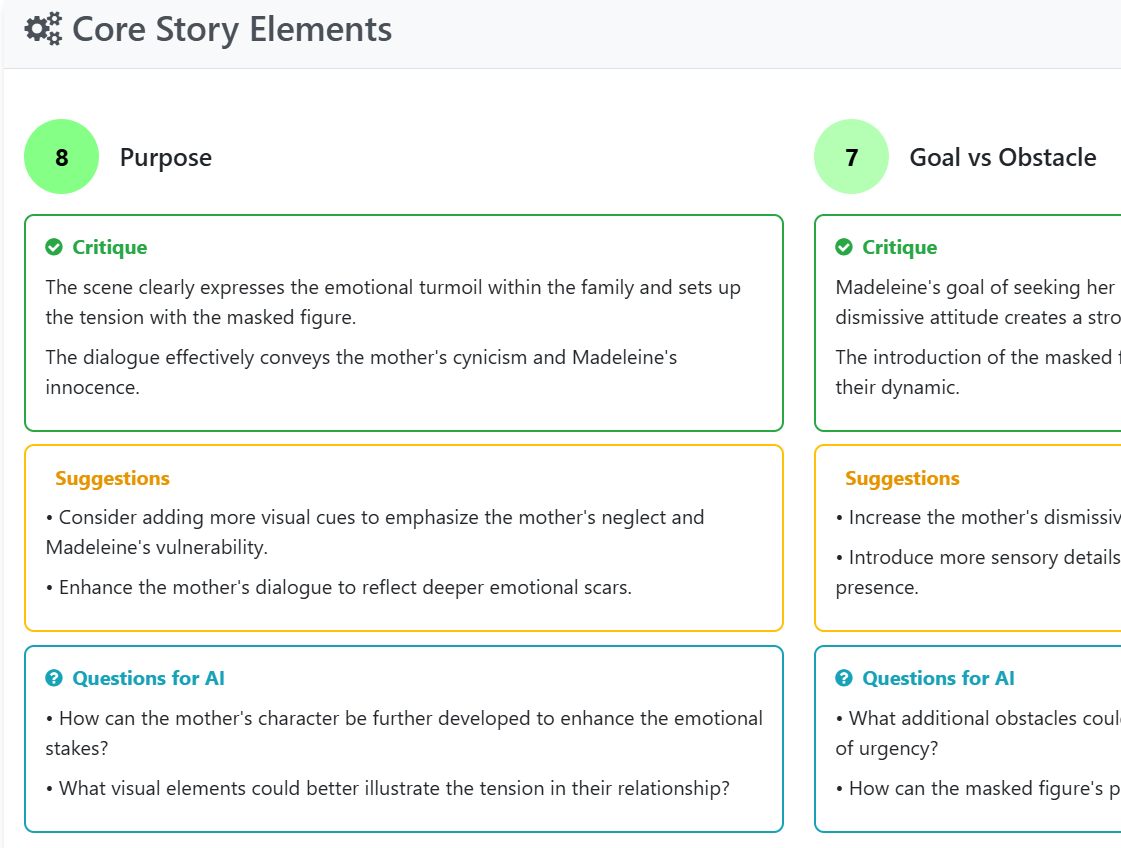
Core Story Elements

8
Purpose
Critique
The scene clearly establishes Barry's character and his anxiety through his phone call and the chaotic events outside.
The introduction of the harmonium foreshadows its significance in Barry's emotional journey.
Suggestions
• Consider adding more internal monologue to deepen Barry's emotional state.
• Enhance the contrast between the mundane phone call and the chaotic events outside.
Questions for AI
• How can Barry's internal conflict be more explicitly tied to the external chaos?
• What additional details could emphasize Barry's anxiety during the phone call?
7
Goal vs Obstacle
Critique
Barry's goal of clarifying the promotion is clear, but the external chaos serves as an obstacle that distracts him.
The tension between his mundane task and the unexpected chaos creates a compelling dynamic.
Suggestions
• Increase the urgency of the external chaos to heighten Barry's distraction.
• Explore Barry's internal conflict more deeply as he navigates the phone call.
Questions for AI
• What specific obstacles could further complicate Barry's phone call?
• How can the external chaos be used to reflect Barry's internal struggles more effectively?
6
Stakes
Critique
The stakes are somewhat low in this scene, primarily focused on a phone call.
However, the introduction of the harmonium hints at deeper emotional stakes to come.
Suggestions
• Introduce a sense of urgency or consequence related to the phone call.
• Highlight the potential impact of the promotion on Barry's life to raise stakes.
Questions for AI
• What could be at stake for Barry if he fails to understand the promotion?
• How can the stakes be made more personal to Barry's character?
7
Progression
Critique
The scene shows a clear progression from Barry's mundane task to the chaotic events outside.
However, the emotional shift could be more pronounced.
Suggestions
• Enhance the transition between Barry's phone call and the chaos outside.
• Consider adding a moment of realization for Barry as he witnesses the chaos.
Questions for AI
• How can the emotional progression be made more impactful?
• What specific moments could serve as turning points in Barry's emotional state?
6
Turn Potency
Critique
The turn from the phone call to the chaos outside is effective but could be sharper.
The moment Barry sees the harmonium could serve as a more significant turning point.
Suggestions
• Create a more dramatic shift in Barry's focus when he hears the chaos.
• Emphasize the moment he sees the harmonium as a pivotal emotional beat.
Questions for AI
• What alternative moments could serve as stronger turning points in this scene?
• How can the transition from the phone call to the chaos be made more surprising?

Supporting Elements

7
Exposition
Critique
The scene provides necessary exposition about Barry's character and the promotion.
However, some details could be woven in more organically.
Suggestions
• Integrate exposition about Barry's business more subtly through his actions.
• Consider showing Barry's emotional state through his interactions rather than just dialogue.
Questions for AI
• How can exposition be delivered more naturally in this scene?
• What additional context might enhance the audience's understanding of Barry?
8
Subtext
Critique
The chaos outside serves as a metaphor for Barry's internal struggles, adding depth to the scene.
The harmonium's introduction hints at Barry's desire for connection and expression.
Suggestions
• Explore the symbolism of the harmonium further in Barry's interactions.
• Consider adding visual motifs that reflect Barry's emotional state.
Questions for AI
• What deeper meanings can be drawn from the chaos outside?
• How can the harmonium's symbolism be expanded in this scene?
7
Setups & Payoffs
Critique
The setup of the airline promotion and the harmonium is clear, with potential payoffs in later scenes.
However, the connection between these elements could be strengthened.
Suggestions
• Foreshadow the significance of the harmonium more explicitly.
• Create a clearer link between the promotion and Barry's emotional journey.
Questions for AI
• What specific payoffs can be tied to the promotion introduced in this scene?
• How can the harmonium's role be more clearly established for future scenes?
8
Beat Clarity
Critique
The beats within the scene are clear, with a good rhythm between dialogue and action.
However, some moments could be tightened for better flow.
Suggestions
• Streamline dialogue to maintain pacing and tension.
• Consider adding pauses to emphasize Barry's emotional state.
Questions for AI
• What specific beats could be tightened for better clarity?
• How can the rhythm of the scene be improved to enhance tension?

Scene Transitions

Next Scene
9

Hook Out: Barry's decision to ignore the harmonium hints at his internal conflict.

Energy UP
The scene hands off momentum effectively, with Barry's actions leading into the next scene. The emotional stakes are raised as Barry grapples with his choices.
Suggestions
• Emphasize the emotional weight of Barry's decision to ignore the harmonium.
• Consider adding a moment of reflection before transitioning to the next scene.
Questions for AI
• What elements can enhance the emotional impact of this scene's exit?
• How can the transition to the next scene be made more seamless?

Scene Necessity

9

MUST HAVE

This scene is essential for establishing Barry's character and the thematic foundation of the story.

Suggestions
Ensure that the emotional stakes are clear to reinforce the scene's necessity.
Questions for AI
• What elements make this scene indispensable to the overall narrative?
• How can the scene's importance be emphasized further?

Enhancement Tags

#anxiety #chaos #connection

Character Delta: Barry begins to confront his anxiety and the chaos around him.

Improvement Recommendations

Add more internal monologue to highlight Barry's emotional state.
Enhance the contrast between the mundane phone call and the chaos outside.
Foreshadow the significance of the harmonium more explicitly.

The #1 Rule of Screenwriting: Make your reader or audience compelled to keep reading.

“Grab ‘em by the throat and never let ‘em go.”

Billy Wilder

The scene level score is the impact on the reader or audience to continue reading.
The Script score is how compelled they are to keep reading based on the rest of the script so far.


Compelled to keep Reading Score: 7/10

This scene immediately grabs the reader's attention with Barry's unusual phone call about an airline promotion that seems too good to be true. The abrupt shift to chaotic, unexplained events outside the warehouse – a flipping Jeep, a car dropping a harmonium – creates a strong sense of mystery and unease. Barry's passive reaction of simply retreating inside, rather than investigating, piques curiosity about his personality and what he might be hiding or avoiding. The presence of the harmonium left behind is a specific, tangible mystery that begs to be explored.

Script Continuation Score: 8/10

The opening scene establishes a unique protagonist, Barry Egan, who is both mundane (dealing with airline promotions) and oddly detached from extraordinary events. The bizarre occurrence of the car skidding and flipping, followed by the mysterious abandonment of the harmonium, introduces a significant element of the surreal and the unexplained. This immediately sets a tone that promises something beyond a typical narrative, hinting at underlying tensions or a world where strange things happen without clear cause. Barry's reaction—or lack thereof—suggests a deeper character complexity and potential for internal conflict, making the reader eager to understand his motivations and the nature of his reality.

Suggestions
  • Consider slightly emphasizing Barry's reaction to the external chaos. While his detachment is intriguing, a slightly stronger flinch or a more pronounced moment of bewildered observation might further amplify the impact of the events on him, thus increasing the reader's curiosity about his internal state.
  • The description of the warehouse products could be more specific or evocative to further cement Barry's character and the slightly off-kilter world he inhabits.
Questions for AI
  • What are some potential symbolic meanings of a harmonium being left abandoned in the street, especially in the context of a character who is initially preoccupied with a promotion and then retreats from observed chaos?
  • How can Barry's passive reaction to the bizarre events outside be further explored to suggest underlying psychological themes without explicitly stating them?
  • What are common narrative devices used in surreal or absurdist comedies to hook an audience into the protagonist's strange reality immediately?

Expert Critiques

Critique by Robert McKee
  • The scene effectively establishes Barry Egan's character as anxious and detail-oriented through his phone conversation about the airline promotion. However, the dialogue could be tightened to enhance clarity and impact. For instance, Barry's explanation of the promotion could be more concise to maintain the audience's engagement.
  • The transition from the phone call to the chaotic events outside is intriguing but could benefit from a stronger emotional connection. Barry's distraction by the sounds of chaos feels abrupt; a more gradual build-up to his reaction could heighten tension.
  • The visual imagery of the warehouse and the overexposed light when Barry steps outside is striking, but it may be worth exploring how this setting reflects Barry's internal state. The contrast between the mundane warehouse and the chaotic street could symbolize his internal struggles.

Robert McKee is known for his emphasis on story structure and character development, making him suitable for analyzing the scene's narrative and emotional impact.

Questions for AI
  • How can the dialogue in Barry's phone call be refined to enhance clarity and maintain audience engagement?
  • What techniques can be used to build tension more effectively between Barry's phone call and the chaotic events outside?
  • In what ways can the setting of the warehouse be used to reflect Barry's internal struggles more explicitly?
Critique by Linda Seger
  • The scene does a great job of introducing Barry's character and his mundane life, but it lacks a clear dramatic question that propels the narrative forward. What does Barry want in this moment? Establishing a more defined goal could enhance the scene's urgency.
  • The introduction of the harmonium is intriguing, but its significance isn't clear yet. It would be beneficial to hint at its importance to Barry's character arc earlier in the scene, perhaps through his reaction to it or a brief internal monologue.
  • The chaotic events outside serve as a catalyst for Barry's character development, but the scene could benefit from a stronger emotional response from Barry. His flinching at the harmonium could be tied to a deeper fear or desire, making his hesitation more impactful.

Linda Seger specializes in character development and dramatic structure, making her insights valuable for enhancing the scene's emotional depth and narrative clarity.

Questions for AI
  • What specific goal could Barry have in this scene to create a clearer dramatic question?
  • How can the significance of the harmonium be foreshadowed to enhance its impact on Barry's character arc?
  • What emotional responses could Barry exhibit to deepen the audience's connection to his character during the chaotic events?
Critique by David Mamet
  • The dialogue in the phone call is realistic but could be sharpened to reflect Mamet's style of concise, impactful exchanges. Streamlining Barry's lines could create a more dynamic rhythm and enhance the tension.
  • The scene's pacing is uneven; the transition from the phone call to the external chaos feels jarring. A more gradual build-up to the chaos could create a stronger sense of anticipation.
  • Barry's reaction to the chaos outside is understated. A more visceral response could heighten the stakes and draw the audience deeper into his psychological state.

David Mamet is known for his sharp dialogue and understanding of pacing, making him an excellent choice for critiquing the scene's dialogue and rhythm.

Questions for AI
  • How can Barry's dialogue be streamlined to create a more dynamic rhythm and enhance tension?
  • What techniques can be employed to create a smoother transition from the phone call to the chaotic events outside?
  • In what ways can Barry's reaction to the chaos be made more visceral to heighten the emotional stakes?

Expert Suggestions

Suggestion by Robert McKee
  • Consider revising Barry's dialogue to make it more concise, focusing on the essential elements of the promotion to keep the audience engaged.
  • Build tension gradually by incorporating more sensory details as Barry hears the chaos outside, allowing the audience to feel his growing anxiety.
  • Use the warehouse setting to reflect Barry's internal struggles, perhaps by contrasting the dullness of his surroundings with the chaos outside.

Robert McKee's focus on narrative structure and character development makes his suggestions valuable for enhancing the scene's emotional resonance.

Questions for AI
  • What specific revisions can be made to Barry's dialogue to enhance its conciseness?
  • How can sensory details be incorporated to build tension more effectively?
  • What visual elements can be used to symbolize Barry's internal struggles in the warehouse setting?
Suggestion by Linda Seger
  • Establish a clear dramatic question for Barry in this scene, such as his desire for clarity or connection, to create a sense of urgency.
  • Foreshadow the significance of the harmonium by having Barry react to it in a way that hints at its importance to his character development.
  • Deepen Barry's emotional response to the chaos outside by tying it to his fears or desires, making his hesitation more impactful.

Linda Seger's expertise in character development and dramatic structure provides actionable suggestions for enhancing the scene's emotional depth.

Questions for AI
  • What dramatic question could be established for Barry to enhance the scene's urgency?
  • How can the harmonium's significance be foreshadowed through Barry's reactions?
  • What fears or desires could be tied to Barry's emotional response to the chaos outside?
Suggestion by David Mamet
  • Revise the dialogue to create sharper, more impactful exchanges that reflect Mamet's style, enhancing the scene's rhythm.
  • Create a smoother transition from the phone call to the chaos outside by incorporating a gradual build-up of sound and tension.
  • Make Barry's reaction to the chaos more visceral, perhaps by having him physically react or express his fear more openly.

David Mamet's emphasis on dialogue and pacing offers valuable insights for enhancing the scene's overall impact.

Questions for AI
  • What specific revisions can be made to create sharper dialogue exchanges?
  • How can a smoother transition be achieved from the phone call to the chaos outside?
  • What physical reactions can Barry exhibit to make his response to the chaos more visceral?
Punch Drunk Love Full Analysis
View Analysis
View Script
2 - A Harmonious Encounter - Overall Grade: 8.5
Punch Drunk Love Full Analysis

INT. BARRY'S WAREHOUSE - THAT MOMENT
Barry on the phone again;
BARRY
....I'm not exactly sure what that
means...
VOICE
If they break or something. What is
it, plastic?
BARRY
It's a plastic, yeah.
VOICE
Right. Alright, lemme call you
first thing tomorrow, I'm gonna run
the numbers, see what's what and
I'll give you a call back --
BARRY
Did you have my home phone number?
VOICE
For what?
BARRY
If you wanted to call me back I
could...
VOICE
I'm fine, I have your work number.
BARRY
Ok...because of the time difference
if you needed to call me early?
VOICE
It's fine. I can just get you at
your office.
BARRY
Ok.
VOICE
Ok, bye, bye.

BARRY
Bye.
He hangs up the phone and walks outside, CAMERA follows him
again, out to the alley, over his shoulder......he looks down
the length of the alley at the Harmonium. HOLD, THEN:
A small FORD ESCORT pulls into the driveway, around the
Harmonium, parks......a young woman named LENA LEONARD exits
the car and starts to walk down the length of the alley
towards him.....CAMERA stays over his shoulder and turns into
a profile 2-shot;
LENA
Hi. Do you work at the mechanic?
BARRY
No.
LENA
They're not open yet?
BARRY
They don't get opened until eight.
BEAT. Barry gently steps back and out of the FRAME.
LENA
Is it ok if I leave my car you
think?
BARRY
I don't know.
LENA
I thought they opened at seven.
(beat)
If I left my car would it be ok?
BARRY
I don't know.
LENA
Do you know them.
BARRY
Not very well.
LENA
Can I ask you, can I trust to leave
my keys with you and give them to
you so that when they get here you
could give them to them?

BARRY
Ok.
LENA
You think it's ok where I left it,
right there?
BARRY
I think that'll be fine.
Lena hands him her keys, he steps back into FRAME, THEN:
LENA
There's a piano in the street.
BARRY
Yeah.
BEAT.
LENA
Ok. Maybe I'll see you later. Thank
you for your help.
BARRY
Thank you.
LENA
Maybe I'll see you later, when I
pick up my car?
BARRY
Ok.
She walks away....he starts back inside the warehouse,
hesitates, watches her go.....right before she reaches the
end of the alley, she glances back quickly, over her
shoulder....he dodges inside real quick.....
HOLD THE EMPTY FRAME......then he steps back out.....looks
off at the Harmonium.....and the empty street.....he looks
around some more....then he makes the long walk down the
street.
ON THE STREET.
Barry stares at the Harmonium a little bit, looks around,
both ways, then casually picks it up and walks back towards
his business.....
He brings it into his office and places it on his desk. He
tries a few keys....pressing down...there's no sound.

He presses his hand on the foot pedal and presses a key and a
small note is made.....BEAT....he does it again....and holds
the note.....
CUT TO BLACK.


Genres: Drama, Romance
Tone: Introspective, Uncertain, Helpful
Summary In this scene, Barry is on a phone call discussing a business matter involving a plastic item, expressing uncertainty about its details. After the call, he steps outside to the alley where he encounters Lena Leonard, who asks if she can leave her car with him. They have a brief, awkward exchange about the mechanic shop's hours, and Barry agrees to hold her keys. After Lena leaves, Barry picks up a Harmonium from the street, takes it back to his office, and experiments with it, discovering how to produce sound using the foot pedal, as the scene concludes.
Strengths
  • Effective introduction of a new character, Intriguing setup for future interactions, Symbolic use of the harmonium
Weaknesses
  • Low conflict level, Some dialogue repetition
General Critique
  • The scene effectively builds on the surreal and chaotic tone established in Scene 1, with the harmonium serving as a recurring motif that symbolizes Barry's inner turmoil and the absurdity of his world. This continuity helps in creating a cohesive narrative thread, making the audience feel the weight of Barry's isolation and hesitation, which is portrayed through his minimal dialogue and physical actions, such as dodging back inside when Lena glances at him. However, the phone conversation at the beginning feels somewhat disconnected from the main action; it introduces business-related anxiety but doesn't advance the plot significantly beyond reinforcing Barry's mundane routine, potentially diluting the focus on the more intriguing external elements like Lena's introduction and the harmonium.
  • Character development is a strong suit here, particularly for Barry, whose awkwardness and social anxiety are vividly depicted through his hesitant responses and body language. The interaction with Lena is a pivotal moment that sets up their relationship, highlighting Barry's discomfort in social situations and Lena's proactive nature, which contrasts nicely with his passivity. That said, the dialogue between them can come across as repetitive and overly simplistic, with phrases like 'Ok' and 'I don't know' being overused, which might emphasize Barry's character but risks making the exchange feel unnatural or stagey, potentially alienating viewers if not balanced with more varied emotional beats.
  • Visually, the camera work described—such as the follow shot from Barry's shoulder and the hold on empty frames—adds to the scene's tension and isolation, effectively mirroring Barry's internal state. This technique enhances the surreal atmosphere, especially when Barry picks up the harmonium, creating a sense of quiet discovery. However, the scene's pacing could be tighter; the beats where Barry hesitates and looks around are important for building suspense, but they might drag in execution, making the scene feel longer than necessary and reducing the impact of key moments, like the discovery of the harmonium's sound.
  • Thematically, this scene deepens the exploration of loneliness and unexpected connections, with Lena's arrival introducing a potential romantic interest that disrupts Barry's routine. The brief acknowledgment of the harmonium by both characters ties into the larger narrative, but it could be more integrated to heighten its symbolic importance. On the downside, the scene lacks deeper conflict resolution; while Barry's interaction with Lena advances the plot, the unresolved tension from Scene 1 (the chaotic events) lingers without progression, which might confuse viewers if not addressed soon, as it could make the story feel disjointed.
  • Overall, the scene successfully conveys Barry's emotional fragility and the film's quirky tone, but it could benefit from more subtext in the dialogue and actions to make character motivations clearer. For instance, Barry's decision to pick up the harmonium feels impulsive yet fitting, but exploring why he chooses this moment to engage with it—perhaps linking it to his emotional state after the phone call and Lena's departure—could add layers, helping readers and viewers better understand his character arc.
General Suggestions
  • Streamline the opening phone conversation to make it more concise, focusing only on key lines that reveal Barry's anxiety or business pressures, and transition quicker to the external action to maintain momentum and keep the audience engaged with the more dynamic elements.
  • Enhance the dialogue between Barry and Lena by adding subtle variations or subtext; for example, have Barry's responses include small hints of curiosity or fear to make his awkwardness more nuanced, and give Lena more personality through specific questions or observations that foreshadow their relationship, making the interaction feel more organic and less repetitive.
  • Adjust pacing by reducing some of the longer holds and beats, such as when Barry looks around the street, to prevent the scene from feeling sluggish; consider intercutting with closer shots of Barry's facial expressions or the harmonium to build tension more efficiently and emphasize his internal conflict.
  • Strengthen thematic ties by adding a small action or line that connects the harmonium to Barry's emotional state, like having him glance at it during the phone call to show it's already on his mind, which would make its retrieval at the end feel more motivated and integral to his character development.
  • Experiment with visual elements to heighten emotional impact; for instance, use closer camera angles during Barry's interaction with the harmonium to capture his fascination and isolation, or suggest sound design cues that blend the harmonium's note with ambient warehouse noises to create a more immersive and symbolic auditory experience.

Ratings
Overall

Overall: 8.5

The scene effectively introduces a new character, establishes a sense of mystery and intrigue, and sets up potential future interactions. The pacing and tone create a contemplative atmosphere, engaging the audience in Barry's world.


Story Content

Concept: 8

The concept of the scene revolves around chance encounters and the impact of small decisions on future events. The introduction of Lena and the harmonium adds depth to the narrative and hints at themes of trust and connection.

Plot: 8

The plot progresses by introducing a new character, Lena, and setting up potential future interactions between her and Barry. The scene adds layers to the story and hints at upcoming developments.

Originality: 7.5

The scene introduces a fresh approach to a common scenario of strangers meeting in an unfamiliar setting. The authenticity of the characters' actions and dialogue adds a layer of originality to the scene.


Character Development

Characters: 8.5

Barry is portrayed as cautious and somewhat reserved, while Lena appears friendly and in need of assistance. Their interaction hints at potential character growth and relationship dynamics. The scene effectively introduces Lena as a significant figure in Barry's life.

Character Changes: 6

While there are subtle shifts in Barry's demeanor and behavior, the scene primarily serves to introduce Lena and set the stage for future character development. Barry's willingness to help Lena hints at potential growth in his character.

Internal Goal: 8

Barry's internal goal in this scene is to navigate a situation where he is unsure of the intentions of Lena and how to handle her request. This reflects his deeper need for connection and trust, as well as his fear of being taken advantage of or making a wrong decision.

External Goal: 7

Barry's external goal is to manage the unexpected arrival of Lena and her request to leave her car at the warehouse. This reflects the immediate challenge of dealing with a stranger and making a decision that could impact his business.


Scene Elements

Conflict Level: 4

The scene has a low level of conflict, focusing more on establishing character dynamics and setting up future developments. The tension arises from the uncertainty and intrigue surrounding Lena's arrival and the harmonium.

Opposition: 7

The opposition in the scene is moderate, with Lena presenting a challenge to Barry's sense of trust and responsibility. The uncertainty of Lena's motives creates a subtle obstacle for Barry to navigate.

High Stakes: 5

The stakes are relatively low in this scene, focusing more on character dynamics and setting up future interactions. The potential for trust, connection, and change is hinted at, but the immediate risks are minimal.

Story Forward: 8

The scene moves the story forward by introducing a new character, Lena, and establishing a connection between her and Barry. It sets up future plot points and hints at upcoming conflicts and resolutions.

Unpredictability: 7.5

This scene is unpredictable because of the ambiguous nature of Lena's request and Barry's responses. The audience is left uncertain about the outcome, adding suspense and intrigue to the scene.

Philosophical Conflict: 6.5

The philosophical conflict in this scene revolves around trust and uncertainty. Lena's trust in Barry to leave her car and keys with him challenges Barry's own beliefs about trust and responsibility, highlighting a clash of values and perspectives.


Audience Engagement

Emotional Impact: 7.5

The scene evokes a sense of curiosity and anticipation, drawing the audience into Barry's world and hinting at emotional connections to come. The interaction between Barry and Lena sparks interest and empathy.

Dialogue: 8

The dialogue is natural and reflective of the characters' personalities. It conveys uncertainty, curiosity, and a subtle connection between Barry and Lena, setting the stage for future interactions.

Engagement: 8.5

This scene is engaging because of the subtle interactions between the characters, the sense of mystery surrounding Lena's intentions, and the building tension as Barry navigates the situation.

Pacing: 8.5

The pacing of the scene is well-executed, with pauses and beats that build tension and suspense. The rhythm of the dialogue and actions enhances the emotional impact of the scene.


Technical Aspect

Formatting: 8

The formatting adheres to the expected format for a screenplay, with clear scene descriptions and character actions. The dialogue is properly formatted, enhancing readability and flow.

Structure: 8

The scene follows a clear structure with a buildup of tension and uncertainty, leading to a climactic moment where Barry makes a decision. The pacing and rhythm contribute to the effectiveness of the scene.


Scene Objective: Introduce Lena as a character and highlight Barry's social anxiety and desire for connection.

Setting: Warehouse alley, early morning.

POV: Barry's perspective, showcasing his internal conflict and awkwardness.

Emotional Arc: - insecurity → + tentative connection

Score Overview

Group Category Score
Overall Overall Score 7.6
Core Elements Purpose
8
Goal vs Obstacle
7
Stakes
6
Progression
7
Turn Potency
6
Supporting Exposition
7
Subtext
8
Setups & Payoffs
6
Beat Clarity
7
Quality Scene Necessity
9
Thematic Resonance
8

Core Story Elements

8
Purpose
Critique
The scene clearly expresses Barry's struggle with social interaction and his desire for connection through his awkward dialogue with Lena.
Suggestions
• Consider adding more internal monologue to emphasize Barry's thoughts during the interaction.
Questions for AI
• How can Barry's internal conflict be more explicitly conveyed during his conversation with Lena?
• What additional details could enhance the emotional weight of this interaction?
7
Goal vs Obstacle
Critique
Barry's goal of connecting with Lena is evident, but his social anxiety acts as a significant obstacle, creating tension in their interaction.
Suggestions
• Introduce more external distractions or interruptions to heighten the tension of Barry's struggle.
Questions for AI
• What specific actions or dialogue could further illustrate Barry's internal conflict during this scene?
• How can Lena's responses be adjusted to create more tension or empathy for Barry?
6
Stakes
Critique
The stakes feel moderate; Barry risks missing a chance for connection, but the urgency could be heightened.
Suggestions
• Introduce a time constraint or external pressure that forces Barry to act more decisively.
Questions for AI
• What could be at stake for Barry if he fails to connect with Lena in this moment?
• How can the stakes be made more personal or urgent for Barry?
7
Progression
Critique
The scene shows a clear progression from Barry's initial awkwardness to a tentative connection with Lena.
Suggestions
• Enhance the emotional shift by adding a moment of realization for Barry about his feelings towards Lena.
Questions for AI
• How can the emotional progression be made more impactful as Barry interacts with Lena?
• What specific moments could serve as turning points in their conversation?
6
Turn Potency
Critique
The pivotal moment occurs when Barry decides to pick up the harmonium, but it could be more impactful.
Suggestions
• Create a more dramatic pause or hesitation before Barry picks up the harmonium to emphasize his internal struggle.
Questions for AI
• What alternative actions could Barry take that would heighten the tension before he picks up the harmonium?
• How can the moment of decision be made more dramatic or surprising?

Supporting Elements

7
Exposition
Critique
Exposition is woven into the dialogue, but it could be more seamless.
Suggestions
• Integrate Barry's backstory or feelings about his sisters more naturally into the conversation.
Questions for AI
• What additional context about Barry's life could be subtly included in this scene?
• How can the exposition be delivered without feeling forced?
8
Subtext
Critique
The subtext of Barry's anxiety and desire for connection is clear, adding depth to the interaction.
Suggestions
• Explore more non-verbal cues from Barry that reflect his internal struggle.
Questions for AI
• What unspoken feelings could be conveyed through body language in this scene?
• How can the dialogue hint at deeper emotional issues without stating them outright?
6
Setups & Payoffs
Critique
There are setups for future interactions with Lena, but they could be more pronounced.
Suggestions
• Foreshadow Barry's emotional journey with Lena through subtle hints in their dialogue.
Questions for AI
• What specific setups could be introduced that would pay off in later scenes?
• How can the dialogue hint at future developments in Barry and Lena's relationship?
7
Beat Clarity
Critique
The beats are clear, but some moments could benefit from more emphasis to enhance tension.
Suggestions
• Add pauses or reactions to heighten the emotional stakes during key exchanges.
Questions for AI
• What specific beats could be emphasized to improve the flow of the scene?
• How can the rhythm of dialogue be adjusted for greater impact?

Scene Transitions

Previous Scene
8

Hook In: Barry's hesitation after witnessing the harmonium being left in the street.

Energy FLAT
The transition maintains a consistent tone, but could build more anticipation for Barry's interaction with Lena.
Suggestions
• Create a more dramatic lead-in from the previous scene to heighten the emotional stakes.
Questions for AI
• How can the emotional tone from the previous scene be better integrated into this one?
• What specific elements could enhance the anticipation for Barry's encounter with Lena?
Next Scene
9

Hook Out: Barry's decision to pick up the harmonium and experiment with it.

Energy UP
The scene effectively hands off momentum, transitioning from social interaction to personal exploration.
Suggestions
• Consider adding a moment of reflection for Barry before he engages with the harmonium.
Questions for AI
• What could be added to enhance the emotional impact of Barry's transition to the next scene?
• How can the connection between Barry's interaction with Lena and his exploration of the harmonium be deepened?

Scene Necessity

9

MUST HAVE

This scene is crucial for establishing Barry's character and his potential relationship with Lena.

Suggestions
Ensure that the emotional stakes are clear to reinforce the scene's necessity.
Questions for AI
• What elements could be added to make this scene feel even more essential to the narrative?
• How can the emotional weight of this scene be amplified to underscore its importance?

Enhancement Tags

#social_anxiety #connection #awkwardness

Character Delta: Barry begins to confront his social anxiety through interaction with Lena.

Improvement Recommendations

Add more internal dialogue for Barry to express his thoughts during the interaction.
Introduce external distractions to heighten the tension of Barry's social anxiety.
Create a more dramatic pause before Barry picks up the harmonium to emphasize his internal struggle.

The #1 Rule of Screenwriting: Make your reader or audience compelled to keep reading.

“Grab ‘em by the throat and never let ‘em go.”

Billy Wilder

The scene level score is the impact on the reader or audience to continue reading.
The Script score is how compelled they are to keep reading based on the rest of the script so far.


Compelled to keep Reading Score: 7/10

This scene effectively builds intrigue around the mysterious harmonium and introduces a new character, Lena, who adds a layer of potential romantic or complicating interest. Barry's hesitant but ultimately curious actions in picking up the harmonium and experimenting with it leave the reader wanting to know its significance and purpose. Lena's appearance, while seemingly random, creates a direct interaction that could lead to further plot development, especially given Barry's awkwardness and her own need for his assistance.

Script Continuation Score: 8/10

The script continues to weave a tapestry of peculiar events and character interactions. The unresolved mystery of the harmonium, initially introduced in Scene 1, is now directly engaged with by Barry, and the introduction of Lena offers a new potential avenue for character development, possibly romantic, which is a strong hook. Barry's internal anxieties and social awkwardness, hinted at in Scene 1, are further explored through his interaction with Lena. The overall narrative is building momentum with these strange occurrences and character dynamics, making the reader curious about where these threads will lead.

Suggestions
  • Consider giving Lena a more immediate reason for needing Barry's help beyond just 'leaving her car there,' perhaps something that connects her more directly to the events of Scene 1, or provides a stronger immediate hook.
  • Subtly hint at the connection between Lena and the events of Scene 1, if any, or establish a stronger reason for her being in that specific alley.
  • When Barry experiments with the harmonium, consider adding a more distinct sound or a subtle visual cue that hints at its unusual nature or potential.
  • Barry's hesitation before picking up the harmonium could be amplified with a slightly longer beat or a more pronounced visual reaction to underscore his internal conflict.
Questions for AI
  • How can I make Lena's reason for being in the alley and needing Barry's help more organic and less coincidental, perhaps linking it to the harmonium or the events of Scene 1?
  • What specific sounds or visual cues could be used when Barry first plays the harmonium to suggest it's more than just a musical instrument?
  • What subtle ways can Barry's internal anxiety and hesitation be visually communicated when he interacts with Lena, beyond just physical actions?
  • Can you brainstorm potential reasons why the harmonium was left in the street, considering the chaotic events of Scene 1 and how it might connect to Barry's character or the broader narrative?

Expert Critiques

Critique by David Mamet
  • The dialogue in this scene is very realistic, capturing the awkwardness of Barry's conversation with the operator. However, it could benefit from more subtext. For instance, Barry's insistence on providing his home number suggests a deeper need for connection or validation, which could be emphasized through more nuanced dialogue.
  • The introduction of Lena is intriguing, but her dialogue feels somewhat generic. It would be more impactful if her lines revealed more about her character or her intentions. For example, instead of simply asking if she can leave her car, she could express a personal stake in the situation, making her more relatable.
  • The scene's pacing is effective, but the transition from the phone call to the outside world could be smoother. The abrupt shift from the mundane phone conversation to the chaotic street events feels jarring. Consider using a more gradual transition that builds tension.

David Mamet is known for his sharp dialogue and understanding of subtext, making him an ideal expert to critique the dialogue and character interactions in this scene.

Questions for AI
  • How can I enhance the subtext in Barry's dialogue with the operator to reflect his emotional state more clearly?
  • What specific changes could I make to Lena's dialogue to give her more depth and make her more memorable?
  • What techniques can I use to create a smoother transition between the phone call and the chaotic events outside?
Critique by Sofia Coppola
  • The scene effectively captures a sense of isolation and confusion, which is a recurring theme in Barry's character arc. However, the visual storytelling could be enhanced. For instance, the way Barry interacts with the harmonium could be more symbolic of his emotional state.
  • Lena's introduction is a pivotal moment, but her character could be more fleshed out through visual cues. Consider adding small details in her body language or expressions that hint at her own insecurities or desires.
  • The use of space in the scene is interesting, but it could be more dynamic. For example, Barry's hesitance to approach the harmonium could be visually represented through his physical movements, creating a more palpable tension.

Sofia Coppola is celebrated for her ability to convey emotion through visual storytelling and character development, making her insights valuable for enhancing the scene's depth.

Questions for AI
  • What visual storytelling techniques can I employ to better symbolize Barry's emotional state through his interaction with the harmonium?
  • How can I incorporate visual cues in Lena's introduction to give her character more depth?
  • What specific actions can I add to Barry's physical movements to enhance the tension in this scene?
Critique by Aaron Sorkin
  • The dialogue is functional but lacks the rhythm and wit that could elevate the scene. Barry's exchanges with the operator and Lena could be more engaging if they included clever repartee or quick back-and-forths that reveal character.
  • The stakes in this scene feel low. While the chaotic events outside create tension, Barry's internal conflict could be more pronounced. Consider adding lines that reflect his anxiety or frustration about his life situation.
  • The scene ends abruptly after Barry picks up the harmonium. A more impactful conclusion could involve a moment of reflection or realization for Barry, perhaps hinting at his emotional journey.

Aaron Sorkin is known for his sharp, fast-paced dialogue and character-driven storytelling, making him an excellent choice to critique the dialogue and emotional stakes in this scene.

Questions for AI
  • How can I infuse more rhythm and wit into Barry's dialogue to make it more engaging?
  • What specific lines can I add to heighten the stakes and reflect Barry's internal conflict?
  • What kind of moment of reflection could I include at the end of the scene to enhance its emotional impact?

Expert Suggestions

Suggestion by David Mamet
  • Revise Barry's dialogue with the operator to include more subtext about his loneliness or desire for connection. For example, he could express frustration not just with the promotion but with his life situation.
  • Enhance Lena's character by giving her a line that reveals her vulnerability or a personal stake in leaving her car, such as mentioning a time constraint or a personal connection to the mechanic.
  • Create a more gradual transition from the phone call to the chaotic street events by incorporating Barry's internal thoughts or feelings as he steps outside.

David Mamet's expertise in dialogue and character subtext can help enhance the emotional depth and clarity of the scene.

Questions for AI
  • What are some examples of subtext that could be added to Barry's dialogue to reflect his emotional state?
  • How can I create a line for Lena that adds depth to her character while still fitting the scene?
  • What techniques can I use to build tension during the transition from the phone call to the street events?
Suggestion by Sofia Coppola
  • Use Barry's interaction with the harmonium to symbolize his emotional state. For instance, he could struggle to produce sound, mirroring his inability to express himself.
  • Add visual details to Lena's introduction, such as her hesitance or a nervous gesture, to hint at her character's complexity and make her more relatable.
  • Incorporate more dynamic movement in the scene, such as Barry pacing or fidgeting, to visually represent his internal conflict and create a more engaging atmosphere.

Sofia Coppola's focus on visual storytelling and character depth can help create a more immersive and emotionally resonant scene.

Questions for AI
  • What are some visual storytelling techniques I can use to symbolize Barry's emotional state through the harmonium?
  • How can I visually represent Lena's character complexity in her introduction?
  • What specific actions can I add to Barry's movements to enhance the scene's tension?
Suggestion by Aaron Sorkin
  • Revise the dialogue to include more engaging and witty exchanges between Barry and the operator, perhaps with Barry making a humorous observation about his situation.
  • Increase the stakes by having Barry express his anxiety about the promotion's implications on his life, making it clear that this is more than just a trivial matter for him.
  • End the scene with a moment of realization for Barry, perhaps as he plays the harmonium and reflects on his life, hinting at his emotional journey.

Aaron Sorkin's expertise in dialogue and character-driven storytelling can help elevate the scene's emotional stakes and engagement.

Questions for AI
  • What are some examples of witty dialogue that could enhance the exchanges between Barry and the operator?
  • How can I effectively raise the stakes in Barry's conversation about the promotion?
  • What kind of moment of realization could I include at the end of the scene to enhance its emotional impact?
Punch Drunk Love Full Analysis
View Analysis
View Script
3 - The Harmonium's Secret - Overall Grade: 8.5
Punch Drunk Love Full Analysis

INT. WAREHOUSE - OFFICE - EARLY MORNING
Barry enters the warehouse with harmonium and runs into his
office. He places it on the desk and hits a key: no sound.
Barry goes to his knees and unlatched the bellows. He pumps
the bellow, reaches up, presses a note, and another...then
stands up into CU. and presses the 5 note
melody......SUDDENLY: THE SOUND OF THE POD BAY DOOR
SLIDING....
....Barry spins around, scared shitless, sees: LANCE, who
enters the warehouse, Barry rushes out to greet him;
LANCE
Hey, good morning, Barry.
BARRY
Hey...Lance....can I.....
LANCE
You ok?
BARRY
Yes I'm fine.
LANCE
Why you wearin' a suit?
BARRY
Um....I bought one. I thought maybe
it would be nice to get dressed for
work, can I show you something?
LANCE
Yeah.....you got here early huh?
BARRY
....yes.....
They enter into the office, Lance sees the harmonium;
LANCE
What is this?

BARRY
I don't know. I think it's a
piano....a small piano.
LANCE
That's not a piano.....I have a
piano at home.....where'd you get
it?
Lance walks around behind the harmonium....leaving Barry
alone....towards the warehouse......he starts to back up a
little.....
BARRY
Well.....it was dropped on the
street.....
Sal, Ernesto and Rico all start to come into work behind
Barry.....he sees them: CAMERA pushes in on Barry....
LANCE (OC)
Why is it here? Barry....Barry?
BARRY
...it just....I don't know....I
don't know.
LAND IN CU. ON BARRY. CUT TO BLACK.
TITLE CARD Punch-drunk Love Movie (maybe color
blooms/overture here)


Genres: Drama, Comedy
Tone: Confusion, Uncertainty, Intrigue, Awkwardness
Summary In a tense morning scene, Barry nervously plays a harmonium in his warehouse office, struggling to produce sound until startled by Lance's entrance. Their interaction reveals Barry's discomfort as Lance questions his suit and the harmonium's origin. As other characters enter, Barry's anxiety escalates, leaving him evasive and the atmosphere charged with unease. The scene concludes with a close-up of Barry's troubled expression before fading to black.
Strengths
  • Intriguing introduction of the harmonium
  • Engaging character interactions
  • Effective use of sound and camera angles
Weaknesses
  • Some pacing issues in certain moments
  • Lack of clear resolution to the harmonium mystery
General Critique
  • The scene effectively continues the motif of the harmonium from the previous scenes, reinforcing Barry's curiosity and isolation. By showing him alone at the start, experimenting with the instrument, it deepens the audience's understanding of his introspective nature and how small, mundane objects can captivate him, mirroring his emotional state. However, this repetition of Barry interacting with the harmonium in quick succession (from Scene 2) might feel redundant if not evolving the character's arc significantly, potentially risking audience fatigue with the same prop without advancing the plot or revealing new layers of Barry's personality.
  • The sound effect of the 'pod bay door sliding' is a bold cinematic choice that startles both Barry and the viewer, effectively heightening tension and emphasizing his heightened anxiety. This auditory cue works well to transition from a quiet, personal moment to a social interaction, but it could come across as overly dramatic or derivative if it echoes famous film references (like '2001: A Space Odyssey'), potentially distracting from the scene's authenticity. Additionally, while it serves to reveal Barry's jumpiness, it might benefit from more subtle integration to avoid feeling like a cheap jump-scare that doesn't fully tie into the story's grounded, absurd tone.
  • Dialogue in the scene is sparse and awkward, which aligns with Barry's character as established in prior scenes, making his responses feel genuine and revealing of his social discomfort. For instance, his hesitant explanation for wearing a suit ('I bought one. I thought maybe it would be nice to get dressed for work') subtly conveys his desire for normalcy amidst his chaotic life. However, the exchange with Lance lacks depth, coming across as expository rather than natural conversation, which could make supporting characters like Lance feel underdeveloped and reduce the scene's emotional impact. This might leave readers or viewers wondering about the purpose of these interactions beyond setting up Barry's isolation.
  • Visually, the camera work described—such as the close-up (CU) on Barry and the push-in as other workers enter—builds a sense of claustrophobia and scrutiny, effectively mirroring Barry's internal panic. This technique helps immerse the audience in his perspective, but it could be more varied to avoid predictability; for example, the repeated use of close-ups might overemphasize his anxiety without providing contrast, making the scene feel monotonous. Furthermore, the abrupt cut to black after the title card disrupts the flow, which, while intentional for dramatic effect, might confuse viewers if not handled with careful editing in the final film.
  • Overall, the scene serves as a transitional piece, introducing the daily routine and workplace dynamics while escalating Barry's unease. It fits well into the broader narrative by maintaining the themes of absurdity and loneliness from Scenes 1 and 2, but it doesn't introduce significant conflict or progression, feeling more like a holding pattern. This could be a missed opportunity to deepen character relationships or foreshadow future events, such as the harmonium's symbolic role or Barry's interactions with his colleagues, potentially making the scene feel inconsequential in the context of a 53-scene screenplay.
General Suggestions
  • Refine the dialogue to add more subtext or humor, such as having Lance's questions about the suit or harmonium reveal subtle insights into Barry's character, making the conversation feel more organic and less interrogative, which could enhance audience engagement.
  • Vary the pacing by incorporating a brief, subtle action or visual cue during Barry's harmonium experiment to build intrigue, like a flashback or sound overlap from the chaotic events in Scene 1, to better connect it to the larger story and avoid repetition.
  • Consider replacing or contextualizing the 'pod bay door sliding' sound effect with something more unique to Barry's world, such as a warehouse-specific noise, to reduce potential distractions and better integrate it into the film's tone of everyday absurdity.
  • Develop supporting characters like Lance by adding a small, telling detail in their interaction, such as Lance commenting on Barry's early arrival in a way that hints at their working relationship, to make them more memorable and provide contrast to Barry's isolation.
  • Strengthen the scene's role in the narrative by ending with a stronger hook, such as Barry's glance at the entering workers hinting at impending intrusion or conflict, to make the transition to the title card feel more purposeful and less abrupt.

Ratings
Overall

Overall: 8.5

The scene effectively introduces a mysterious element (the harmonium) that piques curiosity and sets up potential conflicts. The dialogue and character interactions are engaging, and the use of sound adds depth to the scene. However, some moments could be tightened for better pacing.


Story Content

Concept: 8

The concept of encountering a mysterious harmonium and the subsequent interactions with Lena and Lance is intriguing and sets up potential story developments. The scene effectively introduces new elements while maintaining the overall tone of the screenplay.

Plot: 8

The plot progresses by introducing the harmonium as a new element that could drive future events. The interactions between characters hint at potential conflicts and developments, adding depth to the overall story.

Originality: 8

The scene introduces a fresh situation with the sudden appearance of the harmonium, blending elements of mystery and humor. The characters' actions and dialogue feel authentic, adding depth to the unfolding events.


Character Development

Characters: 8.5

Barry's awkwardness and uncertainty are portrayed convincingly, while Lena and Lance add layers to the scene through their interactions with him. Each character's personality shines through in their dialogue and actions.

Character Changes: 7

Barry experiences a subtle shift in his routine and demeanor due to the unexpected encounter with the harmonium and Lena. This encounter hints at potential changes in his character and future actions.

Internal Goal: 8

Barry's internal goal in this scene is to maintain composure and hide his unease or fear, as seen through his interactions with Lance and his colleagues. This reflects his deeper need for acceptance and control in a potentially unsettling situation.

External Goal: 7.5

Barry's external goal is to explain the presence of the harmonium and justify its sudden appearance in the office. This reflects the immediate challenge of dealing with an unexpected situation and potential scrutiny from his colleagues.


Scene Elements

Conflict Level: 7

The scene contains subtle conflicts in Barry's uncertainty about the harmonium and his interactions with Lena and Lance. These conflicts add tension and set the stage for future developments.

Opposition: 7.5

The opposition in the scene is strong enough to create tension and uncertainty, particularly in Barry's interactions with Lance and his colleagues. The audience is left wondering about the true nature of the harmonium and Barry's motives.

High Stakes: 7

While the stakes are not overtly high in this scene, the introduction of the harmonium and the interactions with Lena and Lance suggest potential consequences and conflicts that could raise the stakes in future developments.

Story Forward: 8

The scene moves the story forward by introducing a new plot element (the harmonium) and setting up potential conflicts and developments with Lena and Lance. It adds depth to the narrative and hints at future story arcs.

Unpredictability: 8

This scene is unpredictable because of the sudden introduction of the harmonium and Barry's cryptic responses, leaving the audience unsure of the true nature of the situation. The unexpected sound of the pod bay door adds to the unpredictability.

Philosophical Conflict: 7

The philosophical conflict in this scene revolves around authenticity and deception. Barry's vague responses and discomfort hint at a struggle between honesty and maintaining appearances, challenging his values and beliefs.


Audience Engagement

Emotional Impact: 7.5

The scene evokes a sense of intrigue and curiosity, drawing the audience into the mystery of the harmonium and the dynamics between the characters. Barry's awkwardness and uncertainty elicit empathy and engagement.

Dialogue: 8

The dialogue effectively conveys the characters' emotions, uncertainties, and curiosity. It drives the interactions forward and sets up potential conflicts, adding depth to the scene.

Engagement: 9

This scene is engaging because it combines mystery, humor, and tension to captivate the audience's attention. The interactions between characters and the unfolding mystery keep viewers intrigued.

Pacing: 8.5

The pacing of the scene is well-crafted, with a gradual build-up of tension and suspense. The rhythm of actions and dialogue enhances the scene's effectiveness in conveying the characters' emotions and the unfolding mystery.


Technical Aspect

Formatting: 8

The formatting adheres to the expected format for a screenplay, with clear scene descriptions, character cues, and dialogue formatting. This enhances readability and understanding of the scene.

Structure: 8

The scene follows a well-paced structure that introduces the setting, conflict, and character dynamics effectively. Transitions between actions and dialogue flow smoothly, engaging the audience.


Scene Objective: To illustrate Barry's internal conflict and his desire for connection through the harmonium.

Setting: Warehouse office, early morning.

POV: Barry's perspective, highlighting his emotional state and interactions.

Emotional Arc: − anxiety → + tentative connection

Score Overview

Group Category Score
Overall Overall Score 7.5
Core Elements Purpose
8
Goal vs Obstacle
7
Stakes
6
Progression
7
Turn Potency
8
Supporting Exposition
7
Subtext
8
Setups & Payoffs
6
Beat Clarity
7
Quality Scene Necessity
8
Thematic Resonance
8

Core Story Elements

8
Purpose
Critique
The scene clearly expresses Barry's emotional turmoil and desire for connection through his interaction with the harmonium and Lance.
Suggestions
• Enhance the emotional weight of Barry's interaction with the harmonium by adding more internal dialogue.
• Consider showing Barry's physical reactions more vividly to emphasize his anxiety.
Questions for AI
• How can Barry's interaction with the harmonium be deepened to reflect his emotional state more clearly?
• What additional internal thoughts could Barry express to enhance the scene's emotional impact?
7
Goal vs Obstacle
Critique
Barry's goal of connecting with Lance is clear, but the obstacle of his anxiety is somewhat implicit rather than explicit.
Suggestions
• Make Barry's anxiety more visible through his body language and dialogue.
• Introduce a moment where Barry hesitates before showing Lance the harmonium to heighten the tension.
Questions for AI
• What specific actions can Barry take to illustrate his anxiety more clearly?
• How can Lance's responses be adjusted to create a stronger contrast with Barry's emotional state?
6
Stakes
Critique
The stakes feel somewhat low as the scene primarily focuses on Barry's internal struggle without a clear external consequence.
Suggestions
• Introduce a minor external conflict, such as a deadline or a pressing phone call, to raise the stakes.
• Highlight the potential consequences of Barry's emotional state on his work or relationships.
Questions for AI
• What external pressures could be introduced to heighten the stakes for Barry in this scene?
• How can the scene's stakes be made more tangible for the audience?
7
Progression
Critique
The scene shows a clear progression from Barry's initial anxiety to a moment of tentative connection with Lance.
Suggestions
• Make the transition from Barry's anxiety to connection more pronounced by adding a moment of realization or clarity.
• Consider ending the scene with a stronger emotional beat to emphasize the shift.
Questions for AI
• How can the emotional progression be made more impactful?
• What specific moment could serve as a turning point in Barry's emotional state?
8
Turn Potency
Critique
The moment when Barry reveals the harmonium to Lance is effective, but could be sharpened for greater impact.
Suggestions
• Add a moment of silence or tension before Barry reveals the harmonium to heighten the turn's potency.
• Consider using a close-up shot of Barry's face to capture his vulnerability during this moment.
Questions for AI
• What could be added to the moment of revelation to make it more surprising or emotional?
• How can the visual framing enhance the impact of this pivotal moment?

Supporting Elements

7
Exposition
Critique
Exposition is woven into the dialogue, but could be more seamlessly integrated into the action.
Suggestions
• Show Barry's thoughts about the harmonium more explicitly to provide context without heavy exposition.
• Consider using visual cues to convey information about Barry's emotional state.
Questions for AI
• How can exposition be delivered more organically through Barry's actions?
• What visual elements could enhance the audience's understanding of the harmonium's significance?
8
Subtext
Critique
The subtext of Barry's desire for connection and his anxiety is present but could be deepened.
Suggestions
• Introduce more non-verbal cues that reflect Barry's internal struggle.
• Consider adding a moment where Barry reflects on his past relationships to enrich the subtext.
Questions for AI
• What additional layers of subtext could be introduced to enhance Barry's emotional journey?
• How can the dialogue between Barry and Lance hint at deeper themes of connection and anxiety?
6
Setups & Payoffs
Critique
The setup of the harmonium is clear, but the payoff in this scene feels underdeveloped.
Suggestions
• Create a stronger connection between Barry's interaction with the harmonium and his emotional state.
• Consider foreshadowing how the harmonium will play a role in Barry's journey.
Questions for AI
• How can the harmonium's significance be established more clearly in this scene?
• What future moments could be hinted at through Barry's interaction with the harmonium?
7
Beat Clarity
Critique
The beats are generally clear, but some moments could benefit from more emphasis to enhance rhythm.
Suggestions
• Add pauses or beats of silence to emphasize emotional moments.
• Consider varying the pacing to create tension and release.
Questions for AI
• What specific beats could be emphasized to improve clarity and rhythm?
• How can the pacing be adjusted to enhance the emotional flow of the scene?

Scene Transitions

Previous Scene
8

Hook In: Barry's initial interaction with the harmonium sets the stage for his emotional exploration.

Energy FLAT
The transition from the previous scene is smooth, maintaining the emotional tone.
Suggestions
• Consider adding a visual cue that links the two scenes more explicitly.
Questions for AI
• How can the transition be made more impactful?
• What visual elements could enhance the connection between the two scenes?
Next Scene
9

Hook Out: Barry's emotional state shifts as he interacts with Lance, leading to a moment of vulnerability.

Energy UP
The scene effectively builds momentum for the next sequence, leaving the audience eager for more.
Suggestions
• Consider ending with a stronger emotional beat to enhance the transition.
Questions for AI
• What could be added to the end of this scene to create a more powerful transition?
• How can the emotional stakes be heightened to ensure a compelling lead into the next scene?

Scene Necessity

8

MUST HAVE

This scene is essential for establishing Barry's emotional state and his desire for connection, which are central to the narrative.

Suggestions
Strengthen the emotional stakes to ensure the scene feels indispensable.
Questions for AI
• What elements could be added to make this scene feel even more crucial to Barry's journey?
• How can the emotional stakes be heightened to reinforce the scene's necessity?

Enhancement Tags

#anxiety #connection #music

Character Delta: Barry begins to confront his anxiety and seeks connection.

Improvement Recommendations

Add more internal dialogue to deepen Barry's emotional state.
Introduce a minor external conflict to raise the stakes.
Enhance the visual storytelling to emphasize Barry's anxiety.

The #1 Rule of Screenwriting: Make your reader or audience compelled to keep reading.

“Grab ‘em by the throat and never let ‘em go.”

Billy Wilder

The scene level score is the impact on the reader or audience to continue reading.
The Script score is how compelled they are to keep reading based on the rest of the script so far.


Compelled to keep Reading Score: 7/10

This scene masterfully builds on the lingering mystery of the harmonium, giving Barry a brief moment of almost musical expression before shattering it with a jarring sound and the abrupt arrival of Lance. The subsequent interaction between Barry and Lance, filled with Barry's nervous rambling and vague answers, creates immediate intrigue. The introduction of Sal, Ernesto, and Rico at the end, coupled with Lance's unanswered question about the harmonium, leaves the audience with a potent sense of unease and a strong desire to know what this object is and why it's causing such distress and confusion for Barry.

Script Continuation Score: 8/10

The script continues to build momentum by weaving together disparate elements: Barry's peculiar business dealings (airline promotions, novelty items), his internal emotional struggles (indicated by his reaction to the harmonium's sound), and the sudden intrusion of external characters who seem to be entering his orbit. The introduction of Lance and other workers adds a layer of potential conflict or exposition, hinting at Barry's workplace life, while the mysterious harmonium continues to be a central enigma. The title card for 'Punch-drunk Love' at the end also promises a thematic exploration that further hooks the reader.

Suggestions
  • Consider slightly prolonging Barry's brief moment of playing the harmonium before the jarring sound effect. This could heighten the contrast and make the disruption more impactful.
  • Flesh out the reactions of Sal, Ernesto, and Rico upon entering. Their presence could either amplify the tension around the harmonium or introduce a new, unexpected dynamic.
  • The title card for 'Punch-drunk Love' is a strong thematic statement. Ensure the visual or narrative elements leading up to it, or the overture if used, effectively set this tone.
Questions for AI
  • What kind of character archetypes could Sal, Ernesto, and Rico represent, and how might their interactions with Barry and Lance in this scene inform Barry's eventual emotional outbursts?
  • Considering the 'pod bay door' sound effect, what narrative or thematic parallels can be drawn between this scene and HAL 9000 from '2001: A Space Odyssey,' and how can this connection be subtly emphasized?
  • Given Barry's nervous demeanor and vague explanations, what are some subtle ways to visually convey his internal anxiety about the harmonium without relying solely on dialogue or explicit actions?
  • How can the introduction of the 'Punch-drunk Love' title card be best integrated with the preceding scene to maximize its thematic impact and leave the reader with a strong emotional resonance?

Expert Critiques

Critique by David Mamet
  • The dialogue in this scene is functional but lacks the sharpness and rhythm that can elevate the tension. For instance, Barry's responses to Lance feel overly hesitant and could benefit from more subtext. Instead of simply saying 'I don't know,' Barry could express his confusion in a way that reveals more about his character's emotional state.
  • The introduction of the harmonium is intriguing, but the scene could better establish its significance to Barry. Why does he feel compelled to play it? This could be conveyed through a brief internal monologue or a more expressive physical reaction when he first hears the sound.
  • The sudden sound of the pod bay door sliding is a jarring transition that could be more effectively integrated into the scene. It feels disconnected from the emotional arc of Barry's moment with the harmonium. Consider foreshadowing this sound earlier or using it to heighten Barry's emotional state.

David Mamet is known for his sharp dialogue and understanding of character motivations, making him a fitting choice to critique the dialogue and emotional depth in this scene.

Questions for AI
  • How can I enhance the dialogue between Barry and Lance to create more tension and subtext?
  • What techniques can I use to better integrate the harmonium's significance into Barry's character development?
  • How can I foreshadow the pod bay door sound to create a more cohesive emotional experience for the audience?
Critique by Linda Seger
  • The scene effectively establishes Barry's isolation and confusion, but it could benefit from a clearer emotional arc. Barry's initial excitement about the harmonium quickly turns to fear, which feels abrupt. Consider adding a moment of reflection or hesitation before he spins around.
  • The introduction of Lance is a pivotal moment, but the interaction feels somewhat flat. Lance's concern for Barry could be more pronounced, perhaps through a more probing question or a physical gesture that indicates his worry.
  • The ending with the close-up on Barry is strong, but it could be enhanced by showing more of his internal struggle. What is he feeling as he faces the chaos of the warehouse? A brief visual cue or a sound design element could amplify this moment.

Linda Seger specializes in story structure and character development, making her insights valuable for enhancing the emotional depth and clarity of the scene.

Questions for AI
  • How can I create a clearer emotional arc for Barry throughout this scene?
  • What specific dialogue or actions can I add to deepen Lance's concern for Barry?
  • What visual or sound design elements could enhance the emotional impact of the scene's conclusion?
Critique by Robert McKee
  • The scene has a strong setup with the harmonium, but it lacks a clear conflict that drives the narrative forward. Barry's interaction with the harmonium should lead to a more significant revelation or decision that impacts his character arc.
  • The pacing feels uneven; the transition from Barry's moment with the harmonium to Lance's entrance is abrupt. Consider using a visual or auditory cue to bridge these moments more smoothly.
  • The stakes in this scene are low, which diminishes the tension. What does Barry stand to lose or gain by engaging with the harmonium? Clarifying this could heighten the audience's investment in his journey.

Robert McKee is a master of story structure and conflict, making him an ideal expert to critique the narrative drive and stakes in this scene.

Questions for AI
  • What specific conflict can I introduce to make Barry's interaction with the harmonium more impactful?
  • How can I improve the pacing between Barry's moment with the harmonium and Lance's entrance?
  • What stakes can I establish in this scene to increase tension and audience engagement?

Expert Suggestions

Suggestion by David Mamet
  • Revise Barry's dialogue to include more subtext and emotional depth. For example, instead of saying 'I don't know,' he could express frustration or longing related to the harmonium.
  • Incorporate a brief internal monologue or physical reaction from Barry when he first hears the harmonium sound, emphasizing its significance to him.
  • Foreshadow the pod bay door sound by introducing a similar sound earlier in the scene, creating a more cohesive emotional experience.

David Mamet's expertise in dialogue and character motivation can help refine the emotional resonance of the scene.

Questions for AI
  • What are some effective ways to convey subtext in dialogue?
  • How can I create a more significant emotional connection between Barry and the harmonium?
  • What techniques can I use to foreshadow sounds effectively in a screenplay?
Suggestion by Linda Seger
  • Add a moment of reflection for Barry after he plays the harmonium, allowing the audience to see his emotional response before the chaos ensues.
  • Enhance Lance's character by giving him a more probing question or a physical gesture that indicates his concern for Barry's well-being.
  • Consider adding a visual cue or sound design element that reflects Barry's internal struggle as the scene concludes, enhancing the emotional impact.

Linda Seger's focus on character development and emotional arcs can guide improvements in the scene's emotional clarity.

Questions for AI
  • How can I create moments of reflection for characters to deepen emotional engagement?
  • What specific actions can I give Lance to show his concern for Barry more effectively?
  • What sound design elements can I incorporate to reflect a character's internal struggle?
Suggestion by Robert McKee
  • Introduce a clear conflict related to the harmonium that drives Barry's character arc forward, such as a decision he must make about its significance.
  • Smooth the pacing by using a visual or auditory cue to transition between Barry's moment with the harmonium and Lance's entrance.
  • Establish higher stakes for Barry in this scene, perhaps by hinting at a personal connection to the harmonium that he must confront.

Robert McKee's insights into conflict and stakes can help elevate the narrative tension and engagement in the scene.

Questions for AI
  • What types of conflicts can I introduce to enhance character development?
  • How can I improve pacing transitions between key moments in a scene?
  • What methods can I use to establish stakes that engage the audience?
Punch Drunk Love Full Analysis
View Analysis
View Script
4 - Plunging into Chaos - Overall Grade: 8.2
Punch Drunk Love Full Analysis

INT. WAREHOUSE/MAIN AREA - DAY
CAMERA pushes in slow as Barry and Lance talk to TWO
CUSTOMERS about the plungers which are on display in front of
them. They speak all over each other doing shop talk, etc;
CUSTOMER
You do guaranteed sale? etc.
BARRY
We back our plungers 100% and we do
ask for a 30 to 60 day display on
the floor.....
In the b.g., RICO over the laud speaker says:
RICO
Barry, your sister's on line one.
Barry doesn't move....

BARRY
Yes.....we do ask for....30 to 60
days....
CUSTOMER
I think you have a call?
Rico turns around, without loudspeaker;
RICO
Barry, your sister is on line one.
They look at him a moment....
BARRY
I'm just gonna grab this call real
quick?
ANGLE, REVERSE. Barry turns and heads for the phone nearby at
Rico's station;
BARRY (CONT'D)
(into phone)
.....This is Barry.
RHONDA
Hey it's me, it's Rhonda. Are you
coming to the party tonight?
BARRY
Hi, Rhonda, yes I am.
RHONDA
Bye.
She hangs up.
BARRY
Ok. Yes I'll see you tonight.
Barry takes a few steps back to the Customers:
BARRY (CONT'D)
Sorry about that: One thing I
wanted to point out, Dave, is that
we've just received a large order
from the Rio Hotel and Casino in
Las Vegas where we're going to be
supplying their hotel rooms with
the dice and money plunger, so
these babies are really moving well
right now...

RICO
(over loudspeaker)
Barry, your sister's on line two.
Barry tries again to ignore it....
BARRY
With the Aqua Blast Whales and
Speed Boats we're gonna ask for a
display at eye level for the little
kids.....
RICO
Barry --
BARRY
-- excuse me.
Barry walks back to the phone;
BARRY (CONT'D)
This is Barry.
KAREN
Hey it's me, what are you doing?
BARRY
Hello, Karen. I'm just working.
KAREN
Yeah but what are you doing?
BARRY
I'm just working....I have some
customers here.....
KAREN
So you can't talk to me?
BARRY
I have a few people here, I can't
really chat right now.
KAREN
"chat?" Did you just say "chat?"
BARRY
Well, I can't talk though --
KAREN
You just fucking said "chat," that
is so -- what are you now?
(MORE)

KAREN (CONT'D)
"chat." I'm just calling to make
sure you show up at this party
tonight.
BARRY
Yes, I'll be there.
KAREN
Fine. You get back to chatting with
your precious customers.
BARRY
Ok, bye-bye.
Barry snaps out of this, turns, claps his hands in confidence
and walks back to the customers and says:
BARRY (CONT'D)
Sorry about that.
CUSTOMER
I didn't know you had a sister?
BARRY
.....Well yes I do....
(beat)
But one more thing I wanted to tell
you guys about the new plungers is
that we're making the handles now
in a non-breakable material
called.....
He takes one of the plungers and to demonstrate smacks it on
the table....it SMASHES and rice falls out everywhere....
BARRY (CONT'D)
Ok...this is one of the old ones, I
think. Lance do we have any new
plungers around?
Lance moves to get a new plunger....
BARRY (CONT'D)
That was a little embarrassing and
that was one of the old handles so
let me get a new one to show you --
RICO
(loudspeaker)
Barry, your sister is on line one.
Barry holds, then;

CUSTOMER
How many sisters do you have?
BARRY
....I have seven.
CUSTOMER #2
Holy shit. You have seven sisters?
BARRY
They're calling because we're
having a party tonight for my
sister and the they're just
calling....can you hang on for just
two more minutes....?
Barry walks this time into his office......CAMERA tracks with
Barry to his office, seeing him try and shake this off.....He
EXITS FRAME.
CUT TO:


Genres: Comedy, Drama
Tone: Quirky, Anxious, Humorous
Summary In a bustling warehouse, Barry and Lance pitch plungers to customers when Barry's sisters repeatedly interrupt with phone calls about a party. Despite his attempts to focus on the sale, Barry's embarrassment escalates after a failed plunger demonstration spills rice. As he juggles family distractions and sales, the comedic chaos highlights his chaotic personal and professional life.
Strengths
  • Effective blend of humor and drama
  • Authentic character interactions
  • Insightful exploration of social anxieties
Weaknesses
  • Repetitive phone call interruptions
  • Limited external conflict
General Critique
  • The scene effectively captures Barry's social awkwardness and the overwhelming pressure from his family, which is consistent with his character development in earlier scenes. The repetitive interruptions from his sisters' phone calls create a comedic tension that highlights his inability to maintain professional composure, making it relatable and engaging for the audience. However, the dialogue feels somewhat redundant, particularly in the exchanges with Karen, where the focus on the word 'chat' is drawn out, potentially diluting the humor and pacing. This repetition might stem from an attempt to emphasize Barry's discomfort, but it risks making the scene feel sluggish if not balanced with more varied interactions.
  • Visually, the camera work is strong, with the slow push-in at the beginning and the tracking shot as Barry walks to his office, which builds intimacy and focuses on his emotional state. This technique mirrors the disorienting tone established in previous scenes, like the chaotic events outside in Scene 1. That said, the scene could benefit from more dynamic visual elements to break up the static dialogue-heavy sections, such as incorporating subtle reactions from the customers or Lance to underscore Barry's embarrassment, which would add layers to the group dynamics and make the warehouse setting feel more alive.
  • Conflict is well-handled through the external disruptions (the phone calls) and Barry's internal struggle, effectively showing how his personal life intrudes on his professional one. This ties into the film's themes of isolation and absurdity, as seen in the harmonium motif from earlier scenes. However, the resolution feels abrupt and unresolved; Barry's embarrassment peaks with the plunger demonstration, but there's little payoff or character growth within the scene itself, leaving it somewhat dangling. Integrating a small moment of reflection or a subtle hint at his coping mechanisms (like the harmonium) could provide better continuity and emotional depth.
  • The dialogue reveals character traits efficiently—Barry's nervousness, the sisters' invasiveness—but it lacks subtext in places. For instance, when Barry claps his hands and tries to regain confidence after the calls, it could be more nuanced to show his internal conflict without relying solely on overt actions. Compared to Scene 3, where Barry's fear and evasion are shown through physical reactions, this scene could use more non-verbal cues to convey his anxiety, making it less tell-heavy and more show-oriented, which is a key principle in screenwriting.
  • Pacing issues arise from the multiple loudspeaker announcements and phone calls, which, while intentional for comedic effect, might overwhelm the audience if not timed perfectly. The scene's length and the cumulative effect of interruptions could make it feel repetitive, especially since the calls from Rhonda and Karen serve similar purposes (confirming the party). This mirrors Barry's real-life frustrations but risks alienating viewers if the humor doesn't land, suggesting a need for tighter editing or more varied comedic beats to maintain engagement.
  • Overall, the scene successfully advances the plot by reinforcing Barry's family dynamics and setting up future conflicts, but it could strengthen its connection to the broader narrative. For example, the business pitch about plungers feels somewhat disconnected from the harmonium and airline promotion threads introduced earlier, which might confuse viewers. A subtle link, like Barry glancing at the harmonium in his office during a moment of stress, could weave these elements together more cohesively, enhancing thematic unity and helping the reader understand Barry's character arc.
General Suggestions
  • Refine the dialogue to reduce repetition; for instance, condense Karen's reaction to Barry's use of 'chat' into a single, punchier line to keep the scene's energy high and avoid dragging the comedic timing.
  • Incorporate more visual storytelling by adding specific camera directions or actions, such as a close-up on Barry's face during the plunger smash to heighten the embarrassment, or have the customers exchange glances to show their discomfort, making the scene more dynamic and engaging.
  • Enhance character depth by including subtle subtext or non-verbal cues; for example, have Barry fidget with an object from his desk (like a pen or the harmonium) during phone calls to externalize his anxiety, allowing the audience to infer his emotions without explicit dialogue.
  • Improve pacing by varying the rhythm of interruptions; alternate between quick, snappy call exchanges and brief pauses for Barry to compose himself, ensuring the comedic tension builds effectively without becoming monotonous.
  • Strengthen thematic ties by adding a small reference to earlier elements, such as Barry briefly eyeing the harmonium in his office as he walks in, to connect his personal turmoil with the mystery introduced in Scene 1 and maintain narrative cohesion.
  • Consider escalating the conflict more gradually; for instance, have the customers' reactions evolve from polite tolerance to mild concern during the interruptions, leading to a more satisfying emotional payoff when Barry excuses himself, which could make the scene feel more structured and impactful.

Ratings
Overall

Overall: 8.2

The scene effectively combines humor, awkwardness, and character dynamics to create an engaging and entertaining sequence that advances the plot while providing insight into Barry's life and relationships.


Story Content

Concept: 8.3

The concept of juxtaposing mundane tasks like selling plungers with personal phone calls adds depth to the scene, highlighting the contrast between Barry's professional facade and his personal struggles. The scene effectively explores themes of communication and social anxiety.

Plot: 8

The plot advances through Barry's interactions with customers and phone calls, revealing his complex relationships and inner conflicts. The scene sets up future developments while providing immediate insights into Barry's character.

Originality: 8

The scene introduces a fresh take on the common theme of work-life balance by incorporating comedic elements and unexpected interruptions to highlight the complexities of managing personal and professional relationships. The characters' actions and dialogue feel authentic and add depth to the narrative.


Character Development

Characters: 8.5

The characters are well-defined, with Barry portrayed as a mix of awkwardness and sincerity, and the customers adding humor and contrast to the scene. The interactions feel authentic and contribute to the overall dynamics.

Character Changes: 7

Barry experiences subtle shifts in his demeanor and interactions, showcasing moments of growth and self-awareness amidst the chaos of his daily life. The scene hints at potential character development to come.

Internal Goal: 8

Barry's internal goal in this scene is to balance his work responsibilities with personal relationships, specifically managing calls from his family while attending to customers. This reflects his desire to maintain professionalism while also fulfilling his familial obligations.

External Goal: 7

Barry's external goal is to successfully pitch and sell the new plungers to the customers, showcasing their features and benefits. This goal reflects the immediate challenge of promoting a product effectively.


Scene Elements

Conflict Level: 7

The conflict in the scene is primarily internal, focusing on Barry's struggles with communication and managing his personal relationships amidst work demands. The tension arises from his attempts to navigate these challenges.

Opposition: 6

The opposition in the scene is moderate, with Barry facing challenges from both work-related tasks and personal calls. The uncertainty of how he will manage these conflicting demands adds a layer of tension and unpredictability.

High Stakes: 7

While the stakes are not overtly high in this scene, the personal and professional challenges faced by Barry hint at larger consequences and conflicts that could arise, adding layers to the narrative.

Story Forward: 8

The scene moves the story forward by deepening the audience's understanding of Barry's character, setting up future conflicts and relationships, and establishing key themes that will likely be explored further in the narrative.

Unpredictability: 7

This scene is unpredictable due to the unexpected interruptions and comedic elements that keep the audience guessing about the characters' reactions and responses. The element of surprise adds to the scene's entertainment value.

Philosophical Conflict: 6

The philosophical conflict in this scene revolves around the juxtaposition of work and personal life, highlighting the tension between professional commitments and familial connections. This challenges Barry's values of dedication to both his job and his family.


Audience Engagement

Emotional Impact: 7.5

The scene elicits a range of emotions from amusement to empathy, drawing the audience into Barry's world and his humorous yet relatable predicaments. The mix of humor and vulnerability adds depth to the emotional impact.

Dialogue: 8.2

The dialogue is witty and natural, reflecting the characters' personalities and adding depth to the interactions. The phone conversations and customer exchanges are engaging and reveal nuances of the characters.

Engagement: 9

This scene is engaging because of its fast-paced dialogue, humorous exchanges, and relatable situations that capture the audience's attention. The blend of personal and professional dynamics adds depth to the interactions.

Pacing: 8

The pacing of the scene is effective in building tension and humor through rapid dialogue exchanges and interruptions. The rhythm of the interactions enhances the scene's comedic and dramatic elements.


Technical Aspect

Formatting: 7

The formatting adheres to the expected standards for a screenplay, with proper scene headings, character names, dialogue formatting, and action descriptions. The clarity of formatting enhances the readability of the scene.

Structure: 8

The scene follows a structured format typical of a dialogue-driven screenplay, with clear character interactions, setting descriptions, and progression of events. The pacing and rhythm contribute to the effectiveness of the scene.


Scene Objective: To illustrate Barry's professional life while revealing his personal anxieties through interruptions from his sisters.

Setting: Warehouse during the day.

POV: Barry's perspective, reflecting his internal struggles and external pressures.

Emotional Arc: - anxiety → + brief confidence

Score Overview

Group Category Score
Overall Overall Score 7.3
Core Elements Purpose
8
Goal vs Obstacle
7
Stakes
6
Progression
7
Turn Potency
6
Supporting Exposition
8
Subtext
7
Setups & Payoffs
6
Beat Clarity
7
Quality Scene Necessity
8
Thematic Resonance
8

Core Story Elements

8
Purpose
Critique
The scene clearly establishes Barry's professional environment and his personal challenges, effectively intertwining the two.
The interruptions from his sisters serve to heighten his anxiety and illustrate his familial obligations.
Suggestions
• Consider adding more visual cues to emphasize Barry's discomfort during the calls.
• Incorporate subtle reactions from the customers to enhance the tension.
Questions for AI
• How can I further illustrate Barry's internal conflict during the sales pitch?
• What additional elements could heighten the tension of the phone calls?
7
Goal vs Obstacle
Critique
Barry's goal of successfully pitching plungers is clear, but the interruptions create a dynamic obstacle that complicates his efforts.
The scene effectively conveys the tension between his professional aspirations and personal distractions.
Suggestions
• Introduce a more immediate consequence for Barry's distractions to raise the stakes.
• Explore the customers' reactions to Barry's distracted behavior more deeply.
Questions for AI
• What could be a more significant obstacle for Barry in this scene?
• How can I better illustrate the impact of his sisters' calls on his sales pitch?
6
Stakes
Critique
The stakes are present but could be more tangible; Barry's professional reputation is at risk, but this isn't fully explored.
The urgency of the phone calls adds a layer of tension, but the scene could benefit from clearer consequences.
Suggestions
• Highlight the potential fallout from Barry's failure to manage the calls effectively.
• Introduce a time constraint that emphasizes the urgency of the sales pitch.
Questions for AI
• What specific consequences could arise from Barry's distractions?
• How can I make the stakes feel more immediate and personal for Barry?
7
Progression
Critique
The scene shows a clear progression from Barry's initial confidence to his eventual embarrassment.
The shift in tone from professional to chaotic is effective, but could be more pronounced.
Suggestions
• Consider adding a moment of realization for Barry that heightens the emotional shift.
• Use visual or auditory cues to emphasize the transition from calm to chaos.
Questions for AI
• How can I better illustrate the emotional progression of Barry throughout this scene?
• What specific moments could serve as turning points in Barry's confidence?
6
Turn Potency
Critique
The pivotal moment occurs when Barry smashes the plunger, but it feels somewhat abrupt.
The turn could be more impactful if it tied back to his internal struggles.
Suggestions
• Build up to the moment of embarrassment with more tension in the dialogue.
• Connect the turn to Barry's emotional state to enhance its significance.
Questions for AI
• What could make the moment of embarrassment feel more earned?
• How can I tie the turn back to Barry's internal conflict more effectively?

Supporting Elements

8
Exposition
Critique
The scene provides necessary context about Barry's work and family dynamics without feeling forced.
The interruptions serve as a natural way to reveal his background.
Suggestions
• Consider weaving in more subtle hints about Barry's relationship with his sisters.
• Use visual elements to reinforce the exposition without relying solely on dialogue.
Questions for AI
• How can I incorporate more background information about Barry's family in a natural way?
• What visual cues could enhance the exposition in this scene?
7
Subtext
Critique
The subtext of Barry's anxiety and desire for connection is present but could be more pronounced.
The chaotic environment reflects his internal struggles effectively.
Suggestions
• Add moments of silence or hesitation that emphasize Barry's discomfort.
• Use body language to convey Barry's emotional state more clearly.
Questions for AI
• What additional layers of subtext could I explore in Barry's interactions?
• How can I better illustrate the contrast between Barry's internal and external worlds?
6
Setups & Payoffs
Critique
The scene sets up Barry's anxiety well, but the payoff of his embarrassment feels somewhat disconnected.
The setup of the phone calls could lead to a more significant payoff.
Suggestions
• Create a stronger connection between the setup of the phone calls and the eventual embarrassment.
• Foreshadow the chaos more clearly to enhance the payoff.
Questions for AI
• How can I create a more cohesive setup that leads to a satisfying payoff?
• What elements could I introduce earlier in the scene to enhance the payoff?
7
Beat Clarity
Critique
The beats are generally clear, but the rhythm could be tightened to enhance tension.
Some transitions between beats feel abrupt.
Suggestions
• Smooth out transitions between beats to create a more cohesive flow.
• Consider adding pauses for dramatic effect during key moments.
Questions for AI
• What specific beats could be clarified or expanded for better flow?
• How can I enhance the rhythm of the scene to build tension?

Scene Transitions

Previous Scene
8

Hook In: Barry's internal conflict is set up through his phone call and the chaotic events outside.

Energy FLAT
The transition from the previous scene is smooth, maintaining the tone and tension. The chaotic environment effectively mirrors Barry's internal struggles.
Suggestions
• Consider adding a visual cue that links the chaos outside to Barry's emotional state.
Questions for AI
• How can I enhance the connection between the previous scene and this one?
• What visual elements could strengthen the transition?
Next Scene
7

Hook Out: Barry's embarrassment leads him to retreat into his office, setting up the next scene.

Energy UP
The scene hands off momentum effectively, with Barry's emotional state shifting. The transition to the next scene feels natural, but could be more impactful.
Suggestions
• Create a stronger emotional hook that leads into the next scene.
Questions for AI
• What could enhance the emotional impact of the transition to the next scene?
• How can I make the exit from this scene feel more significant?

Scene Necessity

8

MUST HAVE

This scene is crucial for establishing Barry's character and the pressures he faces, both professionally and personally.

Suggestions
Enhance the emotional stakes to make the scene feel even more essential.
Questions for AI
• What elements could I add to make this scene feel even more integral to the story?
• How can I deepen the emotional impact of this scene?

Enhancement Tags

#anxiety #family_pressure #professionalism

Character Delta: Barry's confidence is briefly restored before being shattered by embarrassment.

Improvement Recommendations

Add more visual cues to emphasize Barry's discomfort during the calls.
Introduce a more immediate consequence for Barry's distractions to raise the stakes.
Create a stronger connection between the setup of the phone calls and the eventual embarrassment.

The #1 Rule of Screenwriting: Make your reader or audience compelled to keep reading.

“Grab ‘em by the throat and never let ‘em go.”

Billy Wilder

The scene level score is the impact on the reader or audience to continue reading.
The Script score is how compelled they are to keep reading based on the rest of the script so far.


Compelled to keep Reading Score: 8/10

This scene masterfully builds on the prior introduction of Barry's unsettling yet strangely mundane reality. The constant interruptions from his sisters, coupled with the public embarrassment of the plunger demonstration, create a sense of escalating chaos and social awkwardness that leaves the reader eager to see how Barry will navigate these pressures. The introduction of a large order from Las Vegas adds a layer of potential future plotlines, while the sheer number of sisters calling about a party creates a comedic yet stressful situation that demands resolution.

Script Continuation Score: 8/10

The script has successfully established Barry's character as a man under immense pressure, both professionally and personally. The repeated intrusions from his sisters, juxtaposed with his work as a novelty item salesman, create a compelling picture of a man struggling to maintain control. The introduction of the airline promotion and the large Las Vegas order in previous scenes now begins to pay off, hinting at how these elements might intertwine with Barry's personal chaos. The overall momentum is strong, with the audience invested in seeing how Barry's unique coping mechanisms will manifest under these mounting pressures.

Suggestions
  • Consider adding a brief visual gag or a more subtle hint of the harmonium's significance within the office during Barry's sales pitch. While the focus is on the plungers, a quick glance or a subtle sound could pique curiosity.
  • Make the breakdown of the plunger demonstration slightly more impactful or embarrassing to amplify the humor and Barry's mortification.
  • Potentially foreshadow Barry's need to 'escape' or his upcoming trip a little more directly, perhaps through a subtle glance at a calendar or a muttered comment about needing a break, to make the transition to Hawaii in later scenes feel more earned.
Questions for AI
  • Given Barry's repeated phone calls from his sisters, what are some specific ways he might try to avoid or deflect their attention in a business setting without completely alienating his clients, beyond what is shown here?
  • How can the 'rice spill' incident be staged for maximum comedic effect while still highlighting Barry's underlying anxiety and inability to handle unexpected situations gracefully?
  • Considering the introduction of the Las Vegas order, how might this significant business opportunity intersect with Barry's already chaotic personal life, and what kind of unique challenges could it present to him?
  • What are some subtle ways to hint at Barry's underlying emotional distress or his need for escape during the sales pitch, without overtly revealing his internal struggles?

Expert Critiques

Critique by Robert McKee
  • The scene effectively establishes Barry's character as someone who is overwhelmed by familial obligations, as evidenced by his distracted phone calls with his sisters Rhonda and Karen. However, the dialogue lacks tension and stakes; Barry's interactions with the customers feel flat and do not escalate the conflict. The introduction of the loudspeaker interruptions from Rico serves as a comedic element but detracts from the urgency of Barry's situation.
  • The physical comedy of the plunger breaking and spilling rice is a strong visual gag, but it feels disconnected from the emotional stakes of the scene. Barry's embarrassment should be tied more closely to his character's internal conflict about his family and his self-image.
  • The pacing of the scene could be improved. The interruptions from the loudspeaker feel repetitive and could be streamlined to maintain momentum. The audience should feel Barry's growing frustration rather than just observe it.

Robert McKee is known for his emphasis on story structure and character development, making him a suitable expert to critique the emotional stakes and pacing of this scene.

Questions for AI
  • How can the dialogue be adjusted to create more tension between Barry and his sisters during the phone calls?
  • What techniques can be used to better integrate the physical comedy of the plunger breaking with Barry's emotional state?
  • How can the pacing of the scene be improved to enhance the sense of urgency and conflict?
Critique by Linda Seger
  • The scene does a good job of showcasing Barry's awkwardness and his struggle with social interactions, particularly with his sisters. However, the character dynamics could be deepened. For instance, Barry's responses to his sisters could reveal more about his feelings of inadequacy and pressure to conform to family expectations.
  • The customers' reactions to Barry's phone calls could be more pronounced. Their confusion or concern could add layers to the scene, highlighting Barry's isolation in a crowded space.
  • The use of the loudspeaker is clever, but it could be more impactful if it were used to heighten the stakes of Barry's situation rather than just serve as a comedic interruption.

Linda Seger specializes in character development and dialogue, making her insights valuable for enhancing the emotional depth and character dynamics in this scene.

Questions for AI
  • How can Barry's interactions with his sisters be rewritten to reveal more about his internal struggles?
  • What specific reactions from the customers could enhance the emotional depth of the scene?
  • How can the loudspeaker interruptions be utilized to increase tension rather than just provide comic relief?
Critique by William Goldman
  • The dialogue in this scene feels overly expository at times, particularly when Barry explains the plungers and their features. It could benefit from more subtext, allowing the audience to infer information rather than having it stated outright.
  • Barry's character is established as anxious and somewhat inept, but the scene could do more to show his desperation to succeed in his job. The stakes of the sale should feel higher, especially with the interruptions from his sisters.
  • The comedic elements, such as the plunger breaking, should serve a dual purpose: they should not only provide humor but also reflect Barry's internal chaos. This connection could be made clearer.

William Goldman is renowned for his sharp dialogue and understanding of character motivation, making him an ideal expert to critique the dialogue and stakes in this scene.

Questions for AI
  • What strategies can be employed to reduce expository dialogue and create more subtext in Barry's conversations?
  • How can the stakes of Barry's sales pitch be heightened to reflect his desperation and anxiety?
  • In what ways can the comedic elements be tied more closely to Barry's emotional state to enhance the scene's impact?

Expert Suggestions

Suggestion by Robert McKee
  • Introduce a moment where Barry's frustration peaks, perhaps by having him momentarily lose his temper with the customers or his sisters, which would add depth to his character and create a more dynamic scene.
  • Streamline the interruptions from the loudspeaker to create a rhythm that builds tension rather than detracts from it. Consider having Barry's responses become increasingly frantic as the calls continue.
  • Enhance the physical comedy by having Barry's embarrassment lead to a more significant blunder, such as accidentally knocking over a display, which would tie into his emotional state.

Robert McKee's focus on character arcs and tension makes his suggestions particularly relevant for enhancing the emotional stakes in this scene.

Questions for AI
  • How can Barry's emotional outburst be crafted to enhance his character development?
  • What specific changes can be made to the loudspeaker interruptions to create a more cohesive rhythm in the scene?
  • How can the physical comedy be escalated to reflect Barry's internal chaos?
Suggestion by Linda Seger
  • Add a moment where Barry's sisters express their concern for him, which would deepen the emotional stakes and provide insight into their relationship. This could be done through a more extended dialogue that reveals their expectations of him.
  • Encourage the customers to react more visibly to Barry's distractions, perhaps by showing their confusion or impatience, which would highlight Barry's isolation and the pressure he feels.
  • Consider using the loudspeaker to convey a sense of urgency, such as announcing a time limit for the sale, which would raise the stakes for Barry and create a more intense atmosphere.

Linda Seger's expertise in character dynamics and emotional depth makes her suggestions valuable for enhancing the relationships and stakes in this scene.

Questions for AI
  • How can the sisters' dialogue be rewritten to reveal more about their relationship with Barry?
  • What specific reactions from the customers could enhance the emotional depth of the scene?
  • How can the loudspeaker be utilized to create a sense of urgency in the scene?
Suggestion by William Goldman
  • Revise the dialogue to incorporate more subtext, allowing Barry's feelings of inadequacy to come through without explicitly stating them. This could involve him hesitating or stumbling over his words when discussing the plungers.
  • Increase the stakes of the sales pitch by introducing a competitive element, such as a rival company or a deadline for the sale, which would add urgency to Barry's situation.
  • Ensure that the comedic elements serve a dual purpose by connecting them to Barry's emotional state. For example, the plunger breaking could symbolize his failure to maintain control in his life.

William Goldman's focus on dialogue and character motivation makes his suggestions particularly relevant for improving the scene's overall effectiveness.

Questions for AI
  • What techniques can be used to create subtext in Barry's dialogue to reflect his internal struggles?
  • How can a competitive element be introduced to heighten the stakes of Barry's sales pitch?
  • In what ways can the comedic elements be tied more closely to Barry's emotional state to enhance the scene's impact?
Punch Drunk Love Full Analysis
View Analysis
View Script
5 - The Harmonium Call - Overall Grade: 8.2
Punch Drunk Love Full Analysis

INT. WAREHOUSE - OFFICE - THAT MOMENT
Barry enters, takes a quick moment to size up the
harmonium.....He picks up the phone and through the
conversation gently moves the harmonium to a different spot
on the desk;
BARRY
This is Barry.
KATHLEEN
What are you doing?
BARRY
Hi, Kathleen, I'm just working.
KATHLEEN
Are you going to the party tonight?
BARRY
Yes I am.
KATHLEEN
What are you doing?
BARRY
Nothing.
KATHLEEN
Right now, you're doing nothing?

BARRY
I'm just talking on the phone to
you and standing.
KATHLEEN
What time are you gonna be there?
BARRY
Seven o'clock.
KATHLEEN
You can't be late.
BARRY
I won't.
KATHLEEN
I'm serious.
BARRY
I know.
KATHLEEN
Seriously.
BARRY
Ok.
KATHLEEN
You can't be late though.
BARRY
I know.
KATHLEEN
You can't just not show up like you
do, you have to go.
BARRY
I know.
KATHLEEN
Seriously.
BARRY
I know.
KATHLEEN
You can't just stay in your house.
BARRY
I know.

KATHLEEN
Yeah but I'm serious.
BARRY
Ok.
KATHLEEN
I'll see you there.
BARRY
I'll see you there.
KATHLEEN
Don't puss out.
BARRY
I won't.
Barry plays the 5 note melody on the Harmonium (carries over
into next scene....)
CUT TO:


Genres: Drama, Comedy
Tone: Anxious, Casual, Tense
Summary In this scene, Barry enters a warehouse office and answers a phone call from Kathleen, who pressures him to attend a party that evening and expresses concern over his past unreliability. Despite her anxious reminders, Barry responds with minimal engagement, assuring her he will be on time. The tension between Kathleen's insistence and Barry's passive reassurances highlights their conflicting perspectives. The scene concludes with Barry playing a 5-note melody on the harmonium, transitioning to the next scene.
Strengths
  • Tension-filled dialogue
  • Character depth through interaction
  • Foreshadowing of future conflicts
Weaknesses
  • Limited external conflict
  • Repetitive nature of dialogue
General Critique
  • The scene effectively continues the theme of Barry's overwhelming family dynamics, with the repetitive dialogue from Kathleen mirroring the interruptions in the previous scene, reinforcing Barry's passive and isolated character. This repetition highlights his discomfort and lack of assertiveness, which is crucial for understanding his emotional state early in the film, but it risks feeling redundant and monotonous, potentially disengaging the audience if not varied with more dynamic elements.
  • The integration of the harmonium as a prop during the phone call is a subtle nod to the chaotic events from Scene 1 and Barry's growing attachment to it, serving as a visual motif for his inner turmoil. However, the action of moving it is understated and could be more impactful if it were tied more explicitly to Barry's emotions, such as showing frustration or curiosity through his handling of it, making the scene feel more layered and less like background activity.
  • In terms of pacing, this scene fits into the film's pattern of establishing Barry's daily pressures but contributes little new information or plot progression beyond reiterating the party obligation already covered in Scene 4. This can make it feel like filler, especially since Barry's minimal responses ('I know', 'I won't') don't evolve the conversation, potentially weakening the overall momentum of the script at this point.
  • The tone maintains the awkward, introspective quality seen in earlier scenes, which is consistent with Barry's character arc, but the lack of visual or auditory variation during the dialogue exchange might not hold the audience's attention. For instance, the camera could exploit Barry's physical actions, like moving the harmonium, to add visual interest and convey subtext, enhancing the scene's emotional depth without relying solely on words.
  • The transition to the harmonium melody at the end is a strong auditory cue that carries over to the next scene, providing a smooth narrative link and emphasizing the harmonium's symbolic role. However, this could be more effective if the melody were contrasted with Barry's internal state—perhaps showing a brief moment of relief or introspection— to better illustrate how the instrument represents an escape from his familial pressures, making the scene's conclusion more resonant.
General Suggestions
  • Vary the dialogue to reduce repetition; for example, have Kathleen's questions escalate in tone or content to build tension, and give Barry more nuanced responses that hint at his growing irritation, making the conversation feel more dynamic and revealing of character.
  • Enhance the visual elements by adding close-up shots of Barry's face or hands while he interacts with the harmonium, using this to show his emotional state—such as displacement or curiosity— which could add depth and make the scene more engaging without altering the dialogue.
  • Shorten the repetitive sections of the phone call by condensing Kathleen's insistence into fewer lines, allowing the scene to focus on key moments and improve pacing, or integrate a small revelation, like a reference to a past family event, to advance character development.
  • Incorporate more action or subtext during the call; for instance, have Barry's handling of the harmonium become more deliberate or agitated as the conversation progresses, symbolizing his desire to escape the pressure, which would make the scene more visually compelling and thematically rich.
  • Strengthen the transition by ensuring the harmonium melody ties directly to Barry's emotions in this scene, perhaps with a beat where he pauses after the call to reflect, making the cut to the next scene feel more organic and emphasizing the harmonium as a recurring motif for Barry's inner world.

Ratings
Overall

Overall: 8.2

The scene effectively conveys tension and anticipation through the dialogue between Barry and Kathleen, setting up expectations for future events. The use of the harmonium adds an element of curiosity and depth to Barry's character.


Story Content

Concept: 8

The concept of the scene revolves around Barry's internal struggle and the external pressure he faces from Kathleen regarding the party. The inclusion of the harmonium adds a layer of intrigue and foreshadows future developments.

Plot: 8

The plot advances as Barry's commitment to attending the party is established, setting up potential conflicts and character growth. The scene lays the groundwork for future interactions and reveals key aspects of Barry's personality.

Originality: 7

The scene introduces a familiar scenario of social obligations and personal reluctance but adds authenticity through naturalistic dialogue and character dynamics. The authenticity of the characters' actions and dialogue enhances the originality of the scene.


Character Development

Characters: 8.5

Barry is portrayed as anxious and hesitant, while Kathleen is assertive and insistent. Their dynamic adds depth to their characters and hints at potential conflicts to come. The scene effectively showcases their contrasting personalities.

Character Changes: 7

Barry experiences a subtle shift in his resolve as he reaffirms his commitment to attend the party, showing a willingness to step out of his comfort zone. This sets the stage for potential character growth in future scenes.

Internal Goal: 7

Barry's internal goal in this scene seems to be to maintain a sense of normalcy and avoid confrontation or deeper emotional discussions. This reflects his need for stability and perhaps a fear of facing more complex issues in his life.

External Goal: 6

Barry's external goal is to attend the party and fulfill his social obligation. This goal reflects the immediate circumstance of the upcoming event and the challenge of meeting expectations.


Scene Elements

Conflict Level: 7

The conflict in the scene is primarily internal, as Barry struggles with his commitment to attend the party despite his reservations. The tension between Barry and Kathleen hints at potential external conflicts in future scenes.

Opposition: 6

The opposition in the scene is moderate, with Kathleen presenting a challenge to Barry's reluctance, creating a subtle conflict that adds depth to their interaction.

High Stakes: 7

The stakes are moderately high as Barry grapples with the pressure to attend the party and the expectations placed on him by Kathleen. The scene sets up potential consequences for Barry's choices.

Story Forward: 8

The scene moves the story forward by establishing Barry's upcoming attendance at the party and hinting at potential conflicts and developments. It sets the stage for future interactions and character arcs.

Unpredictability: 5

This scene is predictable in terms of the social dynamics and character interactions, lacking significant surprises or twists.

Philosophical Conflict: 6

The philosophical conflict in this scene revolves around the tension between fulfilling social obligations and maintaining personal autonomy. Kathleen emphasizes the importance of attending the party, while Barry seems reluctant and passive, hinting at a clash of values regarding social expectations and personal freedom.


Audience Engagement

Emotional Impact: 8

The scene evokes a sense of tension and anticipation, drawing the audience into Barry's internal struggle and the pressure he faces from Kathleen. The emotional stakes are high as Barry navigates his conflicting feelings.

Dialogue: 8.5

The dialogue between Barry and Kathleen is engaging and reveals important aspects of their relationship. The conversation is tense and filled with subtext, adding layers to the characters' motivations and emotions.

Engagement: 7

This scene is engaging because of the relatable dialogue and the subtle tension between the characters, keeping the audience interested in their dynamic.

Pacing: 8

The pacing of the scene is well-managed, allowing for natural pauses and building tension through the characters' dialogue and actions.


Technical Aspect

Formatting: 8

The formatting adheres to the expected format for a dialogue-heavy scene, making it easy to follow and understand the character interactions.

Structure: 8

The scene follows a standard format for a dialogue-driven interaction, effectively conveying the characters' motivations and conflicts. The pacing and rhythm contribute to the scene's effectiveness.


Scene Objective: Establish Barry's commitment to attending the party while showcasing his ongoing struggle with anxiety and social expectations.

Setting: Warehouse office, early morning.

POV: Barry Egan's perspective, revealing his internal conflicts and interactions.

Emotional Arc: − anxiety → + tentative connection

Score Overview

Group Category Score
Overall Overall Score 7.5
Core Elements Purpose
8
Goal vs Obstacle
7
Stakes
6
Progression
8
Turn Potency
7
Supporting Exposition
7
Subtext
8
Setups & Payoffs
6
Beat Clarity
7
Quality Scene Necessity
8
Thematic Resonance
8

Core Story Elements

8
Purpose
Critique
The scene clearly expresses Barry's anxiety about social obligations and his desire to connect with Kathleen, which is essential for character development.
Suggestions
• Consider adding more visual cues to Barry's body language to emphasize his discomfort during the call.
Questions for AI
• How can Barry's physical actions during the call further illustrate his emotional state?
• What additional dialogue could enhance the tension between Barry's desire to connect and his anxiety?
7
Goal vs Obstacle
Critique
Barry's goal of reassuring Kathleen about attending the party is clear, but his internal obstacles of anxiety and self-doubt could be more pronounced.
Suggestions
• Incorporate more interruptions or distractions during the call to heighten Barry's sense of urgency and anxiety.
Questions for AI
• What specific obstacles could Barry face during this conversation that would heighten the tension?
• How can Kathleen's responses be adjusted to create more conflict in Barry's goal?
6
Stakes
Critique
The stakes are present but could be elevated; Barry's emotional well-being and social acceptance are at risk, yet this could be made more urgent.
Suggestions
• Introduce a time constraint or a more pressing reason for Barry to attend the party to increase the stakes.
Questions for AI
• What could happen if Barry fails to attend the party that would make the stakes feel more immediate?
• How can the conversation with Kathleen reflect the potential consequences of Barry's actions?
8
Progression
Critique
The scene shows a clear progression from Barry's initial anxiety to a more resolved state as he commits to attending the party.
Suggestions
• Enhance the emotional transition by showing Barry's internal conflict more vividly before he agrees to go.
Questions for AI
• What moments can be added to illustrate Barry's internal struggle more clearly before he resolves to attend the party?
• How can the pacing of the conversation be adjusted to better reflect Barry's emotional journey?
7
Turn Potency
Critique
The pivotal moment occurs when Barry reassures Kathleen, but it could be more impactful with a stronger emotional build-up.
Suggestions
• Consider adding a moment of hesitation or a slip of anxiety before Barry confirms his attendance to heighten the emotional turn.
Questions for AI
• What could be a more surprising or unexpected response from Barry that would enhance the turn?
• How can the dialogue be structured to create a more dramatic shift in Barry's emotional state?

Supporting Elements

7
Exposition
Critique
The scene provides necessary context about the party and Barry's relationship with Kathleen, but it could be woven in more naturally.
Suggestions
• Integrate exposition into the dialogue more subtly to avoid feeling forced.
Questions for AI
• How can the conversation reveal more about Barry's past interactions with Kathleen without overtly stating it?
• What details about the party can be hinted at through subtext rather than direct dialogue?
8
Subtext
Critique
The subtext of Barry's anxiety and desire for connection is clear, adding depth to the scene.
Suggestions
• Explore more non-verbal cues that could enhance the subtext of Barry's emotional state.
Questions for AI
• What non-verbal actions can Barry take that would reveal his anxiety without him having to say it?
• How can Kathleen's tone or phrasing add layers to the subtext of their conversation?
6
Setups & Payoffs
Critique
The scene sets up Barry's attendance at the party but lacks a strong payoff that connects to his earlier struggles.
Suggestions
• Create a more direct link between this conversation and Barry's previous experiences with social gatherings.
Questions for AI
• What earlier scenes can be referenced to create a stronger payoff for Barry's commitment to the party?
• How can the dialogue foreshadow future conflicts or resolutions related to the party?
7
Beat Clarity
Critique
The beats are generally clear, but some moments could benefit from more distinct emotional shifts.
Suggestions
• Add pauses or changes in tone to emphasize emotional beats more effectively.
Questions for AI
• What specific beats can be highlighted to create a clearer emotional arc within the scene?
• How can the rhythm of the dialogue be adjusted to enhance the tension?

Scene Transitions

Previous Scene
8

Hook In: Barry walks into his office, trying to shake off the previous scene's tension.

Energy FLAT
The transition maintains a consistent tone, but could benefit from a more dynamic shift in energy.
Suggestions
• Introduce a visual or auditory cue that reflects Barry's emotional state as he enters the office.
Questions for AI
• How can the transition visually represent Barry's internal conflict as he moves into this scene?
• What elements from the previous scene can be echoed to create a stronger connection?
Next Scene
9

Hook Out: Barry plays a melody on the harmonium, leading into the next scene.

Energy UP
The scene hands off momentum effectively, transitioning from dialogue to action with the harmonium.
Suggestions
• Consider enhancing the musical transition to create a more emotional resonance as the scene ends.
Questions for AI
• What musical elements can be introduced to deepen the emotional impact of this transition?
• How can the final moments of this scene foreshadow the upcoming events in the next scene?

Scene Necessity

8

MUST HAVE

This scene is crucial for establishing Barry's character development and setting up future conflicts related to social interactions.

Suggestions
Emphasize the emotional stakes to make the scene feel even more essential to the narrative.
Questions for AI
• What elements can be added to ensure this scene feels indispensable to Barry's journey?
• How can the emotional stakes be heightened to reinforce the necessity of this scene?

Enhancement Tags

#anxiety #connection #social_expectations

Character Delta: Barry shows a slight shift towards accepting social obligations despite his anxiety.

Improvement Recommendations

Add more physicality to Barry's anxiety during the phone call.
Introduce a time constraint to heighten the stakes of attending the party.
Incorporate more non-verbal cues to enhance the emotional depth of the conversation.

The #1 Rule of Screenwriting: Make your reader or audience compelled to keep reading.

“Grab ‘em by the throat and never let ‘em go.”

Billy Wilder

The scene level score is the impact on the reader or audience to continue reading.
The Script score is how compelled they are to keep reading based on the rest of the script so far.


Compelled to keep Reading Score: 6/10

This scene provides a brief but important character moment for Barry, showing his continued fascination with the harmonium and his anxious, somewhat detached interactions. Kathleen's persistent reminders about the party and Barry's repeated assurances create a subtle tension, hinting at his unreliability and potential for social anxiety. While the harmonium melody offers a moment of personal expression, the scene doesn't end with a major cliffhanger or urgent question, making the immediate desire to jump to the next scene moderate.

Script Continuation Score: 7/10

The script continues to build a picture of Barry's complex internal state and his strained relationships. The ongoing theme of his sisters calling and his apparent obligation to attend social events, despite his discomfort, is a recurring thread. The harmonium, introduced as a mysterious object, is now becoming a personal outlet for Barry, suggesting it might play a larger role. Kathleen's dialogue adds to the pressure Barry feels from his family, hinting at past unreliability, which sets up future potential conflicts or character development. The script is effectively weaving together personal struggles with external pressures.

Suggestions
  • Consider having Kathleen say something slightly more specific that directly implies a past failure to show up, increasing the stakes of Barry attending the party.
  • Perhaps a subtle visual cue or action during the phone call that indicates Barry is deliberately trying to distract himself or delay something else.
  • The transition using the harmonium melody is effective; ensure the melody itself evolves or hints at something more complex as the story progresses.
Questions for AI
  • Given Barry's repeated assurances to Kathleen about attending the party, what are some subtle ways to visually or audibly show his underlying anxiety or doubt during this phone call?
  • How can the harmonium melody, as it carries over to the next scene, be developed to foreshadow or comment on the upcoming events or Barry's emotional state?
  • What are common psychological reasons why individuals might repeat assurances like 'I know' so many times when feeling pressured, and how can this be subtly conveyed in Barry's demeanor or dialogue?

Expert Critiques

Critique by David Mamet
  • The dialogue in this scene is repetitive, which can create a sense of tension, but it also risks losing the audience's engagement. Barry's responses to Kathleen are often just variations of 'I know' and 'Ok,' which could be streamlined to maintain the rhythm of the conversation.
  • The stakes of the conversation are not clearly defined. While Kathleen emphasizes the importance of attending the party, Barry's lack of emotional investment makes it hard for the audience to feel the urgency of the situation.
  • The harmonium serves as a physical representation of Barry's emotional state, but its significance is not fully explored in this scene. It would be beneficial to have Barry express some connection to the instrument beyond just moving it around.

David Mamet is known for his sharp dialogue and understanding of subtext, making him a fitting choice to critique the dialogue-heavy nature of this scene.

Questions for AI
  • How can I enhance the emotional stakes in Barry's conversation with Kathleen to make it more compelling?
  • What techniques can I use to create more dynamic dialogue that avoids repetition while still conveying Barry's anxiety?
  • How can I better integrate the harmonium into the scene to reflect Barry's internal struggles?
Critique by Sofia Coppola
  • The scene captures a sense of isolation and disconnection, which is effective, but it could benefit from more visual storytelling. The harmonium's presence is intriguing, yet it feels underutilized as a narrative device.
  • Barry's character is portrayed as passive, which can be interesting, but it might be more engaging to show him taking some action or expressing his feelings about the party or his relationship with Kathleen.
  • The tone of the scene is somewhat flat. While the mundane conversation reflects Barry's life, adding subtle visual or auditory elements could enhance the atmosphere and emotional depth.

Sofia Coppola is adept at creating atmospheric and character-driven narratives, making her insights valuable for enhancing the emotional depth of this scene.

Questions for AI
  • What visual elements can I incorporate to enhance the emotional tone of the scene and reflect Barry's internal conflict?
  • How can I show Barry's character development through his actions or reactions during the phone call with Kathleen?
  • What techniques can I use to create a more immersive atmosphere that complements the dialogue?
Critique by Aaron Sorkin
  • The pacing of the dialogue could be improved. While the back-and-forth nature of the conversation is realistic, it lacks the snappy rhythm that can keep the audience engaged. Consider tightening the exchanges to create a more dynamic flow.
  • Barry's character feels reactive rather than proactive. To make him more compelling, he could interject with his own thoughts or feelings about the party, rather than just responding to Kathleen's prompts.
  • The scene could benefit from a stronger opening line that immediately captures the audience's attention and sets the tone for the conversation.

Aaron Sorkin is known for his fast-paced, engaging dialogue and character-driven storytelling, making him an ideal expert to critique the conversational dynamics in this scene.

Questions for AI
  • How can I improve the pacing of the dialogue to create a more engaging rhythm in Barry's conversation with Kathleen?
  • What strategies can I use to make Barry's character more proactive in this scene?
  • What are some effective ways to craft an opening line that draws the audience into the scene immediately?

Expert Suggestions

Suggestion by David Mamet
  • Consider condensing Barry's responses to Kathleen to create a more impactful exchange. For example, instead of repeating 'I know,' Barry could express his feelings about the party or his anxiety in a more concise manner.
  • Introduce a moment where Barry reflects on the harmonium's significance to him, perhaps by mentioning a memory or a feeling it evokes, to deepen the audience's understanding of his character.
  • Add a moment of silence or a pause in the conversation to heighten the tension and allow the audience to feel Barry's discomfort.

David Mamet's focus on concise dialogue and subtext can help refine the scene's emotional impact.

Questions for AI
  • What are some effective ways to convey Barry's emotional state through fewer words in his dialogue with Kathleen?
  • How can I incorporate a moment of reflection on the harmonium that adds depth to Barry's character?
  • What techniques can I use to create tension through silence or pauses in dialogue?
Suggestion by Sofia Coppola
  • Enhance the visual storytelling by incorporating more details about the warehouse environment that reflect Barry's emotional state, such as clutter or dim lighting.
  • Show Barry interacting with the harmonium in a way that reveals his feelings—perhaps he hesitates before playing, indicating his anxiety about the party and his relationship with Kathleen.
  • Consider adding ambient sounds or music that complement the mood of the scene, creating a richer atmosphere that reflects Barry's internal conflict.

Sofia Coppola's expertise in creating atmospheric narratives can help elevate the emotional depth of the scene.

Questions for AI
  • What visual details can I add to the warehouse setting to enhance the emotional tone of the scene?
  • How can I depict Barry's relationship with the harmonium to reflect his internal struggles more effectively?
  • What types of ambient sounds or music would best complement the mood of this scene?
Suggestion by Aaron Sorkin
  • Revise the dialogue to create a more engaging rhythm, perhaps by interspersing Barry's responses with more assertive statements or questions that reflect his character's growth.
  • Introduce a moment where Barry takes the initiative in the conversation, such as asking Kathleen about her plans or expressing his own feelings about attending the party.
  • Craft a stronger opening line for the scene that immediately captures the audience's attention and sets the tone for the conversation.

Aaron Sorkin's focus on engaging dialogue and character agency can help make this scene more compelling.

Questions for AI
  • How can I revise the dialogue to create a more engaging and dynamic rhythm in Barry's conversation with Kathleen?
  • What are some ways to show Barry taking the initiative in the conversation to make him a more active character?
  • What techniques can I use to create a compelling opening line that draws the audience into the scene?
Punch Drunk Love Full Analysis
View Analysis
View Script
6 - Lunch Break Concerns - Overall Grade: 7.5
Punch Drunk Love Full Analysis

INT./EXT. WAREHOUSE - LATER (BRIDGE/BREAK MUSIC WISE)
Barry and his workers are having lunch. A LUNCH TRUCK is
parked by the driveway. Barry sees the CAR that Lena brought
by at the start of the movie....OC CALL from one of the
workers;
WORKER
Telephone Barry on line one.
A mechanic passes by at this moment, keeps walking past;
BARRY
What's wrong with her car?
MECHANIC
Wha?
BARRY
Is that car gonna be ok?
MECHANIC
It's fine.
The mechanic keeps walking....Barry enters.
CUT TO:


Genres: Drama, Comedy
Tone: Casual, Inquisitive, Nonchalant
Summary In this scene, set during lunchtime outside a warehouse, Barry notices Lena's car and expresses concern about its condition. A mechanic reassures him that the car is fine, but Barry's attention is briefly diverted by an off-camera announcement of a phone call for him. The scene maintains a casual tone, underscored by a musical bridge, and concludes with Barry entering the warehouse.
Strengths
  • Natural character interactions
  • Intriguing setup for future events
  • Subtle tension building
Weaknesses
  • Limited plot progression
  • Low emotional impact
General Critique
  • The scene effectively maintains the film's theme of Barry's awkward, interrupted life by incorporating a phone call announcement, which echoes the persistent family intrusions from previous scenes (e.g., Scene 4 and 5). This repetition builds a sense of ongoing chaos and reinforces Barry's character as someone constantly pulled in different directions, but it risks feeling redundant if not varied, as the interruptions are a recurring motif without much evolution here. The visual of Barry noticing Lena's car is a subtle nod to his budding interest in her, introduced in Scene 2, providing continuity and deepening his emotional arc, but it's underutilized; the scene doesn't delve into his internal reaction, making it feel like a missed opportunity for character insight in a film centered on Barry's isolation and anxiety.
  • The setting outside the warehouse during lunch humanizes Barry's work environment and shows his interactions with coworkers and a mechanic, adding layers to his daily routine. However, the interactions are superficial and lack depth, with dialogue that feels functional rather than revealing. For instance, the mechanic's curt response ('It's fine') mirrors Barry's own brevity in past scenes, but it doesn't advance the narrative or provide new information about the characters, potentially making the scene feel inconsequential in a 53-scene script where every moment should contribute to tension or development. The musical bridge carrying over from Scene 5 is a strong directorial choice that ties into the harmonium motif, symbolizing Barry's emotional state, but without visual or auditory cues to emphasize this transition, it might not land as powerfully for the audience.
  • Pacing-wise, the scene is very brief and ends abruptly with Barry entering the warehouse, which could serve as a quick breather between more intense moments but risks feeling rushed or incomplete. Compared to the detailed summaries of earlier scenes (e.g., Scene 3's focus on Barry's fear and Scene 5's harmonium play), this scene lacks a strong emotional beat or conflict resolution, making it seem like a transitional filler rather than a purposeful segment. The tone remains consistent with the film's awkward, introspective style, but the lack of Barry's typical emotional outbursts or internal conflict here makes it less engaging, especially since the previous scene ended with him playing the harmonium melody, which could have been leveraged for a smoother carryover.
  • Overall, the scene's strength lies in its subtle reinforcement of themes like Barry's social awkwardness and the omnipresence of work and family demands, but it underperforms in character development and narrative progression. By not exploring Barry's thoughts on Lena's car or the phone call, it misses a chance to heighten tension or provide insight into his growing relationships and personal struggles, which are central to the script's exploration of loneliness and redemption. As the sixth scene in a longer narrative, it could benefit from more specificity to avoid blending into the background of Barry's chaotic life.
General Suggestions
  • Add a brief internal monologue or subtle physical action for Barry when he notices Lena's car, such as him pausing to stare at it longer or touching it lightly, to convey his curiosity or affection, making the moment more emotionally resonant and tying it back to his character development from Scene 2.
  • Enhance the dialogue with the mechanic or worker to reveal more about Barry's state of mind; for example, have Barry ask a follow-up question about the car that hints at his anxiety or interest in Lena, or have the mechanic's response include a detail that foreshadows future events, increasing tension and engagement.
  • Extend the scene slightly to incorporate a visual or auditory callback to the harmonium melody from the previous scene, such as Barry humming it absentmindedly during lunch, to strengthen the musical bridge and emphasize its thematic importance without disrupting the flow.
  • Incorporate a small conflict or decision point, like Barry hesitating before entering the warehouse due to the phone call, to build suspense and make the scene feel more dynamic, aligning it better with the film's tone of escalating anxiety seen in scenes like 4 and 5.
  • Consider tightening the scene's purpose by ensuring every element advances the plot or character; for instance, use the phone call announcement to hint at an upcoming family-related conflict, making it a setup for later scenes rather than a standalone interruption.

Ratings
Overall

Overall: 7.5

The scene effectively balances character interactions and subtle intrigue, maintaining interest while setting up potential developments.


Story Content

Concept: 7.5

The concept of a lunch break conversation leading to a mysterious car situation is intriguing and adds layers to the narrative.

Plot: 7.2

While the plot doesn't advance significantly, it subtly builds tension and curiosity around Lena's car, setting the stage for future developments.

Originality: 4

The scene lacks significant originality, presenting a common workplace setting and interactions without introducing fresh or unique elements. The dialogue is straightforward and serves the purpose of advancing the plot without adding complexity.


Character Development

Characters: 7.8

The characters interact authentically, showcasing their dynamics and hinting at potential conflicts or connections.

Character Changes: 5

Character changes are subtle, with hints of intrigue and potential shifts in relationships.

Internal Goal: 7

Barry's internal goal in this scene is to ensure that Lena's car is okay, reflecting his caring nature and sense of responsibility towards his workers and their well-being.

External Goal: 6

Barry's external goal is to manage the operations of the warehouse smoothly, as indicated by his concern for Lena's car and the phone call from a worker.


Scene Elements

Conflict Level: 5

The conflict is minimal but hinted at through the mysterious car situation, adding intrigue without overt drama.

Opposition: 5

The opposition in the scene is mild, with Barry's concern for Lena's car serving as a minor obstacle that does not pose a significant challenge.

High Stakes: 4

The stakes are relatively low but hint at potential complications or revelations, adding depth to the narrative.

Story Forward: 7

The scene moves the story forward by introducing a new element (Lena's car) and setting up future interactions and developments.

Unpredictability: 3

The scene lacks unpredictability as it unfolds in a straightforward manner without introducing unexpected twists or developments.

Philosophical Conflict: 0

There is no evident philosophical conflict in this scene.


Audience Engagement

Emotional Impact: 6.5

While not highly emotional, the scene evokes curiosity and sets a tone of anticipation for future events.

Dialogue: 7.5

The dialogue is natural and serves to reveal character traits and hint at underlying tensions.

Engagement: 6

This scene is engaging because it provides a glimpse into the characters' daily lives and relationships, offering a sense of familiarity and relatability.

Pacing: 7

The pacing of the scene is adequate, maintaining a steady rhythm that allows for the progression of character interactions and dialogue without feeling rushed or slow.


Technical Aspect

Formatting: 8

The formatting adheres to the expected norms for a screenplay, with proper scene headings, character names, and dialogue formatting.

Structure: 8

The scene follows a standard format for a workplace setting, with clear character actions and dialogue that progress the narrative smoothly.


Scene Objective: To depict Barry's mundane work life while hinting at his emotional turmoil and connection to Lena.

Setting: Warehouse during lunchtime.

POV: Barry's perspective, showcasing his interactions and internal conflicts.

Emotional Arc: - anxiety → + brief camaraderie

Score Overview

Group Category Score
Overall Overall Score 7
Core Elements Purpose
8
Goal vs Obstacle
7
Stakes
6
Progression
7
Turn Potency
5
Supporting Exposition
7
Subtext
6
Setups & Payoffs
5
Beat Clarity
7
Quality Scene Necessity
8
Thematic Resonance
7

Core Story Elements

8
Purpose
Critique
The scene clearly establishes Barry's work environment and his relationships with colleagues, setting the stage for his emotional struggles.
The lunch setting provides a contrast to Barry's internal chaos, emphasizing his isolation.
Suggestions
• Incorporate more dialogue that reveals Barry's thoughts on his interactions with Lena.
• Add a moment where Barry reflects on the harmonium, linking it to his emotional state.
Questions for AI
• How can Barry's internal conflict be more explicitly tied to his interactions during lunch?
• What additional elements could enhance the sense of camaraderie among the workers?
7
Goal vs Obstacle
Critique
Barry's goal of connecting with his colleagues is evident, but the scene lacks a strong opposing force that complicates this interaction.
The mechanic's dismissive attitude serves as a minor obstacle, but it could be more pronounced.
Suggestions
• Introduce a colleague who challenges Barry's attempts at connection, creating tension.
• Highlight Barry's anxiety more explicitly during the lunch conversation.
Questions for AI
• What could be a more significant obstacle for Barry in this scene?
• How can the dynamics of the lunch setting be altered to create more tension?
6
Stakes
Critique
The stakes feel low in this scene, as the interactions are light-hearted and do not significantly impact Barry's emotional journey.
While there is a hint of concern for Lena's car, it does not translate into a deeper emotional stake for Barry.
Suggestions
• Introduce a moment where Barry's anxiety about Lena's situation becomes more pronounced.
• Create a scenario where Barry's work performance is questioned, raising the stakes.
Questions for AI
• How can the stakes be raised to reflect Barry's emotional turmoil more effectively?
• What elements could make Barry's concern for Lena's car feel more urgent?
7
Progression
Critique
The scene shows a clear progression from Barry's lunch interactions to his decision to enter the warehouse, but the emotional shift could be more pronounced.
The transition from light-hearted banter to Barry's internal conflict is somewhat subtle.
Suggestions
• Add a moment of reflection for Barry that highlights his emotional state before entering the warehouse.
• Use visual cues to emphasize Barry's internal struggle as he interacts with his colleagues.
Questions for AI
• What visual or auditory elements could enhance the emotional progression in this scene?
• How can Barry's internal conflict be made more visible during the lunch?
5
Turn Potency
Critique
The scene lacks a strong turning point that significantly alters Barry's emotional trajectory.
While there are moments of levity, they do not lead to a meaningful shift in Barry's character.
Suggestions
• Introduce a moment of realization for Barry that connects his lunch interactions to his feelings for Lena.
• Create a conflict during lunch that forces Barry to confront his emotions.
Questions for AI
• What could serve as a pivotal moment for Barry in this scene?
• How can the lunch setting be used to create a more impactful turning point?

Supporting Elements

7
Exposition
Critique
Exposition is woven into the dialogue naturally, providing context for Barry's work life and relationships.
However, some details about Barry's emotional state could be more explicitly stated.
Suggestions
• Include a brief conversation that hints at Barry's feelings for Lena.
• Use visual cues to show Barry's discomfort in the lunch setting.
Questions for AI
• How can exposition be delivered more organically in this scene?
• What additional context about Barry's emotional state could enhance the scene?
6
Subtext
Critique
The subtext of Barry's isolation and anxiety is present but not deeply explored.
Interactions with colleagues hint at his struggles but could be more layered.
Suggestions
• Add subtextual dialogue that reflects Barry's internal conflict.
• Use body language and reactions to convey Barry's discomfort more effectively.
Questions for AI
• What subtextual elements could be introduced to deepen the emotional resonance?
• How can Barry's interactions reveal more about his character without explicit dialogue?
5
Setups & Payoffs
Critique
There are minimal setups and payoffs in this scene, making it feel somewhat disconnected from the larger narrative.
The harmonium's presence is noted but not tied to a payoff in this scene.
Suggestions
• Create a setup that leads to a payoff related to Barry's feelings for Lena.
• Use the harmonium as a recurring motif that connects to Barry's emotional journey.
Questions for AI
• What setups could be introduced to create stronger payoffs later in the story?
• How can the harmonium be integrated into this scene for greater impact?
7
Beat Clarity
Critique
The beats within the scene are clear, but the emotional escalation could be more pronounced.
The rhythm of the scene flows well, but the emotional stakes need to be heightened.
Suggestions
• Add beats that emphasize Barry's internal conflict during lunch.
• Use pacing to create tension leading into Barry's decision to enter the warehouse.
Questions for AI
• What beats could be added to enhance emotional clarity?
• How can the rhythm of the scene be adjusted for greater impact?

Scene Transitions

Previous Scene
7

Hook In: Barry plays a 5-note melody on the Harmonium.

Energy FLAT
The transition from the previous scene is smooth, but the emotional tone could be more aligned. The melody serves as a nice bridge but doesn't fully connect to the lunch scene's emotional stakes.
Suggestions
• Use the melody to foreshadow Barry's emotional struggles during lunch.
• Create a stronger thematic link between the two scenes.
Questions for AI
• How can the transition be made more impactful?
• What thematic elements could be emphasized to connect the two scenes?
Next Scene
8

Hook Out: Barry enters the warehouse after lunch.

Energy UP
The scene hands off momentum effectively, leading into Barry's next interactions. The transition feels natural, but the emotional stakes could be heightened.
Suggestions
• Add a moment of reflection for Barry before he enters the warehouse.
• Use visual cues to emphasize the shift in Barry's emotional state.
Questions for AI
• What elements could strengthen the transition to the next scene?
• How can Barry's emotional state be visually represented as he moves into the warehouse?

Scene Necessity

8

MUST HAVE

This scene is essential for establishing Barry's work environment and emotional state, providing context for his character development.

Suggestions
Enhance the emotional stakes to make the scene feel even more integral to the narrative.
Questions for AI
• What elements could make this scene feel more essential to Barry's journey?
• How can the emotional stakes be heightened to reinforce the scene's necessity?

Enhancement Tags

#emotional_connection #anxiety #isolation

Character Delta: Barry shows brief moments of connection but remains largely isolated.

Improvement Recommendations

Introduce a more significant conflict during lunch to heighten emotional stakes.
Use the harmonium as a recurring motif that connects to Barry's emotional journey.
Add moments of reflection for Barry that tie his lunch interactions to his feelings for Lena.

The #1 Rule of Screenwriting: Make your reader or audience compelled to keep reading.

“Grab ‘em by the throat and never let ‘em go.”

Billy Wilder

The scene level score is the impact on the reader or audience to continue reading.
The Script score is how compelled they are to keep reading based on the rest of the script so far.


Compelled to keep Reading Score: 6/10

This scene provides a small piece of continuity with Barry noticing Lena's car and a brief, slightly odd interaction with a mechanic. The inclusion of the lunch truck and the general atmosphere of his workers' lunch break grounds Barry in his workplace and hints at his social environment. However, the scene is relatively brief and doesn't introduce a new significant plot point or immediate question that compels the reader to jump to the next scene. The dialogue is functional but not particularly engaging, and the primary action is observational rather than proactive.

Script Continuation Score: 7/10

The script is building momentum by weaving together Barry's personal life (the harmonium, his sisters' calls, Lena's car) with his work environment and hints of broader mysteries (the initial chaotic car events, the plastic item). Scene 6 subtly reinforces the presence of Lena in Barry's life by showing her car at his workplace, maintaining her as a point of interest. The ongoing, albeit subtle, connection to the earlier mysterious events (the car that pulled away, the harmonium) and the repeated interruptions in Barry's professional life continue to create a sense that there are many unanswered questions about his life and the events surrounding him.

Suggestions
  • Consider having Barry actively engage with the mechanic about Lena's car, perhaps asking if any damage was found, to create a stronger connection to Lena and the previous events.
  • Briefly show Barry interacting with one of his workers in a more meaningful way to flesh out his work environment and potential relationships there.
  • Add a subtle visual cue or a fleeting thought from Barry that connects the car he sees to Lena or a previous event, even if it's just a glance.
Questions for AI
  • How can the brief interaction with the mechanic in Scene 6 be expanded to subtly reveal more about Lena's car's condition and Barry's developing interest in her, without derailing the scene's pace?
  • What kind of subtle visual details could be added to the background of Scene 6 to hint at the 'chaos' that surrounded Lena's car arrival in Scene 2, without explicitly showing it?
  • Given Barry's tendency to be distracted, how can his internal reaction to seeing Lena's car be made more compelling or reveal more about his state of mind in Scene 6?

Expert Critiques

Critique by David Mamet
  • The scene captures a moment of mundane reality, which is essential in Mamet's style. However, the dialogue feels somewhat flat and lacks the sharpness that could elevate the tension. For instance, Barry's inquiry about the car's condition could be more loaded with subtext, reflecting his anxiety about Lena's presence in his life.
  • The mechanic's response is dismissive, which is effective, but it could be enhanced by adding a layer of conflict or urgency. Perhaps Barry could express more concern or frustration, which would deepen his character's emotional state.
  • The lunch truck setting is a good choice for a casual atmosphere, but it could be used to juxtapose Barry's internal struggles. Consider incorporating more visual elements that reflect Barry's state of mind, such as the chaos of the lunch scene contrasting with his quiet anxiety.

David Mamet is known for his sharp dialogue and exploration of character psychology, making him a fitting choice to critique the emotional depth and dialogue in this scene.

Questions for AI
  • How can I infuse more subtext into Barry's dialogue to reflect his internal conflicts?
  • What techniques can I use to create a stronger contrast between the external setting and Barry's internal state?
  • How can I make the mechanic's response more impactful in terms of Barry's emotional journey?
Critique by Sofia Coppola
  • The scene effectively captures a slice of life, but it could benefit from a more introspective approach. Barry's interactions feel surface-level; exploring his inner thoughts during this moment could add depth. For example, what is he feeling as he sees Lena's car? Is there a sense of longing or regret?
  • The lunch truck setting is visually interesting, but it could be used to symbolize Barry's emotional state. Perhaps the food could represent comfort or chaos in his life, and Barry's reaction to it could reflect his internal struggles.
  • The mechanic's brief interaction with Barry could be expanded to include more visual storytelling. Consider showing Barry's body language or facial expressions to convey his anxiety or hope regarding Lena's car.

Sofia Coppola's work often emphasizes character introspection and visual storytelling, making her insights valuable for enhancing the emotional depth of this scene.

Questions for AI
  • How can I delve deeper into Barry's internal thoughts during this scene to enhance emotional resonance?
  • What visual metaphors can I incorporate to symbolize Barry's emotional state in relation to the lunch truck?
  • How can I use body language to convey Barry's anxiety more effectively in this scene?
Critique by Aaron Sorkin
  • The dialogue in this scene lacks the rapid-fire wit and rhythm that could elevate the tension. Barry's lines could be more dynamic, reflecting his inner turmoil while maintaining a casual tone. For example, he could express his concern about Lena's car in a more engaging way.
  • The mechanic's response is too brief and could be expanded to create a more engaging back-and-forth. Consider adding a layer of humor or sarcasm to lighten the mood while still conveying Barry's anxiety.
  • The scene could benefit from a stronger sense of urgency. Perhaps Barry could be interrupted by another worker or a phone call that heightens the stakes of the moment, forcing him to confront his feelings about Lena more directly.

Aaron Sorkin is known for his sharp, fast-paced dialogue and character-driven narratives, making his perspective valuable for enhancing the dialogue and pacing in this scene.

Questions for AI
  • How can I create a more dynamic dialogue exchange between Barry and the mechanic to enhance tension?
  • What techniques can I use to incorporate humor into the mechanic's response while maintaining the scene's emotional weight?
  • How can I introduce a sense of urgency to this scene to push Barry's character development forward?

Expert Suggestions

Suggestion by David Mamet
  • Revise Barry's dialogue to include more subtext that reflects his anxiety about Lena. For example, instead of simply asking if the car is fine, he could express concern about what it means for their relationship.
  • Enhance the mechanic's response to include a hint of sarcasm or frustration, which could mirror Barry's internal conflict and create a more engaging interaction.
  • Incorporate visual elements that symbolize Barry's emotional state, such as showing him fidgeting with his food or glancing nervously at Lena's car.

David Mamet's expertise in dialogue and character psychology can help deepen the emotional impact of this scene.

Questions for AI
  • What specific dialogue changes can I make to add subtext to Barry's character?
  • How can I revise the mechanic's response to create a more engaging interaction?
  • What visual symbols can I use to represent Barry's emotional state in this scene?
Suggestion by Sofia Coppola
  • Add a voiceover or internal monologue for Barry that reflects his feelings about Lena and her car, providing insight into his character's emotional state.
  • Use the lunch truck as a metaphor for comfort or chaos in Barry's life. Perhaps he could express a desire for something familiar amidst the uncertainty of his feelings for Lena.
  • Show more of Barry's body language and facial expressions during the mechanic's interaction to convey his anxiety and longing.

Sofia Coppola's focus on character introspection and visual storytelling can enhance the emotional depth of this scene.

Questions for AI
  • How can I effectively incorporate a voiceover to enhance Barry's emotional depth?
  • What metaphors can I use to symbolize Barry's emotional state in relation to the lunch truck?
  • How can I visually represent Barry's anxiety through body language in this scene?
Suggestion by Aaron Sorkin
  • Revise the dialogue to include more rapid exchanges that reflect Barry's inner turmoil while maintaining a casual tone. This could create a more engaging rhythm.
  • Expand the mechanic's response to include humor or sarcasm, which could lighten the mood while still conveying Barry's anxiety.
  • Introduce an interruption, such as a phone call or another worker, that heightens the stakes and forces Barry to confront his feelings about Lena more directly.

Aaron Sorkin's expertise in dialogue and pacing can help create a more engaging and dynamic scene.

Questions for AI
  • What specific dialogue changes can I make to create a more dynamic exchange between Barry and the mechanic?
  • How can I incorporate humor into the mechanic's response while maintaining the scene's emotional weight?
  • What interruptions can I introduce to heighten the stakes in this scene?
Punch Drunk Love Full Analysis
View Analysis
View Script
7 - Sibling Tensions and Emotional Release - Overall Grade: 8.5
Punch Drunk Love Full Analysis

INT. WAREHOUSE/NEAR LANCE'S DESK - LATE AFTERNOON
Barry and the boys are prepping some boxes for shipping.
Ernesto walks over, says;
ERNESTO
Barry, your sister's here.
Barry stands up fast, stumbles back a bit over some boxes,
recovers, ELIZABETH enters:
ELIZABETH
Hey, how are you?
BARRY
I'm fine, hi, how are you?
ELIZABETH
I'm just stopping by to say hello.
BARRY
Hello.
ELIZABETH
So you're coming tonight, right?
BARRY
Yes, indeed, yes I am.
ELIZABETH
There's this girl, this friend of
mine from work that I think is
really cute and really cool and I
want you to meet her so I was
thinking about bringing her to the
party tonight.
BARRY
Oh yeah no I don't want to do that.
ELIZABETH
Why?
BARRY
Well I don't want to do something
like that.
ELIZABETH
She's my friend and you should meet
her. You'd like her.
BARRY
Yeah, but please don't do that.

ELIZABETH
I'm not really asking you, I'm
telling you.
BARRY
Yeah but please don't do that:
everyone would be looking at me.
ELIZABETH
It's a free country, we can look at
you if we want to.
BARRY
Yes but I get tense and I feel like
I can't be myself if that happens.
ELIZABETH
That's your fault not mine.
BARRY
I don't think I'm going to the
party.
ELIZABETH
So it's ok if I bring her.
BARRY
Please don't.
ELIZABETH
She's really cute and she's really
nice.
BARRY
...please, I just don't want it....
ELIZABETH
....wait a minute: why is this
about you now? Why is it always
about you?
BARRY
Yeah, no, it's not, it's just --
ELIZABETH
I'm trying to be your friend.
BARRY
I know.
ELIZABETH
I'm trying to get you a girlfriend.

BARRY
Well, yeah, thank you, but --
ELIZABETH
-- but since you're not going I
guess none of this matters and I'll
bring her anyway.
BEAT. HOLD. She stares him down.
ELIZABETH (CONT'D)
All I'm trying to do is be your
friend.
She leaves. HOLD ON BARRY. He air punches/twitch.
CUT TO:
INT. WAREHOUSE - LATER/BLUE HOUR - NIGHT
Barry is alone, closing up. He takes a look at the Harmonium
and presses it, makes a sound....a little bit more....makes a
few notes. END SCORE QUE as it blends and fades into the
notes that Barry plays.
BEAT. He closes its small cover, does something on his desk
and then:
His face gets bright red, he holds back tears, opens his
mouth and has a serious but small burst of overwhelming
emotion and then it's over.


Genres: Drama, Romance
Tone: Tense, Emotional, Confrontational
Summary In this scene, Barry is caught off guard when his sister Elizabeth arrives at the warehouse, insisting he attend a party with a female friend she wants him to meet. Despite Barry's anxiety and refusal, Elizabeth pressures him, leading to a heated argument where she accuses him of being self-centered. The conflict remains unresolved as she leaves determined to bring her friend. Later, alone in the warehouse, Barry plays a Harmonium and experiences a brief emotional outburst, revealing his internal struggles.
Strengths
  • Emotional depth
  • Tension-building dialogue
  • Character exploration
Weaknesses
  • Repetitive dialogue exchanges
  • Limited external action
General Critique
  • The scene effectively continues the theme of Barry's social anxiety and family pressure, building on the interruptions from previous scenes (e.g., sisters' calls in Scene 4 and 5). It highlights Barry's discomfort with being set up, which feels authentic to his character as established earlier, making his emotional outbursts believable and adding depth to his portrayal as a man struggling with personal interactions. However, the dialogue between Barry and Elizabeth becomes repetitive, with Barry's constant pleas of 'please don't' and Elizabeth's insistence creating a loop that drags the scene and might test the audience's patience, potentially diminishing the impact of the conflict.
  • The transition from the afternoon confrontation to the night segment where Barry is alone is abrupt and could benefit from smoother integration. The cut to 'later that night' feels disjointed, as it shifts focus from interpersonal conflict to Barry's internal struggle without clear connective tissue, which might confuse viewers or disrupt the flow. Additionally, while the harmonium motif is a nice callback to earlier scenes (like Scene 3 and 5), its use here as a transitional element is somewhat underutilized, missing an opportunity to deepen the symbolic connection to Barry's emotional state.
  • Elizabeth's character comes across as one-dimensional in this scene, primarily serving as a catalyst for Barry's anxiety without much insight into her own motivations or backstory. This lack of depth makes her insistence feel overly aggressive and less relatable, which could alienate the audience if not balanced with more nuanced interactions. In contrast, Barry's physical reactions, such as stumbling over boxes and the air punch, are vivid and convey his inner turmoil effectively, but they might be more impactful if tied to subtler cues that build throughout the scene rather than feeling isolated.
  • The scene's pacing is generally strong in escalating tension during the dialogue, but the resolution—Elizabeth leaving and Barry's twitch—feels anticlimactic, as it doesn't fully resolve the conflict and instead cuts away, leaving the audience hanging. This could work in the context of the larger script's build-up, but it risks feeling unresolved if not paid off later. Overall, the tone maintains the film's blend of comedy and drama, but the humor in the family dynamic might be sharpened with more witty exchanges to prevent it from veering into caricature.
General Suggestions
  • Vary the dialogue to reduce repetition; for example, have Barry express his discomfort through different phrases or actions, like fidgeting or changing the subject, to make the conversation feel more natural and dynamic, enhancing audience engagement.
  • Improve the transition between the afternoon and night segments by adding a brief visual or auditory cue, such as a time-lapse or a sound bridge from the harmonium, to make the shift less jarring and better connect Barry's external conflicts with his internal emotional state.
  • Flesh out Elizabeth's character by adding a line or two that reveals her intentions, such as her concern for Barry's loneliness or a personal anecdote, to make her actions more empathetic and layered, which could strengthen the family dynamic and make the conflict more relatable.
  • Enhance the emotional payoff by extending Barry's solitary moment with the harmonium, perhaps incorporating a flashback or a subtle reference to earlier events, to reinforce themes of isolation and anxiety, ensuring the scene contributes more cohesively to Barry's arc.
  • Consider adding subtle humor or irony in the dialogue and actions to balance the tension, such as Elizabeth making a light-hearted jab or Barry's stumble being played for comedic effect, to align with the film's 'Punch-drunk Love' tone and prevent the scene from becoming too heavy-handed.

Ratings
Overall

Overall: 8.5

The scene effectively conveys the internal conflict and emotional turmoil of the protagonist, showcasing his vulnerability and reluctance to engage in social interactions. The dialogue and character dynamics create a palpable sense of tension and emotional depth.


Story Content

Concept: 8

The concept of exploring social anxiety and personal boundaries through the interaction between siblings is compelling and well-executed. The scene effectively delves into Barry's inner turmoil and his struggle to assert himself in social situations.

Plot: 8

The plot progression in the scene revolves around the conflict between Barry and his sister, adding depth to Barry's character and setting up potential developments in his relationships. The scene contributes to character development and emotional resonance.

Originality: 7.5

The scene introduces a familiar social dilemma but adds depth through nuanced character interactions and emotional conflicts. The authenticity of the characters' actions and dialogue enhances the originality.


Character Development

Characters: 9

The characters are well-developed, with Barry's social anxiety and reluctance to engage with others effectively portrayed. Elizabeth's assertiveness and attempts to push Barry out of his comfort zone create a dynamic interaction that reveals insights into their relationship.

Character Changes: 8

Barry experiences a subtle but significant emotional shift during the scene, moving from discomfort and resistance to a moment of overwhelming emotion. Elizabeth's persistence challenges Barry's boundaries and prompts introspection, hinting at potential growth and change.

Internal Goal: 8

The protagonist's internal goal in this scene is to avoid social discomfort and pressure from his sister to meet a potential romantic interest. This reflects his fear of judgment, anxiety in social situations, and desire to maintain his sense of self.

External Goal: 7

The protagonist's external goal is to manage his sister's insistence on introducing him to someone at a party. This reflects the immediate challenge of asserting his boundaries and autonomy in social interactions.


Scene Elements

Conflict Level: 8

The conflict between Barry and Elizabeth is palpable, showcasing their differing perspectives and desires. The tension arises from their conflicting desires and boundaries, adding depth to the scene and driving character development.

Opposition: 8

The opposition in the scene is strong, with conflicting desires and power dynamics creating uncertainty and emotional stakes for the protagonist.

High Stakes: 7

The stakes are moderately high in the scene, as Barry's emotional well-being and personal boundaries are at the forefront of the interaction with Elizabeth. The outcome of their conflict could have implications for Barry's growth and relationships.

Story Forward: 7

While the scene primarily focuses on character dynamics and emotional depth, it contributes to the overall narrative by deepening the audience's understanding of Barry's internal struggles and relationships. It sets the stage for potential developments in Barry's personal journey.

Unpredictability: 7

This scene is unpredictable due to the shifting power dynamics and emotional revelations between the characters, keeping the audience uncertain about the outcome.

Philosophical Conflict: 8

The philosophical conflict revolves around personal autonomy versus social expectations. Elizabeth believes she is helping Barry by pushing him to socialize, while Barry values his independence and comfort in social settings.


Audience Engagement

Emotional Impact: 9

The scene has a high emotional impact, evoking feelings of tension, empathy, and introspection. Barry's struggle with social anxiety and Elizabeth's attempts to push him out of his comfort zone resonate with the audience, creating a poignant and relatable moment.

Dialogue: 8.5

The dialogue is impactful, conveying the tension and emotional conflict between Barry and Elizabeth. The exchanges reveal underlying emotions and motivations, adding depth to the characters and driving the scene forward.

Engagement: 9

This scene is engaging because of the relatable interpersonal conflict, emotional intensity, and the audience's investment in the protagonist's dilemma.

Pacing: 8

The pacing of the scene effectively builds tension and emotional intensity, allowing moments of reflection and character development to resonate with the audience.


Technical Aspect

Formatting: 8

The scene adheres to expected formatting conventions for its genre, with clear transitions and character actions described effectively.

Structure: 8

The scene follows a standard format for character interactions and dialogue-driven sequences, effectively conveying the tension and emotional dynamics.


Scene Objective: To illustrate Barry's anxiety about social interactions and his resistance to familial pressure regarding relationships.

Setting: Warehouse, late afternoon.

POV: Barry's perspective, highlighting his emotional turmoil and awkwardness.

Emotional Arc: - insecurity → + tension

Score Overview

Group Category Score
Overall Overall Score 7.4
Core Elements Purpose
8
Goal vs Obstacle
7
Stakes
6
Progression
7
Turn Potency
8
Supporting Exposition
7
Subtext
8
Setups & Payoffs
6
Beat Clarity
7
Quality Scene Necessity
8
Thematic Resonance
8

Core Story Elements

8
Purpose
Critique
The scene clearly expresses Barry's discomfort with being set up on a date, showcasing his internal conflict and anxiety.
Elizabeth's insistence on bringing a friend for Barry to meet adds to the tension and highlights familial expectations.
Suggestions
• Enhance Barry's internal monologue to further illustrate his anxiety.
• Include more physical reactions from Barry to emphasize his discomfort.
Questions for AI
• How can Barry's body language be used to convey his anxiety more effectively?
• What additional dialogue could heighten the tension between Barry and Elizabeth?
7
Goal vs Obstacle
Critique
Barry's goal of avoiding the setup is clear, but Elizabeth's determination creates a strong opposing force.
The dynamic between them effectively illustrates the conflict.
Suggestions
• Introduce a moment where Barry almost agrees, only to pull back, heightening the tension.
• Explore Elizabeth's motivations further to add depth to her insistence.
Questions for AI
• What could Elizabeth say to make Barry's resistance feel more urgent?
• How can Barry's internal conflict be made more visible in his interactions with Elizabeth?
6
Stakes
Critique
The stakes feel personal, as Barry's social anxiety is at risk of being exposed, but they could be made more urgent.
The potential embarrassment at the party adds a layer of urgency.
Suggestions
• Introduce a time constraint to the conversation to heighten the stakes.
• Make Elizabeth's friend more appealing to Barry to increase his internal conflict.
Questions for AI
• What specific fears does Barry have about attending the party that could be articulated?
• How can the stakes be raised to make Barry's decision feel more consequential?
7
Progression
Critique
The scene shows a clear progression from Barry's initial resistance to a more intense confrontation with Elizabeth.
The escalation of tension is well-paced.
Suggestions
• Add a moment of silence or hesitation to emphasize the emotional weight of the conversation.
• Consider a physical action from Barry that reflects his growing anxiety.
Questions for AI
• How can the pacing of the dialogue be adjusted to enhance the emotional buildup?
• What visual cues can be added to show Barry's internal struggle more clearly?
8
Turn Potency
Critique
The pivotal moment occurs when Elizabeth insists on bringing her friend, forcing Barry to confront his fears.
This moment feels inevitable given Barry's character.
Suggestions
• Make the moment of insistence more dramatic, perhaps with a raised voice or physical gesture.
• Explore Barry's reaction more deeply to enhance the emotional impact.
Questions for AI
• What alternative ways could Elizabeth express her insistence that would surprise Barry?
• How can Barry's reaction to this pivotal moment be intensified?

Supporting Elements

7
Exposition
Critique
The scene provides necessary background about Barry's family dynamics and social anxiety without feeling forced.
Elizabeth's dialogue naturally reveals their relationship.
Suggestions
• Consider adding a brief flashback or memory that illustrates Barry's past experiences with dating.
• Weave in more subtle hints about Barry's family dynamics through their conversation.
Questions for AI
• What additional context could be provided to deepen the audience's understanding of Barry's anxiety?
• How can exposition be delivered more organically through dialogue?
8
Subtext
Critique
The subtext of familial pressure and Barry's struggle for autonomy is clear and impactful.
Elizabeth's insistence contrasts with Barry's desire for independence.
Suggestions
• Introduce more non-verbal cues that reflect the underlying tension between them.
• Explore Barry's thoughts on his sisters' expectations to add depth to the subtext.
Questions for AI
• What deeper fears does Barry have about relationships that could be hinted at?
• How can the dialogue be adjusted to reveal more about Elizabeth's motivations?
6
Setups & Payoffs
Critique
The scene sets up Barry's anxiety about social situations well, but the payoff is more emotional than narrative.
The tension builds but doesn't lead to a clear resolution.
Suggestions
• Introduce a callback to a previous scene that reinforces Barry's anxiety.
• Create a more definitive outcome to the conversation that impacts the next scene.
Questions for AI
• What earlier moments can be referenced to enhance the setup for this scene?
• How can the payoff be made more impactful for Barry's character arc?
7
Beat Clarity
Critique
The beats are generally clear, but some moments could benefit from more distinct transitions.
The rhythm of the dialogue flows well, but could be tightened in places.
Suggestions
• Add pauses or beats to emphasize emotional moments.
• Consider reordering some lines for better flow.
Questions for AI
• What specific beats could be adjusted to improve clarity and tension?
• How can the rhythm of the dialogue be enhanced for emotional impact?

Scene Transitions

Previous Scene
7

Hook In: Barry's earlier phone call sets the tone for his anxiety.

Energy FLAT
The transition from the previous scene is smooth, but could benefit from a stronger emotional link. The tone remains consistent, but the stakes could be heightened.
Suggestions
• Add a moment of reflection for Barry before Elizabeth arrives to deepen the emotional connection.
• Consider a visual cue that links the two scenes more closely.
Questions for AI
• How can the emotional tone from the previous scene be carried into this one more effectively?
• What visual elements could enhance the transition between these scenes?
Next Scene
8

Hook Out: Barry's emotional turmoil sets up the next scene's exploration of his isolation.

Energy UP
The scene ends on a strong note of tension, effectively leading into Barry's subsequent emotional struggles. The transition feels natural and impactful.
Suggestions
• Consider a more dramatic exit for Barry to heighten the emotional stakes.
• Add a visual or auditory cue that emphasizes his emotional state as he leaves.
Questions for AI
• What elements can be added to enhance the emotional impact of this scene's exit?
• How can the transition to the next scene be made more seamless?

Scene Necessity

8

MUST HAVE

This scene is crucial for establishing Barry's internal conflict and the pressures he faces from his family. It sets the stage for his emotional journey throughout the film.

Suggestions
Strengthen the emotional stakes to make the scene feel even more essential.
Ensure that the dialogue reflects the urgency of Barry's situation.
Questions for AI
• What elements could be added to make this scene feel even more integral to the story?
• How can the emotional weight of this scene be amplified?

Enhancement Tags

#anxiety #family #connection

Character Delta: Barry becomes more aware of his social anxieties and the pressure from his family.

Improvement Recommendations

Add more physicality to Barry's anxiety to enhance emotional impact.
Introduce a moment of silence to emphasize the weight of the conversation.
Explore Elizabeth's motivations further to add depth to her character.

The #1 Rule of Screenwriting: Make your reader or audience compelled to keep reading.

“Grab ‘em by the throat and never let ‘em go.”

Billy Wilder

The scene level score is the impact on the reader or audience to continue reading.
The Script score is how compelled they are to keep reading based on the rest of the script so far.


Compelled to keep Reading Score: 9/10

This scene is packed with escalating conflict and reveals a lot about Barry's deeply rooted anxieties and his strained family relationships. Elizabeth's insistent setup of Barry with her friend, despite his clear discomfort and pleas, creates significant tension. The confrontation, culminating in Barry's threat and Elizabeth's dismissive departure, leaves the audience with a powerful sense of Barry's internal struggle. The subsequent scene shift to Barry alone with the harmonium, followed by his emotional outburst, provides a cathartic release and a poignant, albeit brief, look into his emotional fragility, making the reader desperate to understand what happens next and how he copes with this pressure.

Script Continuation Score: 9/10

The screenplay continues to build momentum through its exploration of Barry's complex character and his interactions with the people in his life. The recurring themes of family pressure, social awkwardness, and hidden emotional turmoil are central hooks. The harmonium, introduced earlier, is now serving a more emotional purpose, hinting at its significance in Barry's life. The sheer number of sisters calling him, and the implied history of their dynamics, creates a compelling mosaic of his life that the reader wants to see resolved or further understood. The cliffhanger-like ending of Barry's emotional breakdown, immediately after a tense family confrontation, makes the reader eager to see how he navigates these challenges.

Suggestions
  • Consider adding a brief moment where Elizabeth shows a flicker of understanding or regret after Barry's outburst, even if she still dismisses him, to add a touch more nuance to their relationship.
  • The transition from the intense sister confrontation to Barry's private emotional release with the harmonium is effective, but ensure the music choice ('He Needs Me') is perfectly aligned with the emotional arc to amplify its impact.
  • Briefly hint at why Barry feels the need to 'protect' Lena (if she is a factor in his thoughts during his emotional release) or why he's anticipating future harm. This could be a fleeting thought or visual cue.
Questions for AI
  • Given Barry's intense emotional reaction to his sister's setup and his subsequent breakdown, what are some ways the screenplay could foreshadow or visually represent his tendency to 'freak out' in future scenes, beyond just his sisters' accusations?
  • The harmonium seems to be a recurring object that mirrors Barry's emotional state. What are some ways to further develop the symbolism of the harmonium and its connection to Barry's internal struggles throughout the rest of the screenplay?
  • How can the script further explore the dynamic between Barry and his seven sisters to illustrate the source of his anxieties without resorting to exposition dumps?
  • In the scene where Barry plays the harmonium and has an emotional outburst, what specific musical or visual cues could be used to signify the *type* of overwhelming emotion he's experiencing (e.g., sadness, anger, existential dread) if a more nuanced representation is desired?

Expert Critiques

Critique by David Mamet
  • The dialogue in this scene is very naturalistic, which is a strength. However, it could benefit from more subtext. For example, when Elizabeth insists on bringing the girl to the party, Barry's responses could reveal more about his internal conflict rather than just his discomfort. This would add depth to his character.
  • The conflict between Barry and Elizabeth is clear, but it feels somewhat one-dimensional. Elizabeth's insistence could be more layered, perhaps revealing her own insecurities or motivations for wanting Barry to meet someone.
  • The pacing of the dialogue is effective, but consider tightening it further. Some lines could be trimmed to maintain tension and urgency, especially when Barry is trying to avoid the situation.

David Mamet is known for his sharp dialogue and understanding of subtext, making him a fitting choice for critiquing the dialogue-heavy interactions in this scene.

Questions for AI
  • How can I add more subtext to Barry's dialogue to reflect his internal struggles without explicitly stating them?
  • What techniques can I use to deepen Elizabeth's character and her motivations for wanting Barry to meet someone?
  • Are there specific lines in this scene that could be trimmed or rephrased for better pacing?
Critique by Linda Seger
  • The scene effectively establishes the tension between Barry and Elizabeth, but it could benefit from a stronger emotional arc. Consider how Barry's reluctance to meet the girl reflects his deeper fears about relationships.
  • Elizabeth's character serves as a catalyst for Barry's development, but her motivations could be clearer. Why does she feel so strongly about introducing him to someone? This could add layers to her character.
  • The ending of the scene, where Barry air punches, is a nice touch, but it could be more impactful if it followed a more significant emotional beat. Perhaps a moment of silence after Elizabeth leaves could heighten the tension.

Linda Seger specializes in character development and emotional arcs, making her insights valuable for enhancing the depth of this scene.

Questions for AI
  • How can I enhance the emotional arc of Barry's character in this scene to reflect his fears about relationships?
  • What specific motivations can I give Elizabeth to make her character more compelling and relatable?
  • How can I create a more impactful moment after Elizabeth leaves to emphasize Barry's emotional state?
Critique by Robert McKee
  • The scene has a clear conflict, but it lacks a strong turning point. Barry's refusal to meet the girl feels flat; consider introducing a moment where he almost agrees but then pulls back, which would heighten the stakes.
  • The stakes in this scene could be raised. What does Barry stand to lose if he goes to the party? Making this clearer would add urgency to his refusal.
  • The visual elements are minimal in this scene. Consider how the setting of the warehouse could reflect Barry's emotional state. For example, cluttered boxes could symbolize his chaotic feelings about relationships.

Robert McKee is an expert in story structure and conflict, making his perspective valuable for enhancing the dramatic tension in this scene.

Questions for AI
  • What turning point can I introduce in this scene to heighten the conflict between Barry and Elizabeth?
  • How can I clarify the stakes for Barry regarding the party to make his refusal more impactful?
  • What visual elements can I incorporate to reflect Barry's emotional turmoil in the warehouse setting?

Expert Suggestions

Suggestion by David Mamet
  • Revise Barry's lines to include more subtext about his fears of social situations. For instance, instead of just saying he doesn't want to meet the girl, he could express a fear of judgment or inadequacy.
  • Add a line or two for Elizabeth that hints at her own insecurities, perhaps mentioning her past experiences with relationships, which would make her insistence more relatable.
  • Consider cutting some of the repetitive dialogue to maintain a brisk pace and keep the audience engaged.

David Mamet's focus on dialogue and subtext makes his suggestions particularly relevant for enhancing the interactions in this scene.

Questions for AI
  • What specific lines can I revise to add subtext to Barry's character?
  • How can I incorporate Elizabeth's insecurities into her dialogue without making it feel forced?
  • Which lines in the current dialogue feel repetitive and could be cut for better pacing?
Suggestion by Linda Seger
  • Develop Barry's emotional arc by adding a moment where he reflects on past experiences that make him hesitant to meet new people, which could be revealed through a brief flashback or internal monologue.
  • Clarify Elizabeth's motivations by adding a line where she explains why she believes Barry needs to meet someone, perhaps referencing her own experiences or desires for him.
  • After Elizabeth leaves, extend the moment of silence to allow Barry's emotions to resonate, perhaps showing him looking at the harmonium as a metaphor for his feelings.

Linda Seger's expertise in character development and emotional arcs makes her suggestions valuable for deepening the scene's impact.

Questions for AI
  • What techniques can I use to effectively show Barry's past experiences that contribute to his reluctance?
  • How can I make Elizabeth's motivations clearer without detracting from the main conflict?
  • What specific actions or visuals can I include to enhance the emotional weight of the moment after Elizabeth leaves?
Suggestion by Robert McKee
  • Introduce a moment where Barry almost agrees to meet the girl but then hesitates, which would create a stronger turning point in the scene.
  • Make the stakes clearer by having Barry articulate what he fears losing by going to the party, such as his sense of self or comfort in solitude.
  • Incorporate visual elements that reflect Barry's emotional state, such as cluttered boxes representing his chaotic feelings about relationships.

Robert McKee's focus on conflict and stakes makes his suggestions crucial for enhancing the dramatic tension in this scene.

Questions for AI
  • What specific moment can I create to serve as a turning point for Barry's character in this scene?
  • How can I articulate Barry's fears about the party to raise the stakes effectively?
  • What visual metaphors can I use in the warehouse setting to symbolize Barry's emotional turmoil?
Punch Drunk Love Full Analysis
View Analysis
View Script
8 - Pudding Pursuit - Overall Grade: 8.2
Punch Drunk Love Full Analysis

INT. SUPERMARKET - NIGHT
CU. BIRTHDAY CARD.
Barry's hands reaches in and picks a birthday card.
ANGLE, WIDER, THAT MOMENT.
Barry grabs the card and starts to push his cart....but he
pushes it straight into a SIX YEAR OLD KID who's pushing a
cart around....they slam into each other....
Barry apologizes....the KID just takes off....Barry's cart
now has a slightly damaged wheel that wobbles like crazy....

ANGLE, FROZEN FOOD AISLE.
CAMERA tracks left to right with Barry as he heads for the
Healthy Choice Frozen Dinner. He grabs one.
CU. BARRY. LOW ANGLE.
He looks at box.
BARRY'S POV - THE BOX
Slow zoom in. The sticker reads: "Fly Away With Us! The More
You Buy The More You Earn."
ANGLE, SOUP SECTION.
CAMERA tracks along right to left with Barry as he moves
towards some SOUP. He grabs one, inspects it.....then puts it
back.
CU. SOUP CAN.
It's put back on the shelf: TILT down to price: 79 cents.
Barry turns his cart around and SMACKS right into someone
else again, screwing up another wheel on his cart. ANGLE,
BARRY. CAMERA, tracks alongside him, left to right as he
comes across: PUDDING. The price: 4/$1.00.
MED. BARRY in the middle of the aisle. He
reacts......smiles...holds....thinks....looks around, then
starts to load up on the pudding.
ANGLE, BARRY.
He pushes TWO SHOPPING CARTS FULL OF PUDDING over to the
STORE MANAGER who's on his knees, stacking milk.....Barry
kneels down, CAMERA PUSHES INTO A CU. as he speaks sotto;
MANAGER
Hello.
BARRY
Hello, sir. My name is Barry Egan
and I'd like to ask if you have any
more Healthy Choice pudding in the
back?
CUT TO:


Genres: Drama, Comedy
Tone: Quirky, Awkward, Humorous
Summary In a nighttime supermarket, Barry Egan navigates the aisles with a shopping cart, experiencing a series of minor collisions that damage his cart. After a brief encounter with a child and another shopper, he becomes fixated on a promotion for Healthy Choice pudding. With a mix of awkwardness and determination, Barry loads multiple carts with pudding before approaching the store manager to inquire about additional stock, setting the stage for his compulsive behavior.
Strengths
  • Effective humor
  • Character development through actions
  • Engaging interactions
Weaknesses
  • Repetitive comedic elements
  • Limited external conflict
General Critique
  • This scene effectively establishes Barry's obsessive and detail-oriented personality through his interactions with everyday supermarket items, mirroring his larger arc involving the Healthy Choice promotion and airline miles scheme. The repeated cart accidents and his fixation on prices and deals humorously highlight his clumsiness and social awkwardness, which are consistent with the character's portrayal in earlier scenes, such as his emotional outburst in Scene 7. However, the transition from the introspective, emotional tone of the previous scene—where Barry experiences a burst of overwhelming emotion—to this more comedic, external-focused sequence feels abrupt. This lack of emotional continuity might disconnect the audience, as it doesn't fully explore how Barry's internal turmoil influences his behavior here, potentially missing an opportunity to deepen character development and make his actions feel more organic rather than purely plot-driven.
  • The visual style, with its use of tracking shots, close-ups, and specific camera movements (e.g., slow zoom into Barry's POV of the frozen dinner box), is a strong element that immerses the viewer in Barry's perspective, emphasizing his tunnel vision and isolation. This cinematic approach aligns well with the film's overall aesthetic, as seen in scenes like the harmonium interactions, but it could be more nuanced. For instance, the repetitive nature of the cart accidents might come across as overly slapstick or formulaic, reducing the scene's impact and making Barry's mishaps feel less unique to his character. Additionally, the birthday card at the beginning lacks context—why is he buying it? Without tying it explicitly to the family party mentioned in Scenes 4-7, it feels like an underdeveloped detail that could better serve to connect Barry's personal life to his current actions, enhancing thematic cohesion.
  • Dialogue in this scene is minimal and functional, which suits the focus on Barry's physical actions and the absurd humor of his pudding obsession. The sotto voce exchange with the store manager adds a layer of intimacy and vulnerability, revealing Barry's hesitance and politeness, but it doesn't advance the character or plot significantly. Compared to the tense, repetitive dialogues in previous scenes (e.g., with his sisters), this interaction feels underdeveloped and could benefit from more subtext to reflect Barry's emotional state or hint at his growing scheme. The scene's humor relies heavily on visual gags rather than verbal wit, which is effective for comedy but might limit audience engagement if not balanced with character insight.
  • Pacing is generally good for building tension through Barry's escalating actions—from minor accidents to loading up on pudding—but the scene risks feeling drawn out due to the repetition of similar beats (e.g., cart collisions). At around 60-90 seconds of screen time based on typical pacing, it maintains a brisk rhythm, yet the lack of variation in Barry's reactions (e.g., apologizing after each accident without much variation) could make it predictable. This scene fits well into the broader narrative by introducing the key promotional element that drives later plot points, but it could better integrate with the film's themes of isolation and emotional repression by showing how Barry's deal-hunting serves as a coping mechanism for his anxiety, as hinted in Scene 7.
  • Thematically, the scene reinforces Barry's pattern of seeking control through mundane activities amid chaos, a motif established in earlier scenes with family interruptions and the harmonium. However, it doesn't fully capitalize on the immediate aftermath of Scene 7's emotional outburst; Barry's red-faced, tearful moment could be echoed here subtly (e.g., through his intense focus on deals) to show progression in his character arc. Overall, while the scene is effective in showcasing Barry's quirks and advancing the plot, it could be more emotionally resonant by bridging the gap between his internal struggles and external behaviors, helping viewers understand his motivations beyond surface-level comedy.
General Suggestions
  • Add a subtle emotional beat at the beginning, such as Barry glancing at his reflection in a store window or hesitating while picking the birthday card, to connect his emotional state from Scene 7 and show how he's channeling anxiety into obsessive behavior, improving continuity and depth.
  • Streamline the cart accidents by reducing them to one instance or combining them with other actions to avoid repetition, allowing more focus on Barry's discovery of the pudding deal and making the scene feel less formulaic while maintaining humor.
  • Enhance the dialogue with the store manager by adding a line or two that reveals more about Barry's character, such as him nervously explaining his interest in the promotion or tying it to his business, to make the interaction more engaging and less abrupt.
  • Incorporate visual cues that tie into Barry's isolation, like wider shots of empty aisles during his pudding-loading sequence, to emphasize his loneliness and internal focus, strengthening the thematic elements and making the scene more cinematic.
  • Clarify the purpose of the birthday card by referencing the family party (e.g., Barry muttering about it under his breath), creating a stronger link to previous scenes and reinforcing the ongoing family pressure in Barry's life.

Ratings
Overall

Overall: 8.2

The scene effectively combines humor with underlying tension and confusion, showcasing Barry's quirky personality and setting up potential conflicts.


Story Content

Concept: 8.3

The concept of Barry's supermarket mishaps and his fixation on pudding adds depth to his character and sets the stage for future developments.

Plot: 8

The plot progresses by highlighting Barry's eccentric behavior and potential conflicts, laying the groundwork for future events.

Originality: 8.5

The scene introduces a fresh perspective on everyday experiences, such as shopping, by delving into the protagonist's internal struggles and external interactions. The authenticity of Barry's actions and dialogue adds a layer of originality to the familiar setting.


Character Development

Characters: 8.5

Barry's character is well-developed through his actions and interactions, showcasing his quirks, anxieties, and comedic tendencies.

Character Changes: 8

Barry undergoes subtle changes in his behavior and mindset, hinting at potential growth and development as the story progresses.

Internal Goal: 7

Barry's internal goal in this scene is to find a sense of control and order in his life, as indicated by his meticulous inspection of products and his reaction to the damaged cart wheels. This reflects his deeper need for stability and predictability amidst the unexpected events happening around him.

External Goal: 6.5

Barry's external goal is to purchase Healthy Choice pudding, which serves as a symbol of his attempt to make healthier choices and possibly improve his life. This goal reflects the immediate challenge of navigating the supermarket and interacting with other shoppers.


Scene Elements

Conflict Level: 7.2

The conflict arises from Barry's awkward encounters and internal struggles, adding depth to the scene and setting up potential resolutions.

Opposition: 7.5

The opposition in the scene, represented by the damaged cart wheels and the interactions with other shoppers, creates obstacles for Barry that add complexity and uncertainty to his journey.

High Stakes: 7

While the stakes are not extremely high in this scene, the potential for conflicts and character growth adds depth to the narrative.

Story Forward: 8

The scene moves the story forward by establishing Barry's character traits, introducing potential conflicts, and setting the stage for future events.

Unpredictability: 7

This scene is unpredictable because of the unexpected interactions and events that disrupt Barry's shopping routine, keeping the audience intrigued about how he will navigate through these obstacles.

Philosophical Conflict: 8

The philosophical conflict in this scene revolves around consumerism versus personal well-being. Barry's choice of Healthy Choice products and his interaction with the store manager highlight the tension between commercial incentives and individual health concerns, challenging his values and priorities.


Audience Engagement

Emotional Impact: 7

The scene elicits a mix of emotions, including humor, tension, and empathy towards Barry's character, engaging the audience on multiple levels.

Dialogue: 7.5

The dialogue effectively conveys Barry's awkwardness and the humor of the scene, enhancing the character dynamics and setting the tone.

Engagement: 8.5

This scene is engaging because it combines humor, relatable situations, and character depth to draw the audience into Barry's world and his quest for control amidst chaos.

Pacing: 8.5

The pacing of the scene effectively builds tension and humor through well-timed interactions and reactions, enhancing the overall impact of Barry's shopping experience.


Technical Aspect

Formatting: 8

The formatting adheres to the expected standards for a screenplay, with concise scene descriptions, character actions, and dialogue cues that facilitate visualization and understanding.

Structure: 8

The scene follows a coherent structure with clear transitions between different moments and locations within the supermarket. It maintains a good pacing that keeps the audience engaged.


Scene Objective: To illustrate Barry's social awkwardness and his obsessive behavior regarding the Healthy Choice promotion.

Setting: Supermarket at night

POV: Barry Egan's perspective, showcasing his internal struggles and external interactions.

Emotional Arc: - anxiety → + fleeting joy

Score Overview

Group Category Score
Overall Overall Score 7.3
Core Elements Purpose
8
Goal vs Obstacle
7
Stakes
6
Progression
7
Turn Potency
5
Supporting Exposition
7
Subtext
8
Setups & Payoffs
6
Beat Clarity
7
Quality Scene Necessity
8
Thematic Resonance
8

Core Story Elements

8
Purpose
Critique
The scene clearly conveys Barry's emotional state and his fixation on the pudding promotion, reflecting his desire for connection and escape.
Suggestions
• Enhance Barry's internal monologue to deepen the audience's understanding of his motivations.
• Include more sensory details to amplify the supermarket's atmosphere.
Questions for AI
• How can Barry's internal thoughts be more explicitly tied to his actions in the supermarket?
• What additional sensory details could enhance the emotional weight of this scene?
7
Goal vs Obstacle
Critique
Barry's goal of accumulating pudding for airline miles is clear, but the obstacles he faces are more comedic than dramatic, which may dilute tension.
Suggestions
• Introduce a more significant obstacle, such as an encounter with a judgmental shopper or a confrontation with a store employee.
• Heighten the stakes by showing Barry's anxiety about the pudding promotion affecting his social life.
Questions for AI
• What could be a more serious obstacle that Barry faces in the supermarket?
• How can the comedic elements be balanced with more dramatic tension?
6
Stakes
Critique
The stakes feel low as Barry's actions are primarily comedic; the emotional stakes could be raised to enhance engagement.
Suggestions
• Introduce a moment where Barry's actions lead to a social faux pas that heightens his anxiety.
• Show the consequences of his obsession with pudding affecting his relationships.
Questions for AI
• What are the potential social consequences of Barry's behavior in the supermarket?
• How can the stakes be made more personal for Barry?
7
Progression
Critique
The scene shows a clear progression from Barry's initial excitement to a more chaotic and awkward situation, but the emotional arc could be more pronounced.
Suggestions
• Create a more distinct emotional shift from excitement to anxiety as Barry interacts with others.
• Use visual cues to emphasize Barry's growing discomfort.
Questions for AI
• How can the emotional progression be made more visible through Barry's interactions?
• What visual elements could enhance the transition from excitement to anxiety?
5
Turn Potency
Critique
The pivotal moment of Barry loading up on pudding lacks a strong emotional impact, making it feel less earned.
Suggestions
• Build up to the moment with more internal conflict or external pressure.
• Create a more dramatic realization for Barry as he engages with the pudding promotion.
Questions for AI
• What could be a more impactful moment that leads to Barry's decision to load up on pudding?
• How can the emotional stakes be heightened at this turning point?

Supporting Elements

7
Exposition
Critique
Exposition about the Healthy Choice promotion is woven into the scene, but could be more seamlessly integrated.
Suggestions
• Use Barry's interactions with other shoppers to reveal more about the promotion organically.
• Avoid overt exposition by showing rather than telling.
Questions for AI
• How can the exposition about the promotion be made more organic?
• What interactions could reveal Barry's motivations without direct exposition?
8
Subtext
Critique
The subtext of Barry's desire for connection and his social awkwardness is effectively conveyed through his interactions.
Suggestions
• Deepen the subtext by contrasting Barry's joyful moments with his underlying anxiety.
• Introduce subtle cues from other characters that reflect their perceptions of Barry.
Questions for AI
• What additional layers of subtext could be added to Barry's interactions?
• How can other characters' reactions enhance the subtext of Barry's emotional state?
6
Setups & Payoffs
Critique
The setup of the pudding promotion is clear, but the payoff lacks emotional resonance.
Suggestions
• Create a more significant payoff that ties back to Barry's emotional journey.
• Introduce a moment where Barry's obsession with pudding leads to a realization about his life.
Questions for AI
• What could be a more impactful payoff for Barry's obsession with pudding?
• How can the setup be tied more closely to Barry's emotional arc?
7
Beat Clarity
Critique
The beats within the scene are generally clear, but some moments could benefit from tighter pacing.
Suggestions
• Streamline interactions to maintain momentum and clarity.
• Ensure each beat builds on the previous one to enhance tension.
Questions for AI
• What beats could be tightened for better pacing?
• How can the rhythm of the scene be improved to maintain engagement?

Scene Transitions

Previous Scene
8

Hook In: Barry's emotional outburst after playing the harmonium sets the tone for his supermarket experience.

Energy FLAT
The transition from the previous scene is smooth, maintaining the emotional tone established earlier.
Suggestions
• Consider adding a visual or auditory cue that links the two scenes more explicitly.
Questions for AI
• How can the transition be made more impactful?
• What elements could better connect the emotional states of the two scenes?
Next Scene
9

Hook Out: Barry's interaction with the store manager leads to a moment of vulnerability.

Energy UP
The scene effectively hands off momentum to the next, creating anticipation for Barry's family interactions.
Suggestions
• Strengthen the cliffhanger by hinting at the consequences of Barry's actions in the supermarket.
Questions for AI
• What could enhance the anticipation for the next scene?
• How can the exit of this scene be made more impactful?

Scene Necessity

8

MUST HAVE

This scene is essential for illustrating Barry's emotional state and his fixation on the promotion, which are central to his character development.

Suggestions
Enhance the emotional stakes to make the scene feel even more integral to the narrative.
Questions for AI
• What elements could make this scene feel even more essential to Barry's journey?
• How can the emotional stakes be heightened to reinforce the scene's necessity?

Enhancement Tags

#anxiety #consumerism #connection

Character Delta: Barry's obsession with pudding reflects his deeper emotional struggles and desire for connection.

Improvement Recommendations

Add more internal dialogue to reflect Barry's thoughts during his shopping.
Introduce a more significant obstacle in the supermarket to heighten tension.
Enhance the emotional stakes by showing the impact of Barry's actions on his relationships.

The #1 Rule of Screenwriting: Make your reader or audience compelled to keep reading.

“Grab ‘em by the throat and never let ‘em go.”

Billy Wilder

The scene level score is the impact on the reader or audience to continue reading.
The Script score is how compelled they are to keep reading based on the rest of the script so far.


Compelled to keep Reading Score: 8/10

This scene significantly ramps up the pacing and introduces a new, compelling behavior from Barry. His obsessive focus on the Healthy Choice pudding promotion, culminating in him acquiring two overflowing shopping carts, is both bizarre and intriguing. The immediate, almost violent reaction to minor inconveniences (bumping into people, damaging his cart) hints at his underlying volatility, but his calculated pursuit of the pudding suggests a specific, albeit eccentric, goal. The scene ends with him directly engaging the store manager about the pudding, leaving the audience curious about his ultimate objective and how this seemingly mundane product purchase will play into the larger narrative.

Script Continuation Score: 9/10

The script continues to build intrigue around Barry's peculiar behaviors and motivations. The introduction of the Healthy Choice promotion in Scene 1, revisited here with extreme dedication, suggests it's more than a passing thought. The contrast between his internal emotional struggles (seen in the previous scene) and his focused, almost manic, pursuit of a commercial product creates a fascinating dichotomy. The recurring theme of chaos and his difficulty navigating social interactions (bumping into people) is further emphasized, while his direct engagement with the store manager about the pudding plants a seed for future plot developments. The audience is left wondering about the connection between the airline miles, the pudding, and Barry's underlying mental state.

Suggestions
  • Consider subtly foreshadowing the practical application of the pudding purchase earlier, perhaps through a brief mention of a trip or a need for something substantial.
  • Visually emphasize the sheer volume of pudding in a way that feels overwhelming yet deliberate.
  • Explore the underlying emotional catalyst for this specific, intense focus on the promotion in later scenes to provide a more complete understanding of Barry's actions.
Questions for AI
  • Given Barry's intense focus on the Healthy Choice pudding promotion and the airline miles, what are some plausible (even if eccentric) real-world or narrative reasons for such an obsession? Could it be related to escaping something, acquiring something specific, or a form of control?
  • How can Barry's tendency to damage his shopping cart wheels and his explosive reactions to minor collisions be further explored to illustrate his internal state or foreshadow future conflicts?
  • What are some creative ways to visually represent the 'Fly Away With Us! The More You Buy The More You Earn' sticker that could tie into Barry's emotional state or the overall narrative themes of escapism or reward?

Expert Critiques

Critique by Robert McKee
  • The scene effectively captures Barry's awkwardness and social ineptitude, particularly through his interactions with the child and the store manager. The physical comedy of Barry colliding with the child and then another shopper emphasizes his clumsiness, which is a recurring theme in his character arc.
  • However, the scene lacks a clear dramatic tension or conflict that propels Barry's journey forward. While the comedic elements are present, they do not contribute to character development or the overarching narrative. For instance, Barry's obsession with the pudding promotion is amusing but does not seem to connect to his emotional state or the stakes of his life.
  • The dialogue with the store manager is minimal and lacks depth. It would benefit from more interaction that reveals Barry's character or his motivations, rather than just a straightforward inquiry about pudding.

McKee is known for his emphasis on story structure and character development, making him suitable for analyzing the narrative effectiveness of this scene.

Questions for AI
  • How can the scene be adjusted to create more dramatic tension or conflict for Barry? What specific actions or dialogue could enhance his character development?
  • In what ways can the comedic elements be tied more closely to Barry's emotional journey in this scene?
Critique by Linda Seger
  • The scene does a good job of showcasing Barry's quirky personality through his interactions with the supermarket environment. The use of visual gags, such as the wobbly cart, adds to the comedic tone.
  • However, the scene could benefit from a stronger thematic connection to Barry's internal struggles. The pudding promotion is a humorous plot point, but it feels disconnected from the emotional weight of Barry's character. Integrating his emotional state into the shopping experience could enhance the scene's impact.
  • The pacing of the scene feels a bit rushed, particularly in the transitions between Barry's actions. Slowing down certain moments could allow for more comedic timing and character reflection.

Seger specializes in character arcs and thematic development, making her insights valuable for enhancing the emotional depth of the scene.

Questions for AI
  • What thematic elements could be woven into the scene to better connect Barry's shopping experience with his internal struggles?
  • How can the pacing be adjusted to enhance comedic timing and character reflection in this scene?
Critique by David Mamet
  • The dialogue in this scene is sparse, which can be effective for maintaining a comedic tone. However, it may also lead to a lack of engagement with the audience. More witty exchanges or internal monologue could add layers to Barry's character.
  • The physicality of Barry's actions is strong, but the scene could benefit from more subtext in his interactions. For example, what does Barry's obsession with the pudding say about his deeper desires or fears? Exploring this through his actions or reactions could add depth.
  • The scene's structure is straightforward, but it could be enhanced by incorporating more unexpected elements or twists that challenge Barry's character, keeping the audience engaged.

Mamet is known for his sharp dialogue and understanding of subtext, making him a fitting choice for analyzing the dialogue and character interactions in this scene.

Questions for AI
  • How can subtext be incorporated into Barry's actions and dialogue to reveal deeper layers of his character?
  • What unexpected elements could be introduced to challenge Barry in this scene and maintain audience engagement?

Expert Suggestions

Suggestion by Robert McKee
  • Introduce a minor conflict in the supermarket that reflects Barry's internal struggles. For example, have Barry overhear a conversation about relationships or personal success that makes him reflect on his own life.
  • Enhance the dialogue with the store manager to include more back-and-forth that reveals Barry's character. Perhaps Barry could express his frustrations about life while trying to maintain a facade of normalcy.

McKee's focus on story structure and character arcs makes his suggestions valuable for enhancing the narrative depth of the scene.

Questions for AI
  • What specific conflict could be introduced in the supermarket to deepen Barry's character development?
  • How can the dialogue with the store manager be expanded to reveal more about Barry's emotional state?
Suggestion by Linda Seger
  • Integrate Barry's emotional state into the shopping experience by having him react to items in the store that remind him of his family or past experiences, creating a more poignant connection to his character.
  • Slow down the pacing during key moments, such as when Barry first sees the pudding. Allow for a beat where he contemplates the significance of the promotion, which could lead to a humorous yet reflective moment.

Seger's expertise in character arcs and thematic development can help deepen the emotional resonance of the scene.

Questions for AI
  • What specific items in the supermarket could trigger Barry's emotional reflections, and how can this be woven into the scene?
  • How can the pacing be adjusted to create more impactful moments in Barry's shopping experience?
Suggestion by David Mamet
  • Add more internal monologue or witty dialogue that reflects Barry's thoughts as he navigates the supermarket. This could provide insight into his character while maintaining the comedic tone.
  • Introduce an unexpected twist, such as Barry encountering someone from his past in the supermarket, which could challenge him and add complexity to the scene.

Mamet's focus on dialogue and character interaction makes his suggestions particularly relevant for enhancing the scene's engagement and depth.

Questions for AI
  • How can internal monologue be effectively integrated into the scene to enhance Barry's character development?
  • What kind of unexpected twist could be introduced to create a more dynamic interaction for Barry in the supermarket?
Punch Drunk Love Full Analysis
View Analysis
View Script
9 - Family Tensions Erupt - Overall Grade: 8.5
Punch Drunk Love Full Analysis

INT. SUSAN'S HOUSE - NIGHT
The door opens slowly and Barry peers his head around and
into the house very cautiously, CAMERA PUSHES IN and PANS
slightly LEFT to reveal: THE KITCHEN.
Barry's SEVEN SISTERS are all there, preparing dinner and
talking away....they turn and see him;
SUSAN
There he is! Do you remember when
we used to call you gay and you'd
get all mad?
KATHLEEN
-- we were calling you gay and you
got so mad that you threw a hammer
through the sliding glass door --
do you remember?
BARRY
I don't really remember that.
KATHLEEN
Yes you do. We were calling you Gay
Boy and you got so mad....
BARRY
Yes, yes, right.
SUSAN
We're trying to remember why you
had the hammer in the first place?
BARRY
...um.....
KATHLEEN
The hammer that you threw....why
did you have it?
SUSAN
You don't remember -- you had the
hammer and you threw it -- ?
BARRY
I remember, yes.....
SUSAN
Why did you have it?
Another sister, RHONDA, enters from behind, Barry jumps,
says:

RHONDA
He was building a ramp for the dog.
KATHLEEN
He was making a ramp for the dog!
That's right!
SUSAN
That's right....ramp for the
dog..... And you just threw the
hammer.
BARRY
(to Rhonda)
Happy Birthday, Rhonda.
RHONDA
Thank you. Thank you so much,
Barry.
She gives him a very quick hug and kiss and sets the cake
next to a bigger, cooler looking cake.
Mia approaches holding a baby.....Barry tries to say hello to
the baby, but Mia slowly turns the baby out of Barry's
grasp....making herself the center of his attention;
KITCHEN/DINING ROOM, THAT MOMENT
Barry gets slightly turned around trying to reach the
baby...and ends up in a doorway that leads to the dining
room, revealing himself to: ELIZABETH, KAREN, NICOLE AND
ANNA. There are also: THREE BROTHER IN LAW'S (WALTER, LARRY
AND STEVE)
ELIZABETH
Hey....I was just telling everyone
about how I was gonna bring this
girl for you but you wouldn't let
me do it.
BARRY
Hello everyone.
KAREN steps up and greets him;
KAREN
Did you think that we'd all be
looking at you?
BARRY
No, no, no.

KAREN
Well it's just not true. We
wouldn't be looking at you -- why
are you wearing this suit? Did you
say hello to your brother in law's?
STEVE/LARRY
Hi, Barry. How ya doin? Good, good.
KAREN
Say hello to them, that's right,
good, good. Ok. Come on, we're
gonna eat now.....let's go.....
Barry shakes hands and hello's with the brother in law's.
He's left alone for a moment with Walter and Elizabeth;
WALTER
How you doin' Barry?
BARRY
Hi Walter.
WALTER
How's business?
BARRY
Business is very food, thanks.
ELIZABETH
What's very food?
BARRY
What?
ELIZABETH
You just said very food.
BARRY
Did I say that?
WALTER
Yeah.
BARRY
That was weird. I meant good.
WALTER
Maybe you said that because you're
hungry.....
Walter moves to help everyone...they're moving to set the
table......

CAMERA CLOSES IN ON BARRY AND ELIZABETH alone for a beat:
ELIZABETH
You're lucky. She couldn't come
anyway --
BARRY
Well I'm glad you didn't, thank
you.
ELIZABETH
She couldn't come I said. Are you
nervous?
BARRY
No.
ELIZABETH
You look nervous.
BARRY
I'm not, I'm very happy.
RHONDA passes;
RHONDA
Come on homo-boy, we're eating now.
Elizabeth leaves, HOLD ON BARRY.
CAMERA PUSHES IN TOWARDS EVERYONE SETTING THE
TABLE.....CAMERA ROTATES AROUND.....everyone is still
chatting a bit about "Barry gay boy," and "the girl that was
gonna be here that Barry wouldn't allow."
ANGLE, REVERSE. Barry is standing in front of the floor to
ceiling sliding glass doors.....in an INSTANT, he TURNS AND
THROWS HIS FIST STRAIGHT THROUGH THREE OF THEM, THEY
SHATTER....he turns back, they are all staring straight at
him in silence. HOLD, THEN:
In unison they all go ape shit:
GROUP
WHAT THE FUCK IS YOUR PROBLEM.
GODDAMNIT BARRY. YOU FUCKIN'
MANIAC.
ETC. ETC.
CUT TO:


Genres: Drama, Comedy
Tone: Tense, Emotional, Confrontational
Summary In scene 9, set in Susan's house at night, Barry is met with playful yet biting teasing from his seven sisters about his past, particularly regarding his sexuality and a previous incident involving a hammer. As the family prepares for dinner, the atmosphere shifts from humorous to tense, culminating in Barry's frustration boiling over when he punches through a sliding glass door, shattering it and provoking an angry reaction from his family.
Strengths
  • Intense emotional impact
  • Well-developed characters
  • Effective dialogue
Weaknesses
  • Potential for confusion with the large number of characters and interactions
General Critique
  • The scene effectively captures the overwhelming and chaotic family dynamics that contribute to Barry's emotional turmoil, using repetitive dialogue and teasing to build tension, which mirrors his anxiety and sets up his explosive outburst. This portrayal helps the audience understand Barry's character as socially isolated and prone to repression, fitting well into the film's theme of internal conflict, but the repetition can feel drawn out, potentially alienating viewers by making the scene longer than necessary and emphasizing the sisters' cruelty without enough variation in their interactions.
  • Dialogue is naturalistic and reveals character relationships, such as the sisters' casual cruelty and Barry's passive resistance, which adds authenticity to the family gathering. However, the constant revisiting of the hammer incident and the 'gay' teasing lacks progression, making it seem redundant and less engaging; this could be tightened to avoid redundancy and better serve the narrative by focusing on how these interactions specifically trigger Barry's breakdown, rather than just reiterating past events.
  • Visually, the camera work—such as the push-ins, pans, and rotations—enhances the sense of intrusion and escalating discomfort, drawing the audience into Barry's perspective and heightening the dramatic climax. That said, the scene could benefit from more subtle foreshadowing of Barry's outburst, as the shift from passive unease to violent action feels abrupt; incorporating earlier physical cues, like Barry's fidgeting or facial expressions, might make the escalation more believable and less reliant on the dialogue's buildup.
  • The introduction of multiple characters, including the seven sisters and brothers-in-law, effectively conveys the suffocating family environment, but many sisters remain indistinguishable, blending into a generic group of tormentors. This lack of individualization weakens the scene's depth, as it misses an opportunity to explore specific sibling dynamics that could add layers to Barry's relationships and make the family feel more real and less caricatured.
  • The comedic elements, like Barry's misspeak of 'very food,' provide levity and highlight his awkwardness, which is consistent with his character arc. However, this humor sometimes undercuts the seriousness of his emotional state, creating a tonal inconsistency that might confuse viewers about whether the scene is primarily comedic or dramatic; balancing this could strengthen the overall impact by ensuring humor serves to deepen character insight rather than diffuse tension.
  • As a pivotal moment in Barry's development, the scene successfully transitions from external conflict (family teasing) to internal struggle (Barry's solitary outburst in later scenes), reinforcing the film's motifs. Yet, it could be more integrated with recurring elements, like the harmonium, to create thematic continuity; for instance, referencing Barry's recent experiences with it might make the scene feel more connected to the broader narrative, enhancing its role in character growth.
General Suggestions
  • Streamline the repetitive dialogue by condensing the teasing about the hammer incident into fewer exchanges, focusing on key moments that escalate tension and reveal character, to improve pacing and maintain audience engagement without losing the scene's emotional weight.
  • Differentiate the sisters more clearly by giving each a distinct personality trait or line of dialogue that highlights their individual relationships with Barry, such as one being more supportive or another more antagonistic, to add depth and make the family interactions feel more nuanced and less overwhelming.
  • Incorporate subtle visual or physical cues earlier in the scene, like Barry clenching his fists or avoiding eye contact, to foreshadow the glass-shattering outburst, making the climax feel more organic and less sudden while enhancing the cinematic storytelling.
  • Refine the tonal balance by ensuring comedic moments, such as the 'very food' misspeak, tie directly into Barry's anxiety, perhaps by showing how it embarrasses him further, to better blend humor with drama and support the film's overall tone of awkward intensity.
  • Consider adding a brief reference to motifs from earlier scenes, like the harmonium or the pudding scheme, through Barry's thoughts or actions (e.g., him glancing at a phone or fiddling with an object), to strengthen thematic continuity and remind viewers of his ongoing personal struggles outside the family context.
  • Shorten the scene slightly by cutting redundant lines and focusing on the most impactful interactions, aiming for a tighter runtime that keeps the energy high and prevents the audience from disengaging during the buildup to the outburst.

Ratings
Overall

Overall: 8.5

The scene is well-structured, filled with tension and emotional depth, and progresses the plot significantly while developing the characters.


Story Content

Concept: 8

The concept of family dynamics and unresolved tensions is effectively portrayed, adding depth to the characters and advancing the plot.

Plot: 8.5

The plot advances significantly through the family interactions, revealing underlying tensions and setting up future conflicts.

Originality: 8

The scene offers a fresh approach to exploring family dynamics through a mix of humor, vulnerability, and tension. The characters' actions and dialogue feel authentic and contribute to the originality of the scene.


Character Development

Characters: 9

The characters are well-developed, each with distinct personalities and roles within the family dynamic, contributing to the emotional impact of the scene.

Character Changes: 8

Barry undergoes a significant emotional change during the scene, from initial discomfort to a dramatic outburst, showcasing his internal struggles and unresolved issues.

Internal Goal: 8

Barry's internal goal in this scene is to navigate the memories and dynamics of his family, particularly the teasing and past incidents that are brought up. This reflects his desire for acceptance and understanding from his family despite their playful banter.

External Goal: 6

Barry's external goal is to engage with his family members during the gathering and maintain a sense of normalcy despite the teasing and past incidents being brought up.


Scene Elements

Conflict Level: 9

The conflict within the family reaches a high level, leading to a dramatic outburst from Barry and intense confrontations among the characters.

Opposition: 7

The opposition in the scene is strong as Barry faces challenges in navigating his family dynamics, dealing with past incidents, and managing the teasing and expectations of his family members.

High Stakes: 9

The high stakes are present due to the intense family dynamics, unresolved tensions, and Barry's emotional outburst, leading to significant consequences for the characters.

Story Forward: 9

The scene moves the story forward by revealing key family dynamics, setting up future conflicts, and deepening the audience's understanding of the characters.

Unpredictability: 7

This scene is unpredictable because of the sudden shift in Barry's behavior, leading to a dramatic moment that surprises both the characters and the audience.

Philosophical Conflict: 7

The philosophical conflict evident in this scene is the tension between familial bonds and individual identity. Barry is faced with reconciling his past actions and the perceptions of his family members with his own sense of self.


Audience Engagement

Emotional Impact: 9

The scene has a high emotional impact, evoking tension, anxiety, and confrontation, particularly through Barry's outburst and the family dynamics.

Dialogue: 8

The dialogue effectively conveys the familial tensions and conflicts, adding depth to the characters and driving the emotional intensity of the scene.

Engagement: 9

This scene is engaging because of the dynamic interactions between the characters, the humor interspersed with moments of tension, and the relatable family dynamics that draw the audience into the story.

Pacing: 8

The pacing of the scene effectively builds tension and emotion, leading to the climactic moment of Barry breaking the glass doors. The rhythm of the interactions enhances the impact of the scene.


Technical Aspect

Formatting: 8

The formatting adheres to the expected format for a screenplay, effectively conveying the setting, character interactions, and dialogue in a clear and concise manner.

Structure: 8

The scene follows a natural flow of interactions within a family gathering, transitioning smoothly between different characters and conversations. The pacing and structure contribute to the authenticity of the setting.


Scene Objective: To illustrate Barry's anxiety and emotional instability in a familial setting, culminating in a dramatic outburst.

Setting: Susan's house, night.

POV: Barry's perspective, highlighting his internal conflict and social awkwardness.

Emotional Arc: - insecurity → + chaos

Score Overview

Group Category Score
Overall Overall Score 8.1
Core Elements Purpose
8
Goal vs Obstacle
7
Stakes
6
Progression
8
Turn Potency
9
Supporting Exposition
7
Subtext
8
Setups & Payoffs
7
Beat Clarity
8
Quality Scene Necessity
9
Thematic Resonance
9

Core Story Elements

8
Purpose
Critique
The scene clearly expresses Barry's emotional state and the chaotic family dynamics, effectively setting up the tension that leads to his outburst.
Suggestions
• Consider adding more visual cues to emphasize Barry's discomfort before the outburst.
Questions for AI
• How can Barry's internal conflict be visually represented before the climax of the scene?
• What additional dialogue could heighten the tension leading to Barry's outburst?
7
Goal vs Obstacle
Critique
Barry's goal of seeking acceptance is clearly obstructed by his family's teasing, creating a palpable tension.
Suggestions
• Introduce a moment where Barry attempts to assert himself before the outburst to heighten the stakes.
Questions for AI
• What specific actions could Barry take to demonstrate his desire for acceptance before the conflict escalates?
• How can the sisters' teasing be intensified to create a stronger obstacle for Barry?
6
Stakes
Critique
The stakes feel personal and urgent, as Barry's emotional stability is threatened by his family's behavior.
Suggestions
• Make Barry's emotional state more explicit through his internal monologue or physical reactions.
Questions for AI
• What could be at stake for Barry if he doesn't manage to control his emotions in this scene?
• How can the consequences of Barry's outburst be foreshadowed earlier in the scene?
8
Progression
Critique
The scene shows a clear progression from Barry's entrance to his explosive reaction, effectively building tension.
Suggestions
• Add a moment of hesitation or reflection for Barry before the outburst to enhance the emotional impact.
Questions for AI
• How can the pacing of the scene be adjusted to build tension more effectively?
• What moments could be added to show Barry's internal struggle before the climax?
9
Turn Potency
Critique
The turn is impactful and feels inevitable given the buildup of tension, making Barry's outburst a cathartic release.
Suggestions
• Consider varying the pacing leading up to the outburst to enhance its surprise and impact.
Questions for AI
• What alternative reactions could Barry have that would still lead to a dramatic turn?
• How can the buildup to the outburst be made more surprising?

Supporting Elements

7
Exposition
Critique
Exposition is woven into the dialogue naturally, providing context for Barry's relationships with his sisters.
Suggestions
• Trim any redundant dialogue that doesn't contribute to character development or the scene's tension.
Questions for AI
• What additional background information could be subtly included to enhance understanding of Barry's family dynamics?
• How can exposition be delivered more organically in this scene?
8
Subtext
Critique
The subtext of Barry's struggle for acceptance and the absurdity of familial expectations is clear and resonant.
Suggestions
• Explore deeper emotional layers in Barry's interactions with his sisters to enrich the subtext.
Questions for AI
• What deeper themes can be explored through Barry's interactions with his sisters?
• How can the subtext of familial pressure be made more explicit?
7
Setups & Payoffs
Critique
The scene sets up Barry's emotional instability well, leading to a payoff with his outburst.
Suggestions
• Introduce earlier hints of Barry's volatility to strengthen the payoff of his outburst.
Questions for AI
• What earlier moments could foreshadow Barry's eventual breakdown?
• How can setups be made more subtle yet impactful?
8
Beat Clarity
Critique
The beats are clear and escalate effectively, leading to a strong climax.
Suggestions
• Consider varying the rhythm of dialogue to create more tension before the climax.
Questions for AI
• How can the rhythm of dialogue be adjusted to enhance tension?
• What beats could be added to deepen the emotional impact?

Scene Transitions

Previous Scene
8

Hook In: Barry's emotional turmoil from the previous scene sets the stage for his family dynamics.

Energy FLAT
The transition maintains the emotional tone but could benefit from a stronger visual or thematic link.
Suggestions
• Add a visual cue that connects Barry's previous emotional state to the family gathering.
Questions for AI
• How can the transition be made more seamless and impactful?
• What visual elements could enhance the connection between scenes?
Next Scene
9

Hook Out: Barry's explosive reaction leaves the family in shock, setting up the next scene's exploration of his emotional state.

Energy UP
The scene hands off momentum effectively, leaving the audience eager to see the aftermath of Barry's outburst.
Suggestions
• Consider a cliffhanger moment that heightens anticipation for the next scene.
Questions for AI
• What elements could enhance the cliffhanger effect at the end of this scene?
• How can the emotional fallout be teased for the next scene?

Scene Necessity

9

MUST HAVE

This scene is crucial for understanding Barry's character and the pressures he faces from his family.

Suggestions
Ensure that the emotional stakes are clear to make the scene feel indispensable.
Questions for AI
• What elements could be added to make this scene feel even more essential to the narrative?
• How can the emotional stakes be heightened to reinforce the scene's necessity?

Enhancement Tags

#family_dynamics #emotional_instability #acceptance

Character Delta: Barry's emotional outburst reveals his deep-seated insecurities and desire for acceptance.

Improvement Recommendations

Add visual cues to emphasize Barry's discomfort before the outburst.
Introduce a moment of hesitation for Barry to enhance emotional impact.
Foreshadow Barry's volatility earlier in the scene.

The #1 Rule of Screenwriting: Make your reader or audience compelled to keep reading.

“Grab ‘em by the throat and never let ‘em go.”

Billy Wilder

The scene level score is the impact on the reader or audience to continue reading.
The Script score is how compelled they are to keep reading based on the rest of the script so far.


Compelled to keep Reading Score: 9/10

This scene is incredibly compelling due to its abrupt escalation and shocking violence. Barry's meek demeanor throughout the family gathering is shattered by a sudden, explosive act of rage. The immediate aftermath, with his family's unified outcry, creates a powerful cliffhanger. The audience is left wondering not only why Barry erupted but also how his family will react and what the consequences will be.

Script Continuation Score: 9/10

The script has built a strong momentum towards this explosive moment. Barry's awkward interactions with his sisters, the constant teasing, and his underlying anxiety have been palpable. This scene delivers on the accumulated tension, revealing a deeply buried rage that is both terrifying and fascinating. The unresolved nature of his family's reaction, coupled with his emotional state, makes the reader desperate to see how he will cope with this and what it means for his character arc.

Suggestions
  • Consider making the familial teasing slightly more pointed or specific in earlier scenes to foreshadow the intensity of Barry's breaking point.
  • Ensure the transition from Barry's meekness to his violent outburst feels earned, even if sudden, perhaps through a final, subtle visual cue or internal thought just before the act.
  • The immediate aftermath with the family's shouting is effective; consider if any specific sister's reaction could be highlighted to add a personal dimension to the fallout.
Questions for AI
  • How can I subtly foreshadow Barry's capacity for violence in earlier scenes without giving away the exact moment it will manifest?
  • What specific verbal triggers from his sisters could have most realistically led to Barry's extreme reaction in this scenario?
  • How might the different sisters' reactions to Barry's outburst vary, and what does that reveal about their individual relationships with him and their family dynamics?
  • Given the intensity of Barry's outburst, what are plausible immediate actions or consequences for him and his family that could drive the narrative forward after this scene?

Expert Critiques

Critique by David Mamet
  • The dialogue in this scene is sharp and captures the familial tension well, particularly with Susan and Kathleen's teasing of Barry. However, the repetition of the hammer incident could be streamlined to maintain momentum. For instance, instead of having multiple characters ask why Barry had the hammer, it could be condensed to one or two lines to keep the pace brisk.
  • Barry's reaction to the teasing is understated, which is effective, but it might benefit from a more pronounced emotional response to heighten the tension before the explosive climax. This could be achieved through subtle physical cues or a brief internal monologue.
  • The transition from light-hearted teasing to Barry's violent outburst is jarring but effective. However, the buildup could be enhanced by incorporating more visual cues that foreshadow his breaking point, such as Barry's body language or facial expressions as the teasing escalates.

David Mamet is known for his sharp dialogue and understanding of character dynamics, making him well-suited to critique the interpersonal relationships and dialogue in this scene.

Questions for AI
  • How can I enhance the buildup to Barry's outburst to make it feel more organic?
  • What techniques can I use to streamline dialogue without losing character voice?
  • How can I visually foreshadow Barry's emotional state before the climax of the scene?
Critique by Linda Seger
  • The scene effectively establishes Barry's family dynamics and his discomfort within them, which is crucial for character development. However, the pacing could be improved by tightening the dialogue exchanges, particularly where the sisters repeat questions about the hammer.
  • The emotional stakes are high, but Barry's transition from a passive participant to an aggressive outburst could be better motivated. Consider adding a moment where Barry's internal conflict is visually represented, perhaps through a close-up of his face showing frustration before he reacts.
  • The use of humor in the dialogue is a strong point, but it might be beneficial to balance it with more serious undertones to reflect Barry's deeper issues with his family and self-image.

Linda Seger specializes in story structure and character development, making her insights valuable for enhancing emotional depth and pacing in this scene.

Questions for AI
  • What are some effective ways to balance humor and seriousness in family dynamics?
  • How can I visually represent Barry's internal conflict leading up to his outburst?
  • What techniques can I use to tighten dialogue exchanges without losing character authenticity?
Critique by Shonda Rhimes
  • The scene does a great job of showcasing Barry's awkwardness and the chaotic nature of family gatherings. However, the emotional climax could be more impactful if Barry's backstory and his relationship with his sisters were more explicitly tied to the hammer incident.
  • The dialogue is engaging, but it could benefit from more subtext. For example, Barry's nervousness could be hinted at through his interactions with the sisters, perhaps through hesitations or avoidance of eye contact before the outburst.
  • The final moment of Barry breaking the glass doors is shocking and memorable, but it might be more effective if there were a moment of silence or a pause before the chaos ensues, allowing the audience to absorb the gravity of his action.

Shonda Rhimes is known for her character-driven storytelling and emotional depth, making her perspective valuable for enhancing the emotional resonance of this scene.

Questions for AI
  • How can I incorporate Barry's backstory into the dialogue to enhance emotional stakes?
  • What are some techniques for adding subtext to dialogue that can reveal character emotions?
  • How can I create a moment of pause before the climax to heighten the impact of Barry's outburst?

Expert Suggestions

Suggestion by David Mamet
  • Condense the dialogue about the hammer incident to streamline the pacing. Perhaps have Susan ask the question once, and then have Barry respond with a vague answer that hints at his discomfort.
  • Incorporate more physicality into Barry's reactions. For example, show him fidgeting or clenching his fists as the teasing escalates, which would foreshadow his eventual outburst.
  • Add a visual cue, such as a close-up of Barry's face, to capture his internal struggle before he reacts violently, enhancing the emotional impact of the scene.

David Mamet's expertise in dialogue and character dynamics makes his suggestions particularly relevant for improving the scene's pacing and emotional depth.

Questions for AI
  • What are some effective ways to visually represent a character's internal struggle?
  • How can I maintain character voice while condensing dialogue?
  • What techniques can I use to enhance physicality in a scene to convey emotional tension?
Suggestion by Linda Seger
  • Tighten the dialogue exchanges by removing repetitive questions about the hammer. This will keep the scene moving and maintain audience engagement.
  • Introduce a moment where Barry's frustration is visually represented, such as a close-up shot of him taking a deep breath or clenching his jaw, to build tension before his outburst.
  • Balance the humor with more serious undertones by incorporating moments where Barry's discomfort is palpable, perhaps through his body language or facial expressions.

Linda Seger's focus on story structure and character development provides actionable suggestions for enhancing the emotional stakes and pacing of the scene.

Questions for AI
  • How can I effectively balance humor and seriousness in a family scene?
  • What visual techniques can I use to represent a character's emotional state?
  • How can I streamline dialogue while maintaining character authenticity?
Suggestion by Shonda Rhimes
  • Tie Barry's backstory more explicitly to the hammer incident by having him reflect on his childhood or express feelings of inadequacy during the conversation.
  • Add subtext to the dialogue by having Barry avoid eye contact or fidget as his sisters tease him, indicating his discomfort and building tension.
  • Create a moment of silence or pause before Barry's outburst to allow the audience to absorb the gravity of the situation, making the climax more impactful.

Shonda Rhimes' expertise in character-driven storytelling and emotional depth makes her suggestions valuable for enhancing the scene's emotional resonance.

Questions for AI
  • What are some effective ways to incorporate a character's backstory into dialogue?
  • How can I create subtext in dialogue to reveal deeper character emotions?
  • What techniques can I use to build tension before a climactic moment in a scene?
Punch Drunk Love Full Analysis
View Analysis
View Script
10 - Confessions in the Kids' Room - Overall Grade: 8.5
Punch Drunk Love Full Analysis

INT. SUSAN'S HOUSE - HALLWAY - LATER
It's later and WALTER and BARRY walk down a small hall and
into a kids room. They're OC for a few moments as the CAMERA
slowly pushes in and towards the room. Following sotto;
WALTER
What's up?
BARRY
Well I'm sorry. Before...
WALTER
Mhm.
BARRY
And I'm sorry that I did that.
WALTER
It's alright.
BARRY
I wanted to ask you because you're
a doctor, right?
WALTER
Yeah.
BARRY
I don't like the way I am
sometimes.
(beat)
Can you help me?
WALTER
Barry, I'm a dentist, what kind of
help do you think I can give you?
BARRY
I know that. Maybe you know other
doctors?
WALTER
Like a psychiatrist?
BARRY
I don't have anyone to talk to
things about and I understand it's
confidential with a doctor - I'm
embarrassed about that and I don't
want my sisters to know?

WALTER
You want a number for a
psychiatrist, I can get you one,
that's not a problem. but what
exactly is wrong?
BARRY
I don't know if there's anything
wrong with me because I don't know
how other people are.....Sometimes
I cry a lot.....for no reason.
Barry starts to cry. Walter just stares at his. HOLD.
Barry stops, recuperates, then leaves.....as he does;
BARRY (CONT'D)
Please don't tell my sisters.
CUT TO:


Genres: Drama
Tone: Regretful, Vulnerable, Seeking Help
Summary In this emotionally charged scene, Barry apologizes to Walter for his earlier erratic behavior and reveals his struggles with mental health, seeking Walter's help. Walter, a dentist, clarifies his limitations but offers to connect Barry with a psychiatrist. As Barry expresses his vulnerability and uncertainty about his emotions, he breaks down in tears, prompting a silent response from Walter. After composing himself, Barry leaves the room, requesting Walter to keep their conversation confidential, highlighting the tension between his need for support and his embarrassment.
Strengths
  • Emotional depth
  • Character vulnerability
  • Authentic dialogue
Weaknesses
  • Limited external conflict
  • Relatively static setting
General Critique
  • This scene effectively captures Barry's vulnerability and emotional turmoil, serving as a pivotal moment of character development that builds on the chaos from the previous scene where Barry had a violent outburst. By having Barry seek help from Walter, it highlights his isolation and desperation, which is a core theme in 'Punch-Drunk Love.' The dialogue feels authentic and understated, particularly in Barry's confession about crying for no reason, which reveals his inner conflict without overexplaining, allowing the audience to empathize with his condition. However, the scene could benefit from more nuanced handling of Walter's character; as a dentist and brother-in-law, his minimal responses make him come across as passive or detached, which might undercut the emotional weight of Barry's confession. A stronger reaction or more probing questions from Walter could heighten the tension and make the interaction feel more reciprocal, helping the reader understand the family dynamics better.
  • The visual direction, with the slow camera push-in towards the kids' room, creates a sense of intimacy and builds suspense effectively, mirroring Barry's growing emotional exposure. This technique is well-suited to the film's style, emphasizing Barry's internal state through cinematography. That said, the off-camera moments at the beginning, where Barry and Walter are heard but not seen, might confuse viewers or disrupt the flow, as it delays visual engagement and could feel disjointed in a fast-paced sequence following Scene 9's high-energy conflict. This approach risks diluting the immediacy of the scene, especially since the transition from the family's shouting in Scene 9 to this quieter hallway conversation is abrupt, potentially jarring the audience and making it harder to maintain emotional continuity.
  • Pacing-wise, the scene is concise and focused, which is appropriate for a screenplay, but it might feel too brief given the intensity of Barry's revelation. The hold on Barry crying while Walter stares is a strong beat that conveys discomfort and unspoken judgment, but it could be explored more deeply to avoid seeming repetitive or overly reliant on silence. Additionally, the setting in a kids' room adds a subtle irony—symbolizing innocence in contrast to Barry's adult struggles—but this element isn't fully utilized, which might leave readers wondering about its significance or how it ties into the broader narrative. Overall, while the scene advances Barry's arc and sets up future plot points, it could strengthen its impact by integrating more sensory details or actions that ground the emotion in the environment.
  • In terms of dialogue, Barry's lines are poignant and reveal his character efficiently, such as when he admits, 'I don't know if there's anything wrong with me because I don't know how other people are,' which encapsulates his alienation. This helps the reader understand his psychological state without exposition. However, Walter's dialogue is functional but lacks depth, making him feel like a plot device rather than a fully realized character. For instance, his quick agreement to provide a psychiatrist's number resolves the conflict too easily, potentially undermining the scene's tension. A critique from a screenwriting perspective is that this scene could better serve as a turning point if it included more conflict or resistance from Walter, reflecting real-life hesitations in such conversations and making Barry's plea more compelling.
  • Finally, the scene's ending, with Barry's request for confidentiality and the abrupt cut, reinforces his fear of family judgment and ties into the film's themes of secrecy and emotional repression. It's a strong cap to the sequence, but the lack of resolution or follow-through in this moment might leave the audience wanting more closure or a hint of how this affects Barry moving forward. As part of a larger script with 53 scenes, this scene functions well as a breather after the family chaos, but it could be criticized for not advancing the plot enough on its own, relying heavily on emotional beats rather than introducing new conflicts or revelations that propel the story.
General Suggestions
  • Enhance Walter's character by adding more reactive dialogue or physical cues, such as having him show surprise or empathy through a facial expression or a hesitant pause, to make the conversation more dynamic and engaging, ensuring he feels like a real person rather than a sounding board for Barry.
  • Refine the camera work by starting with Barry and Walter in frame during the push-in to avoid confusion from the off-camera audio; this would improve visual clarity and help maintain the audience's immersion in the intimate setting.
  • Extend the emotional beat during Barry's crying moment by incorporating subtle actions, like Barry fidgeting with an object in the kids' room or Walter shifting uncomfortably, to add layers to the silence and make the scene more visually interesting without lengthening it excessively.
  • Smooth the transition from Scene 9 by adding a brief establishing shot or a line of dialogue referencing the earlier outburst, such as Barry saying, 'After what just happened out there,' to provide better emotional continuity and reduce the jarring shift in tone.
  • Incorporate more environmental details in the kids' room to symbolize Barry's childlike vulnerability, such as toys or posters that he interacts with, to deepen the thematic resonance and give the scene additional visual storytelling elements that support the dialogue.

Ratings
Overall

Overall: 8.5

The scene is emotionally charged and provides a deep insight into Barry's character, showcasing his struggles and the beginning of his journey towards self-awareness and growth.


Story Content

Concept: 8

The concept of Barry seeking help for his emotional struggles adds depth to his character and sets the stage for further exploration of his inner conflicts and personal growth.

Plot: 8

The plot advances as Barry confronts his emotional issues and takes the first step towards addressing them, laying the foundation for future developments in his character arc.

Originality: 8

The scene introduces a fresh approach to addressing mental health issues, portraying a character's vulnerability and emotional turmoil in a realistic and relatable manner. The authenticity of the characters' actions and dialogue adds depth to the narrative.


Character Development

Characters: 8.5

The scene focuses on Barry's internal struggles and his vulnerability, deepening the audience's understanding of his character and setting up potential growth and transformation.

Character Changes: 8

Barry undergoes a significant emotional change in the scene by acknowledging his struggles and seeking help, marking the beginning of a potential transformation in his character.

Internal Goal: 8

Barry's internal goal in this scene is to seek help for his emotional struggles and find someone to talk to about his feelings. This reflects his deeper need for understanding, support, and validation of his emotions.

External Goal: 6

Barry's external goal is to find a psychiatrist to talk to about his emotional issues without his family finding out. This goal reflects the immediate challenge he faces in seeking help while maintaining privacy.


Scene Elements

Conflict Level: 6

The conflict in the scene is primarily internal, focusing on Barry's emotional struggles and his reluctance to confront his vulnerabilities, setting up a personal journey of self-discovery.

Opposition: 7

The opposition in the scene is strong in Barry's internal struggle and emotional vulnerability, creating uncertainty and tension as he confronts his feelings and seeks help.

High Stakes: 5

While the emotional stakes are high for Barry in confronting his inner turmoil, the external stakes are relatively low in this scene, focusing more on personal growth and self-discovery.

Story Forward: 7

The scene moves the story forward by deepening the audience's understanding of Barry's character and setting up important dynamics and conflicts that will likely impact future events.

Unpredictability: 6

This scene is unpredictable in Barry's emotional outburst and vulnerability, adding a layer of complexity to his character and the narrative.

Philosophical Conflict: 7

The philosophical conflict evident is the internal struggle Barry faces in accepting his emotional vulnerability and seeking help despite societal stigmas around mental health. This challenges his beliefs about masculinity and self-reliance.


Audience Engagement

Emotional Impact: 9

The scene carries a high emotional impact as Barry opens up about his struggles and seeks help, evoking empathy and connection from the audience towards his character.

Dialogue: 8

The dialogue effectively conveys Barry's emotional turmoil and his plea for help, adding depth to his character and setting up important dynamics with other characters.

Engagement: 9

This scene is engaging because of its emotional intensity and relatable exploration of mental health struggles. The audience is drawn into Barry's vulnerability and emotional journey.

Pacing: 8

The pacing of the scene effectively builds tension and emotional depth, allowing moments of silence and reflection to enhance the impact of Barry's emotional confession.


Technical Aspect

Formatting: 7

The formatting adheres to standard screenplay conventions, effectively guiding the reader through character interactions and emotional beats.

Structure: 7

The scene follows a conventional structure for a character-driven drama, focusing on dialogue-driven interactions to convey emotional depth and character development.


Scene Objective: To reveal Barry's emotional struggles and his desire for help, establishing a pivotal moment of vulnerability.

Setting: Susan's house, later in the evening.

POV: Barry's perspective, showcasing his anxiety and need for connection.

Emotional Arc: - insecurity → + hope

Score Overview

Group Category Score
Overall Overall Score 7.9
Core Elements Purpose
8
Goal vs Obstacle
7
Stakes
6
Progression
8
Turn Potency
7
Supporting Exposition
7
Subtext
8
Setups & Payoffs
6
Beat Clarity
8
Quality Scene Necessity
9
Thematic Resonance
9

Core Story Elements

8
Purpose
Critique
The scene clearly expresses Barry's need for help and his emotional state, making his vulnerability palpable.
Suggestions
• Consider adding more internal conflict in Barry's dialogue to deepen his emotional struggle.
Questions for AI
• How can Barry's emotional state be further emphasized through his body language?
• What additional dialogue could enhance the sense of urgency in Barry's request for help?
7
Goal vs Obstacle
Critique
Barry's goal of seeking help is clear, but Walter's role as a dentist creates a subtle obstacle that adds complexity.
Suggestions
• Introduce more tension in Walter's responses to highlight the disparity between Barry's needs and Walter's limitations.
Questions for AI
• What could Walter say to further challenge Barry's request for help?
• How can the scene illustrate the emotional distance between Barry and Walter more effectively?
6
Stakes
Critique
The stakes feel personal but could be heightened by emphasizing the consequences of Barry's emotional struggles.
Suggestions
• Incorporate a moment where Barry reflects on what failing to get help would mean for him.
Questions for AI
• What specific fears does Barry have about not getting help that could be articulated in this scene?
• How can the stakes be made more immediate for Barry in this conversation?
8
Progression
Critique
The scene shows a clear progression from Barry's apology to his request for help, culminating in a moment of emotional honesty.
Suggestions
• Add a beat where Barry hesitates before asking for help to emphasize his internal conflict.
Questions for AI
• How can the emotional shift from apology to vulnerability be made more pronounced?
• What additional moments could enhance the sense of progression in Barry's emotional journey?
7
Turn Potency
Critique
The pivotal moment occurs when Barry admits to crying for no reason, which is impactful but could be sharpened.
Suggestions
• Consider a more dramatic pause or reaction from Walter to heighten the impact of Barry's admission.
Questions for AI
• What alternative reactions from Walter could amplify the emotional weight of Barry's confession?
• How can the timing of Barry's emotional breakdown be adjusted for greater effect?

Supporting Elements

7
Exposition
Critique
The scene provides necessary background about Barry's emotional state without feeling forced.
Suggestions
• Weave in more subtle hints about Barry's past experiences to enrich the exposition.
Questions for AI
• What additional context about Barry's past could be included to deepen the audience's understanding?
• How can exposition be delivered more organically through dialogue?
8
Subtext
Critique
The subtext of Barry's fear of vulnerability and desire for connection is clear and resonates well.
Suggestions
• Explore more unspoken tension between Barry and Walter to enhance the subtext.
Questions for AI
• What deeper fears might Barry have that could be hinted at without explicit mention?
• How can the dialogue reflect the unspoken dynamics between Barry and Walter?
6
Setups & Payoffs
Critique
The setup of Barry's emotional state pays off in his request for help, but could be more tightly woven.
Suggestions
• Foreshadow Barry's emotional breakdown earlier in the scene to create a stronger payoff.
Questions for AI
• What earlier moments in the scene could serve as setups for Barry's emotional confession?
• How can the scene's structure be adjusted to enhance the setup and payoff relationship?
8
Beat Clarity
Critique
The beats are clear and escalate effectively, leading to a strong emotional climax.
Suggestions
• Consider tightening the dialogue to enhance the rhythm of the beats.
Questions for AI
• What specific beats could be restructured for better clarity and impact?
• How can the pacing of the dialogue be adjusted to enhance emotional tension?

Scene Transitions

Previous Scene
8

Hook In: Barry's emotional outburst at the family dinner sets the stage for his vulnerability.

Energy FLAT
The transition from the previous scene is smooth, maintaining the emotional tone.
Suggestions
• Consider a more dramatic shift in energy to heighten the contrast between scenes.
Questions for AI
• How can the emotional tone from the previous scene be amplified in this transition?
• What specific elements could enhance the connection between these two scenes?
Next Scene
9

Hook Out: Barry's plea for confidentiality and emotional honesty leads directly into his next encounter.

Energy UP
The scene effectively hands off momentum, transitioning Barry's emotional journey forward.
Suggestions
• Strengthen the emotional resonance of the exit to enhance the transition.
Questions for AI
• What elements could be added to make the transition to the next scene more impactful?
• How can the emotional stakes be heightened as Barry moves into the next phase of his journey?

Scene Necessity

9

MUST HAVE

This scene is crucial for establishing Barry's emotional state and his need for connection, making it essential to the narrative.

Suggestions
Ensure that the emotional stakes are consistently high to maintain the scene's necessity.
Questions for AI
• What elements could be added to further emphasize the necessity of this scene?
• How can the emotional stakes be heightened to reinforce the scene's importance?

Enhancement Tags

#vulnerability #seeking_help #emotional_turmoil

Character Delta: Barry begins to confront his emotional struggles and seeks help.

Improvement Recommendations

Add more internal conflict in Barry's dialogue to deepen his emotional struggle.
Introduce more tension in Walter's responses to highlight the disparity between Barry's needs and Walter's limitations.
Foreshadow Barry's emotional breakdown earlier in the scene to create a stronger payoff.

The #1 Rule of Screenwriting: Make your reader or audience compelled to keep reading.

“Grab ‘em by the throat and never let ‘em go.”

Billy Wilder

The scene level score is the impact on the reader or audience to continue reading.
The Script score is how compelled they are to keep reading based on the rest of the script so far.


Compelled to keep Reading Score: 8/10

This scene masterfully ramps up the tension and emotional stakes. Barry's raw vulnerability in confessing his emotional struggles and anxieties to his brother-in-law, Walter, is compelling. The request for a psychiatrist and the admission of crying for no reason opens up a significant new arc for Barry, hinting at deeper psychological issues that readers will want to see explored. The request for confidentiality from his sisters adds another layer of internal conflict and potential future complications. The scene ends on a powerful emotional beat, leaving the audience to wonder how this will impact Barry and his relationships.

Script Continuation Score: 9/10

The script has been building a picture of Barry as a man struggling with immense internal pressure, manifesting in outbursts and social awkwardness. This scene solidifies that and introduces a clear psychological dimension to his character. The previous scenes of family conflict, minor accidents, and his interactions with Lena have all contributed to this underlying tension. Now, with Barry actively seeking professional help, the story gains a new direction and depth, suggesting that the underlying causes of his behavior are about to be explored, which is a powerful hook for the reader. The unresolved issues with his family and the burgeoning relationship with Lena now have a more potent context.

Suggestions
  • Consider having Walter offer more specific advice or insight into Barry's condition, even if he's a dentist. Perhaps he can relate it to stress or pressure in his own field, offering a more tangible piece of guidance than just a number.
  • To enhance the visual aspect of Barry crying, the script could describe more specific physical manifestations of his distress beyond just tears, perhaps a trembling lip, clenched fists, or a specific pained expression.
  • While Walter's silence is effective, a slight, almost imperceptible nod or a shift in his posture could subtly convey empathy or concern without breaking the tension of the moment.
Questions for AI
  • Given Barry's description of his emotional state ('I don't know if there's anything wrong with me because I don't know how other people are... Sometimes I cry a lot... for no reason'), what are some specific psychological conditions or common human experiences that might manifest this way?
  • How can Walter, as a dentist, offer a more nuanced or relatable form of support to Barry, even if he's not a psychiatrist? Could he draw parallels between dental stress and Barry's situation?
  • What are common narrative tropes or character archetypes associated with a character who experiences uncontrolled emotional outbursts and seeks help for underlying psychological issues? How can 'Punch-Drunk Love' subvert or play with these expectations?
  • Considering Barry's deep-seated need for confidentiality, what are potential scenarios where this secret could be revealed to his sisters, and what would be the dramatic impact of that revelation?

Expert Critiques

Critique by David Mamet
  • The dialogue in this scene is realistic and captures the awkwardness of Barry's vulnerability. However, it could benefit from more subtext. For instance, when Barry says, 'I don't like the way I am sometimes,' it feels very direct. A more indirect approach could create tension and allow the audience to infer his deeper issues.
  • Walter's responses are appropriately minimal, but they could be more engaging. Instead of just saying 'It's alright,' he could express a bit more concern or curiosity, which would add depth to his character and the relationship between the two.
  • The emotional climax of Barry crying is powerful, but it could be enhanced by showing more of his internal struggle leading up to that moment. Perhaps include a physical action that symbolizes his turmoil, like fidgeting or pacing.

David Mamet is known for his sharp dialogue and understanding of subtext, making him an ideal expert for critiquing the dialogue and emotional dynamics in this scene.

Questions for AI
  • How can I incorporate more subtext into Barry's dialogue to enhance the emotional impact of the scene?
  • What are some ways to show Walter's concern for Barry without making his dialogue overly verbose?
  • How can I visually represent Barry's internal struggle before he breaks down in tears?
Critique by Linda Seger
  • The scene effectively establishes Barry's vulnerability, but it could benefit from a clearer dramatic arc. Consider introducing a specific goal for Barry in this conversation, such as wanting Walter to agree to help him find a psychiatrist.
  • The emotional stakes could be raised by showing more of Barry's fear of being judged by his sisters. Perhaps he could mention a specific incident that makes him feel this way, which would make his plea for help more relatable.
  • The pacing feels a bit slow; tightening the dialogue could maintain the tension and urgency of Barry's request for help.

Linda Seger specializes in story structure and character development, making her insights valuable for enhancing the dramatic arc and emotional stakes in this scene.

Questions for AI
  • What specific goal could Barry articulate in this scene to create a clearer dramatic arc?
  • How can I incorporate a specific incident from Barry's past to illustrate his fear of judgment from his sisters?
  • What are some techniques to tighten the dialogue without losing the emotional weight of the scene?
Critique by Robert McKee
  • The scene has a strong emotional core, but it lacks conflict. Barry's request for help is met with Walter's passive responses, which diminishes the tension. Introducing a moment where Walter challenges Barry's perception of himself could create a more dynamic exchange.
  • The emotional climax of Barry crying is impactful, but it could be foreshadowed with hints of his emotional state earlier in the scene. Perhaps include a moment where Barry hesitates before speaking, indicating his internal struggle.
  • The scene could benefit from a stronger visual component. Consider using the setting of the kids' room to symbolize Barry's emotional state—perhaps include toys or decorations that reflect his inner child or unresolved issues.

Robert McKee is a renowned expert on story structure and conflict, making his perspective valuable for enhancing the dramatic tension and visual storytelling in this scene.

Questions for AI
  • How can I introduce conflict in the dialogue between Barry and Walter to create a more dynamic exchange?
  • What are some subtle ways to foreshadow Barry's emotional breakdown earlier in the scene?
  • How can I use the setting of the kids' room to visually represent Barry's emotional state?

Expert Suggestions

Suggestion by David Mamet
  • Revise Barry's dialogue to include more indirect expressions of his feelings. For example, instead of stating his discomfort outright, he could say something like, 'Sometimes I feel like I'm not myself, like I'm watching someone else live my life.'
  • Enhance Walter's character by adding a line that shows his concern, such as, 'You know, Barry, it's okay to feel lost sometimes. We all do.' This would create a more engaging dynamic.
  • Incorporate a physical action for Barry that symbolizes his internal struggle, such as him fiddling with a toy in the kids' room or pacing back and forth before he breaks down.

David Mamet's expertise in dialogue and character dynamics can help refine the emotional depth and interactions in this scene.

Questions for AI
  • What are some examples of indirect dialogue that could convey Barry's feelings more subtly?
  • How can I develop Walter's character further through his dialogue without making it too verbose?
  • What physical actions could Barry take to symbolize his internal struggle before he cries?
Suggestion by Linda Seger
  • Introduce a specific goal for Barry in this scene, such as asking Walter for a specific psychiatrist's number, which would create a clearer dramatic arc.
  • Include a specific incident from Barry's past that illustrates his fear of judgment from his sisters, making his plea for help more relatable and urgent.
  • Tighten the dialogue by removing any repetitive phrases or filler words, ensuring that each line serves to advance the emotional stakes.

Linda Seger's focus on story structure and character development can enhance the dramatic arc and emotional stakes in this scene.

Questions for AI
  • What specific goal could Barry articulate to create a clearer dramatic arc in this scene?
  • How can I incorporate a specific incident from Barry's past to illustrate his fear of judgment?
  • What techniques can I use to tighten the dialogue while maintaining emotional weight?
Suggestion by Robert McKee
  • Introduce a moment of conflict where Walter challenges Barry's self-perception, perhaps by asking him why he feels this way or suggesting he confront his fears directly.
  • Foreshadow Barry's emotional breakdown by including a moment of hesitation or physical discomfort before he speaks, indicating his internal struggle.
  • Use the setting of the kids' room to symbolize Barry's emotional state, perhaps by including toys that represent his unresolved childhood issues.

Robert McKee's insights on conflict and visual storytelling can significantly enhance the dramatic tension and emotional resonance of this scene.

Questions for AI
  • How can I introduce conflict in the dialogue to create a more dynamic exchange between Barry and Walter?
  • What are some subtle ways to foreshadow Barry's emotional breakdown earlier in the scene?
  • How can I visually represent Barry's emotional state through the setting of the kids' room?
Punch Drunk Love Full Analysis
View Analysis
View Script
11 - Barry's Vulnerable Call - Overall Grade: 8.2
Punch Drunk Love Full Analysis

INT. BARRY'S APARTMENT - LATER
CU. HEALTHY CHOICE COUPON.
Barry's scissors cut out a coupon and reveal an image beneath
in another section of the newspaper...it's the sexy LEG of a
woman....
BARRY very casually pushes some papers aside and looks at the
ad...
HOLD ON HIS FACE. He looks....then:
MOMENTS LATER, BARRY ON THE PHONE.
He listens;
OPERATOR GIRL (O.C.)
Hi, this is Janice The Operator,
who's this?
BARRY
Hello, how are you?
OPERATOR GIRL (O.C.)
Hi, is this your first time
calling?
BARRY
Yes it is.

OPERATOR GIRL (O.C.)
Can I have your credit card number,
followed by the expiration date?
BARRY
Can I ask how much is this?
OPERATOR GIRL (O.C.)
-- it's $2.99 per minute for the
first half hour and $1.99 per
minute after that.
BARRY
......and this is confidential?
OPERATOR GIRL (O.C.)
What do you mean?
BARRY
It's....confidential, the call, my
information is private.
OPERATOR GIRL (O.C.)
Of course. Would you like to talk
to a girl? I can connect you with a
beautiful girl if I can just get
your credit card number followed by
the expiration date?
BARRY
...3407 2627 3444 8095 expiration
OPERATOR GIRL (O.C.)
And your billing address and the
name as it appears on the card?
BARRY
.....1274 Moorpark. Sherman Oaks,
California. #4. 91403.
OPERATOR GIRL (O.C.)
And your name?
BARRY
Barry Egan.
OPERATOR GIRL (O.C.)
And your Social Security number.
BARRY
What's that for?

OPERATOR GIRL (O.C.)
It's just for verification through
the credit card company.
BARRY
-- and this is confidential?
OPERATOR GIRL (O.C.)
Of course, it's just for us to
verify your credit card
information. It's completely
confidential and it appears on your
credit card billing statement as
D&D Mattress Man.
BARRY
sorry....
OPERATOR GIRL (O.C.)
It's ok, take your time.
BARRY
But I don't want anyone to know my
name.
OPERATOR GIRL (O.C.)
No one will know your name.
BARRY
Can you say that my name is Jack?
OPERATOR GIRL (O.C.)
You want her to call you Jack?
BARRY
I just don't want anyone to know
it's me.
OPERATOR GIRL (O.C.)
That's fine. Can I have a telephone
number, area code first on where we
can call you back?
BARRY
No I just....I don't want to, I
just want to be connected to talk
to a girl.
OPERATOR GIRL (O.C.)
It's a call back service -- a girl
will call you back.

BARRY
I thought I was just gonna be
connected to talk to a girl -
that's fine, ok, I'm sorry, it's,
um.....818....
CUT TO:


Genres: Drama, Comedy
Tone: Anxious, Confused, Humorous
Summary In this tense scene set in Barry's apartment, Barry nervously engages in a phone call with Janice, an operator from a phone sex service. As he inquires about costs and confidentiality, he reveals his anxiety about privacy while reluctantly providing his credit card and personal information. The scene highlights Barry's isolation and vulnerability, culminating in his hesitance to share his phone number before cutting to the next part.
Strengths
  • Humorous dialogue
  • Character development through interaction
Weaknesses
  • Repetitive nature of the conversation
General Critique
  • This scene effectively captures Barry's isolation and vulnerability, building on his character development from the previous scenes where he confides in Walter about his emotional struggles. The transition from cutting out a coupon to engaging with a phone sex operator highlights his loneliness and misguided search for connection, which is relatable and poignant. The dialogue reveals Barry's anxiety and need for reassurance, making his hesitation feel authentic and deepening the audience's understanding of his character as someone who is deeply afraid of exposure and judgment.
  • However, the scene suffers from repetitive dialogue, particularly Barry's repeated questions about confidentiality, which can feel redundant and slow the pacing. This repetition, while possibly intended to emphasize his paranoia, risks disengaging the audience by lingering too long on similar beats without advancing the tension or revealing new aspects of his personality. In the context of the film's overall structure, this scene is crucial for setting up future conflicts, but it could benefit from tighter editing to maintain momentum.
  • Visually, the scene relies heavily on close-ups, which is appropriate for an intimate, character-driven moment, but it lacks broader environmental details that could enrich the atmosphere. For instance, the apartment setting could be used to reflect Barry's mental state—such as cluttered spaces or dim lighting—to make the scene more immersive and cinematic. This minimalism might underscore his solitude, but it misses an opportunity to visually connect with recurring motifs like the harmonium or the pudding scheme, which could strengthen thematic continuity.
  • The abrupt cut at the end, as Barry begins to give his phone number, creates suspense and mirrors the film's style of sudden transitions, but it feels somewhat disconnected from the emotional buildup. The scene ends on a note of anticipation for the call-back service, which is plot-relevant, but it doesn't fully resolve or escalate Barry's internal conflict in a satisfying way, potentially leaving the audience with a sense of incompleteness before the cut.
  • Overall, while the scene successfully portrays Barry's awkward and desperate attempt at human connection, it could better integrate with the film's themes of emotional repression and quirky obsessions. Compared to the preceding scenes, which show Barry's interactions with family and his obsessive behaviors, this scene feels somewhat isolated, and strengthening its links to these elements would make it more cohesive within the narrative.
General Suggestions
  • Streamline the dialogue to reduce repetition; for example, consolidate Barry's multiple inquiries about confidentiality into one or two key exchanges to maintain tension without dragging the pace, allowing the scene to flow more dynamically.
  • Enhance visual storytelling by adding descriptive elements, such as showing Barry's physical restlessness (e.g., fidgeting or glancing around nervously) or using the apartment's disarray to symbolize his inner turmoil, which would make the scene more engaging and help convey his emotional state without relying solely on dialogue.
  • Incorporate subtle references to earlier motifs, like the harmonium or the airline miles promotion, to create thematic continuity; for instance, have Barry glance at the harmonium in the background during the call, reinforcing his loneliness and connecting this scene to his broader character arc.
  • Build tension more gradually by extending the moment before Barry makes the call, perhaps showing him debating the decision or hesitating with the phone, to heighten the dramatic stakes and make his eventual action feel more impactful and less abrupt.
  • Consider adding a small character beat or visual cue at the end to better transition to the next scene, such as Barry's expression changing to anticipation or dread, to ensure the scene not only sets up the plot but also provides a clearer emotional payoff for the audience.

Ratings
Overall

Overall: 8.2

The scene effectively combines humor with a sense of unease, showcasing Barry's social awkwardness and the absurdity of the situation.


Story Content

Concept: 8

The concept of Barry's attempt to maintain confidentiality while engaging with the phone operator is unique and engaging.

Plot: 7.5

The plot progression is driven by Barry's attempt to navigate the conversation with the operator, adding depth to his character.

Originality: 8

The scene introduces a fresh take on the theme of seeking connection through unconventional means, such as a phone call service. The authenticity of Barry's actions and dialogue adds depth to the character's struggles.


Character Development

Characters: 8

Barry's character is further developed through his awkward interactions, showcasing his social struggles and humor.

Character Changes: 7

Barry's character undergoes a minor change as he navigates the challenging conversation, showcasing his adaptability.

Internal Goal: 8

Barry's internal goal is to seek connection and intimacy, as evidenced by his hesitant and cautious approach to the phone call service. This reflects his deeper need for companionship and understanding.

External Goal: 6

Barry's external goal is to engage in a conversation with a girl through the phone service, showcasing his immediate desire for human interaction despite his reservations.


Scene Elements

Conflict Level: 6.5

The conflict arises from Barry's attempt to maintain confidentiality while engaging with the phone operator, creating tension.

Opposition: 7

The opposition in the scene is strong as Barry faces internal conflicts and external pressures, creating a sense of uncertainty and challenge for the audience.

High Stakes: 6

While the stakes are not extremely high, the scene sets up the importance of confidentiality and Barry's social interactions.

Story Forward: 7

The scene moves the story forward by highlighting Barry's social struggles and setting up potential conflicts.

Unpredictability: 7

This scene is unpredictable because of Barry's changing responses and the uncertain outcome of his interaction with the phone service, keeping the audience intrigued.

Philosophical Conflict: 7

The philosophical conflict lies in the tension between anonymity and intimacy. Barry grapples with the idea of revealing personal information for connection, highlighting the clash between privacy and vulnerability.


Audience Engagement

Emotional Impact: 7.5

The scene elicits a mix of emotions, from amusement to empathy for Barry's awkward situation.

Dialogue: 8.5

The dialogue effectively conveys Barry's confusion and humor, adding depth to the scene.

Engagement: 8

This scene is engaging because of the tension between Barry's desire for connection and his reluctance to reveal personal information, creating a sense of anticipation and curiosity.

Pacing: 8

The pacing of the scene effectively builds tension and suspense through Barry's hesitant dialogue and the gradual reveal of his internal conflict, enhancing the overall effectiveness of the scene.


Technical Aspect

Formatting: 7

The formatting adheres to the expected style for a screenplay, making it easy to follow the character actions and dialogue.

Structure: 7

The scene follows a standard format for character interactions and dialogue, effectively conveying the progression of Barry's phone call.


Scene Objective: To illustrate Barry's vulnerability and his attempts to seek connection through a phone sex service.

Setting: Barry's apartment, later in the day.

POV: Barry's perspective, showcasing his internal conflict and emotional turmoil.

Emotional Arc: - insecurity → + fleeting connection

Score Overview

Group Category Score
Overall Overall Score 7.7
Core Elements Purpose
8
Goal vs Obstacle
7
Stakes
6
Progression
7
Turn Potency
8
Supporting Exposition
7
Subtext
8
Setups & Payoffs
6
Beat Clarity
7
Quality Scene Necessity
9
Thematic Resonance
8

Core Story Elements

8
Purpose
Critique
The scene clearly expresses Barry's desire for connection while simultaneously showcasing his anxiety and insecurity.
The dialogue effectively conveys his internal conflict regarding intimacy.
Suggestions
• Consider adding more internal monologue to deepen Barry's emotional state.
• Incorporate visual cues that reflect Barry's discomfort during the call.
Questions for AI
• How can Barry's emotional state be visually represented during the phone call?
• What additional dialogue could enhance the tension in Barry's interaction with the operator?
7
Goal vs Obstacle
Critique
Barry's goal of seeking connection is clear, but the obstacles presented by his anxiety and the operator's scripted responses create a dynamic tension.
The conflict between his desire for anonymity and the need for connection is well-articulated.
Suggestions
• Introduce a moment where Barry hesitates longer before providing personal information to heighten tension.
• Explore the operator's reactions to Barry's requests to add complexity to their interaction.
Questions for AI
• What specific obstacles could be introduced to complicate Barry's goal further?
• How can the operator's character be developed to create more conflict in the scene?
6
Stakes
Critique
The stakes feel personal and urgent, as Barry risks exposing his identity and vulnerability.
However, the stakes could be heightened by emphasizing the potential consequences of his actions.
Suggestions
• Add a moment where Barry reflects on the potential fallout of his actions to raise the stakes.
• Incorporate a sense of urgency in the operator's responses to amplify the tension.
Questions for AI
• What could be at stake for Barry if he continues down this path?
• How can the operator's dialogue be adjusted to increase the urgency of the situation?
7
Progression
Critique
The scene shows a clear progression from Barry's initial hesitance to a more frantic state as he provides personal information.
However, the transition could be made more pronounced.
Suggestions
• Use pacing in the dialogue to reflect Barry's increasing anxiety as the scene progresses.
• Incorporate visual cues that show Barry's emotional shift throughout the call.
Questions for AI
• How can the pacing of the dialogue be adjusted to better reflect Barry's emotional journey?
• What visual elements could enhance the sense of progression in this scene?
8
Turn Potency
Critique
The pivotal moment occurs when Barry reluctantly provides his credit card information, marking a significant turn in his character's vulnerability.
This moment feels earned and impactful, showcasing his desperation.
Suggestions
• Consider adding a moment of hesitation before Barry provides his information to heighten the impact of the turn.
• Explore Barry's internal thoughts during this moment to deepen its significance.
Questions for AI
• What alternative reactions could Barry have at this pivotal moment to create a stronger impact?
• How can the operator's response enhance the weight of Barry's decision?

Supporting Elements

7
Exposition
Critique
The scene provides necessary exposition about Barry's character and his emotional state through his dialogue with the operator.
However, some exposition feels a bit forced within the context of the conversation.
Suggestions
• Weave in exposition more organically through Barry's internal thoughts rather than relying solely on dialogue.
• Consider using visual elements to convey Barry's emotional state without explicit exposition.
Questions for AI
• How can exposition be delivered more naturally in this scene?
• What visual cues could replace verbal exposition to enhance the scene?
8
Subtext
Critique
The subtext of Barry's loneliness and desire for connection is palpable throughout the scene.
The contrast between his desire for anonymity and his need for intimacy adds depth.
Suggestions
• Explore more subtle cues in Barry's dialogue that hint at his deeper emotional struggles.
• Incorporate visual metaphors that reflect Barry's internal conflict.
Questions for AI
• What additional layers of subtext could be introduced to enrich this scene?
• How can visual storytelling enhance the subtext present in Barry's dialogue?
6
Setups & Payoffs
Critique
The scene sets up Barry's need for connection but lacks a clear payoff that resonates with the audience.
The connection to previous scenes could be more explicitly tied to the outcomes of this interaction.
Suggestions
• Create a stronger link between Barry's actions in this scene and the consequences he faces later.
• Introduce callbacks to earlier moments that highlight the significance of this interaction.
Questions for AI
• What specific payoffs could be introduced to enhance the impact of this scene?
• How can earlier setups be more effectively tied to the outcomes of this interaction?
7
Beat Clarity
Critique
The beats within the scene are generally clear, but some moments could benefit from tighter pacing.
The rhythm of the dialogue could be adjusted to better reflect Barry's emotional state.
Suggestions
• Refine the pacing of the dialogue to create a more dynamic rhythm.
• Consider breaking up longer exchanges with pauses to emphasize tension.
Questions for AI
• How can the rhythm of the dialogue be adjusted to enhance beat clarity?
• What specific beats could be tightened for better flow?

Scene Transitions

Previous Scene
8

Hook In: Barry's emotional turmoil from his conversation with Walter leads directly into his desperate call.

Energy FLAT
The transition from the previous scene is smooth, maintaining the emotional tone. However, a stronger visual or auditory cue could enhance the connection.
Suggestions
• Incorporate a visual motif that links the two scenes more clearly.
• Use sound design to bridge the emotional states between scenes.
Questions for AI
• What visual or auditory elements could strengthen the transition between these scenes?
• How can the emotional tone be more effectively carried over?
Next Scene
9

Hook Out: Barry's decision to provide his information sets the stage for the next scene's developments.

Energy UP
The scene effectively hands off momentum to the next, creating anticipation for Barry's upcoming interactions. The emotional stakes are heightened, making the transition impactful.
Suggestions
• Consider adding a cliffhanger moment to further enhance the transition.
• Explore ways to deepen the emotional resonance as the scene concludes.
Questions for AI
• What elements could amplify the anticipation for the next scene?
• How can the emotional stakes be heightened as this scene concludes?

Scene Necessity

9

MUST HAVE

This scene is crucial for illustrating Barry's emotional struggles and his attempts to connect, making it a pivotal moment in the narrative.

Suggestions
Emphasize the emotional stakes further to solidify its necessity in the overall story.
Questions for AI
• What elements could be added to reinforce the scene's necessity?
• How can this scene be made even more integral to Barry's character arc?

Enhancement Tags

#anxiety #connection #vulnerability

Character Delta: Barry becomes increasingly vulnerable as he navigates his desire for connection.

Improvement Recommendations

Add internal monologue to deepen Barry's emotional state during the call.
Introduce more tension through the operator's responses to Barry's requests.
Create a stronger link between this scene and Barry's previous interactions to enhance continuity.

The #1 Rule of Screenwriting: Make your reader or audience compelled to keep reading.

“Grab ‘em by the throat and never let ‘em go.”

Billy Wilder

The scene level score is the impact on the reader or audience to continue reading.
The Script score is how compelled they are to keep reading based on the rest of the script so far.


Compelled to keep Reading Score: 8/10

This scene significantly compels the reader to continue due to its abrupt shift in tone and Barry's increasingly desperate and unusual actions. The introduction of the phone sex service, Barry's hesitant yet detailed provision of personal information (including his SSN), and his explicit concern for confidentiality create immediate intrigue. The juxtaposition of his seemingly mundane life with this clandestine activity, coupled with the underlying theme of him trying to connect or escape his emotional turmoil, makes the reader question his motives and anticipate the consequences of this call. The ending, where he begins to give his phone number, leaves the reader hanging, eager to know who he will be connected to and what will happen next.

Script Continuation Score: 7/10

The script continues to build momentum by introducing a new, unexpected avenue for Barry's emotional expression and potential connection. His interactions with his family in previous scenes (the teasing, the outburst, seeking Walter's help) have established his internal struggles. This scene, however, takes a different turn, exploring a potentially transactional or superficial form of connection that contrasts sharply with his deeper emotional needs. The Healthy Choice promotion, previously a quirky detail, is subtly linked to his current actions by the coupon revealing a woman's leg, hinting at how his obsessions might manifest. The growing mystery surrounding Barry's behavior and the underlying anxieties he's trying to manage keeps the reader invested in his journey.

Suggestions
  • Consider making Barry's request for a fake name more prominent or integrated into his anxieties about his identity and past actions.
  • Perhaps add a subtle visual cue that links the woman's leg in the ad to his current phone call, even if it's just a lingering shot on the ad before he dials.
  • The pacing of the phone call could be slightly tightened to maintain a sense of urgency and awkwardness.
  • The 'D&D Mattress Man' detail is intriguing; explore how this name might be relevant or ironic later.
Questions for AI
  • Given Barry's history of emotional outbursts and his current attempt to seek connection via a phone sex line, what are some potential underlying psychological drivers for this behavior? How does this action reflect his coping mechanisms?
  • How can the detail of the 'D&D Mattress Man' appearing on the credit card statement be used thematically or symbolically later in the script, especially considering Barry's business and personal life?
  • What are the narrative implications of Barry wanting to use the name 'Jack' instead of his own? Does this connect to any past events or foreshadow future deceptions?
  • How does the contrast between Barry's need for privacy and the explicit nature of the phone sex service highlight his internal conflict between his desire for connection and his fear of judgment or exposure?
  • Considering Barry's current financial struggles (mentioned in a later scene contextually), how might this expensive phone call exacerbate his problems or be a desperate attempt to find solace despite the cost?

Expert Critiques

Critique by David Mamet
  • The dialogue in this scene captures Barry's awkwardness and insecurity effectively, particularly in his exchanges with the operator. However, it could benefit from more subtext. For example, Barry's insistence on confidentiality hints at deeper issues, but the dialogue could be sharper to reflect his internal conflict more vividly.
  • The scene's pacing feels a bit slow, especially during the credit card exchange. Consider tightening the dialogue to maintain tension and urgency, reflecting Barry's anxiety about the situation.
  • The reveal of the sexy leg in the advertisement is a strong visual cue, but it could be more explicitly tied to Barry's emotional state. How does this image influence his decision to call the operator? This connection could be made clearer.

David Mamet is known for his sharp dialogue and understanding of subtext, making him a fitting choice to critique the dialogue and pacing in this scene.

Questions for AI
  • How can I enhance the subtext in Barry's dialogue with the operator to reflect his internal struggles more effectively?
  • What techniques can I use to tighten the pacing of the dialogue during the credit card exchange to maintain tension?
  • How can I better connect the visual cue of the sexy leg to Barry's emotional state in this scene?
Critique by Linda Seger
  • The scene effectively showcases Barry's vulnerability, but it lacks a clear arc. Barry starts anxious and ends anxious, which can feel stagnant. Consider introducing a moment of realization or decision that propels him forward.
  • The operator's responses are somewhat generic. Adding more personality to her character could create a more dynamic interaction, making Barry's discomfort more palpable.
  • The use of the coupon and the sexy leg is a clever setup, but it could be more thematically tied to Barry's character. How does this moment reflect his desires or fears? This connection could deepen the scene.

Linda Seger specializes in character development and story structure, making her insights valuable for enhancing the emotional depth and arc of this scene.

Questions for AI
  • What strategies can I employ to create a clearer character arc for Barry within this scene?
  • How can I add more personality to the operator to enhance the dynamic between her and Barry?
  • In what ways can I thematically connect the coupon and the sexy leg to Barry's character development?
Critique by Robert McKee
  • The scene lacks a strong conflict that escalates. While Barry's anxiety is present, there should be a more tangible obstacle he faces during the call. Perhaps the operator could introduce unexpected complications that heighten his stress.
  • The stakes in this scene feel low. What does Barry stand to lose if he goes through with this call? Clarifying the stakes could add urgency and tension.
  • The transition from the coupon to the phone call is a bit abrupt. Consider adding a moment of hesitation or reflection from Barry that bridges these two actions more smoothly.

Robert McKee is an expert in story structure and conflict, making his perspective crucial for enhancing the dramatic tension and stakes in this scene.

Questions for AI
  • How can I introduce a stronger conflict during Barry's phone call to heighten the tension?
  • What methods can I use to clarify the stakes for Barry in this scene to make his decision more impactful?
  • How can I create a smoother transition between Barry's action of cutting the coupon and making the phone call?

Expert Suggestions

Suggestion by David Mamet
  • Revise the dialogue to include more subtext, allowing Barry's insecurities to emerge through his interactions with the operator without explicitly stating them.
  • Cut down on the length of the credit card exchange to maintain a brisk pace, perhaps by having Barry interrupt the operator or by using ellipses to indicate his hesitation.
  • Incorporate a brief moment where Barry reacts to the sexy leg image before making the call, perhaps showing a flicker of desire or shame that informs his decision.

David Mamet's expertise in dialogue and pacing can help refine the scene's emotional impact and flow.

Questions for AI
  • What specific dialogue changes can I make to enhance the subtext in Barry's conversation with the operator?
  • How can I effectively use ellipses or interruptions to tighten the pacing during the credit card exchange?
  • What visual cues can I add to show Barry's internal conflict regarding the sexy leg image before he makes the call?
Suggestion by Linda Seger
  • Introduce a moment of realization for Barry during the call, perhaps when he contemplates the implications of his actions, which could serve as a turning point.
  • Develop the operator's character by giving her a unique quirk or attitude that contrasts with Barry's anxiety, creating a more engaging dynamic.
  • Tie the coupon and the sexy leg more closely to Barry's character by having him reflect on his desires or fears as he interacts with the operator.

Linda Seger's focus on character arcs and thematic depth can enhance the emotional resonance of the scene.

Questions for AI
  • What techniques can I use to create a moment of realization for Barry that propels his character forward in this scene?
  • How can I develop the operator's character to enhance the dynamic between her and Barry?
  • What thematic elements can I incorporate to connect the coupon and the sexy leg to Barry's internal struggles?
Suggestion by Robert McKee
  • Add a complication during the call that raises the stakes for Barry, such as the operator asking for additional information that makes him uncomfortable.
  • Clarify what Barry stands to lose by making this call, perhaps by having him express a fear of being discovered or judged.
  • Create a smoother transition between the coupon cutting and the phone call by including a moment where Barry hesitates, reflecting on his decision before proceeding.

Robert McKee's insights into conflict and stakes can significantly enhance the dramatic tension of the scene.

Questions for AI
  • What specific complications can I introduce during Barry's phone call to heighten the tension?
  • How can I effectively convey what Barry stands to lose in this scene to make his decision more impactful?
  • What techniques can I use to create a smoother transition between Barry's action of cutting the coupon and making the phone call?
Punch Drunk Love Full Analysis
View Analysis
View Script
12 - Awkward Phone Call - Overall Grade: 8.5
Punch Drunk Love Full Analysis

INT. BARRY'S APARTMENT - MOMENTS LATER
Barry waiting at his dining room table. HOLD. The PHONE
RINGS. He picks it up;
BARRY
Hello, this is Back.
SEXY VOICE
Hi, is this Jack?
BARRY
Yes.
SEXY VOICE
This is Georgia.
BARRY
Hi. This is Jack.
SEXY VOICE
So what are you doing tonight,
Jack?
BARRY
Nothing.
SEXY VOICE
Nothing, huh, do you know what I'm
doing?
BARRY
No.
SEXY VOICE
I'm just laying on my bed.
BARRY
Where are you?
SEXY VOICE
I'm in my bedroom.

BARRY
No, I mean, what city, what state
are you in?
SEXY VOICE
Are you watching a porno movie?
BARRY
No.
SEXY VOICE
Do you like porno movies?
BARRY
Sure.
SEXY VOICE
Yeah....? So...Jack...are you
stroking that big fat fucking cock
of yours?
He walks into something.
BARRY
....no....
SEXY VOICE
Yeah? So what are you doing, then?
BARRY
...just talking to you....
SEXY VOICE
Are your pants off?
BARRY
No.
SEXY VOICE
I'm wearing a t-shirt and panties.
BARRY
Really?
SEXY VOICE
Yeah. And looking at myself in the
mirror. Do you wanna know what I
look like?
BARRY
It doesn't matter.

SEXY VOICE
What do you mean it doesn't matter?
BARRY
Well. I have no way of knowing. So
it doesn't matter.
SEXY VOICE
I don't lie, Jack. I'm about 5'8,
blonde 34,28,34. Pretty thin, I
work out. My pussy's shaved. My
friends say I'm pretty cute, so....
BARRY
Really?
SEXY VOICE
What do you mean, "really?" Yeah.
Really. What about you?
BARRY
It doesn't matter.
SEXY VOICE
Yeah....you're married aren't you,
Jack?
BARRY
No.
SEXY VOICE
You have a girlfriend?
BARRY
...yes...
SEXY VOICE
Where is she?
BARRY
She's...not here...she went out.
She went out of town, she travels a
lot.
Barry holds his head in his hands for minute, then stands out
of it --


Genres: Drama, Romance
Tone: Intimate, Vulnerable, Awkward
Summary In this scene, Barry sits alone at his dining room table when he receives a phone call from a woman named Georgia, who engages him in a flirtatious and provocative conversation. As she describes her appearance and asks intimate questions, Barry becomes increasingly uncomfortable and evasive, revealing he has a girlfriend. His physical discomfort is evident as he walks into an object and later holds his head in his hands, indicating his distress. The scene captures the tension and awkwardness of Barry's unexpected encounter, culminating in his decision to stand up abruptly, suggesting he is ready to end the call.
Strengths
  • Intimate character exploration
  • Emotional depth
  • Vulnerability portrayal
Weaknesses
  • Limited plot progression
  • Minimal external conflict
General Critique
  • This scene effectively captures Barry's social awkwardness and discomfort with intimacy, building on his established character from previous scenes where he exhibits anxiety and isolation. The dialogue highlights his evasive responses and physical reactions, such as walking into an object and holding his head, which visually reinforce his internal turmoil and add a layer of physical comedy that aligns with the film's tone of blending humor and pathos. However, the scene feels somewhat repetitive in portraying Barry's awkwardness, as similar elements appear in earlier scenes (e.g., family interactions in scene 9), potentially diluting its impact if not varied enough. The phone sex conversation serves as a pivotal moment that escalates Barry's loneliness into a more dangerous subplot, but the stereotypical dialogue from 'Sexy Voice' (Georgia) lacks depth, making her feel like a generic trope rather than a character with agency, which could undermine the scene's authenticity.
  • In terms of pacing, the scene is well-timed for building tension, starting with a slow hold on Barry waiting and escalating to his abrupt standing, mirroring his growing unease. This mirrors the overall script's structure, where Barry's emotional states are often shown through physical actions. However, the dialogue exchanges are somewhat drawn out, with repetitive questions and denials that might test audience patience, especially since the core conflict—Barry's discomfort and deception—is established early. Additionally, the transition from the previous scene (where Barry initiates the call) is smooth, but it could better integrate with the broader narrative by subtly referencing Barry's recent experiences, such as his family teasing or the harmonium, to deepen thematic connections.
  • Thematically, this scene underscores Barry's theme of seeking connection while sabotaging it through lies and avoidance, as seen in his pretense of being 'Jack' and claiming a girlfriend. This ties into the script's exploration of loneliness and emotional vulnerability, but it could be more nuanced by showing how this interaction contrasts with his budding relationship with Lena, introduced earlier. Visually, the scene uses simple, effective staging in Barry's apartment to convey isolation, but it misses opportunities for more creative cinematography, such as close-ups on his facial expressions or symbolic elements like the newspaper ad from the previous scene, to enhance the erotic tension or awkwardness. Overall, while the scene advances the plot toward future conflicts (e.g., harassment), it could benefit from tighter writing to avoid feeling like a mere setup.
  • From a character development perspective, Barry's responses reveal his insecurity and fear of vulnerability, which is consistent with scenes like 10 where he confides in Walter about crying. However, the scene doesn't push Barry's character forward as much as it reiterates his flaws, missing a chance for growth or a subtle shift in his behavior. The 'Sexy Voice' character is underdeveloped, serving primarily as a catalyst rather than a fully realized antagonist, which might make the audience less invested in the consequences that unfold later. In the context of the entire script, this scene fits into the pattern of Barry's escalating emotional crises, but it could use more specificity to Barry's voice—perhaps incorporating his business-like demeanor or references to his daily life—to make the interaction feel more personal and less generic.
General Suggestions
  • Refine the dialogue to make 'Sexy Voice' (Georgia) less stereotypical by adding unique quirks or personal details that tie into the film's world, such as referencing the 'D&D Mattress Man' service in a way that foreshadows the antagonists, making her feel more integrated into the story.
  • Shorten repetitive exchanges, like Barry's denials of watching porn or masturbating, by condensing them into more concise, impactful lines to improve pacing and maintain audience engagement without losing the awkward tension.
  • Incorporate visual or auditory cues that link to earlier scenes, such as a brief cut to the harmonium in the background or a subtle reference to the pudding scheme, to reinforce thematic continuity and show how Barry's obsessions intersect with his personal life.
  • Enhance Barry's character depth by adding internal monologue or direction notes for subtle actions, like him glancing at a photo of his family or fidgeting with an object, to better illustrate his internal conflict and make his discomfort more relatable and nuanced.
  • Consider adding a small twist or escalation in the conversation, such as Georgia probing deeper into Barry's lies about his girlfriend, to heighten the dramatic tension and better prepare for the fallout in subsequent scenes, ensuring the scene feels like a turning point rather than just an awkward interlude.

Ratings
Overall

Overall: 8.5

The scene effectively captures the vulnerability and awkwardness of Barry through the intimate phone conversation, creating a strong emotional impact.


Story Content

Concept: 8

The concept of Barry seeking connection and intimacy through a phone call adds depth to his character and explores themes of loneliness and human connection.

Plot: 7.5

While the plot progression is minimal in this scene, it serves as a crucial moment for character development, revealing Barry's inner struggles and emotional state.

Originality: 8

The scene introduces a fresh take on the theme of temptation and fidelity through the use of explicit dialogue and a mysterious caller. The authenticity of the characters' actions and dialogue adds to the originality.


Character Development

Characters: 9

The scene focuses heavily on Barry's character, delving into his vulnerabilities and loneliness, showcasing a complex and multi-dimensional portrayal.

Character Changes: 8

Barry undergoes a subtle emotional transformation during the scene, revealing deeper layers of his character and vulnerabilities.

Internal Goal: 7

Barry's internal goal in this scene is to maintain a sense of normalcy and avoid succumbing to the seductive advances of the mysterious caller. This reflects his deeper need for stability and fidelity in his relationships.

External Goal: 6

Barry's external goal is to navigate the conversation with the mysterious caller without revealing too much personal information or succumbing to temptation. This reflects the immediate challenge of maintaining boundaries and loyalty.


Scene Elements

Conflict Level: 6

The conflict in this scene is more internal, focusing on Barry's emotional struggles and loneliness rather than external conflicts.

Opposition: 7

The opposition in the scene is strong as Barry is faced with conflicting desires and the pressure to maintain his boundaries despite the caller's advances.

High Stakes: 5

The stakes are more internal and emotional in this scene, focusing on Barry's personal struggles and loneliness.

Story Forward: 6

While the scene doesn't significantly move the plot forward, it provides essential character development and emotional depth for Barry.

Unpredictability: 8

This scene is unpredictable because of the unexpected turns in the conversation and the ambiguity surrounding the caller's motives.

Philosophical Conflict: 8

The philosophical conflict evident is between fidelity and temptation, as Barry is faced with the choice of remaining loyal to his girlfriend or engaging in a potentially risky interaction with the caller.


Audience Engagement

Emotional Impact: 9

The scene has a high emotional impact, evoking feelings of vulnerability, loneliness, and introspection in the audience.

Dialogue: 8.5

The dialogue effectively conveys Barry's awkwardness and emotional state, adding depth to his character and enhancing the scene's impact.

Engagement: 8

This scene is engaging because of the suspenseful dialogue and the unfolding mystery surrounding the caller's identity and intentions.

Pacing: 7

The pacing of the scene effectively builds tension and suspense, keeping the audience engaged in the unfolding conversation.


Technical Aspect

Formatting: 7

The formatting adheres to the expected format for a dialogue-heavy scene, making it easy to follow the character interactions and cues.

Structure: 7

The scene follows a standard format for a dialogue-driven interaction, effectively building tension and intrigue through the conversation.


Scene Objective: To illustrate Barry's discomfort and emotional state during a phone call with a seductive voice.

Setting: Barry's apartment, night.

POV: Barry's perspective, showcasing his internal conflict and social awkwardness.

Emotional Arc: − anxiety → + fleeting connection

Score Overview

Group Category Score
Overall Overall Score 7.3
Core Elements Purpose
8
Goal vs Obstacle
7
Stakes
6
Progression
7
Turn Potency
8
Supporting Exposition
5
Subtext
7
Setups & Payoffs
6
Beat Clarity
7
Quality Scene Necessity
8
Thematic Resonance
8

Core Story Elements

8
Purpose
Critique
The scene clearly conveys Barry's struggle with intimacy and his awkwardness in social situations, effectively using the phone call as a vehicle for this exploration.
Suggestions
• Consider adding more internal monologue or visual cues to emphasize Barry's discomfort during the call.
Questions for AI
• How can Barry's physical reactions enhance the emotional weight of the conversation?
• What additional dialogue could deepen the contrast between Barry's desires and his reality?
7
Goal vs Obstacle
Critique
Barry's goal of connecting with the voice is clear, but the obstacles of his anxiety and self-doubt create a compelling tension.
Suggestions
• Introduce more explicit stakes for Barry's emotional state to heighten the tension.
Questions for AI
• What specific fears does Barry have about this interaction that could be highlighted?
• How can the seductive voice's responses challenge Barry's self-perception more directly?
6
Stakes
Critique
The stakes feel somewhat abstract; while Barry's emotional well-being is at risk, the immediate consequences of the call are not fully realized.
Suggestions
• Clarify what Barry stands to lose or gain from this interaction to make the stakes more tangible.
Questions for AI
• What could be at stake for Barry if this call goes poorly?
• How can the seductive voice's dialogue reflect the potential consequences of Barry's choices?
7
Progression
Critique
The scene shows a clear progression from Barry's initial awkwardness to a moment of connection, but the transition could be more pronounced.
Suggestions
• Enhance the emotional shift by incorporating more physicality or visual storytelling as Barry's feelings evolve.
Questions for AI
• How can the pacing of the dialogue reflect Barry's emotional journey more effectively?
• What visual elements could signify Barry's internal changes throughout the scene?
8
Turn Potency
Critique
The pivotal moment occurs when Barry's discomfort peaks, leading to a moment of vulnerability, which is impactful and well-timed.
Suggestions
• Consider amplifying the tension leading up to this moment to make the turn feel even more earned.
Questions for AI
• What alternative responses could Barry have that would heighten the tension before the turn?
• How can the seductive voice's tone shift to reflect Barry's emotional state during the turn?

Supporting Elements

5
Exposition
Critique
The scene provides some context about Barry's character through his dialogue, but it could be more seamlessly integrated.
Suggestions
• Weave in subtle hints about Barry's past or current emotional state to enrich the exposition.
Questions for AI
• What background information about Barry could be revealed through his responses to the voice?
• How can the dialogue be structured to reveal more about Barry's character without feeling forced?
7
Subtext
Critique
There is a clear subtext of Barry's longing for connection and his fear of intimacy, which adds depth to the scene.
Suggestions
• Explore more layers of subtext in Barry's responses to the seductive voice to enhance the emotional complexity.
Questions for AI
• What deeper fears about intimacy could Barry express through his dialogue?
• How can the seductive voice's comments reflect societal expectations of masculinity and vulnerability?
6
Setups & Payoffs
Critique
The scene sets up Barry's emotional state well, but the payoff in terms of character development could be stronger.
Suggestions
• Ensure that the emotional revelations in this scene resonate with earlier setups in the screenplay.
Questions for AI
• What earlier moments in the screenplay could be referenced to enhance the payoff of this scene?
• How can Barry's experiences with his sisters inform his reactions during this phone call?
7
Beat Clarity
Critique
The beats are generally clear, but some moments could benefit from more distinct emotional shifts.
Suggestions
• Clarify the emotional transitions between beats to enhance the overall rhythm of the scene.
Questions for AI
• What specific beats could be restructured to improve clarity and emotional impact?
• How can the pacing of the dialogue be adjusted to better reflect Barry's emotional state?

Scene Transitions

Previous Scene
7

Hook In: Barry's previous phone call sets the stage for his emotional state during this interaction.

Energy FLAT
The transition is smooth, but could benefit from a stronger emotional link to the previous scene.
Suggestions
• Consider adding a visual or auditory cue that connects the two scenes more explicitly.
Questions for AI
• What elements from the previous scene could be echoed in this one to enhance continuity?
• How can the emotional tone from the last scene be carried over more effectively?
Next Scene
8

Hook Out: Barry's emotional turmoil leads directly into the next scene's escalating tension.

Energy UP
The scene effectively hands off momentum, setting the stage for Barry's next emotional challenge.
Suggestions
• Strengthen the cliffhanger aspect to enhance the urgency of the transition.
Questions for AI
• What can be done to make the exit from this scene feel even more impactful?
• How can the emotional stakes be heightened to create a stronger lead into the next scene?

Scene Necessity

8

MUST HAVE

This scene is crucial for understanding Barry's emotional struggles and his attempts to connect with others.

Suggestions
Emphasize the emotional stakes further to solidify the scene's necessity.
Questions for AI
• What elements could be added to make this scene feel even more essential to Barry's character arc?
• How can the emotional stakes be heightened to reinforce the scene's importance?

Enhancement Tags

#emotional_connection #anxiety #intimacy

Character Delta: Barry experiences a moment of vulnerability, revealing his deep-seated anxieties about intimacy.

Improvement Recommendations

Add more physicality to Barry's reactions during the call to emphasize his discomfort.
Incorporate visual elements that reflect Barry's emotional state throughout the conversation.
Enhance the stakes by clarifying what Barry stands to lose or gain from this interaction.

The #1 Rule of Screenwriting: Make your reader or audience compelled to keep reading.

“Grab ‘em by the throat and never let ‘em go.”

Billy Wilder

The scene level score is the impact on the reader or audience to continue reading.
The Script score is how compelled they are to keep reading based on the rest of the script so far.


Compelled to keep Reading Score: 7/10

This scene immediately throws the reader into an awkward and uncomfortable situation that is highly compelling. Barry's attempt to connect with someone who he thought would be a 'girl' but turns out to be a phone sex operator is a masterclass in escalating tension. The dialogue is both humorous in its awkwardness and deeply unsettling, showcasing Barry's vulnerability and naivety. The specific details about Georgia's appearance and Barry's evasive responses create a strong push to see how he navigates this bizarre interaction and whether he can extract himself from it without further embarrassment or distress.

Script Continuation Score: 8/10

The script has been building significant momentum through Barry's increasingly erratic and vulnerable behavior. The previous scenes showing his family interactions and his admission of emotional struggles to Walter have established him as a character in crisis. Scene 11, with its foray into a phone sex service and the subsequent fallout, escalates this crisis dramatically. The core mystery of Barry's mental state and his search for connection is intensified, making the reader eager to understand the root of his issues and how they will manifest next. The introduction of the 'D&D Mattress Man' alias also adds a layer of intrigue and potential future plot points.

Suggestions
  • Consider having the 'Sexy Voice' character push Barry for more specific, personal details about his life earlier in the call to heighten his discomfort and sense of exposure.
  • The physical comedy of Barry walking into something mid-call is effective, but ensure it feels organically integrated rather than a tacked-on gag.
  • Explore Barry's internal monologue during the call. What is he thinking and feeling in response to the questions and descriptions, beyond his spoken dialogue?
Questions for AI
  • How can Barry's internal thoughts and anxieties during the phone sex call be more vividly portrayed through action or subtle character behavior, even without explicit narration?
  • What are some subtle ways to foreshadow the potential negative consequences of Barry's involvement with the phone sex service beyond the immediate awkwardness of the call?
  • Could the 'Sexy Voice' character have a more complex motivation than simply fulfilling her role, perhaps picking up on Barry's distress and subtly exploiting it?
  • How can the 'D&D Mattress Man' alias introduced in this scene be used later in the script to create further comedic or dramatic irony?

Expert Critiques

Critique by David Mamet
  • The dialogue in this scene is sharp and reflects Barry's awkwardness, which is a hallmark of Mamet's style. However, the exchanges could be tightened further to enhance the tension. For instance, Barry's responses could be more fragmented to reflect his nervousness and confusion, especially when confronted with the sexual undertones of the conversation.
  • Barry's character is established as anxious and socially inept, but the scene could benefit from more subtext. For example, when he says 'It doesn't matter' in response to the Sexy Voice's description, it could be more impactful if he hesitated or stammered, revealing his discomfort more vividly.
  • The physicality of Barry walking into something is a nice touch, but it could be emphasized further. Perhaps a sound effect or a visual cue could highlight his clumsiness, reinforcing his character's awkwardness.

Mamet is known for his sharp dialogue and character-driven narratives, making him an ideal expert to critique the dialogue and character interactions in this scene.

Questions for AI
  • How can I enhance the subtext in Barry's dialogue to reflect his internal conflict more clearly?
  • What techniques can I use to create more tension in the dialogue exchanges between Barry and the Sexy Voice?
  • How can I visually emphasize Barry's awkwardness in this scene without relying solely on dialogue?
Critique by Linda Seger
  • The scene effectively showcases Barry's vulnerability, but it lacks a clear arc. Barry starts off nervous and remains so throughout the conversation without any significant change. Consider giving him a moment of realization or a breakthrough that adds depth to his character.
  • The Sexy Voice's character could be fleshed out more. While she serves as a catalyst for Barry's discomfort, providing her with a more distinct personality or backstory could enhance the stakes of the conversation.
  • The pacing of the scene feels a bit off. The dialogue could be quickened in certain areas to reflect the urgency of Barry's emotional state, particularly when he is confronted with sexual questions.

Seger specializes in character development and story structure, making her insights valuable for enhancing the emotional depth and pacing of this scene.

Questions for AI
  • What are some ways to create a character arc for Barry within this short scene?
  • How can I develop the Sexy Voice's character to make her more than just a plot device?
  • What pacing techniques can I implement to heighten the urgency in Barry's responses?
Critique by Robert McKee
  • The scene lacks a clear conflict that escalates. While there is tension, it feels stagnant. Introducing a moment where Barry's anxiety peaks could create a more dynamic interaction.
  • Barry's internal conflict about his identity and desires is hinted at but not fully explored. Consider adding a moment where he almost reveals something personal, which could create a stronger emotional connection with the audience.
  • The dialogue could benefit from more dramatic irony. If the audience knows something about Barry that he is trying to hide from the Sexy Voice, it could add layers to the conversation.

McKee is an expert in story structure and conflict, making his perspective crucial for identifying ways to enhance the dramatic elements of this scene.

Questions for AI
  • How can I introduce a moment of peak anxiety for Barry to escalate the conflict in this scene?
  • What techniques can I use to deepen Barry's internal conflict and make it more relatable to the audience?
  • How can I incorporate dramatic irony into the dialogue to enhance the tension?

Expert Suggestions

Suggestion by David Mamet
  • Revise Barry's dialogue to include more fragmented speech patterns that reflect his anxiety. For example, instead of 'It doesn't matter,' he could say, 'It... doesn't matter. I mean, how could it?'
  • Add a physical reaction to Barry's discomfort, such as him fidgeting or pacing, to visually represent his internal struggle.
  • Consider using a sound cue when Barry walks into something to emphasize his clumsiness and enhance the comedic aspect of the scene.

Mamet's expertise in dialogue and character behavior makes his suggestions particularly relevant for improving the scene's impact.

Questions for AI
  • What are some effective ways to show Barry's anxiety through physical actions in this scene?
  • How can I incorporate sound design to enhance the comedic elements of Barry's character?
Suggestion by Linda Seger
  • Introduce a moment where Barry has a realization about his feelings or desires during the call, which could serve as a turning point in the scene.
  • Develop the Sexy Voice's character by giving her a unique catchphrase or mannerism that makes her more memorable and engaging.
  • Adjust the pacing of the dialogue to create a rhythm that reflects Barry's escalating anxiety, perhaps by shortening some exchanges to create a sense of urgency.

Seger's focus on character arcs and emotional depth provides valuable insights for enhancing the scene's overall impact.

Questions for AI
  • How can I create a turning point for Barry in this scene that adds depth to his character?
  • What are some effective ways to develop the Sexy Voice's character to make her more engaging?
Suggestion by Robert McKee
  • Introduce a moment of peak anxiety for Barry, such as a sudden noise or interruption that forces him to confront his feelings more directly.
  • Add a line where Barry almost reveals something personal about himself, which could create a stronger emotional connection with the audience.
  • Incorporate a moment of dramatic irony where the audience knows something about Barry that he is trying to hide from the Sexy Voice, enhancing the tension.

McKee's expertise in conflict and dramatic structure is essential for identifying ways to enhance the scene's emotional stakes.

Questions for AI
  • What techniques can I use to create a moment of peak anxiety for Barry in this scene?
  • How can I effectively incorporate dramatic irony into the dialogue to heighten the tension?
Punch Drunk Love Full Analysis
View Analysis
View Script
13 - Lonely Intimacy - Overall Grade: 8.5
Punch Drunk Love Full Analysis

INT. BARRY'S APARTMENT - MOMENTS LATER
SEXY VOICE
I'm horny, Jack, what about you?

BARRY
...yeah.....
SEXY VOICE
Does Jack like to Jack Off?
BARRY
Sometimes when I'm lonely.
SEXY VOICE
...yeah....well you have me now.
BARRY
You sound very cute, very nice.
SEXY VOICE
Thank you. What do you do, Barry?
BARRY
I have my own business....I work. I
work hard at doing my business.
SEXY VOICE
Yeah....do you do well, do you make
alotta money?
BARRY
I do pretty good, I think. I wish I
was making more, doing a little bit
better. I can,t get over a certain
hump. I will...I will crack
something soon I think and really
do better...I'd like to
diversify...but I'm doing great, I
think, as a start.
SEXY VOICE
So.....are you stroking it, yet,
honey?
BARRY
No.
SEXY VOICE
Well why don't you take your pants
off and stroke it for me?
BARRY
Ok.

SEXY VOICE
Yeah...that's it...God I Am So
Horny...I wish I was there to help
you.....I wish I was there for you,
Barry.
CUT TO:
INT. BARRY'S BATHROOM/BEDROOM - LATER
It's a little bit later and Barry stands in his bathroom,
washes his face....HOLD....then he dries his face, walks into
his bedroom, gets into bed wearing T-shirt and
underwear.....he crawls in, curls up in fetal position....
JUMP CUT TO:
INT. SAME EXACT ANGLE - MORNING
Sun comes in now. Barry is somehow dressed in a FULL ADIDAS
SWEAT SUIT complete with SNEAKERS. He wakes up, looks down
and sees this, confused;
BARRY
Whassis?
CUT TO:


Genres: Drama, Romance
Tone: Intimate, Vulnerable, Conflicted
Summary In this scene set in Barry's apartment, Barry engages in a phone conversation with a seductive voice known as 'Sexy Voice.' The conversation begins with sexual banter, revealing Barry's hesitance and loneliness as he admits to sometimes masturbating. As the dialogue progresses, Barry shares his struggles with work and finances, while Sexy Voice encourages him to embrace his desires. The scene transitions to Barry in his bathroom and bedroom, where he prepares for bed and curls up in a fetal position, highlighting his vulnerability. The next morning, Barry wakes up confused and disoriented, dressed in an Adidas sweat suit, muttering 'Whassis?' This sequence captures Barry's shift from a moment of attempted intimacy to a state of solitude and confusion.
Strengths
  • Deep exploration of character emotions
  • Subtle yet impactful storytelling
  • Effective use of dialogue to convey inner turmoil
Weaknesses
  • Limited external conflict
  • Relatively slow plot progression
General Critique
  • The scene effectively continues Barry's character arc of loneliness and awkwardness from the previous scene, where he was already uncomfortable with the phone sex call. By showing Barry engaging in the conversation and then transitioning to his solitary bedtime routine, it reinforces his isolation and emotional vulnerability, which is a strength in building empathy for the character. However, the dialogue with 'Sexy Voice' feels somewhat generic and stereotypical, lacking depth that could make it more engaging or revealing about Barry's psyche. For instance, while Barry shares details about his business, it comes across as expository rather than organic, potentially missing an opportunity to delve deeper into his insecurities.
  • The pacing of the scene is uneven; the phone conversation builds tension through Barry's hesitant responses, but the abrupt cut to the bathroom and bedroom sequences, followed by a jump cut to the morning, disrupts the flow. This could make the scene feel disjointed, as the emotional fallout from the call isn't fully explored in real-time, leaving the audience with a sense of incompleteness. The jump cut to Barry waking up confused in a sweat suit is a clever visual gag that highlights his disorientation, but it might benefit from more context to connect it thematically to the phone call or his ongoing struggles.
  • Visually, the scene uses simple, intimate settings like the bathroom and bedroom to emphasize Barry's solitude, which is appropriate for the film's style. The hold on Barry washing his face and curling up in a fetal position is a strong visual metaphor for his emotional state, evoking sympathy and underscoring the theme of isolation. However, the lack of additional descriptive elements, such as lighting or sound design cues, could make the scene feel underwhelming; for example, incorporating more sensory details might heighten the discomfort and make the audience feel more immersed in Barry's world.
  • In terms of dialogue, 'Sexy Voice's' lines are direct and provocative, serving to push Barry into revealing more about himself, which advances the plot by setting up future conflicts (like the extortion). Yet, Barry's responses, while awkward and true to his character, could be more nuanced to show his internal conflict more vividly—perhaps through subtext or pauses that indicate his reluctance or confusion. This scene also risks feeling repetitive with the previous one, as both involve similar phone interactions, which might dilute the impact if not differentiated enough.
  • Thematically, this scene fits well into the broader narrative of 'Punch-Drunk Love,' exploring Barry's desperate search for connection and his propensity for self-sabotage. The transition from sexual banter to Barry's vulnerable state in bed ties into his emotional outbursts seen in earlier scenes, like the family gathering. However, the scene could better bridge the gap between his external actions (the phone call) and internal turmoil, making the audience understand how this moment contributes to his character growth or decline. Overall, while the scene is concise and serves its purpose, it might not fully capitalize on the potential for deeper emotional resonance.
  • The ending, with Barry waking up confused and muttering 'Whassis?', is a humorous and poignant cap to the scene, emphasizing his childlike vulnerability. This works well in contrast to the seductive phone call, highlighting the disparity between fantasy and reality. Nonetheless, the scene could be critiqued for not providing enough closure or progression; for instance, the jump cut skips over any immediate reflection on the call, which might leave viewers wanting more insight into how this experience affects Barry in the short term, especially given the consequences that unfold later in the script.
General Suggestions
  • Refine the dialogue to make it less formulaic; for example, have 'Sexy Voice' reference something specific from Barry's earlier conversation or life to make the interaction feel more personalized and less like a generic phone sex script, which could deepen character revelation and make the scene more engaging.
  • Improve transitions between sections by adding more beats or intermediate actions; after the phone call, show Barry sitting in silence for a moment, processing his feelings, before cutting to the bathroom, to better convey his emotional state and create a smoother narrative flow.
  • Enhance visual storytelling by incorporating more descriptive elements, such as dim lighting in the bedroom to emphasize isolation, or sound design like muffled phone static to heighten tension during the call, making the scene more immersive and aligned with the film's stylistic choices.
  • Strengthen the emotional arc by ensuring the scene builds directly on the previous one and foreshadows future events; for instance, add a subtle hint of Barry's growing anxiety about privacy or consequences, which could make the transition to the extortion plot feel more organic.
  • Consider expanding the morning wake-up sequence slightly to show Barry's confusion evolving into a moment of self-reflection, perhaps tying it back to the harmonium or other motifs, to reinforce thematic consistency and provide a stronger setup for subsequent scenes.

Ratings
Overall

Overall: 8.5

The scene effectively delves into Barry's complex emotions and inner conflicts, providing a deep insight into his character and setting up a poignant tone for future developments.


Story Content

Concept: 8

The concept of exploring Barry's inner struggles through a seemingly mundane phone call is innovative and adds depth to his character, revealing layers of complexity and vulnerability.

Plot: 7.5

While the plot progression is subtle, the scene serves as a crucial moment in developing Barry's character arc and laying the groundwork for future narrative twists and emotional revelations.

Originality: 8

The scene presents a unique situation of a phone conversation escalating into a sexual encounter, exploring themes of desire, loneliness, and personal boundaries. The authenticity of the characters' actions and dialogue adds to the originality of the scene.


Character Development

Characters: 8

Barry's character is richly portrayed, showcasing his internal conflicts and vulnerabilities in a raw and authentic manner, making him a compelling and relatable protagonist.

Character Changes: 8

Barry undergoes a subtle but significant emotional transformation in the scene, revealing deeper layers of his character and setting the stage for further development.

Internal Goal: 7

Barry's internal goal in this scene is to feel desired and connected, as evidenced by his willingness to engage in intimate conversation and follow the instructions given by the 'Sexy Voice.' This reflects his deeper need for validation and intimacy.

External Goal: 5

Barry's external goal in this scene is to fulfill the desires of the 'Sexy Voice' and engage in a sexual act, reflecting the immediate circumstances of the conversation and his willingness to comply.


Scene Elements

Conflict Level: 6

The conflict in the scene is primarily internal, focusing on Barry's emotional struggles and inner turmoil rather than external confrontations or obstacles.

Opposition: 6

The opposition in the scene is moderate, with the 'Sexy Voice' presenting a challenge to Barry's moral boundaries and desires, creating a dilemma for the character and uncertainty for the audience.

High Stakes: 5

The stakes in the scene are primarily emotional and internal, focusing on Barry's personal struggles and vulnerabilities rather than high-stakes external conflicts.

Story Forward: 7

While the scene does not significantly advance the external plot, it plays a crucial role in developing Barry's character arc and laying the emotional groundwork for future events.

Unpredictability: 7

This scene is unpredictable due to the unexpected escalation of the phone conversation into a sexual encounter, challenging the audience's expectations and creating suspense around Barry's decisions.

Philosophical Conflict: 6

The philosophical conflict evident in this scene is the juxtaposition between Barry's desire for intimacy and his sense of moral boundaries. The dialogue challenges his values and beliefs regarding sexual interactions and personal boundaries.


Audience Engagement

Emotional Impact: 9

The scene evokes a strong emotional response from the audience, drawing them into Barry's world and eliciting empathy for his internal battles and loneliness.

Dialogue: 8.5

The dialogue effectively conveys Barry's emotional state and inner turmoil, adding depth to his character and setting the tone for future interactions and developments.

Engagement: 8

This scene is engaging because of its provocative dialogue, intimate atmosphere, and the tension between Barry's internal desires and external actions. The unfolding of the interaction keeps the audience intrigued and invested in the character's choices.

Pacing: 7

The pacing of the scene effectively builds tension and suspense through the dialogue exchanges and character actions, leading to a climactic moment of decision for Barry.


Technical Aspect

Formatting: 6

The formatting adheres to the expected format for a dialogue-heavy scene, with clear delineation of characters and actions. The scene directions provide visual cues for the setting and character movements.

Structure: 6

The structure follows a linear progression from intimate phone conversation to Barry's actions in his apartment, effectively conveying the sequence of events and character emotions.


Scene Objective: To illustrate Barry's discomfort with intimacy and his struggle to connect emotionally.

Setting: Barry's apartment, late at night.

POV: Barry's perspective, highlighting his internal conflict and awkwardness.

Emotional Arc: − insecurity → + vulnerability

Score Overview

Group Category Score
Overall Overall Score 7.3
Core Elements Purpose
8
Goal vs Obstacle
7
Stakes
6
Progression
7
Turn Potency
8
Supporting Exposition
6
Subtext
7
Setups & Payoffs
5
Beat Clarity
7
Quality Scene Necessity
8
Thematic Resonance
8

Core Story Elements

8
Purpose
Critique
The scene clearly expresses Barry's struggle with intimacy and his emotional state through the phone conversation.
The dialogue effectively conveys his awkwardness and desire for connection.
Suggestions
• Consider adding more internal monologue to deepen Barry's emotional conflict.
• Incorporate visual cues that reflect Barry's discomfort during the call.
Questions for AI
• How can Barry's internal conflict be more vividly expressed during the phone call?
• What visual elements could enhance the emotional weight of this scene?
7
Goal vs Obstacle
Critique
Barry's goal of seeking connection is clear, but the obstacle of his anxiety and awkwardness is also prominent.
The tension between his desire for intimacy and his fear of vulnerability is well portrayed.
Suggestions
• Heighten the stakes by introducing a more immediate consequence for Barry's actions during the call.
• Explore Barry's thoughts more deeply to clarify his conflicting desires.
Questions for AI
• What specific fears does Barry have about intimacy that could be highlighted in this scene?
• How can the dialogue be adjusted to better reflect the tension between Barry's goals and obstacles?
6
Stakes
Critique
The stakes feel personal but could be more urgent; Barry's emotional well-being is at risk, but the scene lacks immediate consequences.
The connection to Lena is significant, but the urgency of the stakes could be amplified.
Suggestions
• Introduce a time constraint or a more pressing reason for Barry to connect with Lena.
• Make the emotional fallout of the phone call more tangible for Barry.
Questions for AI
• What immediate consequences could arise from Barry's conversation with the sexy voice?
• How can the stakes be raised to create a more urgent emotional impact?
7
Progression
Critique
The scene shows a clear progression from Barry's initial discomfort to a moment of vulnerability.
However, the transition from his awkwardness to emotional release could be more pronounced.
Suggestions
• Add a moment of reflection for Barry after the call to emphasize his emotional state.
• Consider a visual or auditory cue that signifies his emotional shift.
Questions for AI
• How can the transition from discomfort to vulnerability be made more impactful?
• What moments could be added to enhance the emotional progression in this scene?
8
Turn Potency
Critique
The pivotal moment occurs when Barry acknowledges his loneliness, which is a strong emotional turn.
The timing of this realization feels natural and earned within the context of the scene.
Suggestions
• Explore Barry's reaction to this realization more deeply to enhance its impact.
• Consider adding a moment of silence or pause to heighten the emotional weight of the turn.
Questions for AI
• What alternative reactions could Barry have that would still convey his emotional turmoil?
• How can the timing of the pivotal moment be adjusted for greater effect?

Supporting Elements

6
Exposition
Critique
The scene provides some background on Barry's character through his dialogue, but it could be more seamlessly integrated.
Exposition feels a bit forced at times, particularly in the context of the phone call.
Suggestions
• Weave in exposition more naturally through Barry's thoughts or reactions during the call.
• Avoid overt explanations and let the dialogue reveal character traits organically.
Questions for AI
• How can exposition be delivered more subtly within the dialogue?
• What aspects of Barry's character should be highlighted without feeling forced?
7
Subtext
Critique
There is a clear subtext of Barry's fear of intimacy and desire for connection, which adds depth to the scene.
However, the subtext could be further enriched by exploring Barry's past experiences.
Suggestions
• Incorporate hints of Barry's past relationships to deepen the subtext.
• Use visual metaphors or motifs to reinforce the themes of connection and isolation.
Questions for AI
• What past experiences could be referenced to enhance the subtext of Barry's fears?
• How can visual elements be used to reinforce the emotional themes in this scene?
5
Setups & Payoffs
Critique
The scene sets up Barry's emotional state but lacks clear payoffs that resonate later in the narrative.
The connection to Lena feels underdeveloped in terms of setup and payoff.
Suggestions
• Foreshadow future interactions with Lena more clearly to create stronger payoffs.
• Ensure that Barry's emotional journey in this scene has repercussions in later scenes.
Questions for AI
• What specific setups could be introduced to enhance the payoff in Barry's relationship with Lena?
• How can the emotional journey in this scene be tied to future events in the narrative?
7
Beat Clarity
Critique
The beats within the scene are generally clear, but some moments could benefit from tighter pacing.
The rhythm of the conversation flows well, but certain exchanges feel slightly drawn out.
Suggestions
• Tighten dialogue exchanges to maintain momentum and clarity.
• Ensure that each beat contributes to the overall emotional arc of the scene.
Questions for AI
• What specific beats could be tightened to improve the flow of the scene?
• How can the rhythm of the dialogue be adjusted for maximum impact?

Scene Transitions

Previous Scene
7

Hook In: Barry's emotional turmoil from the previous scene sets the stage for this phone call.

Energy FLAT
The transition from the previous scene is smooth, but could benefit from a stronger emotional link. Consider how the tone can be maintained or shifted to build anticipation.
Suggestions
• Add a visual or auditory cue that connects the two scenes more clearly.
• Ensure that the emotional tone carries over effectively.
Questions for AI
• How can the emotional tone from the previous scene be better integrated into this one?
• What specific elements could enhance the transition between these two scenes?
Next Scene
8

Hook Out: Barry's confusion and emotional state lead directly into the next scene.

Energy UP
The scene effectively hands off momentum to the next, with Barry's emotional state propelling the narrative forward. The transition feels natural and meaningful.
Suggestions
• Consider adding a visual cue that emphasizes Barry's emotional shift as he moves to the next scene.
• Ensure that the emotional stakes carry through to the following scene.
Questions for AI
• What visual elements could enhance the transition to the next scene?
• How can the emotional stakes be reinforced as Barry moves forward?

Scene Necessity

8

MUST HAVE

This scene is crucial for understanding Barry's emotional state and sets the stage for his relationship with Lena. It highlights his internal conflict and the theme of seeking connection.

Suggestions
Emphasize the emotional stakes to make the scene feel even more essential.
Ensure that the outcomes of this scene resonate throughout the narrative.
Questions for AI
• What elements could be added to make this scene feel even more integral to the story?
• How can the emotional stakes be heightened to reinforce the scene's necessity?

Enhancement Tags

#intimacy #vulnerability #anxiety

Character Delta: Barry becomes more aware of his emotional struggles and vulnerability.

Improvement Recommendations

Add internal monologue to deepen Barry's emotional conflict during the call.
Incorporate visual cues that reflect Barry's discomfort and vulnerability.
Tighten dialogue exchanges to maintain momentum and clarity.

The #1 Rule of Screenwriting: Make your reader or audience compelled to keep reading.

“Grab ‘em by the throat and never let ‘em go.”

Billy Wilder

The scene level score is the impact on the reader or audience to continue reading.
The Script score is how compelled they are to keep reading based on the rest of the script so far.


Compelled to keep Reading Score: 8/10

This scene significantly ramps up the tension and character exploration by delving into Barry's internalized struggles and his search for intimacy, albeit through an unconventional and potentially exploitative channel. The shift from his interaction with 'Georgia' to the surreal morning-after scene where he's inexplicably dressed in a sweatsuit creates a powerful sense of disorientation and mystery. This abrupt, almost dreamlike transition immediately makes the reader question what happened and what it means for Barry's mental state, compelling them to find answers in the next scene.

Script Continuation Score: 9/10

The script continues to build momentum by escalating Barry's internal turmoil and externalizing it in increasingly bizarre ways. The phone sex encounter, while unsettling, serves as a catalyst for his emotional unraveling, which is then visually represented by the jarring jump cut to his morning confusion. This scene connects to earlier anxieties about his emotional state (Scene 10) and his awkward attempts at connection (Scene 11 & 12), while also planting seeds of mystery about how he ended up dressed in a sweatsuit. The overarching narrative now has a strong undercurrent of psychological distress, making the reader invested in uncovering the cause and potential resolution.

Suggestions
  • Consider making the 'phone sex' interaction slightly more nuanced to explore Barry's loneliness more directly, rather than purely transactional. Perhaps Georgia could offer a moment of genuine (though still professional) connection or understanding that Barry latches onto.
  • The jump cut to the morning scene is effective, but ensure the visual contrast (e.g., the lighting, the state of the apartment beyond Barry's clothing) further emphasizes the surreal shift and Barry's disorientation.
Questions for AI
  • How can the dialogue with 'Georgia' subtly hint at Barry's deeper emotional needs or anxieties, beyond just loneliness, while still maintaining the transactional nature of the call?
  • What are some creative visual or auditory cues that could enhance the surreal and disorienting transition between Barry's phone call and the morning-after scene in his bedroom?
  • What narrative purpose does the specific choice of an Adidas sweatsuit serve in the morning after scene, and how can this detail be further exploited to build mystery or characterization?

Expert Critiques

Critique by Linda Seger
  • The scene effectively captures Barry's awkwardness and vulnerability, particularly in his interactions with the sexy voice. However, the dialogue feels somewhat repetitive, especially when Barry expresses his feelings about his business. This could be streamlined to maintain tension and keep the audience engaged.
  • Barry's character is established as someone who struggles with intimacy and self-identity, but the transition from the phone call to his actions in the bathroom and bedroom could be more fluid. The jump cut to him waking up in a tracksuit feels jarring and could benefit from a smoother transition that reflects his emotional state.
  • The use of the sexy voice as a character is intriguing, but it might be more impactful if her dialogue revealed more about Barry's psyche or fears, rather than just serving as a sexual prompt.

Linda Seger is known for her expertise in character development and structure, making her insights valuable for enhancing the emotional depth and flow of this scene.

Questions for AI
  • How can I make Barry's dialogue more concise while still conveying his emotional state during the phone call?
  • What techniques can I use to create a smoother transition between Barry's phone call and his subsequent actions in the bathroom and bedroom?
  • How can I deepen the character of the sexy voice to make her interaction with Barry more psychologically revealing?
Critique by Robert McKee
  • The scene's conflict is primarily internal, which is effective for character development. However, the stakes could be raised by introducing more external conflict or consequences for Barry's actions during the phone call.
  • Barry's emotional journey is compelling, but the scene lacks a clear arc. It starts with him feeling vulnerable and ends with confusion, but there is no significant change or revelation that propels him forward.
  • The humor in the scene is subtle, but it could be amplified through Barry's reactions to the sexy voice's increasingly suggestive comments, which would enhance the comedic tension.

Robert McKee is a master of story structure and conflict, and his insights can help elevate the tension and emotional impact of this scene.

Questions for AI
  • What external conflicts could I introduce to raise the stakes for Barry during the phone call?
  • How can I create a clearer emotional arc for Barry throughout this scene?
  • What specific comedic techniques can I employ to enhance the humor in Barry's responses to the sexy voice?
Critique by Syd Field
  • The scene effectively sets up Barry's character and his struggles with intimacy, but it could benefit from a stronger inciting incident that propels him into action. The phone call feels passive; Barry should be more proactive in his responses.
  • The jump cut to the morning after feels abrupt and could be better integrated into the narrative. Consider using visual cues or dialogue that foreshadow his confusion upon waking up.
  • The dialogue with the sexy voice is engaging, but it could be more dynamic. Barry's responses could reflect a wider range of emotions, from excitement to fear, to create a more engaging back-and-forth.

Syd Field is known for his emphasis on structure and character motivation, making his feedback particularly relevant for enhancing the scene's impact.

Questions for AI
  • What inciting incident could I introduce to make Barry's phone call feel more active and engaging?
  • How can I better integrate the jump cut to the morning after into the overall narrative flow?
  • What strategies can I use to make the dialogue between Barry and the sexy voice more dynamic and emotionally varied?

Expert Suggestions

Suggestion by Linda Seger
  • Streamline Barry's dialogue about his business to focus on his emotional state rather than the specifics of his work, which can help maintain tension.
  • Consider adding a visual element that reflects Barry's emotional turmoil during the phone call, such as him pacing or fidgeting, to enhance the scene's emotional depth.
  • Develop the sexy voice's character further by incorporating lines that challenge Barry's self-perception, making the interaction more psychologically complex.

Linda Seger's focus on character depth and emotional storytelling makes her suggestions valuable for enhancing the scene.

Questions for AI
  • How can I effectively convey Barry's emotional state through visual storytelling during the phone call?
  • What specific lines could I add to the sexy voice's dialogue to deepen her character and challenge Barry's self-perception?
Suggestion by Robert McKee
  • Introduce a moment of external conflict during the phone call, such as a noise or interruption that forces Barry to confront his situation more directly.
  • Create a clearer emotional arc for Barry by having him experience a moment of realization or decision during the call that propels him into action afterward.
  • Enhance the comedic elements by having Barry's reactions become increasingly exaggerated as the sexy voice's comments escalate, creating a more humorous dynamic.

Robert McKee's expertise in conflict and emotional arcs can help elevate the scene's tension and humor.

Questions for AI
  • What external conflicts could I introduce to create more tension during Barry's phone call?
  • How can I structure Barry's emotional arc to ensure he experiences a significant change by the end of the scene?
Suggestion by Syd Field
  • Make Barry's responses to the sexy voice more varied, reflecting a range of emotions from excitement to anxiety, to create a more engaging dialogue.
  • Integrate the jump cut to the morning after by foreshadowing Barry's confusion through visual cues or dialogue that hint at his emotional state.
  • Consider adding a moment where Barry actively decides to engage with the sexy voice, making the scene feel more dynamic and less passive.

Syd Field's emphasis on character motivation and active engagement makes his suggestions crucial for improving the scene.

Questions for AI
  • What specific emotional responses can I incorporate into Barry's dialogue to make it more engaging?
  • How can I visually foreshadow Barry's confusion upon waking up to create a smoother transition?
Punch Drunk Love Full Analysis
View Analysis
View Script
14 - Unwelcome Request - Overall Grade: 8.5
Punch Drunk Love Full Analysis

INT. KITCHEN - MOMENTS LATER
Barry is dressed for work in another suit now. He grabs some
stuff and heads for the door when the phone rings;
BARRY
Hello?
SEXY VOICE
Hey. What are you doing? How are
you?
BARRY
I'm fine. Who is this?
SEXY VOICE
Georgia.
BEAT.
BARRY
Hi....what....what's up....?

SEXY VOICE
It's ok that I'm calling, right, I
mean? It's ok.
BARRY
Yeah. No. It's ok. What's goin' on?
SEXY VOICE
I just wanted to call and talk to
you, thank you for last night, try
and get you before you went to work
and say, "hey."
BEAT.
BARRY
I'm going to work.
SEXY VOICE
Uhhh...I am sooo tired...I stayed
up too late last night, what about
you, when did you go to sleep?
BARRY
Not very late.
SEXY VOICE
You're going to work now?
BARRY
Yes.
SEXY VOICE
Can I ask you a question?
BARRY
Uh-huh.
SEXY VOICE
Remember last night I was talking
to you and I was telling you about
my apartment, my rent -- ?
(beat)
Do you remember?
BARRY
Yes.
SEXY VOICE
This is really weird and really
embarrassing for me but....uh....
(beat)
(MORE)

SEXY VOICE (CONT'D)
I was wondering if you could help
me out with a little bit of money.
BARRY
Me?
SEXY VOICE
Yeah.
BARRY
I can't really. Yeah, no. I mean. I
can't afford it.
SEXY VOICE
You don't even know how much it is.
BARRY
I know but I....how much is it?
SEXY VOICE
Like seven-fifty. Seven hundred
fifty?
BARRY
Yes, no, yes. I can't. I can't
afford that. I'm sorry. Sorry.
SEXY VOICE
Really? Please?
BARRY
You have trouble, financial
trouble?
SEXY VOICE
Yeah. It's so hard these days and I
really need it.
BARRY
Yes I can't....I don't make enough
money to be able to do that.
SEXY VOICE
I thought you had your own
business. You said you were gonna
diversify and all that stuff....
BEAT. Barry steps back a little....
SEXY VOICE (CONT'D)
So you think you can?
BARRY
No. I'm sorry.

SEXY VOICE
Should I call back and talk to your
girlfriend?
BARRY
....what....?
SEXY VOICE
I was wondering if it's better to
ask your girlfriend for the money?
It could be really easy. I mean, I
have all your information, credit
card information and billing stuff -
-
Barry hangs up the phone real fast. HOLD. He doesn't move.
CUT TO:


Genres: Drama, Romance
Tone: Intimate, Emotional, Awkward
Summary In the kitchen, Barry, dressed for work, receives a call from Georgia, who thanks him for the previous night and awkwardly asks for $750 to help with her rent issues. Despite her flirtatious tone, the conversation turns tense as Barry firmly refuses her request, citing his financial limitations. Georgia escalates the situation by threatening to contact his girlfriend and revealing she has his credit card information. Barry, feeling cornered, abruptly hangs up the phone and stands frozen, leading to a cut to the next scene.
Strengths
  • Authentic portrayal of vulnerability
  • Intimate and emotional tone
  • Effective dialogue
Weaknesses
  • Limited external conflict
  • Repetitive nature of conversations
General Critique
  • This scene effectively escalates the consequences of Barry's impulsive decision to call the phone sex line, as introduced in the previous scenes, by introducing an element of extortion that heightens tension and underscores his vulnerability. It builds on Barry's established character traits—his awkwardness, hesitation, and emotional fragility—making his responses feel authentic and deepening the audience's understanding of his isolation. The dialogue captures the uncomfortable shift from casual conversation to manipulation, which mirrors the film's themes of how small actions can lead to overwhelming complications, and the hold at the end, with Barry frozen in place, is a strong visual beat that conveys his shock and fear, providing a poignant moment of stillness amid the chaos.
  • However, the dialogue could benefit from more nuance and variation to avoid repetition, as Barry's frequent use of phrases like 'Yes, no, yes' and 'I can't' might come across as overly stuttered, potentially diluting the emotional impact and making the exchange feel slightly monotonous. This repetition, while intentional to show his nervousness, risks alienating the audience if not balanced with more dynamic interactions. Additionally, Georgia's character, represented only by her voice, feels somewhat one-dimensional here; her transition from flirtatious to threatening is abrupt, which could be more gradual to build suspense and make her manipulation feel more credible and menacing, enhancing the scene's overall tension.
  • In terms of pacing, the scene maintains a good build-up but could use more visual or action elements to complement the dialogue and prevent it from feeling too static. For instance, while Barry's physical reactions, like stepping back, are noted, expanding on these with additional details—such as his hand trembling or his eyes darting around the kitchen—could heighten the sense of unease and make the scene more cinematic. Furthermore, the scene's placement immediately after Barry's disoriented waking in scene 13 creates a strong narrative flow, but it might miss an opportunity to delve deeper into Barry's internal state, such as through subtle visual cues or a brief flashback, to better connect his confusion from the night before to his current anxiety, thereby strengthening the character's emotional arc.
General Suggestions
  • Refine the dialogue to reduce repetition; for example, consolidate Barry's hesitant responses into more varied phrasing to maintain authenticity while improving flow and emotional depth.
  • Add more descriptive visual elements, such as close-ups on Barry's facial expressions or physical ticks, to enhance the scene's tension and make it more engaging visually, helping to convey his internal conflict without relying solely on dialogue.
  • Gradually build Georgia's extortion attempt by adding layers to her persuasion, such as starting with subtle hints of desperation before escalating to threats, to increase suspense and make the conflict feel more organic and impactful.

Ratings
Overall

Overall: 8.5

The scene effectively conveys a sense of intimacy and vulnerability through awkward conversations, showcasing Barry's discomfort and unease in a sensitive manner.


Story Content

Concept: 8

The concept of exploring intimate conversations that reveal personal struggles and vulnerabilities is well-executed, adding depth to Barry's character.

Plot: 8

The plot progression in the scene focuses on Barry's interactions and emotional revelations, contributing to his character development and setting up future conflicts.

Originality: 9

The scene introduces a fresh take on the theme of financial manipulation and personal boundaries, offering a nuanced exploration of trust and vulnerability. The characters' actions and dialogue feel authentic and relatable, enhancing the scene's originality.


Character Development

Characters: 8.5

The characters, especially Barry, are portrayed with depth and authenticity, showcasing their vulnerabilities and emotional complexities.

Character Changes: 8

Barry experiences emotional revelations and vulnerability, showcasing a shift in his character dynamics and setting up potential growth.

Internal Goal: 8

Barry's internal goal is to maintain boundaries and protect his financial stability while navigating a potentially manipulative situation. This reflects his need for autonomy and self-preservation.

External Goal: 7.5

Barry's external goal is to handle the unexpected request for money tactfully and assert his boundaries. This goal reflects the immediate challenge of dealing with a potentially exploitative situation.


Scene Elements

Conflict Level: 7

The conflict in the scene is more internal, focusing on Barry's emotional struggles and financial constraints, creating tension and vulnerability.

Opposition: 8

The opposition in the scene is strong, as Barry faces a moral dilemma and emotional manipulation from the caller. The uncertainty of the situation adds complexity and intrigue.

High Stakes: 6

The stakes are more personal and emotional, focusing on Barry's vulnerabilities and struggles rather than external conflicts.

Story Forward: 7

The scene contributes to character development and emotional depth, setting the stage for future conflicts and resolutions.

Unpredictability: 8

This scene is unpredictable because of the unexpected turn of events, where the caller's request for money introduces a new layer of conflict and moral ambiguity. The audience is left uncertain about the outcome.

Philosophical Conflict: 8

The philosophical conflict revolves around trust, financial ethics, and personal boundaries. Barry's values of honesty and financial responsibility clash with the caller's manipulative tactics and disregard for boundaries.


Audience Engagement

Emotional Impact: 9

The scene has a high emotional impact, evoking feelings of vulnerability, discomfort, and empathy for Barry's character.

Dialogue: 9

The dialogue effectively conveys the awkwardness and intimacy of the conversations, revealing Barry's emotional struggles and financial difficulties with authenticity.

Engagement: 9

This scene is engaging because of its realistic dialogue, emotional stakes, and the suspenseful nature of the interaction. The audience is drawn into the characters' dilemma and the unfolding tension.

Pacing: 8.5

The pacing of the scene effectively builds tension and suspense, creating a sense of unease and anticipation. The rhythmic flow of dialogue enhances the scene's emotional impact.


Technical Aspect

Formatting: 8

The formatting adheres to industry standards, effectively conveying the dialogue-driven nature of the scene. The use of beats and character cues enhances clarity and readability.

Structure: 8

The scene follows a conventional structure for a dialogue-driven sequence, effectively building tension and revealing character dynamics. The pacing and rhythm contribute to the scene's effectiveness.


Scene Objective: To illustrate Barry's vulnerability and the pressure he feels from the phone sex operator's request for money.

Setting: Barry's kitchen, morning.

POV: Barry's perspective, highlighting his anxiety and discomfort.

Emotional Arc: - insecurity → + desperation

Score Overview

Group Category Score
Overall Overall Score 7.7
Core Elements Purpose
8
Goal vs Obstacle
7
Stakes
6
Progression
7
Turn Potency
8
Supporting Exposition
7
Subtext
8
Setups & Payoffs
6
Beat Clarity
7
Quality Scene Necessity
9
Thematic Resonance
8

Core Story Elements

8
Purpose
Critique
The scene clearly expresses Barry's emotional turmoil and the absurdity of his situation, effectively setting up the conflict with the operator.
Suggestions
• Enhance the tension by adding more internal monologue from Barry as he processes the request.
Questions for AI
• How can Barry's internal conflict be more vividly expressed during the phone call?
• What additional details could heighten the absurdity of the situation?
7
Goal vs Obstacle
Critique
Barry's goal of maintaining his financial boundaries clashes with the operator's manipulative tactics, creating a clear conflict.
Suggestions
• Introduce more stakes by having Barry consider the implications of giving money, perhaps referencing his financial struggles.
Questions for AI
• What specific fears does Barry have about giving money that could be highlighted?
• How can the operator's tone be adjusted to increase the pressure on Barry?
6
Stakes
Critique
The stakes feel somewhat abstract; while Barry's financial situation is precarious, the immediate urgency of the request could be heightened.
Suggestions
• Make the operator's threats more explicit to raise the stakes for Barry.
Questions for AI
• What could be at risk for Barry if he doesn't comply with the operator's request?
• How can the emotional stakes be made more personal for Barry?
7
Progression
Critique
The scene shows a clear progression from casual conversation to a tense request, but the emotional shift could be more pronounced.
Suggestions
• Add a moment of realization for Barry that heightens the emotional impact of the request.
Questions for AI
• What moment could serve as a turning point for Barry's emotional state during the call?
• How can the pacing of the conversation be adjusted to enhance the progression?
8
Turn Potency
Critique
The moment when the operator asks for money is impactful, but could be made more surprising.
Suggestions
• Introduce a sudden shift in the operator's tone to make the request feel more jarring.
Questions for AI
• What alternative phrasing could the operator use to make the request feel more threatening?
• How can Barry's reaction be intensified to reflect the shock of the request?

Supporting Elements

7
Exposition
Critique
The scene provides necessary context about Barry's financial situation through dialogue, but could be more seamlessly integrated.
Suggestions
• Weave in more background about Barry's financial struggles through his thoughts or past conversations.
Questions for AI
• What additional context could be provided to clarify Barry's financial situation without being overt?
• How can exposition be delivered more naturally in the dialogue?
8
Subtext
Critique
The subtext of Barry's anxiety about intimacy and financial insecurity is present, adding depth to the scene.
Suggestions
• Explore more of Barry's internal thoughts to deepen the subtext regarding his relationships.
Questions for AI
• What deeper fears about intimacy could Barry express during the call?
• How can the operator's dialogue reflect Barry's insecurities?
6
Setups & Payoffs
Critique
The setup regarding Barry's previous phone call is clear, but the payoff feels somewhat lacking in emotional weight.
Suggestions
• Reinforce earlier setups about Barry's financial situation to make the payoff of the request more impactful.
Questions for AI
• What earlier moments could be referenced to enhance the emotional payoff of this scene?
• How can the operator's knowledge of Barry's situation be foreshadowed more effectively?
7
Beat Clarity
Critique
The beats are generally clear, but some moments could be tightened for better flow.
Suggestions
• Streamline dialogue to enhance the rhythm and clarity of the conversation.
Questions for AI
• What beats could be adjusted to improve the pacing of the scene?
• How can the dialogue be refined for greater clarity?

Scene Transitions

Previous Scene
8

Hook In: Barry's confusion and disorientation from the previous scene set the stage for this tense phone call.

Energy FLAT
The transition maintains a consistent tone, but could benefit from a stronger emotional link.
Suggestions
• Add a moment of reflection for Barry before the call to enhance the emotional connection.
Questions for AI
• How can the emotional tone from the previous scene be more effectively carried into this one?
• What specific moments could bridge the two scenes more seamlessly?
Next Scene
9

Hook Out: Barry's abrupt hang-up creates a strong cliffhanger, leading into the next scene.

Energy UP
The scene hands off momentum effectively, leaving the audience eager to see Barry's next actions.
Suggestions
• Consider adding a visual cue or sound that emphasizes the abruptness of the hang-up.
Questions for AI
• What elements could enhance the impact of Barry's hang-up on the audience?
• How can the transition to the next scene be made even more dynamic?

Scene Necessity

9

MUST HAVE

This scene is crucial for establishing Barry's emotional state and the pressures he faces, making it essential to the narrative.

Suggestions
Ensure the emotional stakes are as high as possible to reinforce the necessity of this scene.
Questions for AI
• What elements could be added to make this scene feel even more essential to Barry's journey?
• How can the emotional weight of this scene be amplified?

Enhancement Tags

#anxiety #financialstruggle #intimacy

Character Delta: Barry becomes more aware of his vulnerabilities and the pressures of financial responsibility.

Improvement Recommendations

Add more internal conflict for Barry during the call to heighten emotional stakes.
Introduce a moment of reflection before the call to deepen the emotional connection.
Enhance the operator's dialogue to make the request feel more threatening.

The #1 Rule of Screenwriting: Make your reader or audience compelled to keep reading.

“Grab ‘em by the throat and never let ‘em go.”

Billy Wilder

The scene level score is the impact on the reader or audience to continue reading.
The Script score is how compelled they are to keep reading based on the rest of the script so far.


Compelled to keep Reading Score: 8/10

This scene injects immediate tension and consequence into Barry's life, directly following his confusing and isolating night. The unexpected call from Georgia, a direct result of his actions in the previous scene, immediately creates a sense of unease. Her request for $750, coupled with the threat of contacting his girlfriend and revealing his credit card information, puts Barry in a corner. The scene ends on a sharp, decisive action – Barry hanging up the phone – which creates a strong desire to know what happens next. Will Georgia follow through? How will Barry react to this threat? The abrupt ending leaves the reader with pressing questions.

Script Continuation Score: 8/10

The script continues to build momentum by escalating Barry's personal chaos. His foray into phone sex, stemming from his earlier loneliness and confusion, has now directly led to a financial and personal threat. This new conflict, combined with the lingering question of his emotional state and the earlier mysterious events (like the harmonium and the chaotic street incidents), keeps the reader invested. The introduction of specific financial demands and threats from Georgia adds a tangible consequence to Barry's actions, making the reader eager to see how he navigates this new problem and if it ties into other unresolved plot points.

Suggestions
  • Consider foreshadowing Barry's financial struggles more explicitly earlier in the script, so Georgia's demand feels less like a sudden plot device and more like a consequence of a known vulnerability.
  • When Georgia mentions his "girlfriend," it implies he might have one. If he doesn't, her threat is hollow. Clarify this earlier or make her threat more about his 'friends' or 'family' if he's truly isolated.
  • The immediate 'hang up' is effective, but perhaps a beat more of Barry's panicked internal reaction *before* the cut could enhance the emotional impact.
  • Explore the specific nature of the 'girlfriend' threat. Does Georgia *actually* have access to information about a specific girlfriend, or is she bluffing to exploit his potential embarrassment?
Questions for AI
  • How can I organically weave Barry's financial limitations and business struggles into earlier scenes so that Georgia's demand for $750 feels like a more natural escalation of his existing problems, rather than a sudden imposition?
  • What are effective ways to portray Barry's isolation and lack of a clear support system, which makes him vulnerable to threats like Georgia's, without making him seem entirely passive?
  • What are the narrative implications of Georgia threatening to contact a 'girlfriend' when Barry's romantic life is currently non-existent or highly uncertain? How can this threat be made more potent or recontextualized?
  • What are different ways to show Barry's reaction to being threatened with exposure of his credit card information and personal details, beyond just hanging up the phone, that could increase dramatic tension?

Expert Critiques

Critique by David Mamet
  • The dialogue in this scene is a strong example of subtext, particularly in Barry's responses to Sexy Voice. His hesitance and awkwardness reveal his discomfort with the situation, which is a hallmark of Mamet's style. However, the scene could benefit from sharper, more concise dialogue that heightens the tension. For instance, when Barry says, 'I can't really. Yeah, no. I mean. I can't afford it,' it feels overly verbose and could be streamlined to enhance the urgency of his refusal.
  • The stakes in this scene are not clearly defined. While Barry's financial situation is mentioned, the emotional weight of the request for money could be amplified. What does this mean for Barry? Is he feeling guilt, fear, or obligation? Making these emotions clearer would add depth to the scene.
  • The pacing feels uneven. The beats between lines could be tightened to create a more dynamic rhythm, especially during the moments of tension when Sexy Voice pressures Barry for money.

David Mamet is known for his sharp dialogue and understanding of subtext, making him a fitting choice to critique the dialogue-heavy nature of this scene.

Questions for AI
  • How can I tighten the dialogue to create more urgency in Barry's responses?
  • What techniques can I use to better define the stakes in this scene?
  • How can I improve the pacing to enhance the tension between Barry and Sexy Voice?
Critique by Linda Seger
  • The scene effectively showcases Barry's vulnerability, but it lacks a clear character arc moment. Barry starts in a state of confusion and ends up feeling pressured, but there is no significant transformation or realization. Consider adding a moment where Barry reflects on his own insecurities or fears about money, which could deepen his character development.
  • The use of the phone as a device for communication is effective, but it also creates a barrier. This could be an opportunity to visually represent Barry's isolation. Perhaps include a visual element that emphasizes his loneliness, such as a shot of his empty apartment or a close-up of his face reflecting his internal struggle.
  • The emotional stakes could be raised by giving Barry a more personal connection to the request for money. Perhaps he could have a flashback or a moment of realization about his own financial struggles, which would make his refusal more poignant.

Linda Seger specializes in character development and story structure, making her insights valuable for enhancing the emotional depth of this scene.

Questions for AI
  • How can I create a clearer character arc for Barry in this scene?
  • What visual elements can I incorporate to emphasize Barry's isolation?
  • How can I raise the emotional stakes of the money request to make it more impactful?
Critique by Robert McKee
  • The scene lacks a clear conflict that escalates. While there is tension in the conversation, it doesn't build to a climax. Consider introducing a moment where Barry's refusal leads to a more aggressive response from Sexy Voice, which would heighten the stakes and create a more dramatic arc.
  • The dialogue could be more revealing of Barry's character. Instead of simply stating he can't afford the money, he could express his fears or frustrations about his financial situation, which would add layers to his character and make the audience empathize with him.
  • The scene ends abruptly after Barry hangs up. Consider adding a moment of reflection for Barry after the call, which could serve as a powerful emotional beat and give the audience insight into his internal struggles.

Robert McKee is an expert in story structure and conflict, making his perspective crucial for enhancing the dramatic tension in this scene.

Questions for AI
  • How can I introduce a more escalating conflict in this scene?
  • What specific lines can I add to reveal more about Barry's character and his financial fears?
  • What kind of reflective moment can I include after Barry hangs up to deepen the emotional impact?

Expert Suggestions

Suggestion by David Mamet
  • Streamline Barry's dialogue to create a sharper, more urgent response to Sexy Voice's request. For example, instead of 'I can't really. Yeah, no. I mean. I can't afford it,' consider a more direct 'I can't help you.'
  • Clarify the stakes by having Barry express a specific fear or consequence of giving money, such as 'I can't risk my business for this.' This would add emotional weight to his refusal.
  • Tighten the pacing by reducing pauses and beats between lines, especially during moments of tension, to create a more dynamic interaction.

David Mamet's expertise in dialogue and pacing makes him well-suited to provide actionable suggestions for improving the scene's effectiveness.

Questions for AI
  • What are some examples of streamlined dialogue that could enhance urgency?
  • How can I effectively convey the stakes of Barry's financial situation in a single line?
  • What techniques can I use to tighten the pacing in dialogue-heavy scenes?
Suggestion by Linda Seger
  • Add a moment of reflection for Barry where he acknowledges his own financial struggles, perhaps through a brief flashback or internal monologue, to deepen his character arc.
  • Incorporate visual elements that emphasize Barry's isolation, such as shots of his empty apartment or close-ups of his facial expressions during the call, to enhance the emotional impact.
  • Consider giving Barry a more personal connection to the request for money, such as a past experience that makes him sympathetic to Sexy Voice's plight, which would make his refusal more poignant.

Linda Seger's focus on character development and emotional depth makes her suggestions valuable for enhancing the scene's impact.

Questions for AI
  • How can I effectively incorporate a moment of reflection for Barry to deepen his character arc?
  • What visual techniques can I use to emphasize Barry's isolation during the phone call?
  • How can I create a personal connection between Barry and Sexy Voice to enhance the emotional stakes?
Suggestion by Robert McKee
  • Introduce a more aggressive response from Sexy Voice after Barry refuses, which would escalate the conflict and heighten the stakes of the conversation.
  • Have Barry express his fears or frustrations about his financial situation in a way that reveals more about his character, such as saying, 'I’m barely making ends meet as it is.'
  • Add a reflective moment for Barry after he hangs up, where he grapples with his feelings about the call and his financial situation, which could serve as a powerful emotional beat.

Robert McKee's expertise in conflict and character development makes his suggestions crucial for enhancing the dramatic tension in this scene.

Questions for AI
  • What are some effective ways to escalate conflict in dialogue?
  • How can I reveal more about Barry's character through his responses to Sexy Voice?
  • What kind of reflective moment can I include after the call to deepen the emotional impact?
Punch Drunk Love Full Analysis
View Analysis
View Script
15 - Pudding, Phone Calls, and Awkward Encounters - Overall Grade: 8.5
Punch Drunk Love Full Analysis

INT. BARRY'S WORK/WAREHOUSE - MORNING/LATER
CAMERA (HAND HELD) behind Barry, as he walks through the
warehouse, greets the boys, says hello to Lance, etc. Lance,
taking his cue from Barry, is a bit more dressed up today....
LANCE
Good morning, Barry....
BARRY
Hi, Lance.
LANCE
What's with all this pudding, what
is this?
CAMERA sees that all the pudding Barry bought has been
stacked neatly in a corner. Barry stops dead in his tracks to
explain;
BARRY
That's part of a very interesting
airline promotion giveaway that's
really tremendous. I'm going to
start a collection of pudding and
coupons that can be redeemed for
frequent flyer miles through
Healthy Choice and American
Airlines --
LANCE
You're goin' on a trip?

BARRY
No.........but airline miles are
just like a currency these days.
LANCE
You should go on a trip.
BARRY
No thanks.
LANCE
So what should I do with the
pudding?
BARRY
Let's just leave it there for now.
Barry goes into his office and looks at the Harmonium. BEAT.
He presses some keys, makes a little more noise with it. (a
quarter of some sort of melody starts here...)
ANGLE, MOMENTS LATER.
Barry is cutting up his CREDIT CARD with some scissors. He
throws it away.
ANGLE, MOMENTS LATER.
Barry paces around a little bit.....CAMERA stays inside and
watches him as he walks outside for a moment, looks
around....he sees something outside, hesitates, then dodges
back inside the warehouse --
-- once inside, he takes a horrendous, hurtful fall over
something....He stands up quick;
BARRY
This is not supposed to be here.
Seriously. Carlos, Carlos, this is
really not supposed to be here. I
don't mean to be a dick; but that's
gonna hurt someone. It already did
hurt someone: It hurt me, so please
let's move that.
He backs away, then steps OUT OF FRAME...a moment later
ELIZABETH (his sister) and LENA (from the opening) enter the
warehouse, walking towards Barry;

ELIZABETH
(to Lena)
He's wearing a suit again, I don't
know why he's wearing a suit, he
doesn't usually dress like that --
LENA
It's fine.
CAMERA pushes in towards LENA and blends to 30fps...she
smiles, looks ahead, CAMERA slowly pans a 180 around to
become her POV.
Barry is standing near the harmonium, fiddling around. He
looks up, sees Elizabeth and Lena walking towards him and
tenses....they meet in the middle of the warehouse;
ELIZABETH
Hey, what are you doing? Why are
you wearing a suit again?
BARRY
I don't know.
LENA
Hi.
BARRY
Hi.
LENA
Do you remember me, I left my car,
yesterday.
BARRY
Yes I do.
ELIZABETH
This is Lena, she's a good friend
of mine from work. We were in the
neighborhood and she had to pick up
her car and we're getting breakfast
before we go in, so did you want to
go? We're gonna go and eat, let's
go.
BARRY
Yeah I can't.
ELIZABETH
Why?

BARRY
I have work, I can't leave.
ELIZABETH
Seriously, though: We're going to
eat, I said.
BARRY
I'm sorry.
LENA
It's ok. That's alright.
ELIZABETH
Are you learning how to play the
piano? What is that?
BARRY
It's not a piano. LANCE! LANCE!
MAKE SURE THAT YOU CALL THAT GUY IN
TOLEDO.
LANCE (OC)
WHICH?
BARRY
...I'll tell you later.
ELIZABETH
You don't wanna come to eat with
us?
WORKER VOICE
TELEPHONE BARRY ON LINE TWO!
ELIZABETH
What's all this pudding?
BARRY
I don't know. Can you hang on a
second?
CAMERA follows Barry as he walks back to his little office,
picks up the phone;
BARRY (CONT'D)
Hello?
SEXY VOICE
We got disconnected before....

BARRY
No. No. We got disconnect --
why?.....you're calling me at
work....how did you get this number
-- ?
SEXY VOICE
See the thing is I could make it
really easy on you -- I already
have your credit card number, your
information, address and stuff.
This is so awkward asking like
this, I'm sorry --
BARRY
This makes me very uncomfortable.
SEXY VOICE
I need help.
BEAT.
SEXY VOICE
Should I just ask your girlfriend?
(beat)
Maybe I should call back and talk
to your girlfriend?
BARRY
I don't have a girlfriend --
SEXY VOICE
-- you said you did.
BARRY
I know I did. But I don't.
SEXY VOICE
You lied to me?
BARRY
I didn't lie.
SEXY VOICE
Why did you tell me you did, then?
BARRY
This is....illegal....I'll call the
police.
SEXY VOICE
No you won't.

ANGLE, ELIZABETH AND LENA
LENA
I'll go pay for my car.
ELIZABETH
Are you sure?
LENA
Yeah.
ELIZABETH
He's being weird, I'm sorry. I have
no idea why he's being weird and
dressed in a suit --
LENA
It's not bad, it's ok.
ELIZABETH
-- he's so strange I don't know if
you really even would want to go
out with him, someone like him, I
said I'd try, but it's just --
LENA
It's ok, it's alright. I'll come
right back, I'll just go pay for my
car.
ELIZABETH
Sorry.
She leaves. Elizabeth heads for Barry's office; ANGLE, BARRY
on the phone
SEXY VOICE
Come on, I thought we had fun, rich
boy --
BARRY
This is not cool.
SEXY VOICE
It was cool last night.
BARRY
I have to go.
SEXY VOICE
Are you telling me no?

BARRY
No I'm sorry, now I have to get off
the phone....
SEXY VOICE
....this is your mistake....
Elizabeth comes walking into his office, starts whispering to
him as he's on the phone;
ELIZABETH
Hey, hey, you should ask her out --
what do you think, she's cute,
right?
BARRY
(into phone)
I'm gonna call you back.
He starts to hang up the phone, turns to Elizabeth as we
hear;
SEXY VOICE
(trailing off)
...MOTHERFUCKER, NO....
BARRY
She is. I think, why did you come
here like this?
ELIZABETH
It's not cool?
BARRY
It's fine, but --
ELIZABETH
-- do you think you'll ask her out?
BARRY
I feel really on the spot now.
ELIZABETH
Are you gonna do it?
BARRY
I don't do that. I don't - things
like that.
ELIZABETH
You don't do anything, why are you
being scared?

BARRY
I'm not being scared, you're just
going to rag me if I do this --
ELIZABETH
I'm not gonna rag you. Why would I
do this just to rag you?
BARRY
I don't know.
ELIZABETH
I'll leave then, I'll go to get
something from my car, go away so
you don't feel pressure. Can I ask
you a serious question:
BARRY
What?
ELIZABETH
Did you ask Walter to get you a
shrink?
(beat)
Barry, did you ask Walter to get
you a shrink? What's wrong with
you? Are you ok?
BARRY
I didn't ask him that. He's lying.
ELIZABETH
You're being weird again, see. Come
on. Please don't be weird.
ANGLE, BARRY AND ELIZABETH, MOMENTS LATER
They walk out and as they do, Lena comes back in with her
keys in her hand, Elizabeth keeps walking past;
ELIZABETH
I gotta grab something from my
car....
LENA
We should be going --
ELIZABETH
(over her shoulder)
Yeah, no, I have to get something
from my car, I said.
Barry and Lena about to be alone as Lance walks up;

LANCE
Which guy in Toledo are you talking
about?
BARRY
I'll tell you...the
guy...with...just talk to me later
about it, ok?
LANCE
You talkin' to me about Ramada Inn?
BARRY
I have to talk to you in a second
about that, Lance, ok?
He walks away, Lena turns to him;
LENA
I'm sorry I couldn't come to your
sister's birthday party last night,
Elizabeth had invited me and I
couldn't make it --
BARRY
It's fine. It was fun, though.
LENA
It must be weird for you to have so
many sisters?
BARRY
No. Not at all. It's nice.
WORKER (OC)
Telephone, Barry Line One!
Barry turns instantly and walks away....he turns back as he
walks....TWO SHOT - track left with him....
BARRY
(turns back)
One second, sorry.
IN THE OFFICE, THAT MOMENT
He picks up the phone.
BARRY
Hello?

SEXY VOICE
Hang up again and see the trouble
it's gonna make.
Barry instantly hangs up the phone, turns around and walks
back to Lena;
LENA
Business is good, you're busy?
BARRY
Yeah, not really.
LENA
I saw a picture of you.
BARRY
Yes.
LENA
Elizabeth has a picture of you guys
-- your sisters and you, it's a lot
of family, it must be nice.
BARRY
Do you have brothers or sisters?
LENA
No. I'm the exact opposite --
BARRY
That must be nice. That must be
really, really, really great.
LENA
It's terrible, no.
No response from Barry. (cut to reverse 2-shot as they look)
LENA (CONT'D)
What do you do with all this
pudding?
BARRY
That's not mine it's one of the
guys that works here. That
pudding's not mine.
BEAT. In the b.g., two WORKERS are dealing with getting a
large crate on top of a large stack of crates, they're using
a fork lift....in an instant the large CRATE tumbles to the
ground and SMASHES....Barry attempts to not notice this;

LENA
Oh My God.
BARRY
It's ok. That's ok. How long have
you worked with Elizabeth?
The workers start calling out and apologizing for this to
Barry, who keeps looking straight ahead to Lena;
LENA
Six months, maybe five, five or six
months...do you wanna check that?
BARRY
(to the guys)
Are you guys hurt?
WORKERS/LANCE
No, no, we're ok....Barry, sorry --
BARRY
(back to Lena)
So you do what she does, the same
work, the same job?
LENA
I do, but I do field consultations
mainly too which is cool because I
get to travel. I travel. A lot of
the time. I'm going to Hawaii on
Friday.
BARRY
That's great -- Hawaii. I was
thinking about going there.
LENA
Really?
BARRY
I was, yeah, I was thinking about
going there for business --
LENA
-- well, if you're gonna go --
BARRY
-- I'm probably not gonna go
though.

LENA
-- oh that's too bad, it's so great
over there and if you were there we
could say hello to each other or
something --
BARRY
-- yeah that would be great, if I
was gonna go but I'm not exactly
sure, I have so much goin on here --
A lot depends on this thing I might
do here and if that happens I can't
go and if it doesn't happen then I
probably will, but I doubt it.
There's another LOUD CRASH as they try to reposition the box
that's fallen, giving way to something else that FALLS. In
other words, to correct the mistake they've already made,
they have to sacrifice another CRATE that CRASHES. She looks,
Barry just flinches, tries to stay looking straight ahead;
CAMERA (HAND HELD) with Elizabeth, comes walking back
in.....says to Barry:
ELIZABETH
I can't find that thing in my car,
I can't find it so I'll just get it
and give it to you later. So?
LENA
(to Elizabeth)
You ready?
ELIZABETH
Are you coming to eat with us?
BARRY
Yeah I can't.
ELIZABETH
(at the crates)
OH MY GOD. Look at that.
LENA
(to Barry)
It was great to meet you again. To
see you again, thanks for helping
me yesterday --
BARRY
Ok.

ELIZABETH
(to Barry)
What's all this pudding?
BARRY
It's not mine.
ELIZABETH
Why's it here?
BARRY
I have no idea.
LENA
(to Elizabeth)
Are you ready?
ELIZABETH
(to Barry)
Will you call me later to talk
about asking Walter for the shrink?
And we can talk about - he said you
have this crying problem or
something?
LENA
Bye, Barry.
BARRY
Goodbye.
ELIZABETH
Call me later.
Lena and Elizabeth leave. CAMERA leads them as they walk;
Sound starts to drop out, we see Barry and the boys cleaning
up the boxes in the back....move into a CU on Lena....Music
Cue. Score. treated piano, small rhythm/melodic(notes of
harmonium so far)/gentle.
ELIZABETH (CONT'D)
So I'll meet you at the restaraunt?
LENA
Ok.
Lena gets into her car. Elizabeth keeps walking. She waits
until Elizabeth is out of sight at the mouth of the driveway
and then she gets back out of her car and walks straight back
into the warehouse.
CUT TO:


Genres: Drama, Comedy
Tone: Awkward, Tense, Uncomfortable, Confused, Embarrassed
Summary In a tense morning at Barry's warehouse, he navigates social awkwardness with colleagues and family while dealing with harassment from 'Sexy Voice' over the phone. Barry's attempts to deflect pressure from his sister Elizabeth to socialize with Lena lead to uncomfortable conversations, all while workplace hazards loom around him. The scene culminates with Lena returning to the warehouse after Elizabeth leaves, hinting at deeper interest.
Strengths
  • Effective blend of humor and tension
  • Intriguing character dynamics
  • Subtle character development
Weaknesses
  • Some repetitive beats in dialogue
  • Occasional lack of clarity in character motivations
General Critique
  • This scene effectively captures Barry's multifaceted character, showcasing his social anxiety, obsessive tendencies, and vulnerability through a series of overlapping conflicts, such as the pudding subplot, workplace hazards, family intrusions, and harassment from the 'Sexy Voice.' However, the density of events—ranging from Barry's credit card destruction to multiple interruptions and background chaos—makes the scene feel overcrowded, potentially overwhelming the audience and diluting the emotional impact. For instance, the rapid shifts between Barry's interactions with Lance, Elizabeth, Lena, and the phone call create a fragmented narrative that mirrors Barry's internal turmoil but may confuse viewers, especially in a film that relies on subtle character development. Additionally, while the awkward dialogue and physical comedy (like Barry's fall and the crate accidents) highlight Barry's discomfort and the film's quirky tone, some exchanges, such as the repetitive denials about the pudding and his crying problem, feel redundant and could benefit from tighter editing to maintain momentum and avoid beating the audience over the head with Barry's neuroses. The introduction of Lena's return at the end hints at romantic potential, but it's underdeveloped here, as the scene prioritizes Barry's chaos over building a meaningful connection with her, which might leave readers or viewers wanting more depth in their interaction. Overall, the scene is thematically rich, tying into the film's exploration of isolation and redemption, but its busyness risks overshadowing key moments, such as the poignant harmonium playing, which could serve as a stronger emotional anchor if given more focus.
  • From a screenwriting perspective, the use of camera directions (e.g., hand-held shots, 30fps slow-motion) adds kinetic energy and visual interest, effectively conveying Barry's anxiety and the scene's chaotic atmosphere. However, these technical notes might dominate the script, potentially distracting from the dialogue and character actions, which are the core of cinematic storytelling. The phone call with 'Sexy Voice' escalates the tension well, reinforcing the consequences of Barry's earlier mistake, but it interrupts the flow of his interaction with Lena and Elizabeth, making it hard to track emotional beats. This scene also highlights Barry's pattern of evasion and deflection in conversations, which is consistent with his arc, but the lack of resolution in any conflict—such as the harassment or the workplace accidents—leaves the scene feeling unresolved, contributing to a sense of aimlessness that could frustrate audiences. Furthermore, the humor derived from Barry's awkwardness and the physical comedy is engaging, but it sometimes borders on caricature, risking the loss of empathy for Barry if not balanced with moments of genuine vulnerability. In terms of structure, the scene serves as a pivot point, advancing the romance with Lena and foreshadowing Barry's trip, but it could better integrate these elements to create a more cohesive narrative thread.
  • Thematically, this scene underscores the film's motifs of loneliness, control, and unexpected connections, with the harmonium symbolizing Barry's inner life and the pudding representing his futile attempts at gaining agency through consumerism. However, the juxtaposition of comedic and dramatic elements—such as the crate crashes during serious conversations—while intentional, can feel forced, as it may undercut the gravity of Barry's harassment or his budding relationship with Lena. Character dynamics are portrayed authentically, with Elizabeth's pushiness and Lena's patience reflecting their roles, but Lena's character is somewhat passive here, primarily reacting to others rather than driving the action, which diminishes her agency in this early stage of their relationship. Additionally, the scene's length and multiple subplots might challenge pacing in the overall film, as it occurs midway (scene 15 of 53), potentially slowing the narrative momentum if not counterbalanced. Overall, while the scene is rich in detail and contributes to Barry's character development, it could be refined to enhance clarity and emotional resonance, ensuring that each element serves the story's larger themes without overwhelming the audience.
General Suggestions
  • Streamline the scene by reducing redundant dialogue and actions; for example, consolidate Barry's denials about the pudding into a single, more impactful exchange to avoid repetition and maintain pace.
  • Focus more on Barry and Lena's interaction to build romantic tension; add a moment of quiet connection, like a shared glance or a brief, sincere conversation, to make Lena's return at the end feel more earned and less abrupt.
  • Incorporate smoother transitions between conflicts; for instance, use the phone call interruption more sparingly or integrate it with visual cues (e.g., Barry's facial expressions) to heighten tension without disrupting the flow of other interactions.
  • Enhance character depth by giving Lena more proactive lines or actions that reveal her personality, such as commenting on the harmonium or the workplace chaos, to make her a more engaging counterpart to Barry's awkwardness.
  • Refine the visual and technical directions to support the story rather than overshadow it; suggest using camera movements more selectively to emphasize key emotional beats, like Barry's reaction to the 'Sexy Voice' call, for better cinematic clarity.

Ratings
Overall

Overall: 8.5

The scene effectively combines humor, awkwardness, and tension to create a compelling narrative. It introduces intriguing elements and sets up potential conflicts while showcasing Barry's complex character.


Story Content

Concept: 8

The concept of the scene revolves around Barry's social awkwardness, the airline promotion, and the underlying emotional struggles hinted at through his interactions. It sets up intriguing plot threads and character dynamics.

Plot: 8.5

The plot progresses through character interactions, introducing conflicts and building tension. It sets up future developments while providing insight into Barry's internal struggles.

Originality: 8

The scene offers a fresh take on workplace dynamics and personal relationships, presenting a mix of humor, tension, and introspection. The authenticity of the characters' actions and dialogues adds originality to the familiar setting.


Character Development

Characters: 8.5

The characters are well-defined, with Barry's awkwardness and vulnerability shining through. Lena and Elizabeth add depth to the scene, each bringing a different dynamic to Barry's world.

Character Changes: 8

Barry experiences subtle shifts in his demeanor, from awkwardness to moments of assertiveness. The scene hints at potential growth and self-discovery for the character.

Internal Goal: 7

Barry's internal goal in this scene seems to be dealing with personal discomfort and awkward situations, as seen through his interactions with the mysterious caller and his reluctance to engage in personal matters like asking someone out.

External Goal: 6

Barry's external goal is to manage the warehouse operations and address the issues that arise, such as the fallen crates and the misplaced pudding.


Scene Elements

Conflict Level: 7

The scene contains interpersonal conflicts, internal struggles, and hints at potential external threats. The conflicts add depth to the character dynamics and drive the narrative forward.

Opposition: 7

The opposition in the scene is moderate, with challenges arising from personal discomfort, workplace mishaps, and unexpected phone calls. The audience is kept on their toes, unsure of how these obstacles will impact the characters.

High Stakes: 8

While the stakes are not overtly high in this scene, there are hints of potential consequences for Barry's actions and decisions. The interpersonal dynamics and emotional struggles add depth to the stakes.

Story Forward: 9

The scene moves the story forward by introducing key elements, conflicts, and character dynamics. It sets up future developments and hints at deeper narrative arcs.

Unpredictability: 7

The scene is unpredictable due to the unexpected phone call, the mysterious caller, and the tension surrounding Barry's personal boundaries. The falling crates and misplaced pudding add elements of surprise and uncertainty to the scene.

Philosophical Conflict: 8

The philosophical conflict revolves around personal boundaries, honesty, and trust. Barry's encounter with the mysterious caller challenges his sense of security and privacy, highlighting the clash between deception and integrity.


Audience Engagement

Emotional Impact: 8.5

The scene evokes a range of emotions, from humor to discomfort to empathy for Barry's struggles. It hints at deeper emotional layers beneath the surface.

Dialogue: 8

The dialogue effectively conveys the characters' personalities and the underlying tensions. It blends humor with discomfort, adding layers to the interactions.

Engagement: 8

This scene is engaging because of its blend of humor, tension, and personal dilemmas. The interactions between characters, the unfolding events, and the subtle hints of mystery keep the audience intrigued and invested in the unfolding narrative.

Pacing: 8

The pacing of the scene effectively builds tension and intrigue, allowing moments of humor and introspection to breathe while maintaining a sense of momentum. The rhythm of the interactions enhances the overall effectiveness of the scene.


Technical Aspect

Formatting: 7

The scene's formatting aligns with the expected format for a screenplay, effectively conveying the character movements, dialogues, and scene transitions. The use of camera directions enhances the visual storytelling.

Structure: 8

The scene follows a natural flow of interactions and events, capturing the ebb and flow of daily life within the warehouse setting. The dialogue-driven structure enhances the character dynamics and narrative progression.


Scene Objective: To establish a budding connection between Barry and Lena while showcasing Barry's struggles with anxiety and social interaction.

Setting: Warehouse, morning.

POV: Barry's perspective, reflecting his internal turmoil and desire for connection.

Emotional Arc: - anxiety → + potential connection

Score Overview

Group Category Score
Overall Overall Score 7.3
Core Elements Purpose
8
Goal vs Obstacle
7
Stakes
6
Progression
7
Turn Potency
6
Supporting Exposition
7
Subtext
8
Setups & Payoffs
6
Beat Clarity
7
Quality Scene Necessity
8
Thematic Resonance
8

Core Story Elements

8
Purpose
Critique
The scene clearly expresses Barry's desire to connect with Lena while simultaneously showcasing his anxiety and discomfort in social situations.
Suggestions
• Enhance Barry's internal monologue to further illustrate his conflicting feelings about Lena and his sisters.
Questions for AI
• How can Barry's internal conflict be made more explicit during his interactions with Lena?
• What additional cues can be added to emphasize Barry's anxiety in this scene?
7
Goal vs Obstacle
Critique
Barry's goal of connecting with Lena is clear, but his anxiety serves as a significant obstacle, creating tension in the scene.
Suggestions
• Introduce more external distractions or interruptions to heighten the tension between Barry's desire and his anxiety.
Questions for AI
• What specific actions can Barry take to demonstrate his interest in Lena while still being hindered by his anxiety?
• How can Lena's responses be adjusted to create more tension in Barry's pursuit of connection?
6
Stakes
Critique
The stakes feel somewhat low as Barry's interactions are primarily awkward rather than consequential, but the potential for a romantic connection adds some urgency.
Suggestions
• Increase the stakes by introducing a time constraint or a more pressing reason for Barry to connect with Lena.
Questions for AI
• What could be at risk for Barry if he fails to connect with Lena in this scene?
• How can the stakes be raised to make Barry's anxiety feel more impactful?
7
Progression
Critique
The scene shows a clear progression from Barry's initial awkwardness to a moment of potential connection with Lena.
Suggestions
• Add a moment of realization for Barry that he is missing an opportunity, enhancing the emotional weight of the scene.
Questions for AI
• How can the emotional progression be made more pronounced as Barry interacts with Lena?
• What specific moments can be added to show Barry's growth or setbacks in this scene?
6
Turn Potency
Critique
The pivotal moment of Barry's realization of his feelings for Lena is present but could be more impactful.
Suggestions
• Create a more dramatic shift in Barry's demeanor when Lena expresses interest, emphasizing his internal conflict.
Questions for AI
• What alternative reactions could Barry have to Lena's interest that would heighten the scene's emotional impact?
• How can the timing of Barry's realization be adjusted for greater effect?

Supporting Elements

7
Exposition
Critique
Exposition about Barry's family dynamics and his relationship with Lena is woven in, but could be more seamless.
Suggestions
• Integrate exposition more naturally through dialogue rather than direct statements.
Questions for AI
• How can Barry's background be revealed more organically during his conversation with Lena?
• What subtle hints can be added to provide context without overwhelming the dialogue?
8
Subtext
Critique
The subtext of Barry's anxiety and desire for connection is clear, adding depth to the scene.
Suggestions
• Explore more non-verbal cues that reflect Barry's internal struggle during his interaction with Lena.
Questions for AI
• What additional layers of subtext can be introduced to deepen the emotional resonance of this scene?
• How can body language be used to convey Barry's feelings more effectively?
6
Setups & Payoffs
Critique
Some setups for future interactions are present, but the payoffs could be more pronounced.
Suggestions
• Foreshadow future interactions with Lena more clearly to enhance the payoff of their connection.
Questions for AI
• What specific setups can be introduced to create stronger payoffs in later scenes?
• How can Barry's actions in this scene lead to more significant consequences later?
7
Beat Clarity
Critique
The beats are generally clear, but some moments could benefit from tighter pacing.
Suggestions
• Refine the dialogue to enhance the rhythm and flow of the scene.
Questions for AI
• What specific beats could be tightened to improve the overall clarity of the scene?
• How can the pacing be adjusted to maintain tension throughout the interaction?

Scene Transitions

Previous Scene
7

Hook In: Barry's anxiety from the previous phone call carries over into his interaction with Lena.

Energy FLAT
The transition maintains the tone but could benefit from a stronger emotional link.
Suggestions
• Create a more explicit connection between Barry's previous anxiety and his current interactions.
Questions for AI
• How can the emotional tone from the previous scene be more effectively carried into this one?
• What specific moments can bridge the gap between Barry's phone call and his interaction with Lena?
Next Scene
8

Hook Out: Lena's return to the warehouse creates anticipation for their next interaction.

Energy UP
The scene ends on a note of potential connection, effectively setting up the next scene.
Suggestions
• Enhance the cliffhanger by adding a moment of realization for Barry as Lena leaves.
Questions for AI
• What can be added to this scene's conclusion to heighten anticipation for the next interaction?
• How can Barry's emotional state be emphasized as Lena exits?

Scene Necessity

8

MUST HAVE

This scene is crucial for developing Barry's character and his relationship with Lena, making it essential to the narrative.

Suggestions
Emphasize the emotional stakes to reinforce the necessity of this scene.
Questions for AI
• What elements can be added to ensure this scene feels indispensable to the overall story?
• How can the emotional weight of this scene be heightened to reflect its importance?

Enhancement Tags

#anxiety #connection #family

Character Delta: Barry begins to confront his anxiety and consider the possibility of a romantic connection.

Improvement Recommendations

Add more internal monologue for Barry to express his conflicting feelings.
Introduce more external distractions to heighten the tension.
Create a moment of realization for Barry that emphasizes the stakes of his connection with Lena.

The #1 Rule of Screenwriting: Make your reader or audience compelled to keep reading.

“Grab ‘em by the throat and never let ‘em go.”

Billy Wilder

The scene level score is the impact on the reader or audience to continue reading.
The Script score is how compelled they are to keep reading based on the rest of the script so far.


Compelled to keep Reading Score: 8/10

This scene masterfully ratchets up the tension and intrigue surrounding Barry's character. The abrupt phone call from "Sexy Voice", threatening and manipulative, directly contrasts with Barry's awkward attempts at normalcy and his nascent interaction with Lena. The unresolved threat from the phone call, coupled with the escalating workplace accidents and his sister Elizabeth's unsettling questions about a "shrink" and a "crying problem," creates a strong desire to see how Barry will navigate these immediate crises and what the implications of the phone call will be. The lingering threat and the unresolved nature of his sister's suspicions leave the reader wanting to know if he will be able to maintain any semblance of order.

Script Continuation Score: 9/10

The screenplay is building significant momentum. Barry's increasingly bizarre behavior, his entanglement with the phone sex service, and the resulting financial and personal repercussions are creating a compelling, albeit chaotic, narrative. The introduction of Lena as a potential romantic interest, juxtaposed with these escalating threats, adds another layer of intrigue. The audience is invested in seeing if Barry can find some stability or if his internal struggles and external pressures will consume him. The threads of the airline promotion, his sisters' interference, and the unsettling events are weaving into a complex tapestry that begs to be unraveled.

Suggestions
  • Consider subtly foreshadowing the nature of the "Sexy Voice"'s contact earlier in the script to make the escalation feel more earned, rather than entirely out of the blue.
  • While the workplace accidents add to the chaos, ensure they don't become repetitive. Each accident should serve a specific narrative purpose, either to highlight Barry's detachment or to increase the pressure on him.
  • Clarify Elizabeth's motivations for pushing the "shrink" and "crying problem" narrative. Is she genuinely concerned, or is there a more manipulative angle?
  • The interaction with Lena is crucial. Ensure her continued interest in Barry, despite the surrounding chaos, feels believable. Perhaps show a moment of genuine connection or understanding between them that transcends the immediate drama.
Questions for AI
  • How can the "Sexy Voice's" dialogue in Scene 15 be tweaked to increase the sense of dread and psychological manipulation without making it overly theatrical?
  • Brainstorm specific ways the workplace accidents can be visually distinct and serve to highlight Barry's specific mental state or the broader theme of chaos, rather than just being random events.
  • What subtle visual cues or line deliveries could be used for Elizabeth to suggest she might be aware of or involved in the "Sexy Voice"'s operations, or at least privy to Barry's struggles in a more informed way?
  • Given Barry's apparent fascination with the "currency" of airline miles and pudding, how can Lena's character react to this eccentricity in a way that feels genuine, either intrigued, concerned, or amused, to further develop their dynamic?
  • Explore the thematic connection between the "crying problem" Elizabeth brings up and the violent impulses Barry exhibits when encountering "cute" things. Could the "Sexy Voice" be exploiting this specific psychological trait?

Expert Critiques

Critique by David Mamet
  • The dialogue in this scene is rich with subtext, particularly in Barry's interactions with Lena and Elizabeth. Barry's nervousness about his suit and the pudding serves as a metaphor for his internal struggles. However, the scene could benefit from sharper, more concise dialogue that reflects Mamet's style of rapid-fire exchanges. For instance, Barry's explanation of the pudding promotion could be more succinct, emphasizing his awkwardness and obsession with the airline miles.
  • The introduction of Lena is effective, but her character could be given more agency in this scene. Instead of just being a passive participant in the conversation, she could challenge Barry's awkwardness more directly, which would create a more dynamic interaction.
  • The physical comedy with the falling crates is a nice touch, but it feels somewhat disconnected from the emotional stakes of the scene. Integrating the chaos of the warehouse more closely with Barry's emotional state could heighten the tension.

Mamet is known for his sharp dialogue and character-driven narratives, making him an ideal expert to critique the dialogue and character interactions in this scene.

Questions for AI
  • How can I tighten the dialogue in this scene to reflect a more rapid-fire exchange, similar to Mamet's style?
  • What specific actions could Lena take to assert more agency in her interactions with Barry?
  • How can I better integrate the physical comedy of the falling crates with Barry's emotional turmoil?
Critique by Sofia Coppola
  • The scene captures a sense of isolation and awkwardness that is characteristic of Barry's character. However, the emotional beats could be enhanced by focusing more on the visual storytelling. For instance, using close-ups on Barry's face during his interactions with Lena could convey his internal conflict more effectively.
  • The pacing of the scene feels a bit uneven. The transitions between dialogue and physical action could be smoother. For example, after the crate falls, the focus shifts back to Barry and Lena too quickly, which disrupts the flow. Allowing a moment for the chaos to settle before returning to their conversation could enhance the tension.
  • Lena's character could be developed further by giving her more distinct reactions to Barry's awkwardness. This would not only deepen her character but also provide a contrast to Barry's nervousness.

Coppola's films often explore themes of isolation and emotional complexity, making her insights valuable for enhancing the emotional depth of this scene.

Questions for AI
  • What visual techniques can I use to enhance the emotional impact of Barry's interactions with Lena?
  • How can I improve the pacing of the scene to create a more seamless flow between dialogue and action?
  • What specific reactions can I give Lena to make her character more dynamic in this scene?
Critique by Aaron Sorkin
  • The dialogue has a natural rhythm, but it could be elevated with more clever repartee. Sorkin's style often includes witty banter that reveals character while advancing the plot. For instance, Barry's obsession with the pudding could be played for humor, showcasing his quirky personality.
  • The stakes in this scene feel low, which diminishes the tension. Introducing a more pressing reason for Barry to engage with Lena or Elizabeth could raise the stakes. Perhaps Barry could be on the verge of a significant business deal that hinges on his ability to connect with Lena.
  • The scene could benefit from a stronger climax. As it stands, the interactions feel somewhat flat. Building towards a moment where Barry must confront his feelings for Lena or his insecurities could provide a more satisfying emotional payoff.

Sorkin is known for his sharp, engaging dialogue and high-stakes storytelling, making him an excellent choice for critiquing the dialogue and emotional stakes in this scene.

Questions for AI
  • How can I incorporate more witty banter into Barry's dialogue to reflect Sorkin's style?
  • What specific stakes can I introduce to heighten the tension in this scene?
  • How can I create a stronger climax in this scene that leads to a more impactful emotional moment?

Expert Suggestions

Suggestion by David Mamet
  • Revise Barry's explanation of the pudding promotion to be more concise, focusing on his awkwardness and obsession. For example, have him say, 'It's a promotion for airline miles. Pudding is currency now.'
  • Give Lena a more assertive role in the conversation. Have her challenge Barry's awkwardness directly, perhaps by saying, 'You know, you could just ask me out instead of hiding behind pudding.'
  • Integrate the chaos of the warehouse more closely with Barry's emotional state. For instance, have Barry flinch at the falling crates, reflecting his internal turmoil.

Mamet's focus on dialogue and character dynamics makes his suggestions particularly relevant for enhancing the scene.

Questions for AI
  • What are some examples of concise dialogue that effectively convey character traits?
  • How can I write assertive dialogue for Lena that challenges Barry's awkwardness?
  • What techniques can I use to connect physical comedy with emotional stakes?
Suggestion by Sofia Coppola
  • Use close-ups on Barry's face during key moments of interaction with Lena to emphasize his internal conflict and vulnerability.
  • Allow a moment of silence after the crate falls before returning to Barry and Lena's conversation. This pause can heighten the tension and give the audience time to absorb the chaos.
  • Develop Lena's character by giving her distinct reactions to Barry's awkwardness, such as a knowing smile or a raised eyebrow, to create a more dynamic interaction.

Coppola's emphasis on visual storytelling and emotional depth makes her suggestions valuable for enhancing the scene's impact.

Questions for AI
  • What are effective ways to use close-ups to convey character emotions?
  • How can I create impactful pauses in dialogue to enhance tension?
  • What specific reactions can I give Lena to deepen her character in this scene?
Suggestion by Aaron Sorkin
  • Infuse Barry's dialogue with clever repartee that showcases his quirky personality. For example, have him say, 'Pudding is the new gold. I'm just ahead of the curve.'
  • Introduce a more pressing reason for Barry to engage with Lena, such as a business deal that requires him to connect with her. This could raise the stakes and create urgency.
  • Build towards a stronger climax by having Barry confront his feelings for Lena directly, perhaps by saying, 'I don't want to miss out on something good because I'm scared.'

Sorkin's expertise in dialogue and high-stakes storytelling makes his suggestions particularly relevant for enhancing the scene's emotional impact.

Questions for AI
  • How can I write clever repartee that reveals character while advancing the plot?
  • What specific stakes can I introduce to heighten the urgency in this scene?
  • How can I create a moment of confrontation that leads to an emotional payoff?
Punch Drunk Love Full Analysis
View Analysis
View Script
16 - Awkward Invitations and Ominous Calls - Overall Grade: 8.7
Punch Drunk Love Full Analysis

INT. WAREHOUSE - THAT MOMENT
She comes walking in and over to Barry;
LENA
I'm going to go and eat tomorrow
night do you want to go with me?
BARRY
Sure.
LENA
Do you want to pick me up?
BARRY
Sure.
LENA
Can I write down my address and
phone number for you?
BARRY
Sure.
They do a small search for a piece of paper, get it all
written down and sorted out and then -- as they do this there
is even more CRASHING AND SMASHING in the b.g., by the boys --
Barry and Lena settle up and say so long.
BARRY (CONT'D)
This is funny.
LENA
Yeah.
BARRY
I didn't ask anyone for a shrink,
that was someone else. Also: This
pudding is not mine. Also: I'm
wearing a suit because I had a very
important business meeting this
morning and I don't have a crying
problem.
LENA
Ok.
BARRY
Alright?
LENA
....Hi.....

BARRY
....Hi.....
She walks off. CAMERA leads her out, holds a CU. as she
smiles to herself -- lead her a bit more until she's outside,
and she gets in her car -- CU. BARRY. He smiles, looks
around, holds back his emotion so it looks like he'll
explode....tenses, smiles, tears, looks around....HOLD. End
Music Que.
LANCE (OC)
Barry, Line One, Telephone!
Barry walks in. HOLD. He picks up the phone.
BARRY
Hello?
SEXY VOICE
You've just made a war that you
cannot afford.
She hangs up real quick. HOLD. Barry and his harmonium.
CUT TO BLACK.
Title Card: Provo, Utah
FADE IN:


Genres: Drama, Romance, Comedy
Tone: Anxiety, Awkwardness, Emotional, Tense, Intrigue
Summary In a warehouse, Lena invites Barry to dinner, and they awkwardly exchange contact details amidst background chaos. After their flirtatious yet tense interaction, Barry receives a threatening phone call warning him of a war he cannot afford. The scene ends with Barry processing the call, highlighting his emotional struggle, before cutting to black with a title card reading 'Provo, Utah.'
Strengths
  • Nuanced character interactions
  • Emotional depth
  • Subtle tension building
  • Authentic dialogue
Weaknesses
  • Limited plot progression
  • Minimal external conflict
General Critique
  • This scene effectively captures Barry's social awkwardness and emotional vulnerability, which are central to his character arc. The repetitive 'Sure' responses and the list of denials highlight his anxiety and defensive nature, making it relatable for viewers who understand his isolation. However, this approach risks feeling overly expository, as Barry's clarifications about not asking for a shrink, the pudding not being his, and not having a crying problem come across as direct explanations rather than organic dialogue, which could alienate readers or viewers by telling instead of showing his internal state.
  • The visual elements are strong, with specific camera directions like the close-up on Lena smiling to herself and the hold on Barry's emotional tension, which convey subtext and build empathy. This reinforces the film's theme of loneliness and missed connections, but the emotional climax where Barry holds back tears feels somewhat isolated without stronger buildup from the preceding action. The background crashing and smashing noises add chaotic energy, mirroring Barry's inner turmoil, but they can overwhelm the intimate dialogue, potentially diluting the focus on the budding relationship between Barry and Lena.
  • The scene transitions well into broader conflict with the threatening phone call from Sexy Voice, escalating the stakes and linking back to earlier subplots involving the phone sex harassment. This creates a sense of continuity and foreboding, helping readers understand the escalating consequences of Barry's past actions. However, the abruptness of the call might feel unearned if not sufficiently foreshadowed, as it shifts the tone quickly from awkward romance to menace, which could confuse viewers if the pacing doesn't allow for emotional digestion.
  • Lena's character is portrayed as polite and accommodating, which fits her introduction, but she remains somewhat one-dimensional here, primarily serving as a catalyst for Barry's reactions rather than having her own agency. This imbalance might make the interaction feel one-sided, reducing the scene's depth and missing an opportunity to explore her interest in Barry more actively, which could help readers better understand her motivations and make the relationship more engaging.
  • Overall, the scene maintains the film's quirky, tense tone but could benefit from tighter integration of its elements. The hold at the end with Barry and the harmonium is a nice callback to recurring motifs, emphasizing his emotional state, but it might rely too heavily on static shots to convey complexity, potentially slowing the pace in a way that feels indulgent rather than purposeful.
General Suggestions
  • Refine the dialogue to make Barry's denials less list-like by weaving them into actions or having Lena prompt them naturally, such as her reacting to his suit or the pudding in a way that elicits his responses, making the conversation feel more dynamic and less expository.
  • Enhance visual storytelling by incorporating subtle physical cues or interactions with the environment, like Barry fidgeting with the harmonium during the address-writing to show his nervousness, which could reduce reliance on close-ups and make his emotions more implicit.
  • Build suspense for the phone call by adding earlier hints of Barry's anxiety, such as him glancing at the phone or hesitating during the conversation, to make the threat feel more integrated and less abrupt, improving the scene's flow and tension.
  • Develop Lena's character by giving her more proactive lines or reactions, perhaps having her share a small personal detail or ask a question that reveals her curiosity about Barry, to create a more balanced dynamic and deepen the romantic tension.
  • Adjust the pacing by shortening the search for paper and the awkward 'Hi' exchange if they feel redundant, or use the background noise more selectively to punctuate key moments, ensuring the scene advances character development and plot without dragging.

Ratings
Overall

Overall: 8.7

The scene effectively conveys a range of emotions and tensions through subtle interactions and unspoken dialogue, creating a captivating atmosphere. The mix of awkwardness, intrigue, and emotional depth adds complexity to the characters and engages the audience.


Story Content

Concept: 8.6

The concept of exploring unspoken emotions and vulnerabilities in a seemingly casual interaction is compelling. The scene delves into the complexities of human relationships and the masks people wear to hide their true feelings, adding depth to the characters.

Plot: 8.2

While the scene focuses more on character dynamics and emotional depth than plot progression, it serves as a pivotal moment in Barry and Lena's relationship, hinting at future developments and conflicts. The subtle hints and interactions drive the narrative forward.

Originality: 9

The scene introduces a fresh approach to character interactions by placing them in a chaotic environment and exploring the disconnect between their external behavior and internal struggles. The dialogue feels authentic and reveals layers of complexity within the characters.


Character Development

Characters: 9

Barry and Lena are portrayed with depth and complexity, showcasing their vulnerabilities and hidden emotions. The scene highlights their contrasting personalities and sets the stage for potential character growth and relationship dynamics.

Character Changes: 8

Both Barry and Lena experience subtle shifts in their emotional states during the scene, hinting at deeper connections and potential growth. Barry's hidden vulnerabilities and Lena's intrigue suggest evolving character arcs and relationship dynamics.

Internal Goal: 8

Barry's internal goal in this scene seems to be to maintain a facade of normalcy and control despite the chaotic surroundings and his emotional turmoil. His dialogue about not needing a shrink and not having a crying problem hints at deeper insecurities or struggles he is trying to hide.

External Goal: 6

The external goal for Barry in this scene is to exchange contact information with Lena and part ways amicably. This goal reflects the immediate social interaction they are engaged in.


Scene Elements

Conflict Level: 7.5

The scene contains subtle internal conflicts within the characters, primarily revolving around their hidden emotions and unspoken desires. The tension arises from the contrast between what is said and what is felt, adding depth to the interaction.

Opposition: 6.5

The opposition in the scene is subtle, with the characters facing internal conflicts and emotional barriers rather than external obstacles. This adds depth to their interactions and keeps the audience engaged.

High Stakes: 8

The scene carries moderate stakes in terms of emotional vulnerability and potential relationship dynamics between Barry and Lena. The hidden desires and unspoken tensions raise the stakes for the characters, hinting at personal growth and emotional revelations.

Story Forward: 8

While the scene does not significantly advance the plot in terms of external events, it deepens the emotional and relational aspects of the story. It sets the stage for future developments and conflicts, laying the groundwork for character growth and narrative tension.

Unpredictability: 7

This scene is unpredictable because it introduces emotional complexities and hints at deeper character motivations amidst a seemingly ordinary exchange, leaving room for audience interpretation.

Philosophical Conflict: 7

There is a subtle philosophical conflict between Barry's outward appearance of composure and his inner emotional turmoil. This conflict challenges the authenticity of one's public persona versus their private struggles.


Audience Engagement

Emotional Impact: 9

The scene has a high emotional impact, evoking feelings of tension, intrigue, and vulnerability. The restrained emotions and unspoken desires create a sense of intimacy and authenticity, drawing the audience into the characters' inner worlds.

Dialogue: 8.4

The dialogue is minimal but impactful, conveying underlying tensions and unspoken emotions between Barry and Lena. The awkward exchanges and pauses add authenticity to the interaction, revealing more about the characters than explicit words.

Engagement: 8

This scene is engaging because it presents a blend of humor, tension, and emotional depth within a seemingly mundane interaction, keeping the audience intrigued about the characters' inner lives.

Pacing: 8

The pacing of the scene effectively balances moments of tension and introspection with casual dialogue, creating a dynamic rhythm that enhances the overall impact of the interaction.


Technical Aspect

Formatting: 7

The formatting aligns with the genre's expectations, though the scene's pacing and rhythm contribute to its unique tone and atmosphere.

Structure: 7.5

The scene follows a somewhat unconventional structure by interweaving casual dialogue with hints of emotional depth. While it deviates slightly from traditional formatting, it effectively conveys the characters' dynamics.


Scene Objective: Establish a romantic connection between Barry and Lena while highlighting Barry's social anxieties.

Setting: Warehouse, daytime.

POV: Barry's perspective, reflecting his internal struggles and emotional responses.

Emotional Arc: - insecurity → + belonging

Score Overview

Group Category Score
Overall Overall Score 7.8
Core Elements Purpose
8
Goal vs Obstacle
7
Stakes
6
Progression
8
Turn Potency
7
Supporting Exposition
7
Subtext
8
Setups & Payoffs
6
Beat Clarity
8
Quality Scene Necessity
9
Thematic Resonance
8

Core Story Elements

8
Purpose
Critique
The scene clearly expresses Barry's desire for connection and his awkwardness in pursuing it, effectively setting the stage for their relationship.
Suggestions
• Enhance the dialogue to include more subtext about Barry's insecurities.
• Add a moment of hesitation from Lena to emphasize the tension.
Questions for AI
• How can Barry's internal conflict be more explicitly conveyed through his dialogue?
• What additional actions could Barry take to show his nervousness?
7
Goal vs Obstacle
Critique
Barry's goal of connecting with Lena is clear, but the obstacles of his anxiety and past experiences could be more pronounced.
Suggestions
• Introduce a moment where Barry almost backs out of the invitation to heighten the tension.
• Show Lena's reaction to Barry's nervousness to create a more dynamic interaction.
Questions for AI
• What specific fears might Barry express that could complicate his goal?
• How can Lena's character be developed to create more tension in this interaction?
6
Stakes
Critique
The stakes feel somewhat low; while Barry's emotional state is at risk, the immediate consequences of failure are not clearly defined.
Suggestions
• Introduce a time constraint or external pressure that makes the invitation more urgent.
• Highlight the potential emotional fallout if Barry fails to connect with Lena.
Questions for AI
• What could happen if Barry fails to make a connection with Lena?
• How can the stakes be raised to make this moment feel more critical?
8
Progression
Critique
The scene shows a clear progression from awkwardness to a tentative connection, effectively moving the narrative forward.
Suggestions
• Add a moment of silence that emphasizes the tension before they agree to meet.
• Include a physical gesture that signifies their growing comfort with each other.
Questions for AI
• How can the emotional shift from awkwardness to connection be made more impactful?
• What visual cues can be used to signify their changing relationship?
7
Turn Potency
Critique
The pivotal moment of Lena asking Barry out is effective, but could be sharpened to feel more inevitable.
Suggestions
• Build up to the invitation with more tension in their dialogue.
• Create a moment where Barry almost misses the opportunity to respond.
Questions for AI
• What could be added to make Lena's invitation feel more surprising yet inevitable?
• How can Barry's reaction to the invitation be intensified?

Supporting Elements

7
Exposition
Critique
Exposition is woven in through their dialogue, but could be more organic.
Suggestions
• Use subtext to reveal more about Barry's past without overtly stating it.
• Integrate background details about Lena more naturally into the conversation.
Questions for AI
• How can Barry's backstory be hinted at without direct exposition?
• What details about Lena can be revealed through their interaction?
8
Subtext
Critique
The subtext of Barry's insecurities and Lena's interest adds depth to their interaction.
Suggestions
• Enhance the subtext by having Barry misinterpret Lena's intentions.
• Include more non-verbal cues that reflect their emotional states.
Questions for AI
• What deeper meanings can be inferred from their dialogue?
• How can body language enhance the subtext of their conversation?
6
Setups & Payoffs
Critique
There are some setups for future interactions, but they could be more pronounced.
Suggestions
• Foreshadow future conflicts or connections through subtle hints in their dialogue.
• Create callbacks to earlier scenes that resonate in this moment.
Questions for AI
• What earlier moments can be referenced to enrich this scene?
• How can future interactions be hinted at more clearly?
8
Beat Clarity
Critique
The beats are clear and well-defined, contributing to the scene's flow.
Suggestions
• Consider adding a beat where Barry almost backs out to heighten tension.
• Include a moment of silence to emphasize the emotional stakes.
Questions for AI
• What beats could be added to enhance the emotional rhythm?
• How can the pacing be adjusted for maximum impact?

Scene Transitions

Previous Scene
8

Hook In: Lena returns to the warehouse after Elizabeth leaves, creating anticipation.

Energy FLAT
The transition maintains the tone but could build more anticipation for their interaction.
Suggestions
• Add a moment of tension as Barry prepares to interact with Lena.
Questions for AI
• How can the transition from the previous scene be made more dynamic?
• What elements can be added to heighten anticipation for this moment?
Next Scene
9

Hook Out: Barry's emotional turmoil is evident as he holds back tears after Lena leaves.

Energy UP
The scene effectively hands off momentum, leaving the audience eager for what comes next.
Suggestions
• Consider a more dramatic exit for Barry to amplify the emotional impact.
Questions for AI
• What can be done to enhance the emotional resonance of Barry's exit?
• How can the transition to the next scene be made even more impactful?

Scene Necessity

9

MUST HAVE

This scene is crucial for establishing Barry's romantic interest and emotional growth.

Suggestions
Strengthen the emotional stakes to ensure the scene's necessity is felt.
Questions for AI
• What elements could make this scene feel even more essential to the narrative?
• How can the emotional stakes be heightened to reinforce its necessity?

Enhancement Tags

#romantic_connection #social_anxiety #awkwardness

Character Delta: Barry begins to open up emotionally, taking a step towards connection.

Improvement Recommendations

Add more tension to Barry's internal conflict during the conversation.
Enhance Lena's character to create more dynamic interaction.
Introduce a moment of hesitation that heightens the stakes of their connection.

The #1 Rule of Screenwriting: Make your reader or audience compelled to keep reading.

“Grab ‘em by the throat and never let ‘em go.”

Billy Wilder

The scene level score is the impact on the reader or audience to continue reading.
The Script score is how compelled they are to keep reading based on the rest of the script so far.


Compelled to keep Reading Score: 8/10

This scene is compelling due to the setup of a burgeoning romantic connection between Barry and Lena, immediately followed by significant interpersonal and existential threats. Lena's return and invitation to dinner, despite the prior chaos, suggest a genuine interest that pulls Barry out of his immediate anxieties. Barry's attempts to clarify his situation, though awkward, reveal his desire for Lena to understand him. However, the scene ends with a sharp, ominous escalation: the sudden, threatening phone call from 'Sexy Voice,' followed by the title card 'Provo, Utah,' creates immediate suspense and a sense of impending danger, making the reader desperate to know what this new threat entails and how it connects to Barry's established life.

Script Continuation Score: 8/10

The script continues to build momentum through several interconnected threads. Barry's peculiar personal life (pudding obsession, harmonium, emotional volatility) is juxtaposed with his growing connection to Lena and his ongoing harassment from 'Sexy Voice.' The introduction of 'Provo, Utah' after the unsettling phone call suggests a significant narrative turn, possibly involving the characters introduced earlier in Utah or a connection to the threat itself. The unresolved nature of the 'Sexy Voice' harassment and the potential for Barry's emotional breakdown remain strong hooks, while the Utah setting adds a new layer of mystery and potential conflict.

Suggestions
  • Further develop the 'Sexy Voice' threat by giving a hint about their motivations or connection to Barry's past or current situations.
  • Consider subtly weaving in more information about the Utah setting's relevance, perhaps through Barry's internal monologue or a brief visual cue before the title card.
  • Explore the implication of Barry's harmonium as a motif for emotional expression or solace; its presence at the end of the scene alongside the phone call is poignant.
Questions for AI
  • Given Barry's current emotional state and the 'Sexy Voice' threat, what are plausible reasons why Barry might need to go to Provo, Utah, and how could this connect to his past actions or the actions of 'Sexy Voice'?
  • How can the visual of Barry playing the harmonium at the end of Scene 16 be used to symbolize his internal struggle or foreshadow future events related to the 'Sexy Voice' threat?
  • What types of dialogue or actions could Lena exhibit in the next scene to further solidify her trust in Barry, despite his recent erratic behavior and the potential threat looming?
  • Considering Barry's history of emotional outbursts, how might the threat from 'Sexy Voice' specifically exploit or trigger his vulnerabilities in a new environment like Provo?
  • What thematic connections can be drawn between Barry's 'pudding points' scheme and the escalating danger he faces from 'Sexy Voice' and the new setting of Provo?

Expert Critiques

Critique by Robert McKee
  • The scene effectively captures the awkwardness of Barry's character, particularly in his interactions with Lena. His repeated reassurances about not needing a shrink and the pudding not being his serve as comedic relief but also highlight his insecurities.
  • However, the dialogue could benefit from more subtext. For instance, when Barry insists he doesn't have a crying problem, it feels like a defensive mechanism rather than a genuine statement. This could be enhanced by showing more of his internal struggle through his actions or expressions.
  • The background noise of crashing and smashing adds to the chaotic environment, but it could be more integrated into the dialogue. Perhaps Barry could react to the noise in a way that reflects his anxiety or discomfort, making the scene feel more dynamic.

McKee is known for his emphasis on story structure and character development, making him suitable for analyzing the dynamics and subtext in this scene.

Questions for AI
  • How can I enhance the subtext in Barry's dialogue to reflect his internal struggles more effectively?
  • What techniques can I use to better integrate background noise into character interactions to heighten tension?
Critique by Linda Seger
  • The scene does a good job of establishing the budding relationship between Barry and Lena, but it could delve deeper into their emotional connection. Barry's nervousness is palpable, yet Lena's character could be fleshed out more to show her motivations for wanting to connect with him.
  • The humor in Barry's awkwardness is effective, but it risks overshadowing the emotional stakes. Balancing the comedic elements with moments of genuine connection or vulnerability could enhance the scene's impact.
  • The transition from their conversation to Barry's emotional reaction at the end is strong, but it could be more pronounced. Perhaps a moment where Lena acknowledges Barry's tension could create a more poignant moment before she leaves.

Seger specializes in character development and emotional arcs, making her insights valuable for enhancing the relational dynamics in this scene.

Questions for AI
  • How can I better develop Lena's character in this scene to create a stronger emotional connection with Barry?
  • What strategies can I use to balance humor and emotional stakes in character interactions?
Critique by David Mamet
  • The dialogue is sharp and reflects the awkwardness of the characters well, but it could be tightened further. For instance, Barry's repetitive reassurances could be trimmed to maintain a brisk pace and keep the audience engaged.
  • The scene's structure is solid, but the pacing could be improved by varying the rhythm of the dialogue. Introducing pauses or interruptions could heighten the tension and make the exchanges feel more natural.
  • The ending with Barry's emotional turmoil is compelling, but it could be more visually represented. Instead of just holding on his face, consider incorporating a physical action that symbolizes his internal conflict, such as him gripping the harmonium tightly.

Mamet is known for his sharp dialogue and understanding of pacing, making him an excellent choice for critiquing the dialogue and structure of this scene.

Questions for AI
  • What techniques can I use to tighten dialogue and improve pacing in character interactions?
  • How can I visually represent Barry's internal conflict more effectively at the end of the scene?

Expert Suggestions

Suggestion by Robert McKee
  • Incorporate more subtext into Barry's dialogue. For example, instead of him outright denying he has a crying problem, show his discomfort through body language or a moment of hesitation before he speaks.
  • Consider having Barry react to the background noise in a way that reflects his anxiety, such as flinching or looking around nervously, which would enhance the chaotic atmosphere.

McKee's expertise in storytelling and character arcs can help deepen the emotional resonance of the scene.

Questions for AI
  • What are some effective ways to convey subtext through body language in dialogue-heavy scenes?
  • How can I create a more immersive atmosphere by having characters react to their environment?
Suggestion by Linda Seger
  • Develop Lena's character further by giving her a line that reveals her own insecurities or motivations for wanting to connect with Barry. This could create a more balanced dynamic between them.
  • Introduce a moment where Lena acknowledges Barry's tension, perhaps by asking if he's okay or commenting on his suit, which could add depth to their interaction and make the emotional stakes clearer.

Seger's focus on character development can enhance the emotional depth of the scene and the relationship between Barry and Lena.

Questions for AI
  • How can I effectively reveal a character's motivations through dialogue without being too on-the-nose?
  • What are some techniques for creating moments of vulnerability in character interactions?
Suggestion by David Mamet
  • Tighten Barry's dialogue by removing repetitive phrases. For instance, instead of saying 'This pudding is not mine' and 'I didn't ask anyone for a shrink,' consider combining these into a single, more impactful line.
  • Introduce pauses or interruptions in the dialogue to create a more natural rhythm. This could involve Barry being interrupted by the background noise or by Lena's reactions, which would enhance the tension.

Mamet's expertise in dialogue and pacing can help refine the scene for better engagement and flow.

Questions for AI
  • What are some effective ways to create natural dialogue rhythms through pacing and interruptions?
  • How can I streamline dialogue to maintain engagement while still conveying character traits?
Punch Drunk Love Full Analysis
View Analysis
View Script
17 - Urgent Plans for Los Angeles - Overall Grade: 7.5
Punch Drunk Love Full Analysis

INT. STEVENS BROTHERS HOUSE - DAY
CAMERA behind a BLONDE GIRLS HEAD (LATISHA). She speaks to
two blonde brothers, DAVID and JIM. In the b.g., walking
around holding a BABY is NATE. (Maybe a girlfriend or wife or
two).
DAVID
I'll do it.
JIM
I'll do it too.
DAVID
But it's gotta wait until my knee
is better. I can't risk it.
LATISHA
You have to do it now.
JIM
If we drive there it's a problem.

LATISHA
Dean will loan you one of his cars.
JIM
Which one?
LATISHA
You have to talk to him --
DAVID
How do you know he's rich?
LATISHA
Because I know, I just know. I
mean, I talked to him, I know.
Nate emerges a bit from the b.g.
NATE
Where are you guys going?
DAVID
California. Los Angeles.
NATE
When are you leaving?
DAVID
Right now.
LATISHA
Let's go talk to Dean.
CUT TO:


Genres: Drama
Tone: Tense, Anxious, Awkward
Summary In the Stevens Brothers House in Provo, Utah, Latisha pushes brothers David and Jim to act quickly on a plan to travel to Los Angeles. Despite David's hesitation due to a knee injury and Jim's concerns about transportation, Latisha insists they can borrow a car from Dean, whom she claims is wealthy. Nate, holding a baby, interrupts to inquire about their plans, and the scene concludes with Latisha suggesting they discuss the trip with Dean, setting the stage for their immediate departure.
Strengths
  • Realistic character interactions
  • Tension and discomfort portrayed effectively
  • Subtle character development
Weaknesses
  • Lack of significant emotional depth
  • Limited plot progression within the scene
General Critique
  • This scene serves as a pivotal transition to a new location and introduces key antagonist characters (David, Jim, Nate, and Latisha) who are likely connected to the harassment subplot involving Barry. However, the abrupt shift from Barry's intense, personal conflict in the previous scene (where he receives a threatening call) to this casual conversation in Provo, Utah, can feel disjointed. The title card 'Provo, Utah' helps ground the audience, but without stronger visual or narrative bridges, it may confuse viewers who are deeply invested in Barry's story, potentially diluting the emotional momentum built in Scene 16. Additionally, the dialogue is heavily expository, revealing plot details like the task in California and David's knee injury in a straightforward manner, which lacks subtext and makes the scene feel more like a setup for future events rather than a moment with its own tension or character depth. This could make it less engaging on its own, as the characters come across as functional rather than fully realized, with Nate's background action (holding a baby) adding atmosphere but not contributing meaningfully to the scene's purpose.
  • The camera placement behind Latisha's head is an interesting choice that immerses the audience in her perspective, but it might limit the visual dynamism. By focusing primarily on her viewpoint, the scene restricts opportunities to showcase the other characters' reactions or the environment, which could enhance the sense of a lived-in space or build suspense about the brothers' motivations. Furthermore, the dialogue feels somewhat unnatural and on-the-nose, with lines like 'You have to do it now' and 'Because I know, I just know' lacking the nuance or conflict that could make the conversation more compelling. This scene's brevity (estimated at around 30-45 seconds based on the description) is efficient for advancing the plot, but it risks feeling rushed or inconsequential, especially since it doesn't delve into the characters' emotions or stakes beyond the surface level. As a result, while it effectively sets up the antagonists' journey to confront Barry, it may not fully capitalize on the opportunity to heighten tension or foreshadow the danger they pose, making the overall narrative feel somewhat fragmented at this point.
  • In terms of character development, this scene introduces the Stevens brothers and Latisha but does little to make them memorable or sympathetic/antagonistic beyond their immediate actions. David's concern about his knee and Jim's willingness to participate hint at their personalities, but without more distinctive traits or backstory, they come across as generic henchmen. This is particularly noticeable when compared to Barry's arc, which is richly detailed with emotional depth and visual motifs like the harmonium. The scene's tone is casual and matter-of-fact, which contrasts sharply with the anxiety and chaos in Barry's scenes, but this contrast could be better leveraged to build dread if the dialogue incorporated subtle hints of menace or urgency. Overall, while the scene successfully plants seeds for the conflict escalation (e.g., the trip to Los Angeles), it feels like a necessary but underdeveloped bridge in the screenplay, potentially underwhelming readers or viewers who expect more immediate payoff or integration with the main storyline.
General Suggestions
  • To improve the transition, add a brief visual or auditory cue in the previous scene (e.g., a ominous sound effect or a quick cut to a map/phone line) that foreshadows the shift to Provo, Utah, making the change less abrupt and more cohesive with Barry's ongoing threat. This would help maintain narrative flow and keep the audience engaged across subplots.
  • Enhance character introduction by incorporating more specific, revealing actions or dialogue. For instance, have David limp slightly or rub his knee to visually emphasize his injury, or have Nate interact more directly with the group while holding the baby, perhaps commenting on the risks of the trip to add familial tension or subtext. This would make the characters more vivid and memorable, strengthening their role as antagonists.
  • Refine the dialogue to include more conflict and subtext; for example, make Latisha's insistence on immediate action more urgent or secretive, hinting at the consequences of delay without spelling it out. This could involve shorter, punchier exchanges or underlying sarcasm to increase tension and make the scene more dynamic, while tying it back to the main theme of harassment and control.
  • Experiment with camera work to add visual interest; instead of staying fixed behind Latisha, use cuts or pans to show the brothers' reactions or the cluttered house environment, which could mirror the chaos in Barry's life and build a sense of foreboding. Additionally, extend the scene slightly if needed to allow for a beat of silence or a meaningful look that heightens anticipation for their journey.

Ratings
Overall

Overall: 7.5

The scene effectively conveys tension and discomfort through dialogue and character interactions, keeping the audience engaged with the unfolding drama. However, it lacks significant emotional depth or high stakes to elevate it further.


Story Content

Concept: 8

The concept of exploring strained family dynamics, financial pressure, and uncomfortable conversations is well-executed, providing a realistic portrayal of interpersonal relationships and individual struggles.

Plot: 7.5

The plot focuses on the interactions between characters, particularly highlighting Barry's discomfort and financial pressure. While it moves the story forward by introducing conflicts and tensions, it lacks significant development or resolution within the scene itself.

Originality: 7.5

The scene introduces a familiar scenario of planning a trip but adds a twist with the urgency and differing opinions among the characters. The authenticity of the dialogue and the dynamics between the characters contribute to its originality.


Character Development

Characters: 8.5

The characters are well-developed, each displaying unique traits and motivations that drive their interactions. Barry's discomfort and reluctance, Lena's persistence, and Elizabeth's assertiveness add depth to the scene.

Character Changes: 8

Barry experiences a shift in his interactions with Lena, showing a willingness to engage despite his discomfort. This subtle change hints at potential growth and development for his character as he navigates challenging situations.

Internal Goal: 8

The protagonist's internal goal in this scene is to convince his brother and friend to take immediate action despite his physical limitation. This reflects his need for urgency, fear of missing out on an opportunity, and desire to be proactive.

External Goal: 7.5

The protagonist's external goal is to secure a car for their trip to California. This goal reflects the immediate challenge of transportation and the logistical aspects of their journey.


Scene Elements

Conflict Level: 7.5

The conflict arises from the uncomfortable conversations, financial pressure, and strained relationships depicted in the scene. While the conflicts are internal and interpersonal, they drive the narrative forward and create tension.

Opposition: 7.5

The opposition in the scene is moderate, with conflicting viewpoints among the characters creating obstacles to immediate decision-making. The uncertainty adds a layer of tension and suspense.

High Stakes: 7

The stakes are moderately high due to the financial pressure and strained relationships depicted in the scene. While the characters face personal challenges and conflicts, the overall consequences are limited to their immediate interactions.

Story Forward: 8

The scene moves the story forward by introducing conflicts, deepening character relationships, and setting up future developments. While it provides essential context and character dynamics, it lacks significant plot progression within the scene itself.

Unpredictability: 7

This scene is unpredictable because of the characters' differing opinions and the uncertain outcome of their decision-making process. The audience is left wondering how they will resolve their conflicting perspectives.

Philosophical Conflict: 6.5

The philosophical conflict in this scene revolves around the characters' differing beliefs in taking risks and seizing opportunities. While some are cautious due to physical limitations, others advocate for immediate action based on intuition and trust.


Audience Engagement

Emotional Impact: 7.2

The scene evokes a sense of discomfort and concern, eliciting emotional responses from the audience through the characters' interactions and struggles. However, the emotional impact could be heightened with more nuanced performances and deeper exploration of the characters' emotions.

Dialogue: 8

The dialogue effectively conveys the tension and awkwardness present in the scene, showcasing the characters' conflicting emotions and motivations. It drives the interactions forward and reveals key aspects of the characters' personalities.

Engagement: 8.5

This scene is engaging because of the dynamic dialogue exchanges, the sense of urgency in decision-making, and the interpersonal conflicts that drive the narrative forward.

Pacing: 8

The pacing of the scene is effective in building tension and maintaining audience interest. The rhythm of the dialogue and the progression of decisions contribute to a sense of urgency and forward momentum.


Technical Aspect

Formatting: 8

The formatting adheres to the expected standards for a screenplay, with proper scene headings, character names, and dialogue format. It is easy to follow and visually structured for production purposes.

Structure: 8

The scene follows a standard format for a dialogue-driven sequence in a screenplay, with clear character interactions and progression of the conversation. It maintains a coherent flow and logical development.


Scene Objective: Introduce the Stevens brothers and establish their motivations for traveling to California.

Setting: Stevens Brothers House - Day

POV: The audience observes through the lens of Latisha, who is trying to manage the brothers' conflicting desires.

Emotional Arc: + urgency → + determination

Score Overview

Group Category Score
Overall Overall Score 7
Core Elements Purpose
8
Goal vs Obstacle
7
Stakes
6
Progression
7
Turn Potency
5
Supporting Exposition
7
Subtext
6
Setups & Payoffs
5
Beat Clarity
7
Quality Scene Necessity
8
Thematic Resonance
7

Core Story Elements

8
Purpose
Critique
The scene clearly establishes the urgency of the brothers' mission while introducing Latisha as a driving force.
The dialogue effectively conveys their motivations and the tension surrounding their plans.
Suggestions
• Add a moment where Latisha expresses her own stakes in the situation to deepen the emotional impact.
• Include a visual cue that emphasizes the brothers' physical limitations, such as David's knee injury.
Questions for AI
• How can Latisha's character be further developed to enhance her role in this scene?
• What additional stakes can be introduced to heighten the urgency of the brothers' mission?
7
Goal vs Obstacle
Critique
The brothers' goal to leave for California is clear, but their physical limitations create a subtle obstacle.
Latisha's insistence adds pressure, but the scene could benefit from more visible tension between the characters.
Suggestions
• Introduce a moment of conflict between the brothers regarding their willingness to go despite David's injury.
• Highlight Latisha's frustration more explicitly to create a stronger dynamic.
Questions for AI
• What specific actions can the brothers take to illustrate their conflicting desires more vividly?
• How can Latisha's motivations be made clearer to enhance the tension in this scene?
6
Stakes
Critique
The stakes are present but not fully realized; the urgency of their trip is implied rather than explicitly stated.
The scene lacks a sense of immediate consequence for the characters' actions.
Suggestions
• Introduce a time constraint that emphasizes the urgency of their departure.
• Add a hint of potential danger or conflict awaiting them in California to raise the stakes.
Questions for AI
• What external pressures can be introduced to make the stakes feel more urgent?
• How can the brothers' motivations be tied to a larger narrative to enhance the stakes?
7
Progression
Critique
The scene shows a clear progression from indecision to determination as the brothers prepare to leave.
However, the transition could be made more dynamic with a stronger emotional arc.
Suggestions
• Incorporate a moment of doubt or hesitation that is resolved by Latisha's encouragement.
• Use visual storytelling to show the brothers' physical preparations for the trip.
Questions for AI
• How can the emotional journey of the characters be made more pronounced in this scene?
• What visual elements can enhance the sense of progression in their decision-making?
5
Turn Potency
Critique
The pivotal moment of decision-making is present but lacks a strong emotional impact.
The scene could benefit from a more dramatic turn that emphasizes the urgency of their departure.
Suggestions
• Create a moment where Latisha's insistence leads to a heated exchange that forces the brothers to act.
• Introduce an unexpected event that compels them to leave immediately.
Questions for AI
• What unexpected twist can be introduced to heighten the tension in this scene?
• How can the emotional stakes of the characters be amplified during the decision-making moment?

Supporting Elements

7
Exposition
Critique
The scene provides necessary background information about the characters and their motivations.
However, some exposition feels a bit forced and could be integrated more naturally.
Suggestions
• Weave in character backstory through dialogue that feels more organic.
• Use visual cues to show the brothers' relationship dynamics rather than relying solely on dialogue.
Questions for AI
• How can the exposition be delivered in a more subtle manner?
• What visual elements can enhance the audience's understanding of the characters' relationships?
6
Subtext
Critique
There are hints of deeper motivations and tensions, but they are not fully explored.
The scene could benefit from more layers of meaning beneath the surface dialogue.
Suggestions
• Introduce a moment where Latisha's frustration reveals her own stakes in the situation.
• Use body language and visual storytelling to convey unspoken tensions between the brothers.
Questions for AI
• What deeper themes can be explored through the characters' interactions?
• How can subtext be enhanced to reveal more about the characters' motivations?
5
Setups & Payoffs
Critique
The scene sets up the brothers' journey but lacks clear payoffs that resonate later.
There are opportunities for foreshadowing that are not fully utilized.
Suggestions
• Introduce a specific detail that will pay off later in the story.
• Create a moment of tension that foreshadows future conflicts.
Questions for AI
• What specific setups can be introduced to create stronger payoffs later in the narrative?
• How can the brothers' motivations be tied to future events in the story?
7
Beat Clarity
Critique
The beats within the scene are generally clear, but some moments feel rushed.
The rhythm could be improved with more pauses for emotional reflection.
Suggestions
• Incorporate pauses that allow characters to react to each other's statements.
• Use visual storytelling to enhance the emotional beats.
Questions for AI
• How can the pacing of the beats be adjusted for better emotional impact?
• What specific moments could benefit from additional clarity or emphasis?

Scene Transitions

Previous Scene
7

Hook In: Barry's emotional turmoil and the chaotic atmosphere of the warehouse.

Energy FLAT
The transition from Barry's emotional state to the brothers' determination is smooth but lacks a strong tonal shift. The scene could benefit from a more dynamic connection to Barry's struggles.
Suggestions
• Create a visual or thematic link between Barry's emotional state and the brothers' urgency.
• Use sound design to bridge the two scenes more effectively.
Questions for AI
• How can the transition be made more impactful to connect Barry's journey with the brothers' motivations?
• What elements can be introduced to create a stronger tonal shift?
Next Scene
8

Hook Out: Latisha's insistence on leaving immediately.

Energy UP
The scene effectively builds momentum as the brothers prepare to leave, creating anticipation for the next scene. The urgency of their departure is clear and sets up the following events well.
Suggestions
• Add a moment of hesitation that heightens the urgency before they leave.
• Introduce a visual cue that emphasizes their determination to leave.
Questions for AI
• What specific elements can be added to enhance the urgency of the brothers' departure?
• How can the transition to the next scene be made even more dynamic?

Scene Necessity

8

MUST HAVE

This scene is essential for introducing new characters and setting up a subplot that contrasts with Barry's emotional journey.

Suggestions
Enhance the emotional stakes to make the scene feel even more integral to the overall narrative.
Questions for AI
• What elements can be added to ensure this scene feels indispensable to the story?
• How can the emotional stakes be heightened to reinforce the scene's necessity?

Enhancement Tags

#urgency #family_dynamics #determination

Character Delta: The brothers shift from indecision to a determined resolve to leave for California.

Improvement Recommendations

Introduce a moment of conflict between the brothers regarding their willingness to go despite David's injury.
Create a moment where Latisha's insistence leads to a heated exchange that forces the brothers to act.
Add a hint of potential danger or conflict awaiting them in California to raise the stakes.

The #1 Rule of Screenwriting: Make your reader or audience compelled to keep reading.

“Grab ‘em by the throat and never let ‘em go.”

Billy Wilder

The scene level score is the impact on the reader or audience to continue reading.
The Script score is how compelled they are to keep reading based on the rest of the script so far.


Compelled to keep Reading Score: 7/10

This scene effectively pivots the narrative, introducing a new set of characters and a clear objective: a trip to Los Angeles. The immediate setup for a journey, coupled with the characters' eagerness to depart, creates a sense of impending action and curiosity about what awaits them. While not a direct cliffhanger, the clear statement of purpose and the urgency to leave propel the reader forward to discover the nature of this trip and who Dean is.

Script Continuation Score: 7/10

The script has successfully established Barry's erratic but ultimately relatable struggles, and now it's introducing a parallel narrative thread involving Dean and the Stevens brothers. This injection of a new plotline, potentially connected to Barry's troubles or a separate but equally compelling conflict, raises questions about how these threads will eventually intertwine. The overall momentum is maintained by the introduction of new mysteries and potential antagonists, keeping the reader invested in the larger unfolding story, even if Barry's personal arc has momentarily paused.

Suggestions
  • Clarify the relationship between Dean and the Stevens brothers more explicitly early on. Is Dean their boss, a financier, or something else?
  • Hint at the nature of the 'job' in Los Angeles, even if vaguely, to provide a stronger hook. Is it a business trip, a delivery, an investigation?
  • Consider a brief visual of the 'baby' Nate is holding earlier in the scene to add a touch of character detail or potential plot relevance.
Questions for AI
  • What kind of 'job' would Dean assign David, Jim, and Nate that requires an immediate trip to Los Angeles and involves 'checking out a car' for $23,000 (referencing a later scene)?
  • How can the dialogue in this scene be subtly altered to foreshadow Barry's own upcoming perilous journey or his potential connection to Dean's operations?
  • What are some common tropes or narrative devices used in screenplays when introducing a new group of characters who are about to embark on a mission, and how can this scene subvert or lean into them?
  • Given Dean's later volatility (Scene 18), how can Latisha's interactions with him in this scene subtly hint at Dean's character without revealing too much too soon?
  • If the baby Nate is holding is significant, what role could it play in the broader narrative or in the dynamic between Nate and his brothers/Latisha?

Expert Critiques

Critique by David Mamet
  • The dialogue in this scene is functional but lacks the sharpness and rhythm that could elevate it. For instance, Latisha's lines could be more concise to create a sense of urgency. Instead of saying, 'You have to do it now,' she could say, 'Do it now!' to convey a stronger imperative.
  • The characters' motivations are somewhat unclear. Why is Latisha so insistent? Adding a line that hints at the stakes involved could enhance the tension. For example, if she mentioned a deadline or a consequence, it would clarify her urgency.
  • The scene lacks a strong visual element that could enhance the storytelling. The setting is generic, and the characters are not given distinct actions that reflect their personalities. For example, if David were to show frustration by pacing or fidgeting with something, it would add depth to his character.

David Mamet is known for his sharp dialogue and understanding of character motivations, making him suitable for critiquing the dialogue and character dynamics in this scene.

Questions for AI
  • How can I make Latisha's dialogue more impactful while maintaining her urgency?
  • What specific stakes could I introduce to clarify Latisha's insistence on the brothers completing their task?
  • What visual elements could I incorporate to make the setting more dynamic and reflective of the characters' personalities?
Critique by Linda Seger
  • The scene feels like it lacks a clear dramatic arc. While there is a conversation, it doesn't build to a climax or resolution. Consider introducing a conflict that escalates as the scene progresses, perhaps through disagreement among the brothers about the plan.
  • The characters are not fully fleshed out. For instance, we know David has a knee injury, but how does that affect his character? Adding a line that reflects his frustration or determination could make him more relatable.
  • The scene could benefit from a stronger emotional undercurrent. What are the characters feeling? Adding subtext to their dialogue could enhance the emotional stakes. For example, if Latisha expressed concern for their safety or hinted at personal stakes, it would deepen the audience's investment.

Linda Seger specializes in story structure and character development, making her insights valuable for enhancing the dramatic elements of this scene.

Questions for AI
  • How can I create a clearer dramatic arc in this scene to build tension?
  • What specific lines could I add to develop David's character and his frustration with his injury?
  • How can I incorporate emotional subtext into the dialogue to enhance the stakes of the conversation?
Critique by John August
  • The scene's pacing feels uneven. The dialogue could be tightened to maintain momentum. For example, instead of 'You have to talk to him --' Latisha could say, 'Talk to him!' to keep the dialogue snappy.
  • The characters' relationships are not clearly defined. How do David and Jim feel about Latisha's authority? A line that shows their reluctance or agreement could clarify their dynamics.
  • The setting lacks specificity. What does the Stevens Brothers House look like? Adding sensory details could immerse the audience in the scene. For instance, mentioning the clutter or the smell of food could ground the characters in their environment.

John August is known for his focus on pacing and character relationships, making him an excellent choice for critiquing the flow and dynamics of this scene.

Questions for AI
  • What specific lines can I revise to improve the pacing of the dialogue?
  • How can I clarify the relationships between David, Jim, and Latisha through their dialogue?
  • What sensory details can I add to the setting to create a more vivid atmosphere?

Expert Suggestions

Suggestion by David Mamet
  • Revise Latisha's dialogue to be more direct and impactful. For example, change 'You have to do it now' to 'Do it now!' to create urgency.
  • Introduce a line that hints at the stakes involved in their task, such as 'If we don't do this today, we miss our chance.' This will clarify Latisha's insistence.
  • Add a visual element that reflects the characters' personalities, such as David pacing or fidgeting with an object to show his frustration.

David Mamet's expertise in dialogue and character motivation can help sharpen the scene's impact.

Questions for AI
  • How can I make Latisha's dialogue more impactful while maintaining her urgency?
  • What specific stakes could I introduce to clarify Latisha's insistence on the brothers completing their task?
  • What visual elements could I incorporate to make the setting more dynamic and reflective of the characters' personalities?
Suggestion by Linda Seger
  • Introduce a conflict that escalates throughout the scene, such as disagreement among the brothers about the plan, to create a clearer dramatic arc.
  • Develop David's character by adding a line that reflects his frustration with his knee injury, such as 'I hate being sidelined like this.'
  • Incorporate emotional subtext into the dialogue, perhaps by having Latisha express concern for their safety or hint at personal stakes in the task.

Linda Seger's focus on story structure and character development can enhance the emotional depth and clarity of the scene.

Questions for AI
  • How can I create a clearer dramatic arc in this scene to build tension?
  • What specific lines could I add to develop David's character and his frustration with his injury?
  • How can I incorporate emotional subtext into the dialogue to enhance the stakes of the conversation?
Suggestion by John August
  • Tighten the dialogue to improve pacing. For example, change 'You have to talk to him --' to 'Talk to him!' to keep the dialogue snappy.
  • Clarify the relationships between David, Jim, and Latisha by adding a line that shows their reluctance or agreement, such as Jim saying, 'I don't want to deal with Dean today.'
  • Add sensory details to the setting to create a more vivid atmosphere, such as describing the clutter in the house or the smell of food cooking.

John August's expertise in pacing and character relationships can help refine the flow and dynamics of the scene.

Questions for AI
  • What specific lines can I revise to improve the pacing of the dialogue?
  • How can I clarify the relationships between David, Jim, and Latisha through their dialogue?
  • What sensory details can I add to the setting to create a more vivid atmosphere?
Punch Drunk Love Full Analysis
View Analysis
View Script
18 - Barroom Confrontation - Overall Grade: 8.5
Punch Drunk Love Full Analysis

INT. LOCAL BAR/PROVO - LATER
LATISHA, DAVID, JIM and NATE enter and meet DEAN TRUMBELL,
listening to AFTER EDEN play onstage, standing in the middle
of the room.
DEAN
Hey guys.
DAVID/JIM/NATE
Hey, Dean.
LATISHA
So they'll go.
DEAN
I'm only paying two of you guys.

DAVID
That's cool.
DEAN
When can you leave?
DAVID
As soon as you want.
DEAN
I want you to go right away, I
think that's best. I also need you
to check out a car for me down
there that this guy is selling.
They walk towards a back room, as they do they pass a REGULAR
JOE who bumps into Dean accidentally, Dean explodes;
DEAN (CONT'D)
You wanna fuck around, asshole? You
wanna get tough, wanna see me kick
some motherfuck around here?
REGULAR JOE
Take it easy, man, relax. Don't --
DEAN
I'll relax your fucking head --
this is my personal space, man,
this is my personal fucking space,
you don't violate that, you don't
do that.
REGULAR JOE
I've got a glass in my hand why
don't you chill out?
DEAN
You've got a glass?
Dean takes a BEER BOTTLE and SMASHES it in half on the bar,
holds it up to the guy --
DEAN (CONT'D)
YEAH. YOU'VE GOT A GLASS, NOW I'VE
GOT A GLASS. I'VE GOT A GLASS TOO
MOTHERFUCK.
JUMP CUT TO:


Genres: Drama, Thriller
Tone: Intense, Aggressive, Tense
Summary In a local bar in Provo, Latisha, David, Jim, and Nate meet Dean Trumbell, who discusses a job with them. The atmosphere shifts dramatically when Dean has a violent outburst towards a patron named Regular Joe after a minor bump, culminating in him threatening Joe with a broken beer bottle. The scene ends abruptly, leaving the confrontation unresolved.
Strengths
  • Intense confrontation
  • Effective portrayal of aggression and power dynamics
  • High-stakes conflict
Weaknesses
  • Potential for excessive violence overshadowing character development
General Critique
  • The scene effectively establishes Dean Trumbell's volatile personality through his explosive reaction to a minor bump, which serves as a strong character reveal and heightens tension. This moment of uncontrolled aggression contrasts with the initial casual business discussion, underscoring Dean's unpredictability and making him a memorable antagonist in the subplot. However, this escalation feels abrupt and somewhat unearned, as there's little buildup or foreshadowing within the scene itself. Coming directly after a scene where the characters decide to talk to Dean, the shift from professional negotiation to violent confrontation might confuse viewers or come across as contrived if Dean's temper hasn't been sufficiently hinted at in prior scenes.
  • The dialogue is raw and profanity-laden, which fits the tone of Dean's character and the gritty atmosphere of the bar setting. It effectively conveys his dominance and intimidation tactics, especially in lines like 'You've got a glass? YEAH. YOU'VE GOT A GLASS, NOW I'VE GOT A GLASS. I'VE GOT A GLASS TOO MOTHERFUCK,' which is visually and aurally impactful. That said, the other characters—Latisha, David, Jim, and Nate—are largely passive observers, with minimal reactions or contributions. This makes the scene feel one-sided and reduces opportunities for dynamic interplay, potentially diminishing the sense of group dynamics established in the previous scene where they discussed the plan.
  • Visually, the scene uses the bar environment well, with the band playing onstage adding background energy that contrasts with the escalating conflict, creating a chaotic atmosphere. The smash of the beer bottle is a powerful, cinematic moment that symbolizes Dean's readiness for violence and advances his character arc. However, the jump cut at the end disrupts the flow and leaves the confrontation unresolved, which could frustrate audiences if it feels like a cheap shock tactic rather than a deliberate narrative choice. In the context of the overall script, this scene ties into the harassment subplot affecting Barry, but it might not clearly connect the dots for viewers unfamiliar with the broader story, risking confusion about the stakes.
  • The tone shifts rapidly from business-like to aggressive, which mirrors Dean's instability but could alienate viewers if the violence feels gratuitous or out of proportion to the inciting incident. This scene is part of a larger pattern in the script where characters like Dean exhibit extreme behaviors, but without more nuanced development, it might reinforce stereotypes of aggressive masculinity without adding depth. Additionally, the screen time (estimated at 45 seconds based on the description) is concise, which is efficient for pacing, but it might benefit from slight expansion to allow for more tension-building or character reactions, ensuring the moment lands with greater emotional impact.
  • Overall, while the scene successfully introduces conflict and showcases Dean's threatening nature, it could better integrate with the preceding scenes in Provo. The immediate cut from the previous scene's decision to talk to Dean and this confrontation feels seamless in terms of location but abrupt in emotional transition, potentially missing an opportunity to deepen the audience's understanding of the Stevens Brothers' motivations or their relationship with Dean. This could make the subplot feel more cohesive with Barry's main storyline, especially since the harassment theme is central, but as it stands, the scene prioritizes shock value over character-driven storytelling.
General Suggestions
  • Add subtle foreshadowing to Dean's temper earlier in the conversation or through visual cues, such as him fidgeting or speaking more aggressively during the job discussion, to make his explosion feel more organic and less sudden.
  • Incorporate reactions from the other characters (e.g., Latisha showing concern, or David and Jim exchanging uneasy glances) to make the scene more interactive and highlight group dynamics, turning it into a ensemble moment rather than focusing solely on Dean.
  • Provide a bit more context about the job or the car Dean wants checked to better tie it into the larger narrative, perhaps through a quick line of dialogue that references Barry indirectly, strengthening the connection to the main plot without overloading the scene.
  • Consider extending the confrontation slightly to show consequences or resolutions, or use the jump cut more purposefully by linking it to a parallel moment in Barry's storyline for thematic resonance, enhancing the script's interconnectedness.
  • Leverage the band and bar setting more creatively, such as having the music swell or cut out during the fight to amplify tension, or use it to contrast the violence with normalcy, making the scene more visually engaging and emotionally layered.

Ratings
Overall

Overall: 8.5

The scene is impactful due to its intense and aggressive tone, effectively portraying a moment of conflict and escalation. The sudden outburst of violence adds a layer of tension and unpredictability, keeping the audience engaged.


Story Content

Concept: 8

The concept of exploring personal boundaries and the consequences of violating them is effectively portrayed through the aggressive interaction between Dean and the Regular Joe. The scene delves into themes of control, anger, and power dynamics.

Plot: 8

The plot progression in this scene revolves around the sudden conflict that arises when personal space is violated, leading to a tense confrontation. It adds depth to the characters and sets the stage for potential repercussions.

Originality: 8

The scene introduces a fresh take on power dynamics and conflict resolution in a bar setting. The characters' actions and dialogue feel authentic and add depth to the scene.


Character Development

Characters: 8.5

The characters in the scene, particularly Dean and the Regular Joe, are well-defined through their actions and dialogue. Dean's explosive reaction and the Regular Joe's attempts to defuse the situation create a dynamic interaction.

Character Changes: 7

While there is no significant character change within the scene, the interaction between Dean and the Regular Joe reveals aspects of their personalities and establishes their dynamics.

Internal Goal: 8

David's internal goal is to please Dean and prove his loyalty. This reflects his need for approval and validation, as well as his fear of rejection or failure.

External Goal: 7.5

David's external goal is to follow Dean's orders promptly and efficiently, showcasing his ability to handle tasks and responsibilities under pressure.


Scene Elements

Conflict Level: 9

The conflict in the scene is intense and high-stakes, with Dean's aggressive behavior escalating the tension. The clash of personalities and the threat of violence raise the stakes significantly.

Opposition: 8

The opposition in the scene is strong, with Dean's aggressive behavior creating a sense of danger and uncertainty, adding complexity to the conflict.

High Stakes: 9

The stakes are high in the scene due to the threat of violence and the intense confrontation between Dean and the Regular Joe. The outcome of the conflict could have significant consequences for the characters.

Story Forward: 8

The scene moves the story forward by introducing a conflict that may have repercussions for the characters involved. It sets the stage for potential developments and reveals underlying tensions.

Unpredictability: 9

This scene is unpredictable due to the sudden escalation of conflict and the unexpected actions of the characters, keeping the audience on edge.

Philosophical Conflict: 8

The philosophical conflict lies in Dean's aggressive and domineering behavior contrasting with the Regular Joe's attempt to defuse the situation peacefully. This challenges David's beliefs about power dynamics and conflict resolution.


Audience Engagement

Emotional Impact: 8

The scene evokes strong emotions due to the raw display of aggression and power dynamics. The audience is likely to feel tension, discomfort, and anticipation during the confrontation.

Dialogue: 8

The dialogue in the scene effectively conveys the escalating tension and power struggle between Dean and the Regular Joe. The confrontational exchanges add depth to the characters and drive the conflict forward.

Engagement: 9

This scene is engaging because of its high tension, dynamic character interactions, and the sense of unpredictability in the escalating conflict.

Pacing: 8.5

The pacing of the scene effectively builds tension and suspense, leading to a climactic moment that keeps the audience engaged.


Technical Aspect

Formatting: 8

The scene adheres to the expected formatting for a screenplay, with proper scene headings, character names, and dialogue formatting.

Structure: 8

The scene follows a standard format for a tense bar confrontation, with clear character interactions and escalating conflict leading to a dramatic climax.


Scene Objective: Introduce Dean's aggressive nature and establish the stakes for the characters' upcoming tasks.

Setting: Local bar in Provo, during the evening.

POV: The audience observes through the lens of the group, particularly focusing on Dean's interactions.

Emotional Arc: - tension → + urgency

Score Overview

Group Category Score
Overall Overall Score 7.5
Core Elements Purpose
8
Goal vs Obstacle
7
Stakes
6
Progression
7
Turn Potency
8
Supporting Exposition
7
Subtext
6
Setups & Payoffs
7
Beat Clarity
8
Quality Scene Necessity
9
Thematic Resonance
7

Core Story Elements

8
Purpose
Critique
The scene clearly conveys Dean's aggressive personality and the urgency of the characters' mission.
The dialogue effectively establishes the stakes and the dynamics between the characters.
Suggestions
• Add a moment of hesitation from the characters before Dean's outburst to heighten the tension.
• Include a brief reaction from Latisha to Dean's aggression to showcase her perspective.
Questions for AI
• How can Dean's aggression be foreshadowed earlier in the scene?
• What additional details could enhance the urgency of the characters' mission?
7
Goal vs Obstacle
Critique
The characters' goal to leave for California is clear, but Dean's unpredictable behavior serves as a significant obstacle.
The tension between the characters is palpable, but could be heightened further.
Suggestions
• Introduce a specific time constraint for their departure to increase urgency.
• Show more internal conflict among the characters regarding Dean's volatility.
Questions for AI
• What specific obstacles could complicate the characters' plans further?
• How can the characters' motivations be made clearer in this scene?
6
Stakes
Critique
The stakes are present but could be made more tangible; the threat of Dean's aggression is implied but not fully realized.
The urgency of their task is clear, but the consequences of failure could be emphasized more.
Suggestions
• Introduce a specific consequence for failing to complete the task, such as financial repercussions.
• Highlight the potential danger posed by Dean's aggression to raise the stakes.
Questions for AI
• What are the potential consequences if Dean's aggression escalates?
• How can the stakes be personalized for each character involved?
7
Progression
Critique
The scene shows a clear progression from casual conversation to escalating conflict, but the transition could be smoother.
The shift from camaraderie to tension is effective but could benefit from more buildup.
Suggestions
• Include a moment of levity before the conflict to contrast the escalation.
• Add more dialogue that hints at the brewing tension before Dean's outburst.
Questions for AI
• How can the transition from casual to tense be made more impactful?
• What moments could be added to enhance the emotional progression of the scene?
8
Turn Potency
Critique
Dean's explosive reaction serves as a pivotal moment that shifts the scene's tone dramatically.
The timing of the turn is effective, but could be enhanced with more buildup.
Suggestions
• Create a moment of silence or pause before Dean's outburst to amplify its impact.
• Introduce a character's reaction to Dean's aggression to heighten the tension.
Questions for AI
• What alternative reactions could Dean have that would still lead to a similar explosive moment?
• How can the buildup to Dean's outburst be made more suspenseful?

Supporting Elements

7
Exposition
Critique
The scene provides necessary context about the characters' mission and Dean's personality.
However, some exposition feels a bit forced and could be integrated more naturally.
Suggestions
• Weave in exposition through character interactions rather than direct statements.
• Use background details to hint at the stakes without overtly stating them.
Questions for AI
• What background details could enhance the scene's exposition?
• How can character interactions reveal more about their motivations?
6
Subtext
Critique
The subtext of power dynamics and aggression is present but could be explored more deeply.
Dean's behavior hints at deeper issues, but these are not fully unpacked.
Suggestions
• Introduce subtle cues in Dean's dialogue that hint at his insecurities.
• Show how the other characters react to Dean's aggression to reveal their own fears.
Questions for AI
• What deeper motivations might Dean have for his aggressive behavior?
• How can the reactions of the other characters reveal their own vulnerabilities?
7
Setups & Payoffs
Critique
The scene sets up Dean's aggression effectively, leading to a payoff in his explosive outburst.
However, the setup could be more nuanced to enhance the payoff.
Suggestions
• Foreshadow Dean's aggression earlier in the scene with subtle hints.
• Create a moment where the characters express concern about Dean's behavior before it escalates.
Questions for AI
• What earlier moments could serve as setups for Dean's aggression?
• How can the payoff of Dean's outburst be made more impactful?
8
Beat Clarity
Critique
The beats within the scene are clear and escalate effectively, leading to a strong climax.
However, some transitions between beats could be smoother.
Suggestions
• Add transitional dialogue that connects the beats more fluidly.
• Use pauses or reactions to enhance the rhythm of the scene.
Questions for AI
• What beats could be restructured for better clarity?
• How can the rhythm of the scene be improved for greater tension?

Scene Transitions

Previous Scene
7

Hook In: Latisha suggests they go talk to Dean.

Energy FLAT
The transition from the previous scene is smooth, but could benefit from a stronger emotional hook. The tone shifts slightly, but could be more cohesive.
Suggestions
• Add a moment of anticipation before entering the bar to build tension.
• Use a visual cue to link the two scenes more effectively.
Questions for AI
• How can the emotional tone from the previous scene be carried into this one?
• What visual elements could enhance the transition between scenes?
Next Scene
8

Hook Out: Dean's explosive reaction sets the stage for the next conflict.

Energy UP
The scene hands off momentum effectively, leading into the next conflict. The escalation of tension is clear and impactful.
Suggestions
• Consider a cliffhanger moment that leaves the audience wanting more.
• Use a visual or auditory cue to enhance the transition.
Questions for AI
• What elements could strengthen the cliffhanger at the end of this scene?
• How can the transition to the next scene be made more dynamic?

Scene Necessity

9

MUST HAVE

This scene is crucial for establishing Dean's character and the stakes for the upcoming mission.

Suggestions
Ensure that the scene's tension is palpable to reinforce its necessity.
Questions for AI
• What elements could make this scene feel even more essential to the narrative?
• How can the stakes be heightened to emphasize the scene's importance?

Enhancement Tags

#aggression #urgency #powerDynamics

Character Delta: Dean's aggression reveals his need for control and dominance.

Improvement Recommendations

Add a moment of hesitation before Dean's outburst to heighten tension.
Introduce a specific time constraint for their departure to increase urgency.
Foreshadow Dean's aggression earlier in the scene with subtle hints.

The #1 Rule of Screenwriting: Make your reader or audience compelled to keep reading.

“Grab ‘em by the throat and never let ‘em go.”

Billy Wilder

The scene level score is the impact on the reader or audience to continue reading.
The Script score is how compelled they are to keep reading based on the rest of the script so far.


Compelled to keep Reading Score: 9/10

This scene delivers a significant punch of unexpected violence and escalation, immediately grabbing the reader's attention. Dean's explosive reaction to a minor bump and the subsequent smashing of a beer bottle creates a visceral and shocking moment. The abrupt 'JUMP CUT TO:' ending leaves the reader hanging, desperately wanting to know the immediate aftermath of this violent outburst and how it impacts the characters involved, particularly Dean and the men he's about to send on a mission.

Script Continuation Score: 8/10

The introduction of Dean Trumbell and his volatile personality injects a new, dangerous element into the narrative. His immediate aggressive behavior sets a high stakes tone for the mission he is about to assign. This scene, combined with the previous establishment of the Stevens Brothers' (David, Jim, Nate) potential involvement in a shady operation, starts to weave a more complex and potentially dangerous plot. The mention of Los Angeles and a car to check out hints at a larger scheme that is beginning to unfold, and the underlying tension from Barry's earlier phone calls (with Georgia and the 'sexy voice') suggests this violence might be connected to larger criminal dealings or personal vendettas.

Suggestions
  • Consider slightly foreshadowing Dean's temper earlier, perhaps through Latisha's description of him or a brief mention by David or Jim of his intensity, to make his explosive reaction slightly less jarring but still impactful.
  • The jump cut is effective, but briefly showing Dean's immediate aftermath with the 'Regular Joe' or the immediate reaction of David, Jim, and Nate could amplify the shock.
  • Clearly establish what the 'unspecified task' and 'car to check out' entail in the next scene to provide immediate payoff for the reader's curiosity.
Questions for AI
  • Given Dean's explosive anger and the immediate jump cut, what are some possible immediate consequences or reactions from David, Jim, or Nate that could increase the tension and reader's compulsion to continue?
  • How can I subtly build the anticipation for Dean's volatile nature earlier in the script, perhaps through dialogue or character interactions, without giving away the exact moment of explosion?
  • What kind of 'car' might Dean be interested in, and what 'guy' might he be selling it to, that would fit the tone of this developing criminal underworld and potentially connect to Barry's earlier struggles or the mysterious phone calls he received?

Expert Critiques

Critique by David Mamet
  • The dialogue in this scene is sharp and confrontational, particularly Dean's explosive reaction to Regular Joe. However, it could benefit from more subtext. For instance, Dean's aggression seems to stem from a place of insecurity; exploring that could add depth to his character.
  • The pacing is effective, but the transition from the casual conversation about the job to Dean's violent outburst feels abrupt. Consider adding a moment of tension or hesitation before Dean reacts to Regular Joe, which could heighten the impact of his explosion.
  • The use of the band playing in the background is a nice touch, but it could be more integrated into the scene. Perhaps the music could swell during Dean's outburst to emphasize the chaos of the moment.

David Mamet is known for his sharp dialogue and understanding of subtext, making him a fitting choice to critique the dialogue and character dynamics in this scene.

Questions for AI
  • How can I incorporate more subtext into Dean's dialogue to reveal his insecurities?
  • What techniques can I use to build tension before Dean's explosive reaction?
  • How can I better integrate the background music into the scene to enhance the emotional impact?
Critique by Linda Seger
  • The scene effectively establishes the stakes with Dean's demand for immediate action, but it lacks a clear emotional arc for the characters involved. What are David, Jim, and Nate feeling as they prepare for this task? Adding internal conflict could enhance their motivations.
  • Dean's character is established as aggressive, but we need to understand why he feels the need to assert dominance in this way. A brief moment of reflection or a line that hints at his backstory could add layers to his character.
  • The scene could benefit from a stronger visual motif. For example, the smashed beer bottle could symbolize Dean's volatile nature and foreshadow future conflict.

Linda Seger specializes in character development and emotional arcs, making her insights valuable for enhancing the depth of this scene.

Questions for AI
  • How can I better convey the internal conflicts of David, Jim, and Nate in this scene?
  • What kind of backstory elements can I introduce to deepen Dean's character?
  • How can I use visual motifs to enhance the themes of aggression and conflict in this scene?
Critique by Robert McKee
  • The scene has a clear conflict with Dean's aggression, but it lacks a strong resolution or consequence for his actions. What happens after this confrontation? Does it affect the group's dynamics or their mission?
  • The dialogue is punchy, but it could be more purposeful. Each line should serve to advance the plot or deepen character relationships. For instance, Dean's threats could hint at a larger issue within the group.
  • Consider the stakes involved in this scene. What do David, Jim, and Nate stand to lose if they fail? Clarifying their motivations could heighten the tension.

Robert McKee is an expert in story structure and conflict, making his perspective crucial for ensuring the scene has clear stakes and consequences.

Questions for AI
  • What consequences should Dean's aggressive behavior have on the group dynamics?
  • How can I ensure that every line of dialogue serves a purpose in advancing the plot or character relationships?
  • What stakes can I introduce to heighten the tension in this scene?

Expert Suggestions

Suggestion by David Mamet
  • Add a moment of hesitation or tension before Dean reacts to Regular Joe, perhaps by having Dean's body language shift from relaxed to tense, indicating his brewing anger.
  • Incorporate subtext into Dean's dialogue by having him express frustration about something unrelated to the immediate situation, hinting at deeper issues.
  • Consider using the music to reflect the emotional tone of the scene, allowing it to swell during moments of tension and drop during quieter exchanges.

David Mamet's expertise in dialogue and tension makes his suggestions particularly relevant for enhancing the emotional impact of this scene.

Questions for AI
  • What are some effective ways to visually indicate a character's internal tension before an outburst?
  • How can I weave subtext into dialogue without making it feel forced?
  • What techniques can I use to synchronize the music with the emotional beats of the scene?
Suggestion by Linda Seger
  • Introduce a line or two that reveals the internal conflicts of David, Jim, and Nate as they prepare for the task, perhaps expressing doubts or fears about Dean's volatility.
  • Add a brief moment where Dean reflects on his need to assert dominance, perhaps through a line that hints at his past experiences with authority.
  • Use the smashed beer bottle as a recurring motif throughout the scene, perhaps having it serve as a visual reminder of Dean's volatility and the potential for conflict.

Linda Seger's focus on character development and emotional arcs makes her suggestions valuable for deepening the scene's impact.

Questions for AI
  • How can I effectively convey a character's internal conflict through dialogue?
  • What are some subtle ways to hint at a character's backstory without heavy exposition?
  • How can I create a visual motif that resonates with the themes of the scene?
Suggestion by Robert McKee
  • Clarify the stakes for David, Jim, and Nate by adding dialogue that expresses what they stand to lose if they fail in their mission.
  • Ensure that every line of dialogue serves a purpose, either advancing the plot or revealing character motivations. Consider revising lines that feel extraneous.
  • Introduce a consequence for Dean's aggressive behavior, such as a reaction from David or Jim that shows their discomfort or fear, setting up future conflict.

Robert McKee's expertise in story structure and conflict resolution makes his suggestions crucial for ensuring the scene has clear stakes and consequences.

Questions for AI
  • What are effective ways to establish stakes in a scene without heavy exposition?
  • How can I ensure that dialogue is purposeful and contributes to character development?
  • What consequences can I introduce to create a ripple effect from Dean's aggression?
Punch Drunk Love Full Analysis
View Analysis
View Script
19 - Tension at the Bar - Overall Grade: 8.5
Punch Drunk Love Full Analysis

INT. LOCAL BAR/PROVO - MOMENTS LATER
They're all walking towards a back room of the bar, they walk
past a COUPLE that is fighting. The WOMAN is screaming at the
top of her lungs at the MAN;
WOMAN
I WILL CRUSH YOU. I WILL FUCKING
CRUSH YOU AND YOUR FRIENDS.
Dean gets in the middle of it;
DEAN
Take it easy, take it easy you guys
in here, I need to talk to you
later, Tommy -- I wanna know if you
wanna book the boys --
He motions over his shoulder to Ashes to Ashes.
MAN
I'll talk to you later.
WOMAN
YOU WON'T FUCKIN' TALK TO HIM
LATER, I WILL CRUSH YOU. I WILL
CRUSH YOU, ASSHOLE.
CUT TO:


Genres: Drama, Thriller
Tone: Tense, Aggressive, Confrontational
Summary In a local bar in Provo, Dean and his group encounter a volatile couple, with the woman aggressively threatening the man, Tommy. Dean attempts to de-escalate the situation by addressing Tommy about booking the band Ashes to Ashes, but the woman's hostility disrupts the conversation. Despite Dean's efforts, the conflict remains unresolved as the scene abruptly cuts away.
Strengths
  • Intense conflict
  • Authentic character interactions
  • Tension-building
Weaknesses
  • Potential for excessive aggression
  • Lack of resolution in conflicts
General Critique
  • This scene effectively maintains the chaotic and volatile atmosphere established in the previous scene, where Dean's aggressive outburst sets a tone of unpredictability. By immediately transitioning to another confrontation, it reinforces Dean's character as an impulsive and dominant figure who inserts himself into conflicts, which helps build tension and foreshadow his role in the larger narrative involving harassment and violence. However, the scene feels somewhat disconnected from the main storyline centered on Barry, as it focuses on a subplot in Provo that doesn't directly advance Barry's emotional journey or the central conflicts. This could make it challenging for viewers to stay engaged if the subplot isn't clearly tied to the protagonist's arc, potentially diluting the overall focus of the film.
  • The dialogue in this scene, particularly the woman's screamed threats, amplifies the bar's chaotic environment and contrasts with Dean's attempt at de-escalation, highlighting his multifaceted personality—calm one moment, explosive the next. This contrast is a strength in character development, showing Dean's inconsistency and adding depth to his antagonistic role. That said, the fighting couple is introduced abruptly without prior context or resolution, which might confuse the audience or feel like filler. Their conflict doesn't seem to serve a larger purpose beyond illustrating the bar's disorder, missing an opportunity to make it more symbolic or relevant to themes of control, anger, or relationships that are prevalent in Barry's story.
  • Pacing-wise, the scene's brevity and abrupt cut reinforce the film's stylistic choice of jump cuts, which can create a sense of urgency and disorientation, mirroring Barry's own emotional state in other parts of the script. This technique works well here to keep the energy high and transition smoothly to the next subplot elements. However, this approach risks overwhelming the audience if similar cuts are frequent, as it doesn't allow for emotional breathing room or character moments to resonate. In this case, Dean's intervention could benefit from a slight pause or reaction shot to emphasize his motivations, making the scene more impactful and less like a quick sketch.
  • Visually, the scene relies on the movement through the bar and the interaction with the couple to convey chaos, which aligns with the film's use of dynamic camera work in other scenes. The lack of detailed visual descriptions in the script might limit the director's ability to enhance the atmosphere, but it assumes a handheld or tracking shot to follow the group, adding to the realism. A potential weakness is that the scene doesn't utilize unique visual elements to distinguish it from similar chaotic sequences elsewhere, such as in Barry's warehouse, which could make it blend in rather than stand out as a key moment in the Provo subplot.
  • Overall, this scene serves as a bridge in the narrative, connecting Dean's business dealings with his volatile personality and setting up potential future conflicts, like the booking of 'the boys' or further interactions with Tommy. It helps in world-building for the antagonists, but it could be critiqued for not advancing the plot significantly or deepening character relationships. For a reader or writer, understanding this scene's role is crucial: it's part of escalating the stakes in the subplot, but it might feel underdeveloped if not balanced with more substantial character revelations or ties to Barry's central theme of loneliness and redemption.
General Suggestions
  • Expand the scene slightly to include a brief reaction or internal thought from Dean during his intervention, such as a subtle facial expression or a line that hints at his personal stake in booking 'the boys,' to make his character more nuanced and less one-dimensional.
  • Integrate the fighting couple's conflict more directly with the main themes by drawing parallels—e.g., have the woman's threats echo Barry's own emotional outbursts or Dean's aggression—to create thematic cohesion and strengthen the script's unity.
  • Consider adding a visual motif, like a recurring element in the bar (e.g., a mirror reflecting the chaos or a band poster) that ties back to Barry's story, such as the harmonium or airline promotions, to better connect the subplot to the protagonist's arc and avoid isolation.
  • Refine the dialogue to make the woman's threats more specific and less generic; for instance, tie them to a personal grudge that could subtly foreshadow the harassment subplot, making the scene more engaging and less clichéd.
  • Adjust the pacing by ensuring the abrupt cut serves a clear narrative purpose; if it's meant to build suspense, add a cliffhanger element, like Dean glancing back at the couple, to heighten tension and make the transition feel more intentional rather than abrupt.

Ratings
Overall

Overall: 8.5

The scene effectively builds tension and conflict through aggressive interactions, setting a tone of unease and unpredictability. The dialogue and actions of the characters create a sense of impending confrontation, keeping the audience engaged.


Story Content

Concept: 8

The concept of showcasing intense conflicts and power struggles in a bar setting is effectively realized, adding depth to the characters and advancing the narrative with heightened drama.

Plot: 8

The plot is advanced through the escalating conflicts and power dynamics displayed in the scene. The interactions between the characters reveal underlying tensions and motivations, driving the story forward.

Originality: 7.5

The scene introduces a familiar setting of a bar confrontation but adds originality through the intense and aggressive dialogue between the characters. The authenticity of the characters' actions and dialogue enhances the scene's impact.


Character Development

Characters: 8.5

The characters are well-developed in their confrontational interactions, showcasing their conflicting personalities and motivations. Each character's reactions contribute to the escalating tension and drama of the scene.

Character Changes: 8

The characters undergo subtle changes in their dynamics and relationships as the conflicts unfold, revealing new facets of their personalities and motivations.

Internal Goal: 8

Dean's internal goal is to maintain control of the situation and ensure the safety of those involved. This reflects his need for order and his fear of escalating violence.

External Goal: 7.5

Dean's external goal is to secure a booking for the band, Ashes to Ashes, by talking to Tommy. This goal reflects the immediate challenge of advancing the band's career.


Scene Elements

Conflict Level: 9

The conflict in the scene is intense and multi-layered, involving both verbal confrontations and physical threats. The high level of conflict drives the tension and drama, keeping the audience on edge.

Opposition: 8

The opposition in the scene is strong, with the fighting couple presenting a significant obstacle to Dean's goals, creating uncertainty and tension.

High Stakes: 9

The high stakes in the scene are evident through the characters' intense confrontations, threats, and power struggles. The outcomes of their interactions have significant implications for the narrative and character arcs.

Story Forward: 8

The scene propels the story forward by introducing and escalating conflicts, deepening character relationships, and setting the stage for future developments.

Unpredictability: 8

This scene is unpredictable due to the volatile nature of the characters' interactions and the unresolved conflict between them.

Philosophical Conflict: 8

The philosophical conflict lies in the differing values of aggression and control. The woman's aggressive behavior clashes with Dean's attempt to maintain peace and control. This challenges Dean's belief in resolving conflicts calmly.


Audience Engagement

Emotional Impact: 8.5

The scene evokes strong emotions through its intense conflicts and aggressive interactions. The audience is likely to feel tension, unease, and anticipation as the characters navigate the volatile situation.

Dialogue: 8

The dialogue effectively conveys the characters' emotions, intentions, and power dynamics. The confrontational exchanges add depth to the scene and highlight the characters' conflicting motivations.

Engagement: 9

This scene is engaging because of the high emotional stakes, intense conflict, and the uncertainty of how the situation will unfold.

Pacing: 8.5

The pacing of the scene effectively builds tension and suspense, keeping the audience engaged and invested in the outcome of the conflict.


Technical Aspect

Formatting: 8

The formatting adheres to the expected format for a screenplay, clearly delineating the dialogue and actions of the characters.

Structure: 8

The scene follows the expected structure for a dramatic confrontation in a bar setting, effectively building tension and conflict.


Scene Objective: To illustrate the volatile environment and interpersonal conflicts that reflect the characters' emotional states.

Setting: Local bar in Provo, during the day.

POV: The audience experiences the scene through the lens of Dean and the chaotic interactions around him.

Emotional Arc: - tension → + chaos

Score Overview

Group Category Score
Overall Overall Score 7
Core Elements Purpose
8
Goal vs Obstacle
7
Stakes
6
Progression
7
Turn Potency
6
Supporting Exposition
5
Subtext
7
Setups & Payoffs
6
Beat Clarity
7
Quality Scene Necessity
8
Thematic Resonance
7

Core Story Elements

8
Purpose
Critique
The scene clearly establishes the chaotic nature of the bar and the characters' aggressive tendencies, serving to heighten the tension leading into the next scene.
Suggestions
• Consider adding more visual cues to emphasize the chaos, such as close-ups of the fighting couple or the reactions of bystanders.
Questions for AI
• How can the dialogue be sharpened to enhance the sense of urgency and chaos?
• What additional actions could heighten the tension between Dean and the fighting couple?
7
Goal vs Obstacle
Critique
The characters' goals are somewhat clear, but the obstacles they face could be more explicitly defined to enhance the conflict.
Suggestions
• Introduce a specific goal for Dean that is obstructed by the chaos, making the stakes clearer.
Questions for AI
• What specific goals could Dean have that would be complicated by the fighting couple?
• How can the conflict between Dean and the couple be escalated to create a more dynamic interaction?
6
Stakes
Critique
The stakes feel somewhat low as the scene primarily serves to establish chaos rather than personal stakes for the characters.
Suggestions
• Introduce a consequence for Dean if he fails to manage the situation, raising the stakes.
Questions for AI
• What personal stakes could Dean have in this confrontation that would make the scene more impactful?
• How can the stakes be made more immediate for the characters involved?
7
Progression
Critique
The scene shows a clear progression from chaos to a more focused confrontation, but the transition could be more pronounced.
Suggestions
• Add a moment where the chaos directly impacts Dean's actions, making the progression more visible.
Questions for AI
• What specific moment could serve as a turning point in the chaos that leads to Dean's confrontation?
• How can the escalation of chaos be made more dramatic?
6
Turn Potency
Critique
The pivotal moment of Dean confronting the fighting couple lacks a strong emotional impact, making it feel somewhat inevitable.
Suggestions
• Enhance the dialogue during the confrontation to make it more charged and impactful.
Questions for AI
• What could Dean say or do that would make his confrontation feel more urgent and necessary?
• How can the stakes of the confrontation be raised to create a more powerful turn?

Supporting Elements

5
Exposition
Critique
Exposition is minimal and could be woven more organically into the dialogue or actions of the characters.
Suggestions
• Incorporate background details about the bar or the characters' relationships to enhance understanding.
Questions for AI
• What background information could be subtly included to enrich the scene without overwhelming it?
• How can the characters' motivations be made clearer through their dialogue?
7
Subtext
Critique
There is a layer of subtext regarding aggression and control, but it could be more pronounced through character interactions.
Suggestions
• Use body language and non-verbal cues to enhance the subtext of power dynamics in the scene.
Questions for AI
• What unspoken tensions exist between the characters that could be highlighted?
• How can the subtext of aggression be made more evident through visual storytelling?
6
Setups & Payoffs
Critique
The scene sets up the chaotic environment well, but the payoffs in terms of character development are less clear.
Suggestions
• Ensure that the chaos leads to a significant character moment or decision that pays off later.
Questions for AI
• What setups could be introduced that would lead to meaningful payoffs in later scenes?
• How can the chaos be tied to character arcs to create stronger connections?
7
Beat Clarity
Critique
The beats are generally clear, but the rhythm could be tightened to enhance the sense of urgency.
Suggestions
• Consider quickening the pace of dialogue to match the chaotic atmosphere.
Questions for AI
• What specific beats could be adjusted to improve the flow of the scene?
• How can the rhythm of dialogue be altered to heighten tension?

Scene Transitions

Previous Scene
7

Hook In: Dean's aggressive confrontation with Regular Joe sets the tone for chaos.

Energy FLAT
The transition from the previous scene is smooth, but could benefit from a stronger emotional hook.
Suggestions
• Add a moment of reflection for Dean before entering the bar to heighten anticipation.
Questions for AI
• How can the emotional tone from the previous scene be carried into this one?
• What specific moments could enhance the transition between scenes?
Next Scene
8

Hook Out: Dean's confrontation with the couple leads directly into the next scene's escalation.

Energy UP
The scene effectively hands off momentum to the next, creating a sense of urgency and continuity.
Suggestions
• Consider a cliffhanger moment that leaves the audience eager for the next scene.
Questions for AI
• What elements can be emphasized to create a stronger lead into the next scene?
• How can the exit of this scene be made more impactful?

Scene Necessity

8

MUST HAVE

This scene is essential for establishing the chaotic environment that reflects the characters' emotional states and sets the tone for future conflicts.

Suggestions
Ensure that the chaos directly ties into character arcs to reinforce its necessity.
Questions for AI
• What elements of this scene are crucial for the overall narrative?
• How can the scene's necessity be emphasized through character development?

Enhancement Tags

#chaos #aggression #interpersonal_conflict

Character Delta: Dean becomes more assertive in the face of chaos.

Improvement Recommendations

Add more visual chaos to emphasize the bar's atmosphere.
Introduce a specific goal for Dean that is obstructed by the chaos.
Enhance the dialogue during the confrontation to make it more charged.

The #1 Rule of Screenwriting: Make your reader or audience compelled to keep reading.

“Grab ‘em by the throat and never let ‘em go.”

Billy Wilder

The scene level score is the impact on the reader or audience to continue reading.
The Script score is how compelled they are to keep reading based on the rest of the script so far.


Compelled to keep Reading Score: 7/10

This scene immediately throws the reader back into action after Dean's explosive outburst, but it introduces a new, volatile conflict with the fighting couple. The introduction of Tommy and the explicit mention of booking 'the boys' (Ashes to Ashes) directly ties into the overarching plot threads being established with Dean and his associates. The abrupt cut-off of the woman's threats and Dean's dialogue creates a sense of unresolved tension, making the reader wonder how this new conflict will impact the characters and their plans.

Script Continuation Score: 8/10

The script continues to build its complex web of intertwined plotlines. We see Dean's volatile nature, the recruitment of a group (presumably 'the boys' or Ashes to Ashes) for a job, and the hint of further conflict with the fighting couple. The mention of Los Angeles in the previous scene and the ongoing interactions with Dean's crew suggest an impending journey and potential danger. Barry's story, though not directly present, is implicitly linked through the machinations of Dean and his associates, making the reader curious about how their paths will ultimately cross.

Suggestions
  • Clarify the relationship between the fighting couple, Tommy, Dean, and 'the boys' more explicitly to ensure the audience understands the stakes.
  • Consider showing a brief reaction from David, Jim, Nate, or Latisha to the fighting couple or Dean's intervention to add another layer of character perspective.
  • The abrupt cut-off could be slightly softened with a very brief visual or auditory cue that links back to Dean's earlier intention (e.g., a quick glance towards the back room) before the jump cut.
Questions for AI
  • How can the dynamic between Dean and the fighting couple, particularly Tommy and the aggressive woman, be further developed to foreshadow future plot points or character interactions?
  • What are some effective ways to transition from an intense verbal confrontation to another scene without completely losing the reader's engagement with the immediate conflict?
  • Considering the immediate aftermath of Dean's violent outburst in scene 18 and this scene's introduction of another volatile conflict, how can the script maintain the audience's investment in Dean's character and his 'boys' without making him purely antagonistic or predictable?

Expert Critiques

Critique by David Mamet
  • The dialogue in this scene is sharp and confrontational, which is a hallmark of Mamet's style. The woman's aggressive declaration, 'I WILL CRUSH YOU,' immediately sets a high-stakes tone. However, the scene could benefit from more subtext; while the woman is clearly angry, what is her underlying motivation? Is she defending herself, or is there a deeper issue at play?
  • Dean's intervention is a classic move, but it feels somewhat passive. Instead of merely trying to calm the situation, perhaps he could assert his authority more forcefully, which would add tension and complexity to his character.
  • The transition from Dean's previous explosive confrontation to this scene is jarring. The audience might benefit from a clearer connection between the two scenes, perhaps through a visual motif or a line of dialogue that ties them together.

Mamet is known for his sharp dialogue and character-driven narratives, making him an ideal expert to critique the dialogue and character interactions in this scene.

Questions for AI
  • How can I add more subtext to the woman's dialogue to give her character more depth?
  • What are some ways Dean could assert his authority more effectively in this scene?
  • How can I create a smoother transition between this scene and the previous one to maintain narrative flow?
Critique by Sofia Coppola
  • The scene captures a chaotic atmosphere effectively, but it could benefit from a more nuanced exploration of the characters' emotions. The woman's rage is palpable, yet we don't see how it affects those around her, particularly Dean and the man she's confronting.
  • Coppola often emphasizes the emotional landscape of her characters. Perhaps we could include a moment where Dean reflects on the chaos around him, revealing his internal conflict about intervening in such volatile situations.
  • The background noise of the bar adds to the ambiance, but it might be interesting to focus on a specific detail, like a drink being spilled or a glass breaking, to heighten the tension and create a more immersive experience.

Coppola's films often explore emotional depth and character relationships, making her insights valuable for enhancing the emotional resonance of this scene.

Questions for AI
  • How can I deepen the emotional impact of the scene by exploring the characters' internal conflicts?
  • What specific details can I add to the background to enhance the chaotic atmosphere?
  • How can I visually represent Dean's internal struggle during this confrontation?
Critique by Quentin Tarantino
  • The scene has a strong sense of tension, but it could be elevated with more stylistic flair. Tarantino often uses unexpected dialogue and character quirks to create memorable moments. Perhaps the woman could have a unique catchphrase or a bizarre analogy that adds to her character.
  • The abrupt cut to the next scene feels a bit too sudden. Tarantino often allows moments to breathe, letting the tension build before cutting away. Consider extending the confrontation slightly to heighten the stakes before transitioning.
  • The dynamic between Dean and the couple could be more pronounced. Tarantino excels at creating memorable character interactions; perhaps Dean could have a witty retort or a moment of dark humor that showcases his personality.

Tarantino's expertise in creating tension and memorable character interactions makes him a fitting choice to critique the dynamics and pacing of this scene.

Questions for AI
  • What unique dialogue or character traits can I add to make the woman's confrontation more memorable?
  • How can I extend the confrontation to build tension before cutting to the next scene?
  • What kind of witty retort could Dean deliver to enhance his character in this moment?

Expert Suggestions

Suggestion by David Mamet
  • Consider adding a line of dialogue that hints at the woman's backstory or motivation for her anger, which could provide depth to her character.
  • Have Dean take a more commanding role in the confrontation, perhaps by physically positioning himself between the couple or using a more assertive tone.
  • Create a visual connection between this scene and the previous one, such as a recurring motif or a line of dialogue that echoes the earlier confrontation.

Mamet's focus on dialogue and character dynamics makes his suggestions particularly relevant for enhancing the scene's impact.

Questions for AI
  • What are some effective ways to hint at a character's backstory through dialogue?
  • How can I visually connect two scenes to enhance narrative continuity?
  • What techniques can I use to make Dean's character more assertive in this moment?
Suggestion by Sofia Coppola
  • Include a moment where Dean reflects on the chaos, perhaps through a close-up shot that captures his internal conflict about intervening.
  • Add a specific detail in the background, like a drink spilling or a glass breaking, to heighten the tension and create a more immersive atmosphere.
  • Consider incorporating a brief pause in the dialogue where the characters react to the chaos around them, allowing the audience to feel the weight of the moment.

Coppola's emphasis on emotional depth and atmosphere makes her suggestions valuable for enhancing the scene's impact.

Questions for AI
  • How can I visually represent a character's internal conflict during a chaotic moment?
  • What specific details can I add to enhance the atmosphere of tension?
  • How can I create a moment of silence or pause to emphasize the emotional weight of the scene?
Suggestion by Quentin Tarantino
  • Give the woman a unique catchphrase or analogy that reflects her personality and makes her confrontation more memorable.
  • Extend the confrontation slightly to allow for more tension to build before cutting away, perhaps by having Dean engage in a back-and-forth with the couple.
  • Incorporate a moment of dark humor or a witty retort from Dean that showcases his character and adds levity to the tension.

Tarantino's expertise in crafting memorable dialogue and tension makes his suggestions particularly relevant for enhancing the scene's dynamics.

Questions for AI
  • What are some creative ways to develop a character's catchphrase or unique dialogue?
  • How can I effectively build tension in a scene before transitioning to the next?
  • What kind of humor could Dean use to lighten the mood while still maintaining tension?
Punch Drunk Love Full Analysis
View Analysis
View Script
20 - Tensions in Dean's Office - Overall Grade: 8.5
Punch Drunk Love Full Analysis

INT. DEAN'S OFFICE/UPSTAIRS/BACKROOM - MOMENTS LATER
They enter into an upstairs office area. It has a couple
desks and off to the side, in a small, partitioned off room
is The Phone Sex Area; a GIRL on the phone. (We hear bits of
her call, e.g. "Me? I'm in Florida. Laying on my bed.")
There are posters for Ashes to Ashes, filing cabinets,
posters of CARS, lots of various small business items like
order forms and pamphlets, etc. Dean collects a piece of
paper and hands it to David/Nate/Jim;
DEAN
Your expenses are your own.
DAVID
I thought Latisha said you would --
DEAN
-- she didn't know what she was
talking about --

DAVID
It's....whatever....that's not
cool.
DEAN
David, Don't. Just. Seriously. It
doesn't make sense if you think
about it in a fair deal like sense.
Ok? It's business. Seriously. One
hundred dollars for two days work
is a lot more than your family is
making sitting around your house.
I'm serious now. Ok. Please. Now.
Just stop.
He hands him a set of KEYS and goes through the info;
DEAN (CONT'D)
...keys for the track. You have to
gas it up and save the receipts on
that. His address. We have a
business address too if you need
that -- but hit him at his house
first, see what this little bad boy
is all about and shake him up --
give him a little doe-see-doe --
LATISHA
Uch. Shut up, Dean.
DEAN
What's the problem?
LATISHA
You don't need to talk all macho,
"shake him out, little bad boy."
Whatever -- you're not an action
hero, tough guy, you're not a
gangster --
He makes a very SUDDEN AND QUICK MOVE towards her and she
FLINCHES.
DEAN
Flinchy. That's what I thought.
Shut up.
(to Greg)
Call me when you see this guy --
check him out see what's what. She
asked him for seven fifty when she
was on the phone with him, so --
just call me when you get there.

He hands him another piece of paper and a photo;
DEAN (CONT'D)
This is this place called Ace
Vintage, you gotta find it, I don't
know exactly where this is and I
don't understand these maps so just
go there and check it out. It's a
'61 AC Cobra that this old guy says
is fine, but I need to figure out
why he's only asking 23 for it. So
take a look, the whole thing, call
me about that, if it seems alright
then I'll head down there and check
it out.
DAVID
Ok.
DEAN
That's it.
DAVID
Can we maybe ask for more money on
this?
LATISHA
Why?
DAVID
...because it's California? I mean
it's like a nine or ten hour drive.
It's not like going to Salt Lake
and getting the Mormon's, it's
different...
After a long, long staring contest with David, Dean SUDDENLY
AND VERY VIOLENTLY PUTS HIS FIST THROUGH THE WALL....then
turns to David......Latisha rolls her eyes. David, Nate and
Jim leave.
CUT TO:
EXT. UTAH STREET/TRUCK/MOVING - DAY/MAGIC HOUR
CAMERA behind the heads of Nate, Jim, Dave as they drive down
the street.....they call their brother "Mike D" on the phone
and say, "what's up, we're goin' to Los Angeles, you wanna
go?"
JUMP CUT TO:

EXT. UTAH STREET/TRUCK/MOVING - MOMENTS LATER
CAMERA PANS left and picks up the fourth brother MIKE D as he
walks from work and gets in the car.....CAMERA HOLDS behind
the heads of the four blonde brothers as they drive off.
LONG DISSOLVE
TO:


Genres: Drama, Thriller, Comedy
Tone: Tense, Aggressive, Awkward, Macho
Summary In this tense scene, David, Nate, and Jim confront their aggressive boss Dean in his cluttered office, where he assigns them tasks and dismisses their concerns about pay. Latisha criticizes Dean's macho demeanor, leading to a moment of intimidation when he reacts violently. The confrontation escalates when David questions the fairness of their compensation, resulting in Dean punching a hole in the wall. The scene shifts to the brothers driving together, inviting Mike D to join them for a trip to Los Angeles.
Strengths
  • Dynamic character interactions
  • Tension-filled negotiations
  • Humorous moments
  • Clear plot progression
Weaknesses
  • Some dialogue may come off as overly aggressive
  • Dean's sudden violent outburst may feel jarring to some viewers
General Critique
  • This scene effectively escalates the conflict and reveals Dean's volatile personality, which is consistent with his behavior in the previous scenes, such as his outburst in the bar. The power dynamics between Dean and the other characters, particularly Latisha's challenge to his macho language, add depth and tension, highlighting themes of intimidation and gender dynamics. However, the rapid shift from business-like instructions to sudden violence might feel abrupt, potentially undermining the realism and making Dean's character come across as overly caricatured rather than nuanced. For instance, the staring contest leading to Dean punching the wall is a strong visual moment, but it could benefit from more buildup to make the escalation feel earned and less reliant on shock value, helping viewers connect emotionally rather than just reacting superficially.
  • The dialogue serves to advance the plot by outlining the tasks for David, Nate, and Jim, but it includes repetitive phrases like Dean's insistent 'seriously' and 'ok,' which can make the conversation feel stilted and drawn out. This repetition might dilute the tension and pacing, especially in a scene that should be building urgency toward the brothers' trip to Los Angeles. Additionally, Latisha's criticism of Dean's language is a good character beat that shows her assertiveness, but it comes across as somewhat on-the-nose, potentially telegraphing the conflict rather than letting it arise organically from the interaction. This could be improved by integrating her dialogue more seamlessly into the natural flow of the conversation, making it feel less like a direct confrontation and more like a believable exchange.
  • Visually, the setting of Dean's cluttered office, with elements like the phone sex area and posters, creates a vivid atmosphere that ties into the broader story themes, such as the phone sex subplot involving Barry. However, these background details risk distracting from the main action if they aren't clearly connected to the scene's purpose. For example, the overheard phone sex call adds flavor but doesn't directly contribute to this moment, which might confuse viewers or pull focus from the interpersonal drama. The camera work, implied through the description, could be more explicitly utilized to heighten tension, such as close-ups during the staring contest to build suspense, making the scene more cinematic and engaging for the audience.
  • Character development is uneven here; Dean is well-established as an antagonist through his aggressive actions and language, but David, Nate, and Jim remain somewhat passive and underdeveloped, serving more as a group than individuals. David's attempt to negotiate for more money is a nice touch that shows his pragmatism, but it could be expanded to give him more agency or personality, making the group dynamic richer. Latisha's role is compelling as she challenges Dean, but her flinch reaction feels a bit stereotypical and could be explored further to show her vulnerability without reducing her to a trope. This scene is crucial for advancing the subplot of the brothers pursuing Barry, but it might not fully capitalize on opportunities to deepen audience investment in these characters beyond their function as plot devices.
  • Thematically, this scene reinforces the film's exploration of violence, control, and dysfunctional relationships, paralleling Barry's own struggles with emotional outbursts. The punch through the wall echoes Barry's destructive behaviors, creating a mirror effect that could be more explicitly drawn out to strengthen thematic resonance. However, the scene's resolution feels abrupt, with the group simply leaving after the violence, which might leave viewers wanting more closure or consequences to Dean's actions. This could be an opportunity to hint at the broader implications of their mission, such as the moral ambiguity of their task, to better tie it into the main narrative and increase stakes.
  • Pacing-wise, the scene is functional in moving the story forward, but the lengthy exposition of instructions might bog down the momentum, especially following the high-energy confrontations in scenes 18 and 19. The cut to the exterior truck scene provides a smooth transition, but ensuring that this scene doesn't feel like a mere setup could enhance its impact. Overall, while the scene successfully conveys tension and advances the antagonist's arc, it could be tightened to maintain the film's rhythmic flow and avoid any sense of redundancy, helping both the writer refine their craft and readers appreciate the scene's role in the larger story.
General Suggestions
  • Add subtle foreshadowing earlier in the scene or through Dean's dialogue to make his violent outburst feel more organic and less sudden, such as hinting at his frustration building.
  • Streamline repetitive dialogue by removing unnecessary reiterations (e.g., 'seriously' and 'ok') to improve pacing and make the conversation more concise and impactful.
  • Develop supporting characters like David, Nate, and Jim with more distinct reactions or brief lines to give them individuality and make their interactions with Dean more engaging.
  • Integrate background elements, such as the phone sex area, more purposefully by having them tie directly to the plot, like a sound bite that references Barry, to reinforce thematic connections without distraction.
  • Enhance Latisha's character by expanding her confrontation with Dean to show her motivations or consequences, making her a more rounded figure and adding layers to the gender dynamics.
  • Consider adjusting the visual description to include more dynamic camera movements or cuts during tense moments, like the staring contest, to build suspense and make the scene more visually compelling.

Ratings
Overall

Overall: 8.5

The scene effectively combines tension, humor, and character dynamics to create an engaging and memorable sequence. The dialogue and actions drive the plot forward while revealing character traits.


Story Content

Concept: 8

The concept of negotiating tasks, expenses, and dealing with conflicts within a group setting is well-executed. The scene effectively explores power dynamics and communication breakdowns.

Plot: 8.5

The plot advances through the negotiation of tasks, the introduction of conflicts, and the escalation of tensions. Each interaction adds depth to the characters and moves the story forward.

Originality: 8.5

The scene introduces a mix of business dealings and personal dynamics in a unique setting, blending elements of mystery and tension. The characters' actions and dialogue feel authentic and contribute to the scene's originality.


Character Development

Characters: 9

The characters are well-defined through their actions, dialogue, and reactions. Each character's personality shines through, adding layers to the scene and driving the interactions.

Character Changes: 8

The characters experience shifts in power dynamics, confrontations, and negotiations, leading to subtle changes in their interactions and relationships.

Internal Goal: 8

The protagonist's internal goal is to assert himself and stand up for what he believes is fair treatment. This reflects his need for respect and fairness in his interactions.

External Goal: 7.5

The protagonist's external goal is to complete the assigned tasks related to tracking down a car and its seller. This reflects the immediate challenge of navigating business dealings and potentially risky situations.


Scene Elements

Conflict Level: 9

The scene is filled with interpersonal conflicts, power struggles, and confrontations, adding intensity and driving the narrative forward.

Opposition: 8

The opposition in the scene is strong, with conflicting personalities and motivations creating obstacles for the protagonist. Dean's aggressive behavior and the characters' reactions add layers of complexity and uncertainty.

High Stakes: 8

The stakes are high in terms of financial deals, power dynamics, and personal confrontations. The characters' decisions and actions have consequences that impact their relationships and future events.

Story Forward: 9

The scene significantly moves the story forward by introducing new tasks, conflicts, and character dynamics. Each interaction propels the narrative and sets up future developments.

Unpredictability: 8.5

This scene is unpredictable because of the sudden shifts in character behavior and the unexpected reactions to various situations. The audience is kept guessing about the characters' next moves.

Philosophical Conflict: 8

There is a philosophical conflict between Dean's aggressive, macho attitude and Latisha's rejection of that behavior. This challenges the protagonist's values of respect and professionalism.


Audience Engagement

Emotional Impact: 8

The scene evokes a range of emotions from tension to humor, embarrassment to aggression. The characters' vulnerabilities and reactions create a compelling emotional impact.

Dialogue: 8.5

The dialogue is sharp, engaging, and reveals character motivations and conflicts. The exchanges are dynamic and contribute to the scene's tension and humor.

Engagement: 9

This scene is engaging due to its mix of tension, conflict, and character dynamics. The rapid dialogue exchanges and sudden actions keep the audience on edge.

Pacing: 8

The pacing of the scene effectively builds tension and momentum, leading to the climactic moment of Dean putting his fist through the wall. The rhythm of dialogue and actions enhances the scene's impact.


Technical Aspect

Formatting: 8

The formatting adheres to the expected standards for the genre, with clear scene descriptions and character actions. Transitions are smooth and help maintain the flow of the scene.

Structure: 8

The scene follows a structured format that effectively conveys the progression of tasks and interactions. It maintains a good balance between dialogue and action.


Scene Objective: To depict the power dynamics and tension within Dean's office while setting up the brothers' mission.

Setting: Dean's office, daytime.

POV: The perspective is primarily from David's viewpoint, capturing his discomfort and the oppressive atmosphere created by Dean.

Emotional Arc: - tension → + urgency

Score Overview

Group Category Score
Overall Overall Score 7.5
Core Elements Purpose
8
Goal vs Obstacle
7
Stakes
6
Progression
7
Turn Potency
8
Supporting Exposition
7
Subtext
6
Setups & Payoffs
5
Beat Clarity
7
Quality Scene Necessity
9
Thematic Resonance
7

Core Story Elements

8
Purpose
Critique
The scene clearly conveys the purpose of establishing the brothers' mission and the stakes involved, particularly through Dean's aggressive demeanor.
Suggestions
• Enhance the dialogue to further emphasize the stakes of the mission and the brothers' reluctance.
Questions for AI
• How can the dialogue be adjusted to heighten the tension between Dean and the brothers?
• What additional details can be included to clarify the urgency of their task?
7
Goal vs Obstacle
Critique
The brothers' goal of completing the task is clear, but Dean's aggressive demeanor serves as a significant obstacle that complicates their mission.
Suggestions
• Introduce more internal conflict among the brothers to highlight their hesitance in the face of Dean's demands.
Questions for AI
• What internal conflicts can be introduced to deepen the brothers' struggle against Dean's authority?
• How can the scene better illustrate the brothers' fear of Dean?
6
Stakes
Critique
The stakes are present but could be made more tangible; the threat of Dean's aggression is felt, but the consequences of failure are not fully explored.
Suggestions
• Include a more explicit mention of the repercussions if the brothers fail to complete their task.
Questions for AI
• What specific consequences can be introduced to raise the stakes for the brothers?
• How can the dialogue reflect the urgency of their situation more effectively?
7
Progression
Critique
The scene shows a clear progression from the brothers' initial hesitance to a more urgent confrontation with Dean.
Suggestions
• Make the transition from dialogue to Dean's violent outburst more abrupt to heighten the impact.
Questions for AI
• How can the pacing be adjusted to create a more dramatic shift in the scene?
• What moments can be emphasized to enhance the sense of urgency?
8
Turn Potency
Critique
Dean's sudden violent action serves as a pivotal moment that shifts the tone of the scene dramatically.
Suggestions
• Consider foreshadowing Dean's aggression earlier in the scene to make the turn feel more inevitable.
Questions for AI
• What subtle cues can be added to hint at Dean's violent nature before the outburst?
• How can the impact of Dean's action be amplified in the scene?

Supporting Elements

7
Exposition
Critique
The scene provides necessary context about the brothers' task and Dean's character, but some details could be more seamlessly integrated.
Suggestions
• Weave in exposition through character interactions rather than direct statements.
Questions for AI
• How can exposition be delivered more naturally through dialogue?
• What background details about Dean can be hinted at without overtly stating them?
6
Subtext
Critique
There are hints of deeper themes regarding power dynamics and masculinity, but they could be more pronounced.
Suggestions
• Incorporate more subtextual dialogue that reflects the brothers' feelings about Dean's authority.
Questions for AI
• What underlying themes can be emphasized through the characters' interactions?
• How can the dialogue reflect the tension between masculinity and vulnerability?
5
Setups & Payoffs
Critique
The scene lacks clear setups and payoffs; while Dean's aggression is impactful, it feels somewhat disconnected from earlier scenes.
Suggestions
• Introduce earlier hints of Dean's violent tendencies to create a stronger payoff with his outburst.
Questions for AI
• What earlier moments can be referenced to create a stronger setup for Dean's aggression?
• How can the brothers' previous experiences inform their reactions in this scene?
7
Beat Clarity
Critique
The beats are generally clear, but the escalation could be more pronounced to enhance the scene's rhythm.
Suggestions
• Adjust the pacing of dialogue to create more tension leading up to Dean's outburst.
Questions for AI
• What adjustments can be made to the dialogue to improve the flow of beats?
• How can the rhythm of the scene be enhanced to build tension?

Scene Transitions

Previous Scene
8

Hook In: Dean's earlier confrontation sets the tone for the aggressive atmosphere in this scene.

Energy FLAT
The transition from the previous scene to this one is smooth, maintaining the tension established earlier.
Suggestions
• Consider adding a brief moment of reflection for the brothers to enhance the transition.
Questions for AI
• How can the transition be made more impactful to heighten the tension?
• What moments can be included to bridge the emotional tone from the previous scene?
Next Scene
9

Hook Out: The brothers' departure from Dean's office sets the stage for their journey to Los Angeles.

Energy UP
The scene effectively hands off momentum, leading into the brothers' next steps with urgency.
Suggestions
• Enhance the urgency of their departure to create a stronger lead into the next scene.
Questions for AI
• What can be added to the exit to amplify the sense of urgency for the brothers?
• How can the transition to the next scene be made more seamless?

Scene Necessity

9

MUST HAVE

This scene is crucial for establishing the brothers' mission and the oppressive atmosphere created by Dean, making it essential for the narrative.

Suggestions
Ensure that the stakes and character dynamics are as clear as possible to maintain the scene's necessity.
Questions for AI
• What elements can be added to reinforce the scene's necessity in the overall narrative?
• How can the stakes be made more apparent to emphasize the scene's importance?

Enhancement Tags

#powerDynamics #masculinity #tension

Character Delta: The brothers become more aware of their vulnerability in the face of Dean's aggression.

Improvement Recommendations

Add more internal conflict among the brothers to highlight their hesitance.
Introduce earlier hints of Dean's aggression to create a stronger setup.
Enhance the urgency of the brothers' mission through dialogue.

The #1 Rule of Screenwriting: Make your reader or audience compelled to keep reading.

“Grab ‘em by the throat and never let ‘em go.”

Billy Wilder

The scene level score is the impact on the reader or audience to continue reading.
The Script score is how compelled they are to keep reading based on the rest of the script so far.


Compelled to keep Reading Score: 8/10

This scene significantly ramps up the narrative momentum and introduces several compelling hooks. The immediate setup with Dean's aggressive demands, the unclear nature of the 'job,' and the introduction of two distinct tasks (the 'shake up' and the car inspection) create immediate questions about what Barry and his crew will do and the potential dangers involved. The violent outburst from Dean, punching a hole in the wall, is a visceral and shocking moment that emphasizes his volatile nature and the high stakes of their assignments. This, coupled with the abrupt jump cut to the brothers driving off to Los Angeles, leaves the reader eager to understand the connection between these events and what will happen next.

Script Continuation Score: 9/10

The screenplay is building considerable momentum by this point. Scene 16 introduced a new threat and potential romantic interest for Barry, while scenes 17-19 established a new group of characters and their dangerous, criminal activities in Provo. Scene 20 masterfully weaves these threads together by directly involving Barry's associates (David, Nate, Jim) in Dean's criminal enterprise, setting them off on a mission to California. This scene also cleverly links back to Barry's earlier interactions with the 'sexy voice' and the potential for extortion by having Dean instruct David to 'shake up' a person who asked for $750, directly referencing the money involved in Barry's phone sex call incident (Scene 14). The escalating stakes, introduction of new mysteries (the AC Cobra, the 'shake up'), and the clear criminal underworld burgeoning around the protagonists make the reader desperate to see how these plotlines collide and what consequences Barry and his friends will face.

Suggestions
  • Clarify the exact relationship between Dean's crew and the 'sexy voice' from previous scenes. Is Latisha still the 'sexy voice,' or is she working for Dean? This connection could be made more explicit.
  • Hint more strongly at the connection between the $750 demand and Barry's earlier phone sex call. While implied, a more direct link could increase the tension and sense of impending doom for Barry's associates.
  • Ensure the transition from the car inspection task to the phone call with Mike D feels organic and not too abrupt, perhaps through a brief dialogue exchange in the car or a quick shot of them consulting a map.
  • Consider how the 'shake up' task will directly or indirectly impact Barry or his situation. Is this connected to Lena, his sisters, or the general chaos surrounding him?
Questions for AI
  • In Scene 20, Dean instructs David to 'shake him up' and references a person who asked for $750. How can I more explicitly link this to Barry's prior interaction with Georgia (the phone sex worker who demanded $750) and suggest that Dean's crew might be involved in extorting people Barry has interacted with?
  • Given the established pattern of Barry's extreme emotional responses and violence (punching walls, breaking doors), how can I foreshadow Dean's potential violent actions and the danger he poses to David, Nate, and Jim in a way that feels earned and intensifies the reader's anticipation?
  • What are some creative ways to visually represent the tension and potential danger of the 'shake up' task and the inspection of the '61 AC Cobra, making these assignments feel both intriguing and perilous?
  • How can I subtly hint at the broader criminal network that Dean is part of, beyond just his current crew, to raise the stakes and make his actions feel more dangerous and interconnected with the overall narrative?

Expert Critiques

Critique by David Mamet
  • The dialogue in this scene is sharp and reflects the tension between the characters, particularly Dean's authoritative tone and David's pushback. However, the scene could benefit from more subtext; for instance, Dean's aggressive demeanor could be contrasted with moments of vulnerability to add depth to his character.
  • The abruptness of Dean's violent outburst feels somewhat disconnected from the preceding dialogue. It would be more impactful if there were subtle hints of his volatility earlier in the scene, perhaps through his body language or tone.
  • Latisha's role as the voice of reason is commendable, but her character could be fleshed out further. What are her motivations for standing up to Dean? Adding a line or two that hints at her backstory could enhance her presence.

David Mamet is known for his sharp dialogue and character-driven narratives, making him an ideal expert to critique the dialogue and character dynamics in this scene.

Questions for AI
  • How can I incorporate more subtext into Dean's dialogue to reveal his character's vulnerabilities?
  • What techniques can I use to foreshadow Dean's violent outburst earlier in the scene?
  • How can I develop Latisha's character further to make her stand against Dean more impactful?
Critique by Linda Seger
  • The scene effectively establishes the stakes with the introduction of the tasks assigned to David and his crew. However, the stakes could be heightened by clarifying what the consequences are if they fail to complete these tasks.
  • The pacing of the scene feels uneven, particularly with the transition from dialogue to Dean's violent action. Consider using a beat or pause before the outburst to build tension and allow the audience to absorb the gravity of the situation.
  • The setting of the office is visually interesting, but it could be utilized more effectively to reflect the characters' emotions. For example, clutter or disarray in the office could symbolize the chaos in their lives.

Linda Seger specializes in story structure and character development, making her insights valuable for enhancing the stakes and pacing in this scene.

Questions for AI
  • What are some effective ways to clarify the stakes for David and his crew in this scene?
  • How can I improve the pacing to create a more impactful transition to Dean's violent outburst?
  • What visual elements can I incorporate to reflect the emotional state of the characters in the office setting?
Critique by Robert McKee
  • The conflict in this scene is clear, but it could be deepened by exploring the underlying motivations of each character. For instance, why is Dean so insistent on maintaining control? What does he fear losing?
  • The dialogue serves its purpose, but it lacks the emotional resonance that could elevate the scene. Consider adding moments where characters reveal their vulnerabilities or fears, which would create a more engaging dynamic.
  • The abrupt cut to the next scene feels jarring. A more gradual transition could enhance the flow of the narrative. Perhaps a moment of reflection from David or Latisha after Dean's outburst would provide a smoother segue.

Robert McKee is a renowned expert on story structure and character arcs, making his perspective valuable for enhancing the emotional depth and narrative flow of this scene.

Questions for AI
  • How can I explore Dean's motivations to create a more complex antagonist?
  • What techniques can I use to infuse the dialogue with more emotional resonance?
  • How can I create a more gradual transition to the next scene that maintains narrative flow?

Expert Suggestions

Suggestion by David Mamet
  • Add a moment where Dean's facade cracks, perhaps through a brief hesitation or a slip of the tongue, to reveal his underlying insecurities.
  • Incorporate more physicality into the dialogue, allowing characters to use gestures that reflect their emotional states, enhancing the tension.
  • Consider giving Latisha a line that hints at her past experiences with Dean, which would provide context for her resistance.

David Mamet's expertise in dialogue and character dynamics can help refine the emotional impact of the scene.

Questions for AI
  • What are some ways to show Dean's insecurities through his dialogue?
  • How can I incorporate physicality into the dialogue to enhance emotional tension?
  • What backstory elements can I introduce for Latisha to deepen her character?
Suggestion by Linda Seger
  • Clarify the stakes by adding a line that explicitly states the consequences of failing the tasks assigned by Dean.
  • Introduce a moment of silence or a pause after Dean's outburst to allow the characters and audience to process the tension before moving on.
  • Use the clutter in the office to symbolize the chaos in the characters' lives, perhaps by having David knock something over in frustration.

Linda Seger's focus on stakes and pacing can help improve the overall tension and clarity of the scene.

Questions for AI
  • How can I effectively clarify the stakes for the characters in this scene?
  • What techniques can I use to create a moment of silence that enhances tension?
  • How can I use visual symbolism in the office setting to reflect the characters' emotional states?
Suggestion by Robert McKee
  • Explore Dean's motivations by adding a line that hints at his fear of losing control or respect, which would deepen his character.
  • Infuse the dialogue with emotional stakes by having characters express their fears or vulnerabilities, making the conflict more relatable.
  • Create a moment of reflection for David or Latisha after Dean's outburst, allowing the audience to absorb the impact of the scene before transitioning.

Robert McKee's insights into character motivations and emotional stakes can enhance the depth and flow of the scene.

Questions for AI
  • What are some effective ways to explore Dean's motivations in this scene?
  • How can I infuse the dialogue with emotional stakes to enhance relatability?
  • What techniques can I use to create a moment of reflection that allows for a smoother transition to the next scene?
Punch Drunk Love Full Analysis
View Analysis
View Script
21 - Anticipation and Arrival - Overall Grade: 8.5
Punch Drunk Love Full Analysis

EXT/INT. LENA'S APARTMENT COMPLEX - EVENING
This is a SPLIT SCREEN SEQUENCE shot with TWO CAMERAS.
THE LEFT SIDE OF THE SCREEN holds Lena. She waits in her
small, nondescript apartment doing the things you do while
waiting for someone else. She sits, stands, sits, stands....
THE RIGHT SIDE OF THE THE SCREEN travels (STEADICAM) with
Barry as he walks into the RECEPTION AREA. There is a
SECURITY GUARD (black, female) who asks him his name, where
he's going and to sign in. The Security Guard calls up to
Lena's place....
....and we watch Lena answer the phone....
...The Security Guard gives Barry some very complicated
directions....we follow/lead Barry as he makes his way
through the maze/up elevators/down corridors looking for
Lena's apartment.....Finally, he arrives, knocks;
LENA
Who is it?
BARRY
It's Barry.
As she opens the door, THE SPLIT SCREEN SLIDES AWAY AND THE
IMAGES GIVE WAY TO THE ONE OF LENA standing;
LENA
Hi.
CUT TO:


Genres: Drama, Romance
Tone: Tense, Awkward, Anticipation
Summary In Scene 21, a split-screen sequence captures Lena anxiously waiting in her apartment while Barry navigates the complex to reach her. On the left, Lena's restlessness is palpable as she fidgets in anticipation. On the right, Barry interacts with a security guard who verifies his identity and provides complicated directions. The tension builds as Barry maneuvers through the maze-like corridors before finally knocking on Lena's door. The split-screen dissolves as Lena opens the door and greets him with a simple 'Hi,' marking the end of the scene.
Strengths
  • Effective use of split-screen technique
  • Building tension and anticipation through visuals
  • Engaging character dynamics
Weaknesses
  • Minimal plot progression
  • Limited dialogue impact
General Critique
  • The split-screen technique in this scene is a strong visual choice that effectively conveys parallel actions and builds anticipation, mirroring Lena's restlessness and Barry's methodical approach. It enhances the audience's understanding of their emotional states—Lena's anxiety through her repetitive sitting and standing, and Barry's awkward navigation—aligning with the film's themes of isolation and connection. However, this method might feel slightly over-relied upon if similar stylistic elements are used elsewhere in the script, potentially diluting its impact or making the scene feel gimmicky if not seamlessly integrated.
  • Barry's interaction with the security guard adds realism and underscores his social discomfort, which is a consistent character trait throughout the screenplay. This moment helps ground the scene in everyday awkwardness, making Barry more relatable and building tension as he searches for Lena's apartment. That said, the directions given by the guard are described as 'very complicated,' which could slow the pace if visualized in a way that feels overly drawn out, risking audience disengagement in a film that already features multiple scenes of Barry's hesitations and mishaps.
  • The dialogue is minimal and functional, serving to advance the action rather than reveal deep character insights, which fits the scene's purpose as a transitional moment. Lena's simple 'Who is it?' and 'Hi' capture her nervousness effectively, and Barry's announcement of his name reinforces his politeness and caution. However, this sparsity might miss an opportunity to deepen emotional resonance; for instance, without more subtext or subtle expressions, the scene could feel somewhat superficial compared to more intense scenes earlier in the script, like Barry's outbursts or the chaotic family gatherings.
  • The transition from split-screen to a single shot when Lena opens the door is a clever directorial flourish that symbolizes the merging of their worlds and the start of their intimate connection. This visual metaphor supports the film's romantic arc and provides a satisfying payoff to the built-up tension. Nonetheless, in the context of the entire screenplay, this scene acts as a calm interlude amidst more dramatic events (e.g., the Stevens brothers' aggressive pursuits), and while it offers contrast, it could benefit from stronger ties to the overarching conflict, such as hinting at Barry's internal struggles or the looming threat from the phone sex line saga.
  • Overall, the scene effectively uses cinematography to heighten suspense and character development, with the Steadicam following Barry adding a kinetic energy that contrasts Lena's static waiting. This duality emphasizes themes of pursuit and anticipation, helping the reader understand Barry and Lena's relationship dynamics. However, as scene 21 in a 53-scene script, it might not advance the plot significantly on its own, feeling more like a setup for future interactions. To improve, ensuring that every element serves multiple purposes—such as foreshadowing Barry's protective instincts or Lena's patience—could make it more integral to the narrative flow.
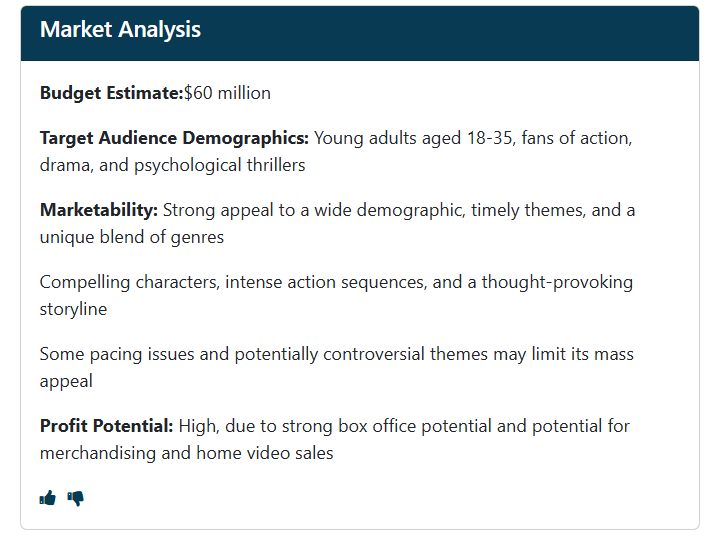
General Suggestions
  • Shorten Barry's navigation through the apartment complex to maintain pacing; consider cutting some of the maze-like elements or making them more concise, perhaps by having him get lost only once for comedic or tense effect, to keep the audience engaged without dragging.
  • Add subtle character beats during the split-screen, such as Lena glancing at a clock or Barry mumbling to himself, to provide more insight into their emotions and make the waiting period more dynamic and revealing.
  • Enhance the audio design in the split-screen sequence by using differing sound levels or background noises (e.g., Lena's fidgeting sounds vs. Barry's footsteps) to heighten the contrast between the two sides and immerse the audience more deeply in the parallel experiences.
  • Incorporate a small piece of foreshadowing or thematic tie-in, like Barry hesitating at a door in a way that echoes his earlier warehouse hesitations, to better connect this scene to the larger story arcs involving his anxiety and the external threats.
  • Review the use of split-screen across the script to ensure it's not repetitive; if this is one of few instances, consider amplifying its uniqueness, or if common, vary the technique to keep it fresh and purposeful in advancing the narrative.

Ratings
Overall

Overall: 8.5

The scene effectively builds tension and anticipation through the split-screen technique, creating a sense of connection between the characters. The awkwardness and curiosity in the tone add depth to the impending interaction.


Story Content

Concept: 8

The concept of using split-screen to show parallel actions leading to a meeting is engaging and innovative. It adds a layer of visual storytelling and anticipation to the scene.

Plot: 7.5

While the plot progression is minimal in this scene, the anticipation and tension built through the characters' movements contribute to the overall narrative. It sets the stage for a significant interaction.

Originality: 8

The scene introduces a fresh approach to depicting a simple interaction between characters by utilizing split-screen sequences and detailed visual descriptions. The authenticity of the characters' actions and dialogue adds depth to the scene.


Character Development

Characters: 8

The characters of Lena and Barry are portrayed through their actions and anticipation, showcasing their curiosity and awkwardness before their meeting. Their dynamic adds depth to the scene.
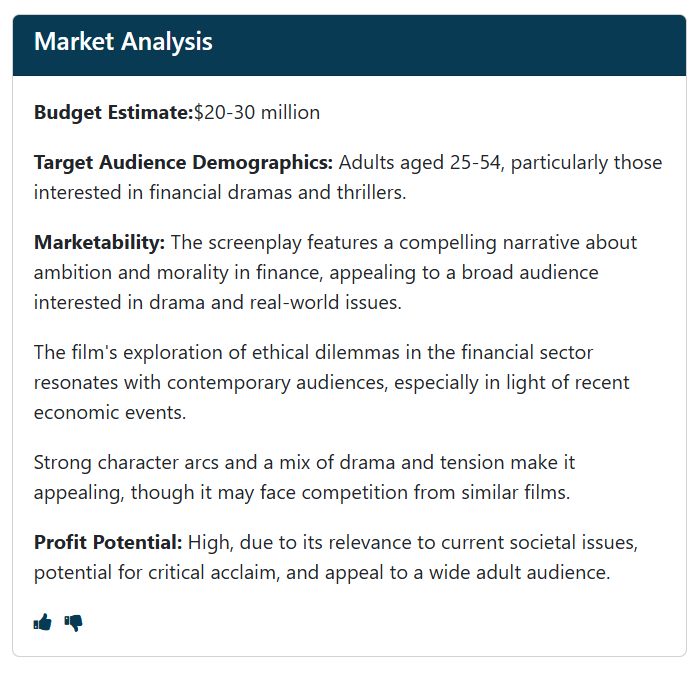
Character Changes: 6

While there are no significant character changes in this scene, the anticipation and awkwardness hint at potential shifts in Lena and Barry's dynamic as they interact.

Internal Goal: 8

Lena's internal goal in this scene is to connect with Barry, as indicated by her waiting for him and her response upon his arrival. This reflects her desire for companionship, interaction, and possibly emotional fulfillment.

External Goal: 7.5

Barry's external goal is to find Lena's apartment within the complex, as he navigates through the maze of corridors and directions given by the security guard. This goal reflects the immediate challenge he faces in reaching Lena.


Scene Elements

Conflict Level: 4

The conflict in this scene is minimal, primarily focusing on the internal tension and anticipation of the characters as they move towards their meeting.
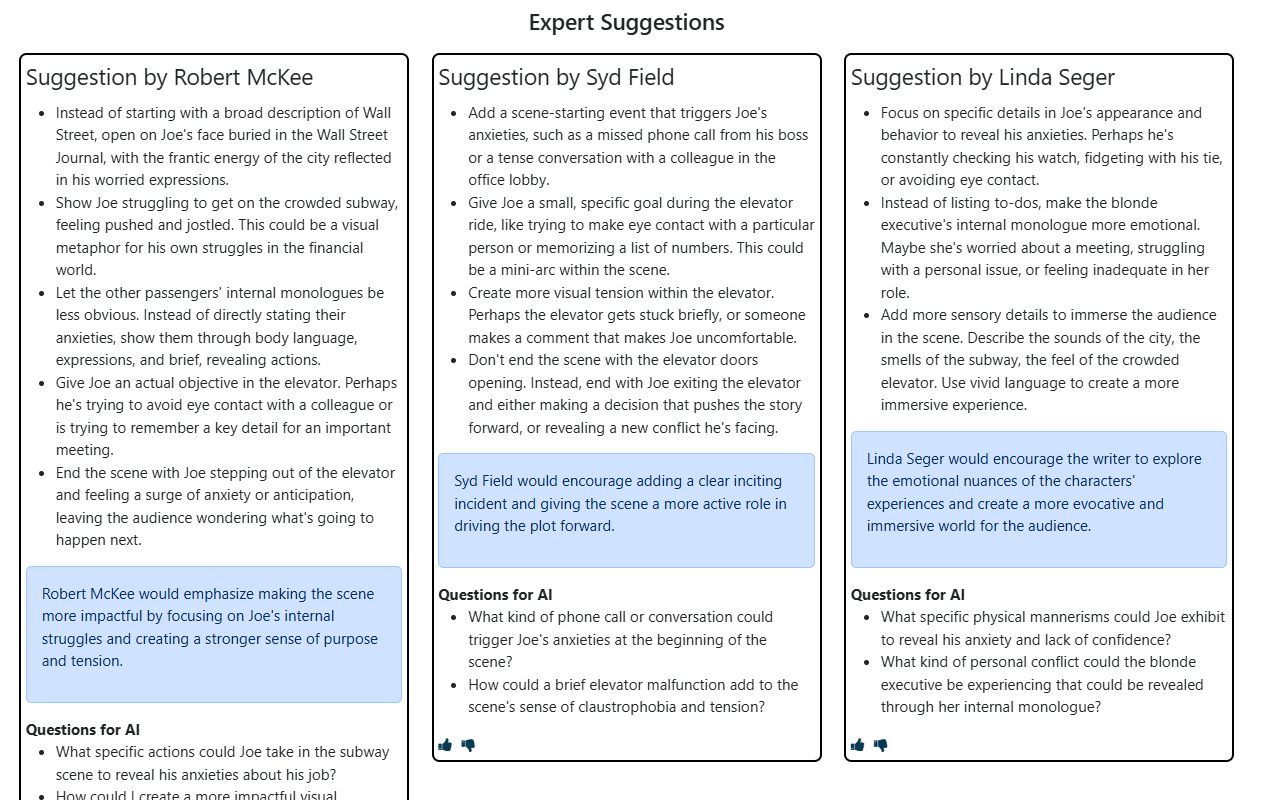
Opposition: 7.5

The opposition in the scene is moderate, with Barry facing challenges in finding Lena's apartment but ultimately overcoming them to reach her. The uncertainty of his journey adds a layer of suspense and conflict to the narrative.

High Stakes: 5

The stakes are moderate in this scene, focusing more on the emotional tension and anticipation between Lena and Barry rather than high-risk situations.

Story Forward: 7

The scene moves the story forward by setting up a crucial meeting between Lena and Barry, hinting at potential developments in their relationship. It builds anticipation for future events.

Unpredictability: 7

This scene is unpredictable due to the uncertain outcome of Barry's search for Lena's apartment and the potential obstacles he may encounter along the way. The audience is kept guessing about the characters' interactions and the resolution of their meeting.
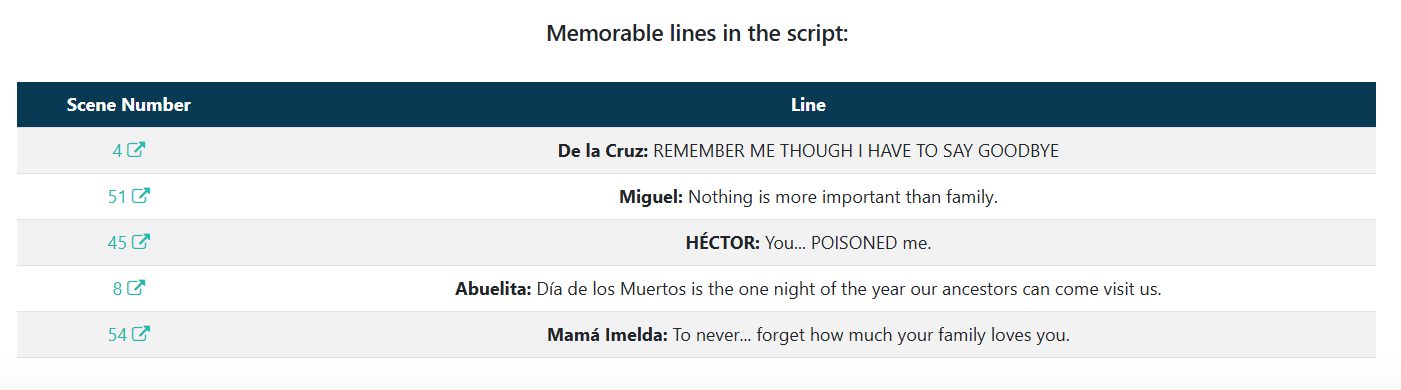
Philosophical Conflict: 7

The philosophical conflict in this scene revolves around the themes of communication and connection. Lena and Barry's interactions highlight the challenges of navigating physical and emotional distances, mirroring the complexities of human relationships.


Audience Engagement

Emotional Impact: 7.5

The scene evokes a sense of anticipation and curiosity, engaging the audience emotionally as Lena and Barry approach their meeting. The awkwardness adds a layer of emotional depth.
Dialogue: 7

The dialogue is minimal but serves its purpose in setting up the meeting between Lena and Barry. It conveys the necessary information without overshadowing the visual storytelling.

Engagement: 8.5

This scene is engaging because of the parallel actions of Lena and Barry, the suspenseful navigation through the apartment complex, and the eventual meeting between the characters. The split-screen technique maintains viewer interest and anticipation.

Pacing: 8

The pacing of the scene effectively builds tension and anticipation as Barry navigates the apartment complex, while Lena's waiting adds a sense of rhythm to the sequence. The gradual convergence of the characters' paths enhances the scene's emotional impact.


Technical Aspect

Formatting: 8

The formatting adheres to the expected style for a screenplay, with clear scene headings, character names, and action descriptions. The use of split-screen is effectively conveyed in the formatting.

Structure: 8

The scene follows a structured format with clear visual cues and transitions between Lena and Barry's actions. The use of split-screen enhances the scene's pacing and visual impact.


Scene Objective: To depict Barry's journey to meet Lena, highlighting his emotional state and the obstacles he faces.

Setting: Lena's apartment complex, evening.

POV: Barry's perspective, emphasizing his nervousness and determination.

Emotional Arc: - anxiety → + hope

Score Overview

Group Category Score
Overall Overall Score 7.8
Core Elements Purpose
8
Goal vs Obstacle
7
Stakes
6
Progression
8
Turn Potency
7
Supporting Exposition
7
Subtext
8
Setups & Payoffs
6
Beat Clarity
8
Quality Scene Necessity
9
Thematic Resonance
8

Core Story Elements

8
Purpose
Critique
The scene clearly establishes Barry's intent to connect with Lena, showcasing his emotional journey.
Suggestions
• Enhance Barry's internal monologue to further express his anxiety and hopes as he approaches Lena's apartment.
Questions for AI
• How can Barry's emotional state be more vividly portrayed as he navigates the complex?
• What specific thoughts might Barry have that reflect his anxiety about meeting Lena?
7
Goal vs Obstacle
Critique
Barry's goal to meet Lena is clear, but the obstacles he faces are more environmental than emotional.
Suggestions
• Introduce a moment of self-doubt or a distraction that heightens the tension as he approaches Lena's door.
Questions for AI
• What external factors could complicate Barry's journey to Lena's apartment?
• How can Barry's internal conflict be mirrored in the physical obstacles he encounters?
6
Stakes
Critique
The stakes feel personal but could be heightened to emphasize the importance of this meeting for Barry.
Suggestions
• Add a moment where Barry reflects on what it would mean to him if he fails to connect with Lena.
Questions for AI
• What could Barry lose if he doesn't successfully meet Lena?
• How can the stakes of this meeting be made more tangible for the audience?
8
Progression
Critique
The scene shows a clear progression from Barry's anxious arrival to his hopeful knock on Lena's door.
Suggestions
• Incorporate a moment of hesitation before Barry knocks to emphasize his internal struggle.
Questions for AI
• What specific moments can be added to illustrate Barry's emotional journey from anxiety to hope?
• How can the pacing of Barry's approach to the door be adjusted to enhance tension?
7
Turn Potency
Critique
The pivotal moment of Barry knocking on the door is impactful, but could benefit from more buildup.
Suggestions
• Create a moment of silence or a sound cue that heightens the tension just before he knocks.
Questions for AI
• What alternative actions could Barry take that would heighten the tension before he knocks?
• How can the moment of knocking be made more dramatic or significant?

Supporting Elements

7
Exposition
Critique
Exposition is woven in through Barry's actions and the split screen, but could be more seamless.
Suggestions
• Use visual cues or Barry's thoughts to provide context about his feelings towards Lena.
Questions for AI
• How can Barry's backstory with Lena be subtly integrated into this scene?
• What visual elements can enhance the audience's understanding of Barry's emotional state?
8
Subtext
Critique
The subtext of Barry's anxiety about connection is clear, adding depth to the scene.
Suggestions
• Introduce more visual metaphors that reflect Barry's emotional state as he navigates the complex.
Questions for AI
• What symbols or motifs could be introduced to deepen the emotional resonance of this scene?
• How can the environment reflect Barry's internal struggles more vividly?
6
Setups & Payoffs
Critique
There are setups for Barry's emotional journey, but the payoffs could be more pronounced.
Suggestions
• Foreshadow Barry's emotional turmoil earlier in the scene to enhance the payoff when he finally meets Lena.
Questions for AI
• What earlier moments in the scene could be tied to Barry's eventual emotional release?
• How can the scene's structure be adjusted to create stronger setups and payoffs?
8
Beat Clarity
Critique
The beats are clear and well-defined, contributing to the scene's overall flow.
Suggestions
• Consider adding a moment of hesitation or reflection between beats to enhance emotional depth.
Questions for AI
• What specific beats could be adjusted to improve the emotional rhythm of the scene?
• How can the pacing of Barry's actions be refined for greater impact?

Scene Transitions

Previous Scene
8

Hook In: Barry's emotional outburst in the warehouse sets the stage for his need to connect with Lena.

Energy FLAT
The transition is smooth, but could benefit from a stronger emotional link between scenes.
Suggestions
• Add a moment of reflection for Barry that directly connects his previous emotional state to his current actions.
Questions for AI
• How can the emotional tone from the previous scene be more effectively carried into this one?
• What specific moments can bridge Barry's emotional journey between scenes?
Next Scene
9

Hook Out: Barry's hopeful knock on Lena's door leads directly into their conversation.

Energy UP
The scene hands off momentum effectively, transitioning smoothly into the next interaction.
Suggestions
• Consider a visual or auditory cue that emphasizes the shift in energy as Barry meets Lena.
Questions for AI
• What elements can enhance the transition to the next scene to maintain momentum?
• How can the emotional stakes be heightened as Barry moves from this scene to the next?

Scene Necessity

9

MUST HAVE

This scene is crucial for establishing Barry's emotional state and his desire for connection with Lena.

Suggestions
Ensure that every moment in the scene contributes to Barry's emotional journey.
Questions for AI
• What elements are essential to maintain in this scene to ensure its emotional impact?
• How can the scene be made even more integral to Barry's overall arc?

Enhancement Tags

#anxiety #connection #hope

Character Delta: Barry moves from anxious anticipation to hopeful determination.

Improvement Recommendations

Add internal monologue to deepen Barry's emotional state as he navigates the complex.
Introduce a moment of self-doubt or distraction to heighten tension before Barry knocks.
Incorporate visual metaphors that reflect Barry's emotional struggles throughout the scene.

The #1 Rule of Screenwriting: Make your reader or audience compelled to keep reading.

“Grab ‘em by the throat and never let ‘em go.”

Billy Wilder

The scene level score is the impact on the reader or audience to continue reading.
The Script score is how compelled they are to keep reading based on the rest of the script so far.


Compelled to keep Reading Score: 8/10

This scene masterfully builds anticipation for the reunion of Barry and Lena. The split-screen technique effectively heightens the tension by showing both characters in their respective waiting states – Lena's anxious pacing and Barry's navigational struggle. The security guard's complex directions add a layer of challenge, making Barry's eventual arrival at Lena's door feel earned. The scene ends just as they are about to truly connect, leaving the reader eager to see their interaction unfold. The introduction of the security guard and the detailed navigation sequence create immediate questions about how Barry will handle this social interaction and if he can even find Lena, driving the desire to see the outcome.

Script Continuation Score: 8/10

The script has been building a strong emotional arc for Barry, marked by his erratic behavior, his burgeoning relationship with Lena, and his ongoing struggles with his mental state and family. This scene re-establishes the romantic connection that was hinted at before, with Barry making a significant effort to reach Lena. The previous scenes have established the potential for this relationship to be a stabilizing force for Barry, while also introducing external threats and internal turmoil. The reader is invested in seeing if this connection can truly help him, or if his nature will inevitably sabotage it. The juxtaposition of his determined arrival with the inherent awkwardness of his social interactions keeps the overall narrative momentum high.

Suggestions
  • Consider adding a brief moment of doubt or hesitation from Barry as he approaches Lena's door, perhaps a quick check of his appearance or a deep breath, to further emphasize his social anxiety.
  • The security guard's complex directions could be visually emphasized with a brief map overlay or graphical element to make the 'maze' aspect more immediate for the reader.
  • Explore the emotional subtext of Lena's waiting – is she purely excited, or is there a hint of trepidation given Barry's past behavior?
Questions for AI
  • What subtle visual cues could be added to the split-screen sequences to further emphasize Barry's disorientation and Lena's anxious anticipation without explicit dialogue?
  • Given Barry's previous social awkwardness, what specific actions or micro-expressions could he exhibit upon arriving at Lena's door that would convey both relief and renewed anxiety?
  • How can the security guard's interaction with Barry be written to feel both procedural and slightly unsettling, hinting at the potential for further complications in Barry's interactions with authority or gatekeepers?

Expert Critiques

Critique by David Mamet
  • The split-screen technique effectively contrasts Lena's anxious waiting with Barry's journey, creating a palpable tension. However, the dialogue is minimal, which can be effective, but it might benefit from more subtext to deepen the characters' emotional states. For instance, Lena's actions while waiting could reflect her inner turmoil more explicitly, perhaps through her thoughts or memories about Barry.
  • Barry's interaction with the security guard is functional but lacks a sense of urgency or personality. Adding a moment where Barry's nervousness or excitement is palpable could enhance the scene's emotional weight.
  • The directions given by the security guard could be more humorous or convoluted to reflect Barry's confusion and anxiety, adding a layer of character development.

David Mamet is known for his sharp dialogue and understanding of character dynamics, making him suitable for critiquing the emotional and conversational aspects of this scene.

Questions for AI
  • How can I incorporate more subtext into Lena's actions while she waits to enhance her emotional state?
  • What techniques can I use to make Barry's interaction with the security guard more engaging and reflective of his character?
  • How can I add humor to the security guard's directions to emphasize Barry's confusion?
Critique by Sofia Coppola
  • The split-screen format is visually interesting and effectively conveys the parallel experiences of Barry and Lena. However, the scene could benefit from more visual storytelling elements that reflect their emotional states. For example, using color grading or lighting to differentiate their moods could enhance the audience's connection to the characters.
  • Lena's apartment is described as 'nondescript,' which might not fully capture her character's essence. Consider adding small details that reflect her personality or current emotional state, such as personal items or decorations that hint at her feelings about Barry.
  • The pacing of the scene feels a bit rushed. Allowing for more moments of stillness or reflection could deepen the audience's engagement with both characters.

Sofia Coppola is adept at creating atmospheric and character-driven narratives, making her insights valuable for enhancing the emotional depth and visual storytelling of this scene.

Questions for AI
  • What visual elements can I incorporate to better reflect Lena's emotional state in her apartment?
  • How can I use lighting or color to differentiate the moods of Barry and Lena in this split-screen scene?
  • What techniques can I use to slow down the pacing and allow for more emotional reflection in the scene?
Critique by Aaron Sorkin
  • The dialogue in this scene is sparse, which can be effective, but it might benefit from more witty or clever exchanges, especially in Barry's interactions with the security guard. This could add levity and showcase Barry's character more vividly.
  • The split-screen technique is a strong choice, but consider using it to create more dramatic tension. For instance, you could intercut between Barry's journey and Lena's increasing anxiety, building suspense as Barry gets closer to her.
  • The scene could use a stronger emotional payoff. Perhaps as Barry arrives, Lena could express a mix of relief and frustration, adding complexity to their reunion.

Aaron Sorkin is known for his sharp dialogue and ability to create tension through character interactions, making him an excellent choice for critiquing the dialogue and pacing of this scene.

Questions for AI
  • How can I incorporate more clever dialogue into Barry's interaction with the security guard to enhance his character?
  • What techniques can I use to build suspense through the split-screen format as Barry approaches Lena's apartment?
  • How can I create a more emotionally complex reunion between Barry and Lena at the end of the scene?

Expert Suggestions

Suggestion by David Mamet
  • Add internal monologue or flashbacks for Lena while she waits to provide insight into her feelings about Barry and their relationship.
  • Infuse Barry's interaction with the security guard with more personality, perhaps by having him fumble with his words or express his nervousness in a humorous way.
  • Make the security guard's directions more convoluted or humorous to reflect Barry's confusion and add a layer of character development.

David Mamet's expertise in character-driven dialogue and emotional depth makes his suggestions valuable for enhancing the scene.

Questions for AI
  • What are some effective ways to incorporate internal monologue for Lena to enhance her emotional depth?
  • How can I create a humorous interaction between Barry and the security guard that reflects his character?
  • What techniques can I use to make the security guard's directions more engaging and reflective of Barry's state of mind?
Suggestion by Sofia Coppola
  • Use visual storytelling to reflect Lena's emotional state, such as incorporating personal items in her apartment that hint at her feelings for Barry.
  • Experiment with lighting and color to differentiate the moods of Barry and Lena, enhancing the emotional impact of the split-screen.
  • Allow for more moments of stillness or reflection in the scene to deepen the audience's engagement with both characters.

Sofia Coppola's focus on atmosphere and character emotion makes her suggestions particularly relevant for enhancing the scene's depth.

Questions for AI
  • What visual storytelling techniques can I use to enhance Lena's emotional state in her apartment?
  • How can I effectively use lighting and color to differentiate the moods of Barry and Lena?
  • What pacing techniques can I employ to create more emotional reflection in the scene?
Suggestion by Aaron Sorkin
  • Incorporate more witty dialogue in Barry's interaction with the security guard to showcase his character and add levity to the scene.
  • Use the split-screen to create dramatic tension by intercutting between Barry's journey and Lena's increasing anxiety as he approaches her apartment.
  • Add complexity to the reunion by having Lena express a mix of relief and frustration upon Barry's arrival, enhancing the emotional stakes.

Aaron Sorkin's expertise in dialogue and tension-building makes his suggestions valuable for enhancing the scene's impact.

Questions for AI
  • How can I write clever dialogue for Barry's interaction with the security guard to enhance his character?
  • What techniques can I use to build dramatic tension through the split-screen format as Barry approaches Lena?
  • How can I create a more emotionally complex reunion between Barry and Lena at the end of the scene?
Punch Drunk Love Full Analysis
View Analysis
View Script
22 - Emotional Turmoil at Dinner - Overall Grade: 8.2
Punch Drunk Love Full Analysis

INT. RESTAURANT - NIGHT
Lena and Barry at a table. They talk (see notes.)

LENA
So I want to tell you something, I
gotta tell you: I saw a picture of
you guys, your sisters and you and
I saw your picture and I really
wanted to meet you.
(beat)
I came to drop my car off there on
purpose, to try and meet you.
Barry leans a little bit out of FRAME.
BARRY
...really? That's nice...are you
lying?
LENA
...I thought I should tell you. I
didn't want to get too far along on
going out and be hiding something --
BEAT. He leans slightly back in FRAME.
BARRY
That's very nice. Thank you. Thank
you for saying that.
(beat)
You're friends with my sister?
LENA
Yeah.
BARRY
How long have you known her?
LENA
About six months.
BARRY
You like her?
LENA
Yeah. Yeah we get along well.
(beat)
You didn't get along with her very
well?
BARRY
Did you really come to meet me on
purpose or are you lying about
that?

LENA
No, no. I did.
BARRY
That's nice. It's nice.
(beat)
I've been looking around a lot
lately at promotional giveaways,
cross promotional work by some
companies. Do you remember all that
pudding?
LENA
Yeah.
BARRY
So that pudding was bought, I
bought that pudding because of a
pretty interesting promotion that's
sponsored by Healthy Choice and
American Airlines. It's designed to
encourage airline travel and
obviously designed to encourage
buying Healthy Choice products.
They make frozen meals, deli meats,
pasta sauce, breads, soups and ice
creams, this sort of thing.....
LENA
Yeah?
BARRY
....I'm sorry....I lost my
thoughts, what I was saying....
LENA
You were talking about the
promotion --
BARRY
-- the promotion says: buy any 10
Healthy Choice products and get 500
miles of airline travel or 1,000
for purchases made with a special
coupon.
(MORE)

BARRY (CONT'D)
So in the supermarket, you notice
their products, first you notice
they have a Teriyaki Chicken Dinner
at $1.79 - that's a pretty good
deal....but then I noticed they had
soup at 89 cents a can.....and you
start to do the math and you start
to notice that it's a really
amazing deal because I stumbled
across the pudding at 25 cents a
cup. Now the crucial thing is the
bar codes on the label. That's
those little bar codes, you know?
The universal product codes?
LENA
Yeah.
BARRY
That's what's used to redeem the
mileage, so in noticing the
pudding, each cup had an individual
bar code -- in other words: Two
dollars and fifty cents for ten
cups of pudding is 500 miles. Add
in the coupon: it's one thousand.
You see?
LENA
Yeah.
BARRY
You see?
LENA
Yeah, no, I see --
BARRY
You see if you spent $3,000 dollars
on pudding you could earn over one
million frequent flyer miles.
LENA
That's insane. That is really,
really crazy. That's just crazy if
you spend three thousand dollars on
pudding.
BARRY
....yeah....
LENA
So that was your pudding?

BARRY
....No....
LENA
I'm sorry. I thought you said --
BARRY
No I didn't say that.
LENA
I thought you said you bought all
that pudding --
BARRY
My friend Carlos is doing it who
works with me. It's his. It's his
pudding, he's doing it. It's not
mine. He's crazy. I told him not to
do it. He's the one who's insane.
He only spent about one hundred
dollars so far though --
LENA
Your sister was telling me a pretty
funny story about you, when you
guys were kids and you were
building a ramp for your dog and
you threw a hammer through a
window? Is that right? You threw a
hammer through a sliding glass
door?
Barry starts to WELL WITH TEARS, which he hides very quickly,
holds a hand up to his face as if he's touching his nose, and
then he smiles;
BARRY
I don't remember that, she might be
lying. I have to go the bathroom.
He gets up and goes.
CUT TO:
INT. BATHROOM - MOMENTS LATER
Barry walks in and goes a little crazy. He's mad at himself
and he HITS a stall....it seems loose already and falls
straight to the floor.
This makes him go crazier and he continues to BEAT and KICK
the shit out of the bathroom/stall.

HOLD. He collects himself and then he hesitates, looks
around, tries to collect the bathroom but it's in ruins, he
exits....
CUT TO:


Genres: Drama, Romance
Tone: Emotional, Reflective, Conflicted
Summary In a restaurant at night, Lena confesses to Barry that she intentionally dropped her car off at his workplace to meet him, revealing her desire to be open as their relationship develops. Barry, skeptical and defensive, questions her honesty while discussing a promotional scheme involving Healthy Choice products. The conversation takes a turn when Lena recounts a childhood story about Barry, triggering an emotional response that leads him to excuse himself abruptly. In the bathroom, Barry loses control, violently destroying a stall before calming down and exiting, leaving his emotional turmoil unresolved.
Strengths
  • Emotional depth of characters
  • Engaging dialogue
  • Character development
Weaknesses
  • Limited plot progression
  • Focus on internal conflict may alienate some viewers
General Critique
  • The scene effectively captures Barry's social awkwardness and emotional volatility, which are central to his character arc in the film. The confession from Lena about seeking Barry out adds depth to their relationship, revealing her proactive interest and setting up potential intimacy, but Barry's repeated questioning of her honesty feels redundant and underscores his trust issues in a way that might alienate viewers if overemphasized. The shift to Barry's monologue about the pudding promotion serves as a deflection mechanism, highlighting his discomfort with personal topics, but it comes across as overly expository and lengthy, potentially disengaging the audience by prioritizing mundane details over emotional progression. This tangent, while tying into the film's themes of obsession and coping mechanisms, disrupts the romantic tension built earlier in the scene. Lena's character is portrayed as patient and supportive, but she lacks agency here, mostly reacting to Barry's statements, which could make her seem one-dimensional in this moment. The emotional trigger with the childhood hammer story is powerful and leads to a raw, cathartic outburst in the bathroom, effectively illustrating Barry's inner turmoil, but the transition feels abrupt, lacking subtle foreshadowing that could make the escalation more believable and less jarring. Overall, the scene is strong in showcasing Barry's fragility but could benefit from tighter pacing to maintain viewer engagement and ensure that the emotional beats land more naturally within the context of the date.
  • In terms of dialogue, the exchange starts promisingly with Lena's vulnerable admission, which humanizes her and contrasts with Barry's skepticism, but it quickly devolves into repetitive affirmations and denials that slow the momentum. Barry's pudding explanation, while thematically relevant, feels like an unnatural info dump, as it mirrors earlier scenes but doesn't advance the character interaction in a meaningful way, making the conversation feel stilted. The use of beats and pauses is effective in building tension, particularly before Barry's emotional breakdown, but some dialogue, like Barry's redundant questions about Lena lying, could be streamlined to avoid repetition. Visually, the scene relies heavily on dialogue with minimal action descriptions, which is appropriate for an intimate conversation, but the cut to the bathroom outburst is vivid and physical, providing a stark contrast that emphasizes Barry's internal conflict—however, this shift might benefit from more intermediate steps to heighten the drama. The scene's placement after the split-screen arrival in scene 21 maintains continuity in Barry and Lena's budding relationship, but it could better integrate with the overall narrative by reinforcing Barry's pattern of emotional avoidance without overshadowing the romantic elements. Finally, the emotional payoff in the bathroom is compelling, aligning with the film's tone of quirky realism, but it risks feeling melodramatic if not balanced with more nuanced character moments.
  • From a structural perspective, the scene balances exposition, character revelation, and action well, but the pudding discussion dominates the middle section, potentially diluting the focus on the interpersonal dynamics. This could confuse viewers unfamiliar with the pudding motif from earlier scenes, as it might seem like an unrelated tangent rather than a character tic. Lena's mention of the hammer story serves as a catalyst for Barry's breakdown, which is consistent with his established traits of sensitivity and rage, but it highlights a missed opportunity to explore Lena's perspective more deeply—her reaction to Barry's tears and subsequent exit is understated, which might limit the audience's understanding of her feelings. The scene's length and content align with the film's exploration of loneliness and connection, but the abrupt end with Barry's destruction of the bathroom stall could be more integrated to show the consequences immediately, such as a reaction from restaurant staff or patrons, to heighten the stakes. Overall, while the scene is effective in portraying Barry's chaotic emotional state, it could be refined to ensure that every element contributes directly to character development and plot progression, making it more cohesive and impactful.
General Suggestions
  • Condense Barry's pudding monologue to focus only on the key aspects that reveal his character, such as his obsession with deals as a coping mechanism, to avoid overwhelming the audience with unnecessary details and keep the romantic tension alive.
  • Add more nonverbal cues or actions during the conversation, like Barry fidgeting or avoiding eye contact, to subtly build tension and foreshadow his emotional outburst, making the transition to the bathroom scene feel more organic and less sudden.
  • Enhance Lena's dialogue and reactions to give her more agency; for example, have her probe deeper into Barry's deflection or share a personal story to create a more balanced exchange, which could deepen their connection and make the scene less one-sided.
  • Reduce repetitive elements, such as Barry's multiple questions about Lena lying, by combining them into a single, more concise inquiry to improve pacing and maintain viewer interest without losing the essence of his skepticism.
  • Consider adding a brief moment after Barry's emotional trigger where Lena responds more actively, perhaps with concern or a question, to bridge the gap to his exit and provide a smoother narrative flow into the bathroom sequence.

Ratings
Overall

Overall: 8.2

The scene effectively delves into the emotional depth of the character Barry, revealing vulnerabilities and inner conflicts. The dialogue is engaging and reveals important character traits and backstory, while the sudden outburst adds a layer of unpredictability and intensity.


Story Content

Concept: 8.3

The concept of exploring personal revelations and emotional struggles is effectively portrayed through Barry's interactions and reactions. The scene delves deep into character psychology and provides insight into Barry's inner world.

Plot: 7.8

While the plot progression is limited in this scene, the focus on character development and emotional revelations drives the narrative forward. The scene adds depth to the character dynamics and sets the stage for future events.

Originality: 8

The scene introduces a fresh perspective on mundane topics like promotional giveaways and family anecdotes, infusing them with humor and emotional depth. The characters' actions and dialogue feel authentic and engaging, contributing to the scene's originality.


Character Development

Characters: 8.5

The characters, especially Barry and Lena, are well-developed in this scene. Barry's emotional complexity and Lena's curiosity and empathy shine through their interactions. Their dialogue reveals layers of their personalities.

Character Changes: 8

Barry undergoes a significant emotional journey in this scene, moving from vulnerability and self-reflection to a moment of intense anger and release. This change adds depth to his character and sets the stage for further development.

Internal Goal: 8

Lena's internal goal is to be honest and open with Barry about her intentions and feelings, showcasing her desire for authenticity and connection in their budding relationship.

External Goal: 6

Barry's external goal is to understand Lena's true intentions and feelings towards him, reflecting his need for clarity and trust in their interaction.


Scene Elements

Conflict Level: 7.5

The conflict in the scene is primarily internal, focusing on Barry's emotional struggles and past experiences. The tension arises from his vulnerability and the revelation of personal truths.

Opposition: 7

The opposition in the scene is moderate, with Lena and Barry facing challenges in understanding each other's intentions and navigating their emotional vulnerabilities. The audience is left uncertain about the outcome of their interaction.

High Stakes: 7

The stakes in this scene are primarily emotional and personal for Barry. His revelations and outburst reveal the internal struggles he faces, impacting his relationships and self-perception.

Story Forward: 8

While the scene does not significantly advance the main plot, it deepens the understanding of the characters and sets the emotional tone for future events. It lays the groundwork for character arcs and relationships.

Unpredictability: 7

This scene is unpredictable because of the shifting dynamics between Lena and Barry, the unexpected revelations about their motives, and the emotional outburst from Barry in the bathroom. The audience is kept on their toes regarding the characters' true intentions.

Philosophical Conflict: 7

The philosophical conflict revolves around honesty and trust in relationships. Lena's openness contrasts with Barry's skepticism, highlighting differing beliefs about communication and sincerity.


Audience Engagement

Emotional Impact: 8.8

The scene has a high emotional impact, evoking empathy and connection with the character Barry. His moments of vulnerability and outburst elicit strong emotions from the audience, creating a memorable experience.

Dialogue: 8.7

The dialogue is engaging and reveals important information about the characters. It effectively conveys emotions, motivations, and conflicts, adding depth to the scene and enhancing character development.

Engagement: 8

This scene is engaging because of the dynamic interplay between Lena and Barry, the humor interspersed with emotional moments, and the gradual reveal of their intentions and feelings. The dialogue keeps the audience invested in the characters' interactions.

Pacing: 8

The pacing of the scene effectively builds tension and emotional resonance through the characters' dialogue and actions. The rhythm of the conversation enhances the scene's impact and allows for meaningful character development.


Technical Aspect

Formatting: 6

The scene adheres to standard screenplay formatting conventions, with clear character cues and dialogue attribution. The formatting supports the readability and flow of the scene.

Structure: 7

The scene follows a conversational structure typical of character-driven interactions, allowing for natural dialogue progression and character development. The pacing and rhythm contribute to the scene's effectiveness in conveying the characters' emotions and intentions.


Scene Objective: To reveal Barry's emotional vulnerabilities and establish a deeper connection with Lena.

Setting: INT. RESTAURANT - NIGHT

POV: Barry's perspective, highlighting his insecurities and desire for connection.

Emotional Arc: - insecurity → + connection

Score Overview

Group Category Score
Overall Overall Score 8
Core Elements Purpose
8
Goal vs Obstacle
7
Stakes
6
Progression
8
Turn Potency
9
Supporting Exposition
7
Subtext
8
Setups & Payoffs
6
Beat Clarity
8
Quality Scene Necessity
9
Thematic Resonance
9

Core Story Elements

8
Purpose
Critique
The scene clearly expresses Barry's desire for connection and his awkwardness in social situations, effectively earning its purpose through dialogue and character interaction.
Suggestions
• Consider adding more non-verbal cues from Barry to emphasize his discomfort and vulnerability.
Questions for AI
• How can Barry's dialogue be adjusted to further reveal his internal conflict?
• What additional actions could Barry take to visually express his anxiety during the conversation?
7
Goal vs Obstacle
Critique
Barry's goal of connecting with Lena is clear, but his awkwardness and the absurdity of his pudding obsession create a dynamic tension that complicates this goal.
Suggestions
• Introduce a moment where Lena challenges Barry's obsession with the pudding to heighten the conflict.
Questions for AI
• What specific obstacles can be introduced to further complicate Barry's attempts to connect with Lena?
• How can Lena's responses be adjusted to create more tension in their interaction?
6
Stakes
Critique
The stakes feel somewhat low as the conversation revolves around pudding and casual banter, but the emotional stakes for Barry are significant as he seeks validation.
Suggestions
• Increase the emotional stakes by having Barry reveal more about his past or fears during the conversation.
Questions for AI
• What can be added to the dialogue to raise the emotional stakes for Barry in this scene?
• How can the conversation be structured to create a sense of urgency or importance?
8
Progression
Critique
The scene shows a clear progression from light-hearted banter to a more serious emotional moment, particularly when Barry reacts to Lena's story about his past.
Suggestions
• Enhance the transition by building more tension before Barry's emotional outburst.
Questions for AI
• How can the pacing be adjusted to make Barry's emotional shift more impactful?
• What additional beats could be added to heighten the sense of progression in the scene?
9
Turn Potency
Critique
The pivotal moment occurs when Barry reacts to Lena's story, showcasing his vulnerability and leading to his breakdown in the bathroom, which feels both inevitable and impactful.
Suggestions
• Consider foreshadowing Barry's emotional reaction earlier in the scene to enhance the inevitability of the turn.
Questions for AI
• What earlier hints can be woven into the dialogue to foreshadow Barry's emotional breakdown?
• How can the timing of Barry's reaction be adjusted for maximum impact?

Supporting Elements

7
Exposition
Critique
Exposition about Barry's relationship with his sisters and his obsession with the pudding promotion is woven into the dialogue, but it could be more seamless.
Suggestions
• Integrate exposition more naturally through subtext rather than direct statements.
Questions for AI
• How can exposition about Barry's family be delivered more subtly in this scene?
• What details can be omitted to streamline the dialogue while still conveying necessary information?
8
Subtext
Critique
The subtext of Barry's emotional struggles and desire for connection is present, particularly in his fixation on the pudding promotion as a metaphor for his life.
Suggestions
• Enhance the subtext by incorporating more visual cues or body language that reflect Barry's internal conflict.
Questions for AI
• What visual elements can be added to reinforce the subtext of Barry's emotional state?
• How can Lena's responses be crafted to reveal her own subtextual motivations?
6
Setups & Payoffs
Critique
The setup regarding the pudding promotion is clear, but the payoff in terms of emotional resonance could be stronger.
Suggestions
• Create a more direct connection between Barry's obsession with pudding and his emotional state to enhance the payoff.
Questions for AI
• What earlier setups can be introduced to make the pudding promotion more relevant to Barry's emotional journey?
• How can the payoff of Barry's emotional breakdown be made more impactful?
8
Beat Clarity
Critique
The beats within the scene are clear, with a good rhythm that escalates towards Barry's emotional breakdown.
Suggestions
• Consider tightening the dialogue to enhance the flow and clarity of each beat.
Questions for AI
• What specific beats can be adjusted to improve the overall rhythm of the scene?
• How can the dialogue be refined to enhance clarity and impact?

Scene Transitions

Previous Scene
8

Hook In: Barry's arrival at Lena's apartment sets the stage for their conversation.

Energy FLAT
The transition from the previous scene is smooth, maintaining the emotional tone established earlier.
Suggestions
• Consider adding a moment of hesitation or reflection for Barry before entering the restaurant to build anticipation.
Questions for AI
• How can the transition from the previous scene be enhanced to build more emotional tension?
• What additional elements can be introduced to create a stronger connection between the two scenes?
Next Scene
9

Hook Out: Barry's emotional breakdown in the bathroom serves as a powerful exit point.

Energy UP
The scene hands off momentum effectively, leaving the audience eager to see the consequences of Barry's emotional turmoil.
Suggestions
• Consider adding a moment of reflection for Barry after the bathroom scene to deepen the emotional impact.
Questions for AI
• What can be done to enhance the emotional resonance of Barry's exit from the restaurant?
• How can the transition to the next scene be made even more impactful?

Scene Necessity

9

MUST HAVE

This scene is crucial for developing Barry's character and his relationship with Lena, making it essential for the narrative.

Suggestions
Ensure that the emotional stakes are heightened to reinforce the scene's necessity.
Questions for AI
• What elements can be added to further emphasize the necessity of this scene in Barry's journey?
• How can the emotional weight of this scene be increased to make it indispensable?

Enhancement Tags

#emotional_connection #vulnerability #absurdity_of_consumerism

Character Delta: Barry becomes more aware of his emotional vulnerabilities and the absurdity of his fixation.

Improvement Recommendations

Add more non-verbal cues from Barry to emphasize his discomfort.
Introduce a moment where Lena challenges Barry's obsession with the pudding.
Increase the emotional stakes by having Barry reveal more about his past.

The #1 Rule of Screenwriting: Make your reader or audience compelled to keep reading.

“Grab ‘em by the throat and never let ‘em go.”

Billy Wilder

The scene level score is the impact on the reader or audience to continue reading.
The Script score is how compelled they are to keep reading based on the rest of the script so far.


Compelled to keep Reading Score: 9/10

This scene masterfully blends Barry's peculiar obsessions with a burgeoning, albeit awkward, romantic connection. The extended explanation of the pudding promotion, delivered with Barry's signature intensity, is both bizarre and fascinating, hinting at his underlying anxieties and potentially a hidden method to his madness. Lena's vulnerability and honesty about her intentions, coupled with her willingness to engage with Barry's eccentricities, creates significant intrigue. The sudden emotional trigger regarding his sister's story and Barry's immediate, explosive reaction in the bathroom provides a powerful cliffhanger, leaving the reader desperate to know the aftermath and how Lena will react to this raw display of his inner turmoil.

Script Continuation Score: 9/10

The screenplay continues to build momentum by weaving together multiple compelling threads. Barry's escalating oddities, particularly his obsession with the Healthy Choice promotion and his emotional fragility, are consistently intriguing. Lena's genuine interest and her connection to Barry's family provide a relatable human element and a potential anchor for him. The introduction of the Stevens Brothers in earlier scenes, their aggressive demeanor, and their apparent connection to the money demanded from Barry, adds a layer of suspense and potential danger that is yet to be fully explored. The contrast between Barry's internal chaos and his attempts at connection keeps the reader invested in his journey and the unfolding mysteries of his life and the people around him.

Suggestions
  • Consider having Lena witness Barry's outburst in the bathroom, or at least see the aftermath, to directly confront his issues rather than him simply exiting the scene. This could lead to immediate tension and a more impactful immediate reaction from her.
  • Further explore the implications of the 'pudding for miles' scheme. Is there a larger purpose to Barry's obsession beyond just accumulating miles? Does it tie into his anxiety or a need for control?
  • Deepen the connection between Lena and Barry's sisters. Lena mentioning she gets along well with Elizabeth is a good start, but showing a brief flashback or further dialogue could solidify this link and provide more context for Lena's interest in Barry.
Questions for AI
  • Given Barry's emotional outburst in the bathroom, what are some immediate and impactful ways Lena could react to seeing the destruction, and how could this reaction further shape their budding relationship?
  • How can the 'pudding promotion' be further integrated into the plot to serve as more than just a quirky obsession? Can it be tied to a specific goal or act as a catalyst for Barry's actions, perhaps even a MacGuffin?
  • What are the potential consequences of Barry's emotional instability and his violent outbursts for his relationship with Lena and his business dealings, especially considering the menacing characters he's encountered (Stevens Brothers, Dean)?
  • Explore the thematic resonance of Barry's 'violent urges towards cute things.' How can this peculiar trait be further explored to reveal deeper aspects of his character and anxieties, perhaps linking it to his fear of intimacy or his family dynamics?

Expert Critiques

Critique by Syd Field
  • The scene effectively establishes the relationship dynamics between Barry and Lena, showcasing Barry's awkwardness and Lena's straightforwardness. However, Barry's fixation on the pudding promotion detracts from the emotional connection that could be built in this moment. The dialogue feels overly expository and could benefit from more subtext.
  • Lena's revelation about wanting to meet Barry is a strong moment, but Barry's immediate skepticism ('are you lying?') undermines the sincerity of the moment. This could be softened to maintain the romantic tension.
  • The transition from their conversation to Barry's emotional breakdown in the bathroom is abrupt. While it serves to highlight Barry's internal struggles, it may confuse the audience regarding the emotional stakes of the dinner.

Syd Field is known for his emphasis on structure and character development, making him a suitable choice for analyzing the emotional and narrative flow of this scene.

Questions for AI
  • How can I balance exposition with emotional depth in dialogue, particularly in scenes like this where character backstory is revealed?
  • What techniques can I use to maintain romantic tension while also allowing for character vulnerability, as seen with Barry's reaction to Lena's story?
Critique by Linda Seger
  • The scene does a good job of establishing character motivations, particularly Lena's desire to connect with Barry. However, Barry's fixation on the pudding promotion feels out of place in a romantic context and could be streamlined to enhance the emotional stakes.
  • The dialogue is somewhat clunky, particularly when Barry explains the promotion in detail. This could be simplified to keep the audience engaged and focused on the characters' interaction rather than the specifics of the promotion.
  • Barry's emotional reaction to the story about the hammer is a pivotal moment, but it feels rushed. More buildup to this emotional climax could enhance its impact.

Linda Seger specializes in character development and dialogue, making her insights valuable for enhancing the emotional resonance of this scene.

Questions for AI
  • What are effective ways to weave character backstory into dialogue without losing the audience's interest in the present moment?
  • How can I create a more seamless transition between light-hearted dialogue and emotional revelations in a scene?
Critique by Robert McKee
  • The scene lacks a clear dramatic arc. While there are moments of tension, particularly with Barry's emotional breakdown, the overall conflict feels diffuse. The stakes should be clearer to maintain audience engagement.
  • Barry's obsession with the pudding promotion detracts from the romantic tension. This subplot could be minimized or integrated more cleverly into the dialogue to serve the main narrative.
  • The abrupt shift to the bathroom scene feels jarring. A more gradual build-up to Barry's emotional outburst would create a stronger connection between the two scenes.

Robert McKee is renowned for his focus on story structure and dramatic tension, making his perspective crucial for refining the narrative flow of this scene.

Questions for AI
  • How can I better establish a dramatic arc within a scene that balances humor and emotional depth?
  • What strategies can I employ to ensure that subplots, like Barry's pudding obsession, enhance rather than detract from the main narrative?

Expert Suggestions

Suggestion by Syd Field
  • Consider revising Barry's dialogue to express curiosity rather than skepticism when Lena reveals her intentions. This could enhance the romantic tension.
  • Streamline Barry's explanation of the pudding promotion to focus on its relevance to his character rather than the specifics of the promotion. This will keep the audience engaged with the emotional stakes.
  • Add a moment of silence or a shared look after Lena's revelation to allow the emotional weight of the moment to resonate before Barry's breakdown.

Syd Field's expertise in character development and dialogue makes his suggestions particularly relevant for enhancing the emotional depth of this scene.

Questions for AI
  • What are some examples of dialogue that effectively balance exposition with emotional connection?
  • How can I create moments of silence or pauses in dialogue to enhance emotional impact?
Suggestion by Linda Seger
  • Revise Barry's fixation on the pudding promotion to be more of a humorous aside rather than a central focus. This will allow for more meaningful dialogue between him and Lena.
  • Consider adding more subtext to Barry's dialogue, allowing him to express vulnerability without directly stating it. This could create a richer emotional landscape.
  • Expand on the emotional buildup before Barry's breakdown in the bathroom. Perhaps include a moment where he hesitates before leaving the table, indicating his internal struggle.

Linda Seger's focus on character and dialogue makes her suggestions valuable for enhancing the emotional resonance of this scene.

Questions for AI
  • How can I effectively use subtext in dialogue to convey character emotions without overtly stating them?
  • What techniques can I use to build emotional tension leading up to a character's breakdown?
Suggestion by Robert McKee
  • Clarify the stakes in the scene by emphasizing what Barry stands to lose if he fails to connect with Lena. This could heighten the dramatic tension.
  • Integrate Barry's pudding obsession more cleverly into the dialogue, perhaps as a metaphor for his desire for control in his chaotic life, rather than a detailed explanation.
  • Create a smoother transition to the bathroom scene by foreshadowing Barry's emotional state earlier in the conversation, perhaps through his body language or facial expressions.

Robert McKee's emphasis on dramatic structure and tension makes his suggestions crucial for refining the narrative flow of this scene.

Questions for AI
  • What are effective ways to establish stakes in a scene to maintain audience engagement?
  • How can I use metaphors in dialogue to deepen character development and thematic resonance?
Punch Drunk Love Full Analysis
View Analysis
View Script
23 - Tension at the Table - Overall Grade: 8.5
Punch Drunk Love Full Analysis

INT. RESTARAUNT - MOMENTS LATER
Barry comes back and sits down, seems a little better. Tries
to be a little flirtatious for half a moment before: the
MANAGER comes over, leans in carefully;
MANAGER
Hello.
LENA & BARRY
Hi.
MANAGER
Sir, can I talk to you?
BARRY
Why?
MANAGER
Just have you for one second,
please.
He looks to Lena, excuses himself.
ANGLE, OFF TO THE SIDE.
The Manager and Barry step away, in a quiet section of the
restaraunt, 2-shot, profile, in sotto; SLOW ZOOM IN.
MANAGER (CONT'D)
Sir, the bathroom was just torn
apart.
BARRY
Yeah.
MANAGER
Did you do it?
BARRY
No.
MANAGER
You didn't just smash up the
bathroom?

BARRY
No.
MANAGER
Well who did?
BARRY
I don't know.
MANAGER
You're hand is bleeding.
BARRY
I cut myself.
MANAGER
How?
BARRY
On my knife.
MANAGER
Sir, a young man saw you coming out
of the bathroom.
BARRY
I didn't do that.
BEAT.
BARRY
Why? ...what?
MANAGER
Your hand is bleeding.
BARRY
I know.
MANAGER
I'm gonna have to ask you to leave.
BARRY
Why?
MANAGER
Sir, I have no way of proving that
you demolished the bathroom --
BARRY
I didn't do it.

MANAGER
Alright, well you're gonna have to
leave. You're gonna have to go.
BARRY
Yeah, but I didn't do anything.
MANAGER
I'm gonna call the police then,
sir.
BARRY
Please don't do this to me.
MANAGER
The police are on their way.
BARRY
Sorry.
He starts to move back....
BARRY (CONT'D)
Can I pay you here? Can I pay you
for our drinks and salad?
MANAGER
That's fine.
Barry takes out some money and hands it over.
BARRY
Keep the change, please.
ANGLE, BACK AT THE TABLE.
They walk back to the table and Barry whispers down to her,
very close, STEADICAM (leads them out - continuous)
BARRY
We should go I think, I don't like
it here.
LENA
Ok.
They head out of the restaraunt.
LENA (CONT'D)
Is everything ok?
BARRY
Yes.

LENA
What happened?
BARRY
Nothing.
LENA
What did he want?
BARRY
Nothing.
They walk a bit.
BARRY (CONT'D)
I have a better idea of where we
can go.
LENA
Ok.
They walk some more.
BARRY
There's a better place for us to
eat.
LENA
Did something happen; are you
alright?
BARRY
Yes I'm fine. Everything is ok.
It's fine. Everything is fine.
They walk some more and get in the car.
CUT TO:


Genres: Drama, Thriller
Tone: Tense, Emotional, Confrontational
Summary In this tense restaurant scene, Barry attempts to flirt with Lena after a chaotic bathroom incident, but is interrupted by the manager who accuses him of vandalism. Despite Barry's denials, the manager insists he leave to avoid police involvement. After paying for their drinks, Barry whispers to Lena that they should leave. Outside, Lena questions him about the incident, but Barry evades her inquiries, assuring her everything is fine as they head to the car.
Strengths
  • Tension-building
  • Emotional depth
  • Character development
Weaknesses
  • Some repetitive dialogue
General Critique
  • This scene effectively captures Barry's ongoing struggle with denial and emotional evasion, a core trait of his character throughout the screenplay. The immediate return to the table after his destructive outburst in the previous scene creates a stark contrast between his internal turmoil and outward attempts at normalcy, such as the brief flirtatious moment, which highlights his desperation to maintain composure. This reinforces the film's theme of suppressed emotions bubbling to the surface, making it relatable and insightful for viewers familiar with Barry's arc. However, the repetitive denials during the confrontation with the manager feel somewhat redundant, potentially diluting the tension and pacing. Barry's constant 'No' responses could be streamlined to avoid monotony, as they emphasize his denial without adding new layers, which might make the scene drag slightly in a film known for its tight, quirky rhythm.
  • The manager's character serves as a necessary antagonist to escalate the conflict and force Barry out, but he comes across as one-dimensional, functioning more as a plot device than a fully realized person. His dialogue is straightforward and accusatory, lacking nuance or empathy, which could make the interaction feel contrived. In a screenplay that excels in character-driven moments, this scene misses an opportunity to add depth to the manager—perhaps by showing a flicker of understanding or frustration that mirrors Barry's own emotional state—making the confrontation more engaging and less predictable for the audience.
  • Lena's role in this scene is understated, with her questions about what happened being repeatedly evaded by Barry. While this underscores their awkward dynamic and Barry's avoidance issues, it doesn't fully capitalize on the potential for character development. Lena's concern could be portrayed with more emotional weight, allowing the audience to see her growing attachment and confusion, which might strengthen the romantic subplot. The scene's focus on Barry's evasion leaves Lena somewhat passive, reducing the opportunity for a more balanced interaction that could heighten the stakes in their relationship.
  • Visually, the use of techniques like the slow zoom during the manager confrontation and the steadicam shot as they exit builds intimacy and movement, effectively conveying Barry's anxiety and the scene's progression. However, these elements could be more integrated with the emotional core; for instance, the zoom could be tied to Barry's physical reactions, like his bleeding hand or shifting gaze, to better externalize his internal conflict. The transition to the car at the end feels abrupt, missing a chance to linger on a visual or auditory cue that echoes earlier scenes, such as the harmonium motif, to maintain thematic continuity and deepen the film's cohesive style.
  • Overall, the scene successfully maintains the film's tone of chaotic awkwardness and denial, serving as a pivotal moment that propels Barry and Lena's story forward. It highlights the consequences of Barry's emotional outbursts but could benefit from tighter pacing and more subtextual depth to avoid feeling like a straightforward escalation. For readers or viewers, this scene is understandable as a continuation of Barry's pattern of self-sabotage, but it might benefit from subtle enhancements to make the conflict feel more organic and less repetitive, ensuring it contributes effectively to the narrative arc without overshadowing the emotional resonance of surrounding scenes.
General Suggestions
  • Condense Barry's repetitive denials in the dialogue with the manager to reduce redundancy and maintain a brisker pace; for example, combine some lines to focus on his escalating panic, making the confrontation more dynamic and intense.
  • Add depth to the manager's character by including a brief moment of hesitation or empathy in his delivery, such as questioning Barry's well-being before insisting he leave, to make the interaction feel more realistic and less adversarial.
  • Enhance Lena's reactions during and after the confrontation by giving her more active lines or actions that show her concern, like reaching out to touch Barry's hand or pressing him with a specific question, to build tension and develop their relationship further.
  • Incorporate visual or auditory elements that tie back to earlier scenes, such as a subtle reference to the harmonium's melody in the background score or Barry glancing at his bleeding hand in a way that recalls his emotional triggers, to strengthen thematic continuity and reinforce character motifs.
  • Extend the exterior walking sequence slightly to allow for a more nuanced exchange between Barry and Lena, perhaps with Barry revealing a small truth unintentionally, to add emotional layers and make the scene a stronger turning point in their dynamic without altering the overall length significantly.

Ratings
Overall

Overall: 8.5

The scene effectively builds tension and emotion through the interaction between Barry and the manager, showcasing a pivotal moment in the character's journey. The dialogue and actions create a sense of unease and conflict, keeping the audience engaged.


Story Content

Concept: 8

The concept of revealing truths and facing consequences is well portrayed in the scene, adding depth to Barry's character and setting the stage for further development.

Plot: 8.5

The plot advances significantly as Barry is confronted with accusations and forced to deal with the aftermath of the bathroom incident, adding layers to the narrative and character dynamics.

Originality: 8

The scene introduces a familiar situation of mistaken identity but adds a fresh twist by leaving the truth ambiguous. The characters' actions and dialogue feel authentic and contribute to the tension.


Character Development

Characters: 8

The characters, especially Barry, are well-developed in this scene, showcasing vulnerability, defensiveness, and inner conflict. The interactions reveal deeper layers of their personalities.

Character Changes: 9

Barry undergoes a significant emotional journey in this scene, from defensiveness to vulnerability, showcasing a shift in his demeanor and inner turmoil.

Internal Goal: 8

Barry's internal goal is to clear his name and prove his innocence in front of the Manager. This reflects his fear of being wrongly accused and his desire to maintain his reputation.

External Goal: 7

Barry's external goal is to avoid getting into trouble with the police and to smoothly exit the restaurant without further conflict. This reflects the immediate challenge of being accused of vandalism.


Scene Elements

Conflict Level: 9

The conflict in the scene is palpable, with accusations, denials, and escalating tensions creating a sense of unease and suspense.

Opposition: 8

The opposition in the scene is strong as Barry faces accusations and the threat of police involvement, creating a sense of urgency and conflict.

High Stakes: 9

The stakes are high as Barry faces potential consequences for actions he denies, leading to a sense of urgency and uncertainty in the scene.

Story Forward: 8

The scene propels the story forward by revealing more about Barry's character, introducing new conflicts, and setting the stage for further developments.

Unpredictability: 8

This scene is unpredictable because the audience is unsure of Barry's innocence, creating suspense and intrigue.

Philosophical Conflict: 7

The philosophical conflict is between trust and suspicion. The Manager suspects Barry of causing damage to the bathroom, challenging Barry's belief in his own innocence and the Manager's trust in his customers.


Audience Engagement

Emotional Impact: 8.5

The scene delivers a strong emotional impact through Barry's internal struggle, vulnerability, and the tense interactions with the manager, evoking empathy and tension.

Dialogue: 8

The dialogue effectively conveys the tension and emotional turmoil present in the scene, with confrontational exchanges adding depth to the character interactions.

Engagement: 8

This scene is engaging because of the escalating conflict and the uncertainty surrounding Barry's innocence, keeping the audience invested in the outcome.

Pacing: 8

The pacing of the scene effectively builds tension and maintains the audience's interest through the Manager's interrogation and Barry's responses.


Technical Aspect

Formatting: 9

The formatting adheres to the expected format for a screenplay, with clear scene descriptions and character actions.

Structure: 9

The scene follows a standard structure for a suspenseful encounter, building tension gradually through dialogue and character interactions.


Scene Objective: To reveal the consequences of Barry's emotional outburst and his struggle to maintain a connection with Lena.

Setting: Restaurant, night.

POV: Barry's perspective, showcasing his anxiety and desire for acceptance.

Emotional Arc: - anxiety → + urgency

Score Overview

Group Category Score
Overall Overall Score 7.6
Core Elements Purpose
8
Goal vs Obstacle
7
Stakes
6
Progression
7
Turn Potency
8
Supporting Exposition
7
Subtext
8
Setups & Payoffs
6
Beat Clarity
7
Quality Scene Necessity
9
Thematic Resonance
8

Core Story Elements

8
Purpose
Critique
The scene clearly expresses Barry's emotional state and the repercussions of his actions, effectively setting up the conflict with the manager.
Suggestions
• Consider adding more internal dialogue to deepen Barry's emotional conflict during the confrontation.
Questions for AI
• How can Barry's internal struggle be more vividly portrayed during his interaction with the manager?
• What additional details could enhance the emotional stakes of this scene?
7
Goal vs Obstacle
Critique
Barry's goal of maintaining a connection with Lena is clearly obstructed by the manager's accusations, creating a dynamic tension.
Suggestions
• Heighten the stakes by showing more of Barry's desperation to avoid conflict.
Questions for AI
• What specific actions could Barry take to better navigate the confrontation with the manager?
• How can the manager's character be developed to create a more formidable obstacle for Barry?
6
Stakes
Critique
The stakes feel urgent as Barry risks losing his chance with Lena, but could be made more personal.
Suggestions
• Introduce a more immediate consequence for Barry if he fails to resolve the situation with the manager.
Questions for AI
• What personal stakes can be introduced to make Barry's situation feel more critical?
• How can the manager's threat be escalated to increase tension?
7
Progression
Critique
The scene shows a clear progression from Barry's initial flirtation to a confrontation, but the emotional shift could be more pronounced.
Suggestions
• Incorporate more visual or auditory cues to emphasize Barry's emotional descent.
Questions for AI
• How can the emotional progression from flirtation to conflict be made more impactful?
• What moments can be added to enhance the transition between Barry's emotions?
8
Turn Potency
Critique
The pivotal moment occurs when the manager confronts Barry, effectively shifting the scene's tone and stakes.
Suggestions
• Consider adding a moment of hesitation from Barry that heightens the tension before the confrontation.
Questions for AI
• What alternative reactions could Barry have that would make the turn more surprising?
• How can the timing of the manager's confrontation be adjusted for greater impact?

Supporting Elements

7
Exposition
Critique
The scene provides necessary context about Barry's emotional state and the consequences of his actions.
Suggestions
• Weave in more subtle hints about Barry's past behavior to enrich the exposition.
Questions for AI
• What additional background information could be integrated to enhance understanding of Barry's character?
• How can exposition be delivered more organically within the dialogue?
8
Subtext
Critique
The subtext of Barry's struggle for connection and fear of rejection is effectively conveyed through his interactions.
Suggestions
• Explore deeper layers of Barry's emotional state through non-verbal cues.
Questions for AI
• What unspoken fears can be highlighted in Barry's body language during this scene?
• How can the dialogue be adjusted to reveal more about Barry's internal conflict?
6
Setups & Payoffs
Critique
The scene sets up the conflict well, but the payoff feels somewhat rushed.
Suggestions
• Build up the tension leading to the confrontation for a more satisfying payoff.
Questions for AI
• What earlier scenes can be referenced to enhance the setup for this conflict?
• How can the payoff of Barry's emotional journey be made more impactful?
7
Beat Clarity
Critique
The beats are generally clear, but some moments could benefit from tighter pacing.
Suggestions
• Refine the dialogue to enhance the rhythm and flow of the scene.
Questions for AI
• What specific beats could be tightened to improve clarity?
• How can the pacing be adjusted to heighten tension?

Scene Transitions

Previous Scene
8

Hook In: Barry's emotional turmoil from the bathroom scene leads directly into the confrontation with the manager.

Energy FLAT
The transition is smooth, but could benefit from a stronger emotional link between the two scenes.
Suggestions
• Add a moment of reflection for Barry before he interacts with the manager.
Questions for AI
• How can the emotional tone from the previous scene be better integrated into this one?
• What visual cues can enhance the transition between these scenes?
Next Scene
7

Hook Out: Barry's decision to leave the restaurant sets up the next scene's exploration of his relationship with Lena.

Energy UP
The scene hands off momentum well, but could be more impactful in setting up the next emotional beat.
Suggestions
• Create a more dramatic exit for Barry that emphasizes his emotional state.
Questions for AI
• What can be added to make Barry's exit more resonant with the audience?
• How can the transition to the next scene be made more seamless?

Scene Necessity

9

MUST HAVE

This scene is crucial for illustrating Barry's emotional struggles and the impact of his actions on his relationship with Lena.

Suggestions
Ensure that the emotional stakes are consistently high to maintain the scene's necessity.
Questions for AI
• What elements can be added to reinforce the scene's importance in the overall narrative?
• How can this scene be made even more essential to Barry's character arc?

Enhancement Tags

#anxiety #connection #confrontation

Character Delta: Barry becomes more aware of his emotional instability and the consequences of his actions.

Improvement Recommendations

Add more internal dialogue to highlight Barry's emotional conflict.
Introduce a more immediate consequence for Barry's actions.
Enhance the pacing of the dialogue to build tension.

The #1 Rule of Screenwriting: Make your reader or audience compelled to keep reading.

“Grab ‘em by the throat and never let ‘em go.”

Billy Wilder

The scene level score is the impact on the reader or audience to continue reading.
The Script score is how compelled they are to keep reading based on the rest of the script so far.


Compelled to keep Reading Score: 7/10

This scene is compelling due to the immediate fallout of Barry's emotional breakdown. The manager's confrontation and the threat of police involvement create significant tension. Barry's desperate attempts to deflect blame and his offer to pay for the damage, followed by his quick decision to leave, create a sense of urgency and unease. The interaction with Lena afterwards, where he downplays the incident, further fuels curiosity about what actually happened and how it will affect their date, making the reader want to see how Barry handles this crisis and if Lena will discover the truth.

Script Continuation Score: 8/10

The script continues to build momentum by escalating Barry's erratic behavior and its consequences. The previous scenes have established his fragility, his complex relationships, and his unusual methods for dealing with stress. This scene directly follows a destructive outburst, raising the stakes considerably by introducing external conflict (the restaurant manager and potential police involvement) and further testing his relationship with Lena. The unresolved nature of the incident and Barry's evasiveness create a strong desire to see how this impacts his burgeoning relationship and his overall precarious situation.

Suggestions
  • Consider a moment where Lena catches a glimpse of Barry's bleeding hand or his panicked expression as they leave, adding a visual cue to the unresolved tension for her.
  • Slightly prolong the awkwardness between Barry and Lena as they get into the car. A moment of silence or a look exchanged could amplify the underlying unease.
  • Perhaps a subtle hint from the manager to Lena as they leave, suggesting that Barry was indeed responsible, could plant a seed of doubt for her character.
Questions for AI
  • How can I visually convey Barry's internal turmoil and his attempt to appear 'fine' to Lena after the bathroom incident, without relying solely on dialogue?
  • What are some subtle ways Lena might suspect that Barry is not being entirely truthful about the restaurant incident, based on his past behavior or his current demeanor?
  • Considering Barry's tendency to deflect and downplay, what are some alternative ways he could have responded to the manager that would have maintained the tension without immediately resorting to leaving the restaurant?

Expert Critiques

Critique by David Mamet
  • The dialogue in this scene is functional but lacks the sharpness and subtext that could elevate the tension. For instance, Barry's repeated denials ('I didn't do it') come off as defensive rather than revealing his character's deeper anxieties. The Manager's questions could be more pointed to create a sense of urgency and conflict.
  • The scene's pacing feels uneven. The slow zoom in on the Manager and Barry could be more effective if it were intercut with Barry's internal struggle, perhaps showing flashbacks or visual cues that hint at his emotional state.
  • The stakes are not clearly defined. While Barry is being accused of vandalism, the scene could benefit from a clearer sense of what is at risk for him. Is he worried about the police involvement, or is it more about how this will affect his relationship with Lena?

David Mamet is known for his sharp dialogue and understanding of tension in character interactions, making him a fitting choice for critiquing this scene.

Questions for AI
  • How can I enhance the subtext in Barry's dialogue to reflect his internal conflict more effectively?
  • What techniques can I use to create a stronger sense of urgency in the pacing of this scene?
  • How can I better define the stakes for Barry in this confrontation with the Manager?
Critique by Linda Seger
  • The scene lacks a clear dramatic arc. Barry's emotional journey from the bathroom to this confrontation with the Manager feels disjointed. There should be a more defined transition that connects his breakdown to the confrontation.
  • The Manager's character could be fleshed out more. Right now, he serves as an obstacle for Barry, but giving him a backstory or a personal stake in the situation could add depth to the conflict.
  • The dialogue could be more dynamic. Instead of Barry simply denying the accusations, he could express his frustration or fear, which would make the scene more engaging.

Linda Seger specializes in story structure and character development, making her insights valuable for enhancing the dramatic elements of this scene.

Questions for AI
  • What are some ways to create a more cohesive emotional journey for Barry in this scene?
  • How can I develop the Manager's character to add more depth to the conflict?
  • What techniques can I use to make the dialogue more dynamic and engaging?
Critique by Robert McKee
  • The scene lacks a clear inciting incident that propels Barry into action. The Manager's confrontation should feel like a turning point for Barry, but it currently feels like a passive encounter.
  • There is a missed opportunity for visual storytelling. The bleeding hand is a strong visual cue, but it could be used more effectively to symbolize Barry's internal struggle. Perhaps showing him trying to hide it could add layers to his character.
  • The resolution of the scene feels abrupt. Barry's exit should have more emotional weight, perhaps showing his desperation or fear of the consequences of his actions.

Robert McKee is an expert in story structure and character arcs, making his perspective valuable for enhancing the narrative flow and emotional impact of this scene.

Questions for AI
  • How can I create a more compelling inciting incident in this scene to drive Barry's actions?
  • What visual storytelling techniques can I employ to enhance the symbolism of Barry's bleeding hand?
  • How can I add emotional weight to Barry's exit from the scene?

Expert Suggestions

Suggestion by David Mamet
  • Revise Barry's dialogue to include more subtext that reveals his internal conflict. For example, instead of just denying the accusations, he could express his fear of being misunderstood or judged.
  • Consider intercutting Barry's confrontation with flashbacks or visual cues that hint at his emotional state, creating a more layered narrative.
  • Clarify the stakes for Barry by showing what he stands to lose if the police get involved, perhaps hinting at his relationship with Lena.

David Mamet's expertise in dialogue and tension makes his suggestions particularly relevant for enhancing the emotional depth of this scene.

Questions for AI
  • What are some effective ways to incorporate flashbacks or visual cues to enhance Barry's emotional state?
  • How can I clarify the stakes for Barry in this scene without over-explaining?
  • What specific dialogue changes could better convey Barry's internal conflict?
Suggestion by Linda Seger
  • Create a more cohesive emotional journey for Barry by adding a moment of reflection before he confronts the Manager, allowing the audience to see his internal struggle.
  • Develop the Manager's character by giving him a personal stake in the situation, perhaps hinting at his own past experiences with vandalism or conflict.
  • Make the dialogue more dynamic by allowing Barry to express his frustration or fear, rather than just denying the accusations.

Linda Seger's focus on character development and emotional arcs makes her suggestions valuable for enhancing the narrative flow of this scene.

Questions for AI
  • What are some techniques to show Barry's internal struggle more effectively before the confrontation?
  • How can I develop the Manager's character to create a more engaging conflict?
  • What specific dialogue changes could make the interaction between Barry and the Manager more dynamic?
Suggestion by Robert McKee
  • Introduce a clear inciting incident that propels Barry into action, such as a specific threat from the Manager that forces Barry to confront his fears.
  • Utilize the visual of Barry's bleeding hand more effectively by showing him trying to hide it, symbolizing his internal struggle and fear of exposure.
  • Add emotional weight to Barry's exit by showing his desperation or fear of the consequences of his actions, perhaps through a moment of hesitation or reflection.

Robert McKee's expertise in narrative structure and character arcs makes his suggestions particularly relevant for enhancing the dramatic impact of this scene.

Questions for AI
  • How can I create a more compelling inciting incident that drives Barry's actions in this scene?
  • What visual storytelling techniques can I use to enhance the symbolism of Barry's bleeding hand?
  • How can I add emotional depth to Barry's exit from the scene?
Punch Drunk Love Full Analysis
View Analysis
View Script
24 - Awkward Conversations in the Car - Overall Grade: 8.5
Punch Drunk Love Full Analysis

INT. BARRY'S CAR - DRIVING - NIGHT
OVER ONTO BARRY. 75mm OVER ONTO LENA. Rear process or poor
man's process.
LENA
So....how is your harmonium doing?
Barry looks at her......
LENA (CONT'D)
Your portable reed organ....the
piano.

BARRY
Well, it's fine. Thank you.
LENA
Did you pick it up from the street?
BARRY
What?
LENA
Did you take it from the street in
front of your work?
BARRY
...yes I did...?
LENA
Are you learning how to play it?
BARRY
Yes? I'm trying.
LENA
Oh that's great.
BEAT.
LENA
So you must travel a lot with all
that pudding you bought?
BARRY
Yes no not really.


Genres: Drama, Romance
Tone: Anxious, Curious, Awkward
Summary In Scene 24, set inside Barry's car at night, Lena engages Barry in a series of probing questions about his harmonium and travel habits. Barry responds minimally and evasively, creating a tense atmosphere as he struggles to articulate his thoughts. The conversation highlights their awkward dynamic, with Lena's curiosity clashing against Barry's discomfort. The scene ends abruptly after Barry gives a confused response about traveling related to pudding, leaving the tension unresolved.
Strengths
  • Subtle tension between characters
  • Emotionally charged dialogue
  • Engaging character dynamics
Weaknesses
  • Limited plot progression
  • Low stakes
General Critique
  • The scene effectively maintains the awkward, tense dynamic between Barry and Lena that was established in the previous scene, where Barry is evading questions about his destructive outburst. This continuity helps in building Barry's character as someone who is deeply uncomfortable with vulnerability and prefers deflection, which is consistent with his portrayal throughout the script as a man struggling with emotional expression. However, the dialogue feels stilted and lacks depth, with Lena's questions coming across as somewhat forced and Barry's responses being minimal and evasive without providing new insights or advancing the relationship meaningfully. This could make the scene feel redundant, as it reiterates Barry's hesitation without escalating the conflict or revealing additional layers of his psyche.
  • The use of specific motifs, such as the harmonium and the pudding, ties back to earlier scenes and reinforces Barry's quirky obsessions, which is a strength in terms of thematic consistency. For instance, the harmonium symbolizes Barry's attempt at finding harmony in his chaotic life, and the pudding represents his escapist schemes for control. However, in this scene, these elements are referenced in a superficial way that doesn't deepen the audience's understanding or emotional connection. Lena's questions about them feel like checklist items rather than organic conversation, potentially missing an opportunity to explore how these objects reflect Barry's inner turmoil in a more introspective or revealing manner.
  • Visually, the specification of a 75mm lens and rear process shots to simulate driving is a good technical choice for creating intimacy and focus on the characters' faces, emphasizing their emotional states. This technique highlights Barry's discomfort through close-ups, which is effective in conveying his internal conflict. That said, the scene could benefit from more descriptive action or environmental details to enhance the atmosphere— for example, the night driving could incorporate elements like passing headlights or rain to mirror Barry's anxiety, but as written, it feels static and underutilized, relying heavily on dialogue without complementary visual storytelling.
  • Pacing-wise, the scene is very brief and serves primarily as a transitional moment between the restaurant confrontation and the end of their date. While this brevity might be intentional to reflect the awkward silence and discomfort, it risks feeling inconsequential in the larger narrative arc. The 'BEAT' indicated in the dialogue is a good pause for tension, but it doesn't build to any significant payoff, such as a breakthrough in their conversation or a shift in their relationship. This could leave readers or viewers feeling that the scene doesn't contribute enough to character development or plot progression, especially in a 53-scene script where every moment should ideally serve multiple purposes.
  • From a character perspective, Lena comes across as persistently probing but lacks agency or depth in this exchange; her questions about the harmonium and pudding seem driven by curiosity rather than personal stakes, making her feel somewhat one-dimensional here. Barry's response 'Yes no not really' to the travel question is intriguing for its ambiguity and hesitation, showcasing his confusion and fear, but it's not clarified enough to be impactful. This line could be a missed opportunity to delve into Barry's avoidance of commitment or his fear of being exposed, which is a recurring theme, but as it stands, it might confuse audiences without providing the necessary context or emotional resonance.
  • Overall, the scene underscores the theme of miscommunication and emotional isolation in Barry's life, which is central to the screenplay. However, it feels underdeveloped compared to more dynamic scenes, such as the restaurant outburst or the hospital confrontation. By not pushing the characters to confront their issues more directly, the scene risks diluting the tension built in prior sequences and could benefit from stronger integration with the broader story, ensuring that it not only reflects Barry's character but also propels the narrative forward toward resolution.
General Suggestions
  • Enhance the dialogue with more subtext and emotional layering; for example, have Lena's questions about the harmonium tie into her own feelings of curiosity or concern for Barry's well-being, and allow Barry's responses to reveal hints of his inner conflict, such as tying the harmonium to his search for stability, making the conversation feel more personal and less interrogative.
  • Extend the scene slightly to include a visual or action element that reflects Barry's state of mind, such as him gripping the steering wheel tightly or the car swerving slightly due to his distraction, which could add physicality and heighten the tension without overloading the dialogue.
  • Clarify or rephrase Barry's response 'Yes no not really' to make it more coherent and character-revealing, perhaps by having him stammer or provide a brief, honest admission about his lack of travel, which could lead to a small moment of vulnerability and deepen the connection with Lena.
  • Consider merging this scene with elements from Scene 23 or Scene 25 to create a smoother narrative flow, reducing fragmentation and allowing the awkwardness to build toward a more significant emotional beat, such as Lena pressing Barry on his earlier behavior.
  • Add sensory details or environmental interactions to make the car setting more engaging, like radio static or streetlights casting shadows on their faces, to symbolize the barriers in their communication and reinforce the scene's themes without altering the core dialogue.

Ratings
Overall

Overall: 8.5

The scene effectively captures the tension and curiosity between Barry and Lena through their dialogue and body language, creating an engaging and emotionally charged atmosphere.


Story Content

Concept: 8

The concept of exploring the subtle dynamics between Barry and Lena through a seemingly casual conversation is well-executed, adding depth to their relationship.

Plot: 7.5

While the plot progression is subtle in this scene, the interaction between Barry and Lena hints at potential developments in their relationship, adding intrigue to the overall story.

Originality: 8.5

The scene introduces a fresh approach to character interactions by using subtle dialogue and pauses to convey emotional depth. The authenticity of the characters' actions and dialogue adds a layer of realism to the scene.


Character Development

Characters: 9

Barry and Lena are well-developed characters with distinct personalities and emotional depth, making their interaction engaging and relatable.

Character Changes: 7

While there are no significant character changes in this scene, it deepens the emotional complexity of Barry and Lena, hinting at potential growth and development.

Internal Goal: 7

Barry's internal goal in this scene is to maintain a sense of normalcy and composure while discussing personal topics with Lena. This reflects his deeper need for acceptance and connection, as well as his fear of vulnerability and judgment.

External Goal: 6.5

Barry's external goal in this scene is to navigate the conversation with Lena without revealing too much about himself or his emotions. This goal reflects the immediate challenge of balancing honesty with self-preservation.


Scene Elements

Conflict Level: 6

The conflict in the scene is subtle, primarily revolving around the emotional tension between Barry and Lena rather than overt confrontation.

Opposition: 6.5

The opposition in the scene is subtle but present in Lena's probing questions, which challenge Barry's defenses and force him to confront his emotions. The audience is left uncertain about the outcome of their interaction.

High Stakes: 5

The stakes in the scene are relatively low, focusing more on emotional tension and character dynamics rather than high-stakes events.

Story Forward: 7

The scene moves the story forward by developing the relationship between Barry and Lena, setting the stage for potential future interactions and conflicts.

Unpredictability: 7

This scene is unpredictable because of the shifting dynamics between Barry and Lena, as well as the underlying emotional subtext that keeps the audience guessing about their true feelings and intentions.

Philosophical Conflict: 8

The philosophical conflict evident in this scene is the tension between authenticity and self-protection. Lena's probing questions challenge Barry's inclination to keep his emotions guarded, highlighting a clash between openness and privacy.


Audience Engagement

Emotional Impact: 8.5

The scene evokes a strong emotional response through the nuanced interactions and unspoken feelings between Barry and Lena, creating a sense of intrigue and connection.

Dialogue: 8.5

The dialogue effectively conveys the tension and curiosity between Barry and Lena, adding depth to their characters and relationship.

Engagement: 8

This scene is engaging because of the subtle tension and emotional depth conveyed through the characters' interactions. The audience is drawn into the quiet intensity of the conversation.

Pacing: 8

The pacing of the scene is well-executed, with pauses and silences used effectively to build tension and convey emotional nuances. The rhythm of the dialogue enhances the scene's impact.


Technical Aspect

Formatting: 7

The formatting adheres to the expected format for a dialogue-driven scene in a screenplay, with clear character cues and dialogue attribution. The scene is easy to follow and visually engaging.

Structure: 7.5

The scene follows a standard format for character-driven dialogue scenes, with a clear progression of conversation and character dynamics. The pacing and rhythm contribute to the effectiveness of the scene.


Scene Objective: To explore Barry's emotional state and his attempts to connect with Lena amidst his social anxieties.

Setting: Inside Barry's car at night.

POV: Barry's perspective, revealing his internal conflicts and hesitations.

Emotional Arc: - insecurity → + tentative connection

Score Overview

Group Category Score
Overall Overall Score 7.4
Core Elements Purpose
8
Goal vs Obstacle
7
Stakes
6
Progression
7
Turn Potency
6
Supporting Exposition
7
Subtext
8
Setups & Payoffs
6
Beat Clarity
7
Quality Scene Necessity
8
Thematic Resonance
8

Core Story Elements

8
Purpose
Critique
The scene clearly expresses Barry's struggle to communicate and connect with Lena, showcasing his awkwardness and vulnerability.
Suggestions
• Consider adding more non-verbal cues to emphasize Barry's discomfort and Lena's reactions.
Questions for AI
• How can Barry's internal conflict be more vividly expressed through his dialogue?
• What specific actions can Barry take to show his nervousness more clearly?
7
Goal vs Obstacle
Critique
Barry's goal of connecting with Lena is evident, but his social anxiety serves as a significant obstacle that complicates their interaction.
Suggestions
• Introduce a moment where Barry almost reveals more about himself but hesitates, heightening the tension.
Questions for AI
• What additional obstacles could Barry face in this conversation to deepen the conflict?
• How can Lena's responses challenge Barry's attempts to connect?
6
Stakes
Critique
The stakes feel personal but could be heightened; Barry's fear of rejection is present but not fully explored.
Suggestions
• Incorporate a moment where Barry fears losing Lena's interest, making the stakes more tangible.
Questions for AI
• What specific fears does Barry have about this interaction that could be highlighted?
• How can the stakes of their relationship be made more urgent in this scene?
7
Progression
Critique
The scene shows a clear progression from awkwardness to a tentative connection, but the emotional shift could be more pronounced.
Suggestions
• Add a moment of vulnerability from Barry that leads to a more significant emotional response from Lena.
Questions for AI
• What specific moment can serve as a turning point in their conversation?
• How can the emotional arc of this scene be made more impactful?
6
Turn Potency
Critique
The pivotal moment of connection is present but lacks a strong emotional punch that could make it more memorable.
Suggestions
• Consider a more dramatic pause or revelation that shifts the tone of the conversation.
Questions for AI
• What could be a surprising revelation for Barry that changes the dynamic of the scene?
• How can the timing of the turn be adjusted for greater impact?

Supporting Elements

7
Exposition
Critique
Exposition is woven in naturally through dialogue, but some details could be more subtly integrated.
Suggestions
• Use Barry's hesitations to reveal more about his character without overt exposition.
Questions for AI
• How can Barry's backstory be hinted at without direct exposition?
• What details about Lena can be revealed through their conversation?
8
Subtext
Critique
The subtext of Barry's insecurities and Lena's curiosity adds depth to their interaction.
Suggestions
• Enhance the subtext by incorporating more layered dialogue that hints at their pasts.
Questions for AI
• What deeper meanings can be inferred from Barry's responses?
• How can Lena's questions reveal her own vulnerabilities?
6
Setups & Payoffs
Critique
Some setups are present, but the payoffs could be more impactful, particularly regarding Barry's harmonium.
Suggestions
• Create a stronger connection between the harmonium and Barry's emotional state.
Questions for AI
• What earlier moments can be referenced to enhance the payoff in this scene?
• How can the harmonium serve as a metaphor for Barry's emotional journey?
7
Beat Clarity
Critique
The beats are generally clear, but some moments could benefit from tighter pacing to maintain engagement.
Suggestions
• Streamline dialogue to enhance the rhythm and flow of the scene.
Questions for AI
• What beats could be tightened to improve the overall pacing?
• How can the dialogue be adjusted for greater clarity?

Scene Transitions

Previous Scene
8

Hook In: Barry and Lena get into the car, setting the stage for an intimate conversation.

Energy FLAT
The transition maintains the emotional tone from the previous scene, allowing for a smooth flow into the next.
Suggestions
• Consider adding a moment of silence or tension before the dialogue begins to heighten anticipation.
Questions for AI
• How can the emotional tone from the previous scene be amplified in this transition?
• What visual cues can enhance the connection between these scenes?
Next Scene
9

Hook Out: Barry's ambiguous response about traveling with pudding leaves the audience curious.

Energy UP
The scene effectively builds momentum for the next interaction, leaving the audience eager to see how Barry and Lena's relationship develops.
Suggestions
• Enhance the cliffhanger by adding a moment of uncertainty in Barry's expression.
Questions for AI
• What lingering questions can be introduced to maintain audience engagement?
• How can the exit of this scene foreshadow future developments?

Scene Necessity

8

MUST HAVE

This scene is crucial for developing Barry's character and his relationship with Lena, serving as a turning point in their dynamic.

Suggestions
Emphasize the emotional stakes to reinforce the necessity of this scene.
Questions for AI
• What elements can be added to ensure this scene feels indispensable?
• How can the emotional weight of this scene be heightened?

Enhancement Tags

#emotional_connection #awkwardness #vulnerability

Character Delta: Barry shows slight growth in his willingness to engage with Lena despite his anxieties.

Improvement Recommendations

Add more non-verbal cues to enhance emotional depth.
Introduce a moment of vulnerability that shifts the dynamic.
Create a stronger connection between the harmonium and Barry's emotional state.

The #1 Rule of Screenwriting: Make your reader or audience compelled to keep reading.

“Grab ‘em by the throat and never let ‘em go.”

Billy Wilder

The scene level score is the impact on the reader or audience to continue reading.
The Script score is how compelled they are to keep reading based on the rest of the script so far.


Compelled to keep Reading Score: 7/10

This scene does a decent job of moving the narrative forward by continuing the development of Barry and Lena's relationship. The dialogue about the harmonium provides a small moment of shared interest and connection. However, Barry's hesitant and confusing response to the pudding and travel question, while characteristic, doesn't create strong forward momentum or introduce a new hook. The scene ends on an awkward beat, leaving the reader curious about how this interaction will evolve but not desperately needing to know what happens next.

Script Continuation Score: 7/10

The script has established several intriguing plot threads: Barry's erratic behavior and emotional outbursts, his strange interactions with various individuals (especially concerning the Healthy Choice promotion and the harmonium), the implied connection to Dean and the 'Ashes to Ashes' group, and his burgeoning relationship with Lena. This scene, while a bit slow, keeps the Barry-Lena dynamic alive and subtly touches on Barry's peculiarities. The unresolved nature of Barry's past actions and his intense emotional state continue to be central mysteries driving the overall narrative forward.

Suggestions
  • While the 'yes no not really' response is characteristic of Barry's anxiety, consider adding a slightly more concrete detail or a more revealing evasion that hints at his current predicament or his trip to Utah. This could create a stronger pull for the reader.
  • The scene could benefit from a visual element or a subtle piece of dialogue that connects back to other unresolved plot points, such as a fleeting thought about the Stevens Brothers or Dean, to re-establish those threads and increase overall narrative tension.
  • Consider having Lena ask a more direct question about Barry's odd behavior from the restaurant. Her current acceptance, while perhaps characteristic of her open nature, might be too passive given the prior destruction.
  • Introduce a subtle foreshadowing of the trouble Barry is in or has escaped from. Perhaps a brief glance in the rearview mirror or a nervous twitch when a certain type of car passes.
Questions for AI
  • What are some ways Barry could have responded to Lena's question about traveling with pudding that would have been characteristic of his anxiety but also generated more forward momentum or intrigue?
  • Given the previous scene where Barry was forced to leave a restaurant due to his actions, how could Lena's response to Barry's evasiveness about the pudding and travel be more layered, reflecting concern or suspicion rather than just acceptance?
  • How can I subtly weave in hints about the Utah storyline (Dean, the brothers, the money) into Barry's dialogue or internal thoughts during this car scene to remind the audience of those ongoing plot points without being too obvious?
  • What kind of visual cues or actions could Barry exhibit in this scene that would more strongly suggest his underlying emotional turmoil or the stress he's under, even as he attempts to appear normal?

Expert Critiques

Critique by Robert McKee
  • The scene effectively captures the awkwardness of Barry and Lena's relationship, but it lacks dramatic tension. Barry's responses are vague and evasive, which reflects his character's anxiety, yet this could be heightened to create more conflict. For instance, when Lena asks about the harmonium, Barry's hesitation could be more pronounced to emphasize his discomfort with sharing personal details.
  • The dialogue feels somewhat flat in terms of emotional stakes. While Lena's questions are straightforward, Barry's responses could reveal more about his internal struggles. For example, instead of simply saying 'Yes? I'm trying,' Barry could express frustration or insecurity about learning to play, which would deepen the audience's understanding of his character.
  • The transition from the previous scene to this one is abrupt. Barry's insistence that 'everything is fine' contrasts sharply with the emotional turmoil he just experienced, and this dissonance could be explored further in his dialogue with Lena.

Robert McKee is known for his emphasis on story structure and character development, making him a suitable expert to critique the emotional depth and tension in this scene.

Questions for AI
  • How can I enhance the emotional stakes in Barry's dialogue to reflect his internal struggles more clearly?
  • What techniques can I use to create a smoother transition between scenes that captures Barry's emotional state?
  • How can I incorporate more dramatic tension into the dialogue between Barry and Lena?
Critique by Linda Seger
  • The scene does a good job of showcasing the budding relationship between Barry and Lena, but it could benefit from more subtext. For example, when Lena asks about the harmonium, there could be an underlying tension or flirtation that isn't fully realized in the dialogue.
  • Barry's evasiveness about the pudding could be a moment to explore his character's quirks further. Instead of a simple 'Yes no not really,' he could elaborate on his obsession with the pudding promotion, which would add layers to his character and provide humor.
  • The pacing of the scene feels a bit slow. The dialogue could be tightened to maintain engagement, especially during the beats where Barry hesitates. These moments could be punctuated with more action or visual cues to keep the audience's interest.

Linda Seger specializes in character development and dialogue, making her insights valuable for enhancing the interactions between Barry and Lena.

Questions for AI
  • What are some effective ways to incorporate subtext into the dialogue between Barry and Lena?
  • How can I enhance Barry's character quirks in this scene to make him more relatable and humorous?
  • What techniques can I use to improve the pacing of the dialogue to maintain audience engagement?
Critique by David Mamet
  • The dialogue lacks the sharpness and rhythm that can make conversations feel more dynamic. Barry's responses are too passive and could be more assertive or confrontational, reflecting his inner conflict.
  • The scene could benefit from more interruptions or overlapping dialogue to create a sense of urgency and realism. For instance, as Lena asks about the harmonium, Barry could be distracted by thoughts of the previous scene, leading to more fragmented responses.
  • The visual elements, such as the use of rear process, could be better integrated into the emotional tone of the scene. The visuals should enhance the dialogue rather than distract from it.

David Mamet is known for his distinctive dialogue style and emphasis on subtext, making him an ideal expert to critique the conversational dynamics in this scene.

Questions for AI
  • How can I sharpen the dialogue to create a more dynamic and engaging conversation between Barry and Lena?
  • What techniques can I use to incorporate interruptions or overlapping dialogue to enhance realism?
  • How can I ensure that the visual elements support the emotional tone of the scene rather than detract from it?

Expert Suggestions

Suggestion by Robert McKee
  • Consider adding a moment where Barry's discomfort with the harmonium leads to a more significant emotional revelation. For example, he could express a fear of failure or inadequacy when discussing his attempts to learn it.
  • Enhance the dialogue to reflect Barry's internal conflict more clearly. Instead of vague responses, have him articulate his struggles with personal connections and his past, which would resonate with the audience.
  • Create a more seamless transition from the previous scene by incorporating Barry's emotional state into his dialogue with Lena, perhaps by having him reference his earlier turmoil directly.

Robert McKee's focus on character arcs and emotional depth makes his suggestions particularly relevant for enhancing the scene's impact.

Questions for AI
  • What specific dialogue changes can I make to better reflect Barry's internal struggles?
  • How can I create a more impactful emotional revelation for Barry in this scene?
  • What are some effective ways to transition Barry's emotional state from the previous scene into this one?
Suggestion by Linda Seger
  • Introduce more subtext in Lena's questions to create a flirtatious undertone. For example, she could tease Barry about his harmonium skills, prompting him to reveal more about himself.
  • Encourage Barry to elaborate on his obsession with the pudding promotion, perhaps by having him share a humorous anecdote that showcases his quirky personality.
  • Tighten the dialogue by removing unnecessary filler words and focusing on the essence of their conversation, which will help maintain a brisk pace.

Linda Seger's expertise in character-driven dialogue makes her suggestions valuable for enhancing the interactions between Barry and Lena.

Questions for AI
  • How can I effectively introduce subtext into Lena's dialogue to enhance the flirtation?
  • What specific anecdotes can I include to showcase Barry's quirky personality and obsession with pudding?
  • What techniques can I use to tighten the dialogue and improve pacing?
Suggestion by David Mamet
  • Revise Barry's dialogue to include more assertive and confrontational responses, reflecting his inner turmoil and making the conversation feel more dynamic.
  • Incorporate interruptions or overlapping dialogue to create a sense of urgency. For example, as Lena speaks, Barry could be distracted by thoughts of his previous emotional outburst, leading to fragmented responses.
  • Ensure that the visual elements, such as the rear process, complement the emotional tone of the scene. Consider using close-ups to capture the characters' expressions during key moments.

David Mamet's focus on dialogue rhythm and subtext makes his suggestions particularly relevant for enhancing the conversational dynamics in this scene.

Questions for AI
  • What specific changes can I make to Barry's dialogue to make it more assertive and engaging?
  • How can I effectively incorporate interruptions or overlapping dialogue to enhance the scene's realism?
  • What visual techniques can I use to ensure that the visuals support the emotional tone of the scene?
Punch Drunk Love Full Analysis
View Analysis
View Script
25 - Bittersweet Farewell - Overall Grade: 8.5
Punch Drunk Love Full Analysis

INT. LENA'S APARTMENT - LATER
Lena and Barry finishing up the date;
BARRY
Ok....well...I'm gonna go.
LENA
...yeah...
BARRY
It was nice to see you again, to
see your face again, to go out with
you --
LENA
I'll be around and back in town in
a few days --

BARRY
Yeah.
LENA
If you come to Hawaii --
BARRY
Yeah, I don't know, we'll see about
that.
LENA
You don't think you'll go --
BARRY
I don't know.
LENA
Ok. Well call me when you get back,
I mean, I'll call you when I get
back. I'll be back for three weeks
and then I go away for a month
after that. So maybe in that
time....
BARRY
Ok. Have a good trip.
They do a shake hands/kiss on cheek goodbye.
CAMERA IN THE HALLWAY with Barry as he walks away .....
CAMERA follows him as he swiftly walks away.
CUT TO:


Genres: Romance, Drama
Tone: Bittersweet, Reflective, Uncertain
Summary In this scene, Lena and Barry conclude their date in her apartment with a mix of affection and hesitation. Barry expresses his departure, complimenting their time together, while Lena invites him to join her in Hawaii, but Barry remains non-committal. They share an awkward goodbye with a handshake and a kiss on the cheek, highlighting the uncertainty in their relationship. The scene ends with Barry walking away quickly, leaving their future interactions ambiguous.
Strengths
  • Emotional depth
  • Subtle character interactions
  • Authentic dialogue
Weaknesses
  • Limited external plot progression
  • Low external conflict
General Critique
  • The scene effectively captures the awkwardness inherent in Barry and Lena's relationship, mirroring Barry's emotional volatility and social anxiety shown in previous scenes. This awkwardness is portrayed through hesitant dialogue and physical actions like the handshake-kiss combo, which feels authentic to their characters and adds to the film's theme of uncomfortable intimacy. However, the brevity of the scene risks undercutting its emotional impact; after the intense buildup in Scenes 22-24, where Barry has a breakdown and evades questions, this goodbye feels too perfunctory, potentially leaving viewers without a satisfying resolution to the immediate tension, making the transition to the next scene feel abrupt and disconnected from the character's arc.
  • Dialogue in this scene is minimalistic and repetitive, with exchanges like 'Yeah' and 'Ok' emphasizing awkwardness but lacking depth or subtext. While this style suits the film's tone of stilted communication, it doesn't fully capitalize on the opportunity to reveal more about Barry's internal state or Lena's growing affection. For instance, Barry's non-committal responses about Hawaii could hint at his fear of commitment, but it's not explored enough, resulting in a scene that feels more like filler than a pivotal moment in their relationship development. This might make the scene less engaging for the audience, as it doesn't advance character understanding beyond what's already established.
  • Visually, the camera work is strong in following Barry as he walks away swiftly, which underscores his discomfort and desire to escape, providing a clear visual metaphor for his emotional retreat. However, the scene could benefit from more descriptive elements to heighten the intimacy or tension, such as close-ups on facial expressions or body language during the goodbye. Currently, the visual focus on Barry's exit is effective but isolated, and without stronger integration with the dialogue and setting, it might not fully immerse the viewer in the characters' emotional states, potentially weakening the scene's contribution to the overall narrative flow.
  • The scene maintains the film's tone of quirky, punch-drunk humor mixed with drama, but it doesn't escalate or vary the awkwardness in a way that surprises the audience. Given that this is a key moment in Barry and Lena's budding romance, it could do more to build anticipation for their future interactions or foreshadow conflicts, such as Barry's hesitation about Hawaii tying into his larger issues with vulnerability. As it stands, the scene feels somewhat redundant after the car conversation in Scene 24, where similar evasive dialogue occurs, which might dilute its uniqueness and make the pacing feel sluggish in the context of the screenplay's structure.
General Suggestions
  • Enhance the dialogue with subtle subtext or additional lines that reveal more about the characters' emotions, such as Barry hesitating before the goodbye and adding a line like 'I really enjoyed tonight, even if I'm not great at this,' to deepen his vulnerability without overexplaining.
  • Extend the scene slightly by adding a beat of prolonged eye contact or a small physical gesture, like Lena touching Barry's arm, to build tension and make the awkwardness more palpable, helping to transition smoothly into the next scene and strengthen emotional connections.
  • Incorporate more visual details, such as a close-up on Barry's face showing his internal conflict as he walks away, or use lighting to contrast the warm apartment interior with the cooler hallway, to emphasize the shift in mood and make the scene more cinematic and engaging.
  • Tie the scene more explicitly to the larger narrative by having Lena reference something from earlier in the date, like the harmonium or the restaurant incident, to create continuity and reinforce character development, ensuring the goodbye feels like a natural progression rather than an isolated moment.
  • Adjust the pacing by adding a brief pause after the handshake-kiss, allowing the audience to absorb the awkwardness, which could heighten comedic or dramatic effect and make the cut to the next scene feel more earned and impactful.

Ratings
Overall

Overall: 8.5

The scene effectively conveys the complex emotions and unspoken desires between the characters, setting up a sense of longing and possibility. The dialogue and interactions feel authentic and layered, adding depth to the characters and their relationship.


Story Content

Concept: 8

The concept of bidding farewell between two characters with underlying emotional tension is well-executed. The scene explores themes of missed opportunities, unspoken desires, and the uncertainty of future connections, adding depth to the narrative.

Plot: 7.5

While the scene does not significantly advance the plot in terms of external events, it plays a crucial role in developing the emotional arc of the characters. It deepens the audience's understanding of Barry and Lena's relationship dynamics and sets the stage for potential future developments.

Originality: 8

The scene's originality lies in its portrayal of a mundane yet emotionally charged interaction between two characters. The authenticity of the dialogue and the unresolved tension add a fresh perspective to familiar relationship dynamics.


Character Development

Characters: 9

The scene excels in character portrayal, showcasing the vulnerabilities and complexities of Barry and Lena. Barry is depicted as reserved yet emotionally expressive, while Lena comes across as open and perceptive. Their interactions reveal layers of their personalities and hint at deeper emotional connections.

Character Changes: 7

While the scene does not involve significant character transformations, it subtly reveals the vulnerabilities and emotional complexities of Barry and Lena. Their interactions hint at potential growth and deeper connections in future encounters, setting the stage for character development.

Internal Goal: 7

Lena's internal goal in this scene seems to be to maintain a connection with Barry despite their uncertain future plans. This reflects her desire for continued companionship and possibly hints at her fear of being alone.

External Goal: 6

The protagonist's external goal is not explicitly clear in this scene, but it may involve trying to navigate the uncertainty of their relationship and potential future plans.


Scene Elements

Conflict Level: 4

The scene features a low level of conflict, primarily stemming from the characters' internal struggles and unspoken emotions rather than external confrontations. The tension arises from the unfulfilled desires and uncertainties between Barry and Lena.

Opposition: 6

The opposition in the scene is moderate, with the uncertainty and lack of clear communication between Lena and Barry serving as a subtle obstacle to their relationship progress.

High Stakes: 5

The stakes in the scene are relatively low in terms of external consequences but high in emotional significance for the characters. The potential for future connections and the unspoken desires between Barry and Lena add a layer of emotional complexity and uncertainty.

Story Forward: 6

The scene contributes to character development and emotional depth rather than advancing the external plot significantly. It sets the stage for potential future interactions between Barry and Lena, hinting at evolving relationships and emotional dynamics.

Unpredictability: 6

This scene is somewhat predictable in terms of the outcome of the interaction between Lena and Barry, but the underlying emotions and uncertainties add a layer of unpredictability.

Philosophical Conflict: 6

There is a subtle philosophical conflict between Lena's desire for a more concrete commitment or plan from Barry and Barry's more passive and non-committal attitude. This challenges Lena's values of stability and certainty.


Audience Engagement

Emotional Impact: 9

The scene carries a high emotional impact, evoking feelings of nostalgia, hope, and resignation in the audience. The poignant farewell between Barry and Lena, filled with unspoken emotions and potential connections, resonates on an emotional level, leaving a lasting impression.

Dialogue: 8.5

The dialogue in the scene is poignant and reflective, capturing the unspoken emotions and underlying tensions between Barry and Lena. It effectively conveys their uncertainties, hopes, and unfulfilled desires, adding depth to their characters and the scene's emotional impact.

Engagement: 7

This scene is engaging because of the subtle tension and unspoken emotions between Lena and Barry, keeping the audience curious about the nature of their relationship.

Pacing: 7

The pacing of the scene effectively conveys the awkwardness and hesitancy in Lena and Barry's conversation, creating a sense of realism and emotional depth.


Technical Aspect

Formatting: 8

The formatting adheres to standard screenplay conventions, with clear character names, dialogue, and scene descriptions that make it easy to visualize the interaction.

Structure: 8

The scene follows a typical format for a dialogue-driven interaction in a screenplay, effectively capturing the back-and-forth conversation between Lena and Barry.


Scene Objective: To depict Barry's farewell to Lena while highlighting his internal conflict about their relationship.

Setting: Lena's apartment, evening.

POV: Barry's perspective, reflecting his insecurities and hopes.

Emotional Arc: - insecurity → + tentative connection

Score Overview

Group Category Score
Overall Overall Score 7.6
Core Elements Purpose
8
Goal vs Obstacle
7
Stakes
6
Progression
8
Turn Potency
7
Supporting Exposition
6
Subtext
7
Setups & Payoffs
5
Beat Clarity
8
Quality Scene Necessity
9
Thematic Resonance
8

Core Story Elements

8
Purpose
Critique
The scene clearly expresses Barry's desire for connection while revealing his hesitations about the future.
The dialogue effectively conveys the emotional stakes of their relationship.
Suggestions
• Consider adding a moment of silence or hesitation to emphasize Barry's internal conflict.
• Incorporate a visual cue, like Barry fidgeting, to enhance his nervousness.
Questions for AI
• How can Barry's body language further reflect his emotional state during this goodbye?
• What additional dialogue could deepen the sense of uncertainty in their relationship?
7
Goal vs Obstacle
Critique
Barry's goal of connecting with Lena is clear, but his anxiety serves as a significant obstacle.
The tension between their desires is palpable, though it could be heightened.
Suggestions
• Introduce a moment where Barry almost reveals more about his feelings but holds back.
• Explore Lena's reactions more to show her own uncertainties.
Questions for AI
• What specific fears might Barry have that could be articulated in this scene?
• How can Lena's responses be adjusted to reflect her own internal conflict?
6
Stakes
Critique
The stakes feel personal and emotional, but they could be made more urgent.
Barry's fear of losing Lena is present but not fully articulated.
Suggestions
• Add a line where Barry explicitly states what he stands to lose if he doesn't act on his feelings.
• Create a moment where Lena expresses her own stakes in the relationship.
Questions for AI
• What could Barry say to make the stakes of this goodbye feel more immediate?
• How can Lena's perspective on their relationship be made clearer to raise the stakes?
8
Progression
Critique
The scene shows a clear progression from awkwardness to a tentative connection.
Barry's emotional state shifts subtly, reflecting his growth.
Suggestions
• Consider a more dramatic shift in Barry's demeanor as he leaves, to emphasize his internal change.
• Incorporate a visual metaphor, like a door closing, to symbolize their relationship's uncertainty.
Questions for AI
• How can the emotional progression be made more visually impactful?
• What specific moment could serve as a turning point for Barry's character?
7
Turn Potency
Critique
The moment of goodbye carries emotional weight, but it could be sharper.
The timing of their farewell feels natural but lacks a surprising element.
Suggestions
• Introduce a sudden realization for Barry that prompts a more heartfelt goodbye.
• Create a moment where Lena's expression changes, indicating her own feelings.
Questions for AI
• What unexpected element could heighten the emotional impact of their goodbye?
• How can Lena's reaction serve as a pivotal moment for Barry?

Supporting Elements

6
Exposition
Critique
The scene provides necessary context about their relationship but could integrate it more seamlessly.
Some exposition feels a bit forced in the dialogue.
Suggestions
• Weave in references to past interactions more naturally through their conversation.
• Use subtext to convey their history without overtly stating it.
Questions for AI
• How can past events be referenced without feeling like exposition?
• What subtle hints can be added to enrich their backstory?
7
Subtext
Critique
There is a layer of unspoken tension that adds depth to their interaction.
However, the subtext could be more pronounced in their body language.
Suggestions
• Enhance non-verbal cues to reflect their emotional states more clearly.
• Consider adding a moment of eye contact that conveys deeper feelings.
Questions for AI
• What unspoken feelings could be expressed through their physical interactions?
• How can the dialogue be adjusted to reveal more subtext?
5
Setups & Payoffs
Critique
The scene lacks strong setups and payoffs that resonate with earlier moments.
While there are hints of their connection, they don't fully pay off here.
Suggestions
• Revisit earlier scenes to identify moments that could be echoed in this goodbye.
• Create a callback to a previous conversation that adds emotional weight.
Questions for AI
• What earlier moments could be referenced to enhance the emotional payoff?
• How can the scene's dialogue reflect earlier setups for greater impact?
8
Beat Clarity
Critique
The beats flow well, with clear emotional shifts throughout the scene.
However, some moments could be tightened for better pacing.
Suggestions
• Identify any redundant lines that could be trimmed for clarity.
• Enhance the rhythm of dialogue exchanges to maintain engagement.
Questions for AI
• What beats could be adjusted for better pacing?
• How can the dialogue be refined to enhance clarity?

Scene Transitions

Previous Scene
8

Hook In: Barry's awkwardness from the previous scene transitions into a more intimate setting.

Energy FLAT
The tone shifts smoothly from the previous scene, maintaining emotional continuity. However, a stronger visual or thematic link could enhance the transition.
Suggestions
• Consider a visual motif that connects the two scenes more clearly.
• Use sound or music to bridge the emotional tone between scenes.
Questions for AI
• What visual elements could strengthen the connection between these scenes?
• How can the emotional tone be more effectively carried over?
Next Scene
9

Hook Out: Barry's departure sets up anticipation for his next interaction with Lena.

Energy UP
The scene concludes with a clear sense of unresolved tension, effectively propelling the narrative forward. The emotional stakes are heightened, leaving the audience eager for what comes next.
Suggestions
• Consider a cliffhanger moment that leaves the audience questioning Barry's next move.
• Use a visual cue to symbolize the uncertainty of their relationship.
Questions for AI
• What elements could enhance the cliffhanger effect at the end of this scene?
• How can the exit be made more impactful to lead into the next scene?

Scene Necessity

9

MUST HAVE

This scene is crucial for developing Barry's character and his relationship with Lena. It encapsulates the emotional stakes and sets the stage for future interactions.

Suggestions
Ensure the emotional weight is palpable to reinforce its necessity.
Questions for AI
• What elements could be added to emphasize the scene's importance?
• How can this scene be made more integral to the overall narrative?

Enhancement Tags

#emotional_connection #anxiety #tentative_relationship

Character Delta: Barry shows growth by confronting his feelings, albeit hesitantly.

Improvement Recommendations

Add a moment of silence to emphasize Barry's internal conflict.
Incorporate a visual metaphor to symbolize their relationship's uncertainty.
Enhance Lena's reactions to reflect her own uncertainties.

The #1 Rule of Screenwriting: Make your reader or audience compelled to keep reading.

“Grab ‘em by the throat and never let ‘em go.”

Billy Wilder

The scene level score is the impact on the reader or audience to continue reading.
The Script score is how compelled they are to keep reading based on the rest of the script so far.


Compelled to keep Reading Score: 4/10

This scene provides a resolution to the date, but it feels a bit abrupt and lacks a strong hook for the immediate next step. While it establishes future contact between Barry and Lena, the goodbye is somewhat awkward and perfunctory. Barry's non-committal responses and the slightly stiff farewell don't create a burning desire to see what happens next with their relationship. It feels more like a natural conclusion to the date rather than a deliberate cliffhanger.

Script Continuation Score: 7/10

The overall script continues to maintain interest due to the underlying mysteries and Barry's peculiar behavior. While this scene doesn't introduce new major plot points, it serves as a brief respite before potentially larger events. The ongoing threads of Barry's emotional instability, his family's involvement, and the introduction of potentially dangerous characters (like Dean and the brothers) still provide strong narrative momentum. The unusual promotional schemes and Barry's eccentricities keep the reader engaged with the hope of seeing how these disparate elements will collide.

Suggestions
  • Consider having Lena initiate a slightly more compelling reason for Barry to be interested in seeing her again, beyond a casual 'call me.' Perhaps she could subtly hint at a shared interest or an upcoming event that requires his participation.
  • Add a small moment of physical awkwardness or a subtle gesture from Barry that hints at his underlying emotional turmoil, even during the polite goodbye. This could create a lingering question about his true state.
  • Slightly extend the lingering shot of Barry walking away, allowing the audience to contemplate his feelings and the uncertainty of his future with Lena.
Questions for AI
  • How can I subtly foreshadow Barry's impending emotional breakdown or external conflict after this seemingly calm departure from Lena's apartment?
  • What are some ways Lena could have reacted to Barry's non-committal responses that would make her character more proactive or intriguing, rather than just passively accepting his vagueness?
  • Are there any ways to weave in a subtle hint about the 'Pudding' scheme or the 'Healthy Choice' promotion into this scene without it feeling forced, to maintain that ongoing thread?

Expert Critiques

Critique by Syd Field
  • The scene effectively captures the tension and uncertainty in Barry and Lena's relationship, particularly through their dialogue. Barry's hesitance about traveling to Hawaii reflects his internal conflict and fear of commitment, which is a recurring theme in his character arc.
  • However, the dialogue could benefit from more subtext. For instance, when Barry says, 'Yeah, I don't know, we'll see about that,' it feels somewhat flat. This could be an opportunity to explore his emotional state further, perhaps by having him express a specific fear or concern about the trip or their relationship.
  • The pacing of the scene is quick, which is appropriate for a goodbye, but it might feel rushed. A moment of silence or a shared look could enhance the emotional weight of their parting.

Syd Field is known for his emphasis on structure and character development, making him suitable for analyzing the emotional and narrative aspects of this scene.

Questions for AI
  • How can I incorporate more subtext into Barry's dialogue to reflect his internal struggles without being overt?
  • What techniques can I use to slow down the pacing of the scene to allow for more emotional resonance?
  • How can I better illustrate the theme of commitment through Barry's actions or expressions in this scene?
Critique by Linda Seger
  • The scene does a good job of establishing the stakes for both characters, particularly Lena's desire for connection and Barry's reluctance. However, Barry's responses could be more varied to reflect his emotional turmoil.
  • Lena's character comes across as more proactive in this scene, which is a positive aspect. However, Barry's responses are somewhat passive, which could make him seem less engaging. Adding a moment where Barry expresses a desire to be more involved could create a stronger dynamic.
  • The physicality of their goodbye—a handshake and kiss on the cheek—feels appropriate, but it could be enhanced by a more intimate gesture or a lingering moment that signifies their connection.

Linda Seger specializes in character development and emotional arcs, making her insights valuable for enhancing the relational dynamics in this scene.

Questions for AI
  • What are some ways to make Barry's dialogue more dynamic and reflective of his internal conflict?
  • How can I enhance the physicality of the goodbye to better convey the emotional stakes of their relationship?
  • What techniques can I use to balance the proactive nature of Lena's character with Barry's more passive responses?
Critique by Robert McKee
  • The scene captures a moment of transition effectively, but it lacks a clear dramatic question that keeps the audience engaged. What is at stake for Barry if he doesn't go to Hawaii? Making this clearer could heighten the tension.
  • The dialogue is functional but could be more impactful. For example, Barry's repeated 'I don't know' could be replaced with a more definitive statement that reflects his fear or uncertainty, which would resonate more with the audience.
  • The emotional stakes could be raised by incorporating a moment of vulnerability from Barry, perhaps by having him express a fear of losing Lena or a regret about their relationship.

Robert McKee is renowned for his focus on story structure and dramatic tension, making his perspective valuable for enhancing the conflict and stakes in this scene.

Questions for AI
  • How can I introduce a dramatic question that raises the stakes for Barry in this scene?
  • What specific changes can I make to Barry's dialogue to enhance its emotional impact?
  • How can I create a moment of vulnerability for Barry that resonates with the audience and deepens his character?

Expert Suggestions

Suggestion by Syd Field
  • Consider adding a moment of silence or a shared look between Barry and Lena to emphasize the emotional weight of their goodbye.
  • Revise Barry's dialogue to include more subtext about his fears regarding the trip or their relationship, perhaps by referencing a specific concern or memory.
  • Slow down the pacing slightly to allow for more emotional resonance, perhaps by extending the goodbye or including a moment of reflection.

Syd Field's expertise in structure and character development can help enhance the emotional depth and pacing of the scene.

Questions for AI
  • What are some effective ways to create a moment of silence that enhances emotional impact?
  • How can I incorporate specific fears into Barry's dialogue without making it feel forced?
  • What pacing techniques can I use to allow for more emotional depth in a scene?
Suggestion by Linda Seger
  • Make Barry's responses more varied and dynamic to reflect his internal conflict, perhaps by having him express a desire to be more involved in Lena's life.
  • Enhance the physicality of their goodbye by incorporating a more intimate gesture, such as a lingering hug or a moment where they hold each other's gaze.
  • Consider adding a line where Barry expresses a specific fear about the relationship or the trip to Hawaii, which would deepen his character.

Linda Seger's focus on character dynamics and emotional arcs can help create a more engaging and relatable scene.

Questions for AI
  • What are some techniques to create more dynamic dialogue that reflects internal conflict?
  • How can I enhance the physicality of a goodbye to convey deeper emotional stakes?
  • What specific lines can I add to Barry's dialogue to express his fears more clearly?
Suggestion by Robert McKee
  • Introduce a clear dramatic question that raises the stakes for Barry, such as what he stands to lose if he doesn't go to Hawaii.
  • Revise Barry's dialogue to replace 'I don't know' with a more definitive statement that reflects his emotional state, such as expressing a fear of losing Lena.
  • Incorporate a moment of vulnerability where Barry admits a regret or fear about their relationship, which would resonate with the audience.

Robert McKee's emphasis on dramatic tension and character depth can significantly enhance the stakes and emotional impact of the scene.

Questions for AI
  • How can I effectively introduce a dramatic question that keeps the audience engaged?
  • What specific changes can I make to Barry's dialogue to enhance its emotional resonance?
  • How can I create a moment of vulnerability for Barry that deepens his character and connects with the audience?
Punch Drunk Love Full Analysis
View Analysis
View Script
26 - Unexpected Confessions - Overall Grade: 8.5
Punch Drunk Love Full Analysis

INT. RECEPTION AREA/LENA'S BUILDING
Barry steps out of the elevator and walks to the exit,
passing a RECEPTION DESK WOMAN.....we hear the PHONE
RINGING......she calls out;
RECEPTION WOMAN
Are you Barry?
BARRY
Yes.
RECEPTION WOMAN
It's for you.
Barry walks towards the phone;
BARRY
This is Barry.

LENA (OC)
This is Lena.
BARRY
Hi.
LENA (OC)
I just wanted you to know, wherever
you're going or whatever you're
doing right now I want you to know
that I wanted to kiss you just
then.
BARRY
Really?
LENA
Yeah.
BARRY
So what do I do then?


Genres: Romance, Drama
Tone: Intimate, Emotional, Awkward
Summary In this scene, Barry exits the elevator and walks through the reception area of Lena's building. He is approached by the Reception Woman, who informs him that a call for him is coming in. Barry answers the phone to find Lena on the other end, who reveals that she wanted to kiss him moments ago. Surprised by her confession, Barry asks, 'So what do I do then?', leaving the scene filled with emotional uncertainty.
Strengths
  • Subtle emotional tension
  • Intimate dialogue
  • Capturing unspoken desires
Weaknesses
  • Lack of significant plot progression
  • Low external conflict
General Critique
  • This scene effectively captures the awkward intimacy and vulnerability central to Barry and Lena's relationship, building directly on the hesitant goodbye from the previous scene. It showcases Lena's boldness in expressing her feelings over the phone, which contrasts with Barry's characteristic passivity and confusion, reinforcing his arc as a socially awkward character. However, the scene feels somewhat abrupt and lacks deeper emotional layering, potentially missing an opportunity to explore Barry's internal conflict more thoroughly. For instance, Barry's response 'So what do I do then?' highlights his indecisiveness but comes across as overly simplistic, which might not fully convey the complexity of his emotions, making the moment feel less impactful for viewers who are following his journey of self-discovery.
  • In terms of dialogue, the exchange is concise and serves to advance the plot by revealing Lena's affection and Barry's surprise, which fits the film's theme of unexpected connections amidst isolation. That said, the dialogue could benefit from more subtext or nuance to avoid feeling too direct; Lena's confession is heartfelt, but Barry's line lacks the kind of stammering or physical hesitation that could make it more authentic to his character, as seen in earlier scenes. This brevity might stem from the scene's short length, which, while efficient for pacing in a larger narrative, risks undercutting the emotional weight in a story that relies heavily on subtle character moments.
  • Visually, the setting in the reception area is functional but underutilized, with the focus primarily on the phone call rather than incorporating more dynamic elements to enhance the atmosphere. The camera work isn't specified in detail here, but based on the script's style, a static or simple shot might not capitalize on the potential for tension—such as Barry's body language as he approaches the phone or his facial expressions during the revelation. This scene could better tie into the film's visual motifs, like the harmonium or Barry's emotional outbursts, to create a stronger sense of continuity and depth, helping readers and viewers understand how this moment fits into the broader character development.
  • The scene's strength lies in its role as a pivot point that escalates the romantic tension, directly leading into Barry's return in the next scene. However, it might reinforce Barry's passivity without sufficient progression, as his question 'So what do I do then?' echoes his evasive behavior from prior interactions without showing growth. This could make the scene feel repetitive in the context of the script's exploration of Barry's emotional struggles, potentially alienating readers if it doesn't offer new insights into his psyche. Overall, while it advances the plot efficiently, it could be more engaging by balancing the awkwardness with moments of genuine connection to better serve the film's tone of punch-drunk romance.
General Suggestions
  • Add more descriptive action lines to show Barry's physical reactions, such as hesitating before picking up the phone or his hands trembling, to heighten the emotional intensity and make his vulnerability more palpable without altering the dialogue.
  • Refine Barry's dialogue to include a hint of his internal conflict, for example, changing 'So what do I do then?' to something like 'I... I don't know what to say to that,' to add depth and make his response feel more natural and character-specific, enhancing the audience's empathy.
  • Extend the scene slightly by including a brief pause or a visual cutaway to Lena on the other end of the line (if intercutting is feasible), which could build suspense and provide a fuller picture of her emotions, making the moment more dynamic and less one-sided.
  • Incorporate a subtle reference to earlier elements, like Barry glancing at his watch or thinking about the harmonium, to better connect this scene to the overarching narrative and reinforce thematic consistency without overloading the scene.
  • Consider adjusting the pacing by adding a beat of silence after Lena's confession to allow the weight of her words to sink in, which could amplify the awkwardness and make Barry's response more impactful, improving the scene's emotional resonance.

Ratings
Overall

Overall: 8.5

The scene effectively conveys a mix of emotions and sets up a potential romantic development between the characters. The dialogue is subtle yet impactful, creating a sense of intimacy and yearning.


Story Content

Concept: 8

The concept of using a phone call to reveal hidden desires and emotions between the characters is engaging and adds depth to their relationship. The scene explores the complexities of romantic yearning and connection.

Plot: 7.5

While the scene doesn't significantly advance the main plot, it sets up a potential romantic subplot between Barry and Lena, adding emotional depth to their characters.

Originality: 9

The scene introduces a fresh approach to a common romantic trope by emphasizing the characters' internal conflicts and unspoken desires. The authenticity of the dialogue and the subtlety of the interactions add to its originality.


Character Development

Characters: 8

Barry and Lena are portrayed with depth and vulnerability, showcasing their inner conflicts and desires. The scene allows for character development and hints at potential growth in their relationship.

Character Changes: 7

While there are no significant character changes in this scene, it sets the stage for potential growth and development in Barry and Lena's relationship.

Internal Goal: 8

The protagonist's internal goal in this scene is to navigate a potentially romantic interaction with Lena. This reflects Barry's deeper desire for connection and intimacy.

External Goal: 6

The protagonist's external goal in this scene is not explicitly stated but could be to handle the unexpected romantic advance from Lena.


Scene Elements

Conflict Level: 3

The scene is low on conflict, focusing more on emotional tension and yearning between the characters rather than external conflicts.

Opposition: 7

The opposition in the scene is moderate, with the characters facing internal conflicts and uncertainties in their interactions, creating a sense of tension and unpredictability.

High Stakes: 4

The stakes are relatively low in this scene, focusing more on emotional connection and romantic tension between the characters.

Story Forward: 6

The scene doesn't move the main plot forward significantly but introduces a new subplot involving Barry and Lena's budding romance, adding depth to the overall narrative.

Unpredictability: 7

This scene is unpredictable because of the unexpected romantic confession from Lena and the ambiguity of Barry's response, leaving the audience unsure of the outcome.

Philosophical Conflict: 7

The philosophical conflict in this scene revolves around the characters' desires for connection and intimacy versus the constraints of their current circumstances or relationships. It challenges their beliefs about taking risks and following their desires.


Audience Engagement

Emotional Impact: 9

The scene has a high emotional impact, evoking feelings of yearning, tenderness, and vulnerability in both characters. It resonates with the audience on an emotional level.

Dialogue: 9

The dialogue is poignant and evocative, revealing the unspoken feelings between Barry and Lena with subtlety and nuance. It effectively conveys their emotional states and sets the tone for their budding relationship.

Engagement: 9

This scene is engaging because of the subtle emotional tension between the characters and the uncertainty of their interactions. The audience is drawn into the unfolding dynamics and the unspoken desires.

Pacing: 8

The pacing of the scene effectively builds tension and suspense through pauses and emotional beats, enhancing the impact of the characters' interactions.


Technical Aspect

Formatting: 8

The formatting adheres to the expected format for a dialogue-heavy scene in a screenplay, making it easy to follow and visualize the interactions.

Structure: 8

The scene follows a standard structure for a dialogue-driven interaction in a screenplay, effectively building tension and revealing character dynamics.


Scene Objective: Establish a moment of emotional connection and intimacy between Barry and Lena.

Setting: Reception area of Lena's building, evening.

POV: Barry's perspective, highlighting his emotional state and reactions.

Emotional Arc: + insecurity → + belonging

Score Overview

Group Category Score
Overall Overall Score 8
Core Elements Purpose
8
Goal vs Obstacle
7
Stakes
6
Progression
8
Turn Potency
9
Supporting Exposition
7
Subtext
8
Setups & Payoffs
6
Beat Clarity
8
Quality Scene Necessity
9
Thematic Resonance
9

Core Story Elements

8
Purpose
Critique
The scene clearly expresses Barry's desire for connection and Lena's reciprocation, effectively advancing their relationship.
The dialogue conveys both characters' feelings, making their intentions clear.
Suggestions
• Consider adding a visual cue or gesture that emphasizes the emotional weight of Lena's confession.
• Enhance the tension by having Barry hesitate longer before responding to Lena's admission.
Questions for AI
• How can Barry's internal conflict about intimacy be more visually represented in this scene?
• What additional dialogue could deepen the emotional stakes of their interaction?
7
Goal vs Obstacle
Critique
Barry's goal of connecting with Lena is clear, but his anxiety creates an internal obstacle that adds depth to the scene.
Lena's straightforwardness contrasts with Barry's hesitance, creating a dynamic interaction.
Suggestions
• Introduce a moment of silence after Lena's confession to heighten the tension before Barry responds.
• Explore Barry's internal thoughts more explicitly to clarify his conflicting desires.
Questions for AI
• What specific fears might Barry have about pursuing this connection with Lena?
• How can Lena's character be further developed to enhance the conflict in this scene?
6
Stakes
Critique
The stakes are personal and emotional, revolving around Barry's fear of rejection and desire for connection.
However, the urgency could be heightened to make the moment feel more critical.
Suggestions
• Introduce a time constraint or external pressure that forces Barry to confront his feelings more urgently.
• Highlight the potential consequences of Barry's hesitation on his relationship with Lena.
Questions for AI
• What external factors could increase the stakes for Barry in this moment?
• How can the emotional stakes be made more tangible for the audience?
8
Progression
Critique
The scene shows a clear progression from Barry's uncertainty to a moment of connection with Lena.
The dialogue effectively transitions from casual to intimate, marking a significant shift in their relationship.
Suggestions
• Consider adding a moment where Barry reflects on his past experiences to deepen the emotional progression.
• Enhance the transition by incorporating a physical gesture that symbolizes their growing closeness.
Questions for AI
• How can the emotional arc of this scene be made more pronounced through visual storytelling?
• What additional dialogue could further illustrate the shift in Barry's emotional state?
9
Turn Potency
Critique
The pivotal moment occurs when Lena expresses her desire to kiss Barry, creating a significant emotional turn.
Barry's response reflects his vulnerability and sets the stage for deeper intimacy.
Suggestions
• Consider a more dramatic pause before Barry's response to heighten the tension.
• Explore Barry's internal thoughts in the moment to enhance the impact of the turn.
Questions for AI
• What alternative responses could Barry have that would change the dynamic of this moment?
• How can the timing of Lena's confession be adjusted for greater impact?

Supporting Elements

7
Exposition
Critique
The scene provides necessary context about Barry and Lena's relationship without excessive exposition.
However, some background on their previous interactions could enhance understanding.
Suggestions
• Incorporate subtle references to past moments that inform their current feelings.
• Use visual cues to reinforce their history without overtly stating it.
Questions for AI
• What past interactions could be referenced to enrich the context of this scene?
• How can exposition be woven into the dialogue more naturally?
8
Subtext
Critique
The subtext of vulnerability and fear of intimacy is present, adding depth to the dialogue.
Barry's hesitance contrasts with Lena's openness, creating an interesting dynamic.
Suggestions
• Explore Barry's internal conflict through visual metaphors or body language.
• Enhance the subtext by incorporating more layered dialogue that hints at their fears.
Questions for AI
• What visual elements could reinforce the subtext of vulnerability in this scene?
• How can the dialogue be adjusted to reveal deeper layers of meaning?
6
Setups & Payoffs
Critique
The scene sets up the potential for a romantic connection but lacks a clear payoff.
The emotional stakes are established, but the resolution feels somewhat open-ended.
Suggestions
• Introduce a moment that solidifies their connection, such as a shared experience or decision.
• Create a more definitive emotional payoff that reflects their growth.
Questions for AI
• What specific actions could serve as a payoff for the emotional buildup in this scene?
• How can the scene's conclusion be adjusted to provide a stronger resolution?
8
Beat Clarity
Critique
The beats within the scene are clear and escalate effectively, maintaining engagement.
The rhythm of the dialogue flows well, contributing to the emotional buildup.
Suggestions
• Consider tightening the dialogue to enhance the pacing and clarity of each beat.
• Introduce a moment of silence to emphasize the emotional weight of the conversation.
Questions for AI
• What specific beats could be adjusted for better clarity or impact?
• How can the rhythm of the dialogue be refined to enhance emotional engagement?

Scene Transitions

Previous Scene
8

Hook In: Barry's awkward goodbye with Lena sets the stage for this moment of connection.

Energy FLAT
The transition from the previous scene is smooth, maintaining the emotional tone. However, a stronger link could enhance the buildup to this moment.
Suggestions
• Incorporate a visual or auditory cue that connects the two scenes more explicitly.
• Consider a brief moment of reflection for Barry before this scene to deepen the transition.
Questions for AI
• What specific elements could strengthen the connection between the previous scene and this one?
• How can the emotional tone be maintained more effectively during the transition?
Next Scene
9

Hook Out: Barry's question about what to do next leaves the audience anticipating their next interaction.

Energy UP
The scene concludes with a clear sense of anticipation, effectively handing off momentum. The emotional stakes are heightened, creating a compelling lead into the next scene.
Suggestions
• Consider a visual cue that emphasizes the emotional weight of Barry's question.
• Enhance the cliffhanger quality by incorporating a moment of hesitation before the scene ends.
Questions for AI
• What elements could amplify the anticipation for the next scene?
• How can the emotional impact of this moment be heightened as it transitions to the next?

Scene Necessity

9

MUST HAVE

This scene is crucial for developing Barry and Lena's relationship, serving as a turning point in the narrative.

Suggestions
Ensure the emotional stakes are palpable to reinforce the scene's necessity.
Highlight the consequences of this moment in subsequent scenes to emphasize its importance.
Questions for AI
• What elements could be added to further emphasize the necessity of this scene?
• How can the emotional impact of this moment be made more significant in the overall narrative?

Enhancement Tags

#emotional_connection #vulnerability #intimacy

Character Delta: Barry becomes more open to emotional connection, moving from insecurity to a desire for intimacy.

Improvement Recommendations

Add a moment of silence after Lena's confession to heighten emotional tension.
Incorporate a visual metaphor that represents Barry's internal conflict.
Explore Barry's thoughts more explicitly to clarify his hesitance.

The #1 Rule of Screenwriting: Make your reader or audience compelled to keep reading.

“Grab ‘em by the throat and never let ‘em go.”

Billy Wilder

The scene level score is the impact on the reader or audience to continue reading.
The Script score is how compelled they are to keep reading based on the rest of the script so far.


Compelled to keep Reading Score: 8/10

This scene is a masterclass in building anticipation. It picks up immediately after a somewhat awkward goodbye, creating a sense of unfinished business. The unexpected phone call from Lena, delivering a direct and vulnerable confession, is a powerful hook. Barry's reaction – surprise, followed by the crucial question, 'So what do I do then?' – leaves the reader desperate to know his next move and Lena's intended response. It perfectly sets up the next interaction by presenting Barry with a direct emotional challenge.

Script Continuation Score: 8/10

The script has been building a complex emotional landscape for Barry, marked by his anxiety, his unusual coping mechanisms (pudding, harmonium), and his burgeoning, yet tentative, relationship with Lena. This scene offers a significant payoff for Lena's earlier deliberate actions (dropping off her car). The narrative has skillfully introduced Barry's sister, his family issues, and his emotional fragility, making his potential connection with Lena a central point of interest. The previous scene's conclusion of Barry leaving Lena's apartment with an uncertain future, followed by this sudden re-engagement, injects new momentum into their storyline, while the unresolved threads of his family and his emotional state continue to loom.

Suggestions
  • Consider having Lena's next line be more direct or actionable, giving Barry a clearer path forward, or conversely, have her be playfully elusive to prolong the tension.
  • The visual of Barry holding the phone receiver while grappling with Lena's words can be emphasized for dramatic effect.
Questions for AI
  • Given Barry's history of anxiety and emotional outbursts, how might he realistically respond to Lena's direct confession of wanting to kiss him? Should he freeze, get more anxious, or surprisingly embrace it?
  • What specific actions could Lena suggest next that would directly play into Barry's internal conflict and his need for reassurance, especially considering his past behavior?
  • How can the visual framing of this scene emphasize Barry's isolation and vulnerability even as he's on the phone, contrasting with the intimacy of Lena's message?

Expert Critiques

Critique by Syd Field
  • The scene effectively captures a moment of vulnerability between Barry and Lena, showcasing their developing relationship. Barry's response to Lena's confession about wanting to kiss him is a pivotal moment that highlights his emotional state and uncertainty. However, the dialogue could benefit from more subtext; Barry's question, 'So what do I do then?' feels somewhat flat and could be more nuanced to reflect his inner conflict and desire for connection.
  • The setting in the reception area adds a layer of public scrutiny to their private moment, which is effective. However, the scene could explore more of Barry's physicality—how he carries himself in this moment of emotional exposure. Does he fidget? Does he lean in closer to the phone? These details could enhance the tension and intimacy of the moment.

Syd Field is known for his emphasis on structure and character development, making him a fitting choice to analyze the emotional dynamics and dialogue in this scene.

Questions for AI
  • How can I add more subtext to Barry's dialogue to reflect his emotional state more effectively?
  • What physical actions could Barry take in this scene to convey his vulnerability and desire for connection with Lena?
Critique by Linda Seger
  • The scene does a great job of establishing the emotional stakes between Barry and Lena. Lena's openness about wanting to kiss Barry is a strong moment that could be further emphasized by Barry's reaction. His hesitance in asking 'So what do I do then?' could be expanded to show his internal struggle more vividly.
  • The use of the phone as a medium for their conversation is interesting, but it also creates a barrier. Consider how this distance affects their connection. Are there moments of silence that could heighten the tension? How does Barry's body language change when he hears Lena's voice?

Linda Seger specializes in character arcs and emotional storytelling, making her insights valuable for enhancing the emotional depth of this scene.

Questions for AI
  • How can I enhance Barry's internal struggle in his response to Lena's confession?
  • What techniques can I use to emphasize the emotional distance created by the phone conversation?
Critique by Robert McKee
  • The scene captures a critical turning point in Barry's character arc, as he grapples with intimacy and vulnerability. However, the stakes could be raised by introducing a sense of urgency or conflict. For example, what if there was a time constraint or an external interruption that forced Barry to confront his feelings more directly?
  • The dialogue is functional but lacks the dramatic tension that could elevate the scene. Consider incorporating more conflict in their exchange—perhaps Barry's self-doubt leads him to question Lena's sincerity, creating a moment of tension that could deepen their connection.

Robert McKee is renowned for his focus on story structure and dramatic tension, making his perspective valuable for enhancing the conflict and stakes in this scene.

Questions for AI
  • How can I introduce external conflict or urgency to heighten the stakes in this scene?
  • What specific changes to the dialogue could create more dramatic tension between Barry and Lena?

Expert Suggestions

Suggestion by Syd Field
  • Revise Barry's line 'So what do I do then?' to include more emotional weight. Perhaps he could say something like, 'I wish I knew what to do with that,' which would convey his desire for connection while also expressing his uncertainty.
  • Incorporate more physicality into Barry's actions as he speaks on the phone. For example, have him lean against the wall or fidget with his hands to show his nervousness and vulnerability.

Syd Field's expertise in character development and emotional storytelling makes his suggestions particularly relevant for enhancing the scene.

Questions for AI
  • What are some examples of dialogue that convey emotional weight and vulnerability?
  • How can I effectively show Barry's physicality to enhance his emotional state in this scene?
Suggestion by Linda Seger
  • Add a moment of silence after Lena's confession to allow the weight of her words to sink in for both characters. This pause can create tension and give Barry a moment to reflect on his feelings.
  • Consider having Barry's body language shift as he processes Lena's words. For instance, he could initially stand tall but then slump slightly as he grapples with his emotions, visually representing his internal conflict.

Linda Seger's focus on emotional storytelling and character arcs makes her suggestions valuable for deepening the scene's impact.

Questions for AI
  • How can I effectively use pauses in dialogue to enhance emotional tension?
  • What are some techniques for visually representing a character's internal conflict through body language?
Suggestion by Robert McKee
  • Introduce an external element that disrupts the moment, such as a loud noise in the reception area or an unexpected visitor, forcing Barry to confront his feelings more directly.
  • Revise the dialogue to include more conflict. For example, Barry could express doubt about Lena's feelings, saying something like, 'Are you sure? It feels too good to be true,' which would create tension and deepen their interaction.

Robert McKee's emphasis on dramatic tension and conflict makes his suggestions particularly relevant for enhancing the stakes in this scene.

Questions for AI
  • What are some effective ways to introduce external conflict in a scene to heighten emotional stakes?
  • How can I revise dialogue to create more dramatic tension between characters?
Punch Drunk Love Full Analysis
View Analysis
View Script
27 - A Moment of Vulnerability - Overall Grade: 8.5
Punch Drunk Love Full Analysis

INT. MAZE OF CORRIDORS - MOMENTS LATER
Barry is walking up and around, looking for the spot. Two or
three shots of various, him getting a little/slightly
lost.....running/walking....
CUT TO:
INT. HALLWAY - THAT MOMENT
CAMERA pushes down towards him as he walks towards the door.
He knocks, she opens up, CAMERA SLIDES right in and lands as
they KISS and then the kiss turns into a small hug and then
they talk, real close. HOLD.
BARRY
That was good.
LENA
Yeah.
BARRY
I'll see you later.
LENA
Ok.
BARRY
I don't freak out very often.

LENA
What do you mean?
BARRY
I don't, no matter what my sisters
say, ok?
LENA
...I don't know what you mean....
BARRY
I don't freak out.
LENA
Ok.
BARRY
Have a good trip.
LENA
Thank you.
CAMERA behind Barry as he walks away...HOLD BEHIND HIM FOR A
BIT LONGER THEN EXPECTED;
CUT TO:


Genres: Romance, Drama
Tone: Intimate, Emotional, Awkward
Summary In this scene, Barry navigates a maze of corridors, appearing disoriented as he searches for Lena. Upon finding her, they share an intimate kiss and hug, followed by a conversation where Barry defensively reassures her about his emotional stability, despite his sisters' opinions. Lena expresses confusion but acknowledges his words. The scene concludes with a lingering shot of Barry walking away, emphasizing his departure.
Strengths
  • Emotional depth
  • Character development
  • Intimate atmosphere
Weaknesses
  • Limited plot progression
  • Low external conflict
General Critique
  • The scene effectively captures the awkward intimacy between Barry and Lena, building on the emotional revelation from the previous scene where Lena confesses her desire to kiss him. However, Barry's immediate defensiveness about not 'freaking out' feels abrupt and somewhat unearned, as it references off-screen family dynamics without sufficient context for the audience. This could alienate viewers who are not fully immersed in Barry's character arc, making the dialogue come across as expository rather than organic, and it disrupts the romantic momentum established by the kiss and hug.
  • The visual direction, with camera movements like the push-in and slide-in, is ambitious and attempts to heighten tension and intimacy, but the execution feels heavy-handed. The 'maze of corridors' sequence at the beginning adds to Barry's disorientation, which is thematically consistent with his character's emotional state, but it may drag the pacing unnecessarily in a short scene. This could make the scene feel repetitive or filler-like, especially since Barry's lost state isn't deeply explored or tied to a larger symbolic purpose beyond mild confusion.
  • Dialogue in the scene is minimalistic and reflective of the characters' awkwardness, which aligns with the film's tone, but it lacks depth and variation. Lena's repeated responses of 'Ok' and 'What do you mean?' come off as passive and underdeveloped, reducing her agency and making the exchange feel one-sided. Barry's lines, while revealing his vulnerability, are somewhat redundant and could benefit from more subtext to convey his internal conflict without stating it outright, potentially making the scene more engaging and less tell-heavy.
  • The scene's structure, starting with Barry's navigation and ending with a prolonged hold on him walking away, creates a sense of isolation and emotional distance, which is fitting for Barry's character. However, this emphasis on visual holds might overemphasize his retreat at the expense of the shared moment with Lena, unbalancing the scene and missing an opportunity to explore their budding relationship more fully. As a result, the romantic progression feels rushed and incomplete, particularly in the context of the overall script where Barry's emotional growth is a key theme.
  • In terms of thematic integration, the scene advances Barry and Lena's relationship post-confession, but it doesn't fully capitalize on the vulnerability exposed in Scene 26. The defensive turn in the conversation could be a missed chance to show Barry's progress or regression, and without stronger emotional beats, it might not resonate as powerfully with the audience. Additionally, the scene's brevity and quick shift from intimacy to farewell could make it feel like a transitional moment rather than a standalone beat with impact, especially in a longer script sequence focused on their interactions.
General Suggestions
  • Streamline the opening corridor sequence by reducing the number of shots or integrating it more seamlessly into the hallway arrival, perhaps by using it to visually represent Barry's internal turmoil through faster cuts or symbolic imagery, ensuring it adds value without slowing the pace.
  • Refine the dialogue to make it more natural and layered; for example, have Barry's defensiveness emerge through subtext or actions rather than direct statements, and give Lena more proactive responses to deepen her character and the dynamic, such as questioning Barry in a way that invites vulnerability instead of confusion.
  • Extend the intimate kiss and hug moment to build emotional weight, perhaps by adding a brief pause or nonverbal exchange that allows the audience to feel the connection before shifting to conversation, helping to balance the scene and emphasize the romantic progression.
  • Enhance visual storytelling by tying camera movements more closely to character emotions; for instance, use the prolonged hold at the end to show Barry's reflection through a mirror or shadow play, making it more purposeful and connected to his arc of isolation and growth.
  • Strengthen the scene's connection to the broader narrative by ensuring Barry's defensiveness ties back to specific events (e.g., his sisters' teasing), perhaps through a subtle flashback or reference, and consider adding a small action or line that foreshadows future conflicts, like his upcoming trip, to make the scene feel more integral to the story.

Ratings
Overall

Overall: 8.5

The scene effectively conveys a mix of intimacy, emotional depth, and awkwardness, providing insight into the characters' inner struggles and unspoken emotions.


Story Content

Concept: 8

The concept of exploring hidden vulnerabilities and emotional barriers between characters is well-developed and adds depth to the scene.

Plot: 7.5

While the plot progression is subtle, the scene serves as a pivotal moment in the relationship between Barry and Lena, setting the stage for further developments.

Originality: 7

The scene introduces a familiar scenario of parting between characters but adds authenticity through nuanced dialogue and unspoken emotions.


Character Development

Characters: 9

The characters of Barry and Lena are richly portrayed, with complex emotions and vulnerabilities that drive the scene's emotional impact.

Character Changes: 8

Both Barry and Lena experience subtle shifts in their emotional dynamics, revealing deeper layers of their personalities.

Internal Goal: 7

Barry's internal goal in this scene is to assert his composure and lack of anxiety, possibly reflecting his need for control and stability in his relationships.

External Goal: 6

Barry's external goal is to bid Lena farewell before she goes on a trip, reflecting the immediate circumstance of their impending separation.


Scene Elements

Conflict Level: 4

The conflict in the scene is more internal and emotional, focusing on the characters' personal struggles and vulnerabilities.

Opposition: 5

The opposition is mild, primarily stemming from Lena's confusion, creating a minor obstacle to clear communication.

High Stakes: 3

The stakes in the scene are more personal and emotional, focusing on the characters' vulnerabilities and emotional connections.

Story Forward: 7

While the scene doesn't propel the main plot forward significantly, it deepens the emotional arc of the characters and sets the stage for future developments.

Unpredictability: 6

The scene is somewhat predictable in its outcome of a farewell conversation, but the underlying tension adds a layer of unpredictability.

Philosophical Conflict: 5

There is a subtle philosophical conflict between Barry's self-perception of calmness and Lena's confusion about his statement. This challenges Barry's belief in his own ability to remain composed.


Audience Engagement

Emotional Impact: 9

The scene has a high emotional impact, drawing the audience into the characters' inner worlds and evoking empathy and connection.

Dialogue: 8

The dialogue effectively conveys the characters' emotions and inner conflicts, adding depth to their interactions.

Engagement: 8

This scene is engaging due to the subtle emotional dynamics between Barry and Lena, keeping the audience invested in their interaction.

Pacing: 7

The pacing effectively builds tension and emotion, enhancing the scene's impact on the audience.


Technical Aspect

Formatting: 8

The formatting adheres to the expected style for a screenplay, facilitating clear visualization of the scene.

Structure: 8

The scene follows a standard format for intimate character interactions, effectively building tension and emotion.


Scene Objective: Establish a deeper emotional connection between Barry and Lena while revealing Barry's insecurities.

Setting: Lena's apartment hallway, evening.

POV: Barry's perspective, reflecting his internal struggles and desire for connection.

Emotional Arc: - insecurity → + belonging

Score Overview

Group Category Score
Overall Overall Score 7.7
Core Elements Purpose
8
Goal vs Obstacle
7
Stakes
6
Progression
8
Turn Potency
7
Supporting Exposition
5
Subtext
8
Setups & Payoffs
6
Beat Clarity
7
Quality Scene Necessity
9
Thematic Resonance
9

Core Story Elements

8
Purpose
Critique
The scene clearly expresses Barry's desire for connection and his struggle with self-doubt, effectively earning its emotional weight.
Suggestions
• Consider adding a moment of hesitation before the kiss to heighten the tension.
• Include a brief flashback or thought from Barry that reflects his past experiences with intimacy.
Questions for AI
• How can Barry's internal conflict be more explicitly tied to his dialogue with Lena?
• What visual cues could enhance the emotional stakes of their interaction?
7
Goal vs Obstacle
Critique
Barry's goal of connecting with Lena is clear, but his internal obstacles could be more pronounced in his dialogue.
Suggestions
• Introduce a moment where Barry almost withdraws before the kiss, emphasizing his fear of intimacy.
• Make Lena's responses more probing to challenge Barry's assertions about not freaking out.
Questions for AI
• What specific fears does Barry have about intimacy that could be reflected in his dialogue?
• How can Lena's character be developed to create more tension in this interaction?
6
Stakes
Critique
The stakes feel personal but could be heightened by emphasizing the consequences of Barry's emotional struggles.
Suggestions
• Introduce a line where Barry hints at the potential fallout if he fails to connect with Lena.
• Show Lena's emotional investment in the relationship to raise the stakes for both characters.
Questions for AI
• What are the potential consequences for Barry if he fails to connect with Lena?
• How can Lena's feelings be made more explicit to raise the stakes for her as well?
8
Progression
Critique
The scene shows a clear emotional progression from uncertainty to a moment of connection, effectively moving the narrative forward.
Suggestions
• Consider adding a moment of silence after the kiss to allow the weight of the moment to settle before they speak.
Questions for AI
• How can the emotional shift from tension to connection be made more impactful?
• What additional moments could enhance the sense of progression in their relationship?
7
Turn Potency
Critique
The pivotal moment of the kiss is well-timed, but the buildup could be more intense to enhance its impact.
Suggestions
• Add a moment where Barry hesitates before leaning in, creating more tension before the kiss.
• Incorporate a visual cue, like a close-up of Barry's anxious expression, to heighten the moment.
Questions for AI
• What alternative actions could Barry take that would lead to a more surprising or earned turn?
• How can the physicality of the kiss be enhanced to reflect their emotional states?

Supporting Elements

5
Exposition
Critique
The scene relies on prior knowledge of Barry's character, but it could benefit from subtle exposition about his fears.
Suggestions
• Include a line where Barry briefly mentions his sisters' comments about him to provide context.
Questions for AI
• What background information about Barry's past could be woven into this scene without feeling forced?
• How can Lena's knowledge of Barry's family dynamics be subtly referenced?
8
Subtext
Critique
The subtext of Barry's anxiety about intimacy is clear, adding depth to their interaction.
Suggestions
• Enhance the subtext by having Barry's body language reflect his internal conflict more visibly.
Questions for AI
• What deeper fears about intimacy could be hinted at through Barry's dialogue?
• How can Lena's responses reflect her own insecurities to create a richer subtext?
6
Setups & Payoffs
Critique
The scene sets up Barry's emotional struggles well, but the payoff could be more pronounced in their interaction.
Suggestions
• Reinforce earlier setups about Barry's fears of intimacy to make the payoff of the kiss more impactful.
Questions for AI
• What earlier moments in the screenplay could be referenced to enhance the setup for this scene?
• How can the kiss serve as a payoff for Barry's character development throughout the film?
7
Beat Clarity
Critique
The beats are generally clear, but some moments could be tightened to enhance the flow.
Suggestions
• Streamline the dialogue to eliminate any redundancy and maintain momentum.
Questions for AI
• What specific beats could be restructured for better clarity and impact?
• How can the rhythm of the dialogue be adjusted to enhance emotional tension?

Scene Transitions

Previous Scene
8

Hook In: Barry's uncertainty about how to respond to Lena's feelings sets the stage for this moment.

Energy FLAT
The transition maintains the emotional tone from the previous scene, effectively linking their interactions.
Suggestions
• Consider a visual cue that connects the two scenes, such as a lingering shot of Barry's expression before the cut.
Questions for AI
• How can the emotional tone from the previous scene be reinforced in this transition?
• What visual elements could enhance the connection between these two scenes?
Next Scene
9

Hook Out: Barry's assertion that he doesn't freak out leads to a moment of uncertainty as he walks away.

Energy UP
The scene hands off momentum effectively, leaving the audience eager to see how Barry navigates his emotions.
Suggestions
• Add a moment of hesitation from Barry as he walks away to heighten the emotional impact.
Questions for AI
• What lingering questions can be posed to the audience to maintain engagement as the scene transitions?
• How can the emotional weight of this scene be carried into the next moment?

Scene Necessity

9

MUST HAVE

This scene is crucial for developing Barry's character and his relationship with Lena, making it essential to the narrative.

Suggestions
Ensure that the emotional stakes are clear to reinforce the necessity of this scene.
Questions for AI
• What elements could be added to further emphasize the necessity of this scene in Barry's journey?
• How can the emotional stakes be heightened to ensure this scene feels indispensable?

Enhancement Tags

#emotional_connection #anxiety #intimacy

Character Delta: Barry shows growth by confronting his fears and seeking connection.

Improvement Recommendations

Add a moment of hesitation before the kiss to heighten emotional tension.
Incorporate a visual cue reflecting Barry's internal conflict during their conversation.
Streamline dialogue to eliminate redundancy and maintain momentum.

The #1 Rule of Screenwriting: Make your reader or audience compelled to keep reading.

“Grab ‘em by the throat and never let ‘em go.”

Billy Wilder

The scene level score is the impact on the reader or audience to continue reading.
The Script score is how compelled they are to keep reading based on the rest of the script so far.


Compelled to keep Reading Score: 7/10

This scene directly follows Barry's uncertain question, 'So what do I do then?', and immediately delivers a cathartic moment of connection between Barry and Lena. The physical intimacy of the kiss and hug, followed by their close conversation, provides a sense of emotional release and forward momentum for their relationship. Barry's defensive explanation about not 'freaking out' and his wish for Lena to have a good trip create a foundation for the next steps in their relationship and his personal journey, leaving the audience curious to see how this newfound connection will evolve, especially given his past anxieties.

Script Continuation Score: 7/10

The screenplay has been building significant tension around Barry's emotional instability, his family relationships, and his burgeoning connection with Lena. This scene offers a much-needed moment of intimacy and a potential turning point in his character arc, suggesting he might be finding some stability through his relationship with Lena. However, the underlying issues—his family's interference, his emotional outbursts, and the unresolved conflicts from his past (like the phone sex calls and the brothers from Utah)—still loom, creating anticipation for how these will be addressed next. Lena's confusion about his 'freak out' comments also adds a layer of intrigue, hinting at potential future misunderstandings or revelations.

Suggestions
  • Clarify the context of Barry's 'I don't freak out very often' line. While it directly answers Lena's potential confusion from his past behavior, it could be made more explicit by showing a brief flashback or a visual cue to a past incident, or having Lena directly reference it.
  • Consider adding a visual detail to the 'holding the shot longer than expected' at the end of Barry walking away. Perhaps he pauses, looks back at Lena's door, or exhibits a subtle change in his demeanor that hints at his internal state.
  • While the intimacy is present, the dialogue is slightly repetitive in Barry's insistence about not freaking out. Streamlining this could make the scene flow even more smoothly while retaining the core message.
Questions for AI
  • How can I visually represent Barry's internal struggle or lingering anxiety even after the intimate moment with Lena, perhaps through subtle body language or the environment?
  • What are some specific, subtle ways Lena could react to Barry's 'I don't freak out very often' comment that would further deepen her curiosity or concern without explicitly confronting him?
  • Given Barry's past destructive behavior and emotional outbursts, how can this scene of connection with Lena also foreshadow the potential for future conflict or misunderstanding arising from his underlying issues?

Expert Critiques

Critique by Robert McKee
  • The scene captures a pivotal moment in Barry and Lena's relationship, showcasing their emotional connection through physical intimacy. However, the dialogue feels somewhat disjointed and lacks the depth needed to convey the complexity of Barry's character. For instance, Barry's insistence that he doesn't 'freak out' seems to come out of nowhere and doesn't resonate with the emotional weight of the previous scene where he was confronted about his behavior.
  • The line 'I don't freak out very often' could be more impactful if it were tied to a specific incident or fear that Barry has, rather than a vague assertion. This would help to ground his character and make his emotional state more relatable.
  • Additionally, the scene could benefit from more subtext in the dialogue. For example, when Barry says 'Have a good trip,' it feels like a polite dismissal rather than a genuine wish for Lena's well-being. This could be enhanced by adding a moment of hesitation or vulnerability in Barry's delivery.

Robert McKee is known for his emphasis on story structure and character development, making him a suitable expert to critique the emotional depth and narrative coherence of this scene.

Questions for AI
  • How can I enhance the subtext in Barry's dialogue to reflect his emotional state more accurately?
  • What techniques can I use to create a stronger connection between Barry's previous actions and his current dialogue in this scene?
Critique by Linda Seger
  • The scene effectively conveys a moment of intimacy between Barry and Lena, but it lacks a clear dramatic arc. The dialogue feels repetitive, particularly Barry's insistence that he doesn't freak out. This could be streamlined to maintain the audience's engagement.
  • Lena's responses are somewhat passive, which diminishes her character's agency in the scene. It would be beneficial to give her a more active role in the conversation, perhaps by challenging Barry's assertions or expressing her own vulnerabilities.
  • The physical actions, such as the kiss and hug, are well-placed, but the emotional stakes could be heightened by showing more of Barry's internal conflict about his feelings for Lena, especially after the chaotic events leading up to this moment.

Linda Seger specializes in character development and the emotional journey of characters, making her insights valuable for enhancing the dynamics between Barry and Lena.

Questions for AI
  • How can I make Lena's character more active in this scene to enhance her agency?
  • What strategies can I employ to create a clearer dramatic arc within this intimate moment?
Critique by William Goldman
  • The scene has a nice rhythm, but it feels like it could use more tension. Barry's nervousness about his relationship with Lena is hinted at but not fully explored. The line 'I don't freak out very often' could be a moment of vulnerability, but it comes off as defensive instead.
  • The dialogue could be more concise. For example, Barry's repeated reassurances could be trimmed to create a more impactful moment. Instead of saying 'I don't freak out,' he could express a specific fear or concern that would resonate more with Lena.
  • The visual storytelling is strong, but the emotional stakes could be raised by incorporating more physicality in their interaction. Perhaps Barry could fidget or show signs of anxiety that contrast with the intimacy of the moment.

William Goldman is known for his sharp dialogue and understanding of character dynamics, making him an excellent choice to critique the conversational aspects of this scene.

Questions for AI
  • What are some ways to increase the tension in Barry and Lena's dialogue to reflect their emotional stakes?
  • How can I incorporate more physicality into the scene to enhance the emotional connection between the characters?

Expert Suggestions

Suggestion by Robert McKee
  • Consider revising Barry's line about not freaking out to include a specific fear or incident that relates to his character arc. This will provide more depth and make his emotional state more relatable.
  • Add moments of hesitation or vulnerability in Barry's delivery to enhance the emotional impact of his dialogue, particularly when he says goodbye to Lena.

Robert McKee's focus on character depth and emotional resonance makes his suggestions particularly relevant for enhancing this scene.

Questions for AI
  • What specific fears or incidents could I reference in Barry's dialogue to enhance his character development?
  • How can I effectively convey vulnerability in Barry's dialogue without losing the scene's momentum?
Suggestion by Linda Seger
  • Revise Lena's dialogue to make her responses more active and engaging. For instance, she could challenge Barry's assertions or share her own feelings about their relationship.
  • Incorporate a moment where Lena expresses her own vulnerabilities, which would create a more balanced dynamic between the characters.

Linda Seger's expertise in character dynamics and emotional journeys makes her suggestions valuable for improving the interaction between Barry and Lena.

Questions for AI
  • What specific lines could I give Lena to make her character more active in this scene?
  • How can I effectively balance the dialogue between Barry and Lena to enhance their emotional connection?
Suggestion by William Goldman
  • Trim down Barry's repetitive reassurances to create a more impactful moment. Focus on one or two key lines that convey his anxiety without diluting the emotional weight.
  • Incorporate more physicality in Barry's actions, such as fidgeting or pacing, to visually represent his inner turmoil and contrast with the intimacy of the moment.

William Goldman's emphasis on concise dialogue and character actions makes his suggestions particularly relevant for enhancing the scene's emotional tension.

Questions for AI
  • What are some effective ways to convey Barry's anxiety through physical actions in this scene?
  • How can I streamline Barry's dialogue to maintain emotional impact while keeping the scene engaging?
Punch Drunk Love Full Analysis
View Analysis
View Script
28 - Coercion at Home - Overall Grade: 8.5
Punch Drunk Love Full Analysis

INT. BARRY'S APARTMENT/GARAGE
CAMERA inside the garage. Barry pulls inside and parks his
car.
ANGLE, BEHIND THE CAR. Brake lights turned off, Barry steps
out.
INT. BARRY'S APARTMENT/KITCHEN - THAT MOMENT
CAMERA on Barry's trash can, the kitchen light comes
on....SLOW PUSH IN....He enters FRAME and lifts the trash bag
out.
EXT. BARRY'S APARTMENT - LATER
CAMERA is behind Barry now in a new location....he's walking
from his garage where he's just parked his car over to his
garbage area as he throws something out...
....he looks up and sees... Jim and Nate driving the Toyota
Pick Up Truck...he cruises past slowly....keeps going....then
makes a u-turn...Barry turns around and DAVID and MIKE D are
right there...

DAVID
Hey.
BARRY
Hi.
DAVID
I need to talk to you for a second.
BARRY
What?
DAVID
You gotta give me some money.
Barry starts to walk away....David walks alongside him,
casually.....Barry looks over and sees the car has pulled
up....
DAVID (CONT'D)
You made a phone call and you said
you'd help a girl out and then you
didn't....I'm here to get the
money.
BARRY
Wait a minute --
DAVID
No, no, no, no c'mon man, don't
make it a thing --
BARRY
Please don't do this.
DAVID
It's just you need to give me the
money...do you have it right now?
MIKE D violently PUSHES BARRY STRAIGHT TO THE GROUND.
BARRY
Whoa...whoa...wait, wait -- don't
please....
DAVID
How much money do you have in your
pockets?
BARRY
Just take it, take the money in my
pockets, take it, it's fine --

They grab the money from his pockets as they hold him down on
the ground;
BARRY (CONT'D)
It's three hundred and twenty
dollars, just take it.
DAVID
What do you have in the house?
BARRY
Nothing....I mean, really...change,
nothing....that's the cash I
have....
DAVID
You have an ATM?
BARRY
Yes.
DAVID
Is this where you live?
BARRY
Yes.
DAVID
You have another house somewhere or
something?
BARRY
No.
MIKE D
This is three hundred and twenty.
Let's just go to your ATM and
that'll be it --
BARRY
I didn't promise her money. She
said that it was confidential, this
isn't fair --
Mike D pushes Barry's face.
MIKE D
Shut up, be quiet. Be quiet.
BARRY
-- don't --

DAVID
HEY. You made a fucking sex call
and now you're gonna pay. It's not
a big thing -- just give us some
money and then it's over -- we'll
just walk down to the ATM and get
your money out --
BARRY
Alright, alright.
They pick him up and then;
BARRY (CONT'D)
How do you want to do this?
MIKE D
Let's just go to the corner, we saw
a place on the corner, you'll just
get your max out and that's it --
you get out what you can and that's
it --
CUT TO:


Genres: Drama, Thriller
Tone: Intense, Confrontational, Tense
Summary In this tense scene, Barry arrives home and is confronted by David and Mike D, who violently demand money from him related to an unfulfilled promise. After being physically assaulted and robbed of $320, Barry is coerced into accompanying them to an ATM to withdraw more cash, despite his protests about the unfairness of the situation.
Strengths
  • Intense conflict
  • Emotional depth
  • Character dynamics
Weaknesses
  • Potential for violence may be unsettling for some viewers
General Critique
  • The scene effectively escalates tension from a mundane action (Barry disposing of trash) to a violent confrontation, mirroring the film's theme of Barry's life spiraling out of control due to his impulsive decisions, such as the phone sex call. This sudden shift highlights Barry's vulnerability and the consequences of his actions, providing a stark contrast to the intimate, affectionate tone of the previous scene with Lena. However, the abruptness of the attack might feel jarring without sufficient foreshadowing, potentially disorienting the audience and reducing the emotional impact. The dialogue reveals character dynamics well—David's casual aggression and Barry's desperate compliance underscore Barry's passivity and fear—but it includes repetitive phrases like 'No, no, no' and 'Wait a minute,' which can make the exchange feel redundant and less dynamic, diluting the urgency. Visually, the camera work (e.g., angles behind Barry and the truck) builds suspense, but it could be more integrated to emphasize Barry's isolation and the brothers' predatory nature, making the scene more cinematic. Overall, while the scene advances the plot and heightens stakes, it risks feeling formulaic in its portrayal of a mugging, and Barry's lack of resistance might reinforce his character arc but could benefit from more nuanced emotional depth to avoid portraying him as purely victimized without agency.
  • In terms of narrative flow, this scene serves as a pivotal moment connecting Barry's personal life (his date with Lena) to the broader conflict stemming from the phone sex subplot, effectively showing how his isolated actions have real-world repercussions. The physical violence is handled with restraint, fitting the film's quirky, surreal tone, but the lack of immediate consequences or follow-through (e.g., no exploration of Barry's injuries or emotional state post-attack) might weaken the scene's impact. The setting—Barry's apartment garage and exterior—reinforces his loneliness, but it could be utilized more symbolically to echo earlier scenes, such as the warehouse, to create a cohesive visual motif. Additionally, the brothers' dialogue and actions feel authentic to their antagonistic roles, but their motivations could be clearer to avoid confusion, especially for viewers not fully recalling the phone sex context. This scene is strong in building suspense and advancing conflict, but it could delve deeper into Barry's internal turmoil to make his character more relatable and the audience more invested in his journey.
  • The transition from the romantic farewell in scene 27 to this violent encounter is thematically rich, contrasting Barry's budding relationship with the chaos of his past mistakes, but it might benefit from a smoother bridge to maintain emotional continuity. For instance, Barry's defensive dialogue in scene 27 about not 'freaking out' could be echoed here to show how his anxiety manifests in real threats, strengthening character consistency. The scene's length and pacing are appropriate for a high-tension moment, but the repetitive back-and-forth in the dialogue slows the momentum, potentially making it feel drawn out. Visually, the slow push-in on Barry during the confrontation effectively conveys his fear, but more varied shot compositions could heighten the chaos, such as quick cuts between Barry's face and the brothers' actions. Overall, while the scene successfully portrays the escalation of conflict, it could be refined to better balance action, emotion, and thematic depth, ensuring it not only entertains but also deepens the audience's understanding of Barry's character arc.
General Suggestions
  • Add subtle foreshadowing in earlier scenes or within this one, such as Barry glancing nervously at passing cars or hearing distant noises, to build suspense and make the confrontation less abrupt, enhancing the audience's anticipation.
  • Refine the dialogue to reduce repetition; for example, condense Barry's protests into more concise, impactful lines that reveal his fear and confusion without redundancy, making the exchange tighter and more engaging.
  • Incorporate more internal or physical reactions from Barry to show his emotional state, such as close-ups of his face or subtle actions like trembling hands, to add depth to his character and make his passivity feel more nuanced and relatable.
  • Improve the transition from the previous scene by including a brief beat or voiceover that links Barry's awkward goodbye with Lena to his current vulnerability, ensuring a smoother emotional flow and reinforcing thematic contrasts.
  • Experiment with camera angles and movements to emphasize the power dynamics, such as low-angle shots of the brothers to make them more intimidating and high-angle shots of Barry to highlight his helplessness, thereby enhancing the visual storytelling and tension.

Ratings
Overall

Overall: 8.5

The scene effectively builds tension and drama through the confrontation, keeping the audience engaged and on edge. The emotional intensity and high stakes contribute to a compelling narrative.


Story Content

Concept: 8

The concept of betrayal and desperation driving a high-stakes confrontation is effectively portrayed, adding depth to the characters and advancing the plot.

Plot: 8.5

The plot is significantly advanced through the intense confrontation, revealing character motivations and setting up future developments. The scene adds complexity to the narrative.

Originality: 7.5

The scene introduces a familiar scenario of coercion and intimidation but adds authenticity through realistic dialogue and character reactions. The authenticity of the characters' actions and dialogue enhances the originality of the scene.


Character Development

Characters: 8

The characters' emotions and motivations are well portrayed, especially in moments of conflict and vulnerability. The scene allows for character growth and reveals underlying tensions.

Character Changes: 8

The characters undergo significant emotional turmoil and face betrayal, leading to potential shifts in their relationships and motivations.

Internal Goal: 8

Barry's internal goal is to avoid confrontation and protect himself from harm. This reflects his fear of being physically threatened and his desire to maintain his safety.

External Goal: 7.5

Barry's external goal is to navigate the situation with the criminals and find a way to resolve the conflict without escalating the danger. He wants to protect his possessions and physical well-being.


Scene Elements

Conflict Level: 9

The conflict in the scene is intense and multi-layered, involving emotional, moral, and physical confrontations. The high stakes drive the tension and keep the audience engaged.

Opposition: 8

The opposition in the scene is strong, with Barry facing physical threats and coercion from the criminals, creating a sense of danger and uncertainty.

High Stakes: 9

The stakes are high in the scene, involving financial, emotional, and physical risks for the characters. The outcome of the confrontation could have significant consequences.

Story Forward: 9

The scene propels the story forward by introducing new conflicts, deepening character dynamics, and setting up future plot developments. It adds complexity and intrigue to the narrative.

Unpredictability: 8

This scene is unpredictable because the audience is unsure how Barry will navigate the dangerous situation and whether he will emerge unscathed.

Philosophical Conflict: 8

The philosophical conflict revolves around the idea of power and control. The criminals believe they are entitled to money from Barry due to his actions, while Barry struggles with the injustice of being coerced into giving them money.


Audience Engagement

Emotional Impact: 8.5

The scene evokes strong emotions through the characters' desperation, betrayal, and vulnerability. The audience is likely to feel tension and empathy for the characters involved.

Dialogue: 7.5

The dialogue effectively conveys the escalating tension and power dynamics within the confrontation. It drives the conflict forward and reveals character traits.

Engagement: 9

This scene is engaging because of its high stakes, intense dialogue, and escalating conflict that keeps the audience on edge.

Pacing: 8.5

The pacing of the scene effectively builds tension and suspense, keeping the audience engaged and invested in the outcome of the conflict.


Technical Aspect

Formatting: 8

The formatting adheres to the expected format for a screenplay, clearly delineating the different locations and character actions.

Structure: 8

The scene follows a standard structure for a tense confrontation, building tension gradually and leading to a climactic moment of conflict.


Scene Objective: To depict Barry's confrontation with the Stevens brothers and the ensuing robbery, emphasizing his helplessness.

Setting: Outside Barry's apartment at night.

POV: Barry's perspective, illustrating his anxiety and desperation.

Emotional Arc: - security → + vulnerability

Score Overview

Group Category Score
Overall Overall Score 8.2
Core Elements Purpose
8
Goal vs Obstacle
7
Stakes
9
Progression
8
Turn Potency
8
Supporting Exposition
7
Subtext
8
Setups & Payoffs
7
Beat Clarity
8
Quality Scene Necessity
9
Thematic Resonance
9

Core Story Elements

8
Purpose
Critique
The scene clearly establishes the stakes for Barry as he faces the consequences of his earlier actions.
The urgency of the confrontation effectively conveys the theme of vulnerability.
Suggestions
• Enhance the tension by adding more internal dialogue from Barry as he realizes the danger.
• Include a moment where Barry considers fleeing to heighten the stakes.
Questions for AI
• How can Barry's internal conflict be more vividly expressed during the confrontation?
• What additional details could heighten the sense of danger in this scene?
7
Goal vs Obstacle
Critique
Barry's goal to avoid confrontation is clear, but the brothers' aggressive tactics create a strong obstacle.
The dynamic between Barry and the brothers is compelling, though it could be more nuanced.
Suggestions
• Introduce a moment where Barry attempts to negotiate, showcasing his desperation.
• Clarify the brothers' motivations to make their aggression feel more justified.
Questions for AI
• What could the brothers say to make their demands more threatening?
• How can Barry's attempts to escape or negotiate be more impactful?
9
Stakes
Critique
The stakes are high as Barry risks losing not only money but also his safety and dignity.
The urgency of the situation is palpable, making the audience invested in Barry's fate.
Suggestions
• Add a moment where Barry reflects on the potential consequences of his actions.
• Show the brothers' reactions to Barry's pleas to emphasize the stakes.
Questions for AI
• How can the emotional stakes for Barry be heightened during this confrontation?
• What specific consequences could Barry face if he fails to comply?
8
Progression
Critique
The scene shows a clear escalation from Barry's initial confusion to a physical confrontation.
The progression feels natural, leading to a climax that is both tense and impactful.
Suggestions
• Consider adding a moment of hesitation from Barry before the confrontation escalates.
• Highlight the transition from verbal confrontation to physical struggle more clearly.
Questions for AI
• What moments could be added to enhance the build-up to the confrontation?
• How can the pacing be adjusted to create a more dramatic progression?
8
Turn Potency
Critique
The pivotal moment of the brothers attacking Barry is well-timed and impactful.
The turn from dialogue to violence feels inevitable given the tension built up.
Suggestions
• Introduce a moment where Barry thinks he might escape, only to be pulled back into the conflict.
• Make the turn more surprising by adding an unexpected action from one of the brothers.
Questions for AI
• What alternative actions could Barry take that would lead to a different outcome?
• How can the moment of violence be made more shocking or unexpected?

Supporting Elements

7
Exposition
Critique
The scene provides necessary context about Barry's previous actions and their consequences.
However, some exposition feels a bit forced through dialogue.
Suggestions
• Weave in more visual cues that hint at Barry's past interactions with the brothers.
• Reduce reliance on dialogue to convey backstory.
Questions for AI
• How can the exposition be delivered more organically within the scene?
• What visual elements could hint at Barry's previous encounters with the brothers?
8
Subtext
Critique
The subtext of Barry's vulnerability and the consequences of his actions is clear.
The brothers' aggression serves as a metaphor for Barry's internal struggles.
Suggestions
• Explore deeper emotional layers in Barry's reactions to the confrontation.
• Add moments that reflect Barry's past traumas to enrich the subtext.
Questions for AI
• What deeper emotional themes can be explored through Barry's interactions with the brothers?
• How can the brothers' dialogue reflect their own insecurities or motivations?
7
Setups & Payoffs
Critique
The setup of Barry's previous phone call and its consequences pays off effectively in this scene.
However, some setups could be more subtly integrated.
Suggestions
• Foreshadow the confrontation earlier in the scene to enhance the payoff.
• Use visual motifs to connect this scene to earlier setups.
Questions for AI
• What earlier moments could be referenced to enhance the payoff of this confrontation?
• How can visual elements be used to create stronger setups?
8
Beat Clarity
Critique
The beats within the scene are clear and escalate effectively.
However, some transitions between beats could be smoother.
Suggestions
• Refine the transitions between dialogue and action to enhance flow.
• Add pauses to emphasize key moments of tension.
Questions for AI
• What specific beats could be restructured for better clarity?
• How can the rhythm of dialogue and action be improved?

Scene Transitions

Previous Scene
8

Hook In: Barry's earlier emotional turmoil sets the stage for this confrontation.

Energy FLAT
The transition from the previous scene to this one is smooth, maintaining the emotional tone. However, a stronger visual or thematic link could enhance the connection.
Suggestions
• Use a visual motif from the previous scene to create a stronger link.
• Consider a brief moment of reflection for Barry before the confrontation.
Questions for AI
• How can the emotional tone from the previous scene be more effectively carried into this one?
• What visual elements could create a stronger connection between the two scenes?
Next Scene
9

Hook Out: Barry's helplessness leads directly into the next scene at the ATM.

Energy UP
The scene transitions effectively into the next, maintaining momentum and urgency. The stakes are heightened as Barry's situation escalates.
Suggestions
• Consider a cliffhanger moment to enhance the transition.
• Use sound design to build tension as the scene ends.
Questions for AI
• What elements can be added to create a more impactful transition to the next scene?
• How can the urgency of this scene be emphasized in the transition?

Scene Necessity

9

MUST HAVE

This scene is crucial for advancing the plot and deepening Barry's character arc, as it directly ties to his emotional struggles.

Suggestions
Ensure that the emotional stakes are consistently high throughout the scene.
Questions for AI
• What elements make this scene essential to Barry's overall journey?
• How can the emotional weight of this scene be amplified?

Enhancement Tags

#vulnerability #confrontation #emotional_turmoil

Character Delta: Barry becomes more aware of his vulnerability and the consequences of his actions.

Improvement Recommendations

Add internal monologue to deepen Barry's emotional experience during the confrontation.
Introduce a moment of hesitation from Barry to heighten the tension.
Use visual motifs to connect this scene to earlier moments in the screenplay.

The #1 Rule of Screenwriting: Make your reader or audience compelled to keep reading.

“Grab ‘em by the throat and never let ‘em go.”

Billy Wilder

The scene level score is the impact on the reader or audience to continue reading.
The Script score is how compelled they are to keep reading based on the rest of the script so far.


Compelled to keep Reading Score: 9/10

This scene dramatically escalates the conflict and physical danger Barry is in. The abrupt physical assault, the threat of further violence, and the demand for money immediately create a sense of urgency and a desire to know how Barry will escape this perilous situation. The introduction of new antagonists (David and Mike D) with clear, immediate motivations (getting money from Barry due to a perceived 'sex call') propels the narrative forward with high stakes.

Script Continuation Score: 9/10

The script has built a substantial amount of tension and intrigue, with Barry's erratic behavior, his burgeoning relationship with Lena, and the lingering mystery of the phone sex calls. This scene injects a potent dose of external conflict and danger, directly linked to the phone sex calls that have been a recurring element. This raises the stakes considerably, as Barry's personal life and emotional struggles now have tangible, violent consequences. The script is successfully weaving together Barry's internal turmoil with external threats, making the reader eager to see how he navigates this new crisis.

Suggestions
  • Consider showing Barry's internal thought process or immediate reaction to being pushed and robbed – is it fear, defiance, or something else entirely? This could add a layer to his characterization.
  • The dialogue from David and Mike D is functional but could be slightly more menacing or specific to further establish their motivations and personalities. For example, hinting at 'the boss' or a larger organization behind them.
  • Ensure the 'sex call' premise is clearly established as the catalyst for this attack, reinforcing its importance to the overall plot.
Questions for AI
  • How can I make David and Mike D's dialogue more distinct and menacing while still serving the plot's need to extort money from Barry based on the 'sex call' premise?
  • What are some potential psychological reactions Barry might have during and immediately after being physically assaulted and robbed, beyond the dialogue and actions shown, that could inform his character arc?
  • How can the script subtly foreshadow or hint at the connection between the 'sex call' service and the 'Stevens Brothers' or 'Dean' characters, if there is one, to create a more intricate web of conflict?
  • What are some ways to visually represent Barry's fear or panic during the ATM sequence that would be more impactful than just his dialogue and actions?

Expert Critiques

Critique by David Mamet
  • The dialogue in this scene is functional but lacks the sharpness and rhythm that can elevate tension. For example, Barry's responses are often passive, which diminishes his character's agency. Instead of simply saying 'Just take it,' Barry could express more desperation or defiance, which would heighten the stakes.
  • The physicality of the confrontation is effective, but the dialogue could be more dynamic. David's line 'You made a fucking sex call and now you're gonna pay' is a strong moment, but it could be followed by a more visceral reaction from Barry, showcasing his fear and vulnerability.
  • The scene's pacing feels uneven; the buildup to the confrontation is good, but once the physical altercation begins, the dialogue becomes repetitive. Streamlining the dialogue during the struggle could maintain tension and urgency.

David Mamet is known for his sharp, rhythmic dialogue and understanding of tension in conflict, making him a fitting choice for critiquing a scene centered around confrontation.

Questions for AI
  • How can I enhance the dialogue to create more tension and urgency in Barry's responses during the confrontation?
  • What techniques can I use to maintain a fast pace during the physical altercation while still conveying the emotional stakes?
  • How can I better showcase Barry's vulnerability and desperation in his dialogue and actions?
Critique by Linda Seger
  • The scene effectively establishes a clear conflict, but it could benefit from deeper character motivations. Why does Barry feel compelled to help the girl? Exploring this could add layers to his character and make the stakes feel more personal.
  • The physical confrontation is impactful, but the emotional fallout for Barry is not fully explored. After the altercation, how does Barry feel about being robbed? Adding a moment of reflection could deepen the audience's connection to him.
  • The scene could also benefit from a stronger sense of place. The garage and apartment setting is functional, but adding sensory details could enhance the atmosphere and make the audience feel more immersed in Barry's world.

Linda Seger specializes in character development and emotional arcs, making her insights valuable for enhancing the depth of this scene.

Questions for AI
  • What strategies can I use to deepen Barry's motivations for helping the girl and how that influences his actions in this scene?
  • How can I effectively convey Barry's emotional state after the confrontation to enhance audience empathy?
  • What sensory details can I incorporate to create a more immersive atmosphere in the garage and apartment setting?
Critique by John August
  • The scene's structure is clear, but it could benefit from a stronger inciting incident. The moment Barry is confronted feels somewhat abrupt; foreshadowing this encounter earlier in the script could build anticipation.
  • The dialogue could be more varied in tone. Right now, it feels very one-note, with Barry primarily in a defensive position. Introducing moments of humor or irony could provide relief and make the tension more impactful.
  • The stakes could be raised further by showing what Barry stands to lose if he doesn't comply. Perhaps hinting at his relationship with Lena or his financial struggles could add urgency to the situation.

John August is known for his focus on structure and character arcs, making him an excellent choice for analyzing the scene's setup and emotional stakes.

Questions for AI
  • How can I better foreshadow the confrontation to build anticipation for the audience?
  • What techniques can I use to vary the tone of the dialogue to enhance the emotional impact of the scene?
  • How can I effectively raise the stakes for Barry to make his predicament feel more urgent and compelling?

Expert Suggestions

Suggestion by David Mamet
  • Revise Barry's dialogue to reflect more urgency and desperation. For example, instead of saying 'Just take it,' he could say something like, 'Please, just take it and leave me alone!' to convey his fear.
  • Incorporate more physical reactions from Barry during the confrontation. Show him trembling or sweating to emphasize his fear and vulnerability.
  • Streamline the dialogue during the physical struggle to maintain a fast pace. Consider using shorter, punchier lines that reflect the chaos of the moment.

David Mamet's expertise in dialogue and tension makes his suggestions particularly relevant for enhancing the emotional impact of the scene.

Questions for AI
  • What specific dialogue changes can I make to enhance Barry's emotional state during the confrontation?
  • How can I visually represent Barry's fear and vulnerability through his physical actions?
  • What are some examples of punchy dialogue that could work during a chaotic physical struggle?
Suggestion by Linda Seger
  • Add a moment where Barry reflects on his motivations for helping the girl, perhaps through a brief flashback or internal monologue, to deepen his character.
  • Include a moment after the confrontation where Barry expresses his feelings about being robbed, either through dialogue with a friend or a moment of solitude, to show his emotional fallout.
  • Enhance the setting by adding sensory details, such as the smell of gasoline in the garage or the sound of distant traffic, to create a more immersive experience.

Linda Seger's focus on character depth and emotional arcs makes her suggestions valuable for enriching the scene's impact.

Questions for AI
  • How can I effectively incorporate a flashback or internal monologue to reveal Barry's motivations?
  • What are some ways to show Barry's emotional state after the confrontation without lengthy exposition?
  • What sensory details can I add to the scene to enhance the atmosphere and immersion?
Suggestion by John August
  • Foreshadow the confrontation by introducing subtle hints earlier in the script, such as Barry receiving a threatening message or overhearing a conversation about the girl.
  • Vary the tone of the dialogue by introducing moments of dark humor or irony, perhaps through Barry's internal thoughts or sarcastic remarks during the confrontation.
  • Raise the stakes by hinting at Barry's relationship with Lena or his financial struggles, perhaps through a line where he mentions needing the money for something important.

John August's expertise in structure and character development makes his suggestions particularly relevant for enhancing the scene's setup and emotional stakes.

Questions for AI
  • What are some effective ways to foreshadow the confrontation without making it too obvious?
  • How can I incorporate humor or irony into the dialogue to enhance the emotional complexity of the scene?
  • What specific lines can I add to raise the stakes for Barry and make his predicament feel more urgent?
Punch Drunk Love Full Analysis
View Analysis
View Script
29 - Night Chase: Intimidation at the ATM - Overall Grade: 8.5
Punch Drunk Love Full Analysis

EXT. GROCERY STORE/BANK PARKING LOT - NIGHT
CU. BARRY at the ATM. Various CU's as he puts his card in,
presses his info, etc. He looks over his shoulder;
ANGLE, THE BROTHERS.
CAMERA SLOWLY PUSHES IN on the three of them watching Barry.
CU.'s MONEY comes out of ATM. Card comes out. Receipt comes
out. Barry grabs the money.
DAVID
Ok. This is what you get when
you're a pervert -- you said you'd
help someone out and you didn't so
we're just getting some money for
her and that's that.
BARRY
You know, please, I just wanna say
that I didn't say I would help her
out; I was very clear about it....I
don't think that this is
fair.....wait, wait, wait, ouch,
ouch.....

MIKE D walks up out of nowhere and straight towards Barry -
throws a PUNCH straight to his FACE.....Barry stumbles a bit,
goes down to the ground.....he NOTICES IN A QUICK FLASH:
Their UTAH license plate......
MIKE D
You don't challenge what my
brother's saying, you don't say
that --
....Barry makes a mad run for it.....
EXT. STREETS & ALLEYS - NIGHT
ANGLE, BARRY. - VARIOUS ALLEY WAY/STREET SHOTS.
He turns some corners.....makes his way down a side street
and through an alley or two....and then he's running like a
mad man as fast as he can down the street......
EXT. STREET NEAR ATM - NIGHT
CAMERA tracks profile with him.....
......The Boys pull up along side him slowly.....Barry looks
over.....Mike D calls out from the passenger window;
MIKE D
Where the fuck are you going?
Barry starts to slow down. CAMERA behind....as he slows, we
push in....land....he turns into CU. and walks back the
opposite direction......


Genres: Drama, Thriller
Tone: Tense, Aggressive, Confrontational, Chaotic
Summary In a tense nighttime scene at a grocery store parking lot, Barry nervously withdraws cash from an ATM while being watched by three brothers. David accuses Barry of being a pervert for not helping someone, leading to Mike D physically assaulting him. Barry, feeling threatened, runs through the streets as the brothers pursue him in a car. The confrontation escalates until Barry, intimidated, slows down and walks back after being called out by Mike D.
Strengths
  • Intense conflict
  • Realistic portrayal of tension
  • Effective escalation of stakes
Weaknesses
  • Some dialogue may feel repetitive or overly explanatory
General Critique
  • The scene effectively builds tension through its visual and action elements, starting with the close-up shots of Barry at the ATM and the slow push-in on the brothers, which creates a sense of impending danger and highlights Barry's vulnerability. This visual approach is strong in conveying suspense and fits well with the film's overall style of using camera movements to emphasize emotional states, making the audience feel Barry's anxiety and the brothers' menace. However, the dialogue feels somewhat expository, with David's lines explicitly stating the reason for the confrontation ('you're a pervert -- you said you'd help someone out'), which can come across as heavy-handed and reduces the subtlety that might otherwise allow the audience to infer the conflict from context, potentially undermining the scene's impact by telling rather than showing.
  • The escalation of violence, particularly Mike D's sudden punch, is a powerful moment that shocks the viewer and propels the action forward, reinforcing the theme of Barry's helplessness in the face of external threats. This physicality adds to the scene's raw energy and mirrors Barry's ongoing struggles with control and emotion throughout the script. That said, the transition to Barry's flight through the streets and alleys feels somewhat disjointed, as the shift in location and the pursuit sequence lack smooth integration, which could disrupt the pacing and make the scene feel fragmented rather than a cohesive unit. Additionally, Barry's decision to slow down and walk back at the end is intriguing and symbolic of defeat or resignation, but it lacks deeper emotional grounding, leaving the audience without a clear understanding of his internal state, which might weaken the character's arc in this moment.
  • In terms of character development, this scene heightens the conflict with the antagonists, showing the consequences of Barry's earlier mistakes (the phone sex call), and it effectively uses the Utah license plate as a subtle callback to previous scenes, enhancing continuity. However, the brothers' dialogue and actions could benefit from more nuance to make them feel less like one-dimensional villains; for instance, David's justification for the robbery is delivered in a way that feels rote, missing an opportunity to explore their motivations or add complexity, which might make the confrontation more engaging and less predictable. Overall, while the scene advances the plot and maintains the film's tone of chaotic violence, it could better balance action with character insight to deepen audience investment.
  • The use of various camera angles and movements, such as the tracking shot during Barry's run and the close-ups on the ATM actions, is commendable for immersing the viewer in the chase and building kinetic energy. This visual style aligns with the script's established aesthetic, seen in earlier scenes like Barry's warehouse interactions. Nevertheless, the scene's reliance on physical action over verbal or emotional depth means it might not fully capitalize on Barry's character traits—such as his anxiety and emotional outbursts—as opportunities for growth or revelation are underdeveloped here, potentially making the sequence feel more like a plot device than a pivotal character moment.
  • Finally, the scene's ending, with Barry slowing down and walking back, creates a poignant image of submission or exhaustion, which could resonate thematically with Barry's journey of self-discovery and redemption. However, it ends abruptly without resolving the immediate conflict or providing a clear transition to the next scene, which might leave viewers disoriented. In the context of the entire script, this scene serves as a high-stakes escalation, but it could be more impactful if it tied more explicitly to Barry's internal conflicts, such as his relationships or the harmonium motif, to reinforce the film's emotional core rather than focusing solely on external action.
General Suggestions
  • Refine the dialogue to be more subtle and character-driven; for example, have David imply the 'pervert' accusation through insinuations or shared looks with the brothers, allowing the audience to piece together the context from earlier scenes, which would reduce exposition and heighten tension.
  • Enhance the emotional depth by adding internal or physical reactions for Barry during key moments, such as a brief flashback to the phone sex call or a close-up of his face showing fear and regret after the punch, to better connect the action to his character arc and make the scene more personally resonant.
  • Improve pacing and transitions by smoothing the shift from the ATM confrontation to the pursuit; consider using shorter, more dynamic cuts or adding transitional elements like sound design (e.g., echoing footsteps or car engines) to maintain momentum and make the location changes feel more fluid and integrated.
  • Develop the antagonists slightly more by giving them distinct personalities or motivations in their dialogue and actions; for instance, have Mike D's punch be preceded by a line that reveals his hot-headed nature, making the brothers feel less generic and adding layers to the conflict.
  • Strengthen the thematic ties by incorporating a subtle reference to Barry's emotional world, such as him glancing at his injured hand (from earlier scenes) during the run, to link the physical violence to his ongoing struggles with self-control and relationships, ensuring the scene contributes more holistically to the film's narrative.

Ratings
Overall

Overall: 8.5

The scene effectively builds tension and conflict, keeping the audience engaged with its high-stakes situation and emotional intensity.


Story Content

Concept: 8

The concept of a sudden confrontation in a parking lot adds a sense of danger and unpredictability to the narrative, driving the plot forward.

Plot: 8.5

The plot advances significantly with the introduction of conflict and betrayal, setting the stage for further developments in the story.

Originality: 7.5

The scene introduces a familiar scenario of a confrontation escalating into violence but adds a twist with the unexpected involvement of the brothers. The characters' dialogue feels authentic and enhances the tension of the scene.


Character Development

Characters: 8

The characters' motivations and actions in the scene are well-defined, showcasing their conflicting interests and emotional responses.

Character Changes: 8

The characters undergo a shift in power dynamics and relationships during the confrontation, leading to potential changes in their motivations and actions.

Internal Goal: 8

Barry's internal goal in this scene is to defend his actions and integrity in the face of accusations and threats. He wants to assert his innocence and stand up for himself, reflecting his need for autonomy and self-respect.

External Goal: 7.5

Barry's external goal is to escape the immediate physical danger posed by the brothers and avoid further confrontation. His actions are driven by the need for survival and self-preservation.


Scene Elements

Conflict Level: 9

The conflict in the scene is intense and high-stakes, driving the narrative forward and heightening the emotional impact.

Opposition: 8

The opposition in the scene is strong, with Barry facing physical violence and intimidation from the brothers. The audience is left uncertain about Barry's safety and the resolution of the conflict, creating tension and suspense.

High Stakes: 9

The stakes are high in the scene, with characters facing betrayal, coercion, and physical danger, adding urgency and tension to the narrative.

Story Forward: 9

The scene significantly moves the story forward by introducing a major conflict and setting the stage for further developments and character arcs.

Unpredictability: 8

This scene is unpredictable because of the sudden escalation of violence and the unexpected appearance of new antagonists. The audience is kept guessing about Barry's fate and the outcome of the confrontation.

Philosophical Conflict: 7

The philosophical conflict in this scene revolves around the idea of justice and personal responsibility. Barry's refusal to accept blame for something he didn't promise highlights the clash between individual accountability and external expectations.


Audience Engagement

Emotional Impact: 8.5

The scene evokes a strong emotional response from the audience, eliciting feelings of tension, anxiety, and anticipation.

Dialogue: 7.5

The dialogue effectively conveys the tension and power dynamics between the characters, adding depth to the confrontation.

Engagement: 9

This scene is engaging because of its high stakes, fast-paced action, and the sense of imminent danger that keeps the audience on edge. The escalating conflict and the protagonist's desperate escape create a compelling narrative.

Pacing: 8.5

The pacing of the scene effectively builds suspense and urgency, keeping the audience engaged and invested in Barry's plight. The rapid sequence of events and the quick escalation of conflict contribute to the scene's intensity.


Technical Aspect

Formatting: 8

The formatting adheres to standard screenplay conventions, clearly delineating the actions and dialogue for visual clarity. The scene is presented in a visually engaging manner.

Structure: 8

The scene follows a dynamic structure that effectively builds tension and suspense through its progression of events. The pacing and sequencing of actions align with the genre's expectations.


Scene Objective: To depict Barry's escalating conflict with the brothers and his frantic attempt to escape their aggression.

Setting: Grocery store/bank parking lot at night

POV: Barry's perspective, emphasizing his fear and urgency.

Emotional Arc: - insecurity → + urgency

Score Overview

Group Category Score
Overall Overall Score 8.1
Core Elements Purpose
8
Goal vs Obstacle
9
Stakes
7
Progression
8
Turn Potency
8
Supporting Exposition
6
Subtext
7
Setups & Payoffs
7
Beat Clarity
8
Quality Scene Necessity
9
Thematic Resonance
8

Core Story Elements

8
Purpose
Critique
The scene clearly conveys Barry's vulnerability and the immediate threat posed by the brothers, effectively escalating tension.
Suggestions
• Enhance the emotional stakes by showing Barry's internal thoughts during the confrontation.
Questions for AI
• How can Barry's emotional state be more vividly expressed during the ATM scene?
• What additional sensory details could heighten the tension in this moment?
9
Goal vs Obstacle
Critique
Barry's goal of retrieving money is sharply contrasted with the brothers' aggressive demands, creating a clear conflict.
Suggestions
• Introduce a moment where Barry considers fighting back, adding complexity to his character's response.
Questions for AI
• What alternative actions could Barry consider in this moment of confrontation?
• How can the brothers' motivations be made clearer to enhance the conflict?
7
Stakes
Critique
The stakes feel urgent as Barry's safety is threatened, but the emotional weight could be deepened.
Suggestions
• Include a moment where Barry reflects on the consequences of failure, heightening the stakes.
Questions for AI
• What personal stakes can be introduced to make Barry's situation feel more critical?
• How can the brothers' threats be framed to feel more immediate and dangerous?
8
Progression
Critique
The scene shows a clear escalation from Barry's ATM withdrawal to his frantic escape, effectively moving the narrative forward.
Suggestions
• Add a moment of hesitation before Barry runs, emphasizing his internal conflict.
Questions for AI
• How can the transition from the ATM to the chase be made more dynamic?
• What visual cues can enhance the sense of urgency in Barry's escape?
8
Turn Potency
Critique
The punch from Mike D serves as a pivotal moment that shifts the scene from tension to chaos, effectively heightening the stakes.
Suggestions
• Consider a more dramatic build-up to the punch to enhance its impact.
Questions for AI
• What alternative actions could Mike D take that would still lead to a similar turning point?
• How can the moment of violence be framed to maximize its emotional impact?

Supporting Elements

6
Exposition
Critique
The scene provides necessary context about Barry's predicament but could benefit from more background on the brothers' motivations.
Suggestions
• Integrate brief dialogue that hints at the brothers' history with Barry to enrich the exposition.
Questions for AI
• What details about the brothers' past interactions with Barry could be woven into this scene?
• How can the exposition be delivered more organically through character actions?
7
Subtext
Critique
The scene hints at themes of vulnerability and aggression, but deeper emotional layers could be explored.
Suggestions
• Introduce a moment where Barry reflects on his past experiences with violence or intimidation.
Questions for AI
• What deeper fears or insecurities could Barry confront during this scene?
• How can the brothers' aggression reflect broader themes of masculinity or power?
7
Setups & Payoffs
Critique
The setup of Barry's ATM withdrawal pays off with the confrontation, but earlier scenes could foreshadow this conflict more clearly.
Suggestions
• Include earlier hints of the brothers' presence or intentions to create a stronger setup.
Questions for AI
• What earlier scenes could be referenced to enhance the payoff of this confrontation?
• How can the buildup to this moment be made more suspenseful?
8
Beat Clarity
Critique
The beats within the scene are clear, with a strong escalation from the ATM to the confrontation.
Suggestions
• Consider tightening the pacing between beats to maintain tension.
Questions for AI
• What specific beats could be restructured for better flow?
• How can the rhythm of dialogue and action be adjusted to heighten tension?

Scene Transitions

Previous Scene
8

Hook In: Barry's tense interaction with the brothers sets the stage for this confrontation.

Energy FLAT
The transition maintains tension but could benefit from a more dramatic lead-in.
Suggestions
• Add a moment of reflection for Barry before the ATM scene to heighten anticipation.
Questions for AI
• How can the emotional tone from the previous scene be more effectively carried into this one?
• What visual or auditory cues could enhance the transition?
Next Scene
9

Hook Out: Barry's frantic escape from the brothers leads directly into his next chaotic situation.

Energy UP
The scene hands off momentum effectively, propelling Barry into further conflict.
Suggestions
• Consider a cliffhanger moment that leaves the audience eager for the next scene.
Questions for AI
• What elements can be introduced to make the transition to the next scene even more impactful?
• How can the urgency of Barry's escape be heightened to ensure a strong lead-in?

Scene Necessity

9

MUST HAVE

This scene is crucial for illustrating Barry's vulnerability and the external threats he faces, driving the narrative forward.

Suggestions
Ensure that the emotional stakes are as high as the physical ones to reinforce necessity.
Questions for AI
• What elements could be added to make this scene feel even more essential to Barry's journey?
• How can the emotional weight of this scene be amplified to ensure it cannot be skipped?

Enhancement Tags

#violence #desperation #vulnerability

Character Delta: Barry's internal struggle intensifies as he confronts physical danger.

Improvement Recommendations

Add internal monologue to convey Barry's emotional state during the confrontation.
Introduce a moment of hesitation before Barry runs to emphasize his internal conflict.
Enhance the physicality of the confrontation to heighten the stakes.

The #1 Rule of Screenwriting: Make your reader or audience compelled to keep reading.

“Grab ‘em by the throat and never let ‘em go.”

Billy Wilder

The scene level score is the impact on the reader or audience to continue reading.
The Script score is how compelled they are to keep reading based on the rest of the script so far.


Compelled to keep Reading Score: 9/10

This scene masterfully ratchets up the tension and immediate stakes for Barry. The act of being robbed at an ATM is inherently suspenseful, but the addition of the brothers' verbal justification and the physical assault by Mike D creates a visceral reaction in the reader. The glimpse of the Utah license plate is a crucial detail that hints at a broader conflict and the brothers' origins, while Barry's sudden, frantic escape leaves the reader desperate to know if he gets away and what will happen next. The abrupt reversal where he stops and walks back adds an unexpected twist that piques curiosity even further.

Script Continuation Score: 9/10

The script has been building a strong narrative momentum through Barry's increasingly erratic behavior, his burgeoning but uncertain relationship with Lena, and the introduction of a more dangerous, organized antagonistic force (the brothers). This scene throws Barry into direct, physical conflict, raising the stakes significantly. The mystery of the brothers' connection to Barry, their Utah origins, and the 'sex call' all converge here, creating a powerful hook that makes the reader invested in understanding the complete picture. The previous scenes have established Barry's vulnerability and his strange coping mechanisms, making this violent confrontation feel like a logical, albeit terrifying, escalation. The audience is eager to see how Barry navigates this danger and if his past actions (or perceived actions) will catch up to him.

Suggestions
  • Consider further developing the motivation behind the brothers' actions. Was the 'sex call' truly Barry's doing, or is this a misunderstanding or manipulation?
  • The detail of Barry noticing the Utah license plate is strong. Expand on this, perhaps showing a brief reaction of recognition or fear from Barry.
  • When Barry turns and walks back, provide a clearer visual or internal hint as to why he stops. Is it a strategy, resignation, or something else?
  • Ensure the pacing of the chase and the brothers' pursuit feels urgent and relentless.
Questions for AI
  • What are common narrative devices used to escalate tension during a chase scene, and how can they be applied to Barry's escape?
  • Given Barry's history of emotional outbursts and the violent confrontation, what are potential psychological justifications for his sudden decision to stop and walk back towards the brothers?
  • How can the 'sex call' motivation be made more ambiguous or complex to heighten the mystery surrounding Barry's alleged debt?
  • What are the symbolic implications of the 'pervert' accusation in relation to Barry's character arc and his interactions with women?
  • How does the visual motif of the Utah license plate tie into the larger themes of the screenplay, and what further thematic resonance can be explored?

Expert Critiques

Critique by David Mamet
  • The dialogue in this scene is functional but lacks the sharpness and rhythm that could elevate the tension. For instance, when David says, 'Ok. This is what you get when you're a pervert,' it feels a bit flat. Consider sharpening the dialogue to reflect the characters' motivations more clearly.
  • The stakes are established, but the emotional weight could be heightened. Barry's pleas for fairness are somewhat passive; he needs to show more desperation or fear to engage the audience fully.
  • The physical confrontation with Mike D is abrupt and lacks buildup. A more gradual escalation of tension leading to the punch could enhance the impact of the moment.

David Mamet is known for his sharp dialogue and understanding of tension in storytelling, making him a suitable expert for critiquing dialogue and conflict.

Questions for AI
  • How can I make the dialogue more impactful and reflective of the characters' emotional states?
  • What techniques can I use to build tension before the physical confrontation between Barry and Mike D?
  • How can I better convey Barry's desperation in this scene?
Critique by Linda Seger
  • The scene effectively establishes conflict, but it could benefit from deeper character motivations. Why does Barry feel compelled to argue about fairness? Exploring his backstory could add layers to his character.
  • The pacing of the scene feels rushed, especially during the transition from dialogue to action. Consider allowing more time for Barry's internal conflict to manifest before the physical altercation.
  • The setting of the ATM is a good choice, but it could be utilized more creatively. Perhaps incorporating more sensory details about the environment could enhance the atmosphere and tension.

Linda Seger specializes in character development and structure, making her insights valuable for enhancing character motivations and pacing.

Questions for AI
  • What are some ways to deepen Barry's character motivations in this scene?
  • How can I improve the pacing to allow for more emotional buildup before the confrontation?
  • What sensory details could I add to the ATM setting to enhance the scene's atmosphere?
Critique by Robert McKee
  • The scene has a clear conflict, but the stakes could be raised further. What does Barry stand to lose if he doesn't get away? Making the consequences more explicit would heighten the tension.
  • The action sequence is somewhat disjointed. The transition from Barry's dialogue to the punch feels abrupt. Consider adding a moment of hesitation or a reaction from Barry that leads into the physical confrontation.
  • The brothers' motivations are somewhat vague. Clarifying their reasons for targeting Barry could add depth to the antagonists and make the conflict more engaging.

Robert McKee is an expert in story structure and conflict, making his perspective valuable for enhancing the stakes and clarity of character motivations.

Questions for AI
  • How can I raise the stakes for Barry in this scene to create a more intense conflict?
  • What can I do to smooth the transition from dialogue to action in the confrontation?
  • How can I clarify the brothers' motivations to enhance their roles as antagonists?

Expert Suggestions

Suggestion by David Mamet
  • Revise the dialogue to include sharper, more impactful lines that reflect the characters' emotional states. For example, instead of Barry saying, 'I didn't say I would help her out,' he could express more urgency, like, 'I never promised anything! This isn't right!'
  • Build tension leading up to the punch by having Barry's body language reflect his fear or desperation. Perhaps he could glance around for help or show signs of panic before Mike D strikes.
  • Consider adding a moment where Barry hesitates before running, allowing the audience to feel his internal conflict and fear.

David Mamet's expertise in dialogue and tension makes his suggestions particularly relevant for improving the scene's emotional impact.

Questions for AI
  • What are some examples of sharper dialogue that could enhance the emotional stakes in this scene?
  • How can I visually represent Barry's fear and desperation before the punch lands?
  • What techniques can I use to create a moment of hesitation for Barry that adds depth to his character?
Suggestion by Linda Seger
  • Incorporate flashbacks or internal monologues that reveal Barry's past experiences with violence or conflict, which could explain his reaction in this moment.
  • Slow down the pacing by allowing Barry to express his feelings more fully before the confrontation. Perhaps he could plead with David and Mike D, showing his vulnerability.
  • Enhance the ATM setting by describing the sounds of the machine, the lighting, and the atmosphere to create a more immersive experience for the audience.

Linda Seger's focus on character development and pacing makes her suggestions valuable for enhancing the emotional depth of the scene.

Questions for AI
  • How can I effectively incorporate Barry's backstory to deepen his character in this scene?
  • What techniques can I use to slow down the pacing and allow for more emotional expression?
  • What sensory details can I add to the ATM setting to create a more immersive atmosphere?
Suggestion by Robert McKee
  • Clarify the stakes for Barry by explicitly stating what he stands to lose if he doesn't escape. Perhaps he could mention something personal that he fears losing.
  • Smooth the transition from dialogue to action by adding a moment where Barry's fear escalates, such as him noticing the brothers' aggressive body language before the punch.
  • Develop the brothers' motivations further by giving them a backstory or a reason for targeting Barry, making them more than just antagonists.

Robert McKee's expertise in conflict and stakes makes his suggestions crucial for enhancing the scene's tension and clarity.

Questions for AI
  • What are some effective ways to raise the stakes for Barry in this scene?
  • How can I create a smoother transition from dialogue to action to enhance the impact of the confrontation?
  • What techniques can I use to develop the brothers' motivations and make them more compelling antagonists?
Punch Drunk Love Full Analysis
View Analysis
View Script
30 - A Confused Escape - Overall Grade: 8.2
Punch Drunk Love Full Analysis

INT. BARRY'S BEDROOM - NEXT MORNING
CAMERA holds on Barry as he wakes up. He's dressed in a FULL
BASKETBALL OUTFIT. Lakers shirt, shorts, high tops, etc.
Small bandage over his ARM. He looks down at the outfit;
BARRY
...what the hell?
CUT TO:
INT. WAREHOUSE/BARRY'S OFFICE - MORNING
CAMERA DOLLIES/ZOOM in real quick to Barry at the Harmonium.
A few more notes are played, something starting to sort of
sound like a melody......but still a little broken....HOLD.
SCORE begins here (ref.notes)

INT. WAREHOUSE/BARRY'S OFFICE - MOMENTS LATER
Barry brings Lance in and closes the door, speaks sotto,
then;
LANCE
What's up?
BARRY
I think I got in trouble. A little
bit of trouble....
LANCE
What happened?
BARRY
....I made a call.....
(beat)
....and, uh....
BEAT. Barry looks over Lance's shoulder and sees THE PUDDING
stacked up. He stares for a moment;
BARRY (CONT'D)
...ok.....ok......I gotta get some
pudding to go somewhere....
One of the WORKER'S pops his head in, says;
WORKER
Telephone on Line One, Barry.
He picks up the phone;
BARRY
Hello?
RHONDA (OC)
I need to talk to you about your
behavior the other night --
Barry hangs up the phone real fast.
BARRY
(to Lance)
Ok. Well. I'm gonna go out of town.
I'm going to go out of town just
for two days...
LANCE
Where you goin?

BARRY
I'm going to go to Hawaii but you
can't tell my sisters that.
LANCE
Wow, you're goin' to Hawaii, that's
great -- you're goin -- ?
BARRY
Yeah but you can't tell my sisters
that.
LANCE
Ok.
BARRY
Alright: And I have to go and buy
some more pudding for this trip to
Hawaii and as I just said that out
loud I'm realizing it sounds a
little strange but it's not. So can
you come and help me out?
LANCE
Ok.
CUT TO:
EXT. WAREHOUSE - MOMENTS LATER
Barry and Lance exit the warehouse and get into Barry's car --
CUT TO:


Genres: Drama, Comedy
Tone: Anxiety, Confusion, Awkwardness
Summary The scene opens with Barry waking up in a basketball outfit, confused about the previous night. In his warehouse office, he plays the Harmonium, revealing his disorientation. He confides in Lance about being in trouble due to a phone call and decides to secretly go to Hawaii for two days, asking Lance to help him buy more pudding for the trip. He quickly dismisses a confrontational call from Rhonda, showcasing his anxiety and urgency to escape his problems. The scene concludes with Barry and Lance leaving the warehouse to get into Barry's car.
Strengths
  • Effective character development
  • Engaging dialogue
  • Surprising plot twists
Weaknesses
  • Some moments of confusion for the audience
General Critique
  • The scene effectively advances the plot by transitioning Barry from a state of confusion and trauma to decisive action, setting up his trip to Hawaii. However, the opening image of Barry waking up in a full basketball outfit feels disjointed and unexplained, potentially confusing viewers who may not connect it to his emotional state or the previous night's events. This lack of clarity could undermine the scene's impact, as it misses an opportunity to deepen character insight or use visual symbolism to reflect Barry's disorientation after the assault.
  • Barry's confession to Lance about being in 'a little bit of trouble' is vague and lacks emotional depth, especially given the intense violence he experienced in the previous scene. This ambiguity dilutes the tension and fails to capitalize on the audience's knowledge of the assault, making Barry's character arc feel less cohesive. A more specific reference to the events could heighten the drama and provide a stronger emotional payoff, helping viewers understand his motivations.
  • The dialogue, while functional, includes repetitive elements—such as Barry repeatedly emphasizing not to tell his sisters—that slow the pacing and make the conversation feel unnatural. This repetition might stem from Barry's anxiety, but it could be streamlined to better reflect his character's voice and maintain momentum, especially in a film known for its quirky, concise style.
  • The integration of the harmonium and the start of the score is a strong visual and auditory motif that ties back to earlier scenes, enhancing the film's thematic consistency. However, the scene doesn't fully exploit this element to explore Barry's internal conflict, such as his lingering fear or determination, which could make the moment more resonant and immersive for the audience.
  • Overall, the scene feels rushed in connecting Barry's personal turmoil to his impulsive decision to pursue Lena in Hawaii, potentially glossing over the emotional repercussions of the assault. This haste might make Barry's actions appear erratic rather than driven, reducing the scene's ability to build suspense and character development in a way that aligns with the script's exploration of isolation and redemption.
General Suggestions
  • Add a subtle visual or auditory cue in the bedroom scene to link the basketball outfit to Barry's trauma, such as a brief flashback or a line of internal dialogue, to provide context and make the confusion more meaningful.
  • Make Barry's admission to Lance more specific by referencing the assault or the phone call directly, allowing for a deeper emotional exchange that strengthens their relationship and adds layers to Barry's character.
  • Streamline repetitive dialogue, such as consolidating Barry's instructions about secrecy, to improve pacing and make the conversation feel more dynamic and engaging.
  • Enhance the harmonium sequence by having Barry's playing reflect his emotional state more explicitly—perhaps the melody becomes more discordant or resolved as he decides to act— to better integrate the motif with the scene's themes.
  • Extend the scene slightly to include more reaction shots or a moment of hesitation before Barry announces his trip, building tension and making his decision feel more motivated and less abrupt.

Ratings
Overall

Overall: 8.2

The scene effectively combines elements of drama and comedy, creating tension through Barry's predicament while also infusing moments of humor and surprise.


Story Content

Concept: 8

The concept of Barry's unexpected trouble with pudding and his sudden trip to Hawaii adds depth to his character and sets up intriguing developments for the plot.

Plot: 8.5

The plot advances significantly with Barry's decision to go to Hawaii, introducing new conflicts and opportunities for character growth.

Originality: 9

The scene introduces fresh elements such as the Harmonium, the stack of pudding, and Barry's impulsive behavior, adding a quirky twist to familiar themes of personal responsibility and escapism. The characters' actions and dialogue feel authentic and engaging, contributing to the scene's originality.


Character Development

Characters: 8

Barry's character is further developed through his reactions to the pudding situation and the trip to Hawaii, showcasing his vulnerabilities and complexities.

Character Changes: 8

Barry undergoes a significant change in his plans and mindset, leading to personal growth and new challenges.

Internal Goal: 8

Barry's internal goal is to navigate the consequences of his impulsive actions and maintain a sense of control over his life. This reflects his deeper need for stability and a desire to avoid conflict or judgment.

External Goal: 7.5

Barry's external goal is to prepare for a trip to Hawaii while dealing with unexpected situations at work. This reflects the immediate challenge of balancing personal desires with professional responsibilities.


Scene Elements

Conflict Level: 7.5

The conflict arises from Barry's trouble with the pudding and escalates with his decision to go to Hawaii, creating tension and uncertainty.

Opposition: 7.5

The opposition in the scene is moderate, with Barry facing internal dilemmas and external challenges that add complexity to his decision-making process, keeping the audience invested in the outcome.

High Stakes: 8

The stakes are raised as Barry faces unexpected consequences and must make crucial decisions that impact his future.

Story Forward: 9

The scene propels the story forward by introducing key developments and setting up future conflicts and resolutions.

Unpredictability: 8.5

This scene is unpredictable due to Barry's erratic behavior and the sudden shifts in tone, creating a sense of suspense and curiosity about his next actions.

Philosophical Conflict: 7

The philosophical conflict revolves around Barry's tendency to act impulsively and the consequences of his actions. This challenges his beliefs about control and responsibility, highlighting the clash between spontaneity and accountability.


Audience Engagement

Emotional Impact: 8.5

The scene evokes a range of emotions from anxiety to surprise to humor, engaging the audience in Barry's journey.

Dialogue: 8.2

The dialogue effectively conveys Barry's internal struggles and the external conflicts he faces, adding depth to the scene.

Engagement: 9

This scene is engaging because of its fast-paced dialogue, unexpected twists, and humorous interactions that keep the audience intrigued and entertained throughout.

Pacing: 9

The pacing of the scene enhances its effectiveness by maintaining a brisk tempo that aligns with the characters' energy and the escalating tension, creating a sense of urgency and anticipation.


Technical Aspect

Formatting: 8

The formatting adheres to standard screenplay conventions, effectively conveying the visual and auditory elements of the scene while facilitating smooth readability for potential production.

Structure: 8

The scene follows a dynamic structure with clear transitions between locations and characters, maintaining a cohesive flow that aligns with the genre's expectations.


Scene Objective: To convey Barry's internal conflict and his decision to escape to Hawaii while highlighting his quirky obsession with pudding.

Setting: Warehouse office, morning.

POV: Barry's perspective, showcasing his anxieties and desires.

Emotional Arc: - anxiety → + determination

Score Overview

Group Category Score
Overall Overall Score 7.8
Core Elements Purpose
8
Goal vs Obstacle
7
Stakes
6
Progression
8
Turn Potency
7
Supporting Exposition
7
Subtext
8
Setups & Payoffs
6
Beat Clarity
8
Quality Scene Necessity
9
Thematic Resonance
8

Core Story Elements

8
Purpose
Critique
The scene clearly expresses Barry's need to escape his troubles and pursue a connection with Lena, using the harmonium as a metaphor for his emotional state.
Suggestions
• Enhance the emotional weight of Barry's decision by adding a moment of reflection before he resolves to go to Hawaii.
Questions for AI
• How can Barry's emotional state be further emphasized through his interaction with the harmonium?
• What additional details could deepen the audience's understanding of Barry's motivations?
7
Goal vs Obstacle
Critique
Barry's goal of escaping to Hawaii is clear, but the obstacles he faces are more internal than external, which could be made more dynamic.
Suggestions
• Introduce a more immediate external conflict, such as a confrontation with a colleague or a reminder of his sisters' expectations.
Questions for AI
• What external pressures could Barry face that would complicate his decision to leave?
• How can the dialogue with Lance reflect Barry's internal struggle more vividly?
6
Stakes
Critique
The stakes feel somewhat abstract; while Barry's emotional journey is significant, the immediate consequences of his actions could be more tangible.
Suggestions
• Clarify what Barry stands to lose if he doesn't go to Hawaii, perhaps by referencing his sisters or the phone call from Rhonda.
Questions for AI
• What specific consequences could Barry face if he fails to act on his desire to escape?
• How can the stakes be made more personal to Barry's character?
8
Progression
Critique
The scene shows a clear progression from Barry's anxiety to his determination to leave, effectively capturing a moment of decision.
Suggestions
• Add a moment of hesitation or doubt before Barry resolves to go, enhancing the emotional arc.
Questions for AI
• What moments of doubt could Barry experience that would make his decision feel more impactful?
• How can the transition from anxiety to determination be made more dramatic?
7
Turn Potency
Critique
The pivotal moment of Barry deciding to go to Hawaii is impactful, but could benefit from a stronger emotional build-up.
Suggestions
• Introduce a moment of realization or clarity that prompts Barry's decision, making it feel more earned.
Questions for AI
• What specific event or thought could trigger Barry's decision to leave?
• How can the emotional weight of this decision be heightened?

Supporting Elements

7
Exposition
Critique
Exposition is woven into the dialogue, but could be more seamlessly integrated into the action.
Suggestions
• Show Barry's emotional state through his actions rather than relying solely on dialogue.
Questions for AI
• How can Barry's backstory be hinted at through his interactions in this scene?
• What visual cues could provide context without explicit exposition?
8
Subtext
Critique
The subtext of Barry's emotional struggle and desire for connection is clear, particularly through his relationship with the harmonium.
Suggestions
• Enhance the subtext by incorporating more visual metaphors related to his emotional state.
Questions for AI
• What additional layers of meaning could be added to Barry's interaction with the harmonium?
• How can the dialogue reflect deeper emotional truths without being overt?
6
Setups & Payoffs
Critique
There are some setups regarding Barry's emotional state, but the payoffs could be more pronounced.
Suggestions
• Reinforce earlier setups about Barry's family dynamics to create a stronger payoff in this scene.
Questions for AI
• What earlier scenes could be referenced to enhance the emotional stakes in this moment?
• How can the harmonium serve as a recurring motif that pays off later?
8
Beat Clarity
Critique
The beats within the scene are clear and contribute to the overall emotional arc.
Suggestions
• Consider tightening the dialogue to enhance the rhythm and flow.
Questions for AI
• What specific beats could be restructured for greater impact?
• How can the pacing be adjusted to heighten tension?

Scene Transitions

Previous Scene
8

Hook In: Barry's emotional turmoil from the previous scene leads directly into his decision-making process.

Energy FLAT
The transition from the previous scene is smooth, maintaining the emotional tone.
Suggestions
• Consider adding a visual cue that links the two scenes more explicitly.
Questions for AI
• How can the emotional tone from the previous scene be reinforced in this one?
• What visual elements could create a stronger connection between the two scenes?
Next Scene
9

Hook Out: Barry's determination to go to Hawaii sets up the next scene's focus on his shopping for pudding.

Energy UP
The scene hands off momentum effectively, transitioning into the next phase of Barry's journey.
Suggestions
• Enhance the cliffhanger aspect by hinting at potential complications in Hawaii.
Questions for AI
• What elements could be introduced to create a stronger sense of anticipation for the next scene?
• How can the exit from this scene be made more impactful?

Scene Necessity

9

MUST HAVE

This scene is crucial for establishing Barry's emotional journey and setting up his trip to Hawaii.

Suggestions
Strengthen the emotional stakes to ensure the scene feels indispensable.
Questions for AI
• What elements could be added to make this scene feel even more essential to the narrative?
• How can the emotional stakes be heightened to reinforce the necessity of this moment?

Enhancement Tags

#emotional_connection #anxiety #escape

Character Delta: Barry moves from a state of anxiety to a determined resolve to seek connection.

Improvement Recommendations

Add a moment of hesitation for Barry before he decides to go to Hawaii to deepen the emotional impact.
Introduce a more immediate external conflict to heighten the stakes of Barry's decision.
Use visual metaphors to enhance the emotional resonance of Barry's interaction with the harmonium.

The #1 Rule of Screenwriting: Make your reader or audience compelled to keep reading.

“Grab ‘em by the throat and never let ‘em go.”

Billy Wilder

The scene level score is the impact on the reader or audience to continue reading.
The Script score is how compelled they are to keep reading based on the rest of the script so far.


Compelled to keep Reading Score: 8/10

This scene immediately throws the reader into a state of disorientation and mystery with Barry waking up in a full basketball outfit. This visual is jarring and immediately prompts questions about how and why he's dressed this way. The transition to Barry playing the harmonium, which is starting to sound like a melody, offers a moment of relative calm and artistic expression before being interrupted by the need to deal with immediate trouble. The introduction of Lance and Barry's admission of being 'in trouble' due to 'a call' creates suspense. The stack of pudding adds a touch of the absurd and hints at a plan, while Rhonda's call and Barry's quick hang-up reveal an ongoing familial conflict. The sudden announcement of a trip to Hawaii and the need to buy more pudding creates an urgent, albeit bizarre, new plot thread. The immediate departure with Lance to buy more pudding leaves the reader wanting to know why and what the 'trouble' is.

Script Continuation Score: 9/10

The script maintains a very high level of engagement. The cumulative effect of Barry's erratic behavior, his volatile emotional state, and the escalating series of strange incidents creates a powerful narrative momentum. The immediate aftermath of the violent encounter in the previous scene, coupled with the hint of a 'call' that got him in trouble, sets up intrigue. The bizarre trip to Hawaii and the obsession with buying pudding, presented as a solution or necessity, further deepens the mystery of Barry's motivations and the interconnectedness of his actions. The repeated mention of his sisters and the need to keep them in the dark adds a layer of ongoing familial tension, hinting at potential future conflicts or revelations.

Suggestions
  • Briefly hint at the nature of the 'call' that got Barry in trouble before he goes to Hawaii to offer a slightly more concrete hook, rather than leaving it entirely vague.
  • Consider showing a brief visual of the pudding's potential use (e.g., a quick shot of airline miles being credited) to make the Hawaii trip feel slightly more grounded, even if still absurd.
  • The interaction with Lance could be slightly expanded to show more of his reaction to Barry's frantic plans, perhaps hinting at his own curiosity or concern.
Questions for AI
  • In Scene 30, Barry mentions he 'made a call' that got him in trouble. Given the preceding scenes involving phone sex, debt collectors, and his sisters, what are the most plausible interpretations of which 'call' this refers to, and how might different interpretations impact the story's direction?
  • The juxtaposition of Barry waking up in a basketball outfit and then immediately focusing on playing the harmonium and needing to buy pudding for a trip to Hawaii feels very disjointed. How can I better connect these disparate elements thematically or narratively to make Barry's actions feel more motivated, even if eccentrically?
  • The script mentions a 'broken melody' on the harmonium. How can the musical element of the harmonium be used more effectively in future scenes to reflect Barry's emotional state or foreshadow plot developments, similar to how the 'He Needs Me' song was used in Scene 34?
  • Rhonda's call at the end of the scene cuts Barry off abruptly. What kind of specific complaints or concerns might Rhonda have about Barry's 'behavior the other night' that would prompt such an immediate hang-up, and how can this call further establish the dynamic between Barry and his sisters?

Expert Critiques

Critique by Robert McKee
  • The scene effectively captures Barry's emotional state post-conflict, showcasing his vulnerability through his attire and the bandage on his arm, which symbolizes his recent struggles. However, the transition from waking up in a basketball outfit to discussing pudding feels disjointed. The stakes of Barry's situation could be heightened by clarifying what 'trouble' he is in, as the audience may not fully grasp the implications of his phone call.
  • Barry's dialogue with Lance is somewhat vague. While it conveys his anxiety, it lacks specificity about the nature of his trouble. This could be an opportunity to deepen the character's internal conflict and provide more context about his emotional state.
  • The introduction of the pudding as a plot device is quirky but may come off as absurd without a clearer connection to Barry's emotional journey. The audience might struggle to see how this relates to his character arc.

Robert McKee is known for his emphasis on story structure and character development, making him a suitable choice for critiquing the emotional stakes and narrative coherence in this scene.

Questions for AI
  • How can I better establish the stakes of Barry's trouble in this scene to enhance audience engagement?
  • What techniques can I use to ensure that the transition from Barry's waking moment to his conversation with Lance feels more cohesive?
  • How can I clarify the significance of the pudding in relation to Barry's character development?
Critique by Linda Seger
  • The scene does a good job of establishing Barry's quirky personality through his dialogue and actions, particularly his fixation on pudding. However, the humor may not land effectively without a stronger setup. The audience needs to understand why Barry's obsession with pudding is relevant to his character and the story.
  • The interaction between Barry and Lance feels somewhat flat. While it serves to convey Barry's state of mind, it lacks the dynamic tension that could make their exchange more engaging. Adding a layer of conflict or humor could enhance their relationship and provide insight into Barry's character.
  • The abruptness of Barry hanging up on Rhonda could be more impactful if it were preceded by a moment of hesitation or a more significant emotional reaction, showcasing his internal struggle.

Linda Seger specializes in character development and dialogue, making her insights valuable for enhancing the interactions and humor in this scene.

Questions for AI
  • What strategies can I employ to enhance the humor in Barry's fixation on pudding and make it more relevant to the story?
  • How can I create a more dynamic interaction between Barry and Lance to deepen their relationship and Barry's character?
  • What techniques can I use to make Barry's reaction to hanging up on Rhonda more emotionally resonant?
Critique by William Goldman
  • The scene's pacing is uneven, particularly with the quick cuts between Barry's waking moment and his conversation with Lance. This could be smoothed out to maintain a consistent rhythm that keeps the audience engaged.
  • Barry's dialogue about going to Hawaii feels rushed. It might benefit from a moment of reflection or hesitation that reveals his internal conflict about leaving, especially after the recent events he experienced.
  • The introduction of the phone call from Rhonda is a good plot device, but it could be more impactful if it were tied more closely to Barry's emotional state. The audience should feel the weight of his decision to hang up.

William Goldman is renowned for his expertise in pacing and dialogue, making his perspective valuable for refining the rhythm and emotional depth of this scene.

Questions for AI
  • How can I improve the pacing of this scene to create a more engaging flow for the audience?
  • What techniques can I use to deepen Barry's internal conflict regarding his trip to Hawaii?
  • How can I enhance the emotional impact of Barry's decision to hang up on Rhonda?

Expert Suggestions

Suggestion by Robert McKee
  • Clarify the nature of Barry's trouble by incorporating a line or two that hints at the consequences of his phone call. This could involve a brief flashback or a more explicit mention of the events leading to his current state.
  • Enhance the dialogue between Barry and Lance by adding specific details about what Barry is worried about. This could involve a more direct reference to the events that transpired, creating a stronger emotional connection.
  • Consider integrating the pudding into Barry's character arc more meaningfully. Perhaps it symbolizes his desire for control or comfort in a chaotic life, which could be explored further in this scene.

Robert McKee's focus on narrative structure and character motivation makes his suggestions particularly relevant for enhancing the emotional depth and clarity of this scene.

Questions for AI
  • What are some effective ways to hint at the consequences of Barry's phone call without overwhelming the audience with exposition?
  • How can I make Barry's dialogue with Lance more impactful while maintaining the quirky tone of the scene?
  • What thematic elements can I explore to give the pudding a deeper significance in Barry's character development?
Suggestion by Linda Seger
  • To enhance the humor surrounding Barry's obsession with pudding, consider adding a comedic moment where Barry tries to justify his need for pudding to Lance, perhaps with an exaggerated explanation that highlights his quirky nature.
  • Inject more dynamic energy into the conversation between Barry and Lance by having Lance react more strongly to Barry's odd behavior. This could create a more engaging back-and-forth that showcases their friendship.
  • Before Barry hangs up on Rhonda, include a moment where he hesitates, showing his internal conflict about facing his sisters and the consequences of his actions. This will add depth to his character.

Linda Seger's expertise in character-driven storytelling and humor makes her suggestions valuable for enhancing the comedic and emotional aspects of this scene.

Questions for AI
  • What comedic techniques can I use to make Barry's obsession with pudding more relatable and humorous?
  • How can I create a more engaging dynamic between Barry and Lance that reflects their friendship and Barry's character quirks?
  • What strategies can I employ to effectively convey Barry's internal conflict before he hangs up on Rhonda?
Suggestion by William Goldman
  • Smooth out the pacing by allowing for a brief moment of silence or reflection after Barry wakes up, giving the audience time to absorb his situation before jumping into dialogue.
  • Add a moment of hesitation in Barry's dialogue about going to Hawaii, perhaps by having him reflect on the implications of leaving after the recent chaos, which will deepen his character's emotional journey.
  • Make the phone call from Rhonda more impactful by having Barry's reaction to her concerns be more pronounced, perhaps showing a flicker of guilt or anxiety before he hangs up.

William Goldman's focus on pacing and emotional depth makes his suggestions particularly relevant for refining the rhythm and impact of this scene.

Questions for AI
  • How can I effectively create a moment of reflection for Barry that enhances the pacing and emotional weight of the scene?
  • What techniques can I use to deepen Barry's internal conflict regarding his trip to Hawaii while maintaining the scene's quirky tone?
  • How can I enhance the emotional resonance of Barry's reaction to Rhonda's phone call to create a more impactful moment?
Punch Drunk Love Full Analysis
View Analysis
View Script
31 - Pudding Pursuits - Overall Grade: 8.5
Punch Drunk Love Full Analysis

INT. SMART AND FINAL - DAY
Barry and Lance are filling up an EXTRA LARGE SHOPPING CART
with PUDDING as Barry explains, CAMERA pushes in;
BARRY
I saw the Teriyaki Chicken first
and that was $1.79 and then the
Soup which made a real deal but
then to come across the
pudding...it's just tremendous when
you think about how most people
just don't look...they
don't....they're not looking at the
fine print, Lance.
CUT TO:


Genres: Drama, Comedy
Tone: Anxious, Confused, Excited
Summary In a Smart and Final store, Barry enthusiastically shares his recent discoveries of great deals with Lance while they fill an extra large shopping cart with pudding. He highlights the importance of checking the fine print to uncover savings, starting with Teriyaki Chicken at $1.79 and moving on to soup and pudding. The scene captures their casual interaction and Barry's educational zeal, concluding abruptly as the camera cuts to another scene.
Strengths
  • Character exploration through mundane activity
  • Humorous tone amidst intense narrative
  • Insight into Barry's unique perspective
Weaknesses
  • Limited impact on main plot progression
  • Low emotional intensity compared to surrounding scenes
General Critique
  • This scene effectively reinforces Barry's character trait of meticulous obsession with details, as seen in his monologue about finding deals through fine print, which ties into the larger motif of overlooked opportunities in the script. It provides a moment of levity and normalcy amidst the escalating chaos of Barry's life, highlighting his coping mechanism through mundane activities like bargain hunting, which helps the audience understand his psychological state without overt exposition.
  • However, the scene feels somewhat disconnected from the emotional intensity of the preceding scenes, particularly the violent robbery in Scene 30 and the assault in Scene 29. Barry's casual discussion of deals comes across as abrupt and tonally jarring, potentially diluting the impact of his recent trauma and making the transition feel unearned. This lack of continuity could confuse viewers or make the scene appear as filler rather than a meaningful beat in Barry's arc.
  • The dialogue is predominantly one-sided, with Barry delivering a monologue that borders on preachy, which might not engage the audience or Lance effectively. While it reveals Barry's analytical mindset, it lacks the natural back-and-forth that could make the interaction more dynamic and humorous, especially given Lance's role as a sounding board in earlier scenes. This could make the scene feel static and less cinematic.
  • Visually, the camera push-in on Barry is a strong directorial choice that emphasizes his intensity and isolation, mirroring his internal focus. However, the scene's brevity and lack of additional descriptive elements (e.g., store atmosphere, Lance's reactions, or subtle hints of Barry's anxiety) limit its depth, making it feel like a missed opportunity to build tension or foreshadow Barry's upcoming trip to Hawaii.
  • In the context of the overall screenplay, this scene serves as a transitional moment that advances Barry's pudding scheme, but it doesn't fully capitalize on the comedic potential or thematic resonance. For instance, the fine print metaphor could be linked more explicitly to Barry's personal relationships or emotional blind spots, enhancing the scene's relevance and deepening the audience's understanding of his character development.
General Suggestions
  • Add more interactive dialogue between Barry and Lance, such as Lance questioning or reacting skeptically to Barry's obsession, to create humor and make the scene feel more conversational and engaging.
  • Incorporate subtle references to Barry's recent assault, like a nervous glance or a physical tic, to maintain emotional continuity and show how the trauma affects his behavior in everyday situations.
  • Enhance visual elements by describing the store environment in more detail—e.g., crowded aisles or other shoppers—to contrast Barry's focused intensity with the chaos around him, adding layers to the scene's atmosphere.
  • Consider expanding the scene slightly to include a small conflict, such as a store employee questioning their large pudding purchase, to inject tension and make the scene more dynamic without altering its core purpose.
  • Strengthen thematic ties by having Barry's monologue subtly parallel his personal life, such as comparing the 'fine print' in deals to overlooked aspects of his relationships, to make the scene more integral to his character arc and the film's themes.

Ratings
Overall

Overall: 8.5

The scene effectively combines elements of humor, character insight, and subtle tension, providing a refreshing break from the intense drama of the surrounding scenes while still maintaining engagement.


Story Content

Concept: 8

The concept of using a shopping trip for pudding to reveal character traits and provide a tonal shift in the narrative is clever and adds depth to Barry's character.

Plot: 7.5

While the scene doesn't significantly advance the main plot, it offers a brief respite and insight into Barry's mindset, contributing to character development.

Originality: 8

The scene introduces a fresh approach to showcasing characters' shopping habits and interactions in a grocery store setting. The dialogue feels authentic and humorous, adding a unique twist to a common scenario.


Character Development

Characters: 9

The scene shines in character exploration, particularly in showcasing Barry's unique perspective and attention to detail, adding layers to his personality beyond the intense situations he faces.

Character Changes: 5

Barry's character remains consistent in this scene, showcasing his attention to detail and unique perspective, providing a deeper understanding of his personality.

Internal Goal: 7

Barry's internal goal in this scene is to showcase his keen eye for spotting good deals and his satisfaction in finding bargains. This reflects his desire for validation and recognition of his shopping skills, as well as a sense of superiority in his ability to notice details that others might overlook.

External Goal: 6

The protagonist's external goal in this scene is to fill up the shopping cart with pudding while discussing the deals he found on other items. This goal reflects the immediate circumstances of their shopping trip and the challenge of balancing cost-effectiveness with product selection.


Scene Elements

Conflict Level: 2

The scene has minimal conflict, focusing more on character exploration and humor rather than intense dramatic tension.

Opposition: 6

The opposition in the scene is moderate, with a small obstacle presented in the form of balancing cost and product selection, adding a layer of challenge to the characters' shopping experience.

High Stakes: 2

The stakes are low in this scene, focusing more on character insight and humor rather than intense conflict or high-risk situations.

Story Forward: 5

The scene doesn't significantly propel the main storyline forward but offers a brief interlude that adds depth to Barry's character and provides a tonal shift.

Unpredictability: 5

This scene is somewhat predictable in its focus on shopping and bargain-hunting, with the humor arising more from the characters' interactions than unexpected plot twists.

Philosophical Conflict: 5

There is a subtle philosophical conflict between Barry's attention to detail and Lance's more laid-back approach to shopping. Barry values thorough examination of prices and products, while Lance seems more relaxed and carefree in his shopping style. This challenges Barry's belief in the importance of being vigilant and observant in consumer decisions.


Audience Engagement

Emotional Impact: 6.5

While the scene evokes a sense of amusement and insight into Barry's character, it doesn't elicit strong emotional responses compared to the more intense scenes in the screenplay.

Dialogue: 8

The dialogue effectively conveys Barry's enthusiasm for finding deals and his quirky observations, adding depth to his character and providing a moment of light-heartedness.

Engagement: 8

This scene is engaging because of the humorous dialogue, quirky character interactions, and relatable setting that draw the audience into the mundane yet entertaining world of grocery shopping.

Pacing: 7

The pacing of the scene is effective in maintaining a light-hearted and comedic tone, with a smooth flow between dialogue and action that keeps the audience engaged.


Technical Aspect

Formatting: 8

The formatting adheres to the standard screenplay format, effectively conveying the character interactions and setting details in a clear and concise manner.

Structure: 8

The scene follows the expected format for a comedic interaction between characters in a grocery store setting, with clear dialogue and action descriptions that enhance the pacing and engagement.


Scene Objective: To illustrate Barry's fixation on the pudding promotion and his desire to find value in overlooked details.

Setting: INT. SMART AND FINAL - DAY

POV: Barry's perspective, highlighting his internal thoughts and anxieties.

Emotional Arc: - anxiety → + excitement

Score Overview

Group Category Score
Overall Overall Score 7.2
Core Elements Purpose
8
Goal vs Obstacle
7
Stakes
6
Progression
7
Turn Potency
5
Supporting Exposition
7
Subtext
8
Setups & Payoffs
6
Beat Clarity
7
Quality Scene Necessity
8
Thematic Resonance
8

Core Story Elements

8
Purpose
Critique
The scene clearly expresses Barry's obsession with the pudding promotion, showcasing his quirky personality and desire for connection through consumerism.
Suggestions
• Incorporate more dialogue that reflects Barry's emotional state to deepen the audience's understanding of his motivations.
Questions for AI
• How can Barry's dialogue further reveal his emotional state during this shopping experience?
• What additional actions could Barry take to emphasize his obsession with the pudding promotion?
7
Goal vs Obstacle
Critique
Barry's goal of accumulating pudding for the promotion is clear, but the obstacles are more implicit, relying on the absurdity of the situation rather than direct conflict.
Suggestions
• Introduce a moment of tension with another shopper or the checkout girl to heighten the stakes of Barry's goal.
Questions for AI
• What external conflicts could arise during Barry's shopping that would complicate his goal?
• How can the checkout girl's reactions serve as an obstacle to Barry's objectives?
6
Stakes
Critique
The stakes feel somewhat low, as the scene primarily focuses on Barry's quirky behavior rather than any significant consequences.
Suggestions
• Introduce a time constraint or a looming deadline related to the promotion to raise the stakes.
Questions for AI
• What could be at risk for Barry if he fails to accumulate enough pudding?
• How can the stakes be made more personal for Barry in this scene?
7
Progression
Critique
The scene shows a clear progression of Barry's excitement as he fills the cart, but the emotional shift could be more pronounced.
Suggestions
• Add a moment of realization for Barry that connects his obsession with the pudding to his deeper emotional needs.
Questions for AI
• How can Barry's emotional journey be more clearly defined from the beginning to the end of this scene?
• What specific moments can highlight Barry's internal conflict as he shops?
5
Turn Potency
Critique
The scene lacks a significant turning point that alters Barry's trajectory or emotional state.
Suggestions
• Introduce a surprising element, such as a confrontation or an unexpected realization, to create a more impactful turn.
Questions for AI
• What unexpected event could occur during Barry's shopping that would force him to confront his anxieties?
• How can the scene's climax be made more surprising or impactful?

Supporting Elements

7
Exposition
Critique
Exposition is woven into Barry's dialogue about the pudding promotion, but it could be more seamlessly integrated.
Suggestions
• Use visual cues or background elements to reinforce the exposition without relying solely on dialogue.
Questions for AI
• What visual elements can be included to enhance the exposition of the pudding promotion?
• How can Barry's actions further clarify the promotion's significance?
8
Subtext
Critique
The scene effectively conveys subtext about Barry's emotional struggles and his need for connection through consumerism.
Suggestions
• Explore deeper layers of Barry's character through his interactions with Lance and the checkout girl.
Questions for AI
• What deeper emotional themes can be explored through Barry's obsession with the pudding?
• How can the dialogue hint at Barry's insecurities without stating them outright?
6
Setups & Payoffs
Critique
The scene sets up Barry's obsession well, but the payoff feels lacking as it doesn't lead to a significant consequence.
Suggestions
• Create a payoff that ties back to Barry's emotional journey, perhaps through a realization or confrontation.
Questions for AI
• What payoff can be introduced that ties Barry's shopping experience to his larger emotional arc?
• How can the scene foreshadow future events related to Barry's obsession?
7
Beat Clarity
Critique
The beats within the scene are clear, but the rhythm could be tightened to maintain momentum.
Suggestions
• Streamline dialogue to enhance pacing and keep the audience engaged.
Questions for AI
• What specific beats can be adjusted to improve the flow of the scene?
• How can the dialogue be tightened to maintain a brisk pace?

Scene Transitions

Previous Scene
8

Hook In: Barry and Lance exit the warehouse and get into Barry's car.

Energy FLAT
The transition maintains a consistent tone, but could benefit from a stronger emotional connection.
Suggestions
• Add a moment of reflection for Barry before entering the store to deepen the emotional link.
Questions for AI
• How can Barry's emotional state be reflected in the transition from the warehouse to the store?
• What moments can bridge the gap between the previous scene and this one more effectively?
Next Scene
7

Hook Out: Barry insists on having each pudding cup scanned individually.

Energy UP
The scene hands off momentum well, but could be more impactful with a stronger emotional beat.
Suggestions
• End with a moment of realization or conflict that propels Barry into the next scene.
Questions for AI
• What emotional or narrative hook can be introduced at the end of this scene to enhance the transition?
• How can the exit beat be made more resonant with Barry's character arc?

Scene Necessity

8

MUST HAVE

This scene is essential for illustrating Barry's character and his relationship with consumerism, which is central to the narrative.

Suggestions
Enhance the emotional stakes to ensure the scene feels indispensable.
Questions for AI
• What elements can be added to make this scene feel even more crucial to Barry's journey?
• How can the emotional stakes be heightened to reinforce the scene's necessity?

Enhancement Tags

#consumerism #emotional_connection #obsession

Character Delta: Barry's obsession with consumerism highlights his deeper emotional struggles.

Improvement Recommendations

Introduce a moment of conflict with another shopper to heighten stakes.
Add a realization for Barry that connects his obsession to his emotional needs.
Create a more impactful exit beat that resonates with Barry's character arc.

The #1 Rule of Screenwriting: Make your reader or audience compelled to keep reading.

“Grab ‘em by the throat and never let ‘em go.”

Billy Wilder

The scene level score is the impact on the reader or audience to continue reading.
The Script score is how compelled they are to keep reading based on the rest of the script so far.


Compelled to keep Reading Score: 6/10

This scene, while visually distinct and focusing on Barry's obsessive behavior with the pudding promotion, doesn't introduce a strong narrative push forward. The dialogue is expository, explaining Barry's logic, but it doesn't raise new questions or create immediate suspense. The quick cut at the end leaves the reader wondering about the *purpose* of this extensive pudding acquisition and where Barry and Lance are going with it, but it's a milder curiosity than a compelling hook.

Script Continuation Score: 7/10

The overall script still maintains a decent level of intrigue. Barry's erratic behavior, his escape to Hawaii, the ongoing threat from the Stevens brothers (implied by the pudding acquisition possibly being a distraction or part of a plan), and his developing relationship with Lena all provide multiple threads to follow. This scene adds to Barry's characterization by showcasing his obsessive-compulsive tendencies and his unique approach to problem-solving (or creating new ones). The immediate aftermath of the confrontation with the brothers and Barry's abrupt departure to Hawaii have set up a sense of impending consequences, keeping the reader invested.

Suggestions
  • Introduce a hint of urgency or a more direct consequence related to Barry's actions in this scene. For example, a quick shot of the Stevens Brothers looking for him, or a worried call from Lance about something unexpected happening.
  • Slightly increase the stakes of the pudding acquisition. Is it for a specific, critical purpose that will be revealed soon, or is it purely a manifestation of his compulsion?
  • Consider a brief moment where Barry or Lance encounters someone who recognizes the sheer volume of pudding and reacts with suspicion or concern, adding a layer of external awareness to Barry's actions.
Questions for AI
  • How can the dialogue in Scene 31 be tweaked to subtly hint at a hidden purpose for Barry's pudding obsession, rather than just explaining his mindset?
  • What visual cues could be added to the Smart and Final setting in Scene 31 to suggest that Barry's actions are being observed or might attract unwanted attention?
  • Given Barry's agitated state and need to escape Utah, how could the act of buying pudding be recontextualized to imply a more desperate or time-sensitive goal, making the reader more invested in this specific activity?

Expert Critiques

Critique by Robert McKee
  • The scene effectively uses a mundane setting to highlight Barry's obsession with the details of the pudding promotion, which reflects his character's need for control in a chaotic life. However, the dialogue could be more dynamic; Barry's monologue about the prices lacks conflict or tension. Consider introducing a moment where Lance challenges Barry's fixation, which could create a more engaging back-and-forth.
  • The camera push-in is a good technique to emphasize Barry's excitement, but it could be enhanced by showing Lance's reactions to Barry's enthusiasm. This would provide a contrast and deepen their relationship dynamic.
  • The scene feels somewhat isolated from the larger narrative. It would benefit from a stronger connection to Barry's emotional state or the ongoing conflict with the brothers, which could be subtly referenced in Barry's dialogue.

Robert McKee is known for his emphasis on story structure and character development, making him a fitting choice to critique the scene's narrative effectiveness.

Questions for AI
  • How can I create more dynamic dialogue between Barry and Lance that reflects their relationship while also introducing conflict?
  • What techniques can I use to better connect this scene to the overarching narrative of Barry's struggles?
Critique by Linda Seger
  • The scene captures a light-hearted moment that contrasts with the darker themes of the screenplay, which is a strength. However, it risks feeling like filler if it doesn't serve a larger purpose. Consider how this scene can foreshadow or reflect Barry's emotional journey.
  • Barry's fixation on the fine print of the pudding promotion is a metaphor for his life, but it could be made clearer. Perhaps Barry could express a deeper emotional connection to the pudding, linking it to his desire for stability or escape.
  • The pacing of the scene is steady, but it could benefit from a moment of silence or a beat where Barry reflects on his situation, allowing the audience to connect more deeply with his character.

Linda Seger specializes in character arcs and thematic development, making her insights valuable for enhancing the emotional depth of the scene.

Questions for AI
  • How can I enhance the metaphor of the pudding promotion to reflect Barry's emotional state more clearly?
  • What specific moments of reflection can I incorporate to deepen the audience's connection to Barry in this scene?
Critique by William Goldman
  • The humor in Barry's obsession with pudding is a nice touch, but it could be sharper. Consider adding a comedic element where Lance reacts with disbelief or sarcasm, which would elevate the humor and provide a more engaging dynamic.
  • The scene lacks a clear objective for Barry beyond filling the cart. What does he hope to achieve with this shopping trip? Clarifying his goal could add stakes to the scene.
  • The transition from this scene to the next could be smoother. Consider how the end of this scene can set up the next conflict or emotional beat in Barry's journey.

William Goldman is renowned for his wit and understanding of character motivation, making him an excellent choice to critique the humor and objectives in this scene.

Questions for AI
  • What comedic elements can I introduce to enhance the humor in Barry's obsession with pudding?
  • How can I clarify Barry's objective in this scene to add stakes and drive the narrative forward?

Expert Suggestions

Suggestion by Robert McKee
  • Introduce a moment where Lance questions Barry's obsession with the pudding, creating a conflict that can lead to a more dynamic dialogue exchange.
  • Show Lance's reactions to Barry's excitement about the pudding to create a contrast that highlights Barry's character traits.
  • Reference the ongoing conflict with the brothers subtly in Barry's dialogue to tie this scene more closely to the larger narrative.

Robert McKee's focus on conflict and character dynamics makes his suggestions crucial for enhancing the scene's impact.

Questions for AI
  • How can I effectively introduce conflict in Barry and Lance's dialogue to enhance character dynamics?
  • What are some ways to subtly reference ongoing conflicts in a light-hearted scene?
Suggestion by Linda Seger
  • Make Barry's emotional connection to the pudding more explicit, perhaps by linking it to his desire for stability or escape from his chaotic life.
  • Incorporate a reflective moment for Barry, allowing him to express his thoughts on the pudding promotion and what it means to him, deepening the audience's understanding of his character.
  • Ensure that this scene foreshadows or connects to Barry's emotional journey, reinforcing its significance in the overall narrative.

Linda Seger's expertise in character arcs and thematic development is essential for enhancing the emotional depth of the scene.

Questions for AI
  • What techniques can I use to deepen Barry's emotional connection to the pudding promotion?
  • How can I incorporate reflective moments that enhance character development in this scene?
Suggestion by William Goldman
  • Add a comedic element where Lance reacts with disbelief or sarcasm to Barry's obsession, enhancing the humor and character dynamics.
  • Clarify Barry's objective in this scene, perhaps by having him express a desire to impress someone or achieve a specific goal with the pudding.
  • Create a smoother transition to the next scene by hinting at the upcoming conflict or emotional beat at the end of this scene.

William Goldman's focus on humor and character motivation makes his suggestions valuable for enhancing the scene's effectiveness.

Questions for AI
  • What comedic elements can I introduce to enhance the humor in Barry's obsession with pudding?
  • How can I clarify Barry's objective in this scene to add stakes and drive the narrative forward?
Punch Drunk Love Full Analysis
View Analysis
View Script
32 - Pudding Panic - Overall Grade: 8.2
Punch Drunk Love Full Analysis

INT. SMART AND FINAL/CHECK OUT - MOMENTS LATER
They're unloading the pudding which comes in packets of
three, but Barry and Lance are taking them out of those
packets and handing them to the CHECK OUT GIRL one by
one.....
BARRY
(to Girl)
They need to be scanned
individually. They each have a bar
code, so I need it scanned
individually so that each and every
cup appears on the receipt...
CHECK OUT GIRL
What is this, man?
BARRY
I'm sorry.
CHECK OUT GIRL
Are you serious with this?
BARRY
Yes. Sorry.
CHECK OUT GIRL
Well....what do you want, then?
BARRY
Each pudding cup has to be scanned
individually so that...it's for a
giveaway...a product giveaway by
this company...
CHECK OUT GIRL
This is a bunch of bullshit.
BARRY
I'm sorry, I know. I know that
it's....
BEAT. She scans them over and over and over....then:
BARRY (CONT'D)
I'm sorry, I'm really sorry.
She scans and scans and scans and scans....

BARRY (CONT'D)
Sorry. I'm sorry, ma'am.
CUT TO:
EXT. SMART AND FINAL - DAY
Barry and Lance pushing the shopping carts....Barry looks
across the parking lot and sees:
A TOYOTA PICK UP coming slowly towards him and Lance...
...Barry starts to move steady/swiftly towards his
car...Lance tries to keep up....Barry gets nervous, looks
left and right...
....The Toyota passes and it's nothing.....Barry and Lance
load the pudding in his car as Barry acts as if nothing
happened. He turns and sees a BABY in a shopping cart and he
reacts;
BARRY
God Damn They're So Beautiful.
CUT TO:
INT. SUPERMARKET - DAY
Barry and Lance stack pudding in, Barry says;
BARRY
You know you can get places in the
world with pudding. That's funny.
LANCE
Yeah.
BARRY
That's funny.
CUT TO:


Genres: Drama, Comedy
Tone: Awkward, Apologetic, Confused
Summary In this scene, Barry and Lance create a comical situation at the Smart and Final checkout by insisting on having each pudding cup scanned individually, much to the annoyance of the checkout girl. After successfully completing their purchase, Barry's nervousness peaks when he spots a slow-approaching Toyota pickup, but it passes without incident. They then move to a supermarket where they stack pudding cups, and Barry lightheartedly jokes about achieving success with pudding, showcasing his quirky personality and the absurdity of the situation.
Strengths
  • Humorous dialogue
  • Character depth through quirks
  • Engaging portrayal of Barry's personality
Weaknesses
  • Limited plot progression
  • Low conflict level
General Critique
  • This scene effectively highlights Barry's obsessive and quirky personality through his insistence on scanning each pudding cup individually, which ties into the larger motif of his pursuit of airline miles and reflects his anxiety-driven behaviors. It provides a moment of continuity from the previous scene where Barry discusses finding deals, reinforcing his character's arc of seeking control in chaotic situations. However, the repetitive nature of the checkout interaction, with Barry's constant apologies and the prolonged scanning, risks feeling monotonous and could disengage the audience, as it doesn't introduce new conflicts or deepen character insights beyond what's already established.
  • The transition to the parking lot and Barry's nervous reaction to the Toyota pickup is a strong link to the recent assault in scenes 28 and 29, building subtle tension and showing how past events affect Barry's psyche. This adds depth to his character, illustrating his heightened paranoia without being overt. On the downside, the false alarm with the truck feels anticlimactic and doesn't resolve or escalate the underlying fear, making it seem like a missed opportunity to explore Barry's emotional state more profoundly, especially since the audience is aware of the brothers' threat.
  • The moment where Barry comments on the baby's beauty humanizes him, offering a brief glimpse of vulnerability and tenderness amidst his eccentricities, which contrasts well with the tension and humor elsewhere in the scene. However, this element feels somewhat disconnected and abrupt, as it shifts focus without clear integration into the scene's flow or Barry's ongoing narrative. Additionally, the final cut to the supermarket where Barry jokes about 'getting places with pudding' concludes on a light note, but it may come across as redundant or self-indulgent, as it reiterates themes from earlier scenes without advancing the plot or providing fresh insights.
  • Overall, the scene maintains the film's tone of awkward humor and anxiety but suffers from pacing issues due to its repetitive dialogue and actions. The checkout girl's frustration is a realistic touch that grounds the scene, but her character is underdeveloped, serving only as a reactive element without contributing to the story's broader dynamics. This could make the scene feel insular, focusing too narrowly on Barry's quirks without sufficiently connecting to the escalating conflicts involving the phone sex line or his relationship with Lena.
General Suggestions
  • Vary Barry's dialogue to reduce repetition; for example, instead of multiple 'I'm sorry's, have him explain his reasoning more assertively or show his anxiety through physical actions, like fidgeting or glancing around, to make the interaction more dynamic and engaging.
  • Enhance the tension in the parking lot sequence by adding subtle visual cues or sound design, such as ominous music or quick cuts to Barry's face, to better connect it to the assault subplot and build suspense, potentially leading to a small payoff or character revelation.
  • Shorten the scanning sequence by using montage or ellipsis to avoid monotony, focusing on key moments like the checkout girl's initial reaction and Barry's nervous explanation, to improve pacing and keep the audience invested.
  • Integrate the baby comment more smoothly by linking it to Barry's emotional state, perhaps having him reflect briefly on his own vulnerability or family issues, to deepen character development and tie it into the larger narrative of his isolation and growth.
  • Consider adding a minor escalation or twist, such as Barry receiving a cryptic call or noticing something suspicious, to make the scene more plot-driven and ensure it propels the story forward rather than lingering on repetitive actions.

Ratings
Overall

Overall: 8.2

The scene effectively combines humor with a touch of awkwardness, showcasing Barry's peculiar behavior in a mundane setting. The meticulous focus on scanning pudding cups individually adds a layer of comedy and character depth.


Story Content

Concept: 8

The concept of focusing on a mundane task like scanning pudding cups individually to highlight a character's quirks is engaging and adds depth to the scene. It effectively blends humor with character development.

Plot: 7.5

While the scene doesn't significantly advance the main plot, it provides insight into Barry's character and sets a tone of humor and awkwardness. It serves as a character-building moment within the larger narrative.

Originality: 8.5

The scene offers a fresh approach to a common scenario of grocery shopping, infusing it with humor and absurdity. The characters' actions and dialogue feel authentic and contribute to the originality of the scene.


Character Development

Characters: 8.5

The scene excellently portrays Barry's unique personality traits, showcasing his attention to detail and quirky behavior. It adds depth to his character and enhances the audience's understanding of him.

Character Changes: 5

While there is no significant character change in this scene, it further solidifies Barry's established personality traits, emphasizing his attention to detail and unique quirks.

Internal Goal: 8

Barry's internal goal is to navigate the awkward situation at the check-out counter caused by his unusual request for individual scanning of pudding cups. This reflects his desire to maintain composure and resolve the issue without escalating the conflict.

External Goal: 7.5

Barry's external goal is to successfully purchase the pudding cups for a product giveaway without causing a scene or drawing unwanted attention.


Scene Elements

Conflict Level: 3

The scene has a low level of conflict, primarily revolving around the awkward situation of individually scanning pudding cups. The conflict is more internal, focusing on Barry's peculiar behavior.

Opposition: 7

The opposition in the scene is moderate, with the check-out girl's resistance to Barry's request adding a layer of conflict and uncertainty to the situation, keeping the audience engaged.

High Stakes: 2

The stakes in the scene are low, focusing more on humor and character development than intense conflict or high-risk situations.

Story Forward: 6

The scene contributes to character development and adds depth to Barry's personality, but it does not significantly propel the main storyline forward. It serves as a moment of insight into Barry's character.

Unpredictability: 7.5

This scene is unpredictable due to the unexpected nature of Barry's request at the check-out counter and the tension created by the clash of perspectives between the characters.

Philosophical Conflict: 7

The philosophical conflict lies in the clash between Barry's adherence to specific rules for the giveaway and the check-out girl's frustration with the unconventional request, highlighting differing perspectives on customer service and efficiency.


Audience Engagement

Emotional Impact: 6

The scene elicits a moderate level of emotional impact through humor and awkwardness. It engages the audience through comedic elements and Barry's quirky personality, creating a light-hearted atmosphere.

Dialogue: 8

The dialogue effectively conveys Barry's awkwardness and apologetic nature, adding humor to the scene. The interactions between Barry and the checkout girl create a comedic dynamic that enhances the overall tone.

Engagement: 9

This scene is engaging because of its blend of humor, tension, and relatable interactions, keeping the audience invested in the characters' actions and the outcome of the situation.

Pacing: 8

The pacing of the scene effectively builds tension during the check-out interaction and provides moments of reflection and humor in between, creating a dynamic rhythm that enhances the scene's impact.


Technical Aspect

Formatting: 8.5

The formatting adheres to the expected format for a screenplay, with clear scene headings, character dialogue, and action descriptions that enhance readability and visualization.

Structure: 8

The scene follows a clear structure with distinct beats and transitions between locations, effectively conveying the progression of events and character interactions.


Scene Objective: To illustrate Barry's compulsive need for control and the lengths he will go to achieve it.

Setting: Inside Smart and Final, during the day.

POV: Barry's perspective, emphasizing his internal struggles and social discomfort.

Emotional Arc: − anxiety → + determination

Score Overview

Group Category Score
Overall Overall Score 7.3
Core Elements Purpose
8
Goal vs Obstacle
7
Stakes
6
Progression
7
Turn Potency
6
Supporting Exposition
7
Subtext
8
Setups & Payoffs
6
Beat Clarity
7
Quality Scene Necessity
8
Thematic Resonance
8

Core Story Elements

8
Purpose
Critique
The scene clearly expresses Barry's obsession with the pudding promotion and his need for validation through consumerism.
The dialogue effectively conveys his anxiety and determination.
Suggestions
• Consider adding a moment where Barry reflects on why this promotion matters to him personally.
• Include a brief interaction with Lance that highlights Barry's emotional state.
Questions for AI
• How can Barry's obsession with the pudding promotion be tied to deeper emotional issues?
• What specific moments can enhance the absurdity of the situation?
7
Goal vs Obstacle
Critique
Barry's goal of ensuring each pudding cup is scanned individually is clear, but the obstacle of the checkout girl's frustration adds tension.
The scene could benefit from more visible stakes regarding Barry's emotional state.
Suggestions
• Introduce a time constraint or a looming deadline to heighten the urgency.
• Show more of Barry's internal conflict as he faces the checkout girl's annoyance.
Questions for AI
• What additional obstacles could Barry face in this scene to heighten tension?
• How can the checkout girl's reactions reflect Barry's internal struggles?
6
Stakes
Critique
The stakes feel somewhat low, as the scene revolves around a trivial promotion.
However, Barry's emotional investment in the promotion adds a layer of personal stakes.
Suggestions
• Make it clear that failing to get the promotion could have significant consequences for Barry.
• Introduce a moment where Barry's anxiety peaks, emphasizing the stakes.
Questions for AI
• How can the stakes be raised to make Barry's obsession feel more urgent?
• What personal consequences could Barry face if he fails in this scene?
7
Progression
Critique
The scene shows a clear progression from Barry's obsessive behavior to a moment of social awkwardness.
However, the emotional shift could be more pronounced.
Suggestions
• Include a moment of realization for Barry that highlights his social discomfort.
• Show a contrast between his determination and the checkout girl's frustration.
Questions for AI
• What specific moments can enhance the emotional progression in this scene?
• How can Barry's interactions with the checkout girl reflect his internal journey?
6
Turn Potency
Critique
The pivotal moment occurs when Barry insists on individual scanning, but it lacks a strong emotional punch.
The turn could be more impactful if it tied directly to Barry's internal conflict.
Suggestions
• Create a moment where Barry's frustration boils over, leading to a more dramatic turn.
• Consider adding a revelation about why this promotion matters to Barry.
Questions for AI
• What alternative turns could heighten the emotional impact of this scene?
• How can Barry's internal conflict be more directly tied to the pivotal moment?

Supporting Elements

7
Exposition
Critique
The scene provides necessary context about the pudding promotion without feeling forced.
However, some exposition could be woven more naturally into the dialogue.
Suggestions
• Integrate Barry's motivations for the promotion into his dialogue with Lance.
• Use visual cues to reinforce the absurdity of the promotion.
Questions for AI
• How can exposition be delivered more organically in this scene?
• What visual elements can enhance the understanding of Barry's obsession?
8
Subtext
Critique
The scene effectively conveys themes of consumerism and emotional connection through Barry's actions.
There is a strong undercurrent of anxiety that resonates with the audience.
Suggestions
• Highlight Barry's emotional state through his body language and reactions.
• Consider adding a moment where Barry reflects on his need for validation.
Questions for AI
• What deeper themes can be explored through Barry's obsession with the promotion?
• How can subtext be enhanced through visual storytelling?
6
Setups & Payoffs
Critique
The scene sets up Barry's obsession well, but the payoff feels somewhat lacking.
There could be stronger connections to earlier setups in the screenplay.
Suggestions
• Reinforce earlier setups about Barry's emotional struggles to create a more satisfying payoff.
• Include callbacks to previous scenes that highlight his anxiety.
Questions for AI
• What earlier setups can be referenced to enhance the payoff in this scene?
• How can the payoff be made more impactful for the audience?
7
Beat Clarity
Critique
The beats within the scene are generally clear, but some moments could be tightened for better flow.
The rhythm of the scene could be improved by varying the pacing.
Suggestions
• Consider tightening dialogue exchanges to enhance clarity.
• Vary the pacing to create more tension during key moments.
Questions for AI
• What specific beats could be refined for better clarity?
• How can the rhythm of the scene be adjusted to enhance tension?

Scene Transitions

Previous Scene
8

Hook In: Barry and Lance are filling up an extra-large shopping cart with pudding.

Energy FLAT
The transition from the previous scene is smooth, maintaining the focus on Barry's obsession. However, a stronger emotional hook could enhance the connection.
Suggestions
• Add a moment of reflection for Barry before entering the checkout line.
• Consider a visual cue that emphasizes the absurdity of the situation.
Questions for AI
• How can the transition be made more impactful?
• What emotional beats can be added to enhance the connection between scenes?
Next Scene
7

Hook Out: Barry sees a baby in a shopping cart and reacts.

Energy UP
The scene hands off momentum effectively, but the emotional resonance could be stronger. The exit moment feels somewhat abrupt.
Suggestions
• Create a more pronounced emotional reaction from Barry as he leaves.
• Consider a moment of realization that ties back to his internal struggles.
Questions for AI
• What can be added to strengthen the emotional impact of the exit?
• How can the transition to the next scene be made smoother?

Scene Necessity

8

MUST HAVE

This scene is essential for illustrating Barry's internal struggles and obsession with consumerism, which are central to the narrative.

Suggestions
Strengthen the emotional stakes to make the scene feel even more crucial.
Questions for AI
• What elements can be added to make this scene feel even more essential to the story?
• How can the emotional stakes be heightened to reinforce the scene's necessity?

Enhancement Tags

#consumerism #anxiety #obsession

Character Delta: Barry becomes more aware of his compulsive behavior and its impact on his social interactions.

Improvement Recommendations

Add a moment where Barry reflects on his obsession with the promotion.
Introduce a time constraint to heighten the stakes.
Create a more pronounced emotional reaction from Barry as he interacts with the checkout girl.

The #1 Rule of Screenwriting: Make your reader or audience compelled to keep reading.

“Grab ‘em by the throat and never let ‘em go.”

Billy Wilder

The scene level score is the impact on the reader or audience to continue reading.
The Script score is how compelled they are to keep reading based on the rest of the script so far.


Compelled to keep Reading Score: 7/10

This scene offers a mix of peculiar charm and mild suspense that encourages the reader to continue. The meticulous, almost obsessive, scanning of each pudding cup is a signature quirky move for Barry, hinting at a larger, odd scheme. Lance's presence offers a foil to Barry's eccentricity, and the brief moment of spotting the Toyota pickup introduces a flicker of external threat, creating a question of whether this is related to his earlier troubles. The scene ends with Barry's lighthearted comment about pudding and success, which, while somewhat amusing, doesn't create a strong hook for the next scene on its own.

Script Continuation Score: 8/10

The overall script continues to build momentum through Barry's increasingly elaborate and eccentric schemes, particularly his focus on acquiring vast quantities of pudding. This scene reinforces his peculiar nature and the broader absurdity of his current pursuits. Coupled with the unresolved tension from his encounter with the brothers in Scene 28-29, and the impending trip to Hawaii promised in Scene 30, the reader is curious about where these threads will lead. The recurring themes of his emotional instability and the potential for external conflict (as hinted by the Toyota) keep the overall narrative compelling.

Suggestions
  • Heighten the tension when the Toyota pickup appears. Make it more ambiguous whether it's the brothers or something else entirely, and have Barry react more overtly, even if he quickly suppresses it.
  • Expand on Lance's reaction to Barry's pudding obsession. While he's agreeable, a moment of deeper confusion or even slight concern from Lance could add another layer to the scene.
  • The final supermarket scene feels a bit tacked on. Consider integrating Barry's comment about pudding and success more organically into the checkout scene or the drive to the next location.
Questions for AI
  • How can I subtly escalate the paranoia around the Toyota pickup in Scene 32 to make it feel more like an immediate threat without directly revealing the brothers?
  • What are some subtle ways Lance could express his bewilderment or concern about Barry's extreme focus on the pudding promotion in this scene?
  • Can you brainstorm alternative, more impactful closing lines for Barry in the supermarket scene that still maintain his quirky perspective but also hint at his underlying anxieties or future plans?
  • Considering Barry's past violent outbursts and current pursuit of airline miles, how might an LLM suggest connecting his obsession with pudding to his emotional state or a potential future conflict?

Expert Critiques

Critique by David Mamet
  • The dialogue in this scene is a great example of how mundane interactions can reveal character. Barry's insistence on having each pudding cup scanned individually reflects his obsessive nature and need for control, which is consistent with his character throughout the screenplay.
  • However, the checkout girl's frustration could be heightened. Instead of just saying 'This is a bunch of bullshit,' she could have a more colorful or sarcastic response that adds to the tension and humor of the scene.
  • The pacing feels a bit off; the repetitive scanning could be played for more comedic effect. Perhaps include a moment where Barry tries to justify his actions in a more elaborate way, leading to an even more exasperated response from the checkout girl.

David Mamet is known for his sharp dialogue and understanding of character-driven narratives, making him an ideal expert to critique the dialogue and character interactions in this scene.

Questions for AI
  • How can I enhance the checkout girl's dialogue to make it more engaging and humorous while maintaining the scene's tension?
  • What techniques can I use to better pace the repetitive actions in this scene for comedic effect?
Critique by Sofia Coppola
  • The scene captures a sense of isolation and awkwardness that is very effective. Barry's nervousness when he sees the Toyota pickup adds a layer of tension that contrasts with the otherwise mundane task of grocery shopping.
  • However, the transition from the checkout scene to the parking lot could be smoother. Consider adding a moment where Barry reflects on his anxiety before he sees the baby, which would deepen the emotional impact of that moment.
  • The visual storytelling is strong, but it could benefit from more close-ups on Barry's expressions to emphasize his internal struggle and anxiety, particularly when he sees the truck.

Sofia Coppola is adept at creating atmospheric and character-driven narratives, making her insights valuable for enhancing the emotional depth and visual storytelling in this scene.

Questions for AI
  • How can I enhance the emotional transitions between scenes to create a more cohesive narrative flow?
  • What visual techniques can I employ to better capture Barry's internal struggle during this scene?
Critique by Christopher Nolan
  • The scene effectively builds tension through Barry's actions and the looming threat of the pickup truck. However, the stakes could be raised further by hinting at the consequences of Barry's actions with the pudding.
  • The dialogue is functional but lacks a sense of urgency that could enhance the tension. Consider incorporating a sense of time pressure, perhaps by having Barry glance at a clock or a nearby sign indicating the time.
  • The cut to the supermarket where Barry jokes about pudding could be more impactful if it contrasted sharply with the previous tension. Perhaps a brief moment of silence before the joke lands could emphasize the relief of the moment.

Christopher Nolan is known for his intricate storytelling and ability to build tension, making him a fitting expert to critique the pacing and stakes in this scene.

Questions for AI
  • How can I create a greater sense of urgency in Barry's dialogue to enhance the tension of the scene?
  • What narrative techniques can I use to create a more impactful contrast between the tension of the ATM scene and the humor of the pudding joke?

Expert Suggestions

Suggestion by David Mamet
  • Revise the checkout girl's dialogue to include more sarcasm or humor, perhaps by having her question Barry's sanity or the absurdity of the situation.
  • Consider adding a moment where Barry tries to explain the pudding promotion in a convoluted way, leading to the checkout girl's increasing frustration, which could enhance the comedic aspect.

David Mamet's expertise in dialogue can help elevate the interactions in this scene, making them more engaging and humorous.

Questions for AI
  • What are some examples of witty dialogue that could enhance the checkout girl's character while maintaining the scene's humor?
Suggestion by Sofia Coppola
  • Add a reflective moment for Barry before he sees the baby, perhaps a brief internal monologue about his anxiety, which would deepen the emotional resonance of the scene.
  • Incorporate more close-up shots of Barry's expressions during the checkout process to visually convey his internal struggle and anxiety.

Sofia Coppola's focus on character emotions can enhance the depth of Barry's experience in this scene.

Questions for AI
  • How can I effectively convey Barry's internal thoughts through visual storytelling in this scene?
Suggestion by Christopher Nolan
  • Introduce a sense of urgency by having Barry glance at a clock or a sign indicating the time, which could heighten the tension as he interacts with the checkout girl.
  • Create a more impactful transition to the supermarket scene by including a moment of silence or a deep breath from Barry before he makes the joke about pudding.

Christopher Nolan's narrative techniques can help enhance the tension and pacing of this scene, making it more engaging.

Questions for AI
  • What techniques can I use to visually represent the passage of time and urgency in Barry's actions during this scene?
Punch Drunk Love Full Analysis
View Analysis
View Script
33 - Closed Doors, Open Thoughts - Overall Grade: 8.5
Punch Drunk Love Full Analysis

EXT. PARKING LOT/ANOTHER SMART AND FINAL.
Barry and Lance walk together towards another Smart and
Final....they walk towards the SLIDING DOORS.....that do not
slide open...Barry walks face first into the doors and
quickly turns around and heads back to the car...
BARRY
I guess they're not open today.

CAMERA holds the long walk back to the car....Barry glances
both directions.....cautious and careful......sees nothing...
BARRY (CONT'D)
That's fine. I think I have enough.
He walks a little faster and gets in the car.....HOLD....SLOW
ZOOM IN....SOUND DROPS out.....he just sits, then, to Lance;
BARRY (CONT'D)
I get really sick of myself
sometimes.
CUT TO:


Genres: Drama, Character Study
Tone: Reflective, Melancholic, Self-Contemplative
Summary In this scene, Barry and Lance approach the sliding doors of a Smart and Final store, only to find them unexpectedly closed, leading to a humorous mishap where Barry walks face-first into the doors. Disappointed, he decides to leave, expressing a sense of self-reflection as he admits to Lance that he often feels sick of himself. The scene captures Barry's internal struggle and isolation, culminating in a poignant moment as the camera zooms in on him in the car, emphasizing his introspective mood.
Strengths
  • Emotional depth
  • Character introspection
  • Subtle storytelling
Weaknesses
  • Lack of external plot progression
  • Minimal dialogue
General Critique
  • This scene effectively captures Barry's ongoing anxiety and self-loathing through a blend of physical comedy and introspective moments, mirroring his character's neurotic tendencies established earlier in the script. The face-first collision with the sliding doors serves as a humorous visual gag that highlights Barry's clumsiness and distraction, which is consistent with his portrayal as a man overwhelmed by life's absurdities. However, this moment risks feeling like a repetitive beat if the audience has already seen similar instances of Barry's mishaps, such as in previous scenes involving his awkward interactions or the pudding obsession. The long hold on the walk back to the car, combined with the slow zoom and sound drop-out, builds a sense of isolation and internal conflict, effectively conveying Barry's emotional state without dialogue for much of the scene. This technique is strong for emphasizing his paranoia, especially in the context of the recent attack by the brothers, but it may drag if not paced perfectly in editing, potentially alienating viewers who expect more dynamic action in a chase or confrontation-heavy narrative. Additionally, Barry's line 'I get really sick of myself sometimes' is a poignant reveal of his self-awareness and depression, adding depth to his character arc, but it comes across as somewhat expository and could benefit from more subtle integration to avoid feeling like a direct confession. Overall, while the scene advances Barry's character by showing his exhaustion with his own behaviors and ties into the theme of evasion and self-sabotage, it might not sufficiently propel the plot forward, as the pudding-buying subplot could be seen as meandering at this point in the story, especially since Scene 33 is roughly two-thirds through the screenplay.
  • From a structural perspective, the scene's placement after a series of high-tension events (like the attack and the pudding accumulation) provides a momentary breather, allowing for character reflection. However, this contrast in tone—from the frantic energy of the previous scene to this slower, more contemplative one—could disrupt the narrative flow if not handled carefully. The cautious glances and faster walk back subtly reference Barry's fear of the brothers, maintaining suspense, but the resolution (seeing nothing and deciding he has enough pudding) feels anticlimactic and doesn't fully capitalize on the built-up paranoia. Visually, the slow zoom and sound drop-out are cinematic techniques that work well to isolate Barry emotionally, but they might be overused if similar methods appear frequently in the film, potentially diminishing their impact. In terms of dialogue, Barry's lines are minimal and serve to reveal his inner turmoil, which is appropriate for his reserved character, but they lack the depth or specificity that could make them more memorable or tied to his relationships with other characters, such as Lance, who is present but largely passive. Finally, as a standalone scene, it underscores the film's themes of loneliness and obsession, but in the context of the entire script, it could be critiqued for reinforcing Barry's quirks without introducing new conflicts or developments, making it feel somewhat redundant in a story that already explores these elements extensively.
General Suggestions
  • To enhance emotional depth, consider adding subtle visual cues or micro-expressions during the walk back to show Barry's internal conflict more dynamically, such as him clenching his fists or glancing at the harmonium in his mind's eye, linking back to earlier motifs without relying solely on dialogue.
  • Shorten the duration of the long walk and hold shots to improve pacing, perhaps by intercutting with quick flashbacks or cutaways to the brothers' earlier attack, to maintain tension and prevent the scene from feeling sluggish while still allowing for introspection.
  • Refine the dialogue to make it less direct; for example, instead of Barry explicitly saying 'I get really sick of myself sometimes,' show this through action, like him slamming the car door or staring at his reflection in the window, to convey the same sentiment more implicitly and cinematically.
  • Strengthen the connection to the larger narrative by having Barry reference the recent attack more tangibly, such as him touching a bruise from the punch, to remind the audience of ongoing threats and make the scene feel more integral to the plot rather than a filler moment.
  • Vary the shot composition to add visual interest; for instance, use a mix of wide shots for the walk and closer angles during Barry's glances to heighten the sense of vulnerability, and consider adding ambient sounds (like distant traffic or whispers) before the sound drop-out to make the silence more impactful when it occurs.

Ratings
Overall

Overall: 8.5

The scene effectively captures a poignant moment of introspection and vulnerability, providing insight into Barry's inner turmoil and self-perception.


Story Content

Concept: 8

The concept of showcasing a character's inner turmoil and self-doubt in a moment of solitude is compelling and adds depth to Barry's characterization.

Plot: 7

While the scene doesn't significantly advance the plot, it provides crucial insight into Barry's emotional journey and internal conflicts.

Originality: 8

The scene introduces a fresh take on the theme of self-reflection and dissatisfaction within a comedic context. The authenticity of Barry's self-criticism and the unexpected twist of the malfunctioning doors add originality to the scene.


Character Development

Characters: 9

Barry's character is richly portrayed through his introspective moment, revealing layers of vulnerability and self-criticism that add depth to his persona.

Character Changes: 8

Barry undergoes a significant internal change as he reflects on his self-perception and expresses his inner struggles, showcasing a moment of vulnerability and self-awareness.

Internal Goal: 7

Barry's internal goal in this scene is to come to terms with his own self-perception and feelings of dissatisfaction or self-criticism. His statement 'I get really sick of myself sometimes' reflects his deeper need for self-acceptance and perhaps a desire for personal growth.

External Goal: 5

Barry's external goal is to complete his shopping at the store, which is thwarted by the malfunctioning doors. This reflects the immediate challenge he faces in achieving a simple task.


Scene Elements

Conflict Level: 2

The scene lacks external conflict but focuses on internal conflict and emotional turmoil within Barry.

Opposition: 6

The opposition in the scene, represented by the malfunctioning doors, presents a small obstacle that adds a touch of uncertainty and challenge to Barry's shopping trip.

High Stakes: 3

The stakes are low in this scene, focusing more on Barry's internal struggles and emotional journey rather than external conflicts.

Story Forward: 5

While the scene doesn't propel the external plot forward significantly, it adds depth to Barry's character development and emotional journey.

Unpredictability: 6

This scene is unpredictable due to the unexpected malfunctioning of the sliding doors, adding a twist to an otherwise routine situation.

Philosophical Conflict: 6

There is a subtle philosophical conflict between Barry's inner thoughts and his external actions. His frustration with himself contrasts with the mundane task of shopping, hinting at a deeper existential struggle.


Audience Engagement

Emotional Impact: 9

The scene evokes a strong emotional response through Barry's vulnerability and self-criticism, resonating with the audience on a deep emotional level.

Dialogue: 6

The minimal dialogue in the scene effectively conveys Barry's emotional state and introspection, enhancing the impact of his self-reflection.

Engagement: 7

This scene is engaging because it combines humor with introspection, drawing the audience into Barry's internal conflict and the unexpected turn of events.

Pacing: 7

The pacing of the scene effectively builds tension as Barry encounters the malfunctioning doors, slows down during his introspective moment, and then picks up pace as he returns to the car, creating a dynamic rhythm.


Technical Aspect

Formatting: 7

The formatting adheres to the expected format for a screenplay, with clear scene descriptions and character dialogue, enhancing readability and visual clarity.

Structure: 8

The scene follows a clear structure with a setup, conflict, and resolution, effectively conveying the character's internal struggles and external obstacles.


Scene Objective: To illustrate Barry's discomfort with himself and his social interactions.

Setting: Parking lot of Smart and Final, during the day.

POV: Barry's perspective, highlighting his insecurities and self-awareness.

Emotional Arc: - insecurity → + self-awareness

Score Overview

Group Category Score
Overall Overall Score 7.1
Core Elements Purpose
8
Goal vs Obstacle
7
Stakes
6
Progression
7
Turn Potency
6
Supporting Exposition
5
Subtext
7
Setups & Payoffs
6
Beat Clarity
7
Quality Scene Necessity
8
Thematic Resonance
8

Core Story Elements

8
Purpose
Critique
The scene clearly expresses Barry's self-reflection and discomfort, using humor to convey his emotional state.
Suggestions
• Consider adding a moment where Barry explicitly acknowledges his feelings to deepen the emotional impact.
Questions for AI
• How can Barry's internal dialogue be enhanced to better express his feelings of insecurity?
• What visual cues could reinforce Barry's emotional state in this scene?
7
Goal vs Obstacle
Critique
Barry's goal of self-acceptance is clear, but the obstacle of his anxiety is subtly portrayed.
Suggestions
• Introduce a more direct conflict with Lance that highlights Barry's struggle.
Questions for AI
• What specific actions could Barry take that would illustrate his internal conflict more vividly?
• How can Lance's reactions serve as a foil to Barry's insecurities?
6
Stakes
Critique
The stakes feel personal but could be heightened to emphasize the urgency of Barry's emotional journey.
Suggestions
• Introduce a time constraint or a specific consequence for Barry's self-doubt.
Questions for AI
• What external pressures could increase the stakes for Barry in this moment?
• How can the scene foreshadow future conflicts related to Barry's self-image?
7
Progression
Critique
The scene shows a clear progression from Barry's initial awkwardness to a moment of self-realization.
Suggestions
• Enhance the transition between Barry's humor and his deeper emotional insights.
Questions for AI
• How can the pacing of the scene be adjusted to better reflect Barry's emotional journey?
• What moments could be added to create a more dramatic shift in Barry's self-perception?
6
Turn Potency
Critique
The pivotal moment of Barry's self-awareness is impactful but could be more pronounced.
Suggestions
• Consider a stronger reaction from Lance that prompts Barry's realization.
Questions for AI
• What alternative reactions from Barry could make his self-awareness feel more earned?
• How can the timing of the turn be adjusted for greater emotional impact?

Supporting Elements

5
Exposition
Critique
Exposition is minimal and feels somewhat forced; it could be woven in more naturally.
Suggestions
• Integrate Barry's backstory through dialogue or visual cues rather than exposition.
Questions for AI
• What background information about Barry could be revealed through his interactions with Lance?
• How can the setting contribute to the exposition without feeling heavy-handed?
7
Subtext
Critique
The subtext of Barry's struggle with self-acceptance is present but could be more layered.
Suggestions
• Introduce symbolic elements in the scene that reflect Barry's internal conflict.
Questions for AI
• What deeper meanings can be drawn from Barry's interactions with the environment?
• How can the dialogue hint at Barry's past experiences without stating them outright?
6
Setups & Payoffs
Critique
Some setups are present, but the payoffs could be more impactful.
Suggestions
• Create stronger connections between Barry's earlier experiences and his current emotional state.
Questions for AI
• What earlier scenes can be referenced to enhance the payoff of Barry's self-realization?
• How can the scene foreshadow future developments in Barry's character arc?
7
Beat Clarity
Critique
The beats are clear, but the rhythm could be tightened for better flow.
Suggestions
• Adjust the pacing of dialogue to create more tension and release.
Questions for AI
• What specific beats could be restructured for greater clarity?
• How can the rhythm of the scene be adjusted to enhance emotional impact?

Scene Transitions

Previous Scene
7

Hook In: Barry's admiration for the beauty of a baby hints at his desire for connection.

Energy FLAT
The transition maintains a consistent tone but lacks a strong emotional build-up.
Suggestions
• Create a more dynamic link between the previous scene's emotional high and this scene's introspection.
Questions for AI
• How can the emotional tone from the previous scene be carried into this one more effectively?
• What visual or auditory cues could enhance the transition?
Next Scene
8

Hook Out: Barry's admission of self-disgust leads into a more intense conflict in the next scene.

Energy UP
The scene hands off momentum effectively, setting up the urgency for the next conflict.
Suggestions
• Consider a cliffhanger moment that leaves the audience eager for the next scene.
Questions for AI
• What can be added to the exit of this scene to create a stronger lead-in to the next conflict?
• How can the emotional stakes be heightened as Barry transitions to the next scene?

Scene Necessity

8

MUST HAVE

This scene is crucial for understanding Barry's emotional landscape and sets the stage for future developments.

Suggestions
Emphasize the emotional stakes to reinforce the scene's necessity.
Questions for AI
• What elements could be added to make this scene feel even more essential to the narrative?
• How can the emotional weight of this scene be amplified to ensure it cannot be skipped?

Enhancement Tags

#self-awareness #anxiety #humor

Character Delta: Barry becomes more aware of his insecurities and begins to confront them.

Improvement Recommendations

Add a moment of reflection where Barry explicitly acknowledges his feelings.
Introduce a more direct conflict with Lance to highlight Barry's struggle.
Create stronger connections between Barry's earlier experiences and his current emotional state.

The #1 Rule of Screenwriting: Make your reader or audience compelled to keep reading.

“Grab ‘em by the throat and never let ‘em go.”

Billy Wilder

The scene level score is the impact on the reader or audience to continue reading.
The Script score is how compelled they are to keep reading based on the rest of the script so far.


Compelled to keep Reading Score: 4/10

This scene provides a moment of introspection for Barry after a series of chaotic and somewhat absurd events. His slamming face-first into the doors of the store and his subsequent self-deprecating comment, "I get really sick of myself sometimes," offers a glimpse into his internal struggles and isolation. However, the scene is very brief and lacks any immediate plot advancement or significant suspense. It feels like a quiet beat before the next plot point, which might leave a reader wanting more concrete action or a stronger hook to propel them forward.

Script Continuation Score: 6/10

The overall script has built a significant amount of momentum through Barry's increasingly erratic behavior, his entanglement with various individuals (Lena, his sisters, Dean, the brothers), and the underlying mystery of the phone sex calls and subsequent threats. The recurring themes of his emotional instability, the peculiar quest for airline miles via pudding, and the escalating violence from the Utah brothers keep the reader engaged. This particular scene, while quiet, adds to Barry's character depth, which is crucial for understanding his motivations and anticipating his next move. The unresolved nature of his relationship with Lena, the ongoing threat from the brothers, and the mystery of the 'D&D Mattress Man' are still strong hooks.

Suggestions
  • Introduce a minor, immediate complication or a hint of impending danger as Barry and Lance leave the second Smart and Final. This could be a brief sighting of the Toyota pickup in the distance, a hushed urgent phone call Barry receives, or a mysterious figure observing them.
  • While the introspection is valuable, consider adding a brief, ambiguous visual cue that relates to a previous or future plot point immediately after Barry's line about being sick of himself. For example, a fleeting image of the harmonium, a brief flashback fragment, or a glimpse of a relevant object.
  • Ensure the transition to the next scene immediately introduces a more active plot element or dialogue that directly addresses an ongoing conflict or mystery.
Questions for AI
  • How can I more effectively connect Barry's internal struggles with external plot progression in a scene that is otherwise quiet and introspective? What visual or auditory cues could I use to foreshadow or link his self-disgust to an impending external event?
  • Given Barry's pattern of self-sabotage and emotional outbursts, what are some subtle ways to hint at the immediate consequences of his actions (like the pudding purchase or the missed appointment) without explicitly stating them, thus raising the stakes for the next scene?
  • Considering the contrast between Barry's intense emotional vulnerability and the aggressive, almost absurd situations he finds himself in, how can I ensure the audience remains invested in his journey and doesn't simply dismiss his struggles as erratic behavior? Are there specific narrative techniques or character interactions that can deepen empathy?

Expert Critiques

Critique by David Mamet
  • The scene effectively captures the absurdity of Barry's situation, particularly with the physical comedy of him walking into the sliding doors. This moment serves as a metaphor for his struggles with social interactions and his own self-perception.
  • However, the dialogue feels a bit flat. Barry's line 'I guess they're not open today' lacks the punch that could elevate the humor. A more clever or self-deprecating remark could enhance the comedic effect.
  • The pacing of the scene is slow, which may detract from the urgency of Barry's emotional state. The long walk back to the car could be trimmed or interspersed with more internal dialogue or visual cues to heighten tension.

Mamet is known for his sharp dialogue and understanding of character-driven narratives, making him a fitting choice for critiquing the dialogue and pacing in this scene.

Questions for AI
  • How can I enhance the comedic timing of Barry's dialogue in this scene to better reflect his character's awkwardness?
  • What techniques can I use to maintain a sense of urgency while still allowing for character development in a scene like this?
Critique by Sofia Coppola
  • The scene captures a sense of isolation and introspection, which is a recurring theme in Barry's journey. The visual of Barry sitting in the car, with the sound dropping out, effectively conveys his internal struggle.
  • However, the emotional weight of Barry's line 'I get really sick of myself sometimes' could be amplified. This moment feels pivotal, and it might benefit from a more visceral reaction or a flashback to a moment that illustrates his self-loathing.
  • The setting of the parking lot is visually mundane, which contrasts with Barry's emotional turmoil. Consider incorporating more atmospheric elements, like ambient sounds or visual motifs, to enhance the mood.

Coppola's work often explores themes of isolation and emotional depth, making her insights valuable for enhancing the emotional resonance of this scene.

Questions for AI
  • How can I visually enhance the atmosphere of the parking lot to better reflect Barry's emotional state?
  • What techniques can I use to deepen the emotional impact of Barry's introspective moment in the car?
Critique by Aaron Sorkin
  • The dialogue in this scene could be sharper. Barry's lines feel somewhat passive; adding more conflict or tension in his speech could create a more dynamic interaction with Lance.
  • The scene lacks a clear objective for Barry. What does he want in this moment? Clarifying his goal could drive the scene forward and make his introspection feel more purposeful.
  • The pacing could be improved by intercutting Barry's thoughts with Lance's reactions, creating a more engaging back-and-forth that highlights their relationship.

Sorkin is renowned for his fast-paced, dialogue-driven narratives, making him an excellent choice for critiquing the dialogue and character dynamics in this scene.

Questions for AI
  • What strategies can I employ to create more dynamic dialogue between Barry and Lance in this scene?
  • How can I clarify Barry's objectives in this moment to enhance the scene's tension and purpose?

Expert Suggestions

Suggestion by David Mamet
  • Revise Barry's line after hitting the doors to something more self-deprecating or witty, such as, 'Well, that’s one way to make an entrance.' This could enhance the humor and reflect his character's awkwardness.
  • Consider shortening the walk back to the car and adding a moment of internal dialogue where Barry reflects on his feelings of inadequacy, which would add depth to his character.

Mamet's expertise in dialogue and character-driven narratives makes him well-suited to provide actionable suggestions for improving the humor and pacing in this scene.

Questions for AI
  • What are some examples of self-deprecating humor that could fit Barry's character in this scene?
  • How can I effectively incorporate internal dialogue to enhance character depth without slowing the pacing?
Suggestion by Sofia Coppola
  • Add visual elements that reflect Barry's emotional state, such as a close-up of his face showing frustration or sadness as he walks back to the car.
  • Consider having Barry's line about getting sick of himself followed by a brief flashback or visual cue that illustrates a moment of self-doubt, enhancing the emotional weight of the scene.

Coppola's focus on emotional depth and atmosphere makes her suggestions valuable for enhancing the scene's emotional resonance.

Questions for AI
  • What visual motifs could I use to symbolize Barry's emotional turmoil in this scene?
  • How can I effectively incorporate flashbacks or visual cues to deepen the emotional impact of Barry's introspection?
Suggestion by Aaron Sorkin
  • Revise the dialogue to include more tension between Barry and Lance, perhaps by having Lance question Barry's choices more directly, which could create a more engaging dynamic.
  • Clarify Barry's objective in this moment—whether it's to escape his feelings, seek comfort, or something else—and ensure that his dialogue reflects that goal.

Sorkin's expertise in dialogue and character dynamics makes his suggestions particularly relevant for enhancing the interaction between Barry and Lance.

Questions for AI
  • How can I create more tension in the dialogue between Barry and Lance to enhance their relationship dynamics?
  • What techniques can I use to clarify Barry's objectives in this scene to drive the narrative forward?
Punch Drunk Love Full Analysis
View Analysis
View Script
34 - Fractured Composure - Overall Grade: 8.5
Punch Drunk Love Full Analysis

INT. BARRY'S WAREHOUSE - DAY
CAMERA pushes in quick, Barry on the phone;
BARRY
No, no, no, no, no. What do you
mean? It doesn't state anywhere
about six to eight weeks.
OPERATOR VOICE
It takes that much time to process
the order and make sure it's valid -
-
BARRY
I had this whole thing in my head,
I was gonna be able to get this to
you today -- I have to leave today -
-
OPERATOR VOICE
I'm sorry.
BARRY
How am I supposed to know what to
do if you don't say it -- if it's
not in your rules and regulations
in your fine print how am I
supposed to know how to be with
this --
OPERATOR VOICE
It takes time to process --
BARRY
No, no, no, no, nO, NO, NO!

Barry drops the phone to the ground, spins around and PUTS
HIS FIST THROUGH THE WALL.....then drops down, lower his
head. CAMERA HOLD CU. as he stops himself, tries to breath;
BARRY (CONT'D)
Don't do that. Don't do that.
That's not right. Calm down now,
please. Please. Ok. Ok. Calm down
now please.
HOLD. "He Needs Me," starts. He closes his eyes.
JUMP CUT TO
MOMENTS LATER:


Genres: Drama
Tone: Frustration, Desperation, Self-Reflection
Summary In scene 34, set in Barry's warehouse, Barry becomes increasingly frustrated during a phone call with an operator regarding a lengthy order processing time. His disbelief and anger escalate as he confronts the operator, ultimately leading to a physical outburst where he punches a wall. Afterward, he collapses and attempts to regain control through self-talk, expressing a desire to calm down as the song 'He Needs Me' plays, highlighting his internal struggle. The scene concludes with a jump cut, emphasizing his moment of vulnerability.
Strengths
  • Intense emotional portrayal
  • Character depth exploration
  • Effective visual storytelling
Weaknesses
  • Limited external conflict
  • Dialogue could be more impactful
General Critique
  • This scene effectively captures Barry's volatile emotional state, a core aspect of his character in 'Punch-Drunk Love'. The rapid escalation from frustration to physical outburst mirrors his pattern of impulsive reactions seen in earlier scenes, such as punching through doors or crying uncontrollably. This consistency helps the audience understand Barry's internal turmoil, making his breakdown relatable and humanizing his struggles with anxiety and isolation. However, the dialogue feels somewhat repetitive with Barry's constant 'no's, which, while conveying frustration, might come across as overly simplistic or cartoonish, potentially undermining the scene's emotional depth. The visual elements, like the quick camera push-in and the jump cut, build tension well and align with the film's style of abrupt, jarring transitions, but the lack of aftermath or reflection could leave viewers wanting more insight into how this moment affects Barry's character arc, especially given the context from the previous scene where he expresses self-dislike.
  • The scene's strength lies in its concise portrayal of Barry's attempt at self-control after the outburst, which adds a layer of vulnerability and growth. His self-talk—'Don't do that. That's not right. Calm down now, please'—is a poignant moment that shows his awareness of his issues, tying into the broader theme of Barry grappling with his emotions amidst everyday stresses like the pudding miles scheme and family pressures. This helps readers understand Barry's character as someone who is not just reactive but also reflective, which is crucial for his development throughout the script. On the critique side, the operator's dialogue is functional but lacks personality, making the interaction feel one-sided and less engaging. Additionally, the jump cut to 'moments later' with the song 'He Needs Me' starting abruptly shifts the tone, which could confuse viewers if not handled carefully in editing, as it might prioritize stylistic flair over narrative clarity.
  • In terms of overall effectiveness, this scene advances the plot by highlighting Barry's mounting pressures—stemming from his secretive Hawaii trip and the fallout from his phone call issues—while reinforcing the film's blend of humor, drama, and absurdity. The physical action of punching the wall is visually striking and cinematic, emphasizing Barry's pent-up rage, but it risks becoming repetitive if similar outbursts occur frequently without variation. For readers, this scene underscores Barry's isolation, as seen in the close-up hold where he calms himself, but it could benefit from more subtle cues, like referencing his earlier self-dislike from scene 33, to create stronger continuity and deepen emotional resonance. Ultimately, while the scene is well-paced and true to the character's arc, it might benefit from more nuanced writing to avoid relying solely on shock value, ensuring it contributes meaningfully to the story's exploration of mental health and personal redemption.
General Suggestions
  • Refine the dialogue to add more nuance and variety; for example, intersperse Barry's repetitions of 'no' with specific questions or accusations that reveal his deeper fears, such as 'How am I supposed to plan my life if your rules keep changing?' to make the conversation feel more dynamic and less monotonous.
  • Enhance the visual and emotional beats by adding descriptive details during Barry's calming moment, such as specifying his breathing patterns or facial expressions (e.g., 'Barry clenches his fists, his knuckles white, as he forces slow breaths'), to draw viewers deeper into his internal struggle and provide a smoother transition into the self-reflection phase.
  • Strengthen continuity with the previous scene by incorporating a subtle callback to Barry's line 'I get really sick of myself sometimes,' perhaps through an internal thought or a muttered reference, to make the outburst feel like a direct extension of his growing self-awareness and add layers to his character development.
  • Consider expanding the aftermath slightly to show the consequences of his actions, like Barry glancing at the hole in the wall or composing himself before facing others, which could heighten the dramatic tension and give the scene more weight in the context of his journey towards control.
  • Experiment with the music cue by integrating it more gradually, such as having the song swell as Barry closes his eyes, to better blend the emotional release with the stylistic element, ensuring it enhances rather than disrupts the scene's flow and ties into the film's score for greater thematic cohesion.

Ratings
Overall

Overall: 8.5

The scene effectively conveys Barry's emotional turmoil and inner conflict through a powerful physical outburst, creating a tense and impactful moment that adds depth to his character.


Story Content

Concept: 8

The concept of portraying Barry's emotional breaking point is well executed, providing insight into his character and setting up potential developments in the story.

Plot: 8

The scene contributes to the plot by revealing Barry's inner struggles and emotional vulnerabilities, hinting at potential conflicts and character growth in the narrative.

Originality: 7

The scene introduces a familiar scenario of a character dealing with frustration, but the raw emotion and introspection add a fresh perspective. The authenticity of Barry's actions and dialogue enhances the originality.


Character Development

Characters: 8.5

Barry's character is explored in depth through his emotional breakdown, showcasing his complexity and internal conflicts. The scene adds layers to his personality and sets the stage for further character development.

Character Changes: 8

Barry undergoes a significant emotional transformation in the scene, moving from frustration and desperation to a moment of self-reflection and attempted self-control. This change sets the stage for potential character growth.

Internal Goal: 8

Barry's internal goal in this scene is to control his anger and frustration. This reflects his deeper need for self-control and his fear of losing his temper in a difficult situation.

External Goal: 6

Barry's external goal is to resolve an issue with an order quickly. This reflects the immediate challenge he is facing in trying to meet a deadline.


Scene Elements

Conflict Level: 7

The internal conflict within Barry drives the scene, creating a sense of tension and emotional turmoil. While the conflict is primarily psychological, it adds depth to the narrative.

Opposition: 7

The opposition in the scene is strong, with Barry facing internal and external obstacles that challenge his control and decision-making, creating uncertainty for the audience.

High Stakes: 6

The stakes are primarily internal in this scene, revolving around Barry's emotional well-being and ability to cope with challenging situations. While not high in external consequences, the emotional stakes are significant for Barry's character.

Story Forward: 7

While the scene primarily focuses on character development and emotional depth, it hints at potential narrative developments and challenges that Barry may face in the future, subtly moving the story forward.

Unpredictability: 7

This scene is unpredictable due to the sudden outburst of violence from Barry, adding a layer of unpredictability to the character's actions and the scene's outcome.

Philosophical Conflict: 7

The philosophical conflict in this scene is between Barry's desire for immediate resolution and the operator's adherence to process and rules. This challenges Barry's impulsive nature and clashes with his need for control.


Audience Engagement

Emotional Impact: 9

The scene evokes a strong emotional response from the audience, drawing them into Barry's internal struggle and emotional breakdown. The raw intensity of the moment leaves a lasting impact.

Dialogue: 7

The dialogue effectively conveys Barry's frustration and desperation, adding to the intensity of the scene. However, more impactful dialogue could enhance the emotional depth of the moment.

Engagement: 9

This scene is engaging because of the high emotional stakes, intense dialogue, and the protagonist's internal struggle, which keeps the audience invested in Barry's journey.

Pacing: 8

The pacing of the scene effectively builds tension and suspense, capturing the escalating emotions and internal conflict of the protagonist.


Technical Aspect

Formatting: 8

The formatting adheres to the expected format for a dramatic scene, effectively guiding the reader through the intense emotional beats.

Structure: 8

The scene follows a structured format with clear character actions and dialogue, effectively conveying the escalating tension and emotional turmoil.


Scene Objective: To illustrate Barry's escalating frustration and emotional breakdown as he confronts the limitations of his situation.

Setting: Warehouse office during the day.

POV: Barry's perspective, highlighting his internal conflict and emotional instability.

Emotional Arc: - frustration → + self-awareness

Score Overview

Group Category Score
Overall Overall Score 7.7
Core Elements Purpose
8
Goal vs Obstacle
7
Stakes
6
Progression
8
Turn Potency
9
Supporting Exposition
5
Subtext
7
Setups & Payoffs
6
Beat Clarity
8
Quality Scene Necessity
9
Thematic Resonance
8

Core Story Elements

8
Purpose
Critique
The scene clearly expresses Barry's frustration with the airline's processing time, which is a critical moment for his character development.
Suggestions
• Consider adding a brief moment of reflection before Barry's outburst to deepen the emotional impact.
Questions for AI
• How can Barry's internal dialogue enhance the audience's understanding of his emotional state before the outburst?
• What specific details could be added to emphasize the absurdity of the situation he faces?
7
Goal vs Obstacle
Critique
Barry's goal of resolving the pudding promotion conflict is clear, but the obstacle of the operator's bureaucratic response feels somewhat generic.
Suggestions
• Introduce a more personal or relatable obstacle from the operator to heighten the tension.
Questions for AI
• What unique challenges could Barry face in this conversation that would reflect his character's deeper issues?
• How can the operator's responses be tailored to reflect Barry's emotional state more effectively?
6
Stakes
Critique
The stakes feel somewhat low as the immediate consequence of the pudding promotion is not life-altering, but it does represent Barry's larger struggles.
Suggestions
• Clarify how this situation impacts Barry's relationship with Lena or his family to raise the stakes.
Questions for AI
• What are the broader implications of Barry's failure to resolve this issue for his emotional state?
• How can the stakes be made more personal to Barry's journey?
8
Progression
Critique
The scene shows a clear progression from frustration to a physical outburst, effectively illustrating Barry's emotional decline.
Suggestions
• Consider adding a moment of calm before the outburst to enhance the contrast.
Questions for AI
• How can the transition from frustration to violence be made more impactful?
• What visual or auditory cues could enhance the emotional progression in this scene?
9
Turn Potency
Critique
The moment Barry punches the wall is a powerful turning point that encapsulates his internal struggle.
Suggestions
• Explore the aftermath of this action to deepen its significance.
Questions for AI
• What alternative reactions could Barry have that would still convey his emotional turmoil?
• How can the impact of this moment resonate throughout the rest of the film?

Supporting Elements

5
Exposition
Critique
The scene provides necessary context about the pudding promotion but could benefit from more organic integration.
Suggestions
• Weave in Barry's past experiences with promotions to enrich the exposition.
Questions for AI
• How can Barry's history with promotions be referenced to add depth to this scene?
• What details can be included to make the exposition feel more natural?
7
Subtext
Critique
There is a clear subtext of Barry's struggle with control and frustration, but it could be more nuanced.
Suggestions
• Incorporate visual metaphors that reflect Barry's emotional state.
Questions for AI
• What symbols could be introduced to enhance the subtext of Barry's emotional struggle?
• How can the dialogue reflect deeper themes of control and frustration?
6
Setups & Payoffs
Critique
The setup regarding the pudding promotion is clear, but the payoff feels somewhat disconnected from Barry's emotional journey.
Suggestions
• Link the pudding promotion more directly to Barry's relationship with Lena or his family.
Questions for AI
• How can the pudding promotion be tied to Barry's larger emotional arc?
• What earlier scenes could foreshadow this moment more effectively?
8
Beat Clarity
Critique
The beats are clear and escalate effectively, leading to a powerful climax.
Suggestions
• Consider varying the pacing of the beats to create more tension.
Questions for AI
• What pacing adjustments could enhance the tension leading up to the climax?
• How can the beats be structured to create a more dynamic flow?

Scene Transitions

Previous Scene
7

Hook In: Barry's previous frustration with the pudding promotion sets the stage for this scene.

Energy FLAT
The transition is smooth, but could benefit from a stronger emotional link.
Suggestions
• Add a visual cue from the previous scene that echoes Barry's frustration.
Questions for AI
• How can the emotional tone from the previous scene be more effectively carried into this one?
• What visual elements could enhance the connection between the two scenes?
Next Scene
8

Hook Out: Barry's decision to take a loss on the pudding promotion leads into his next actions.

Energy UP
The scene hands off momentum effectively, but could be more impactful.
Suggestions
• Create a stronger emotional resonance as Barry moves into the next scene.
Questions for AI
• What emotional beats can be added to enhance the transition to the next scene?
• How can Barry's next steps be foreshadowed more clearly?

Scene Necessity

9

MUST HAVE

This scene is crucial for illustrating Barry's emotional breakdown and sets the stage for his subsequent actions.

Suggestions
Ensure the emotional stakes are clear to reinforce the necessity of this scene.
Questions for AI
• What elements can be added to emphasize the necessity of this scene in Barry's journey?
• How can the emotional stakes be heightened to make this scene indispensable?

Enhancement Tags

#emotional_turmoil #frustration #control

Character Delta: Barry becomes more aware of his emotional instability and the consequences of his actions.

Improvement Recommendations

Add a moment of reflection before Barry's outburst to deepen emotional impact.
Introduce a more personal obstacle from the operator to heighten tension.
Link the pudding promotion more directly to Barry's relationships to raise stakes.

The #1 Rule of Screenwriting: Make your reader or audience compelled to keep reading.

“Grab ‘em by the throat and never let ‘em go.”

Billy Wilder

The scene level score is the impact on the reader or audience to continue reading.
The Script score is how compelled they are to keep reading based on the rest of the script so far.


Compelled to keep Reading Score: 9/10

This scene is highly compelling because it showcases Barry's volatile emotional state and his destructive tendencies in a dramatic and impactful way. The immediate frustration with the operator, culminating in him punching a hole in the wall, is shocking and raises questions about his mental stability. The subsequent self-soothing dialogue and the commencement of the song 'He Needs Me' create a powerful emotional resonance, leaving the reader wanting to understand the source of this distress and how he will cope with it. The abrupt jump cut to 'MOMENTS LATER' further enhances the urgency to know what happens next.

Script Continuation Score: 9/10

The overall script is maintaining a high level of engagement. Barry's erratic behavior, the mysterious pudding promotion, his complicated relationships with his sisters and Lena, and the increasingly dangerous situations he finds himself in (like the encounter with the brothers and now this violent outburst) all contribute to a strong narrative pull. The introduction of the Hawaii trip and the unresolved issues with Dean and the phone sex service add layers of intrigue. This scene's raw display of Barry's emotional fragility, directly following his decision to go to Hawaii and his attempts to manage his problems, raises the stakes significantly for the remainder of the story.

Suggestions
  • Consider visually showing the 'fine print' or the rules and regulations Barry is referencing, even if it's just a brief shot of a document, to ground his frustration.
  • Explore the potential consequences of Barry punching a hole in the wall. Will anyone find out? Will it cause further problems?
  • The 'He Needs Me' song cue is powerful; ensure its placement and continuation in the next scene amplifies the emotional weight rather than detracting from it.
Questions for AI
  • What specific details about the pudding promotion's processing time could be amplified to make Barry's frustration more relatable or understandable, even in his extreme reaction?
  • How can the dialogue Barry uses to calm himself ('Don't do that. That's not right. Calm down now, please.') be explored to suggest deeper psychological underpinnings, perhaps referencing past instances of similar self-regulation or lack thereof?
  • Given Barry's history of emotional outbursts and violent tendencies, what common psychological conditions or defense mechanisms might explain his behavior in this scene, especially the contrast between rage and immediate self-control?
  • How might the 'He Needs Me' song choice reflect Barry's underlying desires or fears at this precise moment of emotional breakdown and attempted recovery, considering its potential lyrical themes?

Expert Critiques

Critique by David Mamet
  • The dialogue in this scene is very effective in conveying Barry's frustration and desperation. However, it could benefit from more subtext. For instance, instead of Barry explicitly stating his frustration with the operator, he could express it through more indirect means, perhaps by using metaphors or analogies that reflect his emotional state.
  • The physical action of Barry putting his fist through the wall is a strong visual moment, but it could be enhanced by building up to it more. Perhaps there could be a moment where Barry hesitates, showing the internal struggle before he acts out violently.
  • The use of the operator's voice as a disembodied presence is effective, but consider giving her a more distinct personality through her responses. This could create a more dynamic interaction, even if she is not physically present.

David Mamet is known for his sharp dialogue and understanding of subtext, making him a fitting choice for critiquing the dialogue-heavy aspects of this scene.

Questions for AI
  • How can I incorporate more subtext into Barry's dialogue to enhance emotional depth?
  • What are some effective ways to build tension before a character's violent outburst?
  • How can I give the operator a more distinct personality through her dialogue?
Critique by Linda Seger
  • The emotional arc of this scene is compelling, as it captures Barry's frustration and subsequent self-reprimand. However, it could be strengthened by showing more of Barry's internal conflict leading up to the phone call. What are his stakes? What does he stand to lose if he doesn't get this order processed?
  • The transition into the music cue 'He Needs Me' is a nice touch, but it could be more impactful if the music started subtly before the emotional climax, building anticipation for the audience.
  • Consider adding a moment of reflection after Barry calms down. This could provide insight into his character and allow the audience to connect with his emotional journey.

Linda Seger specializes in story structure and character development, making her insights valuable for enhancing the emotional and narrative aspects of this scene.

Questions for AI
  • How can I better establish Barry's stakes in this scene to enhance the emotional impact?
  • What techniques can I use to build anticipation for the music cue in this scene?
  • How can I incorporate a moment of reflection for Barry after his outburst to deepen character development?
Critique by Robert McKee
  • The scene effectively portrays a moment of crisis for Barry, but it could benefit from a clearer dramatic question. What is Barry's goal in this moment? Is it simply to get the order processed, or is there a deeper emotional need driving him?
  • The pacing of the scene is good, but consider varying the rhythm of the dialogue to create more tension. Short, clipped responses from Barry could heighten his anxiety and frustration.
  • The visual of Barry dropping to the ground after his outburst is powerful, but it could be enhanced by a close-up shot that captures the raw emotion on his face, allowing the audience to connect with his vulnerability.

Robert McKee is a renowned expert on story structure and dramatic storytelling, making his perspective valuable for ensuring the scene's dramatic effectiveness.

Questions for AI
  • What is the best way to clarify Barry's dramatic question in this scene?
  • How can I vary the rhythm of the dialogue to increase tension?
  • What techniques can I use to visually capture Barry's vulnerability after his outburst?

Expert Suggestions

Suggestion by David Mamet
  • Revise Barry's dialogue to include more metaphors or analogies that reflect his emotional state, allowing for deeper subtext.
  • Build up to Barry's violent outburst by incorporating a moment of hesitation, showcasing his internal struggle before he acts.
  • Give the operator a more distinct personality through her responses, making the interaction more dynamic.

David Mamet's expertise in dialogue and character interaction can help refine the scene's emotional depth and dynamics.

Questions for AI
  • What are some examples of metaphors I could use to enhance Barry's dialogue?
  • How can I effectively show Barry's internal struggle before his outburst?
  • What traits could I give the operator to make her responses more engaging?
Suggestion by Linda Seger
  • Establish Barry's stakes more clearly before the phone call, emphasizing what he stands to lose if the order isn't processed.
  • Introduce the music cue 'He Needs Me' earlier in the scene to build anticipation for the emotional climax.
  • Add a moment of reflection for Barry after he calms down, providing insight into his character and emotional journey.

Linda Seger's focus on character development and emotional arcs can enhance the scene's narrative and emotional resonance.

Questions for AI
  • How can I clarify Barry's stakes in this scene to enhance emotional impact?
  • What techniques can I use to introduce the music cue earlier for greater effect?
  • What kind of reflection could Barry have that would deepen his character development?
Suggestion by Robert McKee
  • Clarify Barry's dramatic question in this scene, ensuring the audience understands his deeper emotional needs.
  • Vary the rhythm of the dialogue to create more tension, using short, clipped responses from Barry to heighten his anxiety.
  • Incorporate a close-up shot of Barry's face after his outburst to capture his vulnerability and connect with the audience.

Robert McKee's expertise in dramatic storytelling can help ensure the scene's effectiveness and emotional impact.

Questions for AI
  • What is the best way to clarify Barry's dramatic question in this scene?
  • How can I vary the rhythm of the dialogue to increase tension effectively?
  • What techniques can I use to visually capture Barry's vulnerability after his outburst?
Punch Drunk Love Full Analysis
View Analysis
View Script
35 - Pudding Delays and Unspoken Tensions - Overall Grade: 8.2
Punch Drunk Love Full Analysis

INT. WAREHOUSE AREA - MOMENTS LATER
Barry walks over to Lance;
BARRY
Ok: the pudding is gonna take six
to eight weeks to process so that
isn't gonna work for today, I'll
just take a bath on that today. Ok.
But here's the thing I gotta tell
you:
BEAT. He looks around at the pudding.
BARRY (CONT'D)
....now: this pudding?
LANCE
Yeah.
BARRY
Let's just figure that out later --
(beat)
Ok. I gotta go. I'm just gonna go
now and I'll call you from there,
you're in charge 'till I get back.
And don't tell my sisters anything?
He exits.
CUT TO:


Genres: Drama, Comedy
Tone: Frustration, Resignation, Instruction
Summary In a tense warehouse scene, Barry informs Lance that the pudding processing will take six to eight weeks, leading to a financial loss he reluctantly accepts. He hesitates to discuss an important issue, deferring it for later, and instructs Lance to take charge while keeping secrets from Barry's sisters. Barry exits hurriedly, leaving unresolved conflicts in the air.
Strengths
  • Effective character development
  • Humorous yet tense tone
  • Intriguing setup for future events
Weaknesses
  • Limited external conflict
  • Lack of immediate high stakes
General Critique
  • This scene serves as a transitional moment in Barry's arc, highlighting his obsessive behavior with the pudding scheme and his evasive nature, but it feels underdeveloped and lacks emotional depth. Barry's hesitation to share 'the thing' creates a moment of intrigue, but it's quickly deferred without resolution, which can leave the audience feeling unsatisfied and disconnected from his internal conflict. In the context of the broader script, where Barry is dealing with escalating personal crises—including rage episodes, family pressure, and threats from the phone sex line fiasco—this scene could better capitalize on building tension by delving deeper into his psyche, making his departure feel more consequential.
  • The dialogue is straightforward and expository, effectively moving the plot forward by explaining the pudding processing delay and Barry's decision to leave, but it lacks nuance and character revelation. For instance, Barry's line about taking a 'bath' on the pudding is a nice colloquial touch that shows his pragmatic side, but the overall exchange with Lance doesn't explore their relationship or Lance's perspective, missing an opportunity to add layers to Barry's isolation. Compared to earlier scenes with more vivid emotional outbursts, this interaction feels muted and routine, potentially underutilizing Lance as a sounding board for Barry's quirks.
  • Pacing in this scene is brisk, which suits its role as a bridge to Barry's Hawaii trip, but it risks feeling rushed or insignificant. The beat where Barry looks around at the pudding is a subtle nod to his obsession, but it's not visually or narratively emphasized enough to heighten the absurdity or humor inherent in the film's tone. This could be contrasted with scenes like the supermarket shopping, which effectively blend comedy and tension; here, the potential for visual comedy or anxiety (e.g., Barry glancing nervously at the pudding stacks) is present but underexplored, making the scene feel like a missed chance to reinforce Barry's character traits through action rather than just dialogue.
  • Conflict is primarily internal—Barry's reluctance to share something important and his decision to leave abruptly—but it's not conveyed with enough intensity or specificity. The audience knows from previous scenes that Barry is under stress, yet this moment doesn't escalate or resolve any tension, instead deferring it vaguely to 'later.' This could alienate viewers if the payoff isn't clear, as it doesn't directly tie into the larger narrative threads like his relationship with Lena or the threats he's facing. Additionally, the warehouse setting, while consistent with earlier scenes, isn't utilized to add atmosphere or symbolism, such as using the nondescript environment to mirror Barry's emotional numbness.
  • Overall, while the scene efficiently advances the plot by setting up Barry's departure and reinforcing his obsessive-compulsive tendencies, it lacks the emotional punch and visual flair that define stronger moments in the script. For example, the jump cut from the previous scene (Barry calming himself after a rage episode) could create a sharper contrast here, emphasizing his fragility, but the transition feels disjointed. This scene could better serve as a pivot point in Barry's journey by integrating more sensory details or subtle actions that underscore his vulnerability, helping readers and viewers understand his motivations without relying solely on exposition.
General Suggestions
  • Enhance Barry's hesitation by adding physical actions or visual cues, such as him fidgeting with a pudding cup or glancing at the harmonium in the background, to make his internal conflict more palpable and tie it to recurring motifs in the film.
  • Develop Lance's character slightly by giving him a reaction line or expression that shows concern or confusion, which could provide contrast and make the scene feel more dynamic, while also deepening their working relationship.
  • Expand the dialogue to hint at what 'the thing' is without revealing it fully, perhaps by having Barry allude to his recent rage episode or the phone threats, to build suspense and connect this scene more explicitly to the overarching narrative.
  • Incorporate more visual storytelling elements, like a slow pan over the piled pudding to emphasize Barry's obsession, or use lighting to convey his anxiety, making the warehouse setting more atmospheric and engaging.
  • Adjust the pacing by either shortening the scene if it's meant to be quick, or adding a brief moment of reflection for Barry after he exits, to ensure it doesn't feel abrupt and allows for better emotional resonance with the audience.

Ratings
Overall

Overall: 8.2

The scene effectively combines humor and frustration, providing insight into Barry's character while setting up potential conflicts and plot developments.


Story Content

Concept: 8

The concept of Barry's obsession with pudding and his secretive nature adds depth to his character and sets the stage for potential conflicts. It introduces a unique element that drives the scene forward.

Plot: 8.5

The plot progresses as Barry makes decisions regarding the pudding situation, hinting at future complications and character developments. It sets up intrigue and potential conflicts.

Originality: 8

The scene introduces a fresh perspective on workplace dynamics by showcasing the challenges of managing a production process in a fast-paced setting. The characters' dialogue feels authentic and captures the urgency of the situation.


Character Development

Characters: 8

Barry's character is further developed through his interactions with Lance, showcasing his quirks, decision-making process, and secretive nature. Lance serves as a foil, highlighting Barry's idiosyncrasies.

Character Changes: 8

Barry's character undergoes subtle changes as he navigates the pudding situation and makes decisions. His secretive nature and quirky behavior hint at potential character growth and revelations.

Internal Goal: 7

Barry's internal goal in this scene is to manage the situation efficiently and maintain control over his responsibilities. This reflects his need for autonomy and competence in his role.

External Goal: 6

Barry's external goal is to delegate tasks and ensure the smooth operation of the pudding processing. This goal reflects the immediate challenge of managing the production process effectively.


Scene Elements

Conflict Level: 7.8

The conflict arises from Barry's dilemma regarding the pudding processing time and his secretive nature towards his sisters. It sets up internal and external conflicts that could unfold in future scenes.

Opposition: 6

The opposition in the scene is moderate, with Barry facing challenges in managing the production process but ultimately maintaining control over the situation.

High Stakes: 7

While the stakes are not extremely high in this scene, the potential consequences of Barry's decisions regarding the pudding and his secretive nature add intrigue and set the stage for future conflicts.

Story Forward: 8

The scene moves the story forward by introducing a new dilemma for Barry, setting up potential conflicts, and deepening his character dynamics with Lance. It hints at future plot developments.

Unpredictability: 7

This scene is unpredictable because of the rapid changes in Barry's decisions and the unexpected challenges that arise in the production process, keeping the audience on their toes.

Philosophical Conflict: 5

There is a subtle philosophical conflict between Barry's desire for control and the unpredictable nature of the production process. This challenges Barry's belief in his ability to manage all situations.


Audience Engagement

Emotional Impact: 7.5

The scene evokes a mix of frustration, humor, and curiosity, engaging the audience in Barry's predicament and decision-making process. It sets the stage for potential emotional developments.

Dialogue: 8.2

The dialogue effectively conveys Barry's frustration, resignation, and instructions to Lance. It adds depth to the scene and sets the tone for future interactions.

Engagement: 9

This scene is engaging because of its fast-paced dialogue, the sense of urgency conveyed by the characters, and the dynamic interactions that keep the audience invested in the outcome.

Pacing: 8

The pacing of the scene effectively conveys the urgency and chaos of the warehouse setting, enhancing the tension and driving the narrative forward.


Technical Aspect

Formatting: 8

The formatting adheres to industry standards, with clear character cues and dialogue formatting that enhance readability and understanding.

Structure: 8

The scene follows a standard format for a dialogue-driven sequence in a screenplay, effectively conveying the characters' interactions and the progression of the scene.


Scene Objective: To illustrate Barry's decision to abandon his current situation and pursue a trip to Hawaii, highlighting his emotional turmoil and impulsiveness.

Setting: Warehouse area during the day.

POV: Barry's perspective, showcasing his anxiety and desire for escape.

Emotional Arc: - anxiety → + impulsiveness

Score Overview

Group Category Score
Overall Overall Score 7.7
Core Elements Purpose
8
Goal vs Obstacle
7
Stakes
6
Progression
8
Turn Potency
7
Supporting Exposition
7
Subtext
8
Setups & Payoffs
6
Beat Clarity
7
Quality Scene Necessity
9
Thematic Resonance
8

Core Story Elements

8
Purpose
Critique
The scene clearly expresses Barry's need to escape his overwhelming emotions and responsibilities, culminating in his decision to leave for Hawaii.
Suggestions
• Enhance Barry's internal conflict by adding a moment of hesitation before he decides to leave.
• Include a brief interaction with Lance that emphasizes the stakes of Barry's departure.
Questions for AI
• How can I deepen Barry's emotional conflict before he makes the decision to leave?
• What additional dialogue could highlight the absurdity of his pudding situation?
7
Goal vs Obstacle
Critique
Barry's goal to escape is clear, but the obstacles he faces are more internal than external, which may lessen the scene's tension.
Suggestions
• Introduce a moment where Lance questions Barry's decision, creating a more dynamic conflict.
• Show Barry's anxiety manifesting physically as he prepares to leave.
Questions for AI
• What external pressures could be introduced to heighten Barry's sense of urgency?
• How can I better illustrate the internal conflict Barry faces in this moment?
6
Stakes
Critique
The stakes feel somewhat abstract, as Barry's decision to leave lacks immediate consequences for him or others.
Suggestions
• Clarify what Barry stands to lose by leaving, such as his job or relationships.
• Introduce a ticking clock element that emphasizes the urgency of his decision.
Questions for AI
• What specific consequences could Barry face for abandoning his responsibilities?
• How can I make the stakes of his decision more tangible?
8
Progression
Critique
The scene shows a clear progression from Barry's frustration to his impulsive decision to leave, marking a significant shift in his character arc.
Suggestions
• Add a moment of reflection for Barry that contrasts his previous emotional state with his current impulsiveness.
• Highlight the transition from his chaotic work environment to the calmness he seeks in Hawaii.
Questions for AI
• How can I better illustrate the contrast between Barry's current life and the escape he seeks?
• What visual or auditory cues could enhance the sense of progression in this scene?
7
Turn Potency
Critique
The pivotal moment of Barry deciding to leave is impactful, but could benefit from a stronger buildup to enhance its inevitability.
Suggestions
• Create a more dramatic moment of realization for Barry that prompts his decision.
• Incorporate a visual metaphor that symbolizes his desire to escape.
Questions for AI
• What could serve as a catalyst for Barry's decision to leave that feels more earned?
• How can I make the moment of departure feel more climactic?

Supporting Elements

7
Exposition
Critique
The scene provides necessary context about Barry's situation, but could weave in more background about his emotional state.
Suggestions
• Integrate subtle hints about Barry's past experiences that inform his current impulsiveness.
• Use dialogue to reveal more about the pudding situation and its significance.
Questions for AI
• What additional context can I provide to enrich the audience's understanding of Barry's motivations?
• How can I make the exposition feel more organic within the scene?
8
Subtext
Critique
The subtext of Barry's desire for escape and emotional turmoil is clear, adding depth to his character.
Suggestions
• Explore Barry's relationship with his sisters more deeply to enhance the emotional stakes.
• Use visual cues to symbolize Barry's internal conflict, such as clutter in the warehouse.
Questions for AI
• What deeper themes can I explore through Barry's decision to leave?
• How can I enhance the visual storytelling to reflect Barry's emotional state?
6
Setups & Payoffs
Critique
The scene lacks strong setups that lead to the payoff of Barry's decision to leave, making it feel somewhat abrupt.
Suggestions
• Foreshadow Barry's impulsiveness earlier in the scene to create a more satisfying payoff.
• Introduce a moment where Barry reflects on past decisions that led him to this point.
Questions for AI
• What earlier moments in the screenplay can I reference to enhance the setup for this scene?
• How can I create a more cohesive narrative thread leading to Barry's departure?
7
Beat Clarity
Critique
The beats within the scene are generally clear, but some moments could benefit from more emphasis to enhance emotional impact.
Suggestions
• Highlight Barry's emotional shifts more distinctly to clarify his internal struggle.
• Use pacing to create a rhythm that mirrors Barry's escalating anxiety.
Questions for AI
• What specific beats can I emphasize to enhance the emotional clarity of this scene?
• How can I adjust the pacing to better reflect Barry's internal conflict?

Scene Transitions

Previous Scene
8

Hook In: Barry's emotional breakdown and decision to leave for Hawaii.

Energy FLAT
The transition from the previous scene is smooth, maintaining the emotional tone established earlier.
Suggestions
• Consider adding a visual cue that links Barry's emotional state to his decision to leave.
Questions for AI
• How can I enhance the emotional continuity between these two scenes?
• What visual elements can I use to create a stronger connection?
Next Scene
9

Hook Out: Barry's impulsive decision to leave for Hawaii.

Energy UP
The scene effectively hands off momentum to the next, creating anticipation for Barry's journey.
Suggestions
• Add a moment of reflection for Barry as he leaves, enhancing the emotional weight of his decision.
Questions for AI
• What can I do to ensure the audience feels the impact of Barry's departure?
• How can I create a more compelling segue into the next scene?

Scene Necessity

9

MUST HAVE

This scene is crucial for Barry's character development and sets the stage for his impulsive journey to Hawaii.

Suggestions
Strengthen the emotional stakes to ensure the audience feels the weight of Barry's decision.
Questions for AI
• What elements can I add to make this scene feel even more essential to the overall narrative?
• How can I ensure that Barry's decision resonates with the audience on a deeper level?

Enhancement Tags

#emotional_escape #absurdity_of_consumerism #anxiety

Character Delta: Barry shifts from a state of frustration to impulsively seeking escape.

Improvement Recommendations

Add a moment of hesitation for Barry before he decides to leave.
Introduce a more dynamic conflict with Lance regarding Barry's decision.
Use visual metaphors to symbolize Barry's desire to escape.

The #1 Rule of Screenwriting: Make your reader or audience compelled to keep reading.

“Grab ‘em by the throat and never let ‘em go.”

Billy Wilder

The scene level score is the impact on the reader or audience to continue reading.
The Script score is how compelled they are to keep reading based on the rest of the script so far.


Compelled to keep Reading Score: 6/10

This scene provides a crucial update on the pudding situation and Barry's immediate departure, creating a sense of forward momentum. The confirmation that the pudding is unusable and Barry's decision to "take a bath on that today" (financial loss) adds stakes. His hurried exit and instruction to Lance to keep his sisters in the dark introduce a minor mystery about where he's going and why the secrecy. However, the scene lacks a direct cliffhanger or immediate unanswered question beyond Barry's destination and the reason for his departure.

Script Continuation Score: 7/10

The script continues to build intrigue through Barry's erratic behavior and sudden departures. The ongoing pudding scheme, now revealed to be financially compromised, adds a layer of desperation. His instruction to Lance to not inform his sisters further deepens the sense that Barry is involved in something secretive or potentially troublesome. Combined with the unresolved tensions from his volatile outbursts and interactions with Lena and his family, the reader is compelled to see where Barry is headed next and what new complications will arise.

Suggestions
  • Consider adding a brief visual cue or a slight lingering shot on Lance's face after Barry leaves to hint at Lance's potential confusion or concern, adding a beat of emotional resonance.
  • While Barry's instruction to Lance is important, adding a small, immediate objective for Lance (e.g., dealing with a specific worker issue, tidying up a mess Barry left) could give Lance something active to do while Barry is gone, further solidifying his 'in charge' role.
  • The mention of 'taking a bath on that today' is a slightly colloquial phrase; ensure it lands as intended for the target audience, or consider a more direct phrasing like 'I'll absorb the financial loss today'.
Questions for AI
  • What are some potential immediate destinations Barry might go to after abruptly leaving his warehouse with the instruction to not tell his sisters, considering his previous actions (Hawaii trip, confrontation with Dean, hospital incident)?
  • How can the dialogue surrounding Barry's decision to 'take a bath on that today' (referring to the financial loss from the pudding) be made more impactful or reveal more about his financial precariousness?
  • What are some common narrative tropes or thematic elements in films that feature characters who are suddenly compelled to leave due to unfolding troubles or secrets, and how can I best integrate them here?

Expert Critiques

Critique by David Mamet
  • The dialogue in this scene is functional but lacks the sharpness and subtext that could elevate it. Barry's line about taking a bath on the pudding feels flat; it could benefit from a more vivid metaphor or a more emotional reaction to the loss.
  • The pacing of the scene is somewhat abrupt. Barry's transition from discussing the pudding to leaving feels rushed. A moment of hesitation or a more pronounced internal struggle could add depth to his character.
  • The use of 'Ok' multiple times in Barry's dialogue feels repetitive and could be trimmed for a more impactful delivery. Each 'Ok' should serve a purpose, either to convey his state of mind or to emphasize a shift in the conversation.

Mamet is known for his sharp dialogue and understanding of subtext, making him a fitting choice to critique the dialogue and pacing in this scene.

Questions for AI
  • How can I enhance the subtext in Barry's dialogue to reflect his emotional state more effectively?
  • What techniques can I use to create a more impactful transition between Barry's discussion of the pudding and his decision to leave?
  • How can I reduce repetitive phrases in dialogue while maintaining the character's voice?
Critique by Linda Seger
  • The scene lacks a clear dramatic arc. Barry's decision to leave feels like a conclusion rather than a moment of tension or conflict. There should be a build-up to his exit that reflects his internal struggle.
  • Barry's relationship with Lance is underdeveloped in this scene. A brief exchange that highlights their dynamic could add emotional weight and make Barry's departure more significant.
  • The visual elements could be more engaging. Instead of just looking around at the pudding, Barry could interact with it in a way that symbolizes his emotional state, perhaps by touching or rearranging the cups.

Seger specializes in story structure and character development, making her insights valuable for enhancing the dramatic elements of this scene.

Questions for AI
  • What are some ways to create a more pronounced dramatic arc in this scene?
  • How can I deepen the relationship between Barry and Lance in this moment to enhance the emotional stakes?
  • What visual metaphors could I incorporate to reflect Barry's internal conflict regarding the pudding?
Critique by Robert McKee
  • The stakes in this scene are unclear. Barry's decision to take a bath on the pudding should have more emotional weight. What does this loss mean for him? Clarifying the stakes will make the scene more compelling.
  • The scene could benefit from a stronger sense of urgency. Barry's exit feels too casual given the context of his earlier emotional turmoil. Adding a sense of impending consequence could heighten the tension.
  • The dialogue could be more dynamic. Instead of Barry simply stating facts, he could express frustration or disappointment in a way that reveals more about his character and situation.

McKee is a master of story structure and character motivation, making him an ideal expert to critique the stakes and urgency in this scene.

Questions for AI
  • How can I clarify the stakes in this scene to make Barry's decision more impactful?
  • What techniques can I use to create a sense of urgency in Barry's actions and dialogue?
  • How can I make Barry's dialogue more dynamic to reflect his emotional state?

Expert Suggestions

Suggestion by David Mamet
  • Revise Barry's dialogue to include a metaphor or vivid imagery when discussing the pudding loss, enhancing emotional resonance.
  • Introduce a moment of hesitation before Barry decides to leave, allowing for a more dramatic build-up to his exit.
  • Trim repetitive phrases like 'Ok' and replace them with more varied expressions that convey Barry's emotional state.

Mamet's focus on dialogue and pacing makes his suggestions particularly relevant for improving the emotional impact of this scene.

Questions for AI
  • What are some effective metaphors I could use to describe Barry's feelings about the pudding?
  • How can I structure the scene to allow for a moment of hesitation that adds tension?
  • What alternative phrases can I use to replace repetitive dialogue while keeping Barry's voice consistent?
Suggestion by Linda Seger
  • Create a clear dramatic arc by building tension around Barry's decision to leave. Perhaps introduce a moment where he considers the implications of his actions.
  • Add a brief exchange between Barry and Lance that highlights their friendship, making Barry's departure feel more significant.
  • Incorporate visual elements that symbolize Barry's emotional state, such as him rearranging the pudding cups or interacting with them in a meaningful way.

Seger's expertise in character development and dramatic structure provides valuable insights for enhancing the emotional stakes in this scene.

Questions for AI
  • What techniques can I use to build tension around Barry's decision to leave?
  • How can I write a brief exchange that deepens the friendship between Barry and Lance?
  • What visual metaphors could effectively symbolize Barry's emotional conflict in this scene?
Suggestion by Robert McKee
  • Clarify the stakes by having Barry articulate what the loss of the pudding means for him personally, perhaps referencing his financial situation or emotional state.
  • Introduce a sense of urgency by having Barry react to an external factor, such as a phone call or a reminder of his responsibilities, prompting his quick exit.
  • Make Barry's dialogue more dynamic by incorporating frustration or disappointment, allowing him to express his feelings more vividly.

McKee's focus on stakes and urgency is crucial for enhancing the dramatic tension in this scene.

Questions for AI
  • How can I articulate the stakes in Barry's decision to take a bath on the pudding?
  • What external factors could I introduce to create a sense of urgency in this scene?
  • How can I revise Barry's dialogue to better express his emotional turmoil?
Punch Drunk Love Full Analysis
View Analysis
View Script
36 - Barry's Flight of Uncertainty - Overall Grade: 8.7
Punch Drunk Love Full Analysis

INT. LOADING AREA/PLANE - DAY
CAMERA (STEADICAM) follows him from the ticket handoff down
the corridor onto the plane.
CUT TO:

INT. PLANE - DAY
CAMERA holds 2-shot on Barry and a BUSINESS GUY sitting
together, just before take off.....HOLD, THEN:
BARRY
I've never been on a plane before.
BEAT. There's the SOUND of the plane starting to move.
BARRY (CONT'D)
What's that sound?
CUT TO:
INT. PLANE - IN FLIGHT - LATER
Barry sits. BEAT. HOLD. We hear the sound of a BABY CRYING.
He looks across the aisle and sees:
A small, THREE YEAR OLD CHILD crying, behind held by its
FATHER. The baby stops crying for a moment, calming down,
breathing heavy, looks around with wide eyes.
CU. BARRY.
HE WELLS WITH TEARS AND A SMILE, CRINGES IN HIS FACE AND WE
SEE THE BUILD UP OF EMOTION, HIS VEINS POP FROM HIS FACE AND
THEN HE SMILES LIKE CRAZY, SMILING AND SMILING AND SMILING,
BRIGHT RED AND PAINFUL.
CUT TO:
INT. HAWAII AIRPORT - LATE AFTERNOON
He walks along the airport, looking out onto planes and palm
trees and people, etc.
CUT TO:
EXT. AIRPORT/CURB - TAXI AREA - THAT MOMENT
Barry hops into a TAXI. The CAB DRIVER asks:
CAB DRIVER
Where?

Barry HOLDS a moment, then realizes he doesn't know, SNAPS
INTO A CONTORTION, STARTS TO TEAR and almost SNAP and then
nothing......
CUT TO:


Genres: Drama, Character Study
Tone: Emotional, Introspective, Confused
Summary In this emotionally charged scene, Barry boards a plane for the first time, expressing his inexperience to a Business Guy seated beside him. As the flight progresses, he becomes overwhelmed by the sight of a child calming down in its father's arms, triggering a deep emotional response that leaves him in tears. Upon arriving in Hawaii, Barry navigates the airport, feeling isolated and uncertain. When asked by a taxi driver for his destination, Barry realizes he has no idea where to go, leading to a moment of distress that abruptly subsides, highlighting his internal conflict and vulnerability.
Strengths
  • Emotional depth
  • Character exploration
  • Vulnerability portrayal
Weaknesses
  • Lack of external conflict development
  • Some narrative cohesion issues
General Critique
  • This scene effectively captures Barry Egan's emotional vulnerability and isolation, key elements of his character arc in 'Punch-Drunk Love.' The intense close-up of Barry's reaction to the crying child is a standout moment, vividly portraying his pent-up emotions through physical descriptions like 'veins popping' and 'face turning bright red,' which aligns with the film's theme of uncontrollable emotional outbursts. This visual intensity helps the audience empathize with Barry's inner turmoil, making it a strong character-driven sequence. However, the scene feels somewhat disjointed due to abrupt cuts between locations—the plane, airport, and taxi area—without sufficient transitional beats to ground the audience in Barry's journey. This could confuse viewers who might not immediately recall from previous scenes that Barry is impulsively traveling to Hawaii for Lena, potentially weakening the scene's narrative flow. Additionally, the dialogue is minimal and functional, which suits Barry's awkward, introspective nature, but the Business Guy's lack of response to Barry's questions makes the interaction feel unnatural and one-sided, missing an opportunity to add subtle humor or contrast to Barry's anxiety. The taxi moment, where Barry realizes he has no destination, is a poignant reflection of his aimlessness, but it resolves too quickly, diminishing the potential for deeper emotional impact and exploration of his character flaws. Overall, while the scene reinforces Barry's loneliness and impulsiveness, it could benefit from better integration with the broader story to heighten its dramatic weight and ensure it doesn't feel like a series of isolated vignettes.
  • The visual style, including the steadicam follow and close-ups, is cinematic and immersive, effectively drawing the audience into Barry's experience. The sound design, such as the baby's crying triggering Barry's emotional build-up, is a clever auditory cue that ties into his sensitivity, echoing earlier scenes where sounds (like phone calls) provoke his reactions. This consistency strengthens the film's motifs, but the scene's pacing might be too slow in parts, with holds and beats that could drag if not balanced properly in editing. For instance, the hold on Barry in the plane and the cut to the airport might test audience patience without advancing the plot significantly, especially since Barry's trip to Hawaii is a major turning point. From a character perspective, this scene highlights Barry's childlike innocence and fragility, contrasting with his earlier aggressive outbursts, but it lacks explicit connections to his ongoing conflicts, such as the phone sex harassment or family pressures, which could make his emotional state more relatable and less ambiguous. As scene 36 in a 53-scene script, it serves as a pivotal moment of transition, but it risks feeling inconsequential if not tied more clearly to the rising action, potentially leaving viewers wondering about the stakes of Barry's journey.
  • In terms of tone, the scene maintains the film's blend of absurdity, humor, and pathos, with Barry's naive question about the plane sound and his over-the-top emotional reaction providing comedic relief amidst his distress. However, the humor might not land as effectively if the audience isn't fully invested in Barry's character by this point, as the scene assumes familiarity with his quirks from prior scenes. The ending, with Barry's brief snap in the taxi, is understated and anticlimactic, mirroring his pattern of suppressed emotions, but it could be more impactful with additional layers, such as a visual callback to earlier moments of emotional release. Critically, the scene's brevity (estimated at around 45-60 seconds based on description) is appropriate for a montage-like sequence, but it might benefit from slight expansion to allow for more breathing room in Barry's reactions, helping to build empathy and understanding. Overall, while the scene is faithful to the character's development and the film's stylistic choices, it could be refined to better serve the narrative progression and emotional depth, ensuring it doesn't feel like a filler between more action-oriented scenes.
General Suggestions
  • Add a subtle reminder of Barry's motivation for the trip, such as a quick flashback insert or an internal thought voiceover during the plane scene, to clarify his impulsive decision to pursue Lena, making the scene more accessible and connected to the overall story arc.
  • Enhance the Business Guy's response to Barry's dialogue to create a more dynamic interaction; for example, have him give a brief, dismissive reply like 'First time, huh? You'll get used to it,' to add realism and subtle humor, while emphasizing Barry's social awkwardness.
  • Extend the emotional reaction sequence in the plane with additional sensory details, such as Barry's physical sensations or a sound bridge to the baby's breathing, to deepen the audience's understanding of his internal conflict and tie it more explicitly to his history of emotional outbursts.
  • Smooth the transitions between cuts by incorporating overlapping sound effects or a continuous score that links the plane, airport, and taxi moments, reducing the disjointed feel and maintaining narrative momentum.
  • In the taxi scene, amplify Barry's moment of realization by adding a physical action, like him gripping the door handle or staring blankly out the window, to heighten the tension and provide a stronger visual cue for his distress, ensuring the emotional payoff is more resonant and less abrupt.

Ratings
Overall

Overall: 8.7

The scene effectively captures Barry's emotional journey with strong character development and impactful moments, but some elements could be further refined for a more cohesive narrative.


Story Content

Concept: 8.6

The concept of exploring Barry's emotional vulnerability and self-discovery is compelling and well-executed, providing depth to the character.

Plot: 8.2

While the plot progression focuses on Barry's emotional state, it could benefit from more direct ties to the overall story arc for increased cohesion.

Originality: 7

The scene introduces a fresh perspective on the common theme of overcoming fears, with a focus on sensory details and internal character reactions that add authenticity and depth to the narrative.


Character Development

Characters: 9

Barry's character is richly developed, showcasing vulnerability, confusion, and growth, making him a compelling focal point of the scene.

Character Changes: 9

Barry undergoes significant emotional growth and self-awareness throughout the scene, leading to a transformative character arc.

Internal Goal: 8

Barry's internal goal is to confront and manage his emotions, particularly his fear and anxiety, as he experiences new and overwhelming situations. This reflects his deeper need for self-assurance and emotional growth.

External Goal: 7

Barry's external goal is to navigate the unfamiliar environment of air travel and make it to his destination. This goal reflects the immediate challenge of dealing with new experiences and uncertainties.


Scene Elements

Conflict Level: 7.5

The internal conflict within Barry drives the scene, but external conflict elements could be further developed to enhance tension.

Opposition: 7

The opposition in the scene, represented by Barry's internal struggles and external challenges, adds complexity and uncertainty to his journey, creating a compelling narrative dynamic.

High Stakes: 7

The stakes are primarily internal for Barry's emotional well-being, adding depth to the scene but could benefit from higher external stakes for increased tension.

Story Forward: 8

While the scene primarily focuses on character development, it contributes to the overall narrative by deepening the audience's understanding of Barry's journey.

Unpredictability: 6

This scene is unpredictable in Barry's emotional reactions and the unexpected moments of vulnerability and strength he displays, keeping the audience intrigued.

Philosophical Conflict: 6

The philosophical conflict revolves around Barry's internal struggle with fear and uncertainty versus the external world's demands for adaptability and resilience. This challenges Barry's beliefs about control and vulnerability.


Audience Engagement

Emotional Impact: 9.2

The scene evokes strong emotions through Barry's journey of self-realization, creating a poignant and memorable experience for the audience.

Dialogue: 8.4

The dialogue effectively conveys Barry's inner thoughts and emotions, adding depth to the scene and character interactions.

Engagement: 8

This scene is engaging because it immerses the audience in Barry's emotional turmoil and growth, creating a sense of empathy and connection with the character's journey.

Pacing: 8

The pacing of the scene effectively builds tension and emotional resonance, allowing moments of reflection and intensity to enhance the overall impact.


Technical Aspect

Formatting: 9

The formatting adheres to industry standards, with clear scene headings, character cues, and concise descriptions that enhance readability and visual clarity.

Structure: 9

The scene follows a clear structure with distinct beats and transitions, effectively capturing the progression of Barry's emotional journey.


Scene Objective: To illustrate Barry's emotional state as he embarks on a new journey and confronts his feelings of anxiety and longing.

Setting: Inside a plane during the day.

POV: Barry's perspective, highlighting his internal struggles and emotional responses.

Emotional Arc: - anxiety → + hope

Score Overview

Group Category Score
Overall Overall Score 7.7
Core Elements Purpose
8
Goal vs Obstacle
7
Stakes
6
Progression
8
Turn Potency
7
Supporting Exposition
5
Subtext
8
Setups & Payoffs
6
Beat Clarity
7
Quality Scene Necessity
9
Thematic Resonance
9

Core Story Elements

8
Purpose
Critique
The scene clearly conveys Barry's emotional turmoil and his longing for connection, effectively setting the stage for his journey.
Suggestions
• Consider adding a brief flashback or memory that triggers Barry's emotional response to the child.
Questions for AI
• How can Barry's emotional reaction to the child be deepened to enhance the audience's understanding of his character?
• What specific memories or thoughts could Barry have that would amplify his emotional response in this moment?
7
Goal vs Obstacle
Critique
Barry's goal of seeking connection is evident, but the obstacles he faces are more internal than external, which may lessen the scene's tension.
Suggestions
• Introduce a moment of external conflict, such as a disruptive passenger, to heighten the stakes.
Questions for AI
• What external factors could complicate Barry's emotional journey on the plane?
• How can the scene better illustrate the contrast between Barry's internal struggles and the external environment?
6
Stakes
Critique
The stakes feel personal and emotional, but they could be made more tangible to enhance the urgency of Barry's situation.
Suggestions
• Incorporate a moment where Barry's emotional state directly impacts his actions or decisions on the plane.
Questions for AI
• What specific consequences could arise from Barry's emotional breakdown during the flight?
• How can the stakes be raised to make Barry's journey feel more critical?
8
Progression
Critique
The scene shows a clear emotional progression from anxiety to a moment of joy, effectively illustrating Barry's internal conflict.
Suggestions
• Consider adding a moment of reflection after the emotional peak to show how Barry processes this experience.
Questions for AI
• How can the transition from anxiety to joy be made more impactful?
• What additional moments could illustrate Barry's emotional journey more clearly?
7
Turn Potency
Critique
The pivotal moment of Barry's emotional reaction is powerful, but its timing could be sharpened for greater impact.
Suggestions
• Introduce a visual or auditory cue that foreshadows Barry's emotional release to enhance the turn's effectiveness.
Questions for AI
• What elements could be introduced earlier in the scene to build anticipation for Barry's emotional turn?
• How can the timing of Barry's emotional reaction be adjusted for maximum impact?

Supporting Elements

5
Exposition
Critique
The scene lacks explicit exposition, which may leave some viewers confused about Barry's emotional state.
Suggestions
• Incorporate subtle dialogue or visual cues that hint at Barry's past experiences and current emotional struggles.
Questions for AI
• What background information could be woven into the scene to clarify Barry's emotional state?
• How can exposition be delivered more organically within the context of the scene?
8
Subtext
Critique
The subtext of Barry's longing for connection and fear of vulnerability is well-expressed through his emotional reaction.
Suggestions
• Explore deeper layers of subtext by contrasting Barry's emotional state with the reactions of other passengers.
Questions for AI
• What additional layers of subtext could be introduced to enrich Barry's emotional experience?
• How can the reactions of other characters enhance the subtext of Barry's journey?
6
Setups & Payoffs
Critique
The scene sets up Barry's emotional vulnerability but lacks a clear payoff that ties back to earlier themes.
Suggestions
• Reinforce earlier setups by connecting Barry's emotional reaction to previous experiences or conversations.
Questions for AI
• What earlier moments in the screenplay could be referenced to enhance the payoff of Barry's emotional reaction?
• How can the scene better tie into the overarching narrative to create a stronger payoff?
7
Beat Clarity
Critique
The beats within the scene are generally clear, but some moments could benefit from tighter pacing to enhance emotional impact.
Suggestions
• Adjust the pacing of Barry's emotional reaction to create a more pronounced rhythm in the scene.
Questions for AI
• How can the beats be restructured to create a more impactful emotional flow?
• What specific moments could be tightened or expanded for better clarity?

Scene Transitions

Previous Scene
8

Hook In: Barry's decision to leave for Hawaii signifies a turning point in his journey.

Energy FLAT
The transition from the previous scene is smooth, maintaining the emotional tone while introducing new settings.
Suggestions
• Consider adding a visual motif that links the emotional themes from the previous scene to this one.
Questions for AI
• How can the transition be enhanced to create a stronger emotional connection between scenes?
• What visual or thematic elements could bridge the two scenes more effectively?
Next Scene
9

Hook Out: Barry's emotional turmoil leads him to seek connection with Lena, setting up the next scene.

Energy UP
The scene effectively hands off momentum to the next, creating anticipation for Barry's interactions with Lena.
Suggestions
• Reinforce the emotional stakes as Barry transitions to the next scene to maintain engagement.
Questions for AI
• What elements can be introduced to heighten the anticipation for the next scene?
• How can the emotional resonance of this scene be carried into the following interactions?

Scene Necessity

9

MUST HAVE

This scene is crucial for illustrating Barry's emotional journey and sets the stage for his subsequent actions and decisions.

Suggestions
Ensure that the emotional stakes are clearly tied to Barry's overall character arc to reinforce the scene's necessity.
Questions for AI
• What elements make this scene essential to Barry's character development?
• How can the scene's importance be emphasized through its connection to the overall narrative?

Enhancement Tags

#emotional_vulnerability #search_for_connection #anxiety

Character Delta: Barry begins to confront his emotional vulnerabilities and desire for connection.

Improvement Recommendations

Introduce a moment of external conflict to heighten tension.
Add a flashback or memory to deepen Barry's emotional response.
Incorporate visual motifs that connect this scene to earlier themes.

The #1 Rule of Screenwriting: Make your reader or audience compelled to keep reading.

“Grab ‘em by the throat and never let ‘em go.”

Billy Wilder

The scene level score is the impact on the reader or audience to continue reading.
The Script score is how compelled they are to keep reading based on the rest of the script so far.


Compelled to keep Reading Score: 7/10

This scene provides a significant emotional payoff for Barry's character, showing his overwhelming reaction to a crying child on the plane. This moment is highly impactful and leaves the reader curious about the root cause of his emotional intensity and how he will process it. The scene then shifts to Hawaii, introducing a new setting and a moment of vulnerability as Barry realizes he doesn't know where to go. This creates immediate intrigue about his next steps and whether he will be able to navigate this new environment and his own emotions.

Script Continuation Score: 8/10

The screenplay has been building a consistent tension around Barry's emotional volatility and his struggle with interpersonal relationships. The introduction of the trip to Hawaii offers a significant shift in setting and potential for new conflicts or resolutions. The emotional breakdown on the plane and his subsequent disorientation in Hawaii strongly suggest a turning point in Barry's journey. The reader is compelled to see how he copes with these intense emotions in an unfamiliar environment and if his pursuit of Lena (implied by his presence in Hawaii) will offer any solace or new complications.

Suggestions
  • Consider having Barry encounter a character or situation in Hawaii that directly relates to or contrasts with his emotional outburst on the plane, providing a thematic link.
  • Slightly extend the moment of Barry's distress at the taxi stand to allow for a brief internal monologue or a visual cue that hints at the specific trigger for his distress (e.g., a fleeting memory).
  • Ensure the transition to the next scene from Hawaii feels earned, perhaps with a brief, subtle callback to his earlier anxieties.
  • Introduce a hint of Lena's presence or whereabouts in Hawaii earlier in the scene to tie Barry's arrival to a specific purpose beyond his emotional breakdown.
Questions for AI
  • What are common psychological underpinnings for Barry's specific type of emotional outburst (smiling intensely while tearing up, vein popping) when presented with something perceived as 'cute' or vulnerable, and how can this be explored further in his interactions in Hawaii?
  • Considering Barry's current emotional state and disorientation, what kind of immediate challenges or opportunities might he encounter upon arriving in Hawaii that would directly test his coping mechanisms?
  • How can the introduction of the specific location in Hawaii (e.g., a busy airport, a tranquil beach, a tourist trap) further amplify or contrast with Barry's internal turmoil?
  • What narrative devices could be employed to subtly foreshadow the encounter with Lena or other significant events in Hawaii, given Barry's current state of being lost?
  • If Barry is seeking Lena, what are believable scenarios for how he might find her or be led to her in an unfamiliar Hawaiian setting, especially in his current disoriented state?

Expert Critiques

Critique by Robert McKee
  • The scene effectively captures Barry's emotional journey as he experiences flying for the first time, which is a significant moment for his character development. However, the transition from the plane to the airport feels abrupt. The emotional buildup with the child crying is poignant, but it could benefit from more context about why this moment affects Barry so deeply. What does the crying child symbolize for him? Is it a reflection of his own childhood or a longing for connection?
  • The use of sound, particularly the baby crying, is a strong choice that enhances the emotional weight of the scene. However, the dialogue is minimal, which is fine, but it might be helpful to include a brief internal monologue from Barry to provide insight into his thoughts and feelings during this pivotal moment.
  • The visual elements, such as the close-up on Barry's face as he wells with tears, are powerful, but the scene could be strengthened by showing more of Barry's surroundings to ground the audience in the setting. The contrast between the chaos of the airport and Barry's internal turmoil could be more pronounced.

Robert McKee is known for his emphasis on story structure and character development, making him a fitting choice to critique the emotional and narrative aspects of this scene.

Questions for AI
  • How can the emotional impact of the crying child be deepened to reflect Barry's internal struggles more clearly?
  • What techniques can be used to enhance the transition between the plane and the airport to maintain emotional continuity?
  • How can internal monologue be effectively integrated into a scene with minimal dialogue to provide deeper character insight?
Critique by Linda Seger
  • The scene does a great job of showcasing Barry's vulnerability, particularly through his reaction to the crying child. This moment serves as a catalyst for his emotional release, which is crucial for character development. However, the scene could benefit from a clearer setup of Barry's emotional state leading into this moment. What has he been feeling before boarding the plane?
  • The dialogue is sparse, which can be effective, but consider adding a line or two that reflects Barry's apprehension or excitement about flying. This would create a stronger emotional arc as he transitions from anxiety to a moment of joy and tears.
  • The pacing of the scene is generally good, but the cut to the airport feels a bit rushed. Perhaps lingering on Barry's emotional reaction for a moment longer before cutting away would allow the audience to fully absorb the significance of the moment.

Linda Seger specializes in character arcs and emotional storytelling, making her insights valuable for enhancing the emotional depth of this scene.

Questions for AI
  • What are some effective ways to establish Barry's emotional state before this scene to enhance the impact of his reaction?
  • How can additional dialogue be used to create a stronger emotional arc for Barry during this pivotal moment?
  • What techniques can be employed to improve the pacing of the transition from the plane to the airport?
Critique by David Mamet
  • The scene's dialogue is minimal, which aligns with Mamet's style of using subtext and brevity to convey deeper meanings. However, the lack of dialogue can also lead to ambiguity. Barry's internal conflict could be more explicitly stated through his actions or expressions, rather than relying solely on visual cues.
  • The emotional crescendo with Barry's tears is well-executed, but it could be more impactful if there were a moment of silence or stillness before the emotional outburst. This would heighten the tension and make the release more cathartic.
  • The cut to the airport feels somewhat disjointed. Consider using a visual motif or sound that connects the two locations, reinforcing the emotional journey Barry is on as he transitions from the plane to the airport.

David Mamet is known for his sharp dialogue and understanding of subtext, making him a fitting choice to critique the dialogue and emotional structure of this scene.

Questions for AI
  • How can the use of subtext in Barry's actions enhance the emotional depth of the scene without relying heavily on dialogue?
  • What techniques can create a moment of stillness before Barry's emotional release to amplify its impact?
  • How can visual motifs or sound design be used to create a smoother transition between the plane and the airport?

Expert Suggestions

Suggestion by Robert McKee
  • Consider adding a brief internal monologue for Barry as he sits on the plane, reflecting on his fears or excitement about flying. This could provide context for his emotional reaction to the crying child.
  • Enhance the transition from the plane to the airport by incorporating a visual motif, such as the sound of the plane's engines fading into the sounds of the airport, to create a more seamless emotional journey.
  • Include a moment where Barry interacts with the child or the father, even if it's just a glance or a shared smile, to deepen the emotional connection and highlight Barry's vulnerability.

Robert McKee's focus on story structure and character development makes his suggestions valuable for enhancing the emotional resonance of the scene.

Questions for AI
  • What are some effective ways to integrate internal monologue into a scene with minimal dialogue?
  • How can sound design be utilized to create a more cohesive emotional transition between scenes?
  • What techniques can be used to visually connect Barry with the child to enhance the emotional impact?
Suggestion by Linda Seger
  • Add a line of dialogue from Barry expressing his feelings about flying, which would set up his emotional reaction to the crying child more effectively.
  • Allow for a longer pause after Barry's emotional reaction before cutting to the airport, giving the audience time to absorb the significance of the moment.
  • Consider showing Barry's surroundings more vividly in the airport scene to contrast with his emotional state, emphasizing his feelings of isolation or joy.

Linda Seger's expertise in character arcs and emotional storytelling makes her suggestions particularly relevant for enhancing the emotional depth of this scene.

Questions for AI
  • How can a single line of dialogue effectively set up an emotional reaction in a character?
  • What techniques can be used to create a more impactful pause in a scene to allow for emotional reflection?
  • How can visual storytelling be enhanced to reflect a character's emotional state in a new environment?
Suggestion by David Mamet
  • Introduce a moment of silence or stillness before Barry's emotional outburst to heighten the tension and make the release more impactful.
  • Use visual cues, such as a close-up of Barry's hands or face, to convey his internal struggle without relying on dialogue.
  • Incorporate a sound motif that connects the plane and airport scenes, such as the fading sound of the plane's engines transitioning into the bustling sounds of the airport.

David Mamet's focus on subtext and brevity makes his suggestions valuable for enhancing the dialogue and emotional structure of this scene.

Questions for AI
  • What are some effective ways to create tension through silence in a scene?
  • How can visual storytelling be used to convey a character's internal struggle without dialogue?
  • What sound motifs can be employed to create emotional continuity between scenes?
Punch Drunk Love Full Analysis
View Analysis
View Script
37 - Desperation on Waikiki Street - Overall Grade: 8.7
Punch Drunk Love Full Analysis

INT. WAKIKI STREET/PHONE BOOTH - LATER
Barry on the phone amid a crowd of people passing;
ELIZABETH
Hey. What are you doing?
BARRY
Nothing. I'm just at work and I'm
wondering, you know your friend
Lena?
INTERCUT:
INT. ELIZABETH'S APARTMENT - THAT MOMENT
CAMERA with Elizabeth;
ELIZABETH
What about her? You didn't ask her
out, you're such a pussy --
BARRY
....she didn't, I didn't ask her
out?
ELIZABETH
You're so scared.
BARRY
Do you know where she's staying in
Hawaii?
ELIZABETH
Oh My God, yeah, I know exactly
where she is, why?
BARRY
......she forgot her purse at my
work and I wanted to get it back to
her.
ELIZABETH
No she didn't; that's a lie.
BARRY
I....please don't do this.

ELIZABETH
What? Tell me why you wanna know --
BARRY
I just want to know where she's
staying.
ELIZABETH
Tell me why.
BEAT. HOLD ON BARRY.
BARRY
There is no reason for you to treat
me like you do -- you're killing
me, you are killing me with the way
that you are towards me --
ELIZABETH
-- what are you talking about, come
on --
BARRY
-- all I want is the number of
where she's staying and that should
be god damn good enough, now stop
treating me this way, please --
Just Give Me The Number Elizabeth
Please Now I think I will kill you
if you don't.
JUMP CUT TO:


Genres: Drama, Romance
Tone: Tense, Emotional, Confrontational
Summary In scene 37, Barry, trapped in a crowded phone booth on Waikiki Street, frantically calls Elizabeth to inquire about her friend Lena's whereabouts, claiming she left her purse at his work. Elizabeth, sensing Barry's deceit, playfully accuses him of being too scared to ask Lena out. As Barry's emotional state deteriorates, he pleads for information, escalating to a violent threat against Elizabeth when she refuses to cooperate. The scene captures the tension and desperation of Barry, culminating in an abrupt jump cut before any resolution.
Strengths
  • Intense emotional confrontation
  • Raw and authentic dialogue
  • Character depth and development
Weaknesses
  • Limited plot progression
General Critique
  • The scene effectively captures Barry's escalating emotional distress and the dysfunctional family dynamics that are central to his character arc in 'Punch-Drunk Love.' Barry's desperation to connect with Lena, masked by a weak lie about her purse, highlights his social awkwardness and vulnerability, which is consistent with his earlier outbursts and internal conflicts. However, the rapid escalation to a death threat feels somewhat abrupt and could risk making Barry appear unhinged in a way that might not be fully earned, especially if viewers haven't been reminded of his history of emotional volatility from previous scenes. This could alienate the audience or make the moment feel melodramatic rather than authentically tragicomic, as the film intends.
  • Dialogue in the scene is raw and confrontational, mirroring the invasive teasing Barry endures from his sisters throughout the script, which adds to the realism of their relationship. Elizabeth's lines, such as calling Barry a 'pussy' and accusing him of being scared, effectively convey her domineering personality, but they lack nuance, potentially portraying her as a one-dimensional antagonist. This could undermine the film's exploration of family bonds, as it doesn't show any underlying care or complexity in her behavior, making the interaction feel more like a caricature than a believable sibling conflict. Additionally, Barry's plea and threat reveal his deep-seated frustration, but the dialogue could benefit from more subtext to show how his words stem from years of accumulated resentment, enhancing emotional depth.
  • Visually, the intercut between Barry in the chaotic phone booth on Waikiki Street and Elizabeth in her calm apartment creates a strong contrast that heightens tension and emphasizes Barry's isolation amid the crowd. The hold on Barry during the beat is a powerful directorial choice that allows the audience to absorb his emotional state, but the busy street setting is underutilized—it could have been leveraged more to externalize his internal turmoil, such as through sound design (e.g., muffled crowd noise building to a crescendo) or visual elements (e.g., passersby glancing at him curiously). This might make the scene feel more immersive and tied to the location, rather than serving primarily as a functional setup for plot progression.
  • Pacing is intense and fits the film's style of abrupt emotional shifts, with the jump cut ending underscoring Barry's volatility. However, this abruptness might disrupt the flow for viewers, as the scene builds to a climactic threat but cuts away without immediate consequences or resolution, potentially leaving the emotional payoff underdeveloped. In the context of the overall script, this scene advances Barry's journey toward confronting his issues, but it risks feeling repetitive if similar outbursts have been shown recently (e.g., in scenes 34 and 36), which could dilute its impact. A more gradual buildup or a unique twist could make this moment stand out as a pivotal escalation in Barry's arc.
  • Thematically, the scene reinforces themes of isolation, miscommunication, and the destructive nature of family relationships, which are key to Barry's character development. It also serves a practical plot function by potentially leading Barry to Lena, but the focus on conflict might overshadow opportunities for quieter character insight. For instance, while Barry's threat is shocking, it could be explored more deeply to show how his loneliness in Hawaii exacerbates his fragility, tying back to his earlier distress in the taxi. Overall, the scene is effective in portraying Barry's breaking point, but it could be refined to better balance high-stakes drama with the film's blend of humor and pathos, ensuring it resonates with both the story's tone and the audience's understanding of Barry's struggles.
General Suggestions
  • Add subtle visual or auditory cues in the phone booth setting, such as increasing crowd noise or quick cuts to passersby, to heighten Barry's anxiety and make the environment more reflective of his internal state, enhancing immersion without overloading the scene.
  • Incorporate a brief flashback or internal thought (via voiceover or subtle memory cues) to reference Barry's past emotional outbursts, like the hammer incident or wall-punching, to make his threat more contextualized and believable, ensuring it feels like a natural progression rather than a sudden leap.
  • Refine Elizabeth's dialogue to include moments of reluctant concern or justification for her teasing, such as hinting at her protective intentions or past experiences with Barry, to add depth and make her character more relatable, reducing the risk of her coming across as purely antagonistic.
  • Extend the beat on Barry with additional physical actions, like him gripping the phone tightly or his hands shaking, to convey his escalating emotions more gradually, allowing the audience to connect with his vulnerability before the threat, and consider softening the language of the threat to maintain intensity while aligning with the film's tone.
  • Adjust the pacing by adding a short resolution or aftermath to the jump cut, such as a brief shot of Elizabeth's reaction or Barry's immediate regret, to provide emotional closure and strengthen the scene's impact within the larger narrative, while ensuring it doesn't repeat similar conflict resolutions from earlier scenes.

Ratings
Overall

Overall: 8.7

The scene is highly impactful due to the raw emotions displayed by the characters, creating a tense and engaging atmosphere.


Story Content

Concept: 8.6

The concept of emotional confrontation and vulnerability is effectively portrayed, adding depth to the characters and advancing the emotional narrative.

Plot: 8.2

While the scene does not significantly advance the main plot, it delves into the emotional complexities of the characters, providing insight into their relationships and motivations.

Originality: 8.5

The scene introduces a familiar scenario of personal relationships and communication but adds a fresh perspective through the characters' intense emotional responses and confrontational dialogue. The authenticity of the characters' actions and dialogue enhances the originality of the scene.


Character Development

Characters: 9

Barry and Elizabeth's characters are well-developed in this scene, showcasing their vulnerabilities, frustrations, and underlying tensions.

Character Changes: 9

Both Barry and Elizabeth undergo emotional shifts during the confrontation, revealing new layers to their personalities and relationships.

Internal Goal: 8

The protagonist's internal goal in this scene is to retrieve Lena's purse and possibly address his feelings for her. This reflects his desire for connection and resolution of personal conflicts.

External Goal: 7.5

The protagonist's external goal is to obtain Lena's contact information from Elizabeth. This goal reflects the immediate challenge of retrieving Lena's purse and potentially expressing his feelings for her.


Scene Elements

Conflict Level: 9

The conflict between Barry and Elizabeth is palpable, escalating the tension and emotional stakes of the scene.

Opposition: 8

The opposition in the scene is strong, with conflicting desires and emotions driving the characters' interactions. The audience is left uncertain about the resolution of the conflict, adding suspense and intrigue.

High Stakes: 9

The emotional stakes are high as Barry and Elizabeth confront their vulnerabilities and strained relationship dynamics.

Story Forward: 8

While the scene does not significantly progress the main plot, it deepens the emotional narrative and enhances character development.

Unpredictability: 7.5

This scene is unpredictable due to the characters' shifting emotions and motivations, creating tension and uncertainty about the outcome of their interaction.

Philosophical Conflict: 7

The philosophical conflict in this scene revolves around honesty, trust, and communication. Barry's attempt to retrieve Lena's purse leads to a confrontation with Elizabeth, challenging their beliefs about honesty and trust in their relationship.


Audience Engagement

Emotional Impact: 9.3

The scene evokes strong emotions from the audience, drawing them into the characters' struggles and vulnerabilities.

Dialogue: 9.2

The dialogue is intense, revealing the emotional depth of the characters and driving the conflict forward with authenticity and raw emotion.

Engagement: 9

This scene is engaging because of its high emotional intensity, escalating conflict, and the audience's investment in the characters' relationships and motivations.

Pacing: 8.5

The pacing of the scene effectively builds tension and suspense through the characters' rapid dialogue exchanges and emotional confrontations, keeping the audience engaged and invested in the outcome.


Technical Aspect

Formatting: 8

The scene adheres to the expected formatting for its genre, with clear transitions between locations and concise dialogue cues. The formatting enhances the readability and flow of the scene.

Structure: 8

The scene follows a standard format for a dialogue-driven interaction, effectively building tension and conflict through the characters' exchanges. The intercutting between locations adds visual interest and pacing to the scene.


Scene Objective: To reveal Barry's emotional state and his desperate need for connection with Lena.

Setting: INT. WAKIKI STREET/PHONE BOOTH - LATER

POV: Barry's perspective, highlighting his internal conflict and anxiety.

Emotional Arc: - anxiety → + desperation

Score Overview

Group Category Score
Overall Overall Score 7.6
Core Elements Purpose
8
Goal vs Obstacle
7
Stakes
6
Progression
7
Turn Potency
8
Supporting Exposition
6
Subtext
7
Setups & Payoffs
5
Beat Clarity
7
Quality Scene Necessity
9
Thematic Resonance
8

Core Story Elements

8
Purpose
Critique
The scene clearly expresses Barry's desperation for connection and his frustration with Elizabeth's dismissive attitude.
The emotional stakes are high as Barry's mental state deteriorates.
Suggestions
• Consider adding more visual cues to Barry's anxiety, such as physical gestures or facial expressions.
• Enhance the dialogue to reflect more of Barry's inner turmoil.
Questions for AI
• How can Barry's emotional state be visually represented in this scene?
• What additional dialogue could heighten the tension between Barry and Elizabeth?
7
Goal vs Obstacle
Critique
Barry's goal of obtaining Lena's contact information is clear, but Elizabeth's resistance adds complexity.
The conflict feels dynamic, but could benefit from more explicit stakes.
Suggestions
• Clarify Elizabeth's motivations for withholding information to deepen the conflict.
• Introduce a time constraint to heighten urgency.
Questions for AI
• What deeper motivations might Elizabeth have for resisting Barry's request?
• How can the stakes be raised to make Barry's goal feel more urgent?
6
Stakes
Critique
The stakes are personal and emotional, but could be made more tangible.
Barry's threat to Elizabeth feels extreme and may need more buildup.
Suggestions
• Introduce a physical element that represents the stakes, such as a ticking clock.
• Explore the consequences of Barry's actions if he fails to connect with Lena.
Questions for AI
• What specific consequences could arise from Barry's failure to reach Lena?
• How can the emotional stakes be made more immediate in this scene?
7
Progression
Critique
The scene shows a clear progression from Barry's initial request to his emotional outburst.
However, the transition could be more pronounced.
Suggestions
• Add a moment of reflection for Barry before he escalates his frustration.
• Use pacing in the dialogue to emphasize the emotional build-up.
Questions for AI
• How can the emotional progression be made more impactful?
• What moments could serve as turning points in Barry's emotional state?
8
Turn Potency
Critique
The pivotal moment of Barry threatening Elizabeth is impactful and unexpected.
It effectively showcases his desperation but may feel abrupt.
Suggestions
• Foreshadow Barry's emotional breakdown earlier in the scene.
• Consider a moment of hesitation before the outburst to enhance its impact.
Questions for AI
• What earlier moments could foreshadow Barry's emotional turn?
• How can the timing of the turn be adjusted for greater effect?

Supporting Elements

6
Exposition
Critique
The scene provides necessary context about Barry's feelings for Lena but could be more organic.
Some exposition feels forced through dialogue.
Suggestions
• Weave in exposition through Barry's internal thoughts or flashbacks.
• Reduce direct exposition and allow subtext to convey information.
Questions for AI
• How can exposition be delivered more naturally in this scene?
• What internal thoughts could Barry have that reveal his feelings for Lena?
7
Subtext
Critique
There is a clear subtext of Barry's fear of rejection and need for validation.
However, it could be more layered.
Suggestions
• Introduce more nuanced dialogue that hints at Barry's deeper insecurities.
• Use body language to convey unspoken tension.
Questions for AI
• What additional layers of subtext could be added to Barry's dialogue?
• How can body language enhance the emotional depth of the scene?
5
Setups & Payoffs
Critique
The scene lacks clear setups and payoffs, making it feel somewhat isolated.
Barry's emotional outburst feels sudden without sufficient buildup.
Suggestions
• Introduce earlier moments that hint at Barry's emotional instability.
• Create a payoff for Barry's earlier interactions with Lena.
Questions for AI
• What earlier scenes could set up Barry's emotional state in this moment?
• How can payoffs be integrated to enhance the emotional impact?
7
Beat Clarity
Critique
The beats are generally clear, but some moments feel rushed.
The escalation of Barry's frustration could be more pronounced.
Suggestions
• Slow down key moments to allow for emotional resonance.
• Clarify the rhythm of dialogue exchanges to enhance flow.
Questions for AI
• What specific beats could be expanded for greater clarity?
• How can the rhythm of dialogue be adjusted for better pacing?

Scene Transitions

Previous Scene
8

Hook In: Barry's emotional turmoil from the restaurant leads directly into his confrontation with Elizabeth.

Energy FLAT
The transition maintains the emotional tone but could benefit from a stronger visual or thematic link.
Suggestions
• Use a visual motif from the previous scene to enhance continuity.
• Consider a brief moment of reflection for Barry before the phone call.
Questions for AI
• How can the emotional tone from the previous scene be more effectively carried into this one?
• What visual elements could connect these two scenes more seamlessly?
Next Scene
9

Hook Out: Barry's emotional outburst sets the stage for his next actions.

Energy UP
The scene hands off momentum effectively, leaving the audience eager to see Barry's next steps.
Suggestions
• Consider a cliffhanger moment to heighten anticipation for the next scene.
• Use a strong visual cue to signify Barry's emotional state as he exits.
Questions for AI
• What elements could enhance the cliffhanger quality of this scene's exit?
• How can the emotional intensity be visually represented as Barry transitions to the next scene?

Scene Necessity

9

MUST HAVE

This scene is crucial for illustrating Barry's emotional state and his relationship with Elizabeth, driving the narrative forward.

Suggestions
Ensure the emotional stakes are clear to reinforce the scene's necessity.
Questions for AI
• What elements could make this scene feel even more essential to the overall narrative?
• How can the emotional stakes be heightened to emphasize necessity?

Enhancement Tags

#emotional_turmoil #desperation #family_dynamics

Character Delta: Barry becomes increasingly desperate and confrontational.

Improvement Recommendations

Add visual cues to Barry's anxiety to enhance emotional depth.
Clarify Elizabeth's motivations to deepen the conflict.
Introduce a time constraint to heighten urgency in Barry's request.

The #1 Rule of Screenwriting: Make your reader or audience compelled to keep reading.

“Grab ‘em by the throat and never let ‘em go.”

Billy Wilder

The scene level score is the impact on the reader or audience to continue reading.
The Script score is how compelled they are to keep reading based on the rest of the script so far.


Compelled to keep Reading Score: 9/10

This scene dramatically escalates Barry's emotional distress and introduces a dangerous threat. The phone call with Elizabeth is fraught with tension, starting with her teasing and quickly devolving into Barry's desperate pleading and ultimately, a violent threat. The threat to kill Elizabeth is a shocking turn that immediately compels the reader to know if she complies, how she reacts, and what the consequences will be. The intercutting between Barry and Elizabeth heightens the drama, showing their separate emotional states and the direct impact of their words on each other. The abrupt jump cut at the end leaves the reader hanging, desperate to see what happens next.

Script Continuation Score: 9/10

The overall script's momentum is significantly amplified by this scene. Barry's breakdown on the plane and his subsequent desperate attempt to find Lena through his sister, Elizabeth, showcases his spiraling emotional state. The introduction of the violent threat, while concerning, also injects a high-stakes element into Barry's quest for connection. This scene directly addresses Barry's need to connect with Lena and his deep-seated emotional issues, which have been building throughout the narrative. The prior incidents of his erratic behavior and emotional outbursts now culminate in this more dangerous form of expression, making his pursuit of Lena incredibly urgent and unpredictable.

Suggestions
  • Consider adding a brief visual cue to Elizabeth's reaction to Barry's threat before the jump cut. This could be a subtle facial expression or a slight physical reaction that hints at her fear or resolve, further increasing the cliffhanger effect.
  • Explore the immediate aftermath of the threat more explicitly in the next scene. Whether Elizabeth complies or not, the reaction to such a severe statement needs to be addressed quickly to maintain the established tension.
Questions for AI
  • Given Barry's threat to Elizabeth, what are potential realistic reactions from Elizabeth that would maintain dramatic tension and propel the narrative forward in the next scene?
  • How can the visual language in the subsequent scene emphasize the weight of Barry's threat and its potential consequences on his relationship with Lena and his family?
  • What are the psychological implications of Barry's extreme emotional reaction and violent outburst in this scene, and how can they be explored to deepen his character arc?
  • Considering Barry's previous erratic behavior, how might this specific threat be perceived by Lena if she were to learn about it, and how would that impact their nascent relationship?

Expert Critiques

Critique by David Mamet
  • The dialogue in this scene is sharp and confrontational, which is a hallmark of Mamet's style. Barry's desperation to get Lena's number is palpable, but the scene could benefit from more subtext. For instance, when Barry says, 'You're killing me with the way that you are towards me,' it hints at deeper emotional issues, but it could be more explicit. What exactly does he mean by that? Is it just about Lena, or does it reflect his broader struggles with relationships?
  • Elizabeth's responses are dismissive, which adds tension, but they could be more layered. Instead of simply calling Barry a 'pussy,' perhaps she could express concern for him, which would create a more complex dynamic. This would allow the audience to see both characters' vulnerabilities.
  • The jump cut at the end is effective in conveying Barry's emotional state, but it might be more impactful if it were preceded by a moment of silence or hesitation from Barry, emphasizing his internal conflict before he lashes out.

Mamet is known for his sharp dialogue and exploration of complex emotional dynamics, making him a fitting expert to critique this scene.

Questions for AI
  • How can I enhance the subtext in Barry's dialogue to reflect his deeper emotional struggles?
  • What techniques can I use to create more layered responses from Elizabeth that show her concern for Barry?
  • Would a moment of silence before Barry's outburst strengthen the emotional impact of the scene?
Critique by Sofia Coppola
  • The scene captures a sense of isolation and emotional turmoil, which is a recurring theme in Coppola's work. Barry's frantic need to connect with Lena through Elizabeth highlights his loneliness, but the setting could be more evocative. Perhaps incorporating more sensory details about the crowd around Barry would enhance the feeling of isolation amidst chaos.
  • The pacing of the dialogue feels rushed, which detracts from the emotional weight of Barry's plea. Slowing down the rhythm could allow the audience to absorb his desperation and Elizabeth's dismissive attitude more fully.
  • The jump cut at the end is a strong choice, but it might be more effective if it were paired with a visual cue that reflects Barry's emotional state, such as a close-up of his face showing the transition from desperation to anger.

Coppola's films often explore themes of isolation and emotional depth, making her insights valuable for this scene.

Questions for AI
  • How can I incorporate sensory details to enhance the setting and reflect Barry's emotional state?
  • What techniques can I use to slow down the pacing of the dialogue to allow for more emotional impact?
  • How can I visually represent Barry's emotional transition at the end of the scene?
Critique by Aaron Sorkin
  • The dialogue is engaging and reflects Sorkin's trademark rapid-fire exchanges, but it could benefit from more strategic pauses. For instance, when Barry pleads for the number, a beat before his outburst could heighten the tension and allow the audience to feel the weight of his desperation.
  • Barry's character is compelling, but his motivations could be clearer. Why does he feel the need to lie about Lena's purse? This could be an opportunity to explore his insecurities more deeply, perhaps by having him articulate his fear of rejection more explicitly.
  • The intercutting between Barry and Elizabeth is effective, but it could be enhanced by showing more of Elizabeth's reactions to Barry's emotional state. This would create a more dynamic interplay between the characters.

Sorkin is known for his sharp dialogue and character-driven narratives, making his perspective valuable for enhancing the scene's emotional depth.

Questions for AI
  • How can I incorporate strategic pauses in the dialogue to enhance tension?
  • What techniques can I use to clarify Barry's motivations and fears regarding Lena?
  • How can I better showcase Elizabeth's reactions to Barry's emotional turmoil to create a more dynamic scene?

Expert Suggestions

Suggestion by David Mamet
  • Add more subtext to Barry's dialogue by having him articulate his deeper emotional struggles, perhaps referencing past experiences that inform his current state.
  • Layer Elizabeth's responses to show her concern for Barry, which would create a more complex dynamic and allow the audience to empathize with both characters.
  • Incorporate a moment of silence or hesitation before Barry's outburst to emphasize his internal conflict.

Mamet's expertise in dialogue and emotional complexity can help refine the scene's impact.

Questions for AI
  • What are some effective ways to add subtext to dialogue without making it feel forced?
  • How can I balance Elizabeth's dismissive attitude with moments of genuine concern?
  • What impact would a moment of silence have on the pacing and emotional weight of the scene?
Suggestion by Sofia Coppola
  • Enhance the sensory details of the setting to reflect Barry's emotional isolation, perhaps by describing the sounds and sights of the crowd around him.
  • Slow down the pacing of the dialogue to allow for more emotional resonance, giving the audience time to absorb the tension between Barry and Elizabeth.
  • Pair the jump cut at the end with a visual cue that reflects Barry's emotional state, such as a close-up shot that captures his transition from desperation to anger.

Coppola's focus on emotional depth and atmosphere can enhance the scene's overall impact.

Questions for AI
  • What sensory details can I include to create a more immersive setting?
  • How can I effectively slow down the pacing of dialogue without losing engagement?
  • What visual techniques can I use to enhance the emotional impact of the jump cut?
Suggestion by Aaron Sorkin
  • Incorporate strategic pauses in the dialogue to heighten tension and allow the audience to feel the weight of Barry's desperation.
  • Clarify Barry's motivations by having him articulate his fears of rejection more explicitly, which would deepen his character.
  • Show more of Elizabeth's reactions to Barry's emotional state during their conversation to create a dynamic interplay between the characters.

Sorkin's expertise in dialogue and character development can help create a more engaging and emotionally resonant scene.

Questions for AI
  • How can I effectively use pauses in dialogue to build tension?
  • What are some ways to clarify a character's motivations without excessive exposition?
  • How can I visually represent Elizabeth's reactions to enhance the emotional dynamics of the scene?
Punch Drunk Love Full Analysis
View Analysis
View Script
38 - Awkward Connections - Overall Grade: 8.5
Punch Drunk Love Full Analysis

INT. WAKIKI STREET/PHONE BOOTH - MOMENTS LATER
Barry on the phone;
HOTEL OPERATOR
Sheraton Wakiki, how may I direct
your call?
BARRY
Lena Leonard's room please.
HOTEL OPERATOR
I'll connect you.
BEAT. A MAN answers the phone;
MAN'S VOICE
Hello?

BARRY
Hello. Is Lena there?
MAN'S VOICE
You have the wrong room.
He hangs up. Barry dials the number again.
HOTEL OPERATOR
Sheraton Wakiki, how may I direct
your call?
BARRY
I just called, I got connected to
the wrong room. I'm looking for
Lena Leonard and there shouldn't be
a man in the room I'm calling.
BEAT. He's put on hold a moment, then it rings, then:
LENA
Hello?
BARRY
Lena?
LENA
Yeah?
BARRY
It's Barry.
LENA
HI. WHERE ARE YOU? ARE YOU HERE?
BARRY
Yes.
LENA
OH WOW. YEAH. THAT'S GREAT. YOU
CAME, YOU CAME. What are you doing?
BARRY
I'm calling you, I'm standing in my
hotel room, I came because I have
my business trip --
LENA
Well let's do something do you want
to do something, can you meet me?

BARRY
You don't have a boyfriend or
anything do you?
LENA
No. What do you mean?
BARRY
I just wanted to know. When was the
last time you had a boyfriend?
LENA
About six months ago. Why?
BARRY
I just wanted to make sure.
LENA
When was the last time you had a
girlfriend?
BARRY
Where you married?
LENA
yeah.
BARRY
Ok. So you were married for how
long?
LENA
Do you want to meet me and talk
about this stuff?
BARRY
Ok. Where are you from originally?
CUT TO:


Genres: Drama, Romance
Tone: Emotional, Desperate, Awkward
Summary In this scene, Barry is in a phone booth on Waikiki Street, attempting to reach Lena Leonard at the Sheraton Waikiki hotel. After a frustrating mix-up with a man's voice dismissing him, he finally connects with Lena, who is excited to hear from him. Their conversation quickly turns tense as Barry probes into her past relationships, leading to an awkward exchange. Lena deflects his questions, suggesting they meet in person to discuss further. The scene highlights Barry's suspicion and urgency, ending with him asking about Lena's origins before transitioning to the next scene.
Strengths
  • Emotional depth
  • Character dynamics
  • Dialogue richness
Weaknesses
  • Repetitive questioning
  • Lack of clear resolution
General Critique
  • The dialogue in this scene effectively captures Barry's anxiety and insecurity, revealing his character through repetitive, probing questions about Lena's personal life. This mirrors his emotional state from previous scenes, such as his heated conversation with Elizabeth, and helps the audience understand his deep-seated fears of rejection and intimacy. However, the interrogation-like quality of Barry's lines can feel overly scripted and unnatural, potentially alienating viewers by making him seem more caricature-like than relatable, which might undermine the nuanced portrayal of his vulnerability established earlier in the script.
  • The initial wrong connection to a man's voice adds a layer of tension and frustration, effectively building on Barry's impulsive and desperate actions from Scene 37. This moment heightens the stakes and reflects his chaotic emotional journey, making the scene more engaging. That said, the transition from this mishap to the correct connection with Lena is abrupt and lacks visual or auditory cues to sustain momentum, which could make the scene feel disjointed and fail to fully capitalize on the dramatic potential of Barry's isolation in the phone booth.
  • While the scene advances the plot by facilitating Barry and Lena's meeting and deepening their relationship dynamics, it relies heavily on dialogue with minimal visual elements, which can make it feel static and less cinematic. The phone booth setting on a busy Waikiki Street offers an opportunity to contrast Barry's internal turmoil with the external vibrancy of Hawaii, but this is underutilized; for instance, the crowd and surroundings are mentioned but not described in a way that enhances the emotional weight, potentially missing a chance to visually underscore Barry's alienation and the theme of disconnection in the larger story.
  • The tone of awkwardness and tension is consistent with Barry's character arc, showing his progression from emotional outbursts to more controlled (yet still flawed) interactions. However, the scene risks repetition with similar awkward conversations in earlier scenes, such as those with Lena or his sisters, which could dilute its impact. A stronger emphasis on evolving Barry's behavior or introducing new conflicts would help maintain audience interest and prevent the scene from feeling redundant within the context of the film's exploration of loneliness and relationships.
  • The ending cut to the next scene is abrupt, which aligns with the script's style of jump cuts to convey Barry's fragmented emotional state, but it leaves the conversation unresolved in a way that might confuse viewers or weaken the buildup to their in-person meeting. This could benefit from a slight adjustment to provide more closure or a clearer hook, ensuring the scene feels like a natural progression rather than an incomplete segment.
General Suggestions
  • Add more descriptive action lines to depict Barry's physical reactions, such as fidgeting, sweating, or glancing nervously at the crowd, to make the scene more visually dynamic and help convey his anxiety without relying solely on dialogue.
  • Refine Barry's dialogue to make it less interrogative and more vulnerable; for example, rephrase questions like 'You don't have a boyfriend or anything do you?' to something like 'I'm just wondering if there's anyone else in your life right now,' to better reflect his insecurity and make the exchange feel more natural and emotionally resonant.
  • Incorporate sensory details of the Waikiki Street setting, such as the sound of waves, distant chatter, or visual contrasts between the phone booth's confinement and the open Hawaiian landscape, to enhance the scene's atmosphere and symbolize Barry's internal conflict, making it more engaging for the audience.
  • Introduce a subtle escalation in conflict, such as Barry hesitating or second-guessing himself mid-conversation, to add depth and prevent the scene from feeling repetitive; this could tie back to his recent emotional meltdown in Scene 34, showing character growth or regression.
  • Extend the wrong number sequence slightly with additional dialogue or a visual reaction from Barry to build more suspense, and ensure a smoother transition to the next scene by ending on a line that foreshadows their meeting, maintaining narrative flow and heightening anticipation.

Ratings
Overall

Overall: 8.5

The scene effectively conveys the emotional turmoil and awkwardness between the characters, setting up a complex dynamic for future interactions. The dialogue and character interactions are compelling, drawing the audience into the tension and uncertainty of the moment.


Story Content

Concept: 8

The concept of reuniting two characters through a phone conversation is engaging and allows for deep exploration of their past and present relationship dynamics. The scene effectively utilizes dialogue to reveal character traits and emotional depth.

Plot: 8

The scene contributes to the overall plot by advancing the relationship between Barry and Lena, introducing tension and emotional complexity. It sets the stage for future developments and character interactions.

Originality: 7

The scene introduces a fresh approach to a familiar scenario of reconnecting with someone over the phone. The authenticity of the characters' dialogue adds depth and originality to the interaction.


Character Development

Characters: 9

Barry and Lena are portrayed with depth and complexity, showcasing their vulnerabilities, insecurities, and desires. The scene allows for character growth and reveals layers of their personalities.

Character Changes: 8

Both Barry and Lena experience emotional shifts during the scene, revealing new layers of their personalities and setting the stage for potential growth and development. Their interactions hint at deeper changes to come.

Internal Goal: 8

Barry's internal goal in this scene is to reconnect with Lena and potentially deepen their relationship. This reflects his need for companionship, understanding, and possibly love.

External Goal: 7

Barry's external goal is to locate Lena and arrange a meeting with her. This goal reflects the immediate challenge of finding her in the hotel and initiating a conversation.


Scene Elements

Conflict Level: 7

The conflict in the scene is primarily internal and emotional, focusing on the characters' struggles with vulnerability, honesty, and past relationships. The tension arises from their attempts to navigate a difficult conversation.

Opposition: 7

The opposition in the scene is moderate, with Barry facing challenges in reconnecting with Lena and navigating their complex conversation.

High Stakes: 7

The stakes in the scene are primarily emotional, focusing on the characters' desires for connection, honesty, and understanding. The outcome of their conversation could have significant implications for their relationship.

Story Forward: 8

The scene moves the story forward by deepening the relationship between Barry and Lena, introducing new conflicts and emotional stakes. It sets the stage for future developments and character arcs.

Unpredictability: 6

This scene is unpredictable because of the unexpected turns in the characters' conversation and the unresolved tension between Barry and Lena.

Philosophical Conflict: 6

The philosophical conflict in this scene revolves around the characters' past relationships and their approach to personal connections. Barry's probing questions about Lena's past relationships hint at a clash between their values and expectations in relationships.


Audience Engagement

Emotional Impact: 9

The scene evokes a strong emotional response from the audience, drawing them into the characters' struggles and desires. The raw and vulnerable moments between Barry and Lena create a poignant atmosphere.

Dialogue: 9

The dialogue is rich in subtext, conveying unspoken emotions and underlying tensions between Barry and Lena. It drives the scene forward, revealing character motivations and establishing a compelling dynamic.

Engagement: 8

This scene is engaging because of the suspenseful dialogue, emotional stakes, and the gradual reveal of the characters' motivations and histories.

Pacing: 8

The pacing of the scene effectively builds tension and emotional depth, enhancing the impact of the characters' interactions and revelations.


Technical Aspect

Formatting: 9

The formatting adheres to the standard conventions of screenplay format, making the scene easy to follow and engaging for readers.

Structure: 9

The scene follows the expected format for a dialogue-driven interaction in a screenplay, effectively building tension and revealing character dynamics.


Scene Objective: To establish a deeper connection between Barry and Lena while revealing their past relationship experiences.

Setting: Phone booth on Waikiki Street, night.

POV: Barry's perspective, showcasing his anxieties and hopes.

Emotional Arc: − anxiety → + hope

Score Overview

Group Category Score
Overall Overall Score 7.7
Core Elements Purpose
8
Goal vs Obstacle
7
Stakes
6
Progression
8
Turn Potency
7
Supporting Exposition
7
Subtext
8
Setups & Payoffs
6
Beat Clarity
7
Quality Scene Necessity
9
Thematic Resonance
8

Core Story Elements

8
Purpose
Critique
The scene clearly expresses Barry's desire to connect with Lena while revealing his insecurities about relationships.
Suggestions
• Consider adding more internal dialogue to emphasize Barry's emotional state during the call.
Questions for AI
• How can Barry's internal conflict be more vividly expressed during the phone call?
• What specific fears does Barry have about Lena's past relationships that could be highlighted?
7
Goal vs Obstacle
Critique
Barry's goal of connecting with Lena is clear, but his insecurities create an internal obstacle that complicates the interaction.
Suggestions
• Introduce a moment of hesitation or doubt from Barry that heightens the tension before he asks about Lena's past.
Questions for AI
• What additional obstacles could Barry face in this conversation to heighten the stakes?
• How can Lena's responses serve as both encouragement and challenge to Barry's goals?
6
Stakes
Critique
The stakes feel personal, as Barry risks rejection by probing into Lena's past, but could be made more urgent.
Suggestions
• Introduce a time constraint or external pressure that raises the stakes of their conversation.
Questions for AI
• What external factors could increase the urgency of Barry's need to connect with Lena?
• How can the stakes of this conversation impact Barry's emotional state moving forward?
8
Progression
Critique
The scene shows a clear progression from Barry's anxiety to a tentative connection with Lena.
Suggestions
• Enhance the emotional shift by incorporating more physical cues or reactions from Barry as the conversation unfolds.
Questions for AI
• How can the emotional progression be made more visible through dialogue or action?
• What specific moments in the conversation could serve as turning points for Barry's confidence?
7
Turn Potency
Critique
The pivotal moment occurs when Barry directly asks about Lena's past relationships, but it could be more impactful.
Suggestions
• Consider building tension leading up to this question to make the turn feel more earned.
Questions for AI
• What alternative phrasing could Barry use to make his inquiry about Lena's past feel more natural?
• How can the timing of this question enhance the emotional weight of the scene?

Supporting Elements

7
Exposition
Critique
Exposition about Lena's past relationships is woven into the dialogue, but could be more subtle.
Suggestions
• Use subtext to convey information about their pasts without overtly stating it.
Questions for AI
• What details about Lena's past can be implied rather than explicitly stated?
• How can Barry's questions reveal more about his character while providing exposition?
8
Subtext
Critique
The subtext of Barry's insecurities and desire for connection is strong, adding depth to the conversation.
Suggestions
• Explore more non-verbal cues that reflect Barry's emotional state during the call.
Questions for AI
• What unspoken fears does Barry have that could be subtly hinted at in his dialogue?
• How can Lena's responses reflect her own insecurities or desires?
6
Setups & Payoffs
Critique
Some setups regarding Barry's past relationships are present, but the payoffs could be clearer.
Suggestions
• Reinforce earlier setups about Barry's fears to create stronger payoffs in this scene.
Questions for AI
• What earlier moments in the screenplay can be referenced to enhance the payoff of Barry's insecurities?
• How can the conversation foreshadow future developments in Barry and Lena's relationship?
7
Beat Clarity
Critique
The beats are generally clear, but some moments could benefit from more distinct emotional shifts.
Suggestions
• Add pauses or reactions to emphasize the emotional weight of certain lines.
Questions for AI
• What specific beats could be restructured for greater emotional impact?
• How can the rhythm of the dialogue enhance the tension in this scene?

Scene Transitions

Previous Scene
8

Hook In: Barry's emotional turmoil from the previous scene leads directly into his desperate call to Lena.

Energy FLAT
The transition maintains the emotional tone, but could build more anticipation for Barry's call.
Suggestions
• Consider adding a moment of reflection for Barry before he makes the call to heighten tension.
Questions for AI
• How can the emotional weight of the previous scene be amplified in this transition?
• What specific moments could bridge Barry's anxiety to his call more effectively?
Next Scene
9

Hook Out: Barry's connection with Lena culminates in a moment of intimacy as they meet in the lobby.

Energy UP
The scene hands off momentum effectively, transitioning from tension to connection.
Suggestions
• Enhance the emotional resonance of the transition by emphasizing Barry's anticipation.
Questions for AI
• What elements can be added to deepen the emotional impact of this transition?
• How can the scene's exit be made more surprising or poignant?

Scene Necessity

9

MUST HAVE

This scene is crucial for developing Barry's character and his relationship with Lena, making it essential to the narrative.

Suggestions
Ensure that the emotional stakes are clear to reinforce the necessity of this scene.
Questions for AI
• What elements could be added to further emphasize the importance of this scene in Barry's journey?
• How can this scene set the stage for future developments in Barry and Lena's relationship?

Enhancement Tags

#emotional_connection #insecurities #past_relationships

Character Delta: Barry becomes more open and vulnerable, seeking genuine connection.

Improvement Recommendations

Add more internal dialogue to highlight Barry's emotional state during the call.
Introduce a moment of hesitation or doubt from Barry to heighten tension.
Use subtext to convey information about their pasts without overtly stating it.

The #1 Rule of Screenwriting: Make your reader or audience compelled to keep reading.

“Grab ‘em by the throat and never let ‘em go.”

Billy Wilder

The scene level score is the impact on the reader or audience to continue reading.
The Script score is how compelled they are to keep reading based on the rest of the script so far.


Compelled to keep Reading Score: 9/10

This scene successfully ratchets up the tension and intrigue surrounding Barry's pursuit of Lena. The initial misdial and the subsequent conversation with the man in Lena's room create immediate suspense. Barry's directness in questioning Lena about her relationship history, while socially awkward, serves to further his complex emotional state and his need for certainty. The scene ends with Lena suggesting they meet to discuss these personal matters, leaving the reader eager to see how this interaction will unfold, especially given Barry's volatile nature and previous emotional outbursts.

Script Continuation Score: 9/10

The script continues to build momentum with the introduction of new narrative threads and the deepening of existing ones. The Utah storyline with Dean and Latisha, though not directly present in this scene, is implied to be reaching a critical juncture, and Barry's personal quest for Lena in Hawaii is now at a crucial point. The narrative has effectively balanced Barry's chaotic personal life with his more organized, albeit eccentric, business dealings (like the pudding scheme) and his intense emotional struggles. The direct pursuit of Lena in Hawaii provides a clear, compelling objective for the audience, making them invested in seeing this relationship develop or implode.

Suggestions
  • Consider adding a brief visual or sound cue that hints at the ongoing conflict in Utah while Barry is on the phone in Hawaii, perhaps a subtle change in background noise or a quick cutaway.
  • Explore the 'why' behind Barry's intense need for certainty regarding Lena's relationship history. Is it a fear of abandonment, a need for control, or something else entirely? This could be explored in their upcoming conversation.
  • The question about Barry's origins, while intriguing, feels slightly out of place immediately after the relationship questions. Ensure the transition feels natural or provide a stronger reason for him to pivot to that topic.
Questions for AI
  • What are common narrative techniques used to build suspense when a character makes a misdial or is connected to the wrong person on the phone, and how can they be applied to scene 12?
  • Given Barry's history of emotional outbursts and his current pursuit of Lena, what are the most compelling ways to explore his anxieties about her past relationships in their upcoming conversation?
  • How can I subtly foreshadow potential consequences from the Utah storyline (Dean, Latisha, the brothers) without explicitly showing them, while Barry is focused on Lena in Hawaii?
  • What are the psychological underpinnings of Barry's need to understand Lena's relationship history and origins, and how can these be explored through dialogue or internal monologue without making him seem overly intrusive or creepy?

Expert Critiques

Critique by Robert McKee
  • The scene effectively captures Barry's emotional state as he navigates the complexities of his relationship with Lena. However, the dialogue feels somewhat disjointed, particularly when Barry jumps from asking about Lena's boyfriend to her marital status. This could be streamlined to enhance clarity and flow.
  • Barry's desperation is palpable, but the stakes could be raised further. The urgency of his situation is somewhat diluted by the casual nature of the conversation. Consider incorporating more tension or conflict in their dialogue to reflect Barry's emotional turmoil from the previous scene.
  • The transition from the previous scene, where Barry threatens Elizabeth, to this scene feels abrupt. It would benefit from a clearer emotional throughline that connects his desperation in both interactions.

Robert McKee is known for his emphasis on story structure and character development, making him a suitable expert for analyzing the emotional stakes and dialogue in this scene.

Questions for AI
  • How can I better connect Barry's emotional state from the previous scene to his conversation with Lena in this scene?
  • What techniques can I use to heighten the tension in Barry's dialogue with Lena without losing the natural flow of conversation?
  • How can I streamline the dialogue to make Barry's inquiries about Lena's relationship status feel more organic?
Critique by Linda Seger
  • The scene does a good job of establishing the setting and the characters' emotional states, but it lacks a clear objective for Barry. What does he want from this conversation with Lena? Clarifying his goal could enhance the scene's impact.
  • Lena's responses are somewhat vague and could be more engaging. Providing her with a stronger point of view or a more defined emotional reaction to Barry's questions would create a more dynamic interaction.
  • The pacing of the scene feels uneven. Barry's urgency contrasts with Lena's more relaxed demeanor, which could be explored further to create dramatic tension.

Linda Seger specializes in character development and dialogue, making her insights valuable for enhancing the interaction between Barry and Lena.

Questions for AI
  • What specific objectives should Barry have in this conversation to make his character arc more compelling?
  • How can I enhance Lena's character in this scene to create a more engaging dynamic between her and Barry?
  • What pacing techniques can I employ to balance Barry's urgency with Lena's responses?
Critique by David Mamet
  • The dialogue has a naturalistic quality, but it could benefit from sharper, more concise exchanges. Consider trimming unnecessary words to create a more impactful rhythm.
  • Barry's questioning of Lena feels repetitive. Instead of asking multiple questions about her past relationships, focus on one or two key inquiries that reveal his insecurities and drive the conversation forward.
  • The scene lacks a strong sense of conflict. While Barry is desperate, Lena's responses do not challenge him significantly. Introducing a point of contention could elevate the stakes and make the dialogue more engaging.

David Mamet is known for his sharp dialogue and understanding of conflict in storytelling, making him an ideal expert for refining the exchanges in this scene.

Questions for AI
  • How can I tighten the dialogue to create a more impactful rhythm in Barry and Lena's conversation?
  • What key questions should Barry focus on to reveal his insecurities without overwhelming the dialogue?
  • How can I introduce conflict in this scene to enhance the tension between Barry and Lena?

Expert Suggestions

Suggestion by Robert McKee
  • Consider revising the dialogue to create a more seamless flow, particularly when Barry transitions between questions about Lena's relationship status. This could involve rephrasing or combining questions to maintain a natural rhythm.
  • Introduce a moment of tension where Barry's desperation is reflected in his tone or body language, perhaps by having him interrupt Lena or speak over her, emphasizing his urgency.
  • Add a line or two that connects Barry's previous emotional outburst to his current state, reinforcing the stakes of this conversation.

Robert McKee's focus on story structure and character arcs makes his suggestions valuable for enhancing the emotional depth of the scene.

Questions for AI
  • What specific lines can I revise to improve the flow of dialogue between Barry and Lena?
  • How can I visually represent Barry's urgency in this scene to enhance the emotional stakes?
  • What additional context can I provide to link Barry's previous emotional state to his current conversation?
Suggestion by Linda Seger
  • Clarify Barry's objective in this scene. Perhaps he should explicitly state his desire to meet Lena, which would give the conversation more direction.
  • Enhance Lena's character by giving her a more defined emotional reaction to Barry's questions. This could involve her expressing frustration or amusement at his inquiries, adding depth to her character.
  • Adjust the pacing by incorporating pauses or beats that allow the audience to absorb the tension in Barry's questions and Lena's responses.

Linda Seger's expertise in character development and narrative structure makes her suggestions crucial for improving the interaction between Barry and Lena.

Questions for AI
  • What specific objectives should Barry articulate to give the scene more direction?
  • How can I deepen Lena's character in this scene to create a more engaging dynamic?
  • What pacing techniques can I use to enhance the tension in their conversation?
Suggestion by David Mamet
  • Revise the dialogue to eliminate redundancy, focusing on key questions that reveal Barry's insecurities. For example, instead of asking multiple questions about Lena's past, have him ask one pointed question that drives the conversation.
  • Introduce a moment of conflict where Lena challenges Barry's assumptions or questions his motives, creating a more dynamic exchange.
  • Consider using subtext in their dialogue, where Barry's underlying fears about relationships are hinted at rather than explicitly stated, adding depth to the conversation.

David Mamet's focus on concise dialogue and conflict makes his suggestions essential for refining the exchanges in this scene.

Questions for AI
  • What specific lines can I revise to eliminate redundancy in Barry's dialogue?
  • How can I introduce conflict in this scene to enhance the tension between Barry and Lena?
  • What subtext can I incorporate into their dialogue to reveal Barry's fears without stating them outright?
Punch Drunk Love Full Analysis
View Analysis
View Script
39 - A Romantic Encounter at the Royal Hawaiian - Overall Grade: 9.2
Punch Drunk Love Full Analysis

INT. ROYAL HAWAIIAN/LOBBY - LATER
Barry is standing, waiting....HOLD....he looks across the
lobby and sees:
Lena....she's walking towards him with a smile on her
face....
...Barry smiles and walks towards her....
...she walks towards him....

...he extends his arm out for a handshake as they get
closer.....
....she opens her arms for a hug as they get closer....
...They shake/hug/kiss on the cheek.....then on the mouth.
They start making out in the lobby of the hotel.
CUT TO:
EXT. ROYAL HAWAIIAN - PATIO/BAR AREA - MAGIC HOUR
CAMERA roams through the Mai Tai bar on the beach and finds
them; (Ladies K playing here.)
LENA
You got me out of my hotel room.
You came and got me out of my room.
BARRY
Yeah......yeah.....
LENA
It's so nice.
BARRY
This really looks like Hawaii here.
They look at each other. HOLD, THEN:
ANGLE, MOMENTS LATER.
They walk back towards the hotel. CAMERA (STEADICAM) behind
them as they move --
CUT TO:
INT. ROYAL HAWAIIAN/HALLWAY - MOMENTS LATER
CAMERA follows behind them as they walk......IRIS into their
hands.....she reaches over and holds his hand.....
CUT TO:


Genres: Romance, Drama
Tone: Romantic, Emotional, Intimate
Summary In scene 39, Barry and Lena share a warm and affectionate reunion in the lobby of the Royal Hawaiian hotel, transitioning from a slightly awkward greeting to an intimate embrace and kiss. They enjoy a romantic moment on the patio during magic hour, where Lena expresses her gratitude for getting out of her hotel room, and they share light-hearted conversation about the beauty of Hawaii. The scene concludes with them walking hand in hand down an interior hallway, highlighting their growing romantic chemistry.
Strengths
  • Emotional depth
  • Romantic tension
  • Authentic character interactions
Weaknesses
  • Limited plot progression
  • Low external conflict
General Critique
  • The scene effectively captures the awkward charm of Barry and Lena's relationship, building on Barry's established social anxieties and Lena's growing affection. The initial handshake/hug/kiss sequence is a strong visual representation of their dynamic, mirroring Barry's discomfort and the tentative nature of their connection, which helps viewers understand his character arc. However, the transition to making out in the lobby feels somewhat abrupt and lacks buildup, potentially undermining the emotional authenticity if not grounded in prior interactions; it might come across as rushed, especially given Barry's history of emotional instability, making it harder for the audience to fully invest in this moment of intimacy.
  • The dialogue in the patio/bar area is minimal and somewhat superficial, with lines like 'You got me out of my hotel room. It's so nice.' and 'This really looks like Hawaii here.' feeling generic and not deeply tied to the characters' psyches. This could weaken the scene's impact, as it doesn't advance character development or reveal new insights into Barry and Lena's motivations, especially when contrasted with the more intense, conflict-driven scenes earlier in the script. The hold on their eye contact is a good beat for building tension, but it risks feeling overly sentimental without additional subtext or action to support it.
  • Visually, the use of steadicam and music ('Ladies K') enhances the romantic atmosphere, creating a fluid, dreamlike quality that fits the 'magic hour' setting and the film's overall style. However, the cuts between locations (lobby to patio to hallway) are functional but could be more seamless or motivated, potentially disrupting the flow and making the scene feel disjointed. Additionally, the focus on their hands holding at the end is a nice touch for intimacy, but it might rely too heavily on visual clichés, missing an opportunity to innovate or tie back to recurring motifs like the harmonium, which could add thematic depth.
  • In terms of pacing, as scene 39 in a 53-scene script, this moment serves as a brief respite from the escalating conflicts (e.g., Barry's phone sex issues and family tensions), allowing for character bonding. Yet, it might not fully capitalize on the emotional momentum from the previous scenes, such as Barry's desperate calls to Elizabeth and Lena, leading to a sense of disconnection. The scene's short duration and lack of internal conflict could make it feel like a placeholder, not fully engaging the audience in the romantic subplot's progression.
  • Overall, the scene reinforces the theme of Barry finding connection amidst chaos, but it could better integrate with the film's tone of quirky, uncomfortable romance. The making out and hand-holding are sweet, but they might not sufficiently contrast with Barry's darker tendencies, risking a tonal shift that feels unearned. This could alienate readers or viewers who expect the same level of tension and unpredictability seen in earlier scenes, highlighting a need for more nuanced character interactions to maintain narrative consistency.
General Suggestions
  • Add more specific, character-driven dialogue that references Barry's recent emotional struggles or Lena's background to make the conversation feel more personal and tied to the larger story, such as having Barry nervously mention his flight or Lena alluding to her work travels, deepening their connection.
  • Incorporate subtle conflict or tension to heighten engagement, like Barry hesitating during the hug due to his anxiety or Lena noticing his unease and addressing it lightly, which would make the romantic progression feel more earned and aligned with the film's themes of vulnerability.
  • Refine the visual transitions by using the harmonium motif more explicitly—perhaps Barry glances at it in his mind or the score subtly incorporates it—to create a smoother flow between scenes and reinforce thematic elements without disrupting the romantic mood.
  • Extend or adjust the pacing by adding a brief beat of hesitation or an internal reaction shot for Barry, drawing from his history of emotional outbursts, to build suspense and make the intimate moments more impactful, ensuring the scene doesn't feel like a lull in the narrative.
  • Experiment with camera work or sound design to emphasize the awkwardness, such as using off-kilter angles during the lobby greeting or layering ambient hotel sounds to contrast with the music, enhancing the scene's uniqueness and better integrating it with the film's stylistic choices.

Ratings
Overall

Overall: 9.2

The scene effectively conveys the blossoming romance between Barry and Lena through intimate moments, emotional depth, and a sense of longing, creating a captivating and heartfelt atmosphere.


Story Content

Concept: 9

The concept of showcasing the deepening bond between Barry and Lena in a romantic and emotionally charged encounter is executed with finesse, highlighting the complexities of human connection and vulnerability.

Plot: 8.5

While the scene focuses more on character interaction and emotional development than plot progression, it serves as a pivotal moment in the evolving relationship between Barry and Lena, setting the stage for future developments.

Originality: 8

The scene offers a fresh approach to romantic encounters, blending physical intimacy with emotional connection in a luxurious setting. The characters' actions and dialogue feel authentic and contribute to the scene's authenticity.


Character Development

Characters: 9.5

Barry and Lena are portrayed with depth and authenticity, their emotional journey and chemistry palpable in the scene, showcasing vulnerability, longing, and a genuine connection that resonates with the audience.

Character Changes: 8

Both Barry and Lena experience emotional growth and a deepening of their connection in the scene, showcasing vulnerability, affection, and a shift in their relationship dynamics.

Internal Goal: 8

The protagonist's internal goal in this scene is to connect with Lena on a deeper emotional level, seeking intimacy and affection. This reflects his need for companionship, love, and emotional fulfillment.

External Goal: 7

The protagonist's external goal is to enjoy a romantic evening with Lena, exploring the beauty of Hawaii and creating memorable moments together. This goal reflects the immediate desire for romance and adventure.


Scene Elements

Conflict Level: 3

While there is a subtle tension and emotional conflict in the scene, the focus is more on the romantic connection and emotional depth between the characters rather than external conflicts.

Opposition: 6

The opposition in the scene is mild, with external distractions and societal norms posing minor obstacles to the protagonists' romantic encounter. The uncertainty adds a touch of realism and tension to the scene.

High Stakes: 4

The stakes are relatively low in this scene, with the emphasis on emotional intimacy and romantic connection rather than external conflicts or high-risk situations.

Story Forward: 7

While the scene primarily focuses on character development and relationship building, it contributes to the overall narrative by advancing the romantic subplot and setting the stage for future interactions between Barry and Lena.

Unpredictability: 7

This scene is unpredictable because it blends moments of tenderness with passionate displays of affection, keeping the audience guessing about the characters' next actions and emotions.

Philosophical Conflict: 6

There is a subtle philosophical conflict between the characters' desire for romantic connection and the external world's distractions and constraints. This conflict challenges the protagonists' beliefs about love, spontaneity, and the importance of seizing the moment.


Audience Engagement

Emotional Impact: 9.5

The scene has a high emotional impact, evoking feelings of tenderness, yearning, and intimacy, drawing the audience into the heartfelt moment shared between Barry and Lena.

Dialogue: 8.8

The dialogue is poignant and reflective of the characters' emotional states, effectively conveying their inner thoughts, desires, and the evolving dynamics of their relationship.

Engagement: 9

This scene is engaging because it captures the audience's attention with its intimate moments, romantic setting, and emotional depth. The characters' chemistry and interactions draw viewers into their relationship.

Pacing: 9

The pacing of the scene contributes to its effectiveness by gradually building tension and intimacy, allowing moments to linger for emotional impact, and maintaining a smooth flow between locations.


Technical Aspect

Formatting: 9

The formatting adheres to the expected format for a romantic scene, with clear scene headings, concise descriptions, and effective transitions between locations. It enhances the readability and flow of the screenplay.

Structure: 9

The scene follows the expected structure for a romantic encounter, building tension, and intimacy gradually while transitioning smoothly between locations. The pacing and rhythm enhance the scene's effectiveness.


Scene Objective: To depict the moment of romantic connection and intimacy between Barry and Lena, solidifying their relationship.

Setting: Royal Hawaiian Hotel, evening.

POV: Barry's perspective, reflecting his emotional state and reactions to Lena.

Emotional Arc: + isolation → + connection

Score Overview

Group Category Score
Overall Overall Score 8.3
Core Elements Purpose
9
Goal vs Obstacle
8
Stakes
7
Progression
9
Turn Potency
8
Supporting Exposition
6
Subtext
8
Setups & Payoffs
7
Beat Clarity
9
Quality Scene Necessity
9
Thematic Resonance
9

Core Story Elements

9
Purpose
Critique
The scene clearly expresses the purpose of showcasing the romantic connection between Barry and Lena, culminating in their first kiss.
Suggestions
• Consider adding more internal dialogue from Barry to deepen the emotional stakes.
Questions for AI
• How can Barry's internal conflict about intimacy be more explicitly conveyed during this moment?
• What visual cues could enhance the emotional weight of their connection?
8
Goal vs Obstacle
Critique
Barry's goal of connecting with Lena is clear, but the potential obstacles of his anxiety and past experiences could be more pronounced.
Suggestions
• Introduce subtle reminders of Barry's insecurities as they interact to heighten the tension.
Questions for AI
• What specific fears might Barry be grappling with in this moment that could be subtly hinted at?
• How can Lena's reactions serve as both encouragement and a potential source of anxiety for Barry?
7
Stakes
Critique
The stakes feel personal and meaningful, as Barry risks emotional vulnerability, but could be heightened by foreshadowing potential consequences.
Suggestions
• Incorporate a moment of hesitation or doubt from Barry to amplify the stakes of this romantic encounter.
Questions for AI
• What could be at stake for Barry if this moment doesn't go well?
• How can the scene foreshadow future challenges in their relationship?
9
Progression
Critique
The scene shows a clear progression from initial awkwardness to intimacy, effectively capturing the emotional journey.
Suggestions
• Consider adding a moment of tension before the kiss to enhance the emotional arc.
Questions for AI
• How can the pacing of their interaction be adjusted to build more tension before the kiss?
• What small gestures could indicate their growing comfort with each other?
8
Turn Potency
Critique
The pivotal moment of their kiss is impactful, but could benefit from a stronger buildup of tension leading to it.
Suggestions
• Introduce a moment of doubt or hesitation before the kiss to heighten its significance.
Questions for AI
• What could be a surprising element that leads to the kiss, enhancing its emotional weight?
• How can the moment of connection be made more unexpected or profound?

Supporting Elements

6
Exposition
Critique
Exposition is minimal, which works well for the scene, but some context about their relationship could enhance understanding.
Suggestions
• Include brief dialogue that references their previous interactions to ground the moment.
Questions for AI
• What subtle hints can be woven into their dialogue to provide context for their relationship?
• How can the setting itself reflect their emotional journey?
8
Subtext
Critique
The subtext of vulnerability and the desire for connection is present, but could be deepened through visual storytelling.
Suggestions
• Use visual metaphors in the setting to reflect their emotional states.
Questions for AI
• What visual elements can symbolize Barry's internal struggle with intimacy?
• How can the environment enhance the emotional resonance of their connection?
7
Setups & Payoffs
Critique
The scene pays off the buildup of their relationship well, but earlier setups could be more pronounced.
Suggestions
• Reinforce earlier moments of tension or connection to make the payoff feel more earned.
Questions for AI
• What earlier scenes can be referenced to enhance the emotional payoff of this moment?
• How can the buildup of their relationship be made more explicit?
9
Beat Clarity
Critique
The beats within the scene are clear and well-paced, effectively guiding the audience through the emotional journey.
Suggestions
• Consider adding a moment of silence or hesitation to heighten the emotional impact.
Questions for AI
• What specific beats could be adjusted to enhance the emotional flow of the scene?
• How can the rhythm of their interaction be fine-tuned for maximum impact?

Scene Transitions

Previous Scene
8

Hook In: Barry's uncertainty about his feelings for Lena.

Energy FLAT
The transition from the previous scene is smooth, but could benefit from a stronger emotional hook.
Suggestions
• Add a moment of reflection for Barry before he sees Lena to enhance the emotional connection.
Questions for AI
• How can the emotional tone from the previous scene be more effectively carried into this one?
• What specific moments can bridge the gap between Barry's uncertainty and his connection with Lena?
Next Scene
9

Hook Out: Barry and Lena's intimacy leads to a pivotal moment in their relationship.

Energy UP
The scene hands off momentum effectively, transitioning from connection to intimacy.
Suggestions
• Consider a more dramatic exit that emphasizes the emotional stakes of their relationship.
Questions for AI
• What can be done to enhance the emotional impact of the transition to the next scene?
• How can the energy of this moment be amplified as it leads into the next?

Scene Necessity

9

MUST HAVE

This scene is crucial for the development of Barry and Lena's relationship, serving as a turning point in the narrative.

Suggestions
Ensure that the emotional stakes are clear to reinforce the necessity of this moment.
Questions for AI
• What elements can be added to emphasize the importance of this scene in the overall narrative?
• How can the emotional stakes be heightened to make this moment feel indispensable?

Enhancement Tags

#romance #vulnerability #connection

Character Delta: Barry becomes more open and vulnerable, embracing intimacy.

Improvement Recommendations

Add internal dialogue for Barry to express his fears about intimacy.
Introduce a moment of hesitation before the kiss to heighten emotional stakes.
Incorporate visual metaphors that reflect Barry's internal struggle.

The #1 Rule of Screenwriting: Make your reader or audience compelled to keep reading.

“Grab ‘em by the throat and never let ‘em go.”

Billy Wilder

The scene level score is the impact on the reader or audience to continue reading.
The Script score is how compelled they are to keep reading based on the rest of the script so far.


Compelled to keep Reading Score: 9/10

This scene is a significant turning point in the relationship between Barry and Lena, and its progression immediately compels the reader to continue. The initial awkwardness and uncertainty from the previous scene dissolve into a passionate and intimate encounter. The physical connection and shared emotional release, particularly the acknowledgment of their unique, violent impulses, create a strong desire to see how this newfound intimacy will develop and impact Barry. The shift from awkward dialogue to passionate making out and hand-holding creates a sense of forward momentum and emotional satisfaction.

Script Continuation Score: 8/10

The script continues to build momentum with the development of Barry and Lena's relationship, offering a much-needed emotional release after numerous conflicts and anxieties. The resolution of Barry's internal struggles regarding intimacy, and his shared understanding of intense feelings with Lena, suggests a positive arc. However, the unresolved conflicts with Dean and the Stevens Brothers still linger, creating anticipation for how these threats will be addressed now that Barry has found a potential source of stability and connection. The contrast between this intimate scene and the unresolved external dangers keeps the reader invested.

Suggestions
  • Consider a brief moment during the making out or hand-holding that hints at an external intrusion or reminder of Barry's past anxieties, to subtly foreshadow future conflict without derailing the current emotional arc.
  • Ensure the 'Ladies K' music playing in the background is thematically relevant or adds to the atmosphere of tropical romance.
  • The 'HOLD, THEN:' instruction is good for pacing, but ensure the actors' expressions and the camera work effectively convey the emotions during these holds.
Questions for AI
  • How can the 'violent impulses' shared by Barry and Lena be further explored in future scenes to reflect the film's dark humor while also deepening their connection?
  • What kind of external conflict could plausibly interrupt this intimate moment without completely undermining the emotional progress Barry and Lena have made?
  • Are there specific visual motifs or recurring symbols from earlier scenes that could be subtly woven into the background of the Royal Hawaiian setting to enhance thematic resonance?

Expert Critiques

Critique by Syd Field
  • The scene effectively captures the emotional climax of Barry and Lena's relationship, showcasing their connection through physical intimacy. However, the transition from the previous scene to this one feels abrupt. Barry's question about Lena's origins could be more seamlessly integrated into their dialogue to enhance the flow.
  • The use of physical actions, such as the handshake turning into a hug and then a kiss, is a strong visual representation of their growing intimacy. However, the dialogue could benefit from more subtext; for instance, Barry could express his nervousness or excitement about seeing Lena again, which would add depth to his character.
  • The setting of the Royal Hawaiian lobby is visually appealing, but the scene lacks a sense of urgency or stakes. What does this moment mean for Barry? Is he overcoming his fears, or is he still grappling with his insecurities? Adding a line or two that reflects his internal conflict could enhance the emotional weight.

Syd Field is known for his emphasis on structure and character development, making him a fitting choice to critique the emotional and narrative aspects of this scene.

Questions for AI
  • How can I better integrate Barry's question about Lena's origins into their dialogue to improve the flow of the scene?
  • What are some ways to add subtext to Barry's dialogue that would reflect his internal conflict about seeing Lena again?
  • How can I create a greater sense of urgency or stakes in this scene to enhance its emotional impact?
Critique by Linda Seger
  • The scene beautifully captures the romantic tension between Barry and Lena, but it could benefit from more character development. Barry's emotional journey leading up to this moment is crucial; perhaps a brief flashback or a line reflecting on his past struggles could provide context for his current happiness.
  • The dialogue is somewhat generic. While it serves its purpose, it lacks the unique voice that could make Barry and Lena's interaction more memorable. Consider incorporating specific references to their previous conversations or shared experiences to deepen their connection.
  • The visual storytelling is strong, but the scene could use more sensory details to immerse the audience. Describing the sounds of the lobby, the feel of the warm Hawaiian air, or the vibrant colors around them could enhance the atmosphere.

Linda Seger specializes in character development and dialogue, making her insights valuable for enhancing the emotional depth and uniqueness of this scene.

Questions for AI
  • What are some effective ways to incorporate Barry's emotional journey leading up to this moment to provide context for his happiness?
  • How can I make the dialogue between Barry and Lena more unique and reflective of their individual personalities?
  • What sensory details can I add to this scene to create a more immersive atmosphere for the audience?
Critique by Robert McKee
  • The scene captures a pivotal moment in the narrative, but it lacks conflict. While the romantic encounter is sweet, there should be an underlying tension or obstacle that Barry must confront. This could be an external factor, such as the presence of other hotel guests, or an internal struggle, such as Barry's fear of intimacy.
  • The pacing feels a bit rushed. The transition from the lobby to the patio area happens quickly, which may detract from the emotional weight of their connection. Consider extending the moment in the lobby to allow the audience to fully absorb their reunion.
  • The use of music is a nice touch, but it could be more thematically tied to the characters' journey. Choosing a song that resonates with their relationship or reflects Barry's emotional state could enhance the scene's impact.

Robert McKee is renowned for his focus on story structure and conflict, making his perspective valuable for ensuring the scene has the necessary tension and pacing.

Questions for AI
  • What are some ways to introduce conflict into this scene to heighten the emotional stakes for Barry?
  • How can I slow down the pacing of the scene to allow for a more impactful emotional connection between Barry and Lena?
  • What thematic elements should I consider when selecting music for this scene to enhance its emotional resonance?

Expert Suggestions

Suggestion by Syd Field
  • Integrate Barry's question about Lena's origins more naturally into their dialogue, perhaps by having him express curiosity about her life before they met.
  • Add a line where Barry acknowledges his nervousness or excitement about seeing Lena again, which would provide insight into his character and enhance the emotional stakes.
  • Consider adding a moment where Barry reflects on his past struggles with intimacy, perhaps through a brief internal monologue or a line of dialogue that hints at his growth.

Syd Field's expertise in structure and character development makes his suggestions actionable for improving the emotional depth of the scene.

Questions for AI
  • How can I effectively integrate Barry's curiosity about Lena's origins into their dialogue?
  • What are some ways to express Barry's nervousness or excitement about seeing Lena again?
  • How can I incorporate Barry's past struggles with intimacy into this scene to enhance his character development?
Suggestion by Linda Seger
  • Incorporate specific references to Barry and Lena's previous conversations or shared experiences to make their dialogue more memorable and unique.
  • Add sensory details that describe the atmosphere of the lobby and patio area, such as the sounds of laughter, the warmth of the sun, or the vibrant colors of the surroundings, to immerse the audience in the scene.
  • Consider adding a brief flashback or line that reflects on Barry's emotional journey leading up to this moment, providing context for his happiness.

Linda Seger's focus on character development and dialogue makes her suggestions valuable for enhancing the uniqueness and emotional depth of the scene.

Questions for AI
  • What specific references can I include in Barry and Lena's dialogue to make it more unique?
  • What sensory details should I focus on to create a more immersive atmosphere in this scene?
  • How can I effectively incorporate a flashback or line reflecting Barry's emotional journey to enhance the context of his happiness?
Suggestion by Robert McKee
  • Introduce an external or internal conflict that Barry must confront during this scene, such as a moment of doubt about his feelings for Lena or an unexpected interruption from another character.
  • Extend the moment in the lobby to allow for a more gradual build-up of their connection, giving the audience time to absorb the significance of their reunion.
  • Choose a song for the background music that thematically resonates with Barry's emotional state or their relationship, enhancing the scene's impact.

Robert McKee's emphasis on conflict and pacing makes his suggestions crucial for ensuring the scene has the necessary tension and emotional weight.

Questions for AI
  • What types of external or internal conflicts could I introduce to heighten the emotional stakes for Barry in this scene?
  • How can I extend the moment in the lobby to create a more impactful emotional connection between Barry and Lena?
  • What thematic elements should I consider when selecting music for this scene to enhance its emotional resonance?
Punch Drunk Love Full Analysis
View Analysis
View Script
40 - Intimate Confessions - Overall Grade: 8.5
Punch Drunk Love Full Analysis

INT. ROYAL HAWAIIAN HOTEL ROOM - MOMENTS LATER
They're in bed making out with their clothes on and a light
on....they hold a second....
BARRY
Do you wanna have sex?

LENA
Yeah.
They take their shirts off.
LENA (CONT'D)
Press together. It feels good.
She cups his face with her hands and tenses;
LENA (CONT'D)
Oh my god, you are so adorable. I
just....god dammit.
BARRY
What's that? What is that that
you're doing?
LENA
I just...your face is so adorable
and your cheek and your skin, I
wanna bite it....I wanna bite your
cheek and chew on it....god damn
cute....fuck....
BARRY
I know what you mean, I know what
you mean, I get this feeling --
LENA
...what...?
BARRY
IIIIIIIIIII don't want to hurt
anything ever, but what I'm talking
about is -- have you ever held a
little puppy or a little kitten and
it's just the cutest, softest, most
precious thing in the world and out
of the blue you get this feeling in
your gut and all you wanna do is
squeeze it. Just fuckin squeeze the
shit out of it. To take a little
puppy and smash its skull...just so
precious, so beautiful. Just so god
damn wonderful and cute you wanna
smack it and kick it and love it.
Fuck. I don't know. I don't know.
And you, you.....I'm looking at you
and I just....your face is so
beautiful I just wanna smash it,
just smash it with a sledgehammer
and squeeze it...you're so pretty.

They kiss and kiss and kiss;
LENA
I know. I know. I know. I just
wanna chew your face and scoop out
your beautiful, beautiful eyes with
an ice cream scooper and eat 'em
and chew 'em and suck on 'em. Fuck.
BARRY
This is funny.
LENA
Yeah.
BARRY
This is nice.
They kiss and make out some more, then: DRUM ROLL into SNARE
HIT THAT LANDS ON THE FOLLOWING SCENE:
CUT TO:


Genres: Romance, Drama
Tone: Intense, Passionate, Emotional, Awkward, Playful
Summary In a hotel room, Barry and Lena share an intimate moment, making out and discussing their intense attraction. As they remove their shirts, they humorously reveal their bizarre urges to harm things they find adorable, relating it to their feelings for each other. This darkly comedic exchange deepens their connection, blending affection with absurdity, before the scene abruptly transitions to the next with a drum roll.
Strengths
  • Intense emotional portrayal
  • Authentic dialogue
  • Character depth and vulnerability
Weaknesses
  • Dark humor may not resonate with all audiences
General Critique
  • This scene effectively captures the quirky, intense essence of 'Punch-Drunk Love' by blending romance with absurdity, mirroring Barry's character arc of emotional volatility and repressed desires. The dialogue reveals a deep psychological insight into Barry's tendency to conflate love with violence, which is consistent with his earlier outbursts and internal conflicts, helping viewers understand his complexity as a character who struggles with expressing affection without destructiveness. However, the rapid escalation from casual making out to graphic confessions of violent impulses might feel jarring or unearned for some audiences, potentially undermining the romantic buildup from previous scenes and making the moment seem more comedic than heartfelt, which could dilute the emotional stakes if not balanced carefully.
  • The dialogue is bold and memorable, serving as a vehicle for character revelation and thematic exploration, such as the film's exploration of how extreme emotions can manifest in unexpected ways. It highlights the shared peculiarity between Barry and Lena, fostering a sense of connection and chemistry that advances their relationship. That said, the explicit language and imagery (e.g., 'smash it with a sledgehammer' or 'scoop out your eyes with an ice cream scooper') risks coming across as overly grotesque or cartoonish, which might alienate viewers or overshadow the intended intimacy, especially in a scene that aims to depict a tender, vulnerable moment. This could make it harder for readers or audiences to empathize with the characters if the humor overshadows the underlying pathos.
  • Thematically, the scene reinforces the film's central motif of love as a force that can be both nurturing and destructive, tying back to Barry's history of emotional eruptions and his journey toward self-acceptance. It provides a cathartic release for Barry, showing progress in his ability to communicate feelings, even if awkwardly, which is a step forward from his earlier isolation. However, the lack of subtlety in how this is presented might make the scene feel repetitive if similar themes have been explored in prior scenes, and the abrupt transition with the drum roll sound effect could disrupt the flow, emphasizing style over substance and potentially leaving viewers confused about the emotional resolution.
  • Pacing-wise, the scene moves quickly from physical affection to deep confession and back to kissing, which mirrors Barry's impulsive nature but might not allow enough breathing room for the audience to process the shift. This rapid-fire delivery could enhance the comedic timing but at the cost of deeper emotional engagement, as the intensity builds and resolves too swiftly, making the moment feel more like a punchline than a pivotal romantic encounter. Additionally, the visual description is minimal, focusing heavily on dialogue, which might limit the scene's cinematic potential; without more detailed action or camera directions, it relies almost entirely on the words, potentially missing opportunities to use visuals to convey the characters' inner turmoil or affection more dynamically.
  • In the context of the overall screenplay, this scene serves as a high point in Barry and Lena's relationship, contrasting with Barry's earlier awkwardness and providing a moment of genuine connection. It helps humanize Lena by showing her willingness to reciprocate Barry's eccentricities, but the scene's reliance on shock value through violent metaphors might not fully serve the narrative arc, as it could reinforce stereotypes of unstable characters rather than offering nuanced development. Furthermore, ending on a drum roll transition feels gimmicky and abrupt, which might not provide a satisfying emotional beat, especially since the previous scenes have built toward this romantic climax, making it crucial for this moment to land with more grace and closure.
General Suggestions
  • Refine the dialogue to make the violent impulses less graphic and more metaphorical or subtle, such as having characters express the urge in softer terms or through internal monologue, to maintain the scene's emotional depth while making it more accessible and less potentially off-putting for audiences.
  • Add visual elements to support the dialogue, like close-up shots of their faces during confessions to emphasize vulnerability, or use lighting and sound design (e.g., a subtle score buildup) to heighten tension and romance, helping to balance the verbal intensity and make the scene more cinematically engaging.
  • Extend the pacing slightly by inserting brief pauses or non-verbal actions (e.g., a lingering look or a gentle touch) between key lines of dialogue to allow the emotional weight to sink in, creating a more natural flow and giving viewers time to connect with the characters' feelings without rushing the comedic or dramatic elements.
  • Integrate more character-specific details or callbacks to earlier scenes, such as referencing Barry's harmonium or Lena's background, to deepen the connection and make the confessions feel more organic and tied to their individual arcs, enhancing thematic consistency and reducing any sense of repetition.
  • Smooth the transition to the next scene by replacing the drum roll sound effect with a more subtle audio cue or a visual fade that echoes the scene's intimacy, ensuring the cut feels earned and maintains the emotional momentum, while considering alternative endings that provide a clearer resolution to the characters' shared vulnerability.

Ratings
Overall

Overall: 8.5

The scene effectively conveys a range of emotions and adds depth to the characters' relationship through intense and passionate dialogue. The mix of adoration and awkwardness creates a memorable and engaging moment.


Story Content

Concept: 8

The concept of exploring adoration through dark humor and intense emotions is intriguing and adds depth to the characters' connection. The scene effectively conveys complex feelings in a unique way.

Plot: 7.5

While the scene focuses more on character dynamics and emotions than plot progression, it deepens the relationship between Barry and Lena, setting the stage for further developments in their romance.

Originality: 9

The scene introduces a fresh approach to depicting intimacy by juxtaposing expressions of love with violent imagery. The authenticity of the characters' actions and dialogue adds originality to the scene.


Character Development

Characters: 8.5

The scene showcases the characters' vulnerability, passion, and quirks, adding layers to their personalities. Barry and Lena's interactions feel authentic and reveal deeper aspects of their feelings.

Character Changes: 7

The characters experience a deepening of their emotional connection and vulnerability, showcasing new layers of their personalities and feelings.

Internal Goal: 8

The protagonist's internal goal in this scene is to express their deep feelings of affection and desire for the other character. It reflects their need for emotional connection and intimacy, as well as their fears of vulnerability and rejection.

External Goal: 4

The protagonist's external goal in this scene is to engage in a physical relationship with the other character. It reflects the immediate circumstances of their intimate moment and the challenge of expressing their desires.


Scene Elements

Conflict Level: 6

While there is emotional tension and internal conflict within the characters, the scene focuses more on their intimate connection and feelings of adoration rather than external conflicts.

Opposition: 6

The opposition in the scene is moderate, with the characters' conflicting desires and expressions creating a sense of uncertainty and tension. The audience is left unsure of how the interaction will unfold.

High Stakes: 5

The stakes in the scene revolve around the characters' emotional vulnerability and the potential impact on their budding relationship, adding depth to their interactions.

Story Forward: 7

While the scene primarily focuses on character dynamics and emotions, it contributes to the progression of Barry and Lena's relationship, setting the stage for further developments in their romance.

Unpredictability: 8

This scene is unpredictable because of the sudden shift from affectionate dialogue to violent imagery, challenging the audience's expectations and creating tension in the interaction.

Philosophical Conflict: 7

The philosophical conflict evident in this scene is the juxtaposition between the characters' expressions of affection and the violent imagery they use. This challenges the protagonist's values of love and tenderness against impulses of aggression and intensity.


Audience Engagement

Emotional Impact: 9

The scene has a high emotional impact, evoking intense feelings of adoration, vulnerability, and passion. The raw and authentic portrayal of emotions resonates with the audience, creating a powerful moment.

Dialogue: 9

The dialogue is a standout element of the scene, blending intense emotions with dark humor and adoration. The exchanges between Barry and Lena are engaging, revealing their inner thoughts and desires.

Engagement: 9

This scene is engaging because of its intense emotional exchanges, the unexpected use of violent imagery in a romantic context, and the dynamic between the characters. It keeps the audience intrigued and invested in the unfolding interaction.

Pacing: 8

The pacing of the scene effectively builds tension and intimacy through the characters' dialogue and actions. It maintains a rhythmic flow that enhances the emotional impact of their interaction.


Technical Aspect

Formatting: 8

The formatting adheres to the expected style for a screenplay, with proper scene headings, character names, and dialogue formatting. It enhances the readability and flow of the scene.

Structure: 7.5

The scene follows a standard format for intimate moments in a screenplay, with clear dialogue exchanges and scene transitions. It effectively conveys the characters' emotions and actions.


Scene Objective: To depict the deepening intimacy between Barry and Lena while highlighting their shared eccentricities.

Setting: Royal Hawaiian Hotel Room, night.

POV: Barry's perspective, revealing his emotional state and thoughts.

Emotional Arc: + desire → + connection

Score Overview

Group Category Score
Overall Overall Score 8.3
Core Elements Purpose
9
Goal vs Obstacle
8
Stakes
7
Progression
8
Turn Potency
9
Supporting Exposition
6
Subtext
8
Setups & Payoffs
7
Beat Clarity
8
Quality Scene Necessity
9
Thematic Resonance
9

Core Story Elements

9
Purpose
Critique
The scene clearly expresses the purpose of exploring Barry and Lena's unique bond through their playful yet dark dialogue.
The humor and vulnerability create a strong emotional connection.
Suggestions
• Consider adding a moment of silence after a particularly intense line to emphasize the weight of their feelings.
• Incorporate more physical actions that reflect their emotional states.
Questions for AI
• How can the dialogue be adjusted to enhance the emotional stakes further?
• What additional physical actions could deepen the connection between Barry and Lena?
8
Goal vs Obstacle
Critique
Barry's goal of connecting with Lena is clear, but the underlying tension of their quirky desires adds complexity.
The obstacle of their past experiences and fears is subtly present.
Suggestions
• Introduce a moment where Barry hesitates, reflecting his internal conflict before fully engaging with Lena.
• Highlight Lena's reactions to Barry's darker thoughts to create a more dynamic interplay.
Questions for AI
• What internal conflicts could Barry express to heighten the tension?
• How can Lena's responses be adjusted to reflect her own vulnerabilities?
7
Stakes
Critique
The stakes feel personal and meaningful, as their connection hinges on their ability to embrace their quirks.
However, the urgency could be heightened to reflect the potential consequences of their emotional revelations.
Suggestions
• Introduce a moment where they acknowledge the risks of their relationship, adding urgency.
• Consider a brief flashback or memory that underscores their fears.
Questions for AI
• What past experiences could be referenced to raise the stakes?
• How can the dialogue be adjusted to emphasize the urgency of their connection?
8
Progression
Critique
The scene shows a clear progression from playful banter to deeper emotional connection.
The shift in tone is effective, but could be made more pronounced.
Suggestions
• Add a moment of silence after a particularly intense exchange to emphasize the shift.
• Incorporate a visual cue that reflects their emotional transition.
Questions for AI
• How can the pacing be adjusted to enhance the emotional progression?
• What visual elements could reinforce the shift in their relationship?
9
Turn Potency
Critique
The pivotal moment where they express their violent affection is impactful and unexpected.
The timing feels natural, leading to a humorous yet profound connection.
Suggestions
• Consider a brief pause before the turn to build anticipation.
• Explore alternative expressions of their affection that could surprise the audience.
Questions for AI
• What alternative expressions of affection could be explored?
• How can the timing of the pivotal moment be adjusted for greater impact?

Supporting Elements

6
Exposition
Critique
Exposition is woven into the dialogue, but could be more organic.
Some references to their pasts feel slightly forced.
Suggestions
• Integrate backstory more subtly through their conversation.
• Use physical actions to convey past experiences instead of relying solely on dialogue.
Questions for AI
• How can backstory be integrated more naturally into the dialogue?
• What physical actions could convey their past experiences?
8
Subtext
Critique
The subtext of their affection and the underlying violence is clear and resonates well.
The humor adds depth to their connection.
Suggestions
• Explore additional layers of subtext through their body language.
• Consider how their past experiences could inform their current dialogue.
Questions for AI
• What additional layers of subtext could be explored?
• How can body language enhance the subtext of their conversation?
7
Setups & Payoffs
Critique
The setup of their quirky desires pays off well in the dialogue.
However, some setups could be more clearly established earlier in the scene.
Suggestions
• Foreshadow their violent affection earlier in the scene.
• Introduce subtle hints that lead to the payoff.
Questions for AI
• What earlier moments could foreshadow their quirky desires?
• How can setups be made clearer to enhance the payoff?
8
Beat Clarity
Critique
The beats within the scene are clear and escalate effectively.
However, some transitions between beats could be smoother.
Suggestions
• Consider adding transitional phrases to enhance flow between beats.
• Explore variations in pacing to create more dynamic shifts.
Questions for AI
• How can transitions between beats be made smoother?
• What variations in pacing could enhance the scene's rhythm?

Scene Transitions

Previous Scene
8

Hook In: Lena reaches over and holds Barry's hand, signaling intimacy.

Energy FLAT
The transition from the previous scene is smooth, maintaining the emotional tone. However, a stronger visual cue could enhance the connection.
Suggestions
• Incorporate a visual element that links the two scenes more clearly.
• Consider a brief moment of silence to emphasize the emotional shift.
Questions for AI
• What visual elements could strengthen the connection between scenes?
• How can the emotional tone be maintained more effectively?
Next Scene
9

Hook Out: The scene ends with a drum roll into a snare hit, emphasizing the abrupt shift.

Energy UP
The scene hands off momentum effectively, creating anticipation for the next scene. The abruptness of the transition adds to the humor and absurdity.
Suggestions
• Consider a brief moment of silence before the transition to heighten impact.
• Explore alternative sound cues that could enhance the transition.
Questions for AI
• What alternative sound cues could enhance the transition?
• How can the pacing of the transition be adjusted for greater impact?

Scene Necessity

9

MUST HAVE

This scene is crucial for establishing the emotional depth of Barry and Lena's relationship. It highlights their unique bond and sets the stage for future developments.

Suggestions
Ensure that the emotional stakes are consistently high throughout the scene.
Consider how this scene could be referenced in later interactions.
Questions for AI
• What elements make this scene essential to the overall narrative?
• How can the emotional stakes be maintained in future scenes?

Enhancement Tags

#intimacy #absurdity #quirkiness

Character Delta: Barry embraces vulnerability and connection with Lena.

Improvement Recommendations

Add a moment of silence after a particularly intense line to emphasize emotional weight.
Incorporate more physical actions that reflect their emotional states.
Foreshadow their quirky desires earlier in the scene.

The #1 Rule of Screenwriting: Make your reader or audience compelled to keep reading.

“Grab ‘em by the throat and never let ‘em go.”

Billy Wilder

The scene level score is the impact on the reader or audience to continue reading.
The Script score is how compelled they are to keep reading based on the rest of the script so far.


Compelled to keep Reading Score: 9/10

This scene is a significant turning point in Barry and Lena's relationship, delving into their shared peculiar urges with a surprisingly dark yet humorous intensity. The frank discussion of violent fantasies stemming from overwhelming adoration is both shocking and strangely intimate. The scene ends with a sudden drum roll and snare hit, creating a jarring transition that leaves the reader wondering what immediate consequence or shift in mood this sonic punctuation signifies. It propels the reader forward, eager to see how this intense, shared peculiarity will impact their relationship and the plot.

Script Continuation Score: 8/10

The screenplay has built significant momentum through Barry's erratic behavior, his budding romance with Lena, and the ongoing threat from the Stevens brothers. Scene 40 deepens the connection between Barry and Lena by revealing a shared psychological quirk, making their relationship more complex and fascinating. The prior scenes established Barry's instability and Lena's growing acceptance, and this scene solidifies their bond through shared vulnerability. The abrupt ending hints at impending plot developments, likely related to the Stevens brothers or other unresolved conflicts, ensuring the reader remains invested in the overall narrative.

Suggestions
  • Consider how the sudden 'DRUM ROLL into SNARE HIT' can be visually or thematically foreshadowed or followed up to create a more cohesive impact.
  • While the dialogue is effective in revealing character, ensure the pacing of their shared fantasies feels earned and not solely gratuitous; perhaps a subtle visual cue before or during the dialogue could enhance this.
  • The underlying tension from the Stevens brothers and the potential consequences of Barry's actions (like the attack in Scene 45) should be kept in mind, ensuring this intimate scene doesn't completely detach from the external conflicts.
Questions for AI
  • Considering the 'violent impulse from adoration' theme, how can this be further explored in future scenes with Barry and Lena? For instance, could this shared trait manifest in unexpected ways that either help or hinder them in their escalating conflicts?
  • The sonic transition at the end of the scene is quite abrupt. What are some potential narrative consequences or immediate follow-ups that the 'DRUM ROLL into SNARE HIT' could signify in relation to the ongoing threats from the Stevens brothers or Barry's personal journey?
  • In terms of pacing, how can the intensity of Barry and Lena's shared fantasies in this scene be balanced with the plot's progression, ensuring the audience remains engaged with both the character development and the overarching narrative tensions?

Expert Critiques

Critique by Linda Seger
  • The scene effectively captures the intimacy between Barry and Lena, showcasing their vulnerability and connection. However, the dialogue about wanting to 'smash' and 'bite' each other could be perceived as jarring or overly aggressive, which might detract from the romantic tone. Barry's metaphor about squeezing a puppy is humorous but could be refined to maintain the romantic atmosphere.
  • The emotional stakes are high, but the juxtaposition of tenderness and violent imagery may confuse the audience. It might be beneficial to clarify the intent behind these metaphors to ensure they resonate positively with viewers.
  • The pacing of the scene is good, but the transition from playful banter to deeper emotional connection could be smoother. The dialogue feels a bit disjointed at times, particularly when Barry shifts from expressing affection to discussing violent impulses.

Linda Seger is known for her expertise in character development and emotional storytelling, making her insights valuable for this intimate scene.

Questions for AI
  • How can the dialogue be adjusted to maintain a romantic tone while still being playful? Are there alternative metaphors that could convey affection without introducing violent imagery?
  • What techniques can be used to ensure that the emotional stakes are clear and resonate positively with the audience?
  • How can the pacing be improved to create a smoother transition between playful banter and deeper emotional connection?
Critique by Robert McKee
  • The scene does a commendable job of revealing character through dialogue, particularly in how Barry and Lena express their affection. However, the violent imagery could overshadow their emotional connection, potentially alienating the audience.
  • The stakes in this scene are primarily emotional, but the introduction of violent metaphors could dilute the impact of their intimacy. It’s essential to ensure that the audience feels the warmth of their connection rather than being distracted by the shock value of the language.
  • The scene's structure is solid, but the dialogue could benefit from more subtext. Instead of explicitly stating their desires, they could imply their feelings through more nuanced conversation.

Robert McKee is a renowned screenwriting guru known for his focus on story structure and character development, making his perspective crucial for enhancing the emotional impact of this scene.

Questions for AI
  • How can the dialogue be refined to enhance subtext and emotional depth without losing the playful tone?
  • What strategies can be employed to maintain the emotional stakes while minimizing the impact of violent imagery?
  • How can the structure of the scene be adjusted to better highlight the characters' emotional connection?
Critique by Syd Field
  • The scene effectively establishes the relationship dynamics between Barry and Lena, showcasing their chemistry. However, the violent imagery could be seen as a distraction from the romantic intent, potentially confusing the audience about the nature of their relationship.
  • The dialogue is engaging, but it may benefit from a clearer focus on the emotional journey of the characters. The metaphors used could be reworked to align more closely with the romantic tone of the scene.
  • The pacing is generally good, but the transition from playful to serious could be more pronounced to enhance the emotional impact. The audience should feel the shift in tone rather than experience it as abrupt.

Syd Field is a pioneer in screenwriting theory, particularly known for his emphasis on structure and character arcs, making his insights valuable for enhancing the emotional clarity of this scene.

Questions for AI
  • What adjustments can be made to the dialogue to ensure it aligns with the romantic tone while still being playful?
  • How can the emotional journey of Barry and Lena be made clearer through their dialogue and actions?
  • What techniques can be used to create a more pronounced transition between playful banter and deeper emotional connection?

Expert Suggestions

Suggestion by Linda Seger
  • Consider rephrasing the violent metaphors to maintain the romantic tone. For example, instead of saying 'I want to smash your face,' Barry could say something like, 'You're so beautiful, I just want to hold you close and never let go.' This keeps the affection while avoiding jarring imagery.
  • Add a moment of silence or a soft gaze between Barry and Lena after the playful banter to emphasize their emotional connection before diving back into the dialogue.
  • Incorporate more physical actions that reflect their emotional state, such as gentle touches or caresses, to enhance the intimacy of the scene.

Linda Seger's focus on character development and emotional storytelling makes her suggestions particularly relevant for enhancing the intimacy of this scene.

Questions for AI
  • What are some alternative phrases that could replace the violent metaphors while still conveying affection?
  • How can moments of silence or non-verbal communication enhance the emotional connection between characters in intimate scenes?
  • What physical actions can be included to reflect the emotional state of characters during intimate moments?
Suggestion by Robert McKee
  • Refine the dialogue to include more subtext. For instance, instead of directly stating their desires, Barry and Lena could express their feelings through playful teasing or shared memories, which would deepen their connection.
  • Consider adding a moment where Barry reflects on his feelings before responding to Lena's affection, allowing the audience to see his internal struggle and vulnerability.
  • Introduce a brief pause after the violent imagery to allow the characters to process their feelings, creating a moment of tension that can enhance the emotional payoff.

Robert McKee's expertise in story structure and character development provides valuable insights for refining the emotional depth of this scene.

Questions for AI
  • How can subtext be effectively integrated into dialogue to enhance character depth and emotional resonance?
  • What techniques can be used to show a character's internal struggle in a way that feels authentic and relatable?
  • How can pauses in dialogue create tension and enhance emotional impact in intimate scenes?
Suggestion by Syd Field
  • Rework the dialogue to focus more on the emotional journey of Barry and Lena. For example, they could share a moment of vulnerability where they express their fears or insecurities about intimacy.
  • Create a clearer transition between the playful banter and the deeper emotional connection by using a visual cue, such as a change in lighting or camera angle, to signify the shift in tone.
  • Incorporate more sensory details to enhance the atmosphere of the scene, such as the warmth of the bed or the softness of their skin, to draw the audience into their intimate moment.

Syd Field's emphasis on character arcs and emotional clarity makes his suggestions particularly relevant for improving the depth of this intimate scene.

Questions for AI
  • What are some effective ways to highlight a character's emotional journey through dialogue?
  • How can visual cues be used to signify shifts in tone within a scene?
  • What sensory details can be included to enhance the atmosphere of intimacy in a scene?
Punch Drunk Love Full Analysis
View Analysis
View Script
41 - Crossroads of Deceit - Overall Grade: 8.5
Punch Drunk Love Full Analysis

INT. TOYOTA - MOVING - DAWN
CAMERA on Mike D and Nate driving. HOLD. Martin rumbles out
of a half sleep and says;
NATE
That guy had more money to give up.
JIM and DAVE wake up a bit in the back seat and listen;
NATE (CONT'D)
Long way to drive just for seven
hundred something bucks. Dean
doesn't have to know.
HOLD. SILENCE for a moment.
MIKE D
We're not that far....I mean, if
we're going to, we're not that
far....
CUT TO:
EXT. HIGHWAY - NIGHT (BLUE SKY - CRACK OF DAWN DEAL)
The Toyota exits the freeway -- CAMERA TRACKS right with it
as it makes a turn at the base of the off ramp...

....goes under a bridge and then makes a turn getting back
onto the freeway heading in the opposite direction.
CUT TO:


Genres: Drama, Thriller
Tone: Tense, Suspenseful, Intense
Summary In Scene 41, Mike D and Nate drive at dawn, discussing a recent money acquisition that raises questions about their loyalty to their leader, Dean. Nate suggests withholding information about the small sum they collected, creating tension among the group as Martin, Jim, and Dave listen. Mike D's hesitant response hints at an impending decision, leading to a visual transition where the Toyota exits the freeway and changes direction, symbolizing a shift in their intentions.
Strengths
  • Tension-building dialogue
  • Effective portrayal of conflict
  • Engaging character dynamics
Weaknesses
  • Limited character development within the scene
  • Potential lack of resolution in immediate context
General Critique
  • The scene effectively maintains the tension of the Stevens Brothers' subplot by building on their criminal activities, with Nate's suggestion to withhold money from Dean creating a moment of moral ambiguity and suspense. However, this subplot feels disconnected from the main narrative arc involving Barry and Lena, especially after the intimate and humorous tone of the previous scene in Hawaii, which could confuse viewers and disrupt the emotional flow of the film.
  • The dialogue is concise and reveals character motivations, such as Nate's greed and Mike D's hesitation, which adds to the intrigue. Yet, the characters remain underdeveloped; their interactions lack depth, making them appear as stereotypical antagonists without much nuance, which diminishes the audience's investment in this side story.
  • Visually, the transition to the external highway shot is dynamic and symbolic, potentially representing indecision or a change in plans, but it feels abrupt and underdeveloped. The scene's brevity and lack of resolution make it seem like a transitional filler rather than a meaningful beat, which could weaken its impact in the overall pacing of the screenplay.
  • The use of silence after Nate's line builds tension effectively, drawing the audience into the characters' internal conflict. However, the introduction of 'Martin' waking up might be an error or inconsistency, as the character isn't prominently featured elsewhere in the provided script summary, potentially confusing readers or viewers familiar with the established brothers (David, Jim, Nate, Mike D).
  • In the context of the entire script, this scene highlights the parallel narratives but doesn't advance Barry's character development or resolve any ongoing conflicts, making it feel somewhat isolated. The tonal shift from the romantic, vulnerable moments in scene 40 to this gritty, criminal dialogue could jar the audience, emphasizing the need for better integration between subplots to maintain cohesion.
General Suggestions
  • To smooth the transition from the previous scene, consider adding a subtle audio bridge, such as carrying over a sound element from the drum roll in scene 40, or use a title card to reestablish the location and characters, helping to reorient the audience and maintain narrative flow.
  • Enhance character depth by expanding the dialogue to include more personal insights or conflicts among the brothers, such as referencing their reasons for working with Dean or their familial dynamics, to make them more relatable and less one-dimensional.
  • Clarify or correct any character name inconsistencies, such as 'Martin' which may be a typo for Mike D or another brother, to ensure continuity and avoid confusion; consult the script's character list to maintain accuracy.
  • Strengthen the scene's purpose by tying it more directly to Barry's storyline, perhaps through a line of dialogue that references their encounter with him or hints at future consequences, to make the subplot feel more interconnected and relevant.
  • Refine the visual elements by using closer shots during the silence to capture facial expressions and build tension more intensely, or shorten the highway sequence if it doesn't add significant value, to improve pacing and keep the audience engaged without unnecessary elongation.

Ratings
Overall

Overall: 8.5

The scene effectively builds tension and sets up a conflict that adds depth to the narrative. The dialogue and actions of the characters create a sense of unease and anticipation, keeping the audience engaged.


Story Content

Concept: 8

The concept of a secretive deal involving money and potential deception adds intrigue to the storyline, setting the stage for future developments and character dynamics.

Plot: 8.5

The plot thickens with the introduction of a clandestine deal and hints at the characters' motivations and moral dilemmas. This scene propels the narrative forward and sets up future conflicts.

Originality: 7

The scene introduces a familiar scenario of characters discussing a questionable decision, but the unique dynamics and moral complexities add originality. The authenticity of the characters' actions and dialogue enhances the scene's realism.


Character Development

Characters: 8

The characters' actions and dialogue reveal their motivations and internal conflicts, adding depth to their personalities. The scene sets up character dynamics that will likely influence future events.

Character Changes: 7

While there are no significant character changes within this scene, the escalating conflict and moral dilemmas presented hint at potential shifts in the characters' motivations and relationships in future developments.

Internal Goal: 7

The protagonist's internal goal in this scene seems to be grappling with the decision to potentially deceive Dean about the money they are discussing. This reflects a deeper need for financial gain, a fear of consequences, and a desire to maintain relationships within the group.

External Goal: 6

The protagonist's external goal is to decide whether to continue driving towards a destination for a sum of money, balancing the risk of getting caught against the reward.


Scene Elements

Conflict Level: 9

The conflict in the scene is palpable, with tensions rising as the characters discuss a potentially deceitful act. The stakes are high, and the sense of danger is effectively conveyed.

Opposition: 7

The opposition in the scene is strong enough to create uncertainty and conflict, with the characters facing internal and external obstacles that challenge their decisions.

High Stakes: 9

The stakes are high in this scene, as the characters engage in a secretive deal involving money and potential deception. The outcome of their actions could have significant consequences for all involved.

Story Forward: 9

The scene moves the story forward by introducing a new conflict and raising the stakes for the characters. It sets the stage for future developments and adds complexity to the narrative.

Unpredictability: 7

This scene is unpredictable due to the characters' ambiguous motivations and the potential consequences of their actions, leaving the audience uncertain about the outcome.

Philosophical Conflict: 6

The philosophical conflict revolves around the characters' differing values regarding honesty, loyalty, and personal gain. This challenges the protagonist's beliefs about trust and integrity.


Audience Engagement

Emotional Impact: 8

The scene evokes a range of emotions, including tension, suspense, and anticipation. The characters' actions and dialogue create a sense of unease and foreboding, engaging the audience emotionally.

Dialogue: 8.5

The dialogue is tense and impactful, revealing the characters' intentions and escalating the conflict. It effectively conveys the characters' emotions and sets the tone for the scene.

Engagement: 8

This scene is engaging because of the interpersonal dynamics, moral dilemmas, and the sense of impending conflict that keeps the audience invested in the characters' decisions.

Pacing: 8

The pacing of the scene effectively builds tension through pauses, character reactions, and the gradual reveal of information, keeping the audience engaged and invested in the unfolding drama.


Technical Aspect

Formatting: 8

The formatting adheres to the expected format for a screenplay, with clear scene transitions and character cues that aid in visualizing the action.

Structure: 8

The scene follows a standard structure for a dialogue-driven moment in a screenplay, effectively building tension and setting up future conflicts.


Scene Objective: To illustrate Barry's emotional state and foreshadow the conflict with the Stevens brothers.

Setting: Inside a moving Toyota at dawn.

POV: Barry's perspective, highlighting his internal struggles and anxieties.

Emotional Arc: - anxiety → + urgency

Score Overview

Group Category Score
Overall Overall Score 7.4
Core Elements Purpose
8
Goal vs Obstacle
7
Stakes
6
Progression
7
Turn Potency
6
Supporting Exposition
7
Subtext
8
Setups & Payoffs
6
Beat Clarity
7
Quality Scene Necessity
8
Thematic Resonance
8

Core Story Elements

8
Purpose
Critique
The scene clearly establishes the urgency of the brothers' motivations and sets the stage for the impending conflict with Barry.
Suggestions
• Enhance the dialogue to further emphasize the brothers' motivations and their perception of Barry.
Questions for AI
• How can the dialogue better reflect the brothers' motivations?
• What additional details could heighten the sense of urgency in this scene?
7
Goal vs Obstacle
Critique
The brothers' goal to confront Barry is clear, but their internal conflicts and hesitations could be more pronounced.
Suggestions
• Introduce more dialogue that reveals their doubts or fears about confronting Barry.
Questions for AI
• What internal conflicts could be introduced to deepen the brothers' motivations?
• How can we better illustrate the tension between their goals and their hesitations?
6
Stakes
Critique
The stakes are present but could be more tangible; the audience needs to feel the urgency of the brothers' actions.
Suggestions
• Add a moment where the brothers discuss the potential consequences of their actions.
Questions for AI
• What specific consequences could be introduced to raise the stakes for Barry?
• How can we make the brothers' motivations feel more urgent and pressing?
7
Progression
Critique
The scene shows a clear progression from the brothers' discussion to their decision to confront Barry, but the emotional shift could be more pronounced.
Suggestions
• Incorporate a moment of hesitation or doubt before they commit to their course of action.
Questions for AI
• How can we better illustrate the emotional journey of the brothers in this scene?
• What moments could be added to enhance the sense of progression?
6
Turn Potency
Critique
The pivotal moment of deciding to confront Barry is present but lacks a strong emotional impact.
Suggestions
• Create a more dramatic moment that solidifies their decision to act against Barry.
Questions for AI
• What could heighten the emotional weight of their decision to confront Barry?
• How can we make the turning point feel more inevitable?

Supporting Elements

7
Exposition
Critique
The necessary background information about the brothers' motivations is present but could be woven in more organically.
Suggestions
• Use dialogue to reveal their past interactions with Barry without feeling forced.
Questions for AI
• How can we integrate exposition more seamlessly into the dialogue?
• What details are essential for the audience to understand the brothers' motivations?
8
Subtext
Critique
The subtext of the brothers' motivations and their perception of Barry adds depth to the scene.
Suggestions
• Explore more nuanced interactions that hint at their insecurities or fears.
Questions for AI
• What deeper motivations could be hinted at through their dialogue?
• How can we enrich the subtext to reflect their internal struggles?
6
Setups & Payoffs
Critique
The setups for future conflict are present, but the payoffs could be more impactful.
Suggestions
• Foreshadow the confrontation with Barry more explicitly to enhance the payoff.
Questions for AI
• What specific setups could lead to a more satisfying payoff later in the story?
• How can we better connect this scene to future events?
7
Beat Clarity
Critique
The beats are generally clear, but some moments could benefit from tighter pacing.
Suggestions
• Streamline dialogue to maintain momentum and clarity.
Questions for AI
• What beats could be tightened for better clarity?
• How can we enhance the rhythm of the scene?

Scene Transitions

Previous Scene
8

Hook In: Barry's emotional turmoil and the tension of his relationship with Lena.

Energy FLAT
The transition maintains the emotional tone but could build more anticipation for the conflict.
Suggestions
• Add a moment that directly connects Barry's emotional state to the brothers' motivations.
Questions for AI
• How can we better link the emotional stakes from the previous scene to this one?
• What elements could enhance the anticipation for the conflict?
Next Scene
9

Hook Out: The brothers' decision to confront Barry sets up the next scene's conflict.

Energy UP
The scene effectively hands off momentum to the next conflict, creating a sense of urgency.
Suggestions
• Consider adding a cliffhanger moment to heighten the tension as the scene ends.
Questions for AI
• What could enhance the urgency of the transition to the next scene?
• How can we make the exit feel more impactful?

Scene Necessity

8

MUST HAVE

This scene is crucial for establishing the conflict that will drive the narrative forward.

Suggestions
Ensure that the emotional stakes are clear to reinforce the necessity of this scene.
Questions for AI
• What elements could make this scene feel even more essential to the overall narrative?
• How can we deepen the emotional impact to emphasize its necessity?

Enhancement Tags

#conflict #urgency #brotherhood

Character Delta: Barry's impending confrontation with the brothers heightens his emotional stakes.

Improvement Recommendations

Enhance dialogue to reveal deeper motivations and conflicts among the brothers.
Introduce moments of hesitation to add complexity to their decision-making.
Foreshadow the confrontation with Barry more explicitly to heighten tension.

The #1 Rule of Screenwriting: Make your reader or audience compelled to keep reading.

“Grab ‘em by the throat and never let ‘em go.”

Billy Wilder

The scene level score is the impact on the reader or audience to continue reading.
The Script score is how compelled they are to keep reading based on the rest of the script so far.


Compelled to keep Reading Score: 5/10

This scene introduces a new, somewhat mysterious plot thread involving Nate, Mike D, Jim, and Dave, and their ambiguous mission. The dialogue is deliberately vague, creating a sense of intrigue about their destination and purpose, especially regarding Dean not needing to know. The visual of the car making a U-turn on the highway adds to the mystery, suggesting a change of plans or a hidden objective. However, the scene doesn't immediately raise specific stakes for Barry or directly advance his personal storylines, which might slightly temper the urge to jump to the very next scene if the reader is primarily invested in his arc.

Script Continuation Score: 8/10

The script continues to weave multiple compelling threads. Barry's burgeoning, albeit unconventional, romance with Lena is a strong hook, and his continued struggles with emotional regulation and his unique coping mechanisms (like the harmonium and pudding) offer consistent character-driven interest. The introduction of the Stevens Brothers' group, especially their sudden appearance and their potentially criminal activities involving Dean, introduces a new layer of suspense and danger that is developing in parallel. The overall arc, which began with Barry's eccentricities and has now introduced serious external threats and complex personal relationships, maintains a high level of engagement.

Suggestions
  • Consider subtly linking the Stevens Brothers' activities back to Barry's past or present predicaments, even if indirectly. For example, if their 'job' involves something Barry might inadvertently be connected to, it could create a stronger immediate pull.
  • Briefly hint at the nature of their 'job' or their destination to give the audience a slightly clearer, though still mysterious, objective, which can enhance anticipation.
Questions for AI
  • Given the mysterious U-turn and Nate's dialogue about Dean not needing to know, what are some specific, yet still suspenseful, reasons why the Stevens Brothers might be changing their plans or direction during this drive?
  • How can the dialogue in this scene be subtly tweaked to imply a connection between the Stevens Brothers' actions and Barry's life without revealing too much, thereby increasing the overall screenplay's narrative tension?
  • What are some common narrative tropes or thematic elements in films that feature seemingly random acts of violence or unexplained group activities like this, and how can they be subverted or amplified in this specific context?

Expert Critiques

Critique by Robert McKee
  • The scene lacks a clear dramatic arc. While it sets up a sense of urgency with the characters discussing the money they could have obtained, it doesn't escalate into a conflict that engages the audience. The dialogue feels flat and doesn't reveal much about the characters' motivations or desires.
  • The transition from the car to the highway is visually interesting, but it could benefit from a stronger emotional connection to the characters. What are Mike D and Nate feeling about their situation? Their dialogue doesn't convey enough urgency or stakes.
  • The scene ends abruptly without a clear resolution or cliffhanger, which can leave the audience feeling unsatisfied. Consider adding a moment of tension or a decision that propels the story forward.

Robert McKee is known for his emphasis on story structure and character development, making him a suitable expert to critique the dramatic elements of this scene.

Questions for AI
  • How can I enhance the emotional stakes in this scene to better reflect the characters' motivations?
  • What techniques can I use to create a more engaging dramatic arc in a scene that primarily consists of dialogue?
  • How can I ensure that the transition between scenes maintains narrative momentum?
Critique by Linda Seger
  • The dialogue feels somewhat generic and lacks the unique voice that could make these characters stand out. Each character should have a distinct way of speaking that reflects their personality.
  • The scene could benefit from more subtext. What are the characters really saying beneath the surface? Their conversation about money could reveal deeper insecurities or desires.
  • The visual storytelling could be enhanced. The scene describes the car and the highway, but what about the characters' expressions or body language? These details can add depth to the scene.

Linda Seger specializes in character development and dialogue, making her insights valuable for improving the interactions between characters in this scene.

Questions for AI
  • What strategies can I employ to create more distinctive character voices in dialogue?
  • How can I incorporate subtext into the dialogue to reveal deeper character motivations?
  • What visual elements can I add to enhance the storytelling in a scene primarily focused on dialogue?
Critique by David Mamet
  • The dialogue lacks the sharpness and rhythm that can make conversations feel more dynamic. Consider tightening the exchanges to create a more engaging flow.
  • The scene could use more conflict. Right now, the characters are merely stating facts without any real tension or disagreement. Introducing a point of contention could elevate the stakes.
  • The abrupt cut to the highway feels disjointed. A smoother transition that connects the characters' conversation to their actions on the road would enhance coherence.

David Mamet is known for his distinctive dialogue style and focus on conflict, making him an ideal expert to critique the conversational dynamics in this scene.

Questions for AI
  • How can I refine the dialogue to create a more dynamic and engaging rhythm?
  • What techniques can I use to introduce conflict in a scene that currently feels flat?
  • How can I improve the transition between dialogue and action to maintain narrative flow?

Expert Suggestions

Suggestion by Robert McKee
  • Introduce a clear conflict in the dialogue that reflects the stakes of their situation. For example, have Mike D express frustration about the long drive, while Nate insists it's worth it, leading to a heated exchange.
  • Add a moment of decision-making where the characters must choose whether to continue their current path or turn back, creating tension and engagement.
  • Consider ending the scene with a cliffhanger or a moment of realization that propels the story forward, such as spotting something significant on the road.

Robert McKee's focus on story structure and conflict makes his suggestions valuable for enhancing the dramatic elements of this scene.

Questions for AI
  • What are some effective ways to introduce conflict in dialogue to enhance dramatic tension?
  • How can I create a moment of decision-making that impacts the characters' journey?
  • What techniques can I use to craft a compelling cliffhanger in a scene?
Suggestion by Linda Seger
  • Revise the dialogue to reflect each character's unique voice. For instance, give Mike D a more aggressive tone while Nate could be more laid-back, creating contrast.
  • Incorporate subtext into their conversation. Perhaps Nate is not just talking about money but is also expressing doubts about their choices or their loyalty to Dean.
  • Include visual cues that reflect the characters' emotions, such as their facial expressions or body language, to add depth to the scene.

Linda Seger's expertise in character development and dialogue makes her suggestions crucial for improving the interactions in this scene.

Questions for AI
  • How can I develop distinct character voices in dialogue to enhance individuality?
  • What are some techniques for incorporating subtext into dialogue to reveal deeper motivations?
  • How can I effectively use visual storytelling to complement the dialogue in a scene?
Suggestion by David Mamet
  • Tighten the dialogue to create a more rhythmic and engaging flow. Eliminate unnecessary words and focus on impactful exchanges.
  • Introduce a point of contention between the characters. For example, have them argue about the morality of their actions or their loyalty to Dean, which can create tension.
  • Create a smoother transition to the highway scene by linking the dialogue to their actions, perhaps by having them react to something they see on the road.

David Mamet's focus on dialogue and conflict makes his suggestions particularly relevant for enhancing the conversational dynamics in this scene.

Questions for AI
  • What are some effective techniques for tightening dialogue to enhance rhythm?
  • How can I introduce conflict in a way that feels natural and engaging?
  • What strategies can I use to create smoother transitions between dialogue and action?
Punch Drunk Love Full Analysis
View Analysis
View Script
42 - Sleepwalking Shadows - Overall Grade: 8.5
Punch Drunk Love Full Analysis

INT. HAWAIIAN HOTEL ROOM - NIGHT/NEAR DAWN - LATER
It's dark and Barry and Lena are asleep in bed together.
Barry gets up, in a haze....Lena moves and opens her
eyes....She watches him as he gets up and casually goes to
the corner of the room and starts talking gently to the
wall....
BARRY
(sotto, calm)
You know you're not supposed to do
that. Because I told you.
Seriously. Please. Not that day.
Ok.
LENA
Barry?
He doesn't respond. He's asleep. He moves to the closet and
gets one of the HOTEL ROBES and puts it on and then he looks
right at her and says:
BARRY
I was talkin' to you last Thursday
about that.
He gets the robe tied tight around his waste and then gets
the COMPLIMENTARY SLIPPERS and puts them on. Then he gets
back into the bed and closes his eyes.
CUT TO:


Genres: Drama, Romance
Tone: Intimate, Reflective, Emotional
Summary In a dimly lit Hawaiian hotel room, Barry sleepwalks in a disoriented state, speaking softly to an unseen presence while Lena watches with concern. Despite her attempts to engage him, Barry remains oblivious, referencing a past conversation before returning to bed. The scene conveys an eerie intimacy as Lena observes his unsettling behavior, leaving the conflict unresolved as Barry drifts back to sleep.
Strengths
  • Intimate character exploration
  • Emotional depth
  • Subtle tension
Weaknesses
  • Limited plot progression
  • Minimal external conflict
General Critique
  • This scene effectively captures the surreal and dream-like quality that is a hallmark of 'Punch-Drunk Love,' highlighting Barry's ongoing psychological struggles in a subtle, understated way. By showing Barry in a sleepwalking or dissociated state, it reinforces his character's vulnerability and emotional instability, which has been built up throughout the script. This moment serves as a quiet contrast to the more explosive outbursts seen earlier, providing a nuanced layer to Barry's arc and emphasizing his internal conflicts without overt exposition. However, the vagueness of the dialogue—Barry talking to an unseen entity and referencing 'that day'—might confuse viewers who aren't deeply familiar with the film's themes or Barry's backstory, potentially making the scene feel disjointed or abstract if not anchored by stronger contextual clues. Additionally, Lena's role is primarily observational; while this underscores her growing intimacy with Barry and her concern, it limits her agency and could miss an opportunity to develop her character further, especially since the previous scene (40) established a deeper emotional and physical connection between them. The transition from the passionate, humorous intimacy of scene 40 to this eerie, isolated moment feels abrupt, which might disrupt the pacing and emotional flow for the audience. Overall, while the scene's brevity and minimalism contribute to its eerie atmosphere, it risks feeling inconsequential if it doesn't clearly advance the plot or character relationships, particularly in a film where every scene needs to contribute to the quirky, interconnected narrative.
  • The use of visual and auditory elements in this scene is restrained but effective in conveying Barry's haze-like state, with actions like putting on the robe and slippers adding a layer of absurdity that fits the film's tone. This helps in building tension and mystery, as Lena's silent observation creates a sense of intrusion into Barry's private turmoil, mirroring the audience's voyeuristic experience. However, the lack of explicit connection to earlier events—such as Barry's phone sex line issues or his emotional breakdowns—might make this scene feel like an isolated oddity rather than a pivotal moment in his character development. For readers or viewers, this could enhance the film's enigmatic quality, but it might also alienate those who prefer more straightforward storytelling. Furthermore, the dialogue is sparse and poetic, which is a strength in maintaining the film's style, but it could benefit from slight clarification to ensure that the reference to 'last Thursday' ties into a specific event from the script, making it more impactful and less ambiguous. The scene's placement right after scene 41, which involves a different storyline with the Stevens Brothers, highlights a potential structural issue in the script: the rapid shifts between Barry's personal arc and the antagonist subplot can feel jarring, and this scene exacerbates that by not providing a smooth narrative bridge.
  • In terms of character dynamics, this scene deepens the portrayal of Barry's mental health issues, showing a more vulnerable side that contrasts with his aggressive or awkward behaviors elsewhere, which helps in humanizing him and building sympathy. Lena's presence adds an element of relational tension, as her watching him without intervention suggests a budding understanding or acceptance of his flaws, which is crucial for their relationship arc. However, this passivity might undermine Lena's character, who has shown initiative in previous scenes (e.g., inviting Barry out), making her seem underdeveloped or reactive in this instance. Critically, the scene's resolution—Barry simply returning to bed—lacks a clear emotional payoff or progression, which could leave audiences wanting more insight into how this affects their relationship or Barry's state of mind. As a teaching point for screenwriters, this scene demonstrates the power of subtext and implication, but it also illustrates the risk of over-reliance on ambiguity, which can sometimes obscure the story's clarity and emotional resonance.
General Suggestions
  • Add subtle visual or auditory cues in the action lines to better connect this scene to Barry's ongoing issues, such as referencing his past sleep disturbances or incorporating a faint echo of earlier dialogue (e.g., from the phone sex calls) to make the unseen entity more contextual and less confusing for the audience.
  • Enhance Lena's reaction by giving her a small action or line of dialogue that shows her internal response, such as her sitting up in bed or whispering a concerned question after he speaks, to add depth to her character and strengthen the emotional bond between them, making the scene more dynamic and relational.
  • Consider tightening the transition from the previous scene by adding a brief establishing shot or a line of dialogue that links the intimacy of scene 40 to this vulnerable moment, ensuring a smoother narrative flow and reducing the potential for audience disorientation.
  • Incorporate more specific details in Barry's monologue to tie it to earlier events in the script, such as alluding to his sisters' pressure or the phone sex harassment, to make the scene feel more integrated into the overall story arc and provide clearer character insight without over-explaining.
  • Experiment with pacing by extending the scene slightly to include a post-incident beat where Lena reflects on what happened, or cut it shorter if it's meant to be a quick, surreal interlude, but ensure it serves a clear purpose in advancing the plot or character development to avoid it feeling like filler.

Ratings
Overall

Overall: 8.5

The scene effectively conveys a mix of emotions through subtle interactions and introspective moments, creating a sense of intimacy and reflection. The dialogue and actions contribute to character depth and emotional complexity.


Story Content

Concept: 8

The concept of exploring vulnerability and emotional intimacy in the aftermath of intense events is well-executed. The scene provides a moment of respite and character development amidst the larger narrative.

Plot: 7.5

While the scene does not significantly advance the main plot, it adds depth to the characters and explores their emotional states, contributing to the overall character arcs and themes.

Originality: 8

The scene introduces a fresh approach to depicting interpersonal communication, using unconventional dialogue and actions to create a sense of mystery and depth. The authenticity of the characters' behavior adds to the originality of the scene.


Character Development

Characters: 9

The scene delves into the inner thoughts and vulnerabilities of Barry and Lena, showcasing their complexities and emotional depth. Their interactions reveal layers of their personalities and past experiences.

Character Changes: 8

Both Barry and Lena experience subtle shifts in their emotional states and perceptions of each other, deepening their connection and revealing new layers of their personalities.

Internal Goal: 8

Barry's internal goal in this scene seems to be a sense of control or communication with someone or something unseen. His dialogue and actions suggest a deeper need for understanding and connection, possibly reflecting his desire for order or stability in his life.

External Goal: 6

Barry's external goal appears to be getting ready for bed and trying to communicate with Lena, albeit in a somewhat disjointed manner. This goal reflects the immediate circumstances of the scene, focusing on the nighttime routine and interpersonal dynamics between the characters.


Scene Elements

Conflict Level: 3

The conflict in the scene is internal and emotional, focusing on the characters' inner struggles and vulnerabilities rather than external events.

Opposition: 6.5

The opposition in the scene is subtle but present in Lena's attempts to engage with Barry and his cryptic responses. The audience is left uncertain about the true nature of Barry's communication, creating a sense of tension and intrigue.

High Stakes: 2

The stakes in the scene are personal and emotional, focusing on the characters' internal struggles and relationships rather than external threats or conflicts.

Story Forward: 6

While the scene does not propel the main plot forward significantly, it enriches the character development and thematic exploration, setting the stage for future events.

Unpredictability: 7

This scene is unpredictable because of the enigmatic nature of Barry's actions and dialogue. The audience is kept guessing about the true meaning behind his behavior, adding a layer of suspense to the scene.

Philosophical Conflict: 7

There is a subtle philosophical conflict between Barry's seemingly one-sided conversation with an unseen entity and Lena's confusion and attempts to engage with him. This conflict challenges the audience to question the nature of communication and understanding, mirroring Barry's internal struggles.


Audience Engagement

Emotional Impact: 9

The scene evokes a strong emotional response through its intimate portrayal of vulnerability, regret, and yearning. The characters' emotional depth resonates with the audience.

Dialogue: 8

The dialogue is sparse but impactful, conveying unspoken emotions and underlying tensions between the characters. The quiet conversations and self-talk add depth to the scene.

Engagement: 7.5

This scene is engaging because of its intriguing dialogue and the sense of mystery surrounding Barry's behavior. The audience is drawn into the characters' interactions and left curious about the underlying motivations.

Pacing: 7

The pacing of the scene is deliberate, allowing for moments of quiet reflection and building tension through Barry's cryptic dialogue. The rhythm of the scene enhances the sense of mystery and draws the audience in.


Technical Aspect

Formatting: 8

The formatting of the scene effectively conveys the intimate setting and character dynamics, using concise descriptions and dialogue to create a vivid picture of the hotel room and the characters' actions.

Structure: 7.5

The scene follows a non-linear structure, focusing on subtle character interactions rather than traditional plot progression. This unconventional approach adds to the scene's uniqueness and depth.


Scene Objective: To illustrate Barry's internal conflict and emotional state as he navigates his relationship with Lena.

Setting: Hawaiian hotel room, near dawn.

POV: Barry's perspective, highlighting his confusion and vulnerability.

Emotional Arc: − confusion → + connection

Score Overview<